05/05/2016

Climate-Exodus Expected In The Middle East And North Africa

Phys.org

Climate-exodus expected in the Middle East and North Africa
Plagued by heat and dust: Desert dust storms such as here in Kuwait could occur more often in the Middle East and North Africa as a result of climate change. In addition, temperatures on very hot days could rise to 50 degrees Celsius on …more
The number of climate refugees could increase dramatically in future. Researchers of the Max Planck Institute for Chemistry and the Cyprus Institute in Nicosia have calculated that the Middle East and North Africa could become so hot that human habitability is compromised. The goal of limiting global warming to less than two degrees Celsius, agreed at the recent UN climate summit in Paris, will not be sufficient to prevent this scenario. The temperature during summer in the already very hot Middle East and North Africa will increase more than two times faster compared to the average global warming. This means that during hot days temperatures south of the Mediterranean will reach around 46 degrees Celsius (approximately 114 degrees Fahrenheit) by mid-century. Such extremely hot days will occur five times more often than was the case at the turn of the millennium. In combination with increasing air pollution by windblown desert dust, the environmental conditions could become intolerable and may force people to migrate.
More than 500 million people live in the Middle East and North Africa - a region which is very hot in summer and where is already evident. The number of extremely has doubled since 1970. "In future, the climate in large parts of the Middle East and North Africa could change in such a manner that the very existence of its inhabitants is in jeopardy," says Jos Lelieveld, Director at the Max Planck Institute for Chemistry and Professor at the Cyprus Institute.
Lelieveld and his colleagues have investigated how temperatures will develop in the Middle East and North Africa over the course of the 21st century. The result is deeply alarming: Even if Earth's temperature were to increase on average only by two degrees Celsius compared to pre-industrial times, the temperature in summer in these regions will increase more than twofold. By mid-century, during the warmest periods, temperatures will not fall below 30 degrees at night, and during daytime they could rise to 46 degrees Celsius (approximately 114 degrees Fahrenheit). By the end of the century, midday temperatures on hot days could even climb to 50 degrees Celsius (approximately 122 degrees Fahrenheit). Another finding: Heat waves could occur ten times more often than they do now.
Climate-exodus expected in the Middle East and North Africa
Unbearably hot: In the Middle East and North Africa, the average temperature in winter will rise by around 2.5 degrees Celsius (left) by the middle of the century, and in summer by around five degrees Celsius (right) if global greenhouse …more
By mid-century, 80 instead of 16 extremely hot days
In addition, the duration of in North Africa and the Middle East will prolong dramatically. Between 1986 and 2005, it was very hot for an average period of about 16 days, by mid-century it will be unusually hot for 80 days per year. At the end of the century, up to 118 days could be unusually hot, even if greenhouse gas emissions decline again after 2040. "If mankind continues to release carbon dioxide as it does now, people living in the Middle East and North Africa will have to expect about 200 unusually hot days, according to the model projections," says Panos Hadjinicolaou, Associate Professor at the Cyprus Institute and climate change expert.
Atmospheric researcher Jos Lelieveld is convinced that climate change will have a major impact on the environment and the health of people in these regions. "Climate change will significantly worsen the living conditions in the Middle East and in North Africa. Prolonged heat waves and desert dust storms can render some regions uninhabitable, which will surely contribute to the pressure to migrate," says Jos Lelieveld.
The research team recently also published findings on the increase of fine particulate air pollution in the Middle East. It was found that in the atmosphere over Saudi Arabia, Iraq and in Syria has increased by up to 70 percent since the beginning of this century. This is mainly attributable to an increase of sand storms as a result of prolonged droughts. It is expected that climate change will contribute to further increases, which will worsen environmental conditions in the area.
In the now published study, Lelieveld and his colleagues first compared climate data from 1986 to 2005 with predictions from 26 climate models over the same time period. It was shown that the measurement data and model predictions corresponded extremely well, which is why the scientists used these models to project climate conditions for the period from 2046 to 2065 and the period from 2081 to 2100.

Largest temperature increase in already hot summers
The researchers based their calculations on two future scenarios: The first scenario, called RCP4.5, assumes that the global emissions of greenhouse gases will start decreasing by 2040 and that the Earth will be subjected to warming by 4.5 Watt per square meter by the end of the century. The RCP4.5 scenario roughly corresponds to the target set at the most recent UN , which means that should be limited to less than two degrees Celsius.
The second scenario (RCP8.5) is based on the assumption that greenhouse gases will continue to increase without further limitations. It is therefore called the "business-as-usual scenario". According to this scenario, the mean surface temperature of the Earth will increase by more than four degrees Celsius compared to pre-industrial times.
In both scenarios, the strongest rise in temperature in the Middle East and North Africa is expected during summer, when it is already very hot, and not during winter, which is more common in other parts of the globe. This is primarily attributed to a desert warming amplification in regions such as the Sahara. Deserts do not buffer heat well, which means that the hot and dry surface cannot cool by the evaporation of ground water. Since the surface energy balance is controlled by heat radiation, the greenhouse effect by gases such as carbon dioxide and water vapor will increase disproportionately.
Regardless of which climate change scenario will become reality: both Lelieveld and Hadjinicolaou agree that climate change can result in a significant deterioration of living conditions for people living in North Africa and the Middle East, and consequently, sooner or later, many people may have to leave the region.

Links

Greens Pledge Almost $3b For New Batteries To Be Paid By Fossil Fuel Industries

Fairfax

As many as 1.2 million homes could have new battery storage systems within five years under a Greens proposal costing almost $3 billion to be paid for by the aviation and fossil fuel industries.
The Greens will use the storage policy in its negotiations with the government over its budget,  Greens energy spokesman Adam Bandt said.
To support people adding batteries, the Greens want a 50 per cent refundable tax credit for individuals to pay for as much as half the cost of a new storage system. The payments would taper off from a maximum of $5000 to $1500 over the five years to 2021 in line with an expected drop of battery prices.
A battery in 1.2m homes?: Tesla may be one beneficiary if Greens policy gets support.
A battery in 1.2m homes?: Tesla may be one beneficiary if Greens policy gets support. Photo: Patrick T Fallon

"Now is the time to jumpstart the battery industry, encourage the take up of storage and help make Australia a renewable energy leader," Mr Bandt said.
The nation's 1.4 million households with solar panels will be likely candidates to add batteries, especially as the price paid for exporting surplus electricity to the grid shrinks to a fraction of the retail price residents have to pay for power.
The Greens are hoping businesses will also take up the offer and will also direct the Australian Renewable Energy Agency (ARENA) to direct grants of as much as $5000 for households with less than $80,000 in annual taxable income to get batteries out to more families.
Homes with solar power are a likely target for a new storage plan.

The policy has been costed by the Parliamentary Budget Office with the household policy totaling $2.85 billion and the business component $38 million over the forward estimates. The bulk of those funds will be paid for by removing the $2.75 billion accelerated depreciation permitted for aircraft and fossil-fuel intensive industries.
Mr Bandt said the battery plan would figure in talks with the Turnbull government over passage of its budget: "We'll be opposing most of this budget, which grows inequality and does nothing for clean energy, but if the government comes to us to talk about some of their less offensive measures, we'll want to talk to them about programs like this one."
John Grimes, chief executive of the Australian Energy Storage Council, said the cost of new batteries continues to tumble as new suppliers enter the market. On Wednesday, Chinas GCL group launched a 5.6 kilowatt-hour system for about $3000, wholesale.
Adam Bandt, Greens energy spokesman.
Adam Bandt, Greens energy spokesman. Photo: Alex Ellinghausen
Still, the Australian market remains "at a standing start", with only about 200 systems added a month and in need of a boost, Mr Grimes said.
Mr Grimes, though, predicted that more consumers will be crunching the numbers on batteries particularly as feed-in tariffs in states such as NSW tumble to zero from next year unless residents negotiate a  deal with their utility.
"People will say, 'blow that, I'd rather install a battery and use the power myself rather than give it away'," Mr Grimes said.
Increased battery use would have other benefits such as accelerating the closure of emissions-intensive coal-fired power plants. Flatter demand for grid power would also reduce the case for gas-fired peaker plants, Mr Bandt said.

ARENA's billion-dollar hole
Separately, Labor has come under more pressure for its decision to support the Coalition's billion-dollar cut from ARENA's grant funding, as reported by Fairfax Media.
The Abbott government stripped out $1.3 billion from ARENA in its 2014 budget and Labor last week committed to putting back just a tad over $300 million as part of its pre-election climate platform.
On Tuesday, Labor joined the Coalition to vote down a Senate motion by the Greens to restore the agency's full funding.
"It's incredibly disappointing that Labor has [on Tuesday] confirmed its climate policy is to lock in most of the Liberal Party's cuts to ARENA, leaving Australia with a $1 billion black hole in clean-energy funding," Greens Deputy Leader Larissa Waters said.

Links

Turnbull’s First Budget Ignores Climate Change, Dumps Clean Energy

Renew Economy

Climate change, prime minister Malcom Turnbull once said, is the ultimate long-term problem that needs to be acted on urgently. But in his first budget as government leader, it is as though the issue does not exist.
turnbull budgetClimate change was not even mentioned as a word, or a concept, or even an issue – despite Tuesday’s budget apparently being about growth and jobs for the future. There was no new money for climate initiatives and the only mention renewable energy got was to confirm that $1.3 billion in funds would be stripped from the Australian Renewable Energy Agency.
“There was nothing in the speech, not a word,” Professor John Hewson, a former leader of Liberal Party, told the SolarExpo conference in 2016.
“The slogan is jobs and growth. I would have though that one of the most significant sectors for economic and jobs growth is renewables – I am staggered that it didn’t get a mention in the speech or in the documents.” Hewson said the decision to remove funding from ARENA was an “absolute tragedy.”
In the budget papers, for instance, there is no extra funding for the Direct Action plan that Turnbull once ridiculed and dismissed as a “fig-leaf” for a climate policy and now forms the basis of the government’s emissions reductions plan, including the Paris agreement it signed just a few weeks ago.
Once the government has spent the current $2.5 billion allocation for handouts to polluters to do pretty much what they were doing anyway, there is zero extra funding for emissions abatement.
The Coalition government might have been expected to shift towards a “modified” scheme that would see Direct Action evolve with its safeguards mechanism to become a baseline and credit scheme. But that’s what Labor suggested last week, and rather than accept the tentative offer of a return to a bipartisan approach to climate policies, the government slammed the door.
It slammed the door, too, on renewable energy innovation. The $1.3 billion of unallocated funds for the Australian Renewable Energy Agency remains excised from the budget papers – even though it remains legislated – while $1 billion is transferred from the Clean Energy Finance Corporation and rebadged as a new Clean Energy Innovation Fund.
Don’t expect Labor to stand in the way of that initiative. It voted with the Coalition earlier this week against a Greens motion to protect ARENA, and has since blamed NGOs for not standing up to the Coalition move to de-fund ARENA, so it won’t stand up either.
For his part, Australian Solar Council chief John Grimes was taking a stand on the matter, telling the Energy Storage Conference in Melbourne on Wednesday that the federal government had “taken a backwards step” in defunding ARENA, and not making the Agency’s competitive grants available any more.
“So they’ll only invest (in clean energy technology) on an equity or …a loan basis, which means that any money that’s given from the government has to be repaid with interest, and there has to be strong independent commercial case… and a risk mitigation.
“A lot of the blue sky research, the first research we might see out of somewhere like the CSIRO… you can’t make a commercial case to say, well lend me $1.5 million I’ll pay you back $2 million in three years (or) five years time.
“It just doesn’t work that way,” he said.
The Climate Institute was also critical of the budget, saying it “ignores the fact that if we do not invest in strong, effective action to reduce emissions now, it will simply cost us much more in the not too distant future.”
CEO John Connor said: “The consequences of ongoing failure to tackle climate change will be escalating energy, unemployment and other economic costs over the next few decades.”
“There’s no extra funding for the government’s current principal policy tool the $2.55bn Emission Reduction Fund now likely to be expended by the end of 2016 well before the policy review in 2017, threatening jobs and growth in the carbon farming and other emission reduction industries.”
He noted that support for climate adaptation research is to be slashed with no new money for CSIRO or the Bureau of Meteorology to fully redress CSIRO climate impact research cuts.
“Droughts, bushfires and the bleaching of the Great Barrier Reef are already major threats to jobs and growth, and weakening our knowledge base means we risk facing these threats blindfolded.”
He said the budget also contains no sign of extra climate finance commitments necessary to do our bit in assisting developing countries boost climate resilience and clean energy.
“We should be scaling up from the current $200 million annually to $1.5 billion by 2020 to help meet commitments made in Paris last year.
“Without a plan to end climate pollution with net zero emissions by 2050 the government doesn’t have a plan for the future let alone a plan for climate change.  This budget of delay is piling up the risks of shocks to electricity prices, energy security and the jobs that depend on both,” concluded Connor.
The Marine Conservation Society said the federal budget contains a mere $8.9 million a year year of new and additional funding over the next three years for the Reef. It noted that this compares with $7.7 billion a year for fossil fuel subsidies which have not been reduced in this Budget.

Links

Scientists Are Figuring Out The Keys To Convincing People About Global Warming

The Guardian

Understanding the greenhouse effect, the expert consensus, and that humans are causing global warming are gateways to support for climate policies
 A commuter bus running on diesel fuel emits thick trail of pollutants in Jakarta. New research shows that when people understand that humans are causing global warming, they’re more likely to be concerned about the problem. Photograph: Romeo Gacad/AFP/Getty Images 

The latest survey data from Yale and George Mason universities underscores the partisan divide on climate science denial – 73% of Americans realize that global warming is happening, including 71% of liberal/moderate Republicans, but the average is dragged down by the mere 47% of conservative Republicans who answer this question correctly. On the bright side, this is a big improvement from the 28% of conservative Republicans who realized global warming was happening just two years ago.
Similarly, 56% of Americans realize global warming is mostly caused by humans, including 49% of liberal/moderate Republicans, but the number is again dragged down by the 26% of conservative Republicans correctly answering this question.
Poll results on the cause of global warming, broken down by American political party. Illustration: Yale and George Mason universities, Politics & Global warming, Spring 2016. 


The numbers and demographics expressing concern about global warming are almost identical to those accepting human-caused global warming. That particular correlation lends support to a recent paper published in Nature Climate Change, led by Jing Shi.

Can facts convince people about global warming?
Social scientist Dan Kahan has argued that ideological and cultural identity can be so strong that scientific evidence, facts, and information can’t break through it. Kahan thinks that on certain issues like climate change, ideological biases make many conservatives immune to facts.
In fact, conservatives with higher education and general scientific knowledge are often more wrong about climate change, in what’s been coined the “smart idiot” effect. This has led Kahan to conclude that on climate change, facts and knowledge can’t sway people. However, other research has found that climate-specific knowledge does correlate with acceptance of climate science.
In the new study led by Jing Shi, the authors surveyed a total of 2,495 people in Canada, China, Germany, Switzerland, the UK, and the US. They asked questions to evaluate the participants’ specific knowledge about the physical characteristics of climate change and understanding of its causes and consequences.
Critically, they found that knowledge about the causes of climate change was correlated with higher concern about climate change in all countries, and knowledge about the consequences was linked to higher concern in most countries.
respondents from Germany and Switzerland had significantly higher scores on knowledge about physical aspects of climate change than participants from Canada and the US. Chinese respondents knew significantly more about the causes of climate change than the respondents from the other countries. German and Swiss respondents were most knowledgeable about the consequences of climate change. In contrast, participants from the US had the lowest level of knowledge about climate change among the six countries we surveyed, independent of the type of knowledge
In short, as illustrated in the Yale/George Mason poll numbers, people who realize that humans are causing global warming are more likely to be concerned about the problem.
In Shi’s survey, the Chinese respondents had the most knowledge about the causes of global warming, with the German and Swiss participants most accurately answering the questions about its consequences. These nationalities also expressed the greatest concern about climate change. Americans showed the least climate knowledge and the least concern.
Concern about climate change (0-6 point scale) vs. average correct score on questions relevant to its causes in six countries. Illustration: Dana Nuccitelli, data from Shi et al. (2016).

The Chinese and Swiss participants were also the most altruistic (caring about the welfare of others), and the most concerned about environmental health. Americans cared least about the welfare of others and the environment.
public education and risk communication efforts regarding climate change may not be the lost cause that some researchers (and some policymakers) assume they are. The emphasis on the causes (versus the physical and consequential dimensions) of climate change should be encouraged in risk education and communication
The keys to convincing people on climate change
Social scientists have identified several key pieces of knowledge that might convince people – even conservatives – about the need to tackle global warming.
  • Shi’s team showed that when people realize humans are causing global warming, they’re more likely to be concerned about the problem.
  • Social scientists at UC Berkeley have shown that when people understand how the greenhouse effect works, they’re more likely to accept human-caused global warming, across the political spectrum.
  • Research by teams led by Lewandowsky has shown that when people are aware of the 90–100% expert consensus on human-caused global warming, they’re more likely to accept that reality, and to support climate policies. Meanwhile, only 16% of Americans, including just 4% of Republicans, realize the expert consensus is so high.
This social science research shows that teaching people about the expert consensus and how the greenhouse effect works can increase their likelihood of accepting the reality human-caused global warming and potentially increase their support of policies to solve the problem.
It may be the case that ideology acts as a mental block preventing conservative Republicans from accepting facts like the 90–100% expert consensus on human-caused global warming. However, while there’s certainly a group who are unreachable due to ideologically-based science denial, they are a relatively small and dwindling segment of the population. For the vast majority of people who underestimate the expert consensus and don’t understand the mechanics of the greenhouse effect, this knowledge can make a difference.

Climate realism is a political winner
In the 2016 US elections, climate change may be a winning political issue. The Yale/George Mason survey found that 43% of Americans (including 36% of liberal/moderate Republicans) are more likely to vote for a candidate who strongly supports taking action to reduce global warming, with just 14% less likely to vote for such a candidate.
Poll results when participants were asked if they would be more or less likely to vote for a candidate who strongly supports climate action. Photograph: Yale and George Mason universities, Politics & Global warming, Spring 2016.

However, only Democrats view climate change as a relatively high priority, with Independents and Republicans viewing it as a low priority. The survey also found that 75% of all voters (including 61% of Republicans) support regulating carbon dioxide as a pollutant, and 68% (including 47% of Republicans) support a revenue-neutral carbon tax.
As this research shows, if climate communicators can successfully inform people about how the greenhouse effect works and that humans are responsible for global warming, more will come to support climate policies, and it will become even more of a winning political issue.

Links

04/05/2016

ANU Experts Comment On ALP Climate Policy

Climate Change Institute

Wind Farm, ANU Climate Change Institute Experts Alert
Image: Russell Smith on flickr
Let's hope that climate change policy will stop being a political football between the two major parties.
The Australia Labor Party has announced a new climate change policy ahead of the federal election.
The policy outlines higher emissions cuts, a return to limited carbon trading, and a move to 50 per cent renewable energy by 2030.
ANU has experts available for comment.

Professor Ken Baldwin, Director, ANU Energy Change Institute
"The recent signing of the Paris CoP agreement in New York was backed by calls for more rapid and concerted action to reduce damaging climate change. Labor has responded by proposing a much-needed acceleration of Australia's emissions reductions to 45 per cent by 2030 via two essential mechanisms: placing a price on carbon through an Emissions Trading Scheme (ETS), and regulating to achieve 50 per cent renewable electricity by 2030.
"In order to undertake the huge investments needed in emissions reduction technology, industry needs long-term certainty in government policy. By creating decadal renewable electricity goals and a well-understood ETS framework, Labor is helping to provide this certainty.
"However, unless there is bipartisan support for an ETS and for renewables, then this certainty will be thrown into disarray. The Coalition and Labor need to work together - not in opposition - otherwise Australia faces international isolation and economic disadvantage by being left behind in this global challenge."

Professor Mark Howden, Director, ANU Climate Change Institute
"The Labor Party climate change action plan provides a comprehensive approach to reducing greenhouse gas emissions so that Australia can play a significant role in meeting the global targets agreed in Paris in December last year.
"But Labor's plan is completely absent of any elements on adaptation - it has only one side of the climate change equation. Climate adaptation is another string to the innovation bow and it will bring major economic, social and environmental advantages if done well.
"To acknowledge the need for climate adaptation does not undermine the positive options in Labor's Plan for reducing emissions. It is simply a practical and pragmatic response to the realities of change as it unfolds.
"A comprehensive climate change plan that delivers fully to the national interest will have both sides of the climate change equation: emission reduction and adaptation."

Associate Professor Frank Jotzo, Director, Centre for Climate Economics & Policy ANU Crawford School of Public Policy
"Labor has provided a comprehensive statement of policy intent. There is now a chance for a serious contest of ideas and proposals, with quite some detail on the table early in the election campaign. Let's hope that climate change policy will stop being a political football between the two major parties.
"The plan's focus on electricity sector transition is well taken. At ANU we have contributed to this debate, and our proposal for a market-based mechanism for exit of coal-fired power stations is taken up in the policy.
"Labor's idea of a stand-alone emissions trading scheme for the power sector is similar to what the government may intend. It is not economically optimal, rather it is fashioned to deal with the difficult politics of the issue. The emissions trading scheme for the broader economy seems geared to help meet the strong national emissions targets through industry-funded purchases of international permits. Before 2020 however the emissions trading scheme would be ineffective and heavy industry would have little incentive for action.
"Fifty per cent renewables by 2030 is possible but would require massive investment. The big open question is what a Labor government would do to get there. This would be left for a review. The government has also announced a climate change policy review for 2017 - perhaps another sign of a gradual convergence at least on some issues."

Dr Paul Burke, ANU Crawford School of Public Policy
"Emissions trading schemes offer a cheap way to reduce emissions. Moving towards emissions trading would be a positive step on the road to decarbonising Australia's economy.
"The plan includes some fresh thinking, such as the idea for an industry-funded mechanism for the retirement of existing coal-fired generators.
"Labor has signalled that their approach would have a quite heavy reliance on emissions offsets, both international and local. There is a good reason why offsets are cheap: they can be of low quality. It would be preferable to move to a system with a more limited role for offsets.
"Australia's climate policy has been politicised and messy. Hopefully a transition to emissions trading is an idea that can win support from all sides of politics."

Professor Andrew Blakers, ANU College of Engineering and Computer Science
"The electricity sector is properly the main focus since it is the largest emissions sector - and will grow to 60 per cent of emissions as cars are electrified and gas heating is displaced by electric-driven heat pumps. Wind and photovoltaics (PV) constitute one quarter each of new generation capacity installed worldwide each year, and constitute all new Australian generation capacity. Costs are now the same as for new-build gas and coal power stations.
"The ALP goal of 50 per cent renewable electricity by 2030 is unambitious - current deployment rates of about one gigawatt (GW) per year each of wind and photovoltaics gets us there. Doubling the current deployment rate to two GW per year each gets us to 80 per cent renewable electricity - and a halving of total greenhouse gas emissions.
"The importance of renewable energy R&D needs emphasis. The Government's new policy severely curtails grants from the Australian Renewable Energy Agency, which will have the effect of severely damaging Australian renewable energy R&D and education."

Link

The Time Has Come To Turn Up The Heat On Those Who Are Wrecking Planet Earth

The Guardian

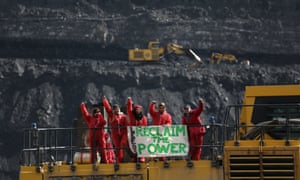
Hundreds of environmental activists invaded the UK's largest opencast coal mine in south Wales on Tuesday.
Global direct action began with hundreds of environmental activists invading the UK's largest opencast coal mine in south Wales on Tuesday. Photograph: Kristian Buus for the Guardian
An interesting question is, what are you waiting for?
Global warming is the biggest problem we've ever faced as a civilisation — certainly you want to act to slow it down, but perhaps you've been waiting for just the right moment.
The moment when, oh, marine biologists across the Pacific begin weeping in their scuba masks as they dive on reefs bleached of life in a matter of days. The moment when drought in India gets deep enough that there are armed guards on dams to prevent the theft of water. The moment when we record the hottest month ever measured on the planet, and then smash that record the next month, and then smash that record the next month? The moment when scientists reassessing the stability of the Antarctic ice sheet have what one calls an 'OMG moment' and start talking about massive sea level rise in the next 30 years?
That would be this moment—the moment when 135 children have drowned in Thailand trying to cool off from the worst heatwave on record there. The moment when, in a matter of months, we've recorded the highest windspeeds ever measured in the western and southern hemispheres.
For years people have patiently and gently tried to nudge us onto a new path for dealing with our climate and energy troubles—we've had international conferences and countless symposia and lots and lots and lots of websites. And it's sort of worked—the world met in Paris last December and announced it would like to hold temperature increases to 1.5C or less. Celebration ensued. But what also ensued was February, when the planet's temperature first broke through that 1.5C barrier. And as people looked past the rhetoric, they saw that the promises made in Paris would add up to a world 3.5C warmer—an impossible world. The world we're starting to see take shape around us.
So there's a need to push harder. A need, as it were, to break free from some of the dogma that's surrounded this issue for a very long time. Yes, we need to have "everyone work together." Yes, we need a "multi-faceted, global effort." But you know what we really need? We need to keep oil and gas and coal in the ground, keep it from being burned and adding its freight of carbon to the global total.
Which is why, from one end of the planet to the other, people are taking greater risks this month. In one of the biggest coordinated civil disobedience actions the world has ever seen, frontline communities and climate scientists and indigenous people and faith leaders and just plain people who actually give a damn will be sitting down and sitting in and standing pat—blocking, at least for a few hours, those places where the coal and oil and gas currently reside, in the hopes of helping keep them there.
In Australia they'll be taking to kayaks at the world's largest coal port in Newcastle, and in Brazil it's the fracking onslaught they're opposing. In Vancouver they'll be surrounding a new proposed oil terminal on the coast, and in Indonesia they'll be outside the presidential palace in Jakarta. Coal will be the target in the Philippines and Turkey and the UK; oil in Nigeria; gas in the Rocky Mountains of Colorado—on and on around the planet, a swell of people saying the time has come.
The time has come to turn up the heat on the small band of companies and people still willing to get rich off fossil fuel, even though it's now utterly clear they're breaking the planet.
The time has come to show that we understand we're in this together across borders and boundaries.
The time has come to take action commensurate with the scale of the problem. Yes, risking arrest is harder than signing a Facebook petition. But experience has shown it can often work—that's what kicked the fight against the Keystone pipeline into high gear, turning it into the highest profile defeat of the oil industry in a generation. That's what made it impossible for Shell to keep drilling in the Arctic, and for Adani to find the funds they need to build Earth's biggest coal mine.
Not everyone can do it—there are regimes that are too authoritarian for anyone to dare even peaceful civil disobedience of this kind. But for those of us who still live in places theoretically committed to freedom, it's time to put that privilege to use. The planet is well outside its comfort zone—that's what it means when whole ecosystems are obliterated in a matter of days. Which means its time for us to be there too.

Links

Budget 2016: Government Pledges $171m For The Great Barrier Reef

Fairfax

The federal government will spend $171 million on ensuring water quality at the Great Barrier Reef.
KEY POINTS
  • Doubt over the long-term future of the Emissions Reduction Fund
  • $56 million over four years for marine reserves
  • Climate Change Authority unfunded beyond next 2017
  • $171 million for the Great Barrier Reef
Reflecting international alarm over the coral bleaching epidemic that has struck the Great Barrier Reef, the government has made good on its promise to spend $171 million on ensuring water quality, with most of that  drawn from the National Landcare program.
About $56 million has been set aside over four years for the marine reserves program, details of which the government is yet to announce.
Commercial and recreational fishers, tourism operators and conservationists have been engaged in fierce debate over how Australia's most sensitive marine areas should be used, and the funding will help affected commercial fishers adjust to the new arrangements, which have not been announced.
The budget confirms the independent Climate Change Authority established by Labor is not funded to operate beyond 2017.
No detail was provided over the future of the government's key climate policy, the $2.55 billion Emissions Reduction Fund, beyond 2029. About $1.2 billion has already been spent on carbon abatement projects.
Environment Minister Greg Hunt said: "The Turnbull government is committed to preserving our natural environment for future generations."

Links

Lethal Heating is a citizens' initiative