28/05/2016

Global Clean Energy Employment Rose 5% In 2015, Figures Show

The Guardian - 

More than 8 million people were employed worldwide in the renewable energy sector last year as rapidly falling costs drove growth in the industry
Workers install solar panels in Washington, DC. A boom in solar and wind power jobs in the US led a global increase in renewable energy employment. Photograph: Alex Wong/Getty Images 

A boom in solar and wind power jobs in the US led the way to a global increase in renewable energy employment to more than 8 million people in 2015, according to a report from the International Renewable Energy Agency (Irena).
More than 769,000 people were employed in renewable energy in the US in 2015, dwarfing the 187,000 employed in the oil and gas sector and the 68,000 in coal mining. The gap is set to grow further, with jobs in solar and wind growing by more than 20% in 2015, while oil and gas jobs fell by 18% as the fossil fuel industry struggled with low prices.
Across the world, employment in renewable energy grew by 5% in 2015, boosted by supportive government policies and subsidies including tax credits in the US, although jobs in renewables fell in Europe. The growth was despite renewable energy subsidies being far outweighed by subsidies for fossil fuels, where jobs were lost.
Another contrast, according to the Irena report, is the greater proportion of women employed in renewable energy compared to the wider energy sector. Irena found 35% of renewable energy sector jobs were held by women, compared to 20-25% in the wider energy sector, although the agency noted the renewables percentage remains lower than women’s overall share in employment of 40-50% in most OECD countries.
Renewables employment fell in the European Union for the fourth year running, due to the Eurozone economic crisis and the cutting of subsidies and other support. The UK employed 112,000 people in renewables in 2015, according to Irena. The report said: “The UK became the continent’s largest [solar panel] installation market, and the second-largest [solar] employer with 35,000 people. However, cuts in feed-in tariffs for residential rooftops in the UK could result in a loss of 4,500 to 8,700 solar jobs according to UK government’s own estimates.
Irena director general, Adnan Amin, said: “The continued job growth in the [global] renewable energy sector is significant because it stands in contrast to trends across the energy sector.” He said the increase is being driven by rapidly falling costs for renewable energy and expect the trend to continue as renewables become ever more competitive and as countries move to achieve the targets pledged in a global climate change deal agreed in Paris in December.
“Even without a price on carbon, renewable energy is competing with dirty energy and winning,” said Ben Schreiber, at Friends of the Earth US. “The question isn’t whether renewable energy supplants fossil fuels, but whether fossil fuels companies can delay the transition long enough to destroy the climate.”
The estimate of 8m renewables jobs included those working in manufacturing, installation and maintenance. It did not include large hydropower schemes, for which less robust data is available, but Irena estimated this sector to employ 1.3 million people in 2015.
The solar photovoltaic (PV) industry was the biggest renewables employer in 2015, with 2.8m jobs worldwide, an 11% increase. About 60% of these were in China, with Japan and the US also significant employers. Japan’s solar PV employment rose by 28% but the country is also being criticised for a large coal expansion plan.
Liquid biofuel was the next biggest renewables sector, with 1.7m jobs, with Brazil and the US the largest nations. However, employment fell by 6% in part due to increasing mechanisation. Biodiesel production from palm oil in Indonesia plummeted by 50%, amid concerns that its environmental impact can actually be worse than fossil fuels.
The third biggest sector was wind power, employing 1.1 million people, up 5% compared to 2014. Other important sectors included solar thermal - using the sun to heat water - and solid biomass.
China added a third of the world’s new renewable energy in 2015 and employed 3.5 million people in the sector. But while employment rose in solar PV and wind, they were offset by losses in the solar thermal and small hydropower sectors, leading to an overall job decline of 2% in the country.
In Europe, solar PV employment in 2015 was a third of its peak in 2011, as economic problems led to subsidy cuts and as solar panel manufacturing moved to Asia.

Links

CSIRO Cuts: As Redundancies Are Announced, The Real Cost Is Revealed

The Conversation - 

Ancient air bubbles preserved in Antarctic ice. The Ellsworth Mountains Project

The unfortunate manner in which the latest phase of restructuring of the Commonwealth Scientific and Industrial Research Organisation (CSIRO) has played out has raised questions about Australia's scientific capability and our ability to meet international responsibilities.
Faced with a budget cut of A$115 million, some 275 staff have apparently been identified for redundancy (though the final number may be as high as 317). Many of them are scientists contributing to long-term sea, air and climate science programs. The restructure is geared towards focusing CSIRO's attention on the question, as framed by chief executive Larry Marshall, of "how can we find solutions for the climate we will be living with?"
The problem is that the programs at threat form the backbone of national and international research efforts. Virtually all of them are critical for helping us mitigate and adapt to future climate.
In 1979, the great scientist Carl Sagan wrote:
We live in an extraordinary age. These are times of stunning changes in social organisation, economic wellbeing, moral and ethical precepts, philosophical and religious perspectives, and human self-knowledge … Had we been born fifty years later, the answers would, I think, already have been in.
Australian scientists do indeed live in extraordinary times, but not necessarily for the best of the reasons. We may be living through a remarkable period of discovery, but recent events are a timely reminder that we must all work harder to manage the precious resources available to science if we're not to threaten decades of investment and hard work.

Global response
The cuts have been met with very public protests, including those by former US vice-president Al Gore and the World Climate Research Program.
The most public of all staff to be earmarked (so far) for redundancy is Dr John Church. He is arguably the world's leading expert on global sea level rise, a role that is more important than ever for adapting to the effects of climate change. It's a decision so extraordinary it was even reported in The New York Times.
The facilities at risk from CSIRO cuts are used by research teams around the world.
The threat to close the "Ice Lab" involves a facility unique in the world for analysing ancient air trapped in Antarctic ice, helping understand future climate-carbon feedbacks.
The Tasmanian Cape Grim atmospheric station is crucial for monitoring greenhouse gas levels in the southern hemisphere. Only last week it confirmed CO₂ concentrations now exceed 400 parts per million, likely the last location on the planet to do so.
And just last month, CSIRO staff (of which Dr Church was a senior author) led a Nature Climate Change article showing anthropogenic emissions of greenhouse gases have dominated global sea level rise since 1970. This is crucial work for understanding the source(s) of sea level rise. Such work can inform major infrastructure projects such as Brisbane Airport's new runway, which is being constructed four metres above minimum required standards to accommodate future coastal flooding.

A wider problem
The funding gap CSIRO faces is a story common to many in the scientific community. Some sectors in the 2016 budget continue to enjoy some funding increases, such as the A$200 million for Antarctic science and A$100 million for Geoscience Australia.
But others have experienced cuts, most notably the Australian Research Council. The ARC has received a further 10% cut on the back of a succession of cuts over recent years.
Putting aside the effect on staff morale and the observation that government science spending has a strong multiplier effect on economic growth, the shortfall of funding in some quarters has immediate implications for how we best co-ordinate our efforts as a community.
Targeted, industry-focused projects are an essential part of a thriving scientific culture in Australia. But the threatened erosion of public science and the loss of capacity in areas of expertise CSIRO has taken decades to build represent a loss to all.
While the recent focus has been on climate science, there are salutary lessons from events of recent months if we are to minimise the impact on this research field and others in the future.

Where to from here?
Like any sector, science needs stability. The cuts have to stop and ideally reverse. If we keep trimming budgets, there will come a point where whatever capacity we have will only be a token effort.
The recent announcement that a CSIRO climate change centre will be established with 40 staff in Hobart is most welcome, but details are sketchy. A major concern regarding all these decisions are how these cuts and developments align with the efforts of the rest of the community.
Reports that the Bureau of Meteorology and Australian Antarctic Division learnt of the proposed cuts in capacity only after the decisions had been made are remarkable if true.
If a realignment of priorities in an institution is to take place, we need to make sure that these decisions are made with wider consultation and as much lead-in time as possible so the scientific community can make the best of a bad situation.
Recently, the Australian Academy of Science announced a welcome, urgent review of national climate science capability. (If you're part of the community, submissions must be made by June 5, so hurry.)
Announcing cuts that have implications for others without discussion doesn't help science, it only stifles findings. I hope the CSIRO climate change science centre has been developed in consultation with others and the 40 staff identified are the number truly required.
We need to make sure everyone is talking to one another. Only last week, the CSIRO released its Australia 2030 report, modelling various scenarios for Australia's future. One scenario is called "weathering the storm", in which geopolitical instability increases, driven by climate change and regional conflicts.
Faced with this situation, CSIRO suggests that "the energy market relies on tried and tested energy sources such as coal rather than further developing the potential of renewables".
To suggest under future climate change we should continue to exploit fossil fuels is a remarkable statement from a national scientific body.
We may be half-way to the great leaps in knowledge Sagan prophetically described by 2030, but our understanding of the planet and how we mitigate and adapt to change has to be better co-ordinated as a community. We need to do a lot better.

Links

Australia, Fearing Fewer Tourists, Has Chapter Taken Out of Climate Report

New York Times - Michelle Innis

The coral in the Great Barrier Reef in Australia has suffered significant bleaching over the last year. Credit David Gray/Reuters

SYDNEY, Australia — Leading scientists in Australia and abroad have expressed concern that a new United Nations report about the impact of climate change on dozens of World Heritage sites is absent a chapter describing damage to the Great Barrier Reef, after the Australian government requested that the section be cut.
"I was amazed," the lead author of the report, Adam Markham, deputy director of climate and energy programs at the Union of Concerned Scientists, said by telephone.
The Australian government requested that the chapter be removed from the report, issued by UNESCO and the United Nations Environment Program on Thursday, so that further accounts of damage to the reef, the world's largest coral ecosystem, would not adversely affect tourism.
In a statement on Friday, the Department of the Environment said "experience had shown that negative comments about the status of World Heritage-listed properties impacted on tourism." The statement went on to say that the department did not support any of the country's World Heritage-listed properties being included in "such a publication.''
Environment Minister Greg Hunt had not been informed of the department's decision, the statement said, but concerns had been relayed to Australia's ambassador to the United Nations Educational, Scientific and Cultural Organization, or UNESCO.
"But as far as I can see, it is in the newspapers every day," Mr. Markham said. "Pretty much everyone in the world knows there is a problem on the Great Barrier Reef."
Mr. Markham said he had thought the report would galvanize support for important sites suffering degradation as sea levels and temperatures rise, and as extreme weather damages the environment.
The Great Barrier Reef, which stretches from the tip of northern Queensland more than 1,400 miles southward along Australia's east coast, has experienced significant coral bleaching over the last year. Bleaching can lead to coral death.
The chapter removed from the report, now published on the website of the Union of Concerned Scientists, warns that Australia is the world's fourth-largest coal producer and that risks come with plans to expand coal mining and shipping near the reef.
"Its future is at risk, and climate change is the primary long-term threat," the chapter says.
Australian scientists who reviewed the chapter before the report was published said they were surprised it had been cut.
Ove Hoegh-Guldberg, a director of the Global Change Institute at the University of Queensland, said the report contained nothing new.
"I was naturally a bit disappointed, because the process had not preserved the science," he said. "And in one sense, if you were trying not to draw attention to the problems on the reef, this would not be the way to do it."
Prof. Will Steffen of the Climate Change Institute at Australian National University said it was troubling that a government department had succeeded in censoring a global report.
"Australia is the only inhabited continent that is not featured in the report," he said. "Information is the currency of democracy, and the idea that government officials would exert pressure to censor scientific information on our greatest national treasure is extremely disturbing."
Australia's conservative coalition government, in the middle of a re-election campaign, has received little support for its approach to climate change. Prime Minister Malcolm Turnbull did not mention it in a major campaign speech recently and has done little to convince voters that his government believes it is an election issue.
Australia's national science agency, the Commonwealth Scientific and Industrial Research Organization, or Csiro, is in the middle of a restructuring that includes cutting the number of climate scientists it employs, drawing criticism from scientists at its partner organizations, including NASA.
The inclusion of the Great Barrier Reef in the United Nations report was founded on its significance, Mr. Markham said, adding that references to the island of Tasmania and to Kakadu National Park, in the Northern Territory, had also been removed from the report.
The report does not cover all World Heritage sites; rather, its authors started with about 100 natural and human-made monuments, including Yellowstone National Park and the Statue of Liberty, and winnowed that list to 31 sites in 29 countries.
Terry Hughes, the director of the Center of Excellence for Coral Reef Studies at the Australian Research Council who spent days in April flying over the Great Barrier Reef tracking bleaching and coral mortality rates, said it was astonishing that the reef would be excluded from such a report.
"There is an unprecedented bleaching event underway," Professor Hughes said. "Climate change and coral bleaching is the single biggest threat to the tourism industry, and the reef itself."

Links

27/05/2016

How Satellites Are Helping To Fight Climate Change

CNBC - Anmar Frangoul


They may be many, many miles up in the air, but satellites have a vital role to play when it comes to analysing our planet and its climate.
In the U.S., for example, NASA says it has over a dozen "Earth science" spacecraft and instruments in orbit, and is conducting research on everything from solar activity to rising sea levels, air pollution and "changes in sea ice and land ice."
The European Space Agency (ESA), based in Paris, is also keen to stress just how important the relationship between space and our climate is.
"The data we get from space in influencing people about climate change is very, very important," Philip Haines, the European Space Agency's head of telecom business development, told CNBC's Sustainable Energy.
The ESA says that climate change is arguably "the greatest challenge facing mankind in the 21st century," and for Haines, the data gathered from up in the heavens is invaluable.
"(A) picture tells 1,000 words, and having a picture of the arctic ice shrinking so you can see how it's changing is much more powerful than going off and having some measurements that you make (in) a report just in a table or a document," Haines added.
To give just one example, at the end of last year radar observations from ESA satellites were used to inform a study which showed that a glacier in Greenland was losing "five billion tonnes of ice a year to the ocean."
But it's not just changes to our planet that satellites are monitoring.
"The satellites are offering a new way of looking at farming production, energy generation and general global conservation by giving a global view of vegetation and water, and atmosphere and climate," the ESA's Ian Downey said.
Satellites were offering farmers, agronomists (who study the science of using food for different purposes) and food producers efficiencies of production, harvest and transportation, Downey added.
They were "also providing important information about the energy resources from the wind from the sun and from biomass fuels," he said.

Links

Australia Scrubbed From UN Climate Change Report After Government Intervention

The Guardian - 

Exclusive: All mentions of Australia were removed from the final version of a UNESCO report on climate change and world heritage sites after the Australian government objected on the grounds it could impact on tourism
Great Barrier Reef
The Great Barrier Reef is in the midst of its worst crisis in recorded history. Unusually warm water has caused 93% of the reefs along the 2,300km site to experience bleaching. Photograph: XL Catlin Seaview Survey/AFP/Getty Images
Statement
Professor Will Steffen
Climate Councillor
Emeritus Professor, ANU
Today it was confirmed that Australian government officials pressured a prestigious international body to silence the truth about the risks of climate change for the Great Barrier Reef.
I was one of the scientists they tried to silence.
Here's the story: last year I was asked to review an international scientific report on the impacts of climate change on World Heritage sites and tourism. I reviewed a case study on the Great Barrier Reef, focussing on the increasing risks to tourism from climate change. The report was authored by UNESCO and the International Union of Concerned Scientists. It promised to alert the world to the escalating risks that climate change poses for some of the most beautiful and valuable places on Earth.
Overnight the report was released -- but mysteriously, the Great Barrier Reef had been cut completely.  I was astonished, given we've just witnessed the worst coral bleaching event in the Reef's history.
Australian officials have now confirmed to The Guardian that they asked the report authors to remove any reference to the Great Barrier Reef, or any Australian world heritage site. No sections about any other country were removed.
As a scientist, I'm angry. As an Australian, I'm disgusted. As a Climate Councillor, I'm now asking for your help.
Today you will hear me on the TV and radio-waves as we ask the government to answer these allegations.
Information is the currency of democracy. When governments attempt to suppress or pressure scientific information, we must speak up. To me, this is about more than one report, and more than the Reef.
Sadly, we can't just rely on governments to provide independent scientific information. We experienced that first hand when the Climate Commission was abolished by the Abbott Government.
Because of people like you chipping in, we were able to keep going as the Climate Council. Because of you we are able to speak out on days like today.
A strong, independent voice for science is more important than ever. If you believe the public deserve to hear the facts; if you believe the government has no right to silence scientists, then please help fund the Climate Council's ongoing work.
The Climate Council receives no government funding. We exist because Tony Abbott abolished the Climate Commission, and thousands of Australians who thought that was a bad call kicked in their own funds to enable us to continue.  Since then, we've seen increasing attacks on science – gutting funding for CSIRO climate research, renewable energy investment and more.
If you're as disturbed by all this as I am, let's all chip in to keep standing up for science. 
Every reference to Australia was scrubbed from the final version of a major UN report on climate change after the Australian government intervened, objecting that the information could harm tourism.
Guardian Australia can reveal the report "World Heritage and Tourism in a Changing Climate", which Unesco jointly published with the United Nations environment program and the Union of Concerned Scientists on Friday, initially had a key chapter on the Great Barrier Reef, as well as small sections on Kakadu and the Tasmanian forests.
But when the Australian Department of Environment saw a draft of the report, it objected, and every mention of Australia was removed by UNESCO. Will Steffen, one of the scientific reviewers of the axed section on the reef, said Australia's move was reminiscent of "the old Soviet Union".
No sections about any other country were removed from the report. The removals left Australia as the only inhabited continent on the planet with no mentions.
Explaining the decision to object to the report, a spokesperson for the environment department told Guardian Australia: "Recent experience in Australia had shown that negative commentary about the status of world heritage properties impacted on tourism."
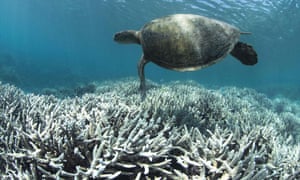
As a result of climate change combined with weather phenomena, the Great Barrier Reef is in the midst of the worst crisis in recorded history. Unusually warm water has caused 93% of the reefs along the 2,300km site to experience bleaching. In the northern most pristine part, scientists think half the coral might have died.
The omission was "frankly astounding," Steffen said.
Steffen is an emeritus professor at the Australian National University and head of Australia's Climate Council. He was previously executive director of the International Geosphere Biosphere Programme, where he worked with 50 countries on global change science.
"I've spent a lot of my career working internationally," Steffen said. "And it's very rare that I would see something like this happening. Perhaps in the old Soviet Union you would see this sort of thing happening, where governments would quash information because they didn't like it. But not in western democracies. I haven't seen it happen before."
The news comes less than a year after the Australian government successfully lobbied UNESCO to not list the Great Barrier Reef in its list of "World Heritage Sites in Danger".
The removals occurred in early 2016, during a period when there was significant pressure on the Australian government in relation to both climate change and world heritage sites.
At the time, news of the government's science research agency CSIRO sacking 100 climate scientists due to government budget cuts had just emerged; parts of the Tasmanian world heritage forests were on fire for the first time in recorded history; and a global coral bleaching event was beginning to hit the Great Barrier Reef – another event driven by global warming.
The environment department spokesperson told Guardian Australia: "The department was concerned that the framing of the report confused two issues – the world heritage status of the sites and risks arising from climate change and tourism."
The report said the case studies were chosen partly because of their geographic representation, their importance for tourism and the robustness of evidence around the impact of climate change on them.
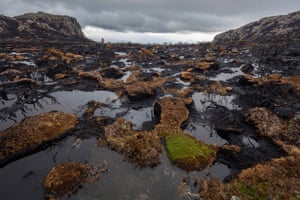
Burnt alpine vegetation at the Lake Mackenzie fire in Tasmania
Burnt alpine vegetation at the Lake Mackenzie fire in Tasmania. Photograph: Rob Blakers for the Guardian
A recent study found the conditions that cause the current bleaching on the Great Barrier Reef was made at least 175 times more likely by climate change and, on the current trajectory, would become the average conditions within 20 years.
Without mentioning the Great Barrier Reef, the report notes: "Research suggests that preserving more than 10% of the world's corals would require limiting warming to 1.5C or less, and protecting 50% would mean halting warming at 1.2C (Frieler et al. 2012)."
The full statement from the environment department said:
"The World Heritage Centre initiated contact with the Department of the Environment in early 2016 for our views on aspects of this report.
The department expressed concern that giving the report the title 'Destinations at risk' had the potential to cause considerable confusion. In particular, the world heritage committee had only six months earlier decided not to include the Great Barrier Reef on the in-danger list and commended Australia for the Reef 2050 Plan.
The department was concerned that the framing of the report confused two issues – the world heritage status of the sites and risks arising from climate change and tourism. It is the world heritage committee, not its secretariat (the World Heritage Centre), which is properly charged with examining the status of world heritage sites.
Recent experience in Australia had shown that negative commentary about the status of world heritage properties impacted on tourism.
The department indicated it did not support any of Australia's world heritage properties being included in such a publication for the reasons outlined above.
The Department of the Environment conveyed these concerns through Australia's ambassador to UNESCO.
The department did not brief the minister on this issue."
Links

26/05/2016

Green Really Is The New Black As Big Oil Gets A Taste For Renewables

The Guardian - 

Shell, Total, Statoil, even Exxon - they're all at it. But are the recent moves into solar and wind power lip service, fashion, or a real shift away from fossil fuels?
A Shell oil refinery in Singapore: the Anglo-Dutch group has set up a New Energies division. Photograph: Edgar Su/Reuters
The world's largest oil companies have in recent weeks announced a series of "green" investments – in wind farms, electric battery storage systems and carbon capture and storage (CCS). These unexpected moves come hot on the heels of revelations by Saudi Arabia, the world's biggest crude exporter, that it plans to sell off parts of its national oil company and diversify its economy away from petroleum.
They also come in the aftermath of a United Nations climate change agreement and before annual general meetings for Shell and Exxon Mobil this week, meetings at which shareholders will demand that more be done to tackle climate change.
So has the fossil fuel industry finally woken up to the dangers posed to their futures by a move to a low-carbon world, or is this all "greenwash" – relatively insignificant investments designed to shake off critics?
Or does it just make good business sense for Big Oil to do this at a time when oil prices are low, renewable projects look like steady long-term investments, and green businesses can be snapped up on the cheap?
Some of the moves certainly have serious amounts of cash behind them. Total of France, for instance, announced two weeks ago that it planned to spend nearly €1bn on buying 100-year-old battery manufacturer Saft. Chairman and chief executive Patrick Pouyanné said the deal would "allow us to complement our portfolio with electricity storage solutions, a key component of the future growth of renewable energy".
Pouyanné had said in April that electricity would be "the energy of the 21st century" and that he wanted his company to take advantage of the entire electricity value chain, including batteries, solar power and biogas generation. Total announced last year that it was spending €200m on transforming an unprofitable oil refinery into a biofuel plant, and separately that it would start to invest $500m a year in renewables.
Total made its first real drive into renewable energy five years ago, with its $1.4bn acquisition of SunPower, one of the largest solar panel makers in the US. Total has also since set up a division, called New Energies, for these low-carbon technologies.
Shell has done the same. No public announcement has yet been made but, behind the scenes, the Anglo-Dutch group has also established a New Energies arm, under the control of executive board member Maarten Wetselaar.
North America’s largest solar farm, built by SunPower, which is 60% owned by Total. Photograph: Olivia Hampton/AFP/Getty Images


Ben van Beurden, the Shell group chief executive, is expected to talk about the new division at the company's annual capital markets day on 7 June, but it is known to encompass existing hydrogen, biofuels and electricity activities. Shell's New Energies arm will have a $200m annual budget for acquisitions. Last month, the group made a bid, with partners, to build two windfarms off the coast of the Netherlands that could generate enough electricity to power 825,000 households.
Its Big Oil rival, Statoil of Norway, has also been active in the sector: it last month outlined plans to spend €1.2bn, in partnership with E.ON, on the German Arkona windfarm in the Baltic sea.
"This investment is in line with our strategy to gradually complement our oil and gas portfolio with profitable renewable energy and other low-carbon solutions," said Eldar Sætre, Statoil's president and chief executive.
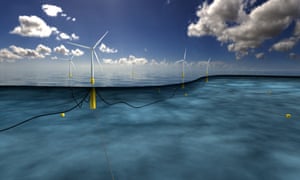
Statoil has also just been granted a seabed lease that will allow it to build the world's largest floating windfarm, Hywind, off the coast of Scotland. A new battery storage solution for offshore wind energy will be piloted from the same project, and Statoil has also followed the trend and established a New Energy division for wind power and CCS. The Norwegian state operator has also just established a new fund, Statoil Energy Ventures, which will invest up to $200m over four to seven years.
An artist's impression of the world's largest floating windfarm, planned off the coast of Scotland.
Irene Rummelhoff, executive vice-president for New Energy Solutions at Statoil, said she was convinced global warming was a very serious problem and her company wanted to help find a solution. "We strongly believe oil and gas will still be needed in future but we also know we have to do things differently and are working to reduce the carbon footprint of these operations," she said.
"Equally we are building a renewable energy business, not because we have to, but because we want to. There is tremendous growth in that sector and we want to be part of that.
"It makes sense to utilise our project-management skills from oil and gas to offshore wind which is why we are operating Sheringham Shoals and Dudgeon Sands off the UK. We are also looking at more carbon capture schemes and at solar [worldwide]."
Even Exxon Mobil, often dismissed by climate change activists as the most conservative oil company of them all, has recently unveiled plans to investigate CCS more fully in a new partnership with a fuel cell company.
But some of the sums being invested are quite small: the Shell New Energies, for example, has a capital expenditure budget of just under 0.5% of its total. And oil companies do have form for shouting loudly about moving into renewables only to beat a hasty retreat.
BP in particular was pilloried for promising to go "beyond petroleum" – then running down its alternative energy division. Shell used to have a very big solar business, but this was scaled down several years ago.
Environmentalists are increasing the pressure on oil companies by accusing them of trying to slow the march to low-carbon energy, if not of being the climate-change deniers some were of old.
There are even claims that Big Oil has been deliberately infiltrating renewable energy lobby groups so that it can push its agenda of keeping gas, in particular, as a "transition fuel" of the future – something the companies deny.
Exxon gas station
Exxon is dismissed as conservative, but has recently become involved with CCS. Photograph: Bloomberg/Getty Images
But academics such as Paul Stevens, an energy expert at thinktank Chatham House, have warned that large oil companies must transform their business or face a "short, brutal" end within 10 years. Jeremy Leggett, a former petroleum geologist who went on to found photovoltaics group SolarCentury, thinks the oil companies are taking precautions as the world moves towards low-carbon energy. "The oil and gas majors are in a fascinating place," he said. "They're starting to use clean-energy investments to hedge their bets that markets for oil and gas will exist decades from now.
"These investments are of varying degrees of seriousness. I would put Total at the top of the league table at the moment. But, unlike many of the big utilities, none of the majors has yet grasped the nettle and told stakeholders that the game is up. That oil and gas will be over by year X, and strategy is now being based on back-mapping from that year."
The Brussels-based SolarPower Europe lobby group also believes that of all the oil majors, Total of France is on a steady path to become the "green giant" of the future.
James Watson, chief executive of SolarPower Europe, says: "We take Total's moves seriously. From our perspective, it has been a long-time player in solar, it was a founding member of SolarPower Europe back in 1985. It acquired SunPower back in 2011 and recently announced that it wants to be one of the top three solar players by early next decade.
"I suspect that it has also been pushing for the French government to drive solar – and we saw recently the announcement by the French government that they will triple the amount of deployed solar in France by 2022. This could make France the leading annual installer in Europe up to that point.
"Shell has a stake in the Japanese solar company Solar Frontier, but has yet to do anything in Europe. We know its boss sees solar as the backbone of energy in the future, but at an undefined time. Having no date does not suggest a strong commitment."
Oil analysts themselves say it makes sense for oil companies to invest in renewables at a time when the value of green firms is also depressed by the low oil price. One leading City figure saw lots of reason for this: "Assets are relatively cheap; it's a good time to diversify; and you can keep some of the low-carbon critics at bay. Also, the oil companies have a herd mentality: once one of them does it, you can expect the rest to follow. You could say green is in fashion."

Links

Australian Climate Job Cuts Leave Hole In Southern Hemisphere Research

Nature - Dyani Lewis

Details of redundancies at CSIRO alarm global climate community.
AFP/Stringer/Getty Images
A laboratory that analyses ice cores from Law Dome, Antarctica (pictured) may be curtailed as a result of layoffs from CSIRO, Australia's national science agency. Job losses at Australia's national science agency will threaten the monitoring and analysis of the Southern Hemisphere's seas, air and climate, scientists say.
Staff at the Commonwealth Scientific and Industrial Research Organisation (CSIRO), which employs thousands of scientists across Australia, were told over the past week where long-awaited job cuts in climate science are likely to fall. Many CSIRO researchers who spoke to Nature about the lay-offs requested anonymity so as not to breach the organization's communications policy, which tells researchers not to discuss funding or management decisions. But the information that is trickling out means that scientists are already evaluating the likely impact on research – although a consultation process means that it may be months before an expected 140 lay-offs in climate research are complete.
"It's significant beyond the numbers because of our overall uniqueness," says oceanographer Peter Craig, who worked for CSIRO for 30 years but retired from the agency at the end of March. "The rest of the world does rely on us for both measurements and interpretation of what's going on on this side of the world."
CSIRO scientists in Melbourne who analyse ice cores from an ice cap called Law Dome in Antarctica – a group colloquially known as the 'Ice Lab' – fear their programme is one that might be curtailed.
Because the Law Dome accumulates ice very rapidly and traps low levels of impurities as it grows, its cores constitute the most reliable record of greenhouse-gas emissions over the past 2,000 years, says Malte Meinshausen, a climate modeller at the University of Melbourne and the Potsdam Institute for Climate Impact Research in Germany. Climate models that predict how many degrees of warming will occur under different greenhouse-gas emissions scenarios rely heavily on its record, Meinshausen says.
David Etheridge, head of ice core research, says that he has not been told he will lose his job, but that other scientists who do ice core analysis are facing redundancy. CSIRO has said that the Ice Lab will remain open, but Etheridge believes that cuts will have negative consequences for palaeo-climate research and the climate models that rely on it.

Aerosol fear
CSIRO researchers also fear that Australia's contributions to the world's largest ground-based network of aerosol sensors, called AERONET — a NASA-led project to verify the sometimes ambiguous aerosol measurements made by satellite — are in jeopardy. On 1 May, Brent Holben, who leads the AERONET project in Greenbelt, Maryland, wrote to CSIRO to urge that it reconsider its cuts. He said that they would cause the loss of aerosol measurements over a large region of the Southern Hemisphere.
Asked for a statement, the agency said: "CSIRO is working with partners to identify the most efficient way of delivering this work."

Sea-level expertise
Notable among individual staff set to lose their jobs is John Church, an expert on sea-level rise who has worked for CSIRO for 38 years and who coordinated a chapter on sea-level change for the most recent assessment report of the Intergovernmental Panel on Climate Change (IPCC), released in 2014.
Church was at sea on the research vessel RV Investigator when he learnt last week that, as he had expected, he would be made redundant.
"John has probably done more to lay a really firm scientific foundation under the issue of sea-level rise than anyone else in the world," says Steve Rintoul, a fellow oceanographer at the CSIRO. "The signal that this sends to both staff within and outside of CSIRO is really horrible."
The RV Investigator's voyage from the Southern Ocean to the Equator is currently mapping deep-ocean temperature and chemistry under the international GO-SHIP program, and is also deploying Argo and biogeochemistry floats that gather data at the ocean surface. CSIRO says that neither the frequency of the ship's expeditions nor the associated data analysis will be adversely affected. But researchers who did not want to be named said that, with the cuts, they doubted that such extensive surveys would be possible in the future, or that other Australian agencies could fill the gaps in expertise if oceanography groups were disbanded.
Layoffs in CSIRO's oceanography groups may dampen the productivity of the Australian research vessel RV Investigator. (CSIRO. CC-BY-3.0)
CSIRO had first announced in February that it planned to shed hundreds of jobs as part of a strategic shift away from basic climate science; in April, it confirmed that this included almost 140 lay-offs in its 'Oceans and Atmosphere' and 'Land and Water' divisions.
The CSIRO cuts are "inexplicable", says Thomas Stocker at the University of Berne, who co-chaired the IPCC's Working Group I (which examines the physical science of climate change) between 2008 and 2015. He is particularly concerned about the cuts to the sea-level research group. "It's simply not understandable for me that the stewards of a country that is so fundamentally exposed to sea-level rise is able to basically terminate research activity in their own country," he says.
Negotiations since February have staved off cuts in some programmes, says one senior scientist at CSIRO's Aspendale site in Melbourne. For example, CSIRO ratcheted back cuts for a team that analyses air pollution from data drawn from the remote Cape Grim Observatory in Tasmania, so that Australia could continue to meet obligations to international agreements such as the Montreal Protocol, which governments signed in 1987 to protect the stratospheric ozone layer from damage by chlorofluorocarbons.
But it seems that the bulk of the cuts will not be reversed. Although more than 3,000 scientists have urged Australian politicians and CSIRO management in an open letter to reconsider the proposed lay-offs, the government has distanced itself, saying that they are an agency-level decision. With national elections set for 2 July, the opposing Labor party has said that if it were elected, it would direct the CSIRO's board to stop the lay-offs. However, it would not reappoint scientists who accept redundancies before then.

Links

Lethal Heating is a citizens' initiative