19/06/2016

Coal-Fired Power Stations Face Closure To Meet Emissions Target, Says Government Agency

The Guardian - 

Australian Energy Market Operator also finds this would push wholesale energy prices up, but reduce consumption 
Yallourn coal-fired power station in Victoria. The Australian Energy Market Operator says such stations face closure to meet emissions targets. Photograph: Bloomberg/Bloomberg via Getty Images
 Australia’s coal-fired power stations will face early closure to meet 2030 emissions reduction commitments, according to assumptions made by a government agency that runs the national electricity grid.
The Australian Energy Market Operator (Aemo) also found such closures would push wholesale energy prices up, but that would be offset by reduced energy consumption and greater energy efficiency, leaving consumers’ energy bills relatively unaffected.
The findings come from the Aemo’s annual 20-year forecast for the country’s electricity consumption, released on Thursday.
Since the last version of the report in 2015, Australia signed an agreement in Paris, committing to reduce greenhouse gas emissions to up to 28% below 2005 levels.
According to the latest report, the Council of Australian Governments (Coag), which created Aemo, decided the energy sector needed to be consistent with those targets.
But in modelling future energy use, Aemo found the Coalition’s current Direct Action policies would not achieve those reductions, and so made further assumptions about carbon abatement policy required in the electricity sector.
The report said “detailed policy measures are yet to be announced”, and so it “assumed the achievement of this target will be supported by energy efficiency trends, electricity pricing trends, and coal-fired generator retirements”.
Many environmentalists, thinktanks, academics and even energy giant AGL – which operates some of the country’s biggest coal-fired power plants – have been urging the government to design policy that would force the early closure of coal power stations.
Neither the Coalition nor Labor has a policy of early closure, although Labor said it would initiate an “electricity modernisation review” after the election to ensure an orderly transition to renewable energy. The Greens policy is to incrementally close coal power plants, starting with the most polluting ones.
According to AGL and other groups, the constant cheap supply of coal power, in addition to being Australia’s biggest producer of carbon emissions, had created an oversupply of electricity, making it hard for renewable energy to enter the market.
A Climate Institute report from April found the regulated and orderly closure of coal power plants was needed to avoid major economic disruption in 2030, when the country would need to rush to meet its international commitments.
Olivia Kember from the Climate Institute said the assumption was revealing. “It’s a recognition that if you’re going to reduce electricity emissions by that amount, there are only so many ways you can do it,” she said.
Kember said it was interesting the market operator had to make such significant assumptions about future policy. “What this points to is a need for more clarity for what kind of changes in the policies and the regulatory framework are going to be necessary to manage the emissions reduction and growth of clean energy in a way that works for everybody,” she said.
The report also found that partly as a result of carbon abatement commitments, energy use would remain roughly stable for the next 20 years, despite a growing population, a growing economy and increasing use of electrical appliances.
There would be a slight increase to 2020 due to the liquified natural gas boom in Queensland, where vast amounts of electricity would be used to compress and chill gas, but as rooftop solar and energy efficiency improvements accelerate, electricity use would flatten after that.
The Aemo chief executive, Matt Zema, said new and improved appliances were replacing energy-intensive appliances such as halogen lights, plasma televisions, desktop computers and stereos.
“Maximum demand is forecast to remain flat across the outlook period, despite increased use and capacity of heating and air conditioning as growth is offset by energy efficiency and rooftop PV.
“Projected energy efficiency savings by the year 2035–36 are expected to total around 27,000 GWh. This translates to an equivalent of close to 15% of current grid-supplied electricity use.”

Links

12,000 Years Ago, Humans and Climate Change Made a Deadly Team

New York Times - Tatiana Schlossberg

An illustration from the 19th century of a giant ground sloth, which was among the many megafaunal species that went extinct in Patagonia during a rapid warming phase that followed the Antarctic Cold Reversal. Researchers found that the combination of human encroachment with the warming contributed to the extinctions. Credit Science Source 
Climate change, habitat destruction, extinctions — the Earth has seen it all before, thousands of years ago. And humans may have been partly to blame for many of those changes in nature, too.
A new study published Friday in Science Advances shows that the arrival of humans in Patagonia, combined with a changing climate, led to the extinction of many species of megafauna about 12,000 years ago in the southern portion of what is now South America. The research offers a significant moment in the natural history of the continent: a definitive date of the mass extinction of megafauna — large or giant animals, like mammoths and giant sloths — in this part of the world. It also suggests a potential relationship between threatened species and climate change in our own time.
The authors of the study from the University of Adelaide in Australia, with help from scientists from South America and elsewhere, found that the presence of humans in Patagonia was not enough to drive extinction, but the one-two punch of humans and a warmer climate led to the collapse of many species.
The scientists sequenced the mitochondrial DNA from 89 megafaunal bone and teeth samples that had been excavated from caves and rock shelters in Patagonia. They were able to date 71 of those samples, and then looked into whether the extinctions of those species were associated with other known events — ice ages or warming periods, for example — in the annals of either climate change or human existence.
Humans had been in Patagonia for at least 1,000 years before this mass extinction, and they overlapped with megafauna during a cold period known as the Antarctic Cold Reversal. After that climatic period, a rapid warming phase followed, and much of the ice that carpeted the region began to melt, allowing for a beech tree forest to creep across the land, reducing their original habitat.
According to this study, the extinction began soon after Patagonia began to heat up. Humans played an important role, too: Their presence put pressure on the animals, through hunting and a smaller habitat range, scattering the megafauna throughout the region.
And it all happened pretty quickly: The scientists found that the extinction of these big animals occurred within a relatively narrow time frame — about 300 years. Of the area's large mammal species, 83 percent died out, including some that the scientists discovered in the course of their work. The researchers also identified a species of puma related to some cats still around today.
The scientists concluded that the extinctions of these Patagonian megafauna were initiated by an environmental change, but it became an ecosystemwide change because of mankind.
For Alan Cooper, one of the authors of the study, the results help put our modern climate change and extinction dilemmas into context.
Over the last 100 years, he said, the earth's atmosphere has warmed enormously, largely because of the emissions of greenhouse gases from human activity. Some modern megafauna have become extinct or are now "in a great bit of trouble," Dr. Cooper said, because of human action — deforestation or hunting — but warming may be a cause, too, directly and indirectly.
Periods of warming and the collapse of megafauna seem to happen at the same time over much of history, Dr. Cooper said.
He paused before asking, "What is it about warming that amplifies humans' destructive instinct?"

Links

18/06/2016

Seven Climate Records Set So Far In 2016

The Guardian - 

From soaring temperatures in Alaska and India to Arctic sea ice melting and CO2 concentrations rising, this year is smashing records around the world
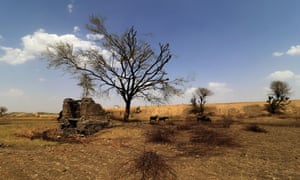
Scorched land on the outskirts of Jaipur, Rajasthan, India
Scorched land on the outskirts of Jaipur, Rajasthan. The desert state recorded India's hottest ever temperature of 51C on 19 May. Photograph: Alamy Stock Photo
1) Arctic sea ice is melting at a rate that by September could see it beat the record low set in 2012. The maximum extent of sea ice in winter was at a record low, and the extent in May was the lowest for that month ever, by more than 500,000 sq km.


2) Every month this year has been the hottest on record globally for that month. May, data published this week by Nasa revealed, was no exception. Nasa's dataset, one of three main global surface temperature records, shows February recorded the highest anomaly against long term average temperatures.


3) India recorded its hottest day ever on 19 May. The mercury in Phalodi, in the desert state of Rajasthan, rose to 51C, as a nationwide drought that has affected more than 300 million people marched on, leaving armed guards at dams, and reservoirs well below their usual levels.

4) Alaska, along with the rest of the Arctic, has experienced record-breaking heat. Spring was the warmest on record in the state, with an average temperature of 0C, and the average year-to-date temperature has been 5.5C above the long term average.
5) Concentrations of carbon dioxide in the atmosphere have been breaking records every year for decades, but the size of the margin by which the record is forecast to break the annual record in 2016 is striking and itself a record. The increase for 2016 is expected to be 3.1 parts per million, up from an annual average of 2.1.


6) Australia, no stranger to record-breaking heat, just clocked up its hottest autumn yet. Average temperatures were 1.86C above the average, beating the previous record of 1.64C above average, set in 2005.


7) The Great Barrier Reef, a natural wonder and world heritage site, experienced its worst ever coral bleaching event, as a blob of warm water made its way around the world. An aerial study found that just 7% of the reef escaped bleaching, which can lead to the coral permanently dying.


Links

Earth's Heat Extends Unprecedented Streak of Shattered Records

Bloomberg -Tom Randall
 
El Niño is over, but the heat remains
1466088894_forest fire
Darryl Dyck/Bloomberg
It's no longer a question of whether 2016 will be the hottest on record, but by how much.
The El Niño warming pattern in the Pacific Ocean is over, but unprecedented heat remains across the planet.
Last month was the hottest May in 137 years of record keeping, according to new reports from NASA and the National Oceanic and Atmospheric Administration (NOAA).
In an age of rising temperatures, monthly heat records have become all too common: May was the 13th consecutive month to set a new record, according to NOAA data released on Wednesday.
The extremes of recent months are such that we're not even halfway into 2016 and there's already a greater than 99 percent likelihood that this year will be the hottest on record, according to Gavin Schmidt, who directs NASA's Goddard Institute for Space Studies.
NASA and NOAA maintain independent records of the Earth's temperatures, but they both agree that last month was a scorcher.
If NASA's Schmidt is right, 2016 will be the the third consecutive year to set a new global heat record—the first time that's ever happened.
So far, 15 of the hottest 16 years ever measured have come in the 21st century.
Results from the world's chief monitoring agencies vary slightly.
The Japan Meteorological Agency said last month was the second-hottest May, not the hottest. Nevertheless, all agree that the extremes of 2016 are unrivaled in the modern climate record.
Some of this is still the result of last year's monster El Niño, which releases heat from the Pacific that typically lingers for months after the underlying conditions subside.
Now that El Niño has finally come to an end, it may soon shift to a cooling La Niña this summer, according to NOAA's Climate Prediction Center. The agency gives a 75 percent chance of a La Niña pattern developing in 2016.
As the effects of El Niño fade, the new monthly records have become less dramatic, as shown by the dip in the animation above.
That doesn't mean we'll ever return to normal temperatures, said Deke Arndt, chief of the U.S. National Centers for Environmental Information in Asheville, North Carolina.
Climate change is like riding on an escalator of rising temperatures, he said, and El Nino is the same as jumping while you're on it.
Still, coastal cities are flooding more regularly, wildfires are starting early, and the world is in the midst of the most prolonged die-off of the ocean's coral ever witnessed.
Beyond the cyclical changes, there's no escaping the larger trend that we live on a planet that's warming rapidly.

A Brief History of Global Warming

Links

Election 2016: Climate Change - An Election Priority For Women

ABC - Erin Stewart

Women care more about addressing climate change than men, doubtless because they suffer more from its effects, writes Erin Stewart. So why are the Coalition and Labor not prioritising it in their election campaigns?
Students volunteer for a 'seaweed tourism' project as part of efforts to improve the health of the Great Barrier Reef. (ABC North Qld: Harriet Tatham)
In his capacity as the former minister for women, Tony Abbott claimed the best thing he did was repeal the carbon tax. "As many of us know," he said in December 2014, "women are particularly focused on the household budget, and the repeal of the carbon tax means a $550-a-year benefit for the average family".
Aside from overstating his figures, Mr Abbott expressed the absurdly inaccurate view that women were more interested in domestic arithmetic than the world around them. In actuality, women care a great deal about climate change, and are more likely to suffer as a result of it.
Eighty-two per cent of female respondents to the ABC's Vote Compass felt the Federal Government should do "much" or "somewhat more" to tackle climate change, compared with just 67 per cent of men.
These findings are in line with data from the Pew Research Centre which found 83 per cent of Australian women see climate change as a serious problem, compared with just 71 per cent of men.
Part of the reason for the climate gap is doubtless because women would be disproportionately affected if climate change was not effectively addressed. Chair of Population Health at Western Sydney University Professor Hilary Bambrick said extreme weather events killed more women than men globally because they were less likely to have the resources to survive.
They were also more likely to experience poverty and social restrictions, were less likely to be part of decision-making processes, and were also more likely to be exposed to mosquito-borne diseases in performing household tasks such as collecting water and harvesting food.
The reasons climate change was especially bad for women, Professor Bambrick wrote recently at the Conversation, was "largely because they are overrepresented among the world's poor and are thus more exposed to these dangers".

Australian women 'financially vulnerable' to climate change
The threats are seen in Australia, too. Greens Senator Larissa Waters said she believed women were particularly financially vulnerable to climate change due to structural disadvantage and discrimination.
"With lesser financial means, it will be harder for women to recover from damage to their homes from extreme weather events driven by global warming, such as flooding, droughts or bushfires," Senator Waters told ABC News.
Federal Greens Deputy Leader Larissa Waters at a press conference at Parliament House in Canberra, Thursday, June 11, 2015.
Federal Greens Deputy Leader Larissa Waters says Australian women are financially vulnerable to climate change. (AAP: Mick Tsikas)
"Tragically, the incidence of family violence can increase in the wake of traumatic events such as serious natural disasters. For example, in the wake of the Black Saturday bushfires in Victoria."
According to the World Health Organization's Gender and Climate Change report, women were also more likely to pick up caring responsibilities in times of disaster and extreme weather events.
These duties created additional disadvantages in earning an income or gaining education. While the risks were heightened for women in developing countries, they were still shared across the world.
Research from Charles Sturt University that looked at the gendered effects of drought in rural Australia showed women tended to ignore their own health in order to look after their family and community in the wake of environmental strain.
"Women often bear the burden of having to rebuild communities after losing community resources, skills, and relationships from families and services that have left," it said.

Men suffer the effects of climate change, too
However, the effects of climate change are not solely experienced by women.
For instance, the Charles Sturt University research showed drought has a devastating impact on men too, who have an increased risk of experiencing isolation and loneliness, as well as suicide. Being confronted with a potential loss of livelihood, and feeling unable to reach out for help because of crushing gender roles, contributes to these risks — which must be taken very seriously.
With a July 2 election fast approaching, the Coalition and Labor have outlined significantly different climate policies, but neither has been campaigning hard on the issue.
Prime Minister Malcolm Turnbull speaks to the media during a media conference in Townsville on June 13, 2016.
Prime Minister Malcolm Turnbull has said Australia should be a "role model in the management of coral reefs". (ABC News: David McMeekin)
Which seems odd, particularly given new reports which show 93 per cent of the Great Barrier Reef has been threatened by coral bleaching, caused (at least in part) by rising sea temperatures.
The Coalition has just announced a $1 billion plan to address the issue by providing concessional loans for clean energy projects that will improve water quality, but Queensland Government modelling suggested $16 billion would be required to meet water quality targets.
Moreover, as Opposition Leader Bill Shorten argued on Q&A on Monday, it makes little sense to talk about saving the reef without talking about climate change. "They are inextricably linked," Mr Shorten said. "It is a joke that on one hand my opponent is out there on the reef — that's good — pledging money — that's good — but if you've got climate change policies which do nothing about climate change, it's just a billion-dollar Band-Aid of neglect."

Majority of voters want greater government action on climate change
It is odder still given the results of a May ReachTEL poll, which found 56 per cent of voters think the Government should do more to address climate change and 64 per cent would be more likely to vote for a party that planned to completely convert Australia to renewable energy within 20 years.
(Although Pew found 71 per cent of Australian women thought people must make lifestyle changes in order to reduce the effects of climate change, while only 57 per cent of men agreed.)
Experts say action on water quality is needed now.

And yet Prime Minister Malcolm Turnbull has done little more to prioritise climate change than his predecessor, aside from signing the Paris Agreement promising to reduce emissions by 26-28 per cent from 2005 levels by 2030. He also has not reversed Mr Abbott's decimation of climate change research and development.
Meanwhile Labor is proposing two emissions trading schemes to charge big polluters for their environmental damages — one for the electricity industry and another for other polluting industries — which are to fund the bigger target of a 45 per cent reduction of emissions by 2030.
Climate Councillor Lesley Hughes, a Distinguished Professor of Biology and Pro Vice-Chancellor at Macquarie University, said the pledges that have been made were insufficient — they would not keep climate warming below 1.5 degrees Celsius.

Men leave a bigger carbon footprint than women
But while the effects of climate change are gendered, so too are its causes and potential solutions.
Dr Ariel Salleh, a Research Associate in Political Economy at the University of Sydney, pointed to evidence from around the world showing women did not leave as large an ecological footprint as men, because of differences in their consumption patterns.
A study from the Swedish Defence Research Agency showed that in some regions — they looked at Germany and Norway — differences in consumption rates were not as pronounced, but even so, men consumed more energy (8 per cent and 6 per cent respectively).
They found significantly larger differences in the two other countries they studied, Greece and Sweden (39 per cent and 22 per cent respectively). The men's bigger carbon footprint was due to their greater tendency to travel by car, go out for meals, and consume alcohol and tobacco products.
In terms of climate solutions, Dr Salleh said men were more likely to prefer "end-of-pipe" answers, that is, where problems were addressed by radical technological responses that may be risky.
Women, however, tended to take on the personal responsibility of making everyday changes, diverting the need to take unnecessary risks and incorporating care for the environment as routine.
"The way society is structured, women are given the labour to do with reproducing the next generation," as well as sustaining their families and communities, Dr Salleh told ABC News.
"It's a logical corollary that they will focus on issues like climate change."

Links

17/06/2016

Antarctic Sees Highest Level Of Greenhouse Gas In 4 Million Years

The Independent - Peter Yeung

South Pole Observatory records highest level in human history
'The increase of carbon dioxide is everywhere, even as far away as you can get from civilisation' Aliscia Young
Carbon dioxide levels in Antarctica have reached their highest levels for four million years.
The South Pole Observatory carbon dioxide observing station recorded 400 parts per million (ppm), according to an announcement by the National Oceanic and Atmospheric Administration, marking the highest level in human history.
Pieter Tans, the lead scientist at the Global Greenhouse Gas Reference Network, said in a statement: "The far southern hemisphere was the last place on earth where CO2 had not yet reached this mark. "Global CO2 levels will not return to values below 400 ppm in our lifetimes, and almost certainly for much longer.
"The increase of carbon dioxide is everywhere, even as far away as you can get from civilization. If you emit carbon dioxide in New York, some fraction of it will be in the South Pole next year."
Carbon dioxide levels have been steadily rising since the start of the industrial revolution, and 400pm now passes the symbolic threshold.
The annual growth rate of atmospheric CO2 measured at NOAA's Mauna Loa Observatory in Hawaii jumped 3.05 ppm during 2015, the largest year-to-year increase in 56 years of monitoring.
A microscopic marine alga with a shell-like skeleton has increased more than tenfold in the North Atlantic over the past 50 years in response to rising levels of carbon dioxide.
But a radical breakthrough in tackling climate change has been made after scientists found a rapid way to turn heat-trapping carbon-dioxide into rock.
Climate change protests around the world. 25 show all

The exclusive two year project, called CarbFix, pumped a carbon dioxide and water mix 540m underground into basalt rock at the Hellisheidi geothermal power plant in Iceland.

Links

What would a global warming increase of 1.5C be like?

The Guardian - 

The Paris climate conference set the ambitious goal of finding ways to limit global warming to 1.5C, rather than the previous threshold of 2C. But what would be the difference? And how realistic is such a target?
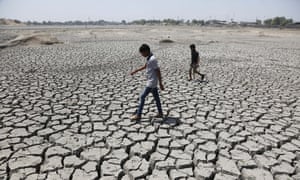
Two boys walk through a dried up Chandola Lake in Ahmadabad, India, May 2016
Two boys walk through a dried up Chandola Lake in Ahmadabad, India, May 2016. Photograph: Ajit Solanki/AP
How ambitious is the world? The Paris climate conference last December astounded many by pledging not just to keep warming "well below two degrees celsius," but also to "pursue efforts" to limit warming to 1.5C. That raised a hugely important question: What's the difference between a two-degree world and a 1.5-degree world?
Given we are already at one degree above pre-industrial levels, halting at 1.5C would look to be at least twice as hard as the two-degree option.
So would it be worth it? And is it even remotely achievable?
In Paris, delegates called on the UN's Intergovernmental Panel on Climate Change (IPCC) to report on the implications of a 1.5C target. They want the job done by 2018, in time to inform renewed talks on toughening emissions targets beyond those agreed upon in Paris.But the truth is that scientists are only now getting out of the blocks to address what a 1.5C world would look like, because until recently it sounded like a political and technological impossibility. As a commentary published online in Nature Climate Change last week warned, there is "a paucity of scientific analysis" about the consequences of pursuing a 1.5C target.
To remedy this, the paper's researchers, led by Daniel Mitchell and others at Oxford University, called for a dedicated program of research to help inform what they described as "arguably one of the most momentous [decisions] to be made in the coming decade." And they are on the case, with their own dedicated website and a major conference planned at Oxford in the fall.
So what is at stake? There are two issues to address. First, what would be gained by going the extra mile for 1.5? And second, what would it take to deliver?
First, the gains. According to available research, says the Oxford group, the biggest boost will not be measured in average temperatures. On its own, the difference between 1.5C and 2C is marginal. But it would have a much greater effect on the probability of extreme and destructive weather events like floods, droughts, storms, and heatwaves.
We know extreme weather is happening more often. A study last year by Erich Fischer of the Institute for Atmospheric and Climate Science in Zurich found that the risk of what was "once in a 1,000 days" hot weather has already increased fivefold. His modelling suggests that it will double again at 1.5C and double once more as we go from 1.5 to 2C. The probability of even more extreme events increases even faster.
The same will be true for droughts, says Carl-Friedrich Schleussner of the Potsdam Institute for Climate Impact Research in Germany. Last year, he reported that the extra half-degree would produce dramatic increases in the likely length of dry spells over wide areas of the globe, including the Mediterranean, Central America, the Amazon basin, and southern Africa, with resulting declines in river flows from a third to a half. Schleussner concluded that going from 1.5 to 2C "marks the difference between events at the upper limit of present-day natural variability and a new climate regime, particularly in tropical regions."
A few studies have tried to drill down to what the difference means for day-to-day lives. And the consequences for many will be stark. At two degrees, parts of southwest Asia, including well-populated regions of the Persian Gulf and Yemen, may become literally uninhabitable without permanent air conditioning.
Some researchers predict a massive decline in the viability of food crops critical for human survival. The extra half-degree could cut corn yields in parts of Africa by half, says Bruce Campbell of the International Center for Tropical Agriculture. Schleussner found that even in the prairies of the US, the risk of poor corn yields would double.
Two degrees, says Johan Rockström, director of the Stockholm Resilience Center, "contains significant risks for societies everywhere; 1.5 looks much more scientifically justifiable."
Ecosystems would feel the difference too. Take tropical coral reefs, which already regularly come under stress because of high ocean temperatures, suffering "bleaching" especially during El Niño events – as happened on the Great Barrier Reef in Australia this year. Most can now recover when the waters cool again, but today's exceptional temperature may soon become the new normal. "Virtually all tropical coral reefs are projected to be at risk of severe degradation due to temperature-induced bleaching from 2050 onwards," as warming slips past 1.5C , reports Schleussner.
By some estimates, curbing warming at 1.5C could be sufficient to prevent the formation of an ice-free Arctic in summer, to save the Amazon rainforest, and to prevent the Siberian tundra from melting and releasing planet-warming methane from its frozen depths. It could also save many coastal regions and islands from permanent inundation by rising sea levels, particularly in the longer run.
In 2100, the difference in sea level rise between 1.5C and 2C would be relatively small: 40cm versus 50cm. But centuries later, as the impact of warmer air temperatures on the long-term stability of the great ice sheets of Greenland and Antarctica takes hold, it would be far greater. Michiel Schaeffer of Climate Analytics, a Berlin-based think tank, calculates that by 2300, two degrees would deliver sea level rise of 2.7 meters, while 1.5 degrees would limit the rise to 1.5 meters.
Historical and projected changes in global temperatures from 1850 through 2100 if greenhouse gases continue to rise unchecked through the end of the century. Photograph: Ed Hawkins/US Geological Survey

It looks like 1.5C matters a great deal. So how hard would it be to keep warming to that level? After all, last year was one degree above pre-industrial levels. And at various times in the past six months, global average temperatures have sometimes gone above 1.5C.
Most researchers agree that, short of some global economic meltdown, even decade-long averaged temperatures are destined to go above 1.5C of warming by mid-century. So delivering the target by the end of the century will require drawing down temperatures by using technologies and energy systems that can extract carbon dioxide from the atmosphere on a large scale.
For some, this would be nonsensical geoengineering. Kevin Anderson, a climate scientist at the University of Manchester in the UK, writing in Nature after the Paris conference, declared "the world has just gambled its future on the appearance, in a puff of smoke, of a carbon-sucking fairy godmother."
But it could be done. The calculations are inexact. Nobody, even now, knows quite how sensitive global temperatures are to rising concentrations of greenhouse gases in the atmosphere. But here is the task, as outlined by Joeri Rogelj, of the Austria-based International Institute for Applied Systems Analysis (IIASA), in an article in Nature Climate Change in March.
The planet's primary thermostat is the concentration of CO2 in the atmosphere. Pre-industrial levels were 280 parts per million. We just hit 400 ppm with warming at one degree and some more in the pipeline, due to time lags. The IPCC, in its most recent report, estimated that to stop at 1.5C will mean holding concentrations to around 430 ppm.
Because much of our CO2 emissions stay in the atmosphere for centuries, that means bringing annual emissions to zero. Impossible? Maybe, but the good news is that greenhouse gas emissions actually fell in 2015 despite rising global economic activity, thanks to the growing use of renewable energy. If we could build on that and bring emissions to zero by 2050, then we might limit emissions from here on out to 800bn tons.
If we could somehow find ways to extract 500bn tons from the atmosphere, Rogelj concluded, we would likely be able to have our wish of CO2 concentrations of 430 ppm and warming capped at 1.5C. The fairy godmother would have delivered.
But how? While there are chemical processes for removing CO2 out of the air, they remain very expensive. More likely are biological methods — using plants to soak up CO2 and then preventing that CO2 from getting back into the atmosphere when the plants die or are burned.
The trick that puts a glint in the eye of some technologists and climate scientists is known by the acronym BECCS, which stands for "biomass energy, carbon capture, and storage." The idea is to convert the world's power stations to burning biomass, such as trees or marine algae. The industrialized production of this biomass on such a scale would accelerate the natural drawdown of CO2 by plants during photosynthesis. If the CO2 created by burning the biomass could then be captured from the stacks and buried in geological strata — the prototype technology known as carbon capture and storage — then the net effect would be a permanent extraction of CO2 from the atmosphere.
It would be the reverse of the current fossil-fuel energy system. And the more energy generated, the more CO2 would be drawn out of the air.
There are huge questions about such a strategy. Wouldn't such a vast new industry have its own absurdly high-energy requirements, putting us back at square one?
Is there the land available to cultivate all that biomass? Would we end up chopping down forests to make room for growing the biomass, creating a massive new source of emissions? While there are back-of-the-envelope calculations, nobody has yet satisfactorily answered these questions.
Other geo-engineering options that have been proposed include fertilizing the oceans so that more algae can grow, sucking up CO2 as they do, or a terrestrial equivalent – burying charred biomass known as biochar into soils, where it could provide a kind of deep fertilizer that would turn soils into carbon-suckers over many centuries. But says IIASA's Florian Kraxner, "Of all the ways of achieving negative emissions, BECCS seems to be the most promising."
Is this all scientific pie in the sky? Some analysts argue that, whatever was said in Paris, there is little chance of hitting even two degrees, let alone anything tougher. David Victor, of the University of California at San Diego, for instance, wrote in Yale Environment 360 at the conclusion of the Paris agreement that "the world has dithered for too long and must now brace for the consequences. Even a realistic crash program to cut emissions will blow through 2C; 1.5C is ridiculous."
Others say that even trying to paint a picture of what a 1.5C world would look like is a fool's errand. Mike Hulme of King's College London in England wrote recently that it could result in bad science, because predictions about future local climate come with such wide error bars. He wondered whether, even at the request of the Paris conference, science should be "corralled into servicing a tightly determined political agenda."
But the Oxford team is not having such defeatism. "It is our job as scientists, first and foremost, to inform. Whether or not the information we provide makes a difference is ultimately up to others," they say in their new paper. Moreover, they point out, "if additional research is not undertaken as a matter of urgency, there is a danger… that the 2018 special report will present all the negative economic constraints of achieving 1.5C" without reporting on the potential positive impacts of reduced extreme weather activity that such a scenario could bring.
Ultimately, this is a highly political issue about who should be in charge of setting targets: those most vulnerable nations, who led the call in Paris for a 1.5C target, or those less vulnerable nations in the rich world, who were ready to stick with two degrees? Them or us?
As Petra Tschakert of Penn State University put it in a paper last year, "danger, risk, and harm would be utterly unacceptable in a 2C warmer world, largely for 'them' – the mollusks, and coral reefs, and the poor and marginalized populations, not only in poor countries – even if this danger has not quite hit home yet for 'us'."

Links

Lethal Heating is a citizens' initiative