The Saturday Paper - Naomi Klein
 |
| Author and social activist Naomi Klein. |
In
recent months, the world's gaze has landed again and again on a hellish
Australian terrain of climate-related disaster. Bushfires ravage some
of the planet's oldest trees in Tasmania. Catastrophic coral bleaching
leaves much of the Great Barrier Reef a ghostly white. The first known
mammal to be wiped out by global warming was recently identified there.
And yet, there is little to no discussion of climate change in your
federal election campaign, which is why many Australian groups are
forcefully calling for "Pollution Free Politics": as in North America,
the fossil fuel industry has managed to capture not only the debate and
key levers of policy, but also huge government subsidies that help to
lock in their civilisation-threatening business model, even as
renewables surge around the world.
The Middle East is now squeezed in the pincer of violence
caused by fossil fuels, on the one hand, and the impact of burning those
fossil fuels on the other.
But responding to the climate crisis is not just a matter of closing
coal plants and building more solar arrays. A rapid transition to green
energy is also an opportunity to remake our world for the better – to
lower emissions in ways that also address historical injustice and
inequality, bolster democracy, and prevent the kind of brutal, inhumane
future that we are already catching far too many glimpses of, from the
treatment of refugees on Manus Island and Nauru to the devastating
tragedy in Orlando.
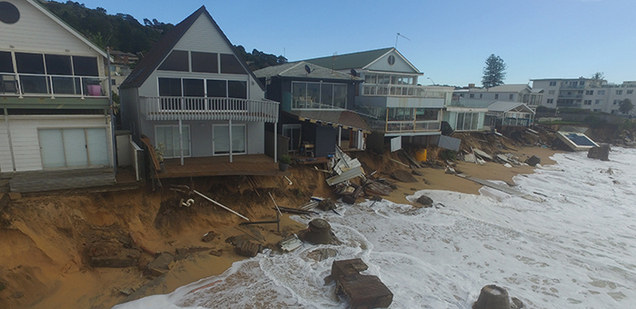
In March, two major peer-reviewed studies warned that sea-level rise
could happen significantly faster than previously believed. One of the
authors of the first study was James Hansen, perhaps the most respected
climate scientist in the world. He warned that, on our current emissions
trajectory, we face the "loss of all coastal cities, most of the
world's large cities and all their history" – and not in thousands of
years, but as soon as this century.
If we don't demand radical change we are headed for a whole world of
people searching for a home that no longer exists. In countries such as
the Marshall Islands and Fiji and Tuvalu, they know that so much
sea-level rise is inevitable that their countries likely have no future.
But they refuse just to concern themselves with the logistics of
relocation, and wouldn't even if there were safer countries willing to
open their borders – a very big if, since climate refugees aren't
currently recognised under international law.
Instead they are actively resisting: blockading Australian coal ships
with traditional outrigger canoes, disrupting international climate
negotiations with their inconvenient presence, demanding far more
aggressive climate action. If there is anything worth celebrating in the
Paris agreement signed in April – and sadly, there isn't enough – it
has come about because of this kind of principled action.
For the past three decades, since the Intergovernmental Panel on
Climate Change was created and climate negotiations began, the refusal
of our governments to lower emissions has been accompanied with full
awareness of the dangers. And this kind of recklessness would have been
functionally impossible without institutional racism, even if only
latent. It would have been impossible without orientalism – what Edward
Said described in his landmark book of the same name as "disregarding,
essentialising, denuding the humanity of another culture, people or
geographical region". It would have been impossible without all the
potent tools on offer that allow the powerful to discount the lives of
the less powerful. These tools – of ranking the relative value of humans
– are what allow the writing off of entire nations and ancient
cultures. And they are what allowed for the digging up of all that
carbon to begin with.
Why? Because the thing about fossil fuels is that they are so
inherently dirty and toxic that they require sacrificial people and
places: people whose lungs and bodies can be sacrificed to work in the
coalmines, people whose lands and water can be sacrificed to open-pit
mining and oil spills. As recently as the 1970s, scientists advising the
United States government openly referred to certain parts of the
country being designated "national sacrifice areas". Think of the
mountains of Appalachia, blasted off for coalmining – because so-called
"mountain-top removal" coalmining is cheaper than digging holes
underground. There were theories of othering used to justify the
sacrificing of an entire geography: after all, if you are a backwards
"hillbilly", who cares about your hills?
Turning all that coal into electricity required another layer of
othering, too: this time for the urban neighbourhoods next door to the
power plants and refineries. In North America, these are overwhelmingly
communities of colour, black and Latino, forced to carry the toxic
burden of our collective addiction to fossil fuels, with markedly higher
rates of respiratory illnesses and cancers. It was in fights against
this kind of "environmental racism" that the climate justice movement
was born.
Fossil fuel sacrifice zones dot the globe. Take the Niger Delta, poisoned with an
Exxon Valdez-worth
of spilled oil every year, a process Ken Saro-Wiwa, before he was
murdered by his government, called "ecological genocide". The executions
of community leaders, he said, were "all for Shell".
Fossil fuels require sacrifice zones: they always have. And you can't
have a system built on sacrificial places and sacrificial people unless
intellectual theories that justify their sacrifice exist and persist:
from manifest destiny to terra nullius to orientalism, from backward
hillbillies to backward Indians.
Some people insist that it doesn't have to be this bad. We can clean
up resource extraction; we don't need to do it the way it's been done in
Appalachia or in the Niger Delta. Except that we are running out of
cheap and easy ways to get at fossil fuels. This, in turn, is starting
to challenge the original Faustian pact of the industrial age: that the
heaviest risks would be outsourced, offloaded, onto the other – the
periphery abroad and inside our own nations. From fracking the
picturesque countryside to oil trains barrelling through major cities,
that outsourcing is becoming less and less possible.
There is also an avalanche of evidence that there is no peaceful way
to run an economy powered by coal, oil and gas. The trouble is
structural. Fossil fuels, unlike renewable forms of energy such as wind
and solar, are not widely distributed but highly concentrated in very
specific locations, and those locations have a bad habit of being in
other people's countries. Particularly that most potent and precious of
fossil fuels: oil. This is why the project of orientalism, of othering
Arab and Muslim people, has been the silent partner of our oil
dependence from the start – and inextricable, therefore, from the
blowback that is climate change. If nations and peoples are regarded as
other – exotic, primitive, bloodthirsty, as Said documented in the 1970s
– it is far easier to wage wars and stage coups when they get the crazy
idea that they should control their own oil in their own interests. The
reverberations from such interventions continue to jolt our world, as
do the reverberations from the successful burning of all that oil. The
Middle East is now squeezed in the pincer of violence caused by fossil
fuels, on the one hand, and the impact of burning those fossil fuels on
the other.
In his latest book,
The Conflict Shoreline, the Israeli
architect Eyal Weizman has a groundbreaking take on how these forces are
intersecting. The main way we've understood the border of the desert in
the Middle East and North Africa, he explains, is the so-called
"aridity line", areas where there is on average 200 millimetres of
rainfall a year, which has been considered the minimum for growing
cereal crops on a large scale without irrigation. He documents that all
along the aridity line, you see places marked by drought, water
scarcity, scorching temperatures and military conflict – from Libya to
Palestine to Syria, to some of the bloodiest battlefields in Afghanistan
and Pakistan.
Weizman also discovered what he calls an "astounding coincidence".
When you map the targets of Western drone strikes onto the region, you
see that "many of these attacks – from South Waziristan through northern
Yemen, Somalia, Mali, Iraq, Gaza and Libya – are directly on or close
to the 200mm aridity line".
Just as bombs follow oil, and drones follow drought, so boats follow
both: boats filled with refugees fleeing homes on the aridity line
ravaged by war and drought. And the same capacity for dehumanising the
other that justified the bombs and drones is now being trained on these
migrants.
Camps are bulldozed in Calais, thousands of people drown in the
Mediterranean, and the Australian government detains survivors of wars
and despotic regimes in camps on the remote islands of Nauru and Manus.
Conditions are so desperate on Nauru that in April an Iranian migrant
died after setting himself on fire to try to draw the world's attention.
Another migrant – a 21-year-old woman from Somalia – set herself on
fire a few days later. Prime Minister Malcolm Turnbull warns that
Australians "cannot be misty-eyed about this" and "have to be very clear
and determined in our national purpose".
I thought about Nauru when I read a columnist in a London-based
Murdoch paper declaring that it's time for Britain "to get Australian.
Bring on the gunships, force migrants back to their shores and burn the
boats." In another bit of symbolism, Nauru is one of the Pacific Islands
very vulnerable to sea-level rise. Its residents, after seeing their
homes turned into prisons for others, will very possibly have to migrate
themselves.
We need to understand that what is happening on Nauru, and what is
happening to it, are expressions of the same logic. A culture that
places so little value on black and brown lives that it is willing to
let human beings disappear beneath the waves, or set themselves on fire
in detention centres, will also be willing to let the countries where
black and brown people live disappear beneath the waves, or desiccate in
the arid heat. When that happens, theories of human hierarchy – that we
must take care of our own first – will be marshalled to rationalise
these monstrous decisions. We are making this rationalisation already,
if only implicitly. Although climate change will ultimately be an
existential threat to all of humanity, in the short term we know that it
does discriminate, hitting the poor first and worst.
The most important lesson to take from all this is that there is no
way to confront the climate crisis as a technocratic problem, in
isolation. It must be seen in the context of austerity and
privatisation, of colonialism and militarism, and of the various systems
of othering needed to sustain them all. The connections and
intersections between them are glaring, and yet so often resistance to
them is highly compartmentalised. The anti-austerity people rarely talk
about climate change, the climate change people rarely talk about war or
occupation.
Overcoming these disconnections – strengthening the threads tying
together our various issues and movements – is the most pressing task of
anyone concerned with social and economic justice. It is the only way
to build a counterpower sufficiently robust to win against the forces
protecting the highly profitable but increasingly untenable status quo.
Links


 Darren Gladman, solar policy manager at the Clean Energy
Council, attributed the drop of solar installations in part to
the winding back of generous state schemes.
Darren Gladman, solar policy manager at the Clean Energy
Council, attributed the drop of solar installations in part to
the winding back of generous state schemes. Kobad Bhavnagri, head of Bloomberg New Energy Finance in
Australia, said "the government has basically not touched the rooftop
sector".
Kobad Bhavnagri, head of Bloomberg New Energy Finance in
Australia, said "the government has basically not touched the rooftop
sector".  While the residential market is struggling, the industry is
increasingly turning to commercial customers, Mr Gladwell said. These
now account for about 30 per cent of sales by capacity.
While the residential market is struggling, the industry is
increasingly turning to commercial customers, Mr Gladwell said. These
now account for about 30 per cent of sales by capacity.