10/07/2016

Offshore Wind Costs Hit Record Low

Climate Home - Megan Darby

Two 350MW arrays in the Netherlands will supply power at €87/MWh, beating the next cheapest project by miles
Cheap steel and favourable regulations are helping to cut offshore wind power costs. DONG Energy A/S
Dong Energy has set a record low price for offshore wind power in a winning bid to build two arrays off the coast of the Netherlands.
The Danish company committed to supply electricity at €72.70/MWh (US$80.40), not including transmission costs. The cables will add about €14/MWh, experts say.
That beats an industry goal of bringing costs below €100/MWh by 2020. The closest any rival had previously come was €103/MWh by Vattenfall in Denmark last year.
“It was a result that was well beyond anyone’s expectations,” said Oliver Joy, spokesperson for the European Wind Energy Association.
It brings a relatively expensive form of renewable energy a step closer to competing on cost with conventional power stations.
Joy credited the Dutch government for creating a favourable regulatory environment, helped by market and site-specific conditions.
The Netherlands has pledged to contract out 700MW of offshore wind a year to 2020, giving developers a big prize to aim for.
Steel to build the turbines is fairly cheap, while low oil prices mean developers can get a bargain on installation vessels that would otherwise serve drilling rigs.
Dong will build 700MW worth of turbines on the Borssele 1 and 2 sites, in a water depth of 14-38m with average wind speeds of 9.5m/s.
Future projects will not necessarily benefit from all the same circumstances, Dong’s head of wind power Samuel Leupold told Climate Home.
“You cannot compare two wind parks directly,” he said, but added: “You will never see us bid at a level which does not create value. The price reflects the rapid development which the offshore wind industry is going through.”
Since 2012, he claimed Dong had cut costs more than 40% by working with the supply chain and improving designs and processes.
Across the industry, companies are experimenting with floating turbines and bigger blades to drive further savings.
The next milestone is €80/MWh, which European developers have pledged to reach by 2025.

Links

How Indigenous Philosophy Could Help Us Understand Climate Change

The Guardian

Cut the Sky draws on Indigenous Australian traditions to help audiences apply emotion, rather than cold logic, to climate change
Edwin Lee Mulligan stars in Cut the Sky, a new work by Broome-based dance company Marrugeku. Photograph: Marrugeku
The Goolarabooloo people have their own name for James Price Point: Walmadany.
It’s a spectacular bit of country in the Kimberley region of Western Australia, with soil the colour of burnt orange, and sapphire blue waters.
But Walmadany is also a site of contention, and Woodside Petroleum’s plans for a $45bn gas hub on the site were met by mass protests. While those plans were eventually abandoned in 2013, talk of drilling for liquified natural gas won’t go away.
This is not the first time the remote and pristine Kimberley has resisted the intrusion of a mining company. In 1980, then WA premier Charles Court gave the nod to a 45-strong convoy of mining trucks and exploratory drilling in Noonkanbah, on the Fitzroy river. The convoy’s police escort had to clear a blockade of protesters that included traditional landowners.
Locals protest a proposal by Woodside Petroleum to build a liquid natural gas plant at James Price Point in Broome, Western Australia. Photograph: Cortlan Bennett/AAP image
Broome-based dance company Marrugeku has devised a new work called Cut the Sky, which draws on these stories and seeks to give an Indigenous perspective on climate change.
Marrugeku’s co-artistic director, Dalisa Pigram, says it has been “quite heartbreaking” to watch her people be torn in half by the creeping industrialisation of the land.
The proposed gas hub placed an ultimatum on the community to protect one of Australia’s last remaining wildernesses or pay the price – “how to maintain that care for country and make life for our people better? Those traditional owners were forced to make those decisions.”
While the work draws from the struggles of the Kimberley people, it is a much larger treatise on how Indigenous people around the world process the issue of climate change.
The diverse cast and crew not only features Indigenous and non-Indigenous Australians, others hail from afar as India, Burkina Faso and Belgium.
Together they share the difficult task set by Marrugeku: how to artistically engage with the issue of climate change. Pigram says the climate change discussion is dominated by “a lot of people coming from logic and science.”
Cut the Sky attempts to access a very complex, global problem using a different language, of theatre and dance. And at its core the work is about “valuing an Aboriginal perspective of looking at country”.
It becomes clear that it’s no easy feat to condense in just a few sentences the complicated and varied ways in which care for the land is embedded in Indigenous Australian social structures, philosophy and spirituality.
“You’re born with this responsibility to manage the balance of country,” says Pigram. These responsibilities are not forced upon but hang over every aspect of their culture and life, and they are always thinking “if we don’t keep that balance, there will be consequences.”
Alongside Pigram sits Rachael Swain, Marrugeku’s other co-artistic director, who adds that climate change is essentially about balance, or more accurately, an environmental imbalance. “A big part of Indigenous knowledge systems is around the balance of the seasons,” says Swain, “and weather patterns changing.”
The pair mention cast member Edwin Lee Mulligan, a custodian of Noonkanbah whose five poems make up the spoken element of the work. Mulligan’s descendants were some of the last Indigenous Australians to walk out from the Great Sandy Desert and their stories seem to illustrate how deeply attuned they were to a changing environment.
Since the coming of time the spirits of the skies have been painting their pictures, telling the story of changing season. They reached to the earth choosing individual vibrant colours to paint the universal giant canvas. Calculating the mathematics of day and night, of rotating cosmos with our sun, stars and the moon. Second by second in an endless equation.
– An excerpt from Cut the Sky, by Edwin Lee Mulligan
“There’s a lot more to it than a few dreaming stories,” says Pigram. “Our culture is the oldest living culture for a reason. There are things to value there.”
There’s a lot more to it than a few dreaming stories. Our culture is the oldest living culture for a reason.
Swain says the piece is split into five mediations on “what happens if we don’t listen to country”, and zig-zags through time. “We did that to break up the tyranny of some kind of lineal progression to climate change. Because that was killing us, artistically, having to carry the weight of that idea.”
The non-linear storytelling also shakes the audience free from their default mode of logic, instead opening up their ability to feel. “That’s the way Indigenous performance functions,” says Swain. “They engage with an audience from a place of feeling: feeling a different point of view, feeling a way of dealing with this information. Rather than understanding it in the way Western theatre operates where information is much more spoon-fed: ‘you will think this now’, ‘you will feel this now’.”
In her choreography work, Pigram set about creating a space in which the audience must actively enter. “To not be observing what’s going on over there, but to really come to us.”
Cut the Sky examines climate change through the framework of an indigenous culture. Photograph: Marrugeku

Pigram doesn’t seem optimistic about the immediate future for Walmadany, which she predicts will be forced to come to the negotiation table and choose between a royalty agreement or compulsory acquisition. “WA laws say you can’t say ‘no’ to anything that’s going on.”
And just as they did Noonkanbah over 30 years ago, such discussions cause a painful riff in the community. “There’s still so much divide in the community with fracking and people’s opinions on water contamination. Sometimes you just want to hide away and not think about any of it.”

Links

Race To Save Hidden Treasures Under Threat From Climate Change

New Scientist - Aisling Irwin
Defrosted and about to disappear. Courtesy of Anne Jensen
THOUSANDS of ancient relics unearthed by climate change could soon be lost forever, destroyed by weathering and pests.
The crisis is so acute that some archaeologists are urging colleagues to abandon their current field sites and focus instead on these newly exposed treasures before they vanish.
Rising seas, raging storms, melting ice and forest fires are exposing artefacts that have much to tell us about our history on Earth – from sunken shipwrecks in Svalbard to the ancient waste dumps filled with bones, shoes and carvings that are emerging all over the Arctic and further south, including in Scotland.
"This material is like the library of Alexandria. It is incredibly valuable and it's on fire now," George Hambrecht, at the University of Maryland, College Park, told New Scientist at the Anthropology, Weather and Climate Change conference in London last month.
"Archaeology provides the longest record of humans on Earth," Robert Kelly, at the University of Wyoming, Laramie, told the meeting. "These sites matter because they contribute to understanding how ancient societies coped with climate change."
. In Norway's Svalbard archipelago, receding sea ice has opened up previously inaccessible areas. This has enabled Øyvind Ødegård at the Norwegian University of Science and Technology in Trondheim to start investigating the estimated 1000 shipwrecks in the region, dating from 1596 to the mid-20th century. Only one wreck had been examined before.
But in January, Ødegård was alarmed when a piece of driftwood was pulled out of Rijpfjorden Bay. It was infested with what he thinks is shipworm (Teredo navalis), a mollusc that is voracious in its consumption of wood but was thought to be absent from such cold waters.
"We don't know if this is climate-related," he says. "It's kind of a race now because if the shipworm is suddenly present due to climate change, it is a new threat to the cultural heritage on the seabed. It would be a complete disaster if we came too late."
Recent advances in archaeological techniques mean that we can now extract immense detail from old artefacts about the lives and environments of ancient peoples. For example, the isotopes found in dental plaque can reveal an individual's diet and where they travelled. And ancient DNA can uncover the genetic histories of crops and livestock – information that could help us adapt the species we rely on to climate change.
"This material is like the library of Alexandria. It is incredibly valuable and it's on fire now" "The archive is being destroyed just as we are able to read it," says Thomas McGovern, an archaeologist at the City University of New York. Take Walakpa Bay in northern Alaska, he says, where a frozen collection of artefacts, spanning 4000 years, of the native Alaskan Iñupiat people is thawing, its contents crumbling into the sea.
In 2014, a single storm washed away half the site. Archaeologists are now racing to retrieve a 3000-year-old frozen walrus stored for food. Isotope studies of lead in the animal's teeth could reveal its diet and foraging routes, and help build a picture of the ecosystem that existed at the time.
The ability to track ancient animals' distributions has only been possible in the past year, says McGovern. This ancient data can help us better understand creatures that are economically important today, such as cod, and how they lived before Earth's habitats were hugely affected by human activity.
Some archaeologists are now calling on their peers to postpone their work on better preserved sites and focus on these disappearing treasures before it is too late. Efforts are under way to collaborate on retrieving as much of the material as possible and storing it in warehouses to be studied by future archaeologists.
"We should concentrate our efforts in the places where we are losing the evidence," says Tom Dawson at the University of St Andrews, UK, who has fought to save thousands of crumbling sites along the coasts of Scotland. "It's a no-brainer."

Links

How China Could Peak CO2 Emissions By 2022

Climate HomeMegan Darby

Detailed policy proposals by influential Chinese and US researchers show potential to speed up low carbon shift
Joe Hunt/Flickr

China could speed up its climate plans to peak carbon dioxide emissions in six years, under proposals presented to policymakers this week.
Two Beijing-based government advisory groups – the National Center for Climate Change and International Cooperation and the Energy Research Institute – drew up an "accelerated low carbon scenario" with American consultancy Energy Innovations.
It would see coal's share of primary energy use fall to 47% in 2030 (down from 64% in 2015), and non fossil fuel sources rise to 22%.
Based on analysis of some 10,000 policy combinations, the report offers details on how to transform key sectors.
"There have been questions about how these recommendations can translate into specific actions for the next five year plan," Sonia Aggarwal of Energy Innovations told Climate Home by phone from the Chinese capital. "That is very encouraging."
China's future CO2 emission scenarios. NCSC/EI/ERI report


The recommendations go beyond China's commitment to halt and start to reverse CO2 emission rates by 2030 – the "low carbon" line on the graph above.
For context, the analysts also sketch out a scenario under which emissions start declining immediately, based on a combination of the strongest policies seen worldwide.
That puts a theoretical upper limit on ambition, explained Aggarwal: "No country in the world has adopted all of those policies at the highest setting."
Carbon pricing is "the single strongest policy available", the report states, although Aggarwal emphasises it is not enough on its own.
Renewable electricity targets and efficiency standards for cars, appliances and buildings are also critical, as is an economic restructuring away from heavy industry into service sectors.
Beijing is preparing to open a nationwide carbon market next year, building on seven regional pilots.
Today, prices range from 10-40RMB a tonne (US$2-6/t). On the fast-track green pathway, researchers see this rising to 252RMB ($38) by 2030.
To make it more effective, policymakers should avoid handing out free pollution permits and apply pricing widely, they recommend.

Links

09/07/2016

Great Barrier Reef: Government Must Choose Which Parts To Save, Says Expert

The Guardian

Professor Hugh Possingham says authorities must confront prospect that some parts of reef are doomed and focus on what to preserve
Professor Hugh Possingham says agencies need to think about which parts of the reef can be saved ‘rather than trying to save everything’. Photograph: Alison Godfrey/AAP


Governments must decide which parts of the Great Barrier Reef they most want to save and confront the prospect that some of it may be doomed, an expert on conservation modelling has warned.
University of Queensland professor Hugh Possingham said agencies, including the Great Barrier Reef Marine Park Authority, needed to make tough decisions about which parts of the natural wonder are most worth preserving “rather than trying to save everything”.
Possingham said the looming “triple whammy” of global warming’s impact on the reef – warmer seas, more acidity and more cyclones – meant time was running out and “triage” priorities were needed.
“We should be identifying the most resilient places – the ones most likely to be able to deal with all these assaults from outside and focusing our attention on them rather than trying to save everything,” he said.
“We need to focus on the bits we can definitely save.”
Possingham, a former Rhodes scholar who is described by the Australian Mathematical Sciences Institute as “the global leader in mathematical modelling and decision science for nature conservation”, conceded it could be “suicide” for politicians to talk of abandoning some parts of the reef over others.
“In politics, there’s a lot of: ‘We can do everything’,” he said.
But a “difficult discussion” was needed with time running out for more research, limits on funding, and the real chance of a “Sophie’s choice” looming for the reef, Possingham said.
“I’ve been asking the GBRMPA and other people several times, what is their plan if things keep going the way they’re going?” he said.
“Are there particular reefs they want to protect? Are there particular sections of reefs? Do they want a few good reefs and lots of degraded reefs? Or do they want everything somewhere in the middle?
“I think it’s a difficult discussion. [But] I would prefer on the environment side that all levels of government have much clearer and more specific objectives and that they would acknowledge that they have to make trade-offs.”
Possingham’s work, including on software for systematic conservation planning, has been hailed as “the most significant contribution to conservation biology to emerge from Australia’s research community”. It has been instrumental in extending marine reserves around the reef.
He was also co-author of “The Brigalow Declaration” which prompted the Beattie state government to bring in a land-clearing ban that helped Australia meet its Kyoto protocol target on carbon emissions.
Possingham said while he welcomed the presence of climate sceptics, it would be “catastrophic” to delay action until the full consequences of how global climate change will play out and coral reefs would evolve were known.
“The person who creates the burden of proof has always got the upper hand because it’s almost impossible to prove anything entirely when we’re talking about large landscapes and seascapes over long periods of time,” he said.
“Technically we’ll never know everything [but] we can’t wait and we’ve got to get to a point where reasonable evidence is enough evidence.”
Possingham said the reef needed an analysis on the most effective steps to preserve it “per unit dollar of activity from the government”.
The same kind of modelling, which involves crunching numbers using “mathematics, statistics, economics and ecology”, has been done at Monash University and elsewhere to work out the cheapest way to reduce carbon emissions.
The analysis applied to carbon emissions, which drive climate change, the reef’s main threat, shows Australia sacrificing less than most other countries to go carbon neutral, Possingham said.
That put the onus on Australia to act, even though the reef’s fate through climate change will be “not entirely, but largely driven by the activities of other countries”.
Australia could go carbon neutral by 2030 “with far less pain than most people think and the average Australian would barely notice the difference”, Possingham said.
“My view is Australia is a filthy, filthy, filthy rich country … if we can’t make a small sacrifice, I don’t see why people in Bulgaria, Brazil, or Columbia – people who enjoy a far lower standard of living than we do – should do it,” he said.
The key threat to the reef within Australia’s control was sediment and chemical run-off, from grazing and agriculture, that can damage coral and trigger harmful crown of thorn starfish outbreaks.
Looking at the most cost-effective ways to tackle the problem through government funding would lead to a dramatic cut in the number of landholders who received assistance or payments to reduce harmful runoff, Possingham said.
“We know that 90% of the nutrients are coming from probably 10-20% of the properties,” he said.
“So if you wanted to target the money to the places that will deliver the greatest benefits to society, it would not necessarily be equitable, but you would achieve a lot more per unit dollar.”
The federal Coalition, poised again to take office, has pledged up to $1bn in loans for water quality projects linked to the reef, which other conservation experts have said is nowhere close to what’s needed.
Possingham said the challenge of choosing some reef parts over others was that conservation was not guaranteed “given the randomness in coral bleaching and cyclones” and which parts of the reef they affected.
“It’s a bit like going into the casino and playing blackjack (but) blackjack is the one game where you can tolerably make a small profit for a short period of time,” he said.

Links

08/07/2016

Climate Change Health Impacts Loom Large

AFP - Marlowe Hood

A crescendo of scientific studies paints an alarming picture of the human suffering in store due to disrupted weather patterns, rising seas, droughts and climate-enhanced superstorms
A crescendo of scientific studies paints an alarming picture of the human suffering in store due to disrupted weather patterns, rising seas, droughts and climate-enhanced superstorms (AFP Photo/Dominique Faget)
Paris (AFP) - The world should brace for potentially devastating impacts on human health due to climate change, top policy makers and officials from around the globe meeting in Paris said Thursday.
Some of these consequences may be avoided if humanity radically curbs its use of fossil fuels in coming decades, but many are already being felt, they said at the opening of a two-day conference run by the World Health Organization (WHO) and hosted by France.
"Health and climate are inextricably linked because human health depends directly on the health of the planet," French environment and energy minister Segolene Royal told participants.
Royal, also the rotating president of UN-led talks on how best to cope with global warming, said health impacts must play a more central role in future negotiations.
"From now on, I will do my best to ensure that health is integrated into all future climate conferences," starting with a special forum at the next high-level gathering of the 196-nation UN climate meeting in Marrakesh in November, she told AFP.
The Paris Agreement, inked in December last year, calls for holding global warming to well under two degrees Celsius (3.6 degree Fahrenheit), and helping poor nations cope with its impacts.
A crescendo of scientific studies paints an alarming picture of the human suffering in store due to disrupted weather patterns, rising seas, droughts and climate-enhanced superstorms.


Tropical disease vectors -- for malaria, dengue and zika, to name a few -- are expanding as the insects that carry them spread following warming climes.
Extreme heat waves set to occur every decade rather than once a century will claims more lives, especially the ill and the elderly.
The WHO estimated in 2005 that killer hot spells claim 150,000 lives annually. More than 45,000 died in Europe alone due to a heatwave in the summer of 2003.
Most worrying of all, perhaps, is the threat to global food supplies.
"Can we feed so many people" -- nine billion by mid-century, according to UN projections -- "when the climate that supports us is changing so adversely?", Letizia Ortiz, the Queen of Spain and a special ambassador to the Food and Agriculture Organization, asked the plenary.
Many staple foods, especially in the developing world, cannot adapt quickly enough to changing weather, resulting in lower yields.
French Environment Minister Segolene Royal (L) and Spain's Queen Letizia walk during the opening of the 2nd Global Conference on Health and Climate on July 7, 2016 in Paris
Fish -- a key source of protein for billions -- have not only been depleted by industrial harvesting but are migrating as oceans warm and coral reefs die.
Sometimes it is the sources, rather than the impacts, of manmade climate change that damage health.
The WHO estimates that seven million people die each year from air pollution, which also contributes to global warming as a greenhouse gas.
"The health sector has been under-represented in this discussion when you think about the millions of lives that will be affected, and even ended," said Richard Kinley, the interim head of the UN climate forum.
"The world is already committed to important levels of climate disruption," he added.
"The health sector will have to deal with the consequences."
The Second Global Conference on Health and Climate will end Friday with a proposed "action agenda" for national governments.

Links

This Election Year, We Can't Lose Sight Of The Perils Of Climate Change

The Guardian - Ralph Nader

Candidates running for Congress and the presidency aren't offering real solutions, despite growing scientific alarm. That is not acceptable
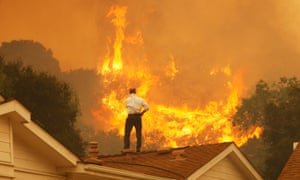
fire
'It is time for citizens to organize town meetings and rallies on climate change.' Photograph: David McNew/Getty Images
Every election year, candidates for office engage in a perverse form of theater. Some flatter voters or try to scare them, others offer promises of a better future. Unfortunately, few candidates feel an obligation to follow through on campaign pledges or grapple with serious problems confronting our country and planet.
Take Barack Obama. He has done far less on climate than his supporters might have expected. Despite claiming COP21 as a victory, Obama's legacy will tell the story of the US surpassing all other nations in oil and gas production. Bill McKibben, founder of 350.org, has called the US "a global warming machine", adding: "At the moment when physics tell us we should be jamming on the carbon brakes, America is revving the engine."
Today, that lack of leadership on climate change continues. Candidates running for Congress and the presidency aren't offering real solutions, despite growing scientific alarm.
Small wonder that the Guardian's readers, when surveyed, resoundingly proclaimed that climate change is one of the most pressing issues that are consistently neglected by our presidential candidates. The fact that many Americans feel this way speaks volumes about the fundamental rift between elected officials and their constituencies.
How many casualties, destroyed communities, flooded coastlands, diminished snow packs feeding key Asian rivers, drought-ridden agricultural belts and new disease vectors, will it take to move a more organized American public to demand a transformation of US energy policy? People care about this issue, so why don't our elected officials seem to reflect that concern?
Special interest lobbying has a lot to answer for. Tiffany Germain, in an article for ThinkProgress.org, notes: "170 elected representatives in the 114th Congress have taken over $63.8m from the fossil fuel industry that's driving the carbon emissions which cause climate change." Many of those representatives deny climate change is man-made.
John Passacantando, former executive director of Greenpeace in the US, once reportedly told big-oil and gas executives: "You're going to wish you were the tobacco companies once this stuff hits and people realize you were the ones who blocked [action]." His warning may eventually be proven correct if it turns out their industry lobby is to blame.
But that day might be far off. That's why, in this election year, we cannot afford to let candidates for federal, state and local office lose sight of the perils of climate change.
There are many policies our presidential candidates could get behind now. We could outlaw the creation of new fossil-fueled electric power plants, provide federal loans for the construction of renewable energy power plants or enforce green requirements on new homes and buildings – just to list some ideas floated by S David Freeman, an energy expert, in a recent book.
All of these are reasonable, possible and necessary steps that our elected officials could be implementing right now, were it not for the corruption that has prevailed in our politics over the last several decades.
This election, voters need to push candidates to support measures that will address the problems associated with climate change – and reporters need to cover this momentous story rigorously. It is time for citizens to organize town meetings and rallies on climate change. It is time for action.

Links

Lethal Heating is a citizens' initiative