Tuesday, October 11, 2016

The Health Impacts Of Climate Change Are Huge And Very Real

Huffington Post - Josh Butler

Health leaders implore government to do more, from a public health standpoint.
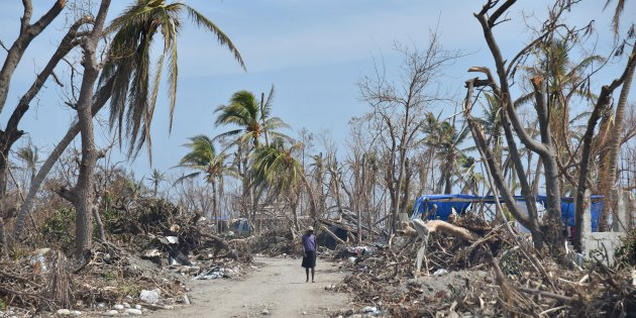
A woman in Les Cayes, Haiti, following the passage of Hurricane Matthew. AFP/Getty Images
Think of climate change, you probably think of melting polar ice caps, rising sea levels, crazy weather and environmental havoc. While the health of Planet Earth is usually the biggest factor, it's not often that the health of the human race enters significantly into the discussion.
A roundtable forum of public health leaders in Canberra hopes to change that, and to place health at the forefront of Australia's action on climate change.
The Climate and Health Alliance (CAHA), along with a number of healthcare and nursing groups, hosted the meeting of around 40 professionals in Parliament House. Assistant Health Minister Ken Wyatt, Shadow Health Minister, Catherine King, and Greens leader Richard Di Natale attended, hearing about how climate change is a "public health emergency", according to CAHA executive director Fiona Armstrong.
"There has been advocacy on climate change over several years, but we're concerned that as the issue becomes more urgent, there has been a failure to reflect the concerns of the health sector in climate policy decisions," she told The Huffington Post Australia.
"The health sector is committed to a public policy response. We'd like to work with the government to get a solution, beginning a discussion about what a public health framework would like."
Armstrong said climate change was about more than rising sea levels, that there are obvious -- and less obvious -- health implications. Continuing to burn fossil fuels for energy causes air pollution, leading to asthma and other respiratory problems; that's a clear one. Heatwaves leading to heat stroke, exhaustion and heat stress are another. However, wild and rapidly changing weather events can wreak massive devastation and cause huge health issues, such as Hurricane Matthew in Haiti and Florida just this week where more than 1000 were reported dead.
"Health impacts of climate change are very diverse. There are direct impacts and then the less direct, but it is is being described as the greatest threat to public health," Armstrong said.
"It's being emphasised by the World Health Organisation, and we're urging all governments to take action on climate change. To be frank, its a public health emergency."
People stand next to their destroyed house in Les Cayes, Haiti following Hurricane Matthew. Haiti faces a humanitarian crisis that requires a 'massive response' from the international community, the United Nations said , with at least 1.4 million people needing emergency aid. AFP/Getty Images
A recent report by CAHA found that Australia's health community thought the country was underprepared for the challenge of climate change-related health issues. It found that 52 percent of health professionals considered the government's direct action plan 'not at all effective'; 78 percent thought Australia's climate policies were not consistent with our international obligations, including the Paris Agreement; and that 98 percent agreed Australia needed to develop a national strategy on climate, health and well-being. Read the full report here.
Armstrong said the politicians attending the meeting had seemed receptive and eager to learn about the intersection of climate and health, and how to prepare Australia's health sector for the incoming climate-related issues. She added, however, that urgent action to lower emissions was the most important immediate priority.
"Mitigation is a top-line issue. Unless we're mitigating then we're not addressing the cause of the problem. Emissions reductions targets must be consistent with the science. Australia needs to accept its fair share of the responsibility, to be a good global citizen, and not be consuming the emissions budgets of developing nations who are using a range of energy systems to lift their populations out of poverty," Armstrong said.
"As a wealthy nation we've emitted our fair share in the past. We have the wealth to get our way to a zero emissions society."
"The health sector is already under considerable pressure. Climate change amplifies every risk factor there is, in every sector. Unless health sector is assisted to develop its climate responsiveness, it may become overwhelmed and unable to respond."

Links

Adani Coal Mine Gains 'Critical' Status As Queensland Government Moves To Kick-Start Project

ABC News

The mine, rail line and water infrastructure have been deemed critical infrastructure. (Source: adanimining.com)
Key points:
  • Queensland Government wants project to go ahead: Development Minister
  • Adani mine, rail and water infrastructure all deemed "critical"
  • More legal obstacles still possible, Resources Council warns
The State Government has declared Adani's Carmichael coal mine project in western Queensland to be "critical infrastructure" in a bid to fast-track its remaining approvals.
In a move branded reckless by the Australian Greens, State Development Minister Dr Anthony Lynham said the Government had invoked special powers to help progress Adani's $21 billion Carmichael coal and rail project in the Galilee Basin.
Dr Lynham said the move would mean less red tape for the project and the Coordinator General can sign off on approvals quickly.
He said the project's special "prescribed project" status had been renewed and expanded to include its water infrastructure.
"This step bundles together major elements of the project for the first time — the mine, the 389-kilometre rail line, and the water infrastructure, including a pipeline, pumping stations and a dam upgrade," he said.
"This Government is serious about having the Adani mine in operation, we want this to happen."
Dr Lynham said water licences were the only outstanding state approvals for the project.
Greens Senator Larissa Waters said the Government's move was reckless and short-sighted when they should be focusing on renewable energy projects for job creation.
"Instead, they're prioritising a coal mine owned by an overseas company, that won't pay any tax in Australia, that will generate a fraction of the jobs that it originally claimed, and it will threaten the Great Barrier Reef and the jobs it provides," she said.
Dr Lynham said when the Palaszczuk Government came to power in early 2015 there was a long way to go with the approvals Adani needed to start construction.
"Since then, 22 key Commonwealth, state and local government approvals have been granted for Adani's mine, rail and port facilities and there have been 29 key milestones reached," he said.
"Adani has now obtained all the necessary primary approvals for its mine, rail and port project - and most importantly, I have granted the mining leases."
Queensland Resources Council CEO Michael Roche described the move as a step forward but said new water license laws introduced to Parliament could lead to more legal obstacles.
"Getting that water licence could open up Adani to more court action, more appeals in the land court and other courts," Mr Roche said.
Dr Lynham said the progress on the project had been achieved while protecting the Great Barrier Reef and meeting Queensland and Commonwealth environmental impact assessment requirements.

Links

Turnbull’s Misgivings On Renewables Overlook Economic And Financial Realities

The Conversation -

Solar power generation is experiencing rapid growth. Alexandra Wey/EPA/AAP
The key breakthrough in the COAG Energy Council meeting last week was the recognition of the need to integrate climate policy and energy policy.
This has the potential to establish a coherent national energy policy for Australia and to fix on firm national targets on emissions reductions to meet Australia’s commitments to the Paris climate change agreement.
The independent panel chaired by chief scientist Alan Finkel will begin this work with a plan to ensure security of energy supply as more renewable energy comes into the grid, and more coal fired power stations close.
Despite Prime Minister Malcolm Turnbull’s misgivings about the “aggressive” renewable energy targets of South Australia, Victoria and Queensland, renewable energy could be considered a central part of his innovation “ideas boom”.
As former US Vice President Al Gore has said, the US$391 billion invested in 2014 in clean energy and low carbon development makes it “the biggest new business opportunity in the history of the world”.

Why the urgency on the switch to renewable energy?
Economist Nicholas Stern has called climate change “the greatest market failure the world has ever seen”. He insists the choice we face is taking mitigation action now, or very expensive adaptation in the future. Stern says “there is still time to avoid the worst impacts of climate change, if we take strong action now”.
In the same vein in a speech to Lloyds insurers, Bank of England Governor Mark Carney, who is also Chairman of the Financial Stability Board, said while a classical problem of environmental economics is the “tragedy of the commons”, climate change is a “tragedy of the horizon”. This is because the catastrophic impact of climate change is beyond the traditional horizon of most people. It is imposed as a cost on future generations as the current generations has little direct incentive to fix this.
As the critical dilemma of our time climate change is now considered worthy of concern by the G20 finance ministers. They asked the Financial Stability Board to consider the risks climate change poses for the financial system.
In 2015 the FSB launched the task force on Climate Related Disclosure (TFDC) applying to financial and non-financial companies, chaired by former New York Mayor Michael Bloomberg. Mark Carney identifies three channels through which climate change can impact on financial stability:

Physical risks: the impact today on insurance liabilities and the value of financial assets arising from climate-related events such as floods and storms that damage property and disrupt trade.

Liability risks: the impacts that could arise if parties suffering loss or damage from the effects of climate change seek compensation from those they hold responsible. These claims could come decades into the future, but could potentially hit carbon resources companies and emitters hard, and if they have liability cover would hit their insurers the hardest.

Transition risks: the financial risks resulting from the process of adjusting towards a low carbon economy as changes in policy, technology, and physical risks prompt a reassessment of the value of a large range of assets as costs and opportunities become apparent.
If renewable energy is our future, then all that’s left to discuss is the transition. Nic Bothma/EPA/AAP 
CarbonTracker
A US$28 trillion carbon bubble?
Aside from the risk to financial stability, there’s also a threat inherent in the way economies are dealing with carbon emissions.
A terrifying thought is that we have created a carbon bubble in financial markets as large and threatening as the toxic securities that delivered the global financial crisis.
CarbonTracker calculates the bubble of unusable carbon assets, using research by the Potsdam Institute. It suggests that to reduce the chance of exceeding 2°C warming to 20%, the global carbon budget for 2000-2050 is 886 billion tonnes of CO₂.
With the emissions that have already occurred since 2000 this leaves a carbon budget until 2050 of 565 billion tonnes of CO₂. However the total carbon potential of the earth’s known fossil fuel reserves of 2,795 billion tonnes of CO₂ exceeds the carbon budget by five times (65% from coal, 22% from oil, and 13% from gas).
According to CarbonTracker: “This means that governments and global financial markets are currently treating as assets, reserves equivalent to nearly 5 times the carbon budget for the next 40 years. The investment consequences of using only 20% of these reserves have not yet been assessed.”
Judged by their recent investment activity in carbon relative to renewable energy (see chart below) it is possible the Australian banks have not yet quite realised the scale of the challenge confronting them in withdrawing from carbon investments.

Big four bank investment in fossil fuels and renewables (A$)
A brighter future?
The combination of the 2015 Paris climate agreement, the UN Sustainable Development Goals, and the prospect of tens of trillions in stranded assets in fossil fuels, is a heady mix for business which might occasion some real traction in the drive for sustainability.
In 2003 just 253 companies reported their greenhouse gas emissions, water management and climate change strategies to the Carbon Disclosure Project (CDP). In 2014 it was 5,003. Companies including Bank of Montreal, Google, Microsoft and Marks and Spencer are now disclosing and some are pursuing zero emissions into their value chain.
The shift to renewable energy is advancing globally. As Clean Energy Council chairman Miles George puts it:
You can follow the money. In 2015 US$286 billion (A$380 billion) was invested in renewable energy worldwide, compared to only US$130 billion in fossil fuel generation. For the first time more than half of all new electricity generation investment is in renewable energy. Global forces at play now mean that renewable energy is our future, and all that’s left to debate is the rate of transition.
Google alone is committed to purchasing 2.5 gigawatts of renewable energy – making it the largest non-utility purchaser of renewable energy in the world. It is also investing in nearly US$2.5 billion in renewable energy projects, producing enough electricity to power more than one million US homes. Not to be outdone, Amazon is building a huge wind farm in Texas.
Wind energy is now experiencing exponential growth in production and sales. Solar energy is exceeding it with 68 times the projected output of solar predicted ten years ago.
We are on the cusp of a revolutionary global paradigm shift towards renewable energy, one that Malcolm Turnbull will find it difficult to ignore.

Links

Monday, October 10, 2016

Finkel Power Review Should Look Into Climate Policies

Fairfax - Mark Ludlow

The Turnbull government's new power review should have been expanded into climate change, says energy experts. Phil Carrick
The Turnbull government's review of energy security is duplicating existing inquiries but missing a key piece of the puzzle – the nation's climate change policies, according to energy experts.
State and federal ministers on Friday agreed to establish the new independent review headed by chief scientist Alan Finkel – which will deliver its preliminary report before Christmas – in the wake of the disastrous blackouts in South Australia last month.
But experts said there were already multiple reviews on the National Electricity Market being done by the Australian Energy Market Operator, Australian Energy Market Commission and the Australian Energy Regulator looking into energy security and adapting rules to deal with the influx of renewable energy. The missing piece of the puzzle is how to marry this to climate change policy.
"This is really a review of the reviews. I don't think it makes sense to do a review of the NEM without including climate change policies," Grattan Institute energy program director Tony Wood told The Australian Financial Review.
"Sadly, the [Finkel] review's terms of reference fail to recognise the elephant in the room – the absence of a federal policy to reduce electricity emissions in line with Australia's committed 2030 target." 
The Turnbull government has committed to a 2017 review of its Direct Action climate change policies, including the $2.5 billion Emissions Reduction Fund and so-called safeguard mechanism for big polluters.
But Mr Wood said the pace of change in the NEM, including problems with the integration of renewables into the nation's energy mix, meant the Turnbull government should consider bringing the review forward.
Other energy observers believe last Friday's "extraordinary" Council of Australian Governments energy council meeting was more about political positioning than genuine action.
The agenda for the meeting, including looking at battery storage, interconnectors and issues arising from more solar and wind projects in the NEM, was essentially the same as the last COAG energy council meeting in August.
Kobad Bhavnagri, head of Australia for Bloomberg New Energy Finance, said the fact energy security had become a paramount concern for federal and state governments demonstrated "the cost of nearly 10 years of shambolic energy policymaking".
"Renewables undoubtedly make system management more complex. However, opposing or limiting the uptake of renewables is, in our view, a retrograde response, which ignores the imperative to decarbonise," he said.
Mr Bhavnagri said the energy sector was concerned Prime Minister Malcolm Turnbull had used the aftermath of the South Australian blackout to attack state-based renewable targets saying it had re-politicised the debate.
"Notwithstanding the cause, the statewide blackout shows the need for management of the electricity system to evolve. Instead, work needs to be done to evolve and improve the current system to facilitate technological change," he said.
Bloomberg New Energy Finance's report on the SA blackout found that while the focus has been on wind power disconnecting from the grid, fossil-fuel generators also failed.
"The two back-up generators that are paid to provide emergency power to restart major suppliers failed. Notably, the fact that these fossil-fuelled facilities failed to provide reliable supply and fulfil their primary function has received little media scrutiny," it found.
AEMO's preliminary review of the SA's "system black" found the destructive storms critically damaged the state's transmission network, but it has yet to find the reason why this triggered a statewide blackout.
Meanwhile, SA network company Electranet said the restoration of damaged transmission lines in the state's mid-north was nearly complete. The delays had caused major headaches for big industrial users, including BHP's Olympic Dam mine.
ElectraNet said it expected one of the damaged circuits will be back up by Monday, provided weather conditions remain stable. Another circuit will follow a few days later.

Links

We Have Money To Fight Climate Change. It's Just That We're Spending It On Defense

The Guardian - Kenneth Pennington

Stopping one fighter plane program would save enough to build wind farms to power 320,000 homes. We need to drastically reassess our priorities
'The F-35 fighter plane program is a prime candidate for big cuts. It's the most expensive weapon ever designed, complete with massive cost overruns.'  Photograph: Lockheed Martin/AAPIMAGE
One year ago this week, I was sitting in a cramped hotel room with 15 other staffers in Las Vegas for Bernie Sanders' first debate for the presidential nomination. The question came from CNN: "What is the greatest national security threat?" Pundits criticized and mocked him for weeks after he answered "climate change". But he was right.
And it's not just Sanders pointing out the imminent threat posed by climate change to global and national security. CIA analysts and our nation's military strategists are rightfully naming it as a contributor to refugee flows, the spread of disease, and conflicts over basic resources like food and water.
In 2014, 17.5 million people were displaced by climate-related disasters. Those numbers will continue to rise dramatically in the coming decades, according to climate displacement program manager Alice Thomas of Refugees International.
Our nation's defense officials know global warming's destructive forces could undermine fragile governments in unstable regions of the world where extremist ideologies can take root. Yet mainstream Republican avoidance of reality on the science of climate change impedes the necessary reassignment of resources to meet the challenges posed.
Now a new report from the Institute of Policy Studies provides the most accurate calculation of government spending on climate security to date. The picture isn't pretty. We're spending 28 times as much on military security than climate security. A public sector investment of $55bn per year is required to meet the challenge, according to the study. With $21bn in the 2017 budget, a shortfall of $34bn is left.
That may seem like an insurmountable hill to climb. It's not! As the IPS report points out, plenty of money lies untouched in the nation's bloated military budget.
The F-35 fighter plane program is a prime candidate for big cuts. It's the most expensive weapon ever designed, complete with massive cost overruns. The sad cherry on top: the military admits that this plane just doesn't work. If we turned back now, IPS says we could build enough offshore wind farms to power 320,000 homes for millions of people.
Savings from gutting a Navy program designed to build close-to-shore combat ships would provide enough funds to retrain more than 150,000 coal industry workers. The ships have been plagued with mechanical errors. Our own Government Accountability Office says the "actual lethality and survivability performance of LCS is still largely unproven through realistic testing". Others have called the ships an outright "waste". Retraining and redistributing our fossil-fuel workforce to green jobs would be a welcome reprioritization.
Congress could harness additional savings by reducing service contracting and canceling other wasteful or unnecessary weapons programs. But one party largely stands in the way. Republicans are hell-bent on leading our country down an unforgivable road with grave consequences. Their party's nominee for president believes that global warming is a hoax engineered by the Chinese. That would be comical if it weren't so dangerous.
Rich Americans justify inaction by dismissing climate change as a far off problem that will affect others. But climate change is here and now. And while the sharpest edge of its destructive forces will sadly hurt people of color and lower-income the hardest, we're all in deep trouble.
In an unusually forceful public service announcement, The Weather Channel this week warned Floridians that Hurricane Matthew would lead to a heartbreaking loss of life. Florida governor Rick Scott said: "This storm will kill you." These un-natural weather occurrences are becoming more and more frequent.
My home state of California faces its worst drought in 1,200 years. When I traveled home for the holidays two years ago, I saw the devastating impact of climate change firsthand. Where boats once sat docked in my hometown marina, only dust remained. Climate scientists are telling us that the United States is not immune to the instability and infighting that will occur when populations are forced to fight over food and water. They need only look to California for confirmation, where northerners and southerners argue fiercely over water access.
The only practical solution to curb unrest, suffering and death here and abroad is a massive redistribution of government money. This week's new report from IPS serves as a thoughtful blueprint.
Republicans should take heed of former GOP President Dwight Eisenhower's words of wisdom:
Every gun that is made, every warship launched, every rocket fired signifies, in the final sense, a theft from those who hunger and are not fed, those who are cold and are not clothed. This world in arms is not spending money alone. It is spending the sweat of its laborers, the genius of its scientists, the hopes of its children.
Let's steward our resources wisely. Let's choose climate over combat.

Links

Removing CO2 From the Air Only Hope for Fixing Climate Change, New Study Says

InsideClimate News - Zahra Hirji

Without 'negative emissions' to help return atmospheric CO2 to 350 ppm, future generations could face costs that 'may become too heavy to bear,' paper says.
Scientist James Hansen, lead author of a new study urgently calling for removal of carbon dioxide from the atmosphere, poses next to a mock grave stone declaring "Climate change a matter of life or death" in 2009 in Coventry, England. Hansen, a prominent climate researcher, has dismissed criticisms that his recent papers blur the line between advocacy and research. Credit: Christopher Furlong/Getty Images
The only way to keep young people from inheriting a world reeling from catastrophic climate change is to reduce carbon dioxide emissions dramatically and immediately, according to a new paper. Not only that, but it's also necessary to aggressively remove greenhouse gas that's already accumulated.
"If rapid emission reductions are initiated soon, it is still possible that at least a large fraction of required CO2 extraction can be achieved via relatively natural agricultural and forestry practices with other benefits," the authors wrote.
"On the other hand, if large fossil fuel emissions are allowed to continue, the scale and cost of industrial CO2 extraction, occurring in conjunction with a deteriorating climate with growing economic effects, may become unmanageable. Simply put, the burden placed on young people and future generations may become too heavy to bear."
The study's 12 authors, led by prominent climate scientist James Hansen, the former head of NASA's Goddard Institute for Space Studies, call for bringing atmospheric carbon dioxide levels down to levels not recorded since the 1980s: 350 parts per million, a long standing goal of Hansen's.
The level is now above 400 ppm, up more than 40 percent since before the Industrial Revolution. Many scientists reckon that 450 ppm is the safe limit to avoid the worst effects of global warming.
The paper, called "Young People's Burden: Requirement of Negative CO2 Emissions," was published Tuesday in the journal Earth System Dynamics Discussions.
It was written to support litigation by Hansen and a group of young people (including Hansen's granddaughter) seeking to force more ambitious climate action. And it is the latest in a string of scientific analyses showing that nations are far from reining in dangerous warming, despite the imminent entry into force of a comprehensive treaty negotiated last year in Paris.
The Paris deal aims to limit warming to 1.5 degrees or 2 degrees Celsius, in line with the 450 ppm level. That would require bringing emissions to "net zero" sometime in the second half of this century through a swift clean energy transformation. Any CO2 spewed into the air—be it from a coal plant, an SUV or an airplane—would have to be completely offset, or "zeroed," by increasing the growth of forests and other carbon sinks.
But according to the paper, even a net-zero world wouldn't be enough to prevent burdening future generations with an impossible task.
To attain Hansen's bolder goal, countries have to achieve "negative emissions," by removing more accumulated CO2 from the atmosphere.
The paper lays out five possible scenarios. In the worst-case scenario, emissions continue to rise by at least 2 percent a year after 2015, and CO2 levels more than double to 864 ppm by 2100. To prevent that dire outcome, which assumes countries aren't reducing their emissions to net zero, 768 ppm of CO2 would have to be sucked out of the atmosphere by that time.
That would be enormously expensive for future generations—perhaps impossible.
In the most optimistic scenario, CO2 emissions stay flat until 2020, and then emissions drop by a steep 6 percent a year. This implies the world is rapidly transitioning to a clean energy economy and producing net-zero emissions before mid-century. But even this scenario requires pulling 72 ppm of CO2 out of the air by 2100—a more plausible, but still difficult burden.
Hansen, now an adjunct professor at Columbia University, has long warned that global warming inaction would lead to dire consequences. Nearly 40 years ago he developed one of the world's first climate models, and was among the first scientists to conclude that the burning fossil fuels was to blame for modern climate change.
Eleven other scientists contributed to the paper from academic institutions across the globe, including the Chinese Academy of Sciences, the Australian National University and the University of Paris-Saclay in France.
It was published in a discussion journal, where research is published and sent for peer review at the same time.
Last year, Hansen and a team of 16 international scientists similarly publicized a paper in the journal Atmospheric Chemistry and Physics before it was peer reviewed. The move was criticized by some as blurring the line between advocacy and research. The study, timed to influence the Paris climate talks, warned that even 2 degrees of warming is "highly dangerous" and could cause sea level rise of "at least several meters" this century. The peer-reviewed version was published earlier this year.
"Some people might object to discussing such a paper before it has gone through the peer-review process. But again I'm going to do that, simply because we are running out of time on this climate issue," Hansen told reporters this week.
As part of the paper, the scientists analyzed how today's warming compares to the rest of the Holocene period, which covers the previous 11,700 years, and an even warmer period of history called the Eemain period, which occurred 130,000 to 115,000 years ago. During the warm Eemian, sea-level rise was between 20 and 30 feet higher than it is today. Today's global temperatures are already at the level expected during the Eemian, or possibly above them, the paper says.
The authors recommend aiming for temperature and CO2 levels observed during the 1980s because they're more in line with conditions during the early Holocene period, which did not experience catastrophic sea-level rise.
"A danger of the 1.5 degree C and 2 degree C temperature targets is that they are far above the Holocene temperature range," the authors wrote. "If such temperature levels are allowed to long exist they will spur 'slow' amplifying feedbacks, which may have potential to run out of humanity's control. The most threatening slow feedback likely is ice sheet melt and consequent sea level rise, but there are other risks in pushing the climate system far out of its Holocene range."
To achieve negative emissions the study recommends using forestry and agricultural practices that increase the carbon-sucking ability of soil and trees, with the goal of pulling 100 gigatons of carbon out of the atmosphere. Even if that's achieved, more expensive and intensive methods for emissions extraction would be needed, such as carbon capture and sequestration. One such approach would burn biomass as fuel while capturing the CO2 emissions and burying the pollutant deep in the ground.
"We assume that improved practices will aim at optimizing agricultural and forest carbon uptake via relatively natural approaches, compatible with delivering a range of ecosystem services from the land," the authors wrote. "In contrast, proposed technological extraction and storage of CO2 does not have co-benefits and remains unproven at relevant scale."
Hansen, his 17-year-old granddaughter Sophie Kivlehan and 20 other young people are suing the federal government to take more action on climate change. The Department of Justice and fossil fuel industry groups have opposed the lawsuit, but a judge ruled in April that it could proceed. Oral arguments were made in Oregon on Sept. 13, and U.S. District Court Judge Ann Aiken plans to rule within 60 days on whether the case will proceed.
"If the case goes to trial, we do expect that we can introduce this paper into the considerations," Hansen told InsideClimate News via email.
The study's chief conclusion on negative emissions "is hardly new or surprising or controversial," said Michael Mann, a Penn State climate scientist who was not involved in the study. "That's well known."
But the fact that it's being publicized prior to peer review and submitted in a legal case "will certainly raise eyebrows about whether or not this breaches the firewall many feel should exist wherein policy agenda should not influence the way that science is done," he said.
Typically, scientific papers are subject to peer review when they're submitted. If journal editors and outside commenters have any questions or concerns, the authors revise their work to address them before publication.
For this paper, scientists and others can now submit comments online and Hansen's team must respond.

Links

Sunday, October 09, 2016

10 Countries That Have Ratified The Paris Climate Deal (Australia Still MIA)

Climate Council

Australia is once again late to the climate action party.
As of today, 74 countries representing over 55% of global emissions have ratified the Paris Climate Agreement, putting it into effect. The agreement requires signatories to do everything possible to limit global warming to no more than 2°C above pre-industrial levels, with an aspirational target of 1.5°C.
The historic deal required ratification by at least 55 countries representing 55% of global emissions for it to become operational – which it now is!
Sounds like good news, right? Well unfortunately Australia remains one of the largest emitters to delay ratification.
But while Australia lags behind the rest of the world, many other nations are stepping up – here are 10 countries that have been pro-active in the ratification of the landmark climate agreement!
China
When the world's two biggest carbon emitters ratified the Paris Climate Agreement together, it was kind of a huge deal.
China and the US ratified in a joint statement, collectively totally 38% of global emissions.
China has pledged to cap their total emissions limits by 2030, reducing the carbon intensity of economic output by 60-65%, with 20% non-fossil fuel energy, and forest stock by 4-5 billion cubic metres!
USA
The United States is the world's second largest producer of GHGs
The country has pledged a reduction of 26-28% on 2005 levels, and aims to reach its targets by placing restrictions on power producers' emissions levels, while offering incentives to renewable energy producers.
However, the result of the US election has worried some about the United States' ability to maintain the pledge, as a little known part of the agreement is a four-year wait required to abandon the pledge – exactly the length of a US presidential term
!
India
The fourth largest emitter of GHGs ratified the Paris Agreement this week, on Mahatma Gandhi's birthday.
The government has pledged to reduce the emissions intensity of their economic output by 33-35% by 2030, on 2005 levels with 40% non-fossil fuel based power, an ambitious pledge in the coming decades where hundreds of millions will access energy for the first time.
Additionally, 2.5-3 gigatons of CO2 will be stored through additional forestation by 2030.
India has faced several devastating heatwaves in recent years, with a long coastline leaving it exposed to sea-level rise, storms and floods – threats heightened among vulnerable populations.
European Union
Ratification this week by the EU, representing around 12% of global emissions, pushed the agreement past the 55% threshold and led to the Paris Agreement coming into effect.
EU negotiators were among leaders in the "high ambition coalition", a pact formed 6 months ahead of the Paris negotiations to spur more ambitious change.
The parliament has a formal, binding target of a 40% reduction in emissions by 2030 on 1990 levels.

Brazil
Latin America's biggest emitter, Brazil, has been an early and active part of the ratification process.
Brazil intends to reduce its GHG intensity by 37% by 2025 on 2005 levels, with a further attempt to reach a 43% reduction.
Significant emissions reductions have already been achieved in the country through reforestation efforts in the Amazon, hydropower and other renewable energies.

Canada
Canada has pledged a 30% drop in emissions by 2030 on 2005 level.
Along with ratifying Canada's portion of the agreement, the government has announced a national price on carbon, at C$10 per ton, rising $10 each year until 2022, when it will be reviewed.
This is an extension of different carbon pricing programs in four of Canada's most populous provinces.

Mexico
Mexico is the 13th largest emitter in the world.
Mexico has pledged a 36% reduction of GHGs by 2030, by increasing their mix of renewable energy and stopping deforestation by 2030.
Conditional on some international support, the government has signalled an ambition of making a 40% reduction.

United Arab Emirates
The UAE is the first Middle Eastern country to ratify the Paris agreement.
The UAE's pledges involve a 24% mix of non-fossil fuel energy production by 2021, a fast but small contribution for a large oil producer.
Efforts to increase renewable energy, water efficiency, sequester carbon, and achieve an economic diversification away from oil will contribute to the country's targets.
Morocco
Ahead of the next UN climate change conference in Marrakesh this November, Morocco has ratified the Paris agreement.
With some international assistance, Morocco has pledged to reduce their emissions by 32% by 2030, and to stop any emission growth along with 42% renewable energy by 2020
New Zealand
Even our neighbours across the ditch have ratified the Paris Agreement, pledging a 30% reduction of GHGs by from 2005 levels.

So what about Australia?
Australia's former Environment Minister signed the agreement in April but it is yet to be approved by Parliament.
"If the pledges are honoured promptly, and then deepened, this could be the turning point in tackling climate change," the Climate Council's Chief Councillor Professor Tim Flannery said.
"Around the world, we have seen leaders act swiftly in acknowledging the huge task ahead of us. Unfortunately, here at home in Australia, we continue to bicker and drag our feet."
Climate Councillor Professor Lesley Hughes, who last week appeared before a Parliament committee considering the Paris agreement, said Australia had so much work to do to reduce its emissions, and no time to lose.
"The severe storms that recently hit South Australia and other states, disrupting electricity supply and flooding our agricultural heartland, illustrates once again that Australia is on the front line of climate change," Professor Hughes said.
"Without drastic and deep emissions reductions we will face even more severe climate impacts, which could cripple the nation's major infrastructure and seriously affect our economy and way of life. Now is the time to get to work."

Links

Lethal Heating is a citizens' initiative