25/11/2016

We Can Limit Global Warming To 1.5°C If We Do These Things In The Next Ten Years

The Conversation | 

The shipping industry must clean up its act. Darrin Zammit Lupi/Reuters
After the climate talks in Marrakech, our climate mission remains the same as what was set out in the 2015 Paris Agreeement: to eliminate all carbon dioxide emissions by the middle of this century.
While the long-term focus is on 2050 or 2100, what matters now is the next ten years. If we miss bending the rising emissions curve downward by around 2020, we may well miss the chance to avoid the worst climate damage.
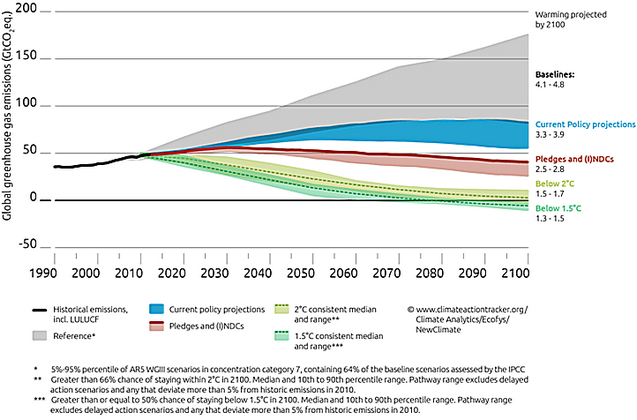
Climate Action Tracker Author provided
We  looked at all the major emitting sectors and the most recent scientific analyses of what can be done – and how fast – to come up with a list of the most important things to do in the next five to ten years to bend the emissions curve downwards.
Here’s the good news: for all areas, we show signs that a transition of this magnitude is possible. In many cases, it’s already happening.

Phasing out coal
The scientific literature shows that decarbonising the electric power sector is the most important, fastest and cheapest step, reinforced by rapid reductions in the price of renewable technologies such as wind and solar power.
The most important thing to know about the feasibility of reducing CO2 emissions from the power sector to zero by 2050 is this: if we continue the growth rate of wind and solar we’ve seen in the past few years for the next decade globally, we will be well on the way to achieving this goal.
That means we will need to phase out coal. We need to reduce emissions from existing power stations – but that is already happening – and we will need to cancel any new coal capacity in the world.
We know that renewables, energy efficiency and, in a number of cases, natural gas, can meet foreseen power needs, while lifting millions of people out of poverty. Reducing coal emissions from power will have substantial benefits for human health: more than half the pollutants that cause damage to human lives, ecosystems and agriculture comes from fossil fuels.
A number of governments have already committed to doing this: we’ve seen China’s emissions peak in 2013 and continue to drop. The UK has promised to phase out coal by 2025; and we’ve seen regions in other countries, such South Australia, close their last coal plants.

The UK plans to phase out coal by 2025. Phil Noble/Reuters
All this takes is political will and effort, and a just transition for workers that enables communities to move from coal to alternative means of employment and energy production.

Electric cars
We also need to electrify the transport system, starting with cars.
In the early 1900s, Henry Ford took cars into mass production. A century later, we’re on the brink of the next major transition towards electric vehicles, pioneered by manufacturers such as Elon Musk’s Tesla and making a major contribution to reducing emissions from transport.
Just before the Marrakech climate talks, China, which has the world’s biggest and fastest growing market in quantitative terms, announced it would introduce quotas for electric vehicles. This was a shock for German and other European car manufacturers, who anticipated their future as being based on old fossil fuel technologies.
One can only hope that these manufacturers will now rush into electric mobility. We calculate that the last fossil fuel car has to be sold before 2035 to be in line with holding warming to 1.5°C.
Electric cars must become standard in the next decade. Phil Noble/Reuters 
Aviation and shipping remain of great concern, and we find efforts by the industry, including technology standards and emissions offset schemes for any extra emissions after 2020, don’t have the teeth to really make a difference in this sector. There’s also a risk that these measures could obscure the need for much deeper and further-reaching changes.

Zero energy building
Another huge sector is buildings. It’s very important that new buildings move towards near-zero energy by 2020. New buildings can be built in a way that produces net zero energy. The upfront investments are recovered by the zero energy costs during operation.
Given the rapid growth of infrastructure in much of the Global South, as well as ongoing replacement of old buildings in the developed world, efforts toward ensuring zero-energy buildings become the global standard for new construction need to be accelerated. This will already be the case in the EU from 2020.
Of course, we still need to do a lot with existing buildings, one of the most difficult areas for governments to tackle. We know that clean energy renovation is highly beneficial not only to occupants and the environment but also to the economy. Renovation rates need to be at least tripled. These measures need to move beyond being voluntary and underfunded to being backed by regulation and proper financial support.

Forests and agriculture
Deforestation remains a serious issue in many countries, causing large-scale air pollution, loss of biodiversity, and affecting the livelihoods of local people. We know however, that reducing emissions to 95% below recent levels by 2030 will have large sustainable development benefits.
The other areas we have to look at are the industrial sector and agriculture, but again, we find there are solutions and steps that these sectors can take. The industrial sector needs to move to state-of-the-art low-carbon technologies for all new plants as of 2020 and agriculture needs to apply current best practices.
www.climateactiontracker.org Climate Analytics, Author provided
Removing carbon from the atmosphere
There has been so little climate action since the world first started talking about emission reductions in 1992, when the UN climate convention was adopted, that we have nearly used up the carbon budget available to limit warming to 1.5°C.
As a consequence, technology that removes CO2 from the atmosphere will need to be deployed 30 years from now, to hold warming below 2°C, let alone limit warming to 1.5°C.
It’s important to realise that even if we reduce emissions to zero ten years before the most advanced models indicate (around 2035), we will still need to deploy negative emission technologies at scale.
That means that if we are successful and throw everything at the problem, plus the proverbial kitchen sink, we still need to be preparing to deploy negative emissions technologies from the 2040s onward. About the only good news from this is that we have time to research this, test it and work out the most sustainable way of doing it.
Phasing out greenhouse gas emissions entirely by mid-century is possible, and promising trends are emerging. But the next five to ten years will be the real test of whether we can make that happen.

Links

Threat To NASA Climate Role A 'Disaster' For Global Warming Action: Researchers

Fairfax -

A threat by the incoming Trump administration to the climate research of US space agency NASA would be disastrous for global efforts to monitor and counter global warming, Australian researchers said.
NASA's earth science division would be stripped of funds, with the money diverted to deep space exploration, the Guardian reported on Tuesday, citing comments by Bob Walker, a senior advisor to president-elect Donald Trump.


Greenhouse gases: not just a bunch of hot air
From tracing the exact source of CO2 in our atmosphere to measuring the earth's "carbon budget," the scientists studying climate change know a lot more about the greenhouse effect than you might think.

"I believe that climate research is necessary but it has been heavily politicised, which has undermined a lot of the work that researchers have been doing," Mr Walker was quoted as saying. "Mr Trump's decisions will be based upon solid science, not politicised science."
The election two weeks ago of the Republican candidate to replace Democrat Barack Obama next January for a four-year term sent shockwaves through the global climate research community. Mr Trump has said climate change was a hoax "created by and for the Chinese in order to make US manufacturing non-competitive".
As Fairfax Media reported, Australian scientists are keenly aware that much of the climate monitoring and models they rely on are sourced from US agencies including NASA.
Matthew England, a professor of oceanography and climate dynamics at the University of NSW, said NASA was "one of the iconic climate science centres in the US".
"Cutting NASA out of earth observation would be disastrous," Professor England said. "We need the observations that this lab underpins."
Professor England, though, said Mr Trump was sending mixed signals on his intentions. During a meeting with New York Times journalists on Monday, the President-Elect declined to repeat his campaign promise to abandon the international climate accord reached last year in Paris, saying, "I'm looking at it very closely."
NASA supplies key data for Australia's climate research - and many other countries' efforts. Photo: BOM
Mr Trump told the Times "I have an open mind to it" and that clean air and "crystal clear water" were vitally important, the paper reported.
While those comments were welcomed, Professor England noted many of Mr Trump's appointments so far bore "almost a hatred of our field of research".
"They are people who don't have an open-mind," he said, adding that many of them had close ties to the fossil-fuel industry – one that Mr Trump had pledged to help.

'Whole world'
Roger Jones, a former CSIRO scientist now at Victoria University, said "the whole world" uses processes developed by NASA such as the satellite observation system MODIS.
"In Australia [the data] is used to monitor floods and drought on an on-going basis," Dr Jones said. "It's used to ground-truth our understanding of soil moisture and production systems."
"This is an area where global-scale earth system science is seen as an aspect of 'globalisation' and thus suspect," he said. "The UN agenda is to use science funded by the people of America against the interests of everyday Americans – this is what they see as happening now."
Malte Meinshausen, director of the Climate & Energy College at Melbourne University, said there were few other agencies that could shoulder similarly advanced satellite projects.
"While deep space exploration enables us to have big dreams, understanding planet earth enables us to live better lives and actually save lives," Professor Meinshausen said.
The NASA Aqua satellite "now delivers unprecedented detail about the water cycle, and the patterns of carbon-dioxide concentrations", he said. "Those satellites are what the X-ray instrument is in any hospital - vital to our understanding where the patient planet earth is sick and what the root causes are."
Ceding America's technological edge could see US farmers, among others, lose out. Photo fluorescent measurements, for instance, involve NASA scientists working with a Japanese satellite to offer advanced detection of crop disease and droughts, he said.

'Shockingly stupid'
Mr Walker's comments have added to international anxiety over the future of US climate research.
Hans Joachim Schellnhuber, director of the Potsdam Institute for Climate Impact Research, said end NASA´s Earth observatory mission was "would seriously impair our ability to see the big planetary picture".
"Unfortunately, these plans echo the weakening of climate science capacities at CSIRO by the Australian government," Professor Schellnhuber said, referring to efforts by CSIRO management earlier this year to slash climate modelling and monitoring.
"The scientific community has to stand together now [to avert] the Trump attacks," he said. "Otherwise, not only America would go myopic and risk lagging behind the scientific state of the art, but today´s and future generations would suffer direly from the consequences."
Bob Ward, policy and communications director at the Grantham Research Institute on Climate Change and the Environment at the London School of Economics and Political Science, said stripping NASA of its climate role "would be a shockingly stupid move that would deal a very severe blow to global research on environmental change across the world".
"Stopping all funding would, for instance, mean abandoning satellites that monitor the earth's surface and would be an enormous waste of billions of dollars of scientific research," Mr Ward said. "It would also trigger the departure of many world-class scientists that would have catastrophic consequences for the competitiveness of universities and businesses in the United States."
Stefan Rahmstorf, head of Earth System Analysis at the Potsdam Institute for Climate Impact Research, took aim at Mr Walker's comment that NASA science was "politicised science": "That is preposterous and probably just means that he does not like the results."
"We're in the midst of rapid global warming and many associated changes to Arctic and Antarctic ice cover, sea level, extreme weather events, droughts and wildfires, to name just a few," Professor Rahmstorf said. "NASA's observations of planet Earth from space and NASA's ability to analyse and understand the changes is of critical importance to  America and the world."
"Hampering this capability would be like trying to navigate blind-folded into treacherous waters."

Links

A Portrait of a Man Who Knows Nothing About Climate Change

New York Magazine

Photo: Spencer Platt/Getty Images
In  his interview with the New York Times, Donald Trump expressed more flexibility on climate change, which he has previously called a hoax created by China. That is the good news. The bad news is that Trump’s lack of commitment to the cause of climate-science denial is rooted in a comprehensive failure to grasp the issue. The few snippets of concrete factual information he has to ground his beliefs are mostly false. His New York Times interview forced the president-elect to grapple with the issue in more depth than he did at any time during the campaign (the three debates had no questions on this issue, and climate-change policy in general received vanishingly little attention from the media). The portrait that comes out of the interview is one of almost complete ignorance.
Trump began by promising “an open mind.” Then he began to defend his denialist position:
You know the hottest day ever was in 1890-something, 98. You know, you can make lots of cases for different views. I have a totally open mind.
The hottest single day on record is not relevant to a problem centered on increased average temperatures. The reality is that the Earth has seen a long-term rise in surface temperature:
Photo: NASA
That data comes via NASA. (In related news, Trump’s lead adviser on NASA, Bob Walker, today advocates zeroing-out all climate-related research at the agency, which he calls “politically correct environmental monitoring.”)
Trump then cited the authority of his late uncle:
My uncle was for 35 years a professor at M.I.T. He was a great engineer, scientist. He was a great guy. And he was … a long time ago, he had feelings — this was a long time ago — he had feelings on this subject. It’s a very complex subject. I’m not sure anybody is ever going to really know.
John G. Trump was a physicist and engineer, not a climate scientist. And he died in 1985, a time when the scientific consensus on anthropogenic global warming was far less solid than it is today.
Trump then moved on to hacked emails among climate scientists:
I know we have, they say they have science on one side but then they also have those horrible emails that were sent between the scientists. Where was that, in Geneva or wherever five years ago? Terrible. Where they got caught, you know, so you see that and you say, what’s this all about. 
He is referring here to a popular right-wing conspiracy that claimed that scientists were conspiring to falsify climate data to support their theory. This claim has been debunked.
Trump then begins rambling about other environmental issues:
I absolutely have an open mind. I will tell you this: Clean air is vitally important. Clean water, crystal clean water is vitally important. Safety is vitally important.
And you know, you mentioned a lot of the courses. I have some great, great, very successful golf courses. I’ve received so many environmental awards for the way I’ve done, you know. I’ve done a tremendous amount of work where I’ve received tremendous numbers. Sometimes I’ll say I’m actually an environmentalist and people will smile in some cases and other people that know me understand that’s true.
What any of these disconnected sentiments have to do with his beliefs about greenhouse-gas emissions is difficult to tell. He seems to want to assert his authority as a good guy for the environment without connecting this element of his self-image to his policy agenda for the U.S. government.
Sensing the drift, the Times tries to refocus Trump on the question of whether he accepts the scientific connection between greenhouse-gas emissions and rising global temperatures. Trump replies:
I think right now … well, I think there is some connectivity. There is some, something. It depends on how much. It also depends on how much it’s going to cost our companies. You have to understand, our companies are noncompetitive right now.
There are two revealing things about this snippet. First, Trump concedes that there is “some” connection between the atmospheric concentration of heat-trapping gasses and higher temperatures, but will not say how much, or whether this has any bearing on policy. Instead he moves directly to the cost to American companies, saying the answer to the scientific relationship depends on the cost to American companies. Of course, one could make a coherent argument that climate change is real, but any particular policy response fails the cost-benefit test. Indeed, many conservatives embarrassed by having to defend anti-scientific conspiracy theories have urged Republicans to shift their line of defense in just this way. But Trump is giving the game away by explicitly linking the two arguments.
Later in the interview, Trump is asked about using his meeting with Nigel Farage, in which Trump lobbied against an offshore wind farm that he believed would mar the vistas at a Trump-owned golf course. Trump defending this blatant display of self-interest as a consistent application of his overarching hatred for wind energy:
I mean, the wind is a very deceiving thing. First of all, we don’t make the windmills in the United States. They’re made in Germany and Japan.
This is wrong. American wind-turbine manufacturers and their supply-chain have a large domestic presence:
Trump then begins to ramble again:
They’re made out of massive amounts of steel, which goes into the atmosphere, whether it’s in our country or not, it goes into the atmosphere. The windmills kill birds and the windmills need massive subsidies. In other words, we’re subsidizing wind mills all over this country. I mean, for the most part they don’t work. I don’t think they work at all without subsidy, and that bothers me, and they kill all the birds. You go to a windmill, you know in California they have the, what is it? The golden eagle? And they’re like, if you shoot a golden eagle, they go to jail for five years and yet they kill them by, they actually have to get permits that they’re only allowed to kill 30 or something in one year. The windmills are devastating to the bird population, O.K. With that being said, there’s a place for them. But they do need subsidy. So, if I talk negatively. I’ve been saying the same thing for years about you know, the wind industry. I wouldn’t want to subsidize it. Some environmentalists agree with me very much because of all of the things I just said, including the birds, and some don’t.
Yes, the birds. Some birds do die via wind turbine, and it is very sad for them. On the other hand, unchecked climate change will create mass species extinction. Even if Trump somehow cares more about animals than effects on human life, opposing an important component of the response to climate change on animal-loving grounds is bizarre.

Links

24/11/2016

Washington State Youth Sue Government Over Climate Change

News1130 - Phuong Le, Associated Press

Petitioners Gabe Mandell, 14, left, and Adonis Williams, 12, look on as an attorney speaks at a court hearing Tuesday, Nov. 22, 2016, in Seattle. Eight children are asking a Seattle judge to find Washington state in contempt for failing to adequately protect them and future generations from the harmful effects of climate change, part of a nationwide effort by young people to try to force action on global warming. (AP Photo/Elaine Thompson)
SEATTLE – Eight children asked a Seattle judge Tuesday to find Washington state in contempt for failing to adequately protect them and future generations from the harmful effects of climate change, part of a nationwide effort by young people to try to force action on global warming.
The petitioners, between 12 and 16 years old, asked a state judge to step in and require the state Department of Ecology to come up with science-based numeric emissions reductions.
The state argued that it has complied with the court’s prior orders and there’s no basis for finding the Department of Ecology in contempt.
After hearing arguments Tuesday afternoon, King County Superior Court Judge Hollis Hill said she needed more time and would rule at a later date.
The case is part of a nationwide effort led by the Oregon-based non-profit Our Children’s Trust to force states and the federal government to take action on climate change.
This month, a federal judge in Eugene, Oregon, allowed a similar climate change case against President Barack Obama’s administration to proceed. In that lawsuit, 21 activists ages 9 to 20 argue that the federal government’s actions violate their constitutional rights to life, liberty, and property, and the government has violated its obligation to hold certain natural resources in trust for future generations.
Aji Piper, 16, of Seattle is a plaintiff in both the federal and Seattle cases. He said he and others are fighting for their right to live in a world that is healthy, safe and sustainable.
“The most concerning thing to me is that our planet will be destroyed and I would have done nothing about it,” he said outside court. “We’re bringing this case because we need to have a stronger voice and right now that’s through the legal system.”
Piper and seven others in Seattle brought their petition in 2014 asking the court to force state officials to adopt new rules to limit carbon emissions based on the best available science.
“Ecology has the legal authority and responsibility to remedy the ongoing legal violations of these young people’s fundamental rights,” Andrea Rodgers, the children’s attorney, told the judge Tuesday.
In November, Hill denied their appeal but affirmed some of the children’s arguments, saying the state has an obligation to protect natural resources for future generations. At the time, the judge noted that the Department of Ecology was already working on meeting that obligation by writing new rules for greenhouse gas emissions ordered by the governor.
The plaintiffs again asked the judge to step in after the Department of Ecology in February withdrew its proposed clean air rule to make changes. The department was in the process of writing new rules but Hill in April ordered the agency to proceed with its rulemaking and come up with a rule by the end of 2016.
The Seattle children contend the clean air rule the state adopted in September — which caps emissions from the state’s largest carbon polluters — doesn’t do enough to protect young people, and that the state is violating prior court orders by not doing more.
Assistant Attorney General Kay Shirey said in court Tuesday that the department complied with court orders by adopting its clean air rule requiring power plants, refineries and others large polluters to reduce emissions by an average 1.7 per cent each year.
She argued that the petitioners’ claims amount to a challenge of the department’s clean air rule, which should be heard in Thurston County Superior Court.
She also noted in court filings that the court didn’t direct the department to adopt any particular rule, nor did the court say what should or should not be in the rule.
The case is not about the clean air rule, Rodgers said, but about whether the state has fulfilled its constitutional and statutory duties to protect the fundamental rights of young people from the perils of climate change.
“This is the world I’m going to have to grow up in,” said Gabe Mandell, 14, of Seattle, before the hearing. “Ecology has a mandate to protect our future and they’re not doing it. They’re not doing their job and they’re not doing what the judge ordered.”

Links

Climate Change, Explained

Teen Vogue

Here's what you need to know.

It’s getting hot in here, America. Whether you voted for him or not, as a country we have officially elected Donald J. Trump as the 45th president of the United States. He has denied climate change, pledged to deregulate coal, and he's tapped Myron Ebell, a climate change denier, to lead the Environmental Protection Agency transition team. But the climate can’t afford four more years of denial — here, we unpack some of the most commonly heard phrases about climate change, so you can arm yourself with the facts.

“The climate has always been changing”
First, it's important to understand what "climate" means in the first place. Climate is long-term average weather on a global or regional scale. The Earth’s climate has always been changing due to natural variations such as volcanic eruption or slight shifts in the earth’s orbit. But humans have effectively been holding a giant finger down on the fast-forward button for the past few decades. We’re speeding up a process that takes thousands of years without our influence. Yes, the climate has changed before, but not to this extent, and not in the span of a century. Since 1880, we’ve experienced an increase of about 0.8 °C in the global climate. This has resulted in melting sea ice, rising sea levels, and more extreme weather events. It will only get worse the hotter it gets. Global warming and climate change are often used interchangeably as synonymous terms. However, there are specific differences in their definitions. Global warming refers to an increase in average surface temperature. Climate change refers to all the climatic changes that occur due to greenhouse gas emissions. This not only includes increasing temperature, but also extreme weather events, rising sea levels, and melting glaciers, for example.

The "Greenhouse Effect"

Since the late 19th century, we’ve known that greenhouse gases warm the Earth by trapping heat in the atmosphere. Imagine the atmosphere as a greenhouse encircling the planet. The same way greenhouses are used to grow plants in the winter or in cold regions, the greenhouse effect allows us to live our lives on Earth in comfort. The sun emits solar radiation, which travels into Earth’s atmosphere without any fuss, heating us up. The Earth, in turn, emits radiation back into space, but some of it is blocked from getting that far by the greenhouse gases in the atmosphere. Greenhouse gases, namely carbon dioxide and methane, trap that heat that’s trying to escape back into space. Without these gases, Earth would be freezing and uninhabitable for us. Too much of anything is a bad thing and an overabundance of greenhouse gases leads to an atmosphere that traps too much heat. The major player consistently talked about is carbon dioxide, CO2. When we burn fossil fuels, we’re emitting carbon dioxide up into the atmosphere where it will stay and trap heat for decades. Oil, natural gas, and coal are the three fossil fuels that we just can’t seem to get enough of. We use oil to fuel our transportation needs and coal and natural gas to supply our electricity. The more fossil fuels we use, the more carbon dioxide goes into the atmosphere, making the greenhouse effect stronger, warming up the planet more and more.

“But there isn’t a consensus”
Our president-elect Donald Trump has famously called climate change a “hoax” invented by China. (Liu Zhenmin, China’s vice foreign minister, has denied this.) Both former Republican presidents Ronald Reagan and George H.W. Bush supported efforts on climate change mitigation and negotiation. Here’s the truth: there is no scientific debate about climate change. A study done this year found that 97% of scientists, experts in their fields, agree that climate change is being sped up by human actions. In politics and big business, the reality of climate change means new regulations, policies that restrict actions that need to be followed, and adaptation. The fossil fuel industry has a vested interest in making sure none of that comes to pass.

What if we stopped using fossil fuels right now?
If we were to quit using fossil fuels, climate change would keep going, and the temperature would keep rising. It all has to do with the thermal inertia of the oceans. Imagine you’re trying to boil a pot of water on a stove. You put the pot on the burner, turn on the stove, and wait. The water takes a bit of time to heat up and eventually start boiling, but once it's hot t stays hot for a while. In that same way, our oceans take time to heat up, delaying the full heating of the atmosphere. At this point, we are committed to a level of climate change that is irreversible. Despite the disheartening effect of that last sentence, the more carbon dioxide we continue to emit, the worse those irreversible effects get.

Okay, it’s a big deal, but what can I do?
Though it may seem hopeless, we still have options. In your everyday life, try to minimize your own carbon footprint. The Nature Conservancy offers a free online calculator to show you how much carbon dioxide your everyday activities emit. Quick changes? Ride your bike or walk when you can. Carpool if a car is the only option or use public transportation. Consider limiting consumption of red meat, or at least commit to meatless Mondays: about half of the greenhouse gas emissions from agriculture come from livestock and the worst offender is beef production.Most importantly, keep educating yourself on the subject, and get loud about it. NASA has a great website that compiles the evidence, causes, and effects with scientific evidence. If you want the government to know you’re serious about the climate, go and make your voice heard. If taking on the government seems like a lot to handle, start with your local or state representatives. Write to or call your congressperson letting them know your opinion on the issue.

Links

23/11/2016

Study Sheds New Insights Into Global Warming Trends

NASA

A new multi-institutional study of the latest research into the temporary slowdown in the global average surface temperature increase seen between 1998 and 2013 concludes it represented a redistribution of heat/energy within the oceans. Credit: Flickr user Brian Richardson, CC by 2.0
Fast Facts
  • Latest research into the temporary slowdown in the global average surface temperature warming trend seen between 1998 and 2013 attributes the phenomenon to Earth's ocean absorbing the planet's extra heat.
  • On time scales of a decade or so, natural climate variability plays a large role in the rate of global surface warming, but the global average surface temperature is still increasing.
  • Improved understanding of how heat is distributed around the globe will help scientists better monitor how Earth responds to this extra heat energy. 
A new multi-institutional study of the temporary slowdown in the global average surface temperature warming trend observed between 1998 and 2013 concludes the phenomenon represented a redistribution of energy within the Earth system, with Earth's ocean absorbing the extra heat. The phenomenon was referred to by some as the "global warming hiatus." Global average surface temperature, measured by satellites and direct observations, is considered a key indicator of climate change.
In a paper published today in Earth's Future, a journal of the American Geophysical Union, lead author Xiao-Hai Yan of the University of Delaware, Newark, along with scientists from NASA's Jet Propulsion Laboratory, Pasadena, California, and several other institutions, discuss new understanding of the phenomenon. The paper grew out of a special U.S. Climate Variability and Predictability Program (CLIVAR) panel session at the 2015 American Geophysical Union fall meeting.
"The hiatus period gives scientists an opportunity to understand uncertainties in how climate systems are measured, as well as to fill in the gap in what scientists know," said Yan.
"NASA's examination of ocean observations has provided its own unique contribution to our knowledge of decadal climate trends and global warming," said study co-author Veronica Nieves of JPL and the University of California, Los Angeles. "Scientists have more confidence now that Earth's ocean has continued to warm continuously through time. But the rate of global surface warming can fluctuate due to natural variations in the climate system over periods of a decade or so."

Where's the missing heat?
While Yan said it's difficult to reach complete consensus on such a complex topic, a thorough review of the literature and much discussion and debate revealed a number of key points on which these leading scientists concur:
  • From 1998 to 2013, the rate of global mean surface warming slowed, which some call the "global warming hiatus."
  • Natural variability plays a large role in the rate of global mean surface warming on decadal time scales.
  • Improved understanding of how the ocean distributes and redistributes heat will help the scientific community better monitor Earth's energy budget. Earth's energy budget is a complex calculation of how much energy enters our climate system from the sun and what happens to it: how much is stored by the land, ocean or atmosphere.
"To better monitor Earth's energy budget and its consequences, the ocean is most important to consider because the amount of heat it can store is extremely large when compared to the land or atmospheric capacity," said Yan.
According to the paper, "arguably, ocean heat content -- from the surface to the seafloor -- might be a more appropriate measure of how much our planet is warming."

Charting future research
In the near term, the researchers hope this paper will lay the foundation for future research in the global change field. To begin, they suggest the climate community replace the term "global warming hiatus" with "global surface warming slowdown" to eliminate confusion.
"This terminology more accurately describes the slowdown in global mean surface temperature rise in the late 20th century," Yan said.
The scientists also called for continued support of current and future technologies for ocean monitoring to reduce observation errors in sea surface temperature and ocean heat content. This includes maintaining Argo, the main system for monitoring ocean heat content, and the development of Deep Argo to monitor the lower half of the ocean; the use of ship-based subsurface ocean temperature monitoring programs; advancements in robotic technologies such as autonomous underwater vehicles to monitor waters adjacent to land (like islands or coastal regions); and further development of real- or near-real-time deep ocean remote sensing methods.
Yan's research group reported in a 2015 paper that some coastal oceans (e.g., U.S. East Coast, China Coast) responded faster to the recent global surface warming rate change than the global ocean.
"Although these regions represent only a fraction of the ocean volume, the changing rate of ocean heat content is faster here, and real-time data and more research are needed to quantify and understand what is happening," Yan said.
Variability and heat sequestration over specific regions (e.g., Pacific, Atlantic, Indian, Southern Oceans, etc.) require further investigation, the authors conclude. However, there is broad agreement among the scientists and in the literature that the slowdown in the global mean surface temperature increase from 1998 to 2013 was due to increased uptake of heat energy by the global ocean.
This research was funded by NASA, the National Science Foundation and NOAA. Other participating institutions include the NOAA, Silver Spring, Maryland; the National Center for Atmospheric Research (NCAR), Boulder, Colorado; Scripps Institution of Oceanography, La Jolla, California; and the University of Washington, Seattle.
NASA collects data from space, air, land and sea to increase our understanding of our home planet, improve lives and safeguard our future. NASA develops new ways to observe and study Earth's interconnected natural systems with long-term data records. The agency freely shares this unique knowledge and works with institutions around the world to gain new insights into how our planet is changing.

Links

The Cost Of Climate Change: World's Economy Will Lose $12tn Unless Greenhouse Gases Are Tackled

The IndependentIan Johnston

Damage caused by rising seas, increased storms and other climate-related problems pose 'a very serious challenge to poverty eradication efforts in the developing world'
Five of the Solomon Islands have completely vanished as a result of rising sea levels. Island Conservation
Preventing global warming from rising above 1.5 degrees Celsius will mean the world’s economy is at least 10 per cent bigger by 2050 than it would be if action is not taken to reduce greenhouse gases, according to a new report.
The planet’s average temperature has already risen about 1C in about 130 years, with scientists admitting that restricting this to just 0.5C more will be difficult.
However the report – released by the United Nations Development Programme and a group of 43 developing countries which are highly vulnerable to climate change – argued doing so would be worth it.
As a result, the world’s gross domestic product would fall by $21 trillion by 2050, compared to $33 trillion under a ‘business-as-usual’ approach that allows global warming of 2.5 degrees. This saving of $12 trillion (about £9.6 trillion) represents about 10 per cent of global GDP.It would also “substantially” reduce the risk of the flooding of large parts of the world’s lowest lying land, “with the Greenland ice sheet facing irreversible decline most likely around 1.6C of warming”.
All the ice on Greenland would take some time to melt but would raise sea levels by seven metres once completely gone.
Keeping global warming to 1.5 per cent would mean at least 10 per cent of the coral reefs on the planet would survive; any higher and the “virtual disappearance” of this key marine ecosystem would begin.
The report, called Pursuing the 1.5C Limit, said such changes would dramatically affect the world’s economy.
“In the high-warming scenario in Bangladesh, GDP per capita growth would decrease from 6 per cent per year in a no-climate-change reference scenario, to only 4 per cent, and annual growth for China would be reduced from 2 per cent to 0.5 per cent per year,” it said.
“The contractions in India and China alone may have large implications specifically on the growth of neighbouring countries in the region, as well as the world economy.
“These reductions in macroeconomic outputs induced by climate-change impacts could therefore pose a very serious challenge to poverty eradication efforts in the developing world.
The dead sea: Global warming blamed for 40 per cent decline in the ocean's phytoplankton
“In rich countries like Japan and the USA, climate-change damages might flip the GDP projections from a modest annual growth to a potential annual decline, in the absence of adaptation.”
Writing in the report’s foreword, Professor Magdy Martinez-Soliman, of the United Nations Development Programme, said: “Pursuing efforts to limit warming to 1.5°C is absolutely critical so that all countries take strong and ambitious action on the ground.
“This global threshold will guide our efforts for decades to come and shape our achievement of the goals we agreed to within the Paris Agreement.”
He said that efforts to restrict global warming would also help tackle poverty.
Climate change protests around the world
“Renewable energy and the potential it has to plug off-grid power gaps, for example, may be indispensable to achieving universal energy access,” Professor Martinez-Soliman said.
“Reducing vulnerability of food systems can help to end hunger and malnutrition around the world.”

Links

Lethal Heating is a citizens' initiative