13/01/2017

Protection Of Human Rights Should Be At The Center Of Climate Actions

Samoa PlanetNews Source

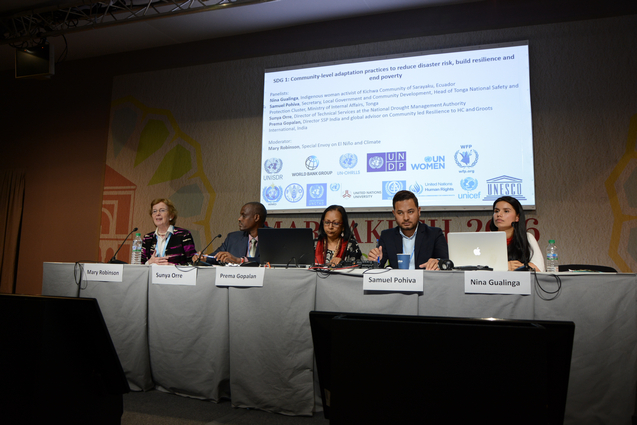
Samuela Pohiva participating at a side event in COP22 in Marrakech, Morocco (Photo: UNDP/Jone Raqauqau)
The linkages between climate change, disaster risk reduction and sustainable development needs to be strongly emphasized in order to facilitate an integrated and holistic approach to climate action.
The Protection in the Pacific (ProPa) Network which include national government actors working for Ministries responsible for issues related to gender, human rights and protection from Fiji, Solomon Islands, Tonga and Vanuatu, supported their national delegations to the twenty-second session of the Conference of the Parties (COP 22).
Following the adoption and the entering into force of the Paris Agreement on 4 November, the ProPa Network emphasised that issues such as human mobility, gender-equality and social inclusion, community governance land-rights and protection of core human rights should be specifically reflected in all climate actions.
“Different countries have varying degrees of vulnerabilities, however, underscoring all these is the need to protect core human rights which include the rights to life, dignity, security and non-discrimination from disasters and climate change”, said Samuela Pohiva, Under Secretary for Local Government and Community Development under the Ministry of Internal Affairs in Tonga.
“The Protection of all these rights must be at the centre of all climate change actions and the Pacific region has displayed this leadership with the adoption of the Framework for Resilient Development in the Pacific (FRDP)”, said Mr. Pohiva.
The Network also stressed that issues such as human mobility, gender-equality and social inclusion, community governance land-rights and protection of core human rights should be specifically reflected in all climate actions.
Speaking at the Momentum for Change: Women for Results side event at COP22, the Australian Government’s Foreign Affairs Minister, Julie Bishop acknowledged the participation of the Network members at the global climate change conference.
“We also support the ProPa Network – a collaboration of government actors in the Pacific that works to ensure social inclusion and gender issues are integrated into climate change action and humanitarian response”, said Ms. Bishop.
The ProPa Network is driven by the National Government’s representatives, and supported by the UNDP’s Pacific Risk Resilience Programme (PRRP). The Network will also extend learnings to other Pacific Island countries that may be interested in this approach.

Links

Queensland Community Action Prevents Santos From Freely Dumping Coal Seam Gas Waste

The Guardian

Challenge by Western Downs Alliance prompts environment minister Josh Frydenberg to revamp approval of development
Independent Expert Scientific Committee warned environment minister Josh Frydenberg of ‘considerable scientific uncertainty about potential impacts on surface water’. Photograph: Matthew Abbott for the Guardian
Legal action by a Queensland community group has forced the federal government to stop Santos freely dumping coal seam gas waste water in Surat Basin rivers and streams.
A federal court challenge by the Western Downs Alliance has prompted the minister for environment and energy, Josh Frydenberg, to revamp his approval of the Santos gasfield development, in what has been hailed as a victory in protecting the Dawson river.
The case was set down to be heard by the full bench of the federal court next month, in what was to be the first legal test of the “water trigger” in Australia’s environmental laws, which requires the minister to consider the impact of a resources project on local waterways.
The alliance argued Frydenberg’s approval of the 6,100-well gasfield south-west of Gladstone last March was unlawful because he did not properly assess the impact of releasing millions of litres of waste water into the Dawson river and elsewhere.
The Independent Expert Scientific Committee had warned Frydenberg before the approval that there was “considerable scientific uncertainty about potential impacts [of this project] on surface water and groundwater and associated ecosystems” and that the project’s environmental impacts should be properly assessed.
Despite this, Frydenberg approved conditions that allowed Santos to dump the wastewater into local watercourses without further assessment.
However, Frydenberg and Santos then preempted the legal challenge by agreeing on 23 December to change conditions of the approval to prohibit discharge of wastewater unless the gas giant can gain the minister’s approval by showing it has no harmful impact.
The Environmental Defenders Office New South Wales, which acted for the alliance, said this settled the case and satisfied its client’s claim.
The alliance secretary, Paul King, said the mining lobby group, the Queensland Resources Council, had “scoffed and derided our community when we lodged this challenge, even though this was a vital case that has been successful in preventing Santos from discharging wastewater into our rivers illegally”.
“We’re proud to have stood up for our precious water resources as a community group by taking the federal government and Santos to court to help save the Dawson River from being polluted with coal seam gas wastewater,” King said.
These new conditions on the project should be seen as a win for environmental protection.
“The big mining lobby should stop deriding Queenslanders and start recognising the vital role that communities play in ensuring environmental laws are upheld to protect the land and water our regional communities rely on.”
Santos said little had changed from the original approval, the Courier-Mail reported.
The chief executive of EDO NSW, Sue Higginson, said while many in the community still opposed the project approval over the environmental and social impacts, “these new conditions on the project should be seen as a win for environmental protection and the integrity of the water trigger, which is an important part of Australia’s environmental laws”.
“The community is rightly concerned about Santos’s activities in the Surat Basin – in 2013 Santos began discharging CSG waste water generated from its existing GLNG Project into the Dawson River after discovering it has no other viable means of dealing with the millions of litres of waste water,” she said.
“This case is another great example of the importance of the community’s right to be able to uphold Commonwealth laws designed to protect the environment. The community’s right to access environmental justice is essential to ensure our environment is not irreversibly degraded and our economy grows sustainably.”
A Santos spokesman said the company’s GLNG environmental assessments were “comprehensively reviewed by a range of experts at both State and Federal levels as part of the rigorous and public approvals processes”.
“This condition is consistent with the approach Santos was planning to undertake as per its March 2016 approvals,” he said.
“At all times Santos uses the best available science to explore for and extract natural gas safely without adversely impacting the environment, including water resources.”
Frydenberg’s office has been contacted for comment. QRC declined to comment further.

Links

Obama: Denying Science On Climate Change Betrays Spirit Of America

Huffington Post - Igor Bobic

"Without bolder action, our children won’t have time to debate the existence of climate change -- they’ll be busy dealing with its effects."

In his last address to the nation while in office, President Barack Obama warned Americans about several threats facing democracy, including the threat partisan polarization poses to science and reason.
Speaking to thousands of supporters in his hometown of Chicago, the president cautioned that without agreement on a “common baseline of facts” like the overwhelming evidence in support of man-made climate change, “we’ll keep talking past each other, making common ground and compromise impossible.”
“In just eight years, we’ve halved our dependence on foreign oil, doubled our renewable energy and led the world to an agreement that has the promise to save this planet,” Obama said. “But without bolder action, our children won’t have time to debate the existence of climate change. They’ll be busy dealing with its effects ― environmental disasters, economic disruptions and waves of climate refugees seeking sanctuary.”
Obama added that Americans can and should debate the best way to fight issues like climate change.
“But to simply deny the problem not only betrays future generations,” he said. “It betrays the essential spirit of innovation and practical problem-solving that guided our founders.”
Many Republican lawmakers in and out of Washington deny the link between human activity and climate change, despite overwhelming scientific evidence. Obama’s successor, President-elect Donald Trump, for example, has called climate change a hoax perpetrated by China.

Links

12/01/2017

Hospitals Feel The Heat Too From Extreme Weather And Its Health Impacts

The ConversationMartin Loosemore | Anumitra Mirti Chand

Cyclone Oswald caused flooding that forced the evacuation of more than 100 patients from Bundaberg Hospital to Brisbane in January 2013. Dave Hunt/AAP
As southeastern Australia swelters through another heatwave, how well equipped are our hospitals to cope with severe weather events?
Hospitals lie at the heart of our ability to manage the significant potential health impacts of extreme weather events. Many people would be surprised to hear that the vast majority of our hospitals have not been designed with these risks in mind. And they have not been adapted to ensure they can maintain healthcare services during such events.
The recent thunderstorm asthma outbreak in Melbourne, which was linked to eight deaths and put 8,500 people in hospital, is a vivid example of the health impacts of extreme weather. Such events can be life-threatening, especially for the aged, obese and critically ill.
Individually, health services workers do a remarkable job in coping with such events. However, the buildings they work in and the infrastructure that supports them often constrain their ability to respond.
Stories of power outages and of sick people waiting hours for beds and patients dying because hospitals were overstretched do not inspire confidence in the health system as Australia faces the prospect of more frequent extreme weather events such as heatwaves, floods and storms.
A map of temperatures like this one for Wednesday, January 11, spells trouble for health services across Australia. Bureau of Meteorology
LARGE IMAGE
Warning bells are ringing

During the 2014 heatwave in South Australia, when Adelaide became the hottest place on the planet, heart attack rates increased by more than 300%. Other emerging extreme weather health risks include asthma from bush fires, increasing waterborne and vector diseases such as malaria, dengue fever and typhoid, dehydration and heat exhaustion, and physical injury from flying debris and floods.
Hospitals need power supplies that remain reliable even during extreme weather events. Dan Himbrechts/AAP
There are many reports of hospital buildings and infrastructure failing during extreme weather events in Australia. For example, power outages have affected numerous hospitals and back-up systems reportedly failed during the 2004 heatwaves that swept Australia.
During the 2005 Sydney heatwaves, hospitals were swamped. Many people were simply seeking respite in air-conditioned reception areas.
In 2006, Cyclone Larry closed much of Innisfail Hospital. Staff required medical support from Townsville and Cairns hospitals. Herberton Hospital was without power until a generator was provided. Leaking roofs resulted in emergency evacuations.
In 2009, one-in-100-year storms left more than 3,000 NSW residents stranded by floods, many of them old and seriously at risk. Floodwaters isolated Coffs Harbour, Dorrigo and Bellingen hospitals. People needing urgent medical treatment had to be sent up to 80 kilometres away.
Most recently, after super-cell thunderstorms blacked out South Australia, back-up generators failed at an Adelaide hospital. Seventeen patients had to be transferred from Flinders Medical Centre to Flinders Private Hospital.

What are the systemic problems?
These stories are worrying, but perhaps not surprising, given that most of our hospitals were designed when these risks were not on the horizon. In the quest for cheap land not suited to commercial development, many hospitals have been built in areas prone to floods and storms. And many are built out of materials and designed in a way that could increase the risk to patients during extreme weather events.
Hospitals face many challenges in adapting to a changing climate. Our research identified a long list of issues, including:
  • underfunded building and infrastructure maintenance and capital works programs
  • poor road access for new patients and back-up medical supplies
  • generators built in basements prone to flooding
  • lack of accommodation for staff trapped on site
  • poor coordination with other emergency and health agencies such as aged care
  • access roads being cut off
  • managers who do not understand the role of buildings in healthcare delivery
  • buildings and infrastructure that cannot adapt to changing healthcare needs and patient surges during extreme weather events.
The impacts of extreme weather on hospital buildings and infrastructure and how these influence service delivery during such events have been neglected. These aspects of disaster planning systems need to be properly considered.
In the high-pressured, resource-stretched, highly politicised and hierarchical health sector, current disaster management practices too often overlook the role of buildings and infrastructure.
While severely limited resources are understandably directed towards frontline health service needs, the current system is creating a stock of health buildings and infrastructure that represent a risk, rather than an asset, to quality healthcare delivery during extreme weather events.
The designers and facilities managers of new hospitals are now required to think about these risks, but our understanding of how to mitigate the risks is poor. This means most of our hospitals and other health facilities remain vulnerable to the inevitable extreme weather events in the future.
It’s a matter of time before we see the next headline about needless death and suffering due to a hospital being poorly designed to cope with an extreme weather event.

How do we fix these problems?
The problems would be easier to overcome if we had a more holistic approach to disaster management planning. Such planning needs to better integrate the organisational and built environment aspects of hospital resilience.
This will require a paradigm shift in hospital disaster management. That, in turn, requires an emphasis on involving all hospital stakeholders in disaster management planning.
Hospital infrastructure design, planning, construction and ongoing maintenance need to be revisited. Robust quality control will be required to ensure compliance with improved standards consistent with changing needs.
We will inevitably need to redirect and find additional resources for building adaptation and modification. However, this is probably why nothing will change until we have a disaster big enough to force policymakers to change. Such is life … and death.

Links

This Electric Bus Recharges At Bus Stops In Just A Few Minutes

Fast CompanyAdele Peters

As part of Sweden's plan to eliminate fossil-fuel vehicles by 2030, a Stockholm suburb is experimenting with charging electric buses as they drive along their routes.
The bus charges overnight via standard wired charger
Then, each time it comes to the final stop throughout the day, it quickly recharges
A sensor shows the bus driver exactly where to park, and a charging box on the bus lowers until it almost touches the ground
When a new hybrid-electric bus in a Stockholm suburb pulls up to the last stop on its route, it stays a few extra minutes after the last passenger gets off: under the pavement, a wireless charger is recharging the bus.
A full charge—enough for the bus to run its entire route on electric power—takes six or seven minutes.
"Bus stop fast-charging capability is important in order to keep to the timetable of the bus service," says Markus Fischer from Vattenfall, the company that owns and operates the charging station, supplying it with renewable electricity.
The route is part of a new pilot run with the city of Södertälje, the bus manufacturer, Scania, and the Stockholm-based Royal Institute of Technology. While there are other ways to charge an electric bus—like overhead wires or plug-in charging stations—the partners wanted to test hidden chargers partly for aesthetic reasons.

–– ADVERTISEMENT ––
"The design of the inductive technology has been adapted so as not to disturb existing urban environments and is essentially invisible," says Fischer.
In the pilot, the bus charges overnight via a standard wired charger. Then, each time it comes to the final stop throughout the day, it quickly recharges. A sensor shows the bus driver exactly where to park, and a charging box on the bus lowers until it almost touches the ground.
Sweden plans to make all vehicles in the county fossil-free by 2030, and a simple system to charge buses is part of that; unlike most cars, buses drive all day long and can't rely on an overnight charge alone.
On a longer bus route, multiple stops might have even faster chargers, each charging for 20 to 30 seconds. Eventually, entire roads might also be electrified. Vattenfall believes that wireless charging would also be useful for private cars and trucks.
"In the future, we believe wireless charging will be essential to make it easy and hassle-free to own and use electric vehicles," Fischer says.

Links

Donald Trump Urged To Ditch His Climate Change Denial By 630 Major Firms Who Warn It 'Puts American Prosperity At Risk'

The IndependentIan Johnston

'We want the US economy to be energy efficient and powered by low-carbon energy'
The US President-elect is facing calls not to abandon the fight against climate change. AP
More than 630 companies and investors have called on Donald Trump and the Republican-dominated Congress to continue the move to a low-carbon economy, warning that failing to do so would “put American prosperity at risk”.
The US President-elect has talked about scrapping the United States’ international commitments to tackle global warming, such as the Paris Agreement, dismissed climate change as a hoax, and appointed a string of climate science deniers to senior positions in his administration.
His election has been described as a “very big challenge” to the world’s efforts to address the problem by UK Climate Change Minister Nick Hurd.
In a joint statement, leading companies, such as Johnson & Johnson, General Mills, Kellogg’s, General Mills, Hewlett Packard Enterprise and Unilever, appealed to Mr Trump to reconsider his apparent views.
“We want the US economy to be energy efficient and powered by low-carbon energy,” they said.
“Cost-effective and innovative solutions can help us achieve these objectives. Failure to build a low-carbon economy puts American prosperity at risk.
“But the right action now will create jobs and boost US competitiveness.”
More than 530 companies, which collectively have revenues amounting to nearly $1.15 trillion (about £950bn) a year and employ about 1.8 million people, signed the statement.
The 100 investors include the New York State Common Retirement Fund, the California State Teachers Retirement System and other firms that manage assets worth more than $2 trillion.
Anna Walker, senior director of global policy and advocacy at another signatory to the statement, Levi Strauss & Co, said: “It’s imperative that businesses take an active role in meeting the goals set out by the Paris climate agreement.
“It will be critical that we work together to ensure the US maintains its climate leadership, ultimately ensuring our nation’s long-term economic prosperity.”
And Jonas Kron, senior vice president at Trillium Asset Management, said huge sums of money were going into the low-carbon sector.
“With tens of billions of dollars of US renewable energy investment in the works this year alone, and far more globally, the question for American political leadership is whether they want to harness this momentum and potential for economic growth,” he said.
A group of emperor penguins face a crack in the sea ice, near McMurdo Station, Antarctica. Kira Morris
“It is critically important to realise this is an opportunity that state policymakers can take advantage of, too, not just national leaders.”
The signatories called for the people soon to be the United States’ political leaders to continue policies designed promote a low-carbon economy at home and abroad.
And they specifically asked Mr Trump not to remove the US from the signatories of the Paris Agreement on climate change.

Links

11/01/2017

Melbourne Weather: Intense Rain, Humid Night Beats Records As Conditions Mirror Far North

ABC NewsLoretta Florance

Tropical weather hit southern Victoria late last year.
Melbourne's tropical weather late last year broke records for humidity and short-term rainfall, according a special state of the climate report released by the Bureau of Meteorology (BOM).
Victoria's capital was hit by sweltering conditions and severe storms on December 29 last year, damaging houses and prompting the rescue of more than 40 motorists trapped on flooded roads.
Senior climatologist at the BOM Blair Trewin said the rare weather event was caused by tropical air from the Northern Territory, combining with remnants of a cyclone off the West Australian coast.
Not since 1982 have Victorians experienced a night like it, he said.
"We saw a number of places set records for humidity, including Melbourne, and also records for the greatest moisture content in the atmosphere," he said.
"The rainfall intensities we saw on the afternoon of the 29th, were pretty exceptional by Victorian standards - we had a fall of 40 millimetres in 15 minutes at Viewbank at the peak of the storm.
"That's up there with the highest rainfalls on record in Victoria for such a short timeframe, so it was definitely one of the most intense short term rainfalls that we've seen in Victoria."
The dew point temperature, a moisture measure which indicates what temperature air must be cooled to for dew to form, on December 29 was 24C.
Rivers burst their banks at the height of the rain, later causing Port Phillip Bay beaches to be closed due to faecal contamination from waste run-off.

Effect of climate change inconclusive
Storm clouds gather over Melbourne before a deluge. (ABC: Ben Lisson)
The special report comes less than a week after the bureau released its Annual Climate Statement, which reported last year was Australia's fourth warmest on record.
With the release of annual statement, Climate Information Services assistant director Neil Plummer said 2016 was one of extreme weather events.
"We had our warmest autumn on record partly due to a very strong 2015-16 El Nino," he said.
"Widespread, drought-breaking rains led to flooding in multiple states. Even northern Australia saw widespread rainfall, during what is usually the dry season, greening regions that had been in drought for several years."
Globally, 2016 was the hottest year on record by a wide margin, European Union's Copernicus Climate Change Service found in a report also released last week.
But Mr Trewin said it was too early to tell whether Victoria's latest tropical turn was directly linked to climate change.
The last time a tropical weather pattern like December's reached as far south as Victoria was in 2011, following floods in Queensland, though it did not reach Melbourne.
Mr Trewin said two events in five years were not enough to draw a definitive conclusion.
"We do know that as the atmosphere warms one of consequences of that is that warmer air is capable of holding more moisture," he said.
"So there are good reasons why we would expect that we would get more events with extreme humidity of this type, but the number of cases we have so far is probably too small for us to be able to conclude that we're already observing a significant trend.
"What you'd be looking for is a sustained trend over a period of a number of decades — the nature of isolated extreme events because they are relatively rare, even if there is a real trend underlying it, it takes a while before we've actually got statistically convincing evidence of that."
Mr Trewin said despite the brief tropical conditions, he doubted Victorians planning to retire north for the warmer weather would be abandoning their plans just yet.
"I suspect that Victorians thinking of retiring to Queensland are thinking more about the winter than what it's doing in the summer," he said.
As far as the outlook for the rest of summer, Victorians can expect it to be as dry and warm as usual.
"The best indication is that it will end up coming in reasonably close to normal," Mr Trewin said.
Brighton Beach-goers seek shelter as heavy rains sweep across Melbourne. (Fairfax Media: Penny Stephens)
Links

Lethal Heating is a citizens' initiative