25/01/2017

Climate Change Driving More Risks Than Ever Before

Insurance BusinessJordan Lynn

The impact of climate change is being felt in more ways than ever, according to one industry expert.
Geoffrey Au, APAC chief risk officer for Zurich, said Asia Pacific is among the most vulnerable regions to the effects of climate change.
"Climate change is exacerbating more risks than ever before in terms of water crises, food shortages, constrained economic growth, weaker societal cohesion and increased security risks," Au told Insurance Business.
"The social and economic development in the region has resulted in a rapid transition to more urban living, meaning its cities are more densely populated and the impact of natural catastrophes is amplified."
Climate change was listed as the number two underlying risk in the recently released Global Risks Report 2017, released by the World Economic Forum in association with Marsh and Zurich.
The report also found that, for the first time, all five environmental risks were ranked both high-risk and high-likelihood as extreme weather events were named the single most prominent risk facing the world.
Australia particularly remains on the front line of climate risk. With temperatures hitting record highs across the country in January, the impact climate risk can have remains front and centre for businesses and the public at large.
Au noted that while much has been done in terms of climate risk, a quicker response is still needed.
"2016 did see some progress to address climate and other environmental risks, reflecting firm international resolve on the transition to a low-carbon global economy and on building resilience to climate change.
"However, the pace of change is frankly not fast enough in Asia Pacific or anywhere else."
Au stressed that the role of the insurance industry is inextricably linked to climate risk. Global insurers can advocate for closer cooperation to develop responses to the challenges that arise in the future.

Links

China Eyes An Opportunity To Take Ownership Of Climate Change Fight

The Guardian - Li Shuo*

The economic and environmental cost of pollution will drive Beijing’s policies regardless of what Donald Trump does
Smog in Liaocheng in eastern China. Reducing carbon emissions is a priority for Beijing’s leadership, which could influence the global battle against climate change. Photograph: Sipa Asia/REX/Shutterstock
Twenty years ago, climate change was believed by many in Beijing to be a conspiracy cooked up by the western world to contain China’s development.
Since then, China has performed an about-turn, not only recognising climate change as a major global challenge but also, ahead of Davos this week, vowing to lead the world’s effort in combating it.
The election of Donald Trump, who, labelling climate change a “hoax” created by China, has reversed the conspiracy, casts a dark shadow on the prospect of future international climate cooperation. But for China, now could be a moment of opportunity.
Since the catastrophic Copenhagen failure in 2009, China has anchored climate actions at the core of its political agenda. There are three main reasons for this, and over the next four years, they will be the drivers that will propel China’s climate action forward regardless of the political situation in the US.
First, the calculus of cost and benefit has shifted.
For a long time, environmental protection was positioned on the opposite side of economic prosperity – the pursuit of one could only sacrifice the other. In China, this binary has fallen apart, as the enormous health impacts of air pollution have galvanised both political and public opinion against polluting industry, and as the booming clean energy industry shows the possibility to make both environmentally and economically sound investments.
Second, China feels an increased – and increasing – sense of global responsibility, as displayed in phrase after phrase of Xi Jinping’s speeches in Davos and Geneva this week. Beijing was quick to learn from its mistakes in Copenhagen. In the run up to the Paris conference, it managed to forge consensus on the most difficult political questions with other key players ahead of time.
Many of these political breakthroughs, such as on common but differentiated responsibilities (CBDR) and the issue of transparency, will require China to move beyond its previous positions and take more ambitious action. In addition, China has started to implement its own south-south cooperation scheme, aimed at helping other developing countries to pursue climate action. China is slowly but surely re-defining its international responsibilities and shifting to a more active and cooperation oriented climate diplomacy.
Third, China’s leaders have started to take ownership of combating climate change.
This new dynamic could bear promising prospects over the next few years. US-China cooperation on climate in the Obama era helped to elevate climate change to the very top of the Chinese leadership’s agenda. This has ensured the unprecedented direct engagement of the Chinese leaders for multiple years, and not only familiarised them with the technicality and politics of climate change, but also allowed them to see the strategic value it can generate.
With Xi soon entering his second five-year tenure, he might well take a leaf out of the outgoing US president’s book and try to secure climate action as one of his political legacies. This could mean further investment in and greater leadership on climate action.
These three reasons, coupled with the fundamental trend of China’s economic transition and the associated coal consumption decline, present a real opportunity for China to project further international leadership on climate change.
What China urgently needs now is a comprehensive strategy that sets climate change as a diplomatic priority. For the past years, China’s policy circle primarily considered climate change through the lens of managing US-China relations and as an issue subordinate to the most important bilateral relationship in the world.
As the political winds shift in Washington, climate change now deserves an independent strategy that takes into account but is not dependent on the US-China relationship. Chinese leaders should be confident in such an approach and not underestimate the country’s potential for global leadership. The establishment of the Asian Infrastructure Investment Bank and the One Belt, One Road initiative both demonstrate that, when the issue is given political priority, China is not only able to participate in international diplomacy, but can also actively lead.
None of these is to say China should step in for the US. Climate change is a crisis larger than any single country. And it is neither feasible nor fair to expect other countries to fill the hole left by the US. But for China, if what it takes to move from a climate villain to a reluctant leader is the short five years of the first half of this decade, it is not completely unreasonable to expect the country to become a true leader by the end of this decade.
As Trump drops Obama’s legacy, Xi might well establish one of his own.

*Li Shuo is Greenpeace’s east Asia senior climate policy adviser based in Beijing.

Links

Mayors To Trump: ‘Don’t Get In Our Way’

Think Progress

As Trump takes office, leaders of the country's biggest cities are preparing to continue the climate fight.
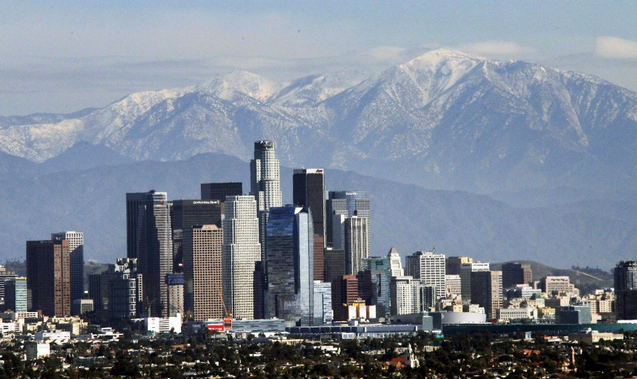
The Los Angeles city skyline. CREDIT: AP Photo/Nick Ut
On the eve of President-elect Donald Trump's inauguration, Los Angeles mayor Eric Garcetti had a message for an incoming administration with notoriously backwards views on climate policy.
"Don't get in our way," he told a small group of reporters at the United States Conference of Mayors' winter meeting.
There are projects, Garcetti continued, where federal support would certainly be looked upon favorably — helping Los Angeles reduce its dependence on imported water, for instance, or transition its public transportation fleet from natural gas to electricity. But in the absence of a strong federal ally, the best case scenario for cities under Trump would be the autonomy to carry out their climate policies unencumbered.
"We'd love a federal partner that can help accelerate this, but at the very least, just don't get in our way," Garcetti reiterated.
The age of Trump ushers in an unsettling future for American climate policy: as a candidate, Trump promised to unleash fossil fuel extraction on federal lands and along the nation's coasts, roll back environmental regulations, and withdraw from the international leadership role the previous administration worked so hard to build.
As president-elect, his decisions have been equally antagonistic towards climate action — he and his transition team have named climate deniers to every major environmental cabinet position, sought information on career employees that worked on Obama-era climate policies, and pledged to cut entire programs from the Department of Energy.
Meanwhile, the consequences of human-caused climate change are becoming increasingly clear and increasingly dire. The National Oceanic and Atmospheric Administration (NOAA) just officially named 2016 the hottest on record, breaking previous records set in 2015 and 2014. Extreme weather events are becoming more common — and climate change definitively played a role in dozens of floods, heat waves, and droughts throughout 2016.
As city leaders, mayors are familiar with both the consequences and the causes of climate change. Population density and geographic location — the fact that many cities are located along the coast, for instance — make them especially vulnerable to the kinds of extreme weather events and sea level rise fueled by climate change. But cities are also responsible for 75 percent of global greenhouse gas emissions, meaning action taken at the local level can go a long way towards reducing greenhouse gas emissions worldwide.
That's a fact mayors like Garcetti are taking to heart. The city has plans to enact sweeping climate policies — from pledging to go completely carbon neutral in its electricity sector to planning a vast expansion of the city's public transportation system. Those are initiatives, Garcetti said, that can be accomplished at a local level but can have national and international implications. Mayors, it is said, are a notoriously competitive bunch — if one city enacts a policy that both benefits the environment and saves money, other cities are likely to follow. Last year, for instance, Los Angeles made the decision to purchase electric vehicles for all new non-patrol police vehicles — a move that saved the city 60 percent on fleet maintenance.
"You can't be a good mayor without talking about how you're going to convert your street lights to LED. You can't be a good mayor without saying where your EV plug-ins are going to be for people. It's become normalized," Garcetti said. "It's not just our city. It's Michigan, it's Colorado, it's Texas, it's Indiana, it's South Carolina, it's North Carolina, it's Ohio, it's Nevada. We've got cities everywhere. It's small, it's big, it's in between. And it's growing."
The economic case for climate action — the fact that Los Angeles' $57 million worth of LED lights paid for themselves with returns on energy efficiency in just six years, for instance — is one mayors are hoping will get through to the jobs-focused administration. In Boston, a study is underway to test autonomous vehicles on the city streets, a move that could both lower emissions and fundamentally transform the city's economy.
"As that program gets vetted and moves forward, the Trump administration might not look at the savings on the environment side of that, but they're certainly going to look at the business side of that," Boston mayor Marty Walsh said.
Electric vehicles in Los Angeles. CREDIT: AP Photo/Nick Ut, File
Both Garcetti and Walsh noted that for many mayors, climate action is not the partisan issue it has become at the federal level. Walsh said that when Boston started talking about making a pledge to become carbon-neutral by 2050, a Republican mayor from a small town nearby signed onto the pledge and even dedicated staff and resources to the issues. Garcetti brought up Jim Brainard, the Republican mayor of Carmel, Indiana, who has worked to make his city more climate-friendly during his 21-year tenure in office.
"We really have a ton of allies who understand," Garcetti said. "Republicans represent a lot of outdoors people who are seeing the change on the frontline when they are out there, people who spend a lot of time seeing those impacts and even having to fight them."
But while cities can take significant steps to reduce their carbon footprints and improve environmental policies — "the federal government can't force me to make my buildings more polluting, or to emit more energy or use more water," Garcetti said — there are things the federal government can do to slow that progress. Trump has promised to essentially zero out federal funding for the research and development of renewable energy, which would significantly undermine the United States' green energy sector.
"I think we would take some steps backwards with some very important things that are clearly about the Trump agenda: for national security and for manufacturing jobs, for batteries, for electric vehicles, for solar power," Garcetti said of cuts to federal funding. "We can see those only being done in other places, or we can retain those jobs here. I think if this administration looks at what are the high-paying jobs of the future, which I know they are laser-focused on, you can't take out green jobs because the ideology that somebody in the administration has says that this is combating a problem that doesn't exist."
Another concern is that a Trump administration — bolstered by a Republican majority in Congress — will prove so opposed to climate action that they take steps to preempt any progressive climate action at the state or local level. Trump's nominee for EPA administrator, Scott Pruitt, stoked these fears during his confirmation hearing when he refused to promise Democratic lawmakers from California and Massachusetts that he would uphold a waiver that allows California to set stricter vehicle emissions standards than the national average.
"I think it would be not only bad for California but bad for the nation," Garcetti said of preemption strategies like denying California's waiver. "If we're settling for being average, I don't see that this country will have much progress."
"If we're settling for being average, I don't see that this country will have much progress."
"We will very strongly fight against attempts to roll back California's independence to chart its own path," he added. "It has been good for jobs and great for the country."
But even if the federal government tries to slow — or halt — climate action at a local level, mayors like Garcetti are prepared to fight back, arguing that a Trump administration can only slow, not stop, progress.
"In a worst case scenario, the federal government can take away maybe 20 or 30 percent of our progress, and I'd rather have 100 percent than 70 or 80 percent, but I feel like that 70 or 80 percent of further progress is inevitable based on the leadership that we've already had," he said.
Boston's Walsh agreed.
"You're talking about on the ground where you can actually make a difference, not a policy coming down from Congress," Walsh added. "It's actually something being carried out on the streets of our cities in America."

Links

24/01/2017

Bangladesh Struggles To Turn The Tide On Climate Change As Sea Levels Rise

The Guardian

From incessant rains to flooded rice fields, the economic impact of global warming has been keenly felt in the coastal town of Cox’s Bazar
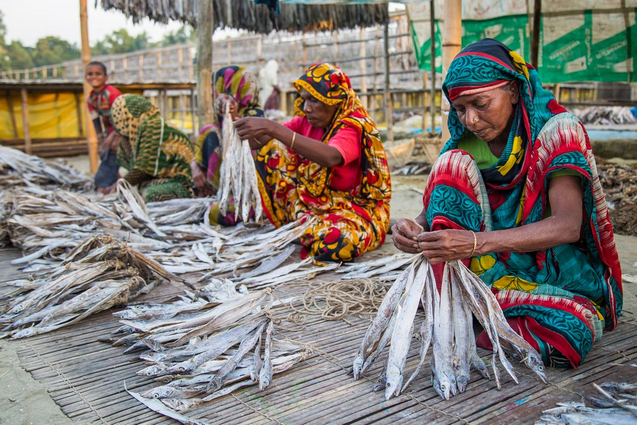
Women work at a dry fish yard in the Bangladeshi coastal resort of Cox’s Bazar. Changing weather conditions have hit the business hard. Photograph: Noor Alam/Majority World for the Guardian
Bangladesh is already one of the most climate vulnerable nations in the world, and global warming will bring more floods, stronger cyclones. At the dry fish yards, close to the airport at the coastal town of Cox’s Bazar, women are busy sorting fish to dry in the sun. They say the process, which begins in October, can continue through to February or March if the weather is good.
But Aman Ullah Shawdagor, a dry fish businessman who employs 70 people, says high tides and seasonal changes have hit his business hard. Last year there were four cyclones, more than ever before. In 2015, there was only one.
“My business is not doing so well because of the changing weather conditions,” says Shawdagor. “This is a dry season business. But for the last couple of years, the rain has become more frequent. It rains not only in the rainy season but also in the winter. There have also been more signals [storm warnings] with the rise in high tides. When the high tide comes, it frequently covers the whole of the land here. It is very bad for the dry fish.”
Nurul Hashem, a schoolteacher from Kutubdia Para, a nearby shanty town where many of the dry fish workers live, has also noted the trend. “We believe the water level is getting higher here,” he says. “Last year, my home was under water three or four times.”
Scientists predict that, by 2050, as many as 25 million people in Bangladesh will be affected by the rising sea level. Hashem and Shawdagor believe that they are already seeing the effects of a changing climate, however.

Kutubdia
Along the coast lies Kutubdia, an island in the Bay of Bengal where lush green rice fields give way to acres and acres of flat fields. Consisting of small rectangles of varying hues of brown, they are salt fields. The encroachment of saline water from rising tides has made rice farming impossible.
Abdus Shukur, 50, a former agricultural farmer, says he learned to farm salt 10 years ago, when sea water flooded the land he rents. It took him six months to learn the craft and he finds it back-breaking work.
“I was an agricultural farmer before,” says Shukur. “But the embankment broke down and saline water came on to the land. We had no choice but to adapt.”
Salt farming, he says, brings in more money that crops. But it is harder.
Flooded salt fields on the island of Kutubdia. Photograph: Noor Alam/Majority World for the Guardian
“Farming crops, I worked two or four hours a day. I’m now earning double what I earned before. But in the salt fields I have to work from morning till evening, the whole day.”
The small island, which has halved in size over the past 20 years due to erosion and sea level rise, is surrounded by a three-metre high concrete embankment, built by the Bangladeshi government to protect it from disappearing into the sea. But it is broken in several places and the sea water enters the land.
“The coastal belt is facing many problems of salinity,” says Mokbul Ahmed, a project co-ordinator for Coast, an organisation that helps local communities affected by the changing climate. “Day by day, salt water enters the land. In Kutubdia, every year, the government builds the embankment and every year, it is destroyed.”

Links

WA's South West A 'Canary In The Coalmine' For Climate Change

ABC RN Science Show - Bill Bunbury

Land clearing may have had the unintended effect of lowering rainfall in South West WA. (Getty Images: Australian Scenics)
After 200 years of changing the landscape of the world's most distinctive continent we are only just beginning to understand how European settlers and their successors have vitally affected its ecology, its diversity and its climate.
And while those effects pervade much of our island continent, they are singularly visible in Western Australia's South West.
Recording social history for RN's Hindsight program in the 1980s, an interview with an observant old forester, Jack Thompson, offered me an early lesson.
Jack worked for most of his life in the jarrah and karri forests of the South West, initially as a tree feller and ultimately as a conservationist.


Audio: Listen to Bill Bunbury's report (Science Show)

One vivid recollection was his daily journey to work from the forest camp.
"I remember once, we were camped on the Balingup Brook and we couldn't find a place to cross this brook," he told me. "It was in flood, about 30 feet across and waist deep.
"Every man cut his own crib [lunch] and you hung it on the back of your belt. So to get across we'd lift the crib up and just wade through this icy water up to your waist. But after you'd walked for half a mile, you'd walked yourself warm again. You took that all in your stride."
It's a story that stayed with me. Not so much that the redoubtable Jack took it all in his stride, but because the Balingup Brook no longer floods the way it did in his day.
Rainfall has declined significantly in this part of Australia. Anecdotes are sometimes evocative reminders of change.
The climate of South West WA has changed appreciably in the last century. (Getty Images: Dazman)

More recently, writing a book for the WA Department of Water, Till the Stream Runs Dry, I talked to those now responsible for measuring the considerable decline in rainfall: men like hydrographer Bernie Hawkins, whose career began in the 1960s.
"The winters then were massively wetter," he said. "We were in waterproofs, wellington boots and sou'westers most of the winter."
But even 10 years later, things had changed: "We were quite aware that there had been a change in rainfall. The winters weren't the same. We kept on saying it all the time as the years went by."
Large areas of the South West had been cleared, most heavily in the last century. Forests fell to make way for wheat, which had a direct effect on rainfall. The old settler saying "rain follows the axe" could easily be re-stated as "rain heads for the woods".
It has recently been shown that where rain meets woodland, trees attract rainfall. As rainclouds cross a landscape and encounter higher ground and/or wooded areas they are much more likely to shed their contents. By contrast, where rain sweeps across a largely un-treed landscape, not much reaches the ground.
Map of rabbit proof fence near Lake King, WA
The most graphic illustration of this is aerial photography of the Rabbit Proof Fence, which runs parallel to farmland in the eastern WA Wheatbelt. East of the fence vegetation is thick and pervasive. West of it is largely treeless; the result of clearing to achieve maximum crop yield.
Woodland, farmland and scarce water sources are all vitally interconnected in ways we are only beginning to understand. But uncertainty and unpredictability also complicate our understanding of climate change. We are still learning surprising lessons.
For instance, frost is now more frequent on winter nights, especially in the far south of WA, and affects both farm and forest. But there is a logical explanation. Cloudless, non-rain-bearing skies are colder.
CO2 has the potential to encourage plant growth and perhaps increase forest cover, minimising the risk of further drying. But it doesn't. CO2 is best absorbed by the lighter hued deciduous trees that dominate much of the northern hemisphere. Much of our antipodean vegetation is too dark to permit effective CO2 absorption.
Despite the end of the mining boom, Perth and its suburbs continue to grow. (Getty Images: David Messent)
Water issues apply equally to city dwellers and rural communities. Perth residents are the highest water-users in Australia, and declining supply now demands a big rethink to meet the demands of a still-growing city.
Changing silviculture practices may well assist. Our forest clearing has often resulted in thirsty, younger, denser forest, which might benefit from thinning to allow more groundwater to sink into the water table.
Regardless of where we live, the South West has lessons it can share with the rest of us.
As environmental scientist Joe Fontaine points out, this corner of the continent, with its Mediterranean climate, offers "many sometimes cautionary tales to the rest of the world".
"Areas throughout the world with this type of climate are warming and drying. So south-west Australia is a case of a 'canary in a coalmine' for understanding what climate change impacts may mean in in the future."
It's not the only "canary" in the world, but it's ours.

Links

How Climate Change Will Shape Environmental Law

Murdoch University


Environmental Law Conference
Murdoch University
7th February 2017
8:30am – 5:30pm
  • A Climate Change Model Statute
  • Sustainable Development Law
  • How a Modern Environmental Appeals Jurisdiction would work
How can climate change be accommodated within environmental law?
This one day conference will consider:
  • how environmental laws can be reformed to accommodate climate change and sustainable development
  • concepts, internationally and in Western Australia.
A panel of eminent speakers has been assembled to address these important issues.
Environmental protection statutes around the world generally have limited capacity to deal with climate change and sustainable development.
Traditional models of causation and remoteness of damage, for example, do not relate easily to climate change related events, with the consequence that governments may look to innovative models to transfer climate risk to the private sector.
Recognising the international nature of these issues, the International Bar Association (IBA), as the global voice of the legal profession, established in 2014 an expert Working Group to draft a model climate law statute.
The model statute is designed to be a resource for legislatures, government departments and judiciaries, with potential statutory provisions to assist in addressing climate change, in particular to enhance mitigation and adaptation measures.

The Speakers
  • Professor Jürgen Bröhmer, Dean of Law, Murdoch University
    Professor Bröhmer is an eminent international lawyer whose expertise includes climate change law.
  • Justice Brian Preston, Chief Judge, New South Wales Land and Environment Court
    Justice Preston is an eminent international authority on climate law and is widely recognized as an innovative environmental Judge who has published many leading judgements and articles in that field. He Co-Chairs the International Bar Association panel responsible for developing a model statute on climate change law.
  • Judge David Parry, District Court and former Deputy President of the State Administrative Tribunal
    Judge Parry's distinguished 11year tenure at the State Administrative Tribunal included substantive contributions to the jurisprudence on sustainable development in the town planning jurisdiction.
  • Glen McLeod, Principal, Glen McLeod Legal, Adjunct Professor Murdoch University Law School and a member of the Dean's Advisory Group at Murdoch School of Law
    Professor McLeod is the Chair of IBA's Environment, Health and Safety Committee and the Law Society of WA's 2016 Lawyer of the Year. He has been an environmental and planning lawyer for 39 years and a partner in major Australian and international law firms.
  • Dr Tom Hatton, Chair of the WA Environmental Protection Authority
    Dr Hatton is a former senior executive of the CSIRO who has since becoming Chair of the State Environmental Protection Authority in 2015, overseen important policy reform in the wake of significant litigation involving the EPA.
  • The Hon. Cheryl Edwardes AM
    Mrs Edwardes is a former Liberal State Attorney General and Environment Minister who Chairs a mining company and practises in environmental and mining law. She is the Deputy Chair designate of the IBA's Environment Health and Safety Committee and is a member of the Dean's Advisory Group at the Murdoch School of Law.
  • The Hon. Alannah MacTiernan
    Ms MacTiernan is a Labor member designate of the State's Legislative Council, having previously been a highly regarded State Planning and Infrastructure Minister and then the Federal Member for Perth, before stepping down in 2016. She was the Minister responsible for ending Ministerial Planning Appeals in favour of the former Town Planning Appeal Tribunal, a precursor to the creation of the State Administrative Tribunal in 2005. She has also served as Mayor of the City of Vincent and is a member of the Dean's Advisory Group at the Murdoch School of Law. She is a former partner of a WA law firm and has a strong interest in climate change issues.
The Programme
8:30-8:45 Registration
8:45-9:00 Introduction
Professor Jürgen Bröhmer, Dean of Law, Murdoch University
9:00-10:00 The International Bar Association's Climate Change Model Statute
Justice Brian Preston, Chief Judge, New South Wales Land and Environment Court
10-10:30 Panel Q&A on the Model Climate Change Law Statute
10:30-11:00 Morning Refreshments
11:00-11:45 Sustainable Development Principles recognized and applied in Western Australian Planning Cases
Judge David Parry, District Court and former Deputy President of the State Administrative Tribunal
11:45-12:15 Sustainable Development Principles - Environmental Protection Act 1986 (WA)
Glen McLeod, Principal, Glen McLeod Legal, Chair of IBA's Environmental, Health and Safety Committee
12:15-1:00 The WA Environmental Protection Authority's Climate Change Policy
Dr Tom Hatton, Chair of the WA Environmental Protection Authority
1:00-2:15 Lunch
2:15-3:00 Climate Change and the Mining Industry in Western Australia
The Hon. Cheryl Edwardes AM
3:00-3:30 Panel Q&A on Sustainable Development Law and Policy in Western Australia
3:30-4:00 Afternoon refreshments
4:00-4:45 Lessons from Ending Ministerial Planning Appeals and the Creation of a New Tribunal
The Hon. Alannah MacTiernan
4:45-5:15 Panel Discussion on how an Environmental Jurisdiction for the State Administrative Tribunal would work in WA
5:15-5:30 Closing Remarks
Professor Jürgen Bröhmer, Dean of Law, Murdoch University

Registration
The cost of the course includes attendance at the sessions, lunch, refreshments on arrival and morning and afternoon tea. 6 CPD points for lawyers (C2-1pt; C3-1pt; C4-4pt) will be available if requested for full day attendance.
Please register at: http://goto.murdoch.edu.au/CCERC

Links

23/01/2017

Australian High School Scores International Green Technology Gong

Fairfax -

It's not every day an Australian high school student from Australia gets to share a stage with Abu Dhabi's Crown Prince, Sheikh Mohamed Bin Zayed and the President of Kazakhstan Nursultan Nazarbayev – and walks away with a $US100,000 ($132,000) prize.
But for 15 year-old Toby Thorpe, this week's award ceremony in Abu Dhabi was merely the end of the beginning for a two-year plan to spur interest in renewable energy and energy savings among students and his local community south-west of Hobart.

World temperatures hit a new high
World temperatures hit a record high for the third year in a row in 2016, creeping closer to a ceiling set for global warming, US government agencies said on Wednesday.

"It's been a long time coming … now we can actually put our plan into action," Mr Thorpe said. "It's quite exciting." So far, about 20 students have helped design and install a pellet mill, bio digester, a bicycle-powered mobile cinema, and started work on a greenhouse made from 2500 recycled bottles.
The main venture, though, will now proceed with the funding from the Zayed Future Energy Prize. That venture will transform a decrepit former dental clinic at the school into a six-star energy rated training site on campus.
"It will be a research centre for students and an example for community members and other schools to learn what we're doing so they can take it back and do it themselves," Mr Thorpe said.
Those other schools may include fellow finalists for the Oceania category of the prize scooped by Huonville.
"[It's] a lighthouse school for the region," Geoff Williamson, the school's principal said. "We're already having conversations with Samoans and the Fijians – a lot of their projects are similar."
Facing the future: Toby Thorpe ventures out from Huonville High. Photo: Peter Hannam
And for Mr Thorpe, the adventure may be just beginning. His long-held plan to become a civil engineer with the Australian airforce may get a makeover after a visit to Abu Dhabi's main renewable energy research centre, the Masdar Institute.
Toby Thorpe, shares the stage with Sheikh Mohamed bin Zayed Al Nahyan, Crown Prince of Abu Dhabi (left) and Nursultan Nazarbayev, President of Kazakhstan. Photo: Supplied
Links

Lethal Heating is a citizens' initiative