20/02/2017

Turnbull Resorts To Poppycock On Renewables At Big Mining's Bidding

Independent Australia - 

John Ward investigates the misleading campaign against renewable energy by coal and oil interests using the Turnbull Government as the attacking force.
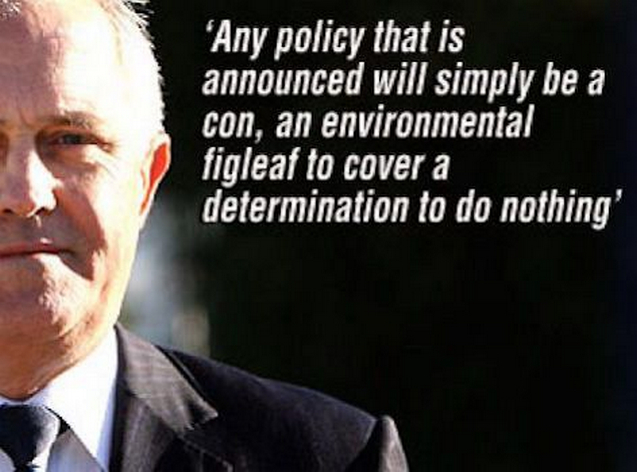
Turnbull of Abbott and climate change back in December 2009. (Image via @smh)
ARE YOU confused by the issues of alternative energy and climate change?
This is why.
The president of the World Bank, Jim Yong Kim MD PhD recently stated that it was crazy that governments were still driving the use of coal, oil and gas by providing subsidies.
Said the president:
“We need to get rid of fossil fuel subsidies now.”
In July 2016, Nicholas Stern estimated that tackling climate change would require investment of 2% of world GDP each year. The IMF indicates that if governments stopped world fossil subsidies of $5.6 trillions per year, it would benefit world GDP a year by 3.8%.

How did the fossil fuel industry react to this knowledge in 1980?
The Global Climate Science Communications Plan, written with the direct involvement of fossil fuel companies including ExxonMobil (then Exxon) and Chevron, detailed a plan for dealing with climate change that explicitly aimed to confuse and misinform the public.
IMAGE
How did governments and fossil fuel industries collude?
There is collusion to bring about World Government subsidies of $5.6 trillions per annum (according to the IMF calculations), to create the illusion of low costs and reliable coal generated electricity, and to manage, resist and delay the growing threat of investment in renewable energy as competition to the dominance of the fossil fuel sector.
There certainly has been a climate hoax that continues today. It is the four decades long campaign by the world’s largest fossil fuel companies to deceive the public by distorting the realities and risks of climate change.

Why do taxpayer funds subsidise the fossil fuel industry while coal and oil giants pay virtually no tax?
Malcolm Turnbull has been subsidising the fossil fuel industry with, according to IMF estimates, $1,712 per Australian a year, or $41 billion of taxpayer funds. This includes exploration funding for Geoscience Australia, and tax deductions for mining and petroleum exploration. The IMF calculates that Australians subsidisations to the fossil fuel industry account for hidden adverse costs spread out across the states and the ATO that, ultimately, permanently come out of taxpayers’ pockets.
IMAGE
Why does the CEFC cause offence to the fossil fuel industry, its institutions and its front group, the IPA?
In 2013, Tony Abbott addressed the Institute of Public Affairs (IPA).
"I want to assure you," he said, "that the coalition will repeal the carbon tax, abolish the Department of Climate Change, and abolish the Clean Energy Fund. (CEFC)".
That was his intent. However, the legislature (Parliament) twice refused to allow the executive’s bill to abolish the CEFC Act to become law.
To undermine the purpose of the Act, the executive attempted for two years to alter the CEFC investment mandate by revoking a provision of the Clean Energy Finance Corporation Act 2012. The fact is any change to the CEFC Act 2012 must be to the original Act. Altering the CEFC Act to achieve the executive’s purpose can only be done by going back to the Senate.

What is the CEFC?
The CEFC was set up by the Gillard Government in 2012.
It mobilises capital investment to facilitate increased flows of finance into the clean energy sector in renewable energy, low-emission technology and energy efficiency in Australia.
The corporation operates like a traditional financer, working with co-financers and project proponents to seek ways to secure financing solutions for the clean energy sector.
IMAGE
Was the aim to change the law or maximise confusion and demoralise the alternative energy participants?
Coalition ministers have schemed with coal and oil corporations to support coal generation of electricity, and attacked alternative energy by removing all possible funds from the CEFC.
Treasurer Hockey created a disruption so great that the alternative energy industry collapsed by 88%, mirroring a similar executive incursion into the car manufacturing sector. Prime Minister Turnbull caused similar disruption during the 2016 election campaign by pledging a total amount of $6.5 billion, left in the CEFC account to other non-climate change related LNP causes.
As the PM reallocates funds, he is disrupting and ignoring the directly expressed objectives of the Act — that the CEFC invest to increase the flow of finance into the clean energy sector.
Also ignored were the CEFC’s constitutional functions relating to external affairs powers (section 51(xxix) of the Constitution) — that is, giving effect to Australia’s obligations under the United Nations Climate Change Convention, by investing in the development of renewable energy and low-emission technologies that could reasonably be expected to control, reduce or prevent anthropogenic emissions of greenhouse gases.
Recently, the cabinet created a third investment directive to modify the intent of the CEFC Act and, in so doing, has exceeded its authority, ignoring the need to return to the Parliament to get the required authority from the legislature. By doing so they are committing misfeasance, by benefitting the coal and oil energy sector, but causing a deficit to the alternative energy sector.
IMAGE
Expressed or implied, which is it?
Ministers Hunt and Cormann have claimed that the power to issue new investment mandates is implied in section 64(1) of the Act, what they continue to ignore are the express limits placed on them by section 65. As responsible ministers, they cannot issue direction that has the purpose or that is likely to have the effect, of directly or indirectly requiring the board to, or not to, make a particular investment that is inconsistent with the CEFC Act – (including the object of the Act), which is:
'The Object of this Act is to establish the Clean Energy Finance Corporation to facilitate increased flows of finance into the clean energy sector.'
When will the correct interpretation be made to sweep away this manufactured confusion?
The level of malfeasance, and misfeasance and corruption, in Federal and state governments must be addressed by courts as a matter of urgency. The High Court and Federal Courts are ultimately the only judicial bodies with the constitutional authority to address these executive levels of wrongdoing.
The fundamental rule of interpretation is that a statute is to be expounded according to the intent of the parliament that made it and that intention has to be found by an examination of the language used in the statute as a whole. It is abundantly clear that the Parliament that produced the Clean Energy Finance Corporation Act 2012 intended that the Act not be easily diverted or altered by new directives inimical to its purpose.
As former Chief Justice Murray Gleeson said in his ABC Boyer Lecture ‘The Rule of Law’:
The High Court is given jurisdiction in matters in which a writ of mandamus or prohibition or an injunction is sought against an officer of the Commonwealth. This jurisdiction cannot be altered or taken away by Parliament. It confers on the High Court the power, by making certain forms of order that historically followed judicial review of executive action, to compel officers of the Commonwealth to act according to law. The expression 'officer of the Commonwealth' includes the Prime Minister and Ministers, and all public servants. The effect of the provision is, no one is above the law. Thus government officials must exercise their powers according to law. If they do not, then, in the last resort, the High Court may order them to do so The Constitution, which is the basic law, itself declares that the government must obey the law, and gives the High Court the jurisdiction to compel such obedience.
That jurisdiction cannot be removed or modified except by constitutional amendment.
Parliament, if acting within the limits of the powers assigned to it by the Constitution, may change the law. The executive government must obey the law. That is what the rule of law means.
IMAGE
Links

Comical Coal-ition Is A Dunce On Renewable Energy

Fairfax - Crispin Hull

In the past fortnight, I've been reminded of "Comical Ali", Iraq's former information minister, Mohammad Saeed al-Sahhaf, whose broadcasts and media conferences denied the presence of US troops and tanks in Baghdad even as they could be seen behind him. The delusional in denial.
What reminded me of him, of course, were all the climate-change deniers spouting their nonsense while high-temperature records were broken and bushfires raged across the country.
Coal salesman? Mohammad Saeed al-Sahhaf ignored the tanks, just as many conservatives can't see that the climate has already changed. 
America's tanks are in Baghdad. The climate has already changed. But still they want to open new coal mines and build new coal-fired power stations.
How do you explain it? Perhaps we're looking at these people the wrong way. We assume they don't think climate change is happening, therefore it's fine to continue to mine and burn coal. But it seems to me that it's the other way around. They first want to continue to make money by mining and burning coal (or receive donations from those who do) and therefore they must deny that climate change is happening, even in the face of overwhelming evidence and appalling economic and health costs.
Renewable blame game
The Liberal Party has been accused by Labor of lying about the reason for South Australia's blackouts by blaming renewable energy, something Malcolm Turnbull rejects. Courtesy ABC News 24.

We've seen it before. People wanting to make money by selling tobacco must deny that it causes lung cancer, even in the face of overwhelming evidence.
Unfortunately, therefore, it doesn't matter if – climate change aside – there are other reasons for stopping the mining and burning of coal. Those, too, will be ignored.
This is what we've seen recently. There are solid reasons, based on economics and energy technology, to stop mining and burning coal for electricity generation. But this government is ignoring the obvious.
Let's look at technology. We have an existing technology that works quite well. Let's call it coal, or taxis, or hotels, or vinyl records, or CDs or books. Then something comes along that delivers to consumers what they want more efficiently, and cheaper.
Cartoon: Alan Moir
Usually governments play a role. They have regulatory regimes, taxes and other mechanisms that usually help the status quo against the newcomer, at least for a while. But invariably the new technology wins. Horse and buggy gives way to car. CDs, tapes and vinyl give way to MP3. Coal power stations give way to solar, wind and batteries.
So it's going to happen, and these things have a history of happening very rapidly. Battery technology will become cheaper and more effective. And governments need to deal with it.
But the Coalition (let's call it the Coal-ition) has gone backwards, starting in late 2016, when it ruled out a carbon-intensity trading scheme for electricity generation, against the chief scientist's advice, just because then Coal-ition senator Cory Bernardi said it was "economic suicide". In fact, not implementing it would be economic suicide. Kowtowing to Bernardi has proven to be futile, now he has left the Coal-ition.
Compare this to the good sense put out by then environment minister Greg Hunt in 2015, when he said: "Australia has the highest rate of household solar in the world. This makes Australia an ideal place to develop storage and battery technology."
That's where we are with electricity generation in Australia: as mad and irrational as Americans with their guns.
In fact, Australia has 1.6 million Australian households with rooftop solar already installed and most of them say they intend to install battery storage. They are saying this for several reasons. Electricity is very expensive in Australia and looks like it will get more expensive. Many have a moral conviction that we should reduce carbon emissions.
Further, like all humans, they like getting something for free. Once the capital equipment is installed, the sun and wind are free. So it's galling to see the paltry amounts electricity generators pay for household-generated surplus electricity, at least outside the ACT.
How much better to store that excess and use it later, perhaps even to charge the electric car and cut fuel bills.
The market and technology are all pointing one direction, and it's not down a publicly subsidised railway line to coal mine or to a coal-fired power station.
But if you start from a position "I want coal" (or, to use a US analogy, "I want a gun"), no rational economic or health and safety argument has a chance. And that's where we are with electricity generation in Australia at present: as mad and irrational as Americans with their guns.
This government is allowing Australia to fall behind on technology and exposing us to trade sanctions if we don't meet our Paris targets.
There's a further point about the government not embracing and encouraging battery technology. People will go it alone if necessary as the financial cases for household batteries gets inevitably stronger. If that happens, the government will lose what should become a very important grid-security mechanism.
With government regulation and incentives, you can ensure that household battery systems are open to the grid, not just the excess off the roof after the batteries are fully charged, but a full-scale system of households selling some or all of the power in their batteries at times of peak demand.
In the long run, that will be a far cheaper and easier way of easing the strain on the grid than using coal.
Ultimately, real energy security can only come through renewables. Financiers and businesses realise this. This week, they joined environmentalists in crying out for sensible energy policies. Even without those policies, financiers are not going to put long-term money into a technology that will be priced out of the market.
So the question for our politicians is not, childlike, to go vermillion in the face (Barnaby Joyce) nor, stuntlike, to bring a lump of coal into the parliamentary chamber (Scott Morrison). It's to deal with the market. Coalition governments are supposed to be masters of the market. But on renewable energy they are dunces.
(A footnote: my rooftop solar system is now four years old and has generated 25,000 kilowatt hours of electricity worth about $7000. The system cost $9000. I thought it would take nine years to pay for itself, allowing for forgone interest and lower prices for power sent back to the grid. But with the rising cost of electricity, it now looks like it will be less than six years.)

Links

Climate Change A 'Material' Risk For The Financial System: APRA

Fairfax - 

Australia's powerful financial regulator has revealed it views climate change as a "material" risk that it will be watching much more closely in its monitoring of banks, insurers and wealth managers.
Geoff Summerhayes, an executive board member of the Australian Prudential Regulation Authority, on Friday made the first detailed comments from a domestic regulator on how they are responding to financial risks created by global warming.
Geoff Summerhayes says APRA will keep a close eye on climate change risks. Photo: Jessica Hromas
As global regulators also turn their sights to these risks, Mr Summerhayes signalled APRA would be looking more closely at how the financial system may be affected by a move away from carbon-intensive energy.
It also expects big companies to carefully consider these risks, and warned that company directors could be liable if they failed to do so.
Mr Summerhayes said climate change was often seen as a "future problem" or a "non-financial" one, but APRA did not view it this way.
"Some climate risks are distinctly 'financial' in nature. Many of these risks are foreseeable, material and actionable now," he said.
"Climate risks also have potential system-wide implications that APRA and other regulators here and abroad are paying much closer attention to."
Specifically, he emphasised the financial risks created by changes in laws or technology, as opposed to physical changes in the environment.

The world is moving closer to catastrophic peril, scientists say
Scientists have moved the hands of their metaphorical 'Doomsday' clock closer to midnight, warning of the increasing threats of nuclear weapons and climate change.

The transition towards less carbon-intensive forms of energy could trigger a "significant repricing of carbon-intensive resources and activities and reallocation of capital," he said.
He said APRA was "keenly aware of potential systemic implications," but it was not possible to properly understand these risks and how they could be averted, unless companies were disclosing enough information and talking about these risks.
Companies should be including climate change in their internal risk management processes, he said, highlighting that Australia was a signatory to the Paris Climate Agreement, a pledge to limit global warming to a temperature increase of no more than 2 degrees.
He also referred to a legal opinion from barrister Noel Hutley SC that found company directors could be personally liable if they fail to properly consider and disclose climate related risks they could have foreseen.
Climate risks also have potential system-wide implications that APRA and other regulators here and abroad are paying much closer attention to.
Geoff Summerhayes
It comes after a business taskforce working under the Financial Stability Board in December recommended new guidelines pushing for listed companies to disclose more information on how they were handling the risks of climate change.

Links

19/02/2017

NASA Is Defiantly Communicating Climate Change Science Despite Trump’s Doubts

Washington Post - Jason Samenow

Via NASA Climate Change’s Facebook page: “Two of the three top January temperature anomalies have been during the past two years.”
If you peruse NASA’s social media feeds dedicated to climate change, you would have no clue a new administration has taken power that has expressed doubts about the reality or seriousness of the issue.
Every day, NASA has dutifully posted updates on Twitter (@nasaclimate) and Facebook pertaining to climate change science, including some that are in direct contradiction to statements made by President Trump and some of his Cabinet picks.
Steve Cole, a NASA spokesperson, told the Capital Weather Gang the change in the administration has not altered how the agency communicates science. “We’re doing our jobs, it’s business as usual,” Cole said.
Early Thursday afternoon, the @NASAClimate account tweeted, “I want to put images right in front of people that #globalwarming is, in fact, happening,” quoting and displaying the work of aerial photographer Timo Lieber who is documenting climate-change effects in Greenland.
IMAGE
Trump has long been a global warming doubter, at one point calling it a Chinese hoax. In a November interview with the New York Times, he would only concede there may be “some connectivity” between human activity and climate change.
But on Monday, and in direct contradiction to Trump, the @NASAClimate Twitter account retweeted a scientific finding that humans are climate change’s dominant cause. “Humans are changing the climate 170 times faster than natural forces, according to a new study,” the tweet said.

At his confirmation hearing, President-elect Trump's Environmental Protection Agency administrator nominee Scott Pruitt outlined his plan for the agency. (Video: Thomas Johnson/Photo: Melina Mara/The Washington Post)

This finding was not only at odds with Trump’s view of the issue, but also Scott Pruitt’s, his pick to head the Environmental Protection Agency. During his confirmation hearing, Pruitt waffled on the linkages between human activity and climate change, saying: “I believe the ability to measure, with precision, the degree of human activity’s impact on the climate is subject to more debate on whether the climate is changing or whether human activity contributes to it.”
NASA’s climate change website has a far less ambiguous characterization: “The vast majority of actively publishing climate scientists — 97 percent — agree that humans are causing global warming and climate change.”
On Wednesday, NASA’s climate change Facebook page highlighted the specter of “significant” damages from climate change, quoting the United Nations Intergovernmental Panel on Climate Change.
IMAGE (NASA Climate Chance Facebook page, accessed Feb. 16, 2017)
Trump, of course, has been dismissive of the scale of the problem, telling The Washington Post: “I just think we have much bigger risks.”
The Facebook post touting the risk of climate change damages then linked to NASA’s website on climate change effects. It states scientists have “high confidence” in predictions of future temperature rise. This doesn’t quite square with a statement of Rex Tillerson, now Trump’s secretary of state. Tillerson said the ability to predict the effect of increasing greenhouse gases is “very limited” during his confirmation hearing.
NASA appears unfazed by the political winds swirling around the climate change issue. It has steadfastly shared information, even when out of step with the positions of new leadership.
NASA’s active presence on social media is in stark contrast to the EPA, which hasn’t published a single tweet since Trump was inaugurated. Trump’s officials imposed a media blackout at the agency.
The EPA media blackout and the administration’s stance on climate change have worried some scientists that more drastic efforts to suppress scientific information may follow. Some scientists are even working with computer coders to back up federal online data, including NASA’s, out of fear the administration will remove it.
NASA insists none of its data has been touched.
“Availability of NASA Earth science data has not changed in recent months, nor have any Earth science data sets been taken offline,” the agency said in statement. “Since 1994, NASA has supported a full and open sharing of data from Earth science satellites, field campaigns and research.”
One does wonder whether NASA will be an enduring safe-haven for climate change science information and if it will continue to post information that contradicts the positions of administration officials. But so far, no one has stopped it.

Links

Critical Condition: Health Experts Sound The Climate Alarm

Daily Climate - Peter Dykstra

Experts paint a dire portrait of climate change’s public health impacts, but leave a little room for hope.
Al Gore. Climate Reality
ATLANTA—In a gathering impacted by presidential politics, an all-star cast of public health experts largely stuck to their own bleak script: Climate change is poised to unleash an unprecedented, global public health crisis.
Panel at the event. Climate Reality
Not even former Vice President Al Gore, who served as the day's emcee, waded into the political swamp. He presented a half-hour, health-themed version of his much-lauded slide show.
While Gore summarized the gobsmacking array of climate impacts—heat stress, water supplies, food security, mental health, respiratory and infectious diseases, allergens, and weather disasters—he left room at the end for some more convenient truths: The world, he said, is more than able to shift to a clean energy economy, reduce CO2 emissions, and blunt the worst impacts of climate change.
Harvard internist Ashish Jha discussed the climate-related spread of pathogens, and provided one of the conference’s few direct political jabs: “Walls,” he said, “will not keep these pathogens out.”
Activist and philanthropist Laura Turner Seydel gave an impassioned pitch to participate in the April 22 Scientists’ March in Washington, and to resist the anticipated science and environmental rollbacks of the Trump Administration.
But much of the day focused on overwhelmingly bad news for the world. Harvard’s Sam Myers presented potential impacts on the global food supply that go beyond the links between extreme weather and crop failure. Research shows that increased CO2 actually decreases nutrients in certain food crops, he said.
Rising temperatures, he added, encourage some forms of plant blight, and could also make the backbreaking outdoor work of food production impossible in regions like northern Africa.
Psychologist Lise Van Susteren introduced examples which she said illustrate climate change’s impacts not on the body, but on the mind. “Climate anxiety” and its sharper cousin, “climate trauma,” contribute to depression, substance abuse, violence, and more, she said.
“Destructive impacts from climate change,” she said, “will someday be treated as if they were child abuse.”
Sir Andy Haines of the London School of Hygiene and Tropical Medicine tried gamely to provide an antidote to the barrage of negative news. ”Motivating people through fear, is often difficult, and can lead to cynicism,” he said. Instead, promoting the health benefits of a low-carbon economy can be a winning strategy.
"Destructive impacts from climate change will someday be treated as if they were child abuse." Lise Van Susteren 
The cost savings from those benefits will more than offset any financial hit occasioned by moving away from fossil fuels. Haines added the semi-obvious: Eschewing the car for a bike or a hike cuts emissions and increases health simultaneously.
Electric cars and bicycles, he said, cut both emissions and noise, while improved building efficiency can both reduce heating and cooling and indoor air pollution. Conversion from a heavily meat-reliant diet would provide twin benefits to health and climate.
Other panelists and speakers discussed the health impacts of adapting to a changing climate; the unique challenges of climate-related health issues in poor and minority communities; and the Centers for Disease Control and Prevention’s assistance to state and local governments on climate issues.
Healthcare advocate Gary Cohen tossed out a stat that was clearly intended to drive home the public health community’s role in climate issues: “Our addiction to fossil fuels…. is killing more people than AIDS, malaria and TB combined.”
Sir Andy Haines. Climate Reality
Cohen added “In the 21st Century we can no longer support healthy people on a sick planet.”
The conference closed with a panel on climate communication. It was mostly a primer for solid climate communication by health professionals, but one of the panelists was hardly a “usual suspect” in all things climate. Jerry Taylor is former vice president of the CATO Institute, often booked onto TV talk shows to call climate science into question. For the past few years, he’s burned former political bridges by acknowledging climate change and advocating a carbon tax. “After 20 years of wrestling with the climate bear, I lost,” he said.
Taylor’s prescription for persuading conservatives and Republicans on climate change focused on talking about risk management, and avoiding discussions of the social cost of carbon or the massive restructure of the world’s economy.

To CDC, or not to CDC
The meeting was originally announced in mid-2016 by the Atlanta-based Centers for Disease Control and Prevention. After Donald Trump’s election, the CDC abruptly pulled the plug on the three-day event, citing “uncertainty” in the agency’s direction under Trump.
Several non-government groups, universities and philanthropies teamed up to salvage a one-day conference on short notice. The Carter Center’s Chapel held a capacity crowd of 340, including 40 accredited journalists.
The short notice perhaps explains the adorably generic name for the meeting: “Climate & Health Meeting.” In a surprise appearance, host and former President Jimmy Carter gave the CDC a pass for cancelling its event.
“The CDC has to be a little more careful politically,” he said. “The Carter Center doesn’t.”
Politics loomed large in one other portion of the gathering: A physician scheduled to present in Atlanta ended up doing so remotely. According to American Public Health Association President Georges Benjamin, Dr. Nick Watts had recently visited hospitals in Iran, and was denied a visa to enter the U.S.

Links

Australia Positioned To Be Renewable Energy Superpower

Fairfax -

The old joke says the questions in economics exams don't change from year to year, but the answers do. Welcome to the economics of energy and climate change, which has changed a lot without many people noticing - including Malcolm Turnbull and his climate-change denying mates.
They've missed that the economics has shifted decisively in favour of renewable energy, as Professor Ross Garnaut​, of the University of Melbourne, pointed out at an energy summit in Adelaide last October.
Illustration: Glen Le Lievre. 
Garnaut is chairman of Zen Energy, a supplier of solar and battery storage systems. But there aren't many economists who know more about the energy industry and climate change than Garnaut, who's conducted two federal inquiries into the subject.
He says that, since his second review in 2011, there have been four big changes in the cost of renewable energy relative to the cost of energy from coal or gas.
Ross Garnaut says that nowhere in the developed world are solar and wind resources together so abundant as in the west-facing coasts and peninsulas of southern Australia. Photo: Luke Sharrett
First, the cost of renewable energy generation and energy storage equipment has fallen "massively".
The modelling conducted for his inquiry assumed the cost of photovoltaic solar generation would fall by a few per cent a year. In practice, costs have fallen by about five-sixths since that assumption was made.
"Similarly large reductions have occurred in the cost of lithium ion batteries and related systems for storing energy," he says.
There have been less dramatic but substantial reductions in costs of equipment for electricity from wind and other renewables.
The cost reductions come from economies of scale in the hugely increased production by China and others, plus savings through "learning by doing". Advances in technology will keep prices falling after scale economies have been exhausted.
Second, there have been "transformational improvements" in battery storage technology, used at the level of the electricity grid, to ensure balance between supply and demand despite renewables generators' "intermittency​" (inability to operate when the sun's not shining or the wind's not blowing).
Third, there's been a dramatic reduction in the cost of borrowing the money needed to cover the capital cost of generation equipment.
Real interest rates on 10-year bonds are below or near zero in all developed countries, including Australia.
"These exceptionally low costs of capital are driven by fundamental changes in underlying economic conditions and are with us for a long time," Garnaut says.
Low interest rates reduce the cost of producing, storing and transporting renewable energy more than they reduce the cost of fossil-fuel energy because renewable costs are overwhelmingly capital (sun and wind cost nothing), whereas fossil fuel costs are mainly recurrent (digging more coal out of the ground).
Fourth, there's been a dramatic increase in the cost of gas - and thus gas-fired electricity.
Ten years ago Australia had the developed world's cheapest natural gas - about a third of prices in the US. Today, our prices are about three times higher than in the US.
Why? Because the development of a liquid natural gas export industry in Queensland has raised the gas prices paid in eastern Australia to "export parity" level - the much higher price producers could get by selling their gas to Japan or China (less the cost of liquefaction and freight).
It's worse than that. Because foreign investors were allowed to install far too much capacity for LNG exports - meaning none of them is likely to recover their cost of capital - they've been so desperate for throughput they've sometimes bid gas prices well above export parity.
Apart from making gas-fired power more expensive relative to renewables, this has implications for how we handle the transition from "base-load" coal-fired power (once you turn a generator on, it runs continuously) to intermittent solar and wind production.
It had been assumed that gas-fired power would bridge the gap because it was cheap, far less emissions-intensive than coal, and able to be turned on and off quickly and easily to counter the intermittency of renewables.
Now, however, without successive federal governments quite realising what they'd done, gas has been largely priced out of the electricity market, with various not-very-old gas-fired power stations close to being stranded assets.
What now? We thank our lucky stars the cost of energy storage is coming down and we get serious about storage - both local and at grid level - using batteries and such things as "pumped hydro storage" (when electricity production exceeds immediate needs, you use it to pump water up to a dam then, when production is inadequate, you let the water flow down through a hydro turbine to a lower dam).
In other words, the solution is to get innovative and agile. Who was it who said that?
Turnbull's party seem to be pro coal and anti renewables partly because they know we have a comparative advantage in coal.
We can produce it cheaply and we've still got loads in the ground. The rest of the world is turning away from coal and the environmental damage it does, but let's keep opening big new mines and pumping it out, even though this pushes the prices our existing producers get even lower.
If the banks are reluctant to finance new coal mines at this late stage, prop them up with government subsidies. Join the international moratorium on new mines? That would be unAustralian.
But get this: Garnaut says we also have a comparative advantage in the new world of renewables.
"Nowhere in the developed world are solar and wind resources together so abundant as in the west-facing coasts and peninsulas of southern Australia. South Australian resources are particularly rich...
"Play our cards right, and Australia's exceptionally rich endowment per person in renewable energy resources makes us a low-cost location for energy supply in a low-carbon world economy.
"That would make us the economically rational location within the developed world of a high proportion of energy-intensive processing and manufacturing activity.
"Play our cards right, and Australia is a superpower of the low-carbon world economy."

Links

18/02/2017

Climate Change Doubled The Likelihood Of The New South Wales Heatwave

The Conversation -  |  | 

Emergency crews tackle a bushfire at Boggabri, one of dozens across NSW during the heatwave. AAP/Karen Hodge
The heatwave that engulfed southeastern Australia at the end of last week has seen heat records continue to tumble like Jenga blocks.
On Saturday February 11, as New South Wales suffered through the heatwave's peak, temperatures soared to 47℃ in Richmond, 50km northwest of Sydney, while 87 fires raged across the state amid catastrophic fire conditions.
On that day, most of NSW experienced temperatures at least 12℃ above normal for this time of year. In White Cliffs, the overnight minimum was 34.2℃, a new record for the state's highest observed minimum temperature.
On Friday, the average maximum temperature right across NSW hit 42.4℃, beating the previous February record of 42.0℃. The new record stood for all of 24 hours before it was smashed again on Saturday, as the whole state averaged 44.0℃ at its peak. At this time, NSW was the hottest place on Earth.
A degree or two here or there might not sound like much, but to put it in cricketing parlance, those temperature records are the equivalent of a modern test batsman retiring with an average of over 100 – the feat of outdoing Don Bradman's fabled 99.94 would undoubtedly be front-page news.
And still the records continue to fall. Mungindi, on the border of NSW and Queensland, broke the Australian record of 50 days in a row above 35℃, set just four years ago at Bourke Airport, with the new record now at 52 days.
Meanwhile, two days after that sweltering Saturday we woke to find the fires ignited during the heatwave still cutting a swathe of destruction, with the small town of Uarbry, east of Dunedoo, all but burned to the ground.
Maximum temperature anomalies across NSW on February 11, the peak of the heatwave. Bureau of Meteorology, Author provided
This is all the more noteworthy when we consider that the El Niño of 2015-16 is long gone and the conditions that ordinarily influence our weather are firmly in neutral. This means we should expect average, not sweltering, temperatures.
Since Christmas, much of eastern Australia has been in a flux of extreme temperatures. This increased frequency of heatwaves shows a strong trend in observations, which is set to continue as the human influence on the climate deepens.
It is all part of a rapid warming trend that over the past decade has seen new heat records in Australia outnumber new cold records by 12 to 1.
Let's be clear, this is not natural. Climate scientists have long been saying that we would feel the impacts of human-caused climate change in heat records first, before noticing the upward swing in average temperatures (although that is happening too). This heatwave is simply the latest example.
What's more, in just a few decades' time, summer conditions like these will be felt across the whole country regularly.

Attributing the heat
The useful thing scientifically about heatwaves is that we can estimate the role that climate change plays in these individual events. This is a relatively new field known as "event attribution", which has grown and improved significantly over the past decade.
Using the Weather@Home climate model, we looked at the role of human-induced climate change in this latest heatwave, as we have for other events before.
We compared the likelihood of such a heatwave in model simulations that factor in human greenhouse gas emissions, compared with simulations in which there is no such human influence. Since 2017 has only just begun, we used model runs representing 2014, which was similarly an El Niño-neutral year, while also experiencing similar levels of human influence on the climate.
Based on this analysis, we found that heatwaves at least as hot as this one are now twice as likely to occur. In the current climate, a heatwave of this severity and extent occurs, on average, once every 120 years, so is still quite rare. However, without human-induced climate change, this heatwave would only occur once every 240 years.
In other words, the waiting time for the recent east Australian heatwave has halved. As climate change worsens in the coming decades, the waiting time will reduce even further.
Our results show very clearly the influence of climate change on this heatwave event. They tell us that what we saw last weekend is a taste of what our future will bring, unless humans can rapidly and deeply cut our greenhouse emissions.
Our increasingly fragile electricity networks will struggle to cope, as the threat of rolling blackouts across NSW showed. It is worth noting that the large number of rooftop solar panels in NSW may have helped to avert such a crisis this time around.
Our hospital emergency departments also feel the added stress of heat waves. When an estimated 374 people died from the heatwave that preceded the Black Saturday bushfires the Victorian Institute of Forensic Medicine resorted to storing bodies in hospitals, universities and funeral parlours. The Victorian heatwave of January 2014 saw 167 more deaths than expected, along with significant increases in emergency department presentations and ambulance callouts.
Infrastructure breaks down during heatwaves, as we saw in 2009 when railway lines buckled under the extreme conditions, stranding thousands of commuters. It can also strain Australia's beloved sporting events, as the 2014 Australian Open showed.
These impacts have led state governments and other bodies to investigate heatwave management strategies, while our colleagues at the Bureau of Meteorology have developed a heatwave forecast service for Australia.
These are likely to be just the beginning of strategies needed to combat heatwaves, with conditions currently regarded as extreme set to be the "new normal" by the 2030s. With the ramifications of extreme weather clear to everyone who experienced this heatwave, there is no better time to talk about how we can ready ourselves.
We urgently need to discuss the health and economic impacts of heatwaves, and how we are going to cope with more of them in the future.

Links

Lethal Heating is a citizens' initiative