Huffington Post - Rob Sturrock
We are missing a singular opportunity to ready ourselves against domestic climate security threats.
 |
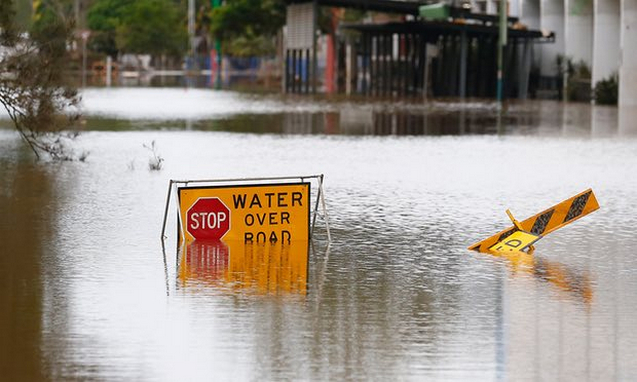
Events such as Cyclone Debbie remind us of the
destructive impact extreme weather has on our communities and
livelihoods. POOL New / Reuters
|
Australia is sleepwalking into a new and uniquely 21st century
security challenge -- the far-reaching impacts of climate change. It is
unlike any previous security challenge we've come across. We're living
with this threat now, and will be for generations.
Recently, US filmmakers released an aptly titled documentary, '
The Age of Consequences', which was also
aired on Four Corners in March.
It serves as another reminder of how far behind Australia really is in
dealing with this challenge. The film catalogues in high definition the
many security ramifications of a changing climate, as told by former US
military and senior policy experts from across the political spectrum.
One can only hope that our local politicians digest its sober warnings.
The arguments in the film are not new. Over the past decade,
the evidence has mounted
that climate change is a direct threat to our peace, prosperity and
health, as well as a phenomenon exacerbating geopolitical instability in
our region. Australia's future is one of increasingly extreme weather
and more natural disasters, both in terms of frequency and severity.
This is not a theoretical threat, it is affecting our communities today. Events such as Cyclone Debbie -- during which
the army was deployed
to offer assistance -- remind us of the destructive impact extreme
weather has on our communities and livelihoods, with the present damage
bill
likely to run into the billions of dollars. Last year we also saw properties on Sydney's northern beaches
unexpectedly get much closer to the shores of the Pacific.
 |
|
An inground pool sits amongst the rocks after a severe
storm at Collaroy on Sydney's northern beaches on June 6, 2016. AFP/Getty Images |
Internationally, Australia resides in the region worst affected by
climate change; a region that is already facing instability due to
booming populations, resource insecurity and some of the highest levels
of natural and humanitarian disasters.
Seven out of 10 of the world's most vulnerable countries to climate change are in the Asia–Pacific, and Asia has approximately
90 percent of the world's risk of tropical cyclones.
Our
region is already adjusting to a more fluid and contested geopolitical
order. This task is compounded due to the increasingly scarce food,
energy and water situation aggravated by climate change. Emerging
superpowers will be jostling for resource security alongside developing
nations with fragile economies and equally fragile governments. It
doesn't take much imagination to understand how, for example, extended
droughts in wheat-producing countries could lead to supply shortages,
increases in grain prices, greater food insecurity, and ultimately
intensified social and political unrest in volatile parts of the world.
Indeed, this has already happened in North Africa and the Middle East.
These challenges are great but they are manageable so long as Australia acts decisively and urgently.
We
can add to this complex security situation the risk that international
climate governance may unravel, courtesy of a retreating United States
and the self-serving 'America First' rhetoric of the Trump Presidency. A
vacuum on climate leadership would be a disaster for the international
community. At best China will fill this breach which would, in turn,
offer a new leadership dynamic in the region to which we will need to
adjust.
These
challenges are great but they are manageable so long as Australia acts
decisively and urgently. Instead of acting as the evidence has mounted,
Australia has endured a costly, lost decade of action on climate
security. It's been a period of torpor created by ideological gridlock
and opportunistic denialism. Ten years of federal policies totaling
little more than piecemeal and low-key responses to a great and profound
challenge.
Our
long national sleepwalk on climate security policy must end. We are
missing a singular opportunity to ready ourselves against domestic
climate security threats. We must also offer to the region a strong,
positive role on climate adaptation and preparation. If we do not, we
leave ourselves more insecure and vulnerable as a result.
Firstly,
we need a plan of action -- a comprehensive climate security strategy
from the Federal Government. A genuine bright spot in recent years was
the acknowledgement of climate security concerns in the
Defence White Paper 2016.
However more sophisticated policy must build upon the White Paper's
foundations. The US Department of Defense has done the hard work of
producing detailed strategies and roadmaps over recent years. They
empower the public service and armed services to plan and prepare for
their coming security environment with confidence. In our Federal
Government, a climate security strategy should be put together via an
advisory council comprising the Departments of Foreign Affairs,
Environment and Defence.
The next decade of climate security policies must be a vast improvement on the previous one.
Australia
also has a constructive role to play in collaborating within our region
on building climate resilience. Utilising the ADF, Australia can offer
leadership that encourages cooperation on defence preparedness for
climate-induced crises. This includes identifying likely humanitarian
flashpoints in the region, such as population displacement in Bangladesh
or extreme heat fatalities and power outages in India and Pakistan.
Executing effective joint responses to humanitarian and natural
disasters will be pivotal in coming years. Australia should be at the
forefront of this preparatory work.
Finally,
Australia should work closely with its neighbours to invest in their
climate adaptation capacity, such as improving the resilience of
communities particularly vulnerable to climate change. Australia has
large reserves of soft power, and could better utilise these reserves by
addressing climate change through well-financed aid and development
programs. Australia improves its own security position by making the
region more able to withstand incoming climate security threats.
For
all our sakes, the next decade of climate security policies must be a
vast improvement on the previous one. Otherwise the consequences of our
inaction will be measured not just across years, but generations.
Links