04/06/2017

India, Once A Coal Goliath, Is Fast Turning Green

New York Times - Geeta Anand

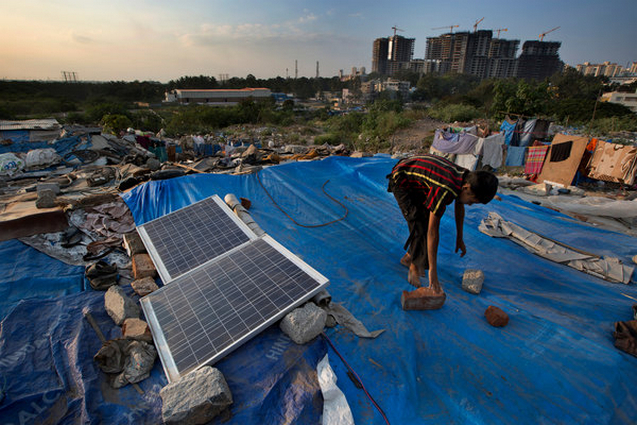
Solar panels on the roof of a shop in a settlement in Bangalore, India. Kuni Takahashi for The New York Times
MUMBAI, India — Just a few years ago, the world watched nervously as India went on a building spree of coal-fired power plants, more than doubling its capacity and claiming that more were needed. Coal output, officials said, would almost triple, to 1.5 billion tons, by 2020.
India’s plans were cited by American critics of the Paris climate accord as proof of the futility of advanced nations trying to limit their carbon output. But now, even as President Trump pulls the United States out of the pact, India has undergone an astonishing turnaround, driven in great part by a steep fall in the cost of solar power.
Experts now say that India not only has no need of any new coal-fired plants for at least a decade, given that existing plants are running below 60 percent of capacity, but that after that it could rely on renewable sources for all its additional power needs.
Rather than building coal-fired plants, it is now canceling many in the early planning stages. And last month, the government lowered its annual production target for coal to 600 million tons from 660 million.
The sharp reversal, welcome news to world leaders trying to avert the potentially deadly effects of global warming, is a reflection both of the changing economics of renewable energy and a growing environmental consciousness in a country with some of the worst air pollution in the world.
What India does matters, because it is the world’s third-largest emitter of greenhouse gases, behind China and the United States. And its energy needs are staggering — nearly one-quarter of its population has no electricity and many others get it only intermittently.
With India’s power needs expected to grow substantially as its economy continues to expand, its energy use will heavily influence the world’s chances of containing the greenhouse gases that scientists believe are driving global warming.
Much attention at the time of the signing of the Paris agreement was focused on the role President Barack Obama played in pushing India’s prime minister, Narendra Modi, to sign. In doing so, Mr. Modi committed India to achieving 40 percent of its electricity capacity from nonfossil-fuel sources by 2030.
Workers at a coal-fired power plant under construction in Kudgi, India, in 2015. Aijaz Rahi / Associated Press
Less understood was Mr. Modi’s longstanding personal commitment to taking India in a greener direction. That has been strengthened in recent years by growing evidence that a greener path makes political and economic sense as well, says Harsh Pant, a fellow at the Observer Research Foundation, a New Delhi-based research organization.
“Modi’s constituency is the middle class, and the middle class in Indian cities is choking on pollution,” Mr. Pant said. “Modi knows climate change is good politics. Climate change makes sense to Modi because he believes it as it is good economics and politics.”
Two major economic factors lie at the heart of India’s move away from coal. The first is that the country’s growth rate, while faster than that of most major economies, slipped to 6.1 percent for the most recent quarter, down from 7 percent in the previous quarter. And much of that growth has come in service industries rather than in power-hungry manufacturing.
Equally important is the startling drop in the price of renewable energy sources. Many energy experts say renewables are poised to become a less expensive alternative to coal within the next decade.
“The train has left the station. Mr. Trump has come too late” to slow the transition to renewable energy, said Ajay Mathur, director general of the Energy Resources Institute, a New Delhi policy center closely associated with the government. “By the time the coal-fired plants come up to full capacity because of increasing demand, the price of renewables will be lower than the price of coal.”
Based on December data from the Central Electric Authority, Mr. Mathur’s institute reported in March that India might be able to meet its additional power needs in the future with renewable energy.
It based that prediction on the remarkable drop in the cost of solar power. In approving proposals for new solar power plants, the Indian government seeks bids from prospective builders who compete to pledge the lowest price at which they anticipate selling power.
Five years ago, the lowest bid came in at 7 rupees, or 11 cents, per kilowatt-hour. In early May, the lowest bidder came in at less than half of that price, or 2.44 rupees per kilowatt-hour, a little under 4 cents, experts here say.
The latest bid makes solar power less expensive than coal, which sells for about 3 rupees per kilowatt-hour.
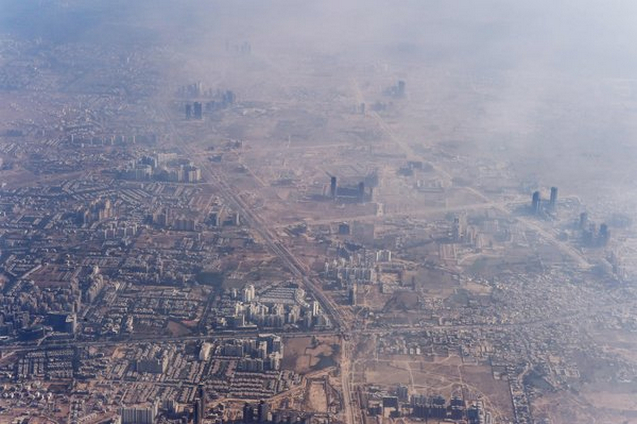
Smog enveloping buildings on the outskirts of New Delhi in November 2014. Roberto Schmidt / Agence France-Presse — Getty Images
Storage costs, a critical component of renewable energy systems, have also fallen. “The crucial question has been, ‘Yes, but what do you do when the wind doesn’t blow and the sun doesn’t shine?’” said Adair Turner, the chairman of the Energy Transitions Commission, which studies climate issues.
The cost of lithium ion batteries, the gold standard in solar power storage, has fallen significantly, Mr. Turner said, largely because of economies of scale. Where the price was about $1,000 per kilowatt-hour more than five years ago, it is now $273 and dropping, Mr. Mathur said.
The price needs to fall to $100 per kilowatt-hour for renewable energy to be comparable in price to coal, Mr. Mathur says. Mr. Turner thinks that will happen far sooner than the year 2030, which his group had been predicting.
“To be blunt, the success of this has been bigger than I certainly realized,” Mr. Turner said. “There were people who were optimists, and it’s the optimists who have won out.”
New Delhi had long argued that it was hypocritical of Western nations that have burned fossil fuels for centuries to ask Indians to sacrifice their growth to cope with the effects. But the Modi administration has set ambitious targets for a greener Indian future.
The government pledged in 2015, when the country’s electricity capacity from renewables was 36 gigawatts, to increase it to 175 gigawatts by 2022.
Piyush Goyal, India’s power minister, announced in a speech in late April that the country would take steps to assure that by 2030 only electric cars would be sold.
“That’s rather ambitious,” Rahul Tongia, a fellow at Brookings India, said. “The targets are there. The vision is there. The question is: ‘Is it going to happen? How?’”
The Indian government’s policy research arm, the National Institution for Transforming India, or NITI Aayog, recently released a report in collaboration with the Rocky Mountain Institute in Boulder, Colo., that calculated India could save $60 billion and reduce its projected carbon emissions by 37 percent by 2030 if it adopted widespread use of electric vehicles and more public transportation.
A street scene in the old Hyderabad city in India. Atul Loke for The New York Times
Mr. Mathur says that even if India falls short of those ambitious goals, just coming close will have a huge impact on the concentration of greenhouse gases in the world and pollution within the country.
“Even a year and a half ago, I didn’t expect we would go out on a limb and say electric vehicles are a public policy goal for us. It is truly exciting,” he said in an interview.
Besides reducing the choking pollution in India’s cities, moving to electric vehicles also makes sense because the country has excess generation capacity in the underused coal-fired plants and is too heavily reliant on petroleum imports, which present a geopolitical risk.
“There has for a very long time been a push to reduce the growth in imports,” Mr. Mathur said. “This is one of those perfect policy opportunities, with short-term and long-term benefits.”
Navroz Dubash, a fellow at the Center for Policy Research in New Delhi, cautions that even though India is likely to meet its additional energy needs in the future from renewable sources, that does not mean India is about to stop burning coal tomorrow.
“It is important not to draw from this that India’s tryst with coal is necessarily done,” Mr. Dubash said, “just that there are signs it will end sooner and at a lower level than expected.”
India canceled 13.7 gigawatts of proposed coal-fired power plants last month alone, the Institute for Energy Economics and Financial Analysis said. The government has admitted that an additional 8.6 gigawatts of coal-fired generation capacity built at a cost of $9 billion is potentially no longer financially viable because of competition from renewable sources, the institute said.
This is hopeful news for the world, said Mr. Tongia, because the only way for the world not to grow too warm is for “developing countries, especially India, to do more, to come in lower than budget, to do their unfair share.”
And, Mr. Tongia said, “the good news” is that India has decided that it is in its interest to do its “unfair share.”

Links

Australia Can’t Lose In The Global Race For Cheaper, Cleaner Energy

The Conversation

Australia is awash with options for low-emissions energy. AAP Image/Lukas Coch
Despite our sometimes heated national debate about our energy future, Australia is well positioned to benefit from innovative low emission technologies. No matter which avenue we take to cleaner energy, our energy-rich resources means there are opportunities for Australian businesses – and cheaper energy for Australian consumers.
That's the conclusion reached by CSIRO in our Low Emissions Technology Roadmap, which outlines potential pathways for the energy sector to contribute to Australia's emissions reduction target.
Our target under the Paris climate agreement calls for a 26-28% reduction of emissions by 2030 from 2005 levels. Our analysis also considers how the energy sector could meet the more ambitious aspiration of avoiding 1.5-2℃ global warming.

Looking past the political wrangling
Perhaps one of the reasons the energy debate in Australia is so vehement is that, with the exception of oil, we are rich in energy resources. While we cannot wait indefinitely, the lack of resource constraints means we can monitor and test what options emerge as the most cost effective. Technology neutrality is often called upon as a key policy design principle.
Another reason for caution is that technological change is inherently unpredictable. For example, at the start of this century, few would have expected solar photovoltaics to be one of the lowest cost sources of electricity. Current expectations of sourcing cost-effective bulk electricity storage would have seemed even less likely at the time.
However, there are two key choices that will determine how we reduce greenhouse gases, and the shape of our energy future.
First, we must decide how much weight we give to improving energy productivity, versus decarbonising our energy supply. This is essentially a policy decision: should we use our existing energy more intelligently and efficiently in our buildings, industries and transport, or aggressively pursue new technology?
Whatever strategy we pick, we also need to choose what technology we emphasise: dispatchable power, from flexible and responsive energy generation, or variable renewable energy (from sources like solar, wind and wave), supported with storage.
From these choices four pathways are derived: Energy productivity plus, Variable renewable energy, Dispatchable power and Unconstrained.
There are four broad pathways to cheaper, cleaner energy. (Click to view larger image.) CSIRO
 Our electricity market modelling found the different pathways lead to comparable household electricity bills. High energy productivity scenarios tend to delay generation investment and reduce energy use, leading to slightly lower bills in 2030 (including the cost of high efficiency equipment).

Weighing risk
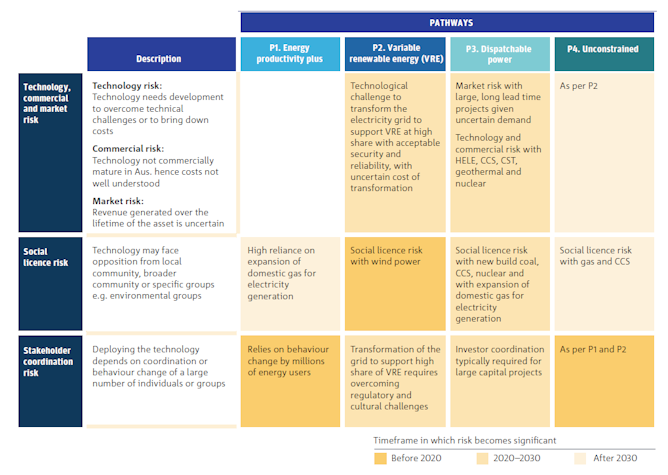
The main attribute that separates the pathways is the mix of risks they face. We've grouped risks into three categories: technology, commercial and market risk, social licence risk and stakeholder coordination risk.
Risks identified with each pathway to cheaper renewable energy. (Click to view larger image.) CSIRO
Energy productivity plus combines mature existing low emissions technology with gas, so there's no significant market risk. However there is a social license risk, as many will protest a stronger reliance on expanding gas supplies.
Gas-fired generation is high in this scenario. If improved energy productivity reduces emissions elsewhere, the electricity sector will have less pressure to phase out highly polluting generators.
This scenario would also require a high degree of cooperation between government, companies and customers. We would need to coordinate, to make sure incentives and programs work together to bring down household and business energy use.
Variable renewable energy invites more technical and commercial risk, as our electricity grid will need to be transformed to accept a high level of energy from fluctuating sources like wind. There's also considerable community concern around the reliability of variable renewables.
While the evolution towards a secure system with very high variable renewable generation has been modelled in detail for the Roadmap, its final costs will remain uncertain until demonstrated at scale. Whether stakeholders will have the appetite to demonstrate such a system (with some risk to supply security and electricity prices) represents a coordination risk for this pathway.
Dispatchable power is perhaps the most risky option. Solar thermal, geothermal, carbon capture and storage and nuclear power are all relatively new to Australia (although other countries have explored them further). Developing them here will mean taking some technological and commercial gambles.
Carbon capture and storage and nuclear power are also deeply unpopular, and there's a risk of dividing community consensus even further.
While solar thermal – and potentially nuclear power – could be deployed as small modules, in general the technologies in this category require high up-front capital investment. These projects may need strong government guarantees to achieve financing.
Unconstrained would mean both improving energy productivity and investing in a wide range of generation options: solar, efficient fossil fuels and carbon capture and storage.
Unfortunately there is no objective way of weighing the risks of one pathway against another. However, we can narrow risks over time through research, development and demonstration.
Between now and 2030 we are likely to rely on a narrow set of mature technologies to reduce greenhouse gases: solar photovoltaics, wind, natural gas and storage.
As the world, and Australia's, greenhouse gas reduction targets ramp up after 2030, we'll be well positioned to adapt, with the capacity to incorporate a broader range of options.

Links

Does Donald Trump Still Think Climate Change Is A Hoax? No One Can Say

New York Times

Scott Pruitt, the administrator the E.P.A., spoke to members of the news media at the White House on Friday. Credit Al Drago/The New York Times
WASHINGTON — As a businessman, President Trump was a frequent and scornful critic of the concept of climate change. In the years before running for president, he called it “nonexistent,” “mythical” and a “a total con job.” Whenever snow fell in New York, it seemed, he would mock the idea of global warming.
“Global warming has been proven to be a canard repeatedly over and over again,” he wrote on Twitter in 2012. In another post later that year, he said, “The concept of global warming was created by and for the Chinese in order to make U.S. manufacturing non-competitive.” A year later, he wrote that “global warming is a total, and very expensive, hoax!”
But on Friday, a day after Mr. Trump withdrew the United States from the Paris climate change accord, the White House refused to say whether the president still considers climate change a hoax. As other leaders around the world vowed to confront climate change without the United States, Mr. Trump’s advisers fanned out to defend his decision and, when pressed, said they did not know his view of the science underlying the debate.
“I have not had an opportunity to have that discussion,” said Sean Spicer, the White House press secretary.
“I do not speak for the president,” said Ryan Zinke, the interior secretary.
“You should ask him that,” said Kellyanne Conway, the White House counselor.
Mr. Trump offered no opportunity for anyone to ask him that on Friday. But his current views, whatever they may be, presumably shaped his thinking as he evaluated whether to remain in the Paris accord. Given that he promised on Thursday to seek to re-enter the pact on better terms or negotiate an entirely new deal that he said would be fairer to the United States, his acceptance or denial of climate science seems likely to determine his approach.
In his speech announcing his decision, he did not address the science of climate change or repeat any of the skepticism he has expressed for years. Instead, he cast it largely in economic terms, arguing that President Barack Obama agreed to a bad deal for Americans that would handcuff the economy and put the United States at a disadvantage against its international competitors. He did not say the goal itself was pointless, only that it would be too much of a burden.
But administration officials clearly saw no benefit in clarifying. If they affirmed that he still believed climate change to be fake, they would expose him to even more criticism at home and abroad and complicate the lives of those advisers who accept the broad scientific consensus. If they asserted that he had changed his mind and now agreed that climate change is real, then they would have to explain a flip-flop while risking criticism from his own base.
Moreover, recent weeks have reminded White House aides about the dangers of making declarative statements about the president’s beliefs or actions only to have him contradict them within days or even hours. When Mr. Trump fired James B. Comey, the F.B.I. director, he sent out his vice president and top aides to give an explanation of his decision that quickly unraveled after he gave an interview with a conflicting version of events.
Climate science deniers, cheered by his decision to pull out of the Paris agreement, seemed willing to live without a clearer statement taking on what they call the bogus claims of environmental advocates.
“I think his withdrawing us from Paris was the greatest action by a president in my lifetime,” said Steve Milloy, who runs a website, JunkScience.com, which aims to debunk climate change and who served on Mr. Trump’s environmental transition team. “And he explained his action brilliantly. Most substantive explanation I’ve ever heard from a president — including Reagan.”
“What he believes,” Mr. Milloy added, “you need to get from him.”
Supporters of the Paris accord said the White House refusal to outline Mr. Trump’s beliefs on climate change indicated that he had not bothered to inform himself on the issue before making a decision with enormous consequences. “By not admitting what his views on this, the White House is just hiding the fact that Trump is too incurious to actually look seriously at the issue,” said Andrew Light, a former Obama State Department official who helped negotiate the Paris pact.
Carol Browner, a former Environmental Protection Agency administrator under Bill Clinton and adviser to Mr. Obama, said Mr. Trump’s action seemed founded on misinformation. “Seems he accepts junk science in his decision making which makes you wonder if next he will repeal bans on indoor smoking and put lead back in paint,” she said.
Scott Pruitt, the administrator of the E.P.A. and a longtime critic of what he calls “climate exaggerators,” said the question of what Mr. Trump believed about the science never came up during the administration’s deliberations over the Paris agreement.
“What’s interesting about all the discussions that we had through the last several weeks have been focused on one singular issue: Is Paris good or not for this country?” he told reporters at the White House. “That’s the discussions I’ve had with the president.”
Mr. Pruitt and other administration officials defended Mr. Trump’s decision as a courageous action to protect the United States. “We have nothing to be apologetic about as a country,” he said, noting that the country has reduced its carbon emissions in recent years, attributing that to innovation and technology rather than government regulation.
“So, when we look at issues like this, we are leading with action and not words,” he said. “I also want to say that exiting Paris does not mean disengagement.”
Describing his own views, Mr. Pruitt derided those “climate exaggerators,” who he said make assertions with great certainty. Mr. Pruitt said he has concluded that “global warming is occurring, that human activity contributes to it in some manner” but “measuring with precision, from my perspective, the degree of human contribution is very challenging.”
Mr. Trump has not been so shy in the past about his opinions on the subject. At one point in 2009, he and three of his adult children signed an open letter to Mr. Obama published as an ad in newspapers supporting “meaningful and effective measures to control climate change.”
But he soon found climate change to be a favorite subject on Twitter, mentioning the topic scores of times over the years, particularly during cold weather spells. “Any and all weather events are used by the GLOBAL WARMING HOAXSTERS to justify higher taxes to save our planet!” he wrote in 2014. “They don’t believe it $$$$!”
As he opened his presidential campaign, he told Hugh Hewitt, the conservative radio host, that the weather changed naturally over time and that there was not a major problem. “I’m not a believer in global warming,” he said. “I’m not a believer in man-made global warming.”
After he won the election last November, he tempered his views in an interview with The New York Times, saying that he believed “there is some connectivity” between human activity and climate change and promising to look at the issue with fresh eyes.
“I have a very open mind,” he said. “And I’m going to study a lot of the things that happened on it and we’re going to look at it very carefully. But I have an open mind.”
By this week, however, Mr. Trump was no longer speaking his mind on the question of the science, and neither were his aides.
Mr. Spicer said twice this week that he had not had the chance to ask the president. Asked if he would find time to take the question to Mr. Trump, he said, “If I can, I will.”

Links

03/06/2017

Climate Change Authority Says Turnbull Government Should Adopt New Low Emissions Target

FairfaxJames Massola | Heath Aston | Fergus Hunter

The Turnbull government should adopt a Low Emissions Target as a fall back option to help Australia reduce its carbon emissions and meet its Paris climate targets, according to the Climate Change Authority.

Trump's climate call
US President Donald Trump has withdrawn America from the Paris climate change agreement, but Australia will not follow according to the energy minister.

The call is contained in a new joint report by the Authority and the Australian Energy Market Regulator, requested by Environment and Energy Minister Josh Frydenberg, on how to improve power security in Australia and reduce electricity prices.
Fairfax Media understands the recommendation is likely to be mirrored in chief scientist Alan Finkel's review of the electricity sector, which will be released at the next Council of Australian Governments meeting next Friday.
The report argues that an Emissions Intensity Scheme is still the best way to reduce emissions but the Turnbull government ruled out this policy after a revolt by the Coalition backbench late last year.
In the absence of an emissions intensity scheme, "a LET could support a wide range of generation technologies including gas and carbon capture and storage" the Authority stated.
The energy market regulator said it had not compared a Low Emissions Target with an Emissions Intensity Scheme in terms of its impact on the electricity market, including on prices and system security.
A low emission target operates in a similar way to the Renewable Energy Target and implementing one could help provide a path forward for the Turnbull government.
The Climate Change Authority says the Turnbull government should adopt a low emissions target. Photo: AP
It would require more electricity be supplied from – depending on its design – renewables, carbon capture and storage and highly efficient gas
A low emissions generation target could be set in a LET, and scaled up in future if needed, or a desired level of emissions intensity per unit of electricity generated could be set.
President Donald Trump speaks about the US role in the Paris climate change accord. Photo: AP
The report was released on Friday as Mr Turnbull stared down calls from his backbench to postpone the release of the Finkel review after the United States abandoned the Paris climate treaty.
A coalition of groups including the Business Council, ACTU, ACOSS, Conservation Foundation and the Climate Institute issued a joint statement on Friday that said Australia must remain a signatory to the Paris deal, which requires a 26-28 per cent emissions cut, against 2005 level, by 2030.
Malcolm Turnbull has rebuffed backbench climate change rebels. Photo: Alex Ellinghausen
In Singapore, Mr Turnbull said President Donald Trump's withdrawal from the Paris international climate change pact was not a surprise, but disappointing.
"We would prefer the United States to remain part of the agreement," he said.
Mr Trump's decision to pull out of the landmark accord – which seeks to limit global warming to 2 degrees celsius through emissions cuts from member nations – has been met with a swift global backlash.
Mr Turnbull also rebuffed calls by senior conservative Eric Abetz to put the Finkel Review on ice and ask its author to consider the local ramifications for a Paris accord that does not include the US, including putting beef producers at a competitive disadvantage.
Fairfax Media revealed on Thursday that five Coalition backbenchers – Ian Goodenough, Senator Abetz, Ian MacDonald, Tony Pasin and environment committee chair Craig Kelly – want the government to reassess the Paris agreement.
But Mr Turnbull said the timing of the release of the Finkel Review will not change and that the nation needed an "informed, hard-headed, practical approach" to the future of the electricity system.
Labor Climate spokesman Mark Butler said "any notion that the Turnbull government's opposition to an EIS is based on rational concerns for impacts on electricity affordability, reliability or policy effectiveness is demolished by this latest report".
Greens climate spokesman Adam Bandt said that a low emissions target was a "second best option".
This week Dr Finkel told a Senate hearing that his report would cover Australia's responsibilities to cut total emissions under the Paris agreement but did not say whether it would advocate placing a price on carbon.
Environment Minister Josh Frydenberg told the ABC on Friday that an EIS pushed by business leaders would not solve the major issue of reliability, typified by the South Australian blackout earlier this year.
"Our position on an emissions intensity scheme is clear: we believe that that does punish some of the existing coal-fired power generators in the country," he said.
Environment groups are pushing for a faster transition to a 100 per cent renewable power grid.
The ACF, Wilderness Society and Solar Citizens on Friday released a document that called for an "urgent energy system overhaul that provides a clear pathway to a clean, reliable, affordable, inclusive and equitable renewable energy future for all Australians".

Links

Will India Ever Need Another Coal Plant?

CityLab - 

The country’s energy infrastructure is changing rapidly as solar prices plummet.
Amit Dave/Reuters
In 2010, India was experiencing a massive boost in coal power—but not everyone was benefitting. Those in the Siddhi community, spread across the foothills of the Western Ghats, were almost entirely left in the literal dark. Francis Wilson relied entirely on kerosene lamps since the power grid didn’t cover his area. Mohan Appu had no direct connection to electricity because he had no documents to prove ownership of the house he had lived in for years. Residents of this rural community would have to travel almost 13 miles to charge a mobile phone.
This scenario, which plays out often across pockets of rural areas in the country, reflects the curious situation of India’s energy landscape. For the past two years, there’s been an overabundance of coal power, even though 240 million people in India still have little to no access to electricity. Meanwhile, over the last five months, the price of renewable energy has plummeted so low that analysts have hailed it as both “record-breaking” and “unsustainable” in the same breath. In fact, the pace of change in the country’s energy infrastructure has been so swift that even researchers are scrambling to keep a steady pulse on a constantly developing beat.
As China slowly cut down on its own coal infrastructure, the International Energy Agency in 2015 projected India to be the next coal center in the near future. It stated that “half of the net increase in coal-fired generation capacity worldwide [through 2040] occurs in India.” Nearly a year later, in July 2016, the nonprofit CoalSwarm put out a report that found 370 proposals for coal plants in the works across the country.
The findings revealed a pretty explosive conclusion: that India’s outsized plans for coal energy would wipe out climate goals set out in the Paris Agreement. Merely a few months after the report, the researchers at CoalSwarm were surprised by a new twist. In December 2016, the Central Authority of India (CAI) laid out an electricity plan that said no new coal plants, beyond those already under construction, are needed for at least the next decade. The CAI also put forth new renewable energy goals—a production of 275 gigawatts (GW) generated from solar, wind, and hydro by 2027.
“You can’t keep building expensive coal-fired power plants that pollute the country and think there’s going to be demand—[some residents] just can’t afford it.”
This means that the majority of the plants that CoalSwarm tracked are now going to be shelved. It’s also a show of India’s push towards reforming its energy infrastructure: the country added more renewable power than thermal in the 2016 fiscal year. “It was hard to keep up,” says Christine Shearer, a senior researcher at CoalSwarm and lead author of the report. “The country is supposed to be at the heart of coal plant growth, but it’s interesting to see the tide go against what we often hear about China and India—that they’re going to keep building coal plants—when actually, they’re both stalling production.”
The glut of power doesn’t mean that every corner of the country is electrified— rather, it gestures strongly towards inertia, uneven distribution, and redundancy. “There are many coal plants which aren’t functioning at full capacity,” says Ashish Fernandes, a senior campaigner at Greenpeace. This underutilization, he points out, has led to an abundance of stale power contained inside state-owned distribution companies.
Another reason for the overabundance: rural areas that lack electricity can’t seem to afford the price of it. The cost can range from around Rs. 120 ($1.86 USD) to Rs. 500 ($7.75 USD) per month for domestic utilities, depending on the state. “If [residents] can’t afford the power, it doesn’t matter what fuel they use,” says Tim Buckley, a director at the Institute for Energy Economics and Financial Analysis (IEEFA). “You’ve got to solve energy poverty, education, and employment to address that problem,” he adds.“You can’t keep building expensive coal-fired power plants that pollute the country and think there’s going to be demand—[some residents] just can’t afford it.” Even when data shows an area as having electricity, it may not mean much, Fernandes says. “We need to look at individual households that have power. According to the government data, if you have one building or streetlight in a rural area that has power, the entire town is considered to be connected,” he adds.
A look at the annual growth of coal capacity, in megawatts, added in India between 1960-2015, right before the country declared an oversupply of coal power. (Courtesy of CoalSwarm)
A report by Greenpeace published in October 2016 identified 65GW of coal power stations under construction in India and an additional 176GW of projects at various stages of obtaining permissions. The report forecast that 94 percent of the capacity being built would not be needed by 2022, representing a waste of $49 billion in investments. This could partly explain why a $150 million coal plant in the state of Maharashtra is currently sitting idle, with a lack of demand from power generators. And it could also explain why another state in India, Gujarat, has walked away from a $4 billion coal plant of 4000 megawatts this month. “There is no financial investment to fund coal in the Indian market because they’re simply not competitive against solar energy prices right now,” says Buckley.
As prospects for India’s coal sector are falling, so is the price of renewable energy. In turn, the country’s future outlook, if all goes accordingly, is pretty good news for the planet. India first set a record-low price in February this year when a kilowatt-hour of solar energy was selling at Rs. 2.97 ($0.046 USD). This month, the country hit another record low—the price of solar dropped 12 percent further, currently selling at Rs. 2.62 ($0.041 USD) per kilowatt-hour. “To spell it out, new solar is 15 percent cheaper than existing domestic coal. No one, anywhere in the world, was expecting solar to get that cheap for at least a decade,” Buckley says, “and India just got there this year.” It’s a marked shift for India—which, in a matter of months, went from potentially thwarting global climate goals to possibly saving them.
The news of falling solar prices in India, and the country’s recent (but significant) efforts to divest from coal as the fundamental energy source, stands in contrast to the current scenario in the U.S. Analysts fear that President Trump’s “America First Energy Plan” will put the country behind China and India in the push to reinvigorate renewable solutions. “What gives me hope is that at a time when Trump is busy trying to destroy the Paris Agreement, the two most important countries in the world for the agreement are China and India,” says Buckley.
According to a study released last week by the Climate Action Tracker, India and China are on pace to “overachieve” their climate goals by 2030. While Trump has taken recent action to revitalize the coal industry, the report finds that China and India’s recent aggressive stances on carbon emissions “significantly outweigh” America’s lack of clean energy initiatives. Ultimately, Buckley points out that it might come down to those two countries taking the lead. “If Trump backs out of the Paris Agreement, which [is] a very likely scenario, he would be ceding America’s leadership in energy markets to China and India,” Buckley says.
Out of the world’s top three carbon transmitters, the U.S. is the only one at risk of missing its target goal, the Climate Action Tracker report concludes. An energy blueprint released this week by the Indian government predicts that 57 percent of total electricity capacity will come from non-fossil fuel sources by 2027—exceeding the Paris Agreement’s target of 40 percent by 2030. Currently, almost 33 percent of the country’s total energy comes from non-fossil fuel, which makes the Paris target relatively unambitious—it looks like India is almost three-and-a-half years ahead of schedule.
The research is undoubtedly positive and the numbers trumpet a new standard being set by two unlikely countries. But in terms of large-scale implementation, neither solar nor coal are easy options in India. For solar energy to be reliable and widespread, the country would need to build grid infrastructure on an unprecedented scale. The dwindling prices of non-fossil fuel energy is encouraging, and the slow-but-steady withdrawal from coal is optimistic, but is it enough to plug the gaps? Fernandes doesn’t think so. “The biggest threats to renewable expansion are the distribution companies,” he says, adding that this is the root of the problem. “Unless the distribution model is overhauled, the same issues will be transferred.”
Solutions like off-grid solar panels are one kind of sustainable technology that could address the distribution problem, says Harish Hande, co-founder of SELCO, an enterprise that introduced off-grid solar energy in the Siddhi community in 2010. Within a year, 100 homes in the area were connected to power in the Western Ghats region. SELCO has been nationally awarded for its energy work in under-served households and areas—but, as Hande points out, a long-standing solution has to go beyond the mere mechanics of the supply chain. “It’s much larger than providing electricity,” he says, “and there have to be enough public-private partnerships that cross over education, health, and the bigger ecosystem for sustainable energy services to become more accessible.”

Links

Fact-Checking President Trump’s Claims On The Paris Climate Change Deal

Washington Post - Glenn Kessler | Michelle Ye Hee Lee


In his speech announcing his decision to withdraw from the Paris Accord on climate change, President Trump frequently relied on dubious facts and unbalanced claims to make his case that the agreement would hurt the U.S. economy. Notably, he only looked at one side of the scale — claiming the agreement left the United States at a competitive disadvantage, harming U.S. industries. But he often ignored the benefits that could come from tackling climate change, including potential green jobs.
Trump also suggested that the United States was treated unfairly under the agreement. But each of the nations signing the agreement agreed to help lower emissions, based on plans they submitted. So the U.S. target was set by the Obama administration.
The plans are not legally binding, but developing and developed countries are treated differently because developed countries, on a per capita basis, often produce more greenhouse gases than developing countries. For instance, on a per capita basis, the United States in 2015 produced more than double the carbon dioxide emissions of China — and eight times more than India.
Here’s a roundup of various statements made by the president during his Rose Garden address. As is our practice, we do not award Pinocchios in roundups of speeches.
“We’re getting out, but we will start to negotiate, and we will see if we can make a deal that’s fair.”
Each country set its own commitments under the Paris Accord, so Trump’s comment is puzzling. He could unilaterally change the commitments offered by President Barack Obama, which is technically allowed under the Accord. But there is no appetite to renegotiate the entire agreement, as made clear by various statements from world leaders after his announcement.
“China will be allowed to build hundreds of additional coal plants. So, we can’t build the plants, but they can, according to this agreement. India will be allowed to double its coal production by 2020.”
This is false. The agreement is nonbinding and each nation sets its own targets. There is nothing in the agreement that stops the United States from building coal plants or gives the permission to China or India to build coal plants. In fact, market forces, primarily reduced costs for natural gas, have forced the closure of coal plants. China announced this year that it would cancel plans to build more than 100 coal-fired plants.
Gary Cohn, chairman of Trump’s National Economic Council, recently told reporters that “coal doesn’t even make that much sense anymore as a feedstock. Natural gas, which we have become an abundant producer, which we’re going to become a major exporter of, is such a cleaner fuel.”
“Compliance with the terms of the Paris accord and the onerous energy restrictions it has placed on the United States could cost America as much as 2.7 million lost jobs by 2025, according to the National Economic Research Associates. This includes 440,000 fewer manufacturing jobs — not what we need.”
Trump cited a slew of statistics from a study that was funded by the U.S. Chamber of Commerce and the American Council for Capital Formation, foes of the Paris Accord. So the figures must be viewed with a jaundiced eye. Moreover, the study assumed a scenario that no policy analyst expects — that the United States takes drastic steps to meet the Obama pledge of a 26 to 28 percent reduction in emissions by 2025.
Moreover, the study did not consider possible benefits from reducing climate change. A footnote says: The study “does not take into account potential benefits from avoided emissions. … The model does not take into consideration yet-to-be developed technologies that might influence the long-term cost.”
Trump also cited the impact by 2040, including a “cost to the economy” of nearly $3 trillion in lost gross domestic product. But in addition to an unrealistic scenario, that number must be viewed in context over more than two decades, so “$3 trillion” amounts to a reduction of 6 percent. The study concludes coal usage would almost disappear, but innovation in clean energy sources would slow considerably, which also raises the cost of complying with the commitments.
Environmentalists say greater investment in clean energy will lower costs and spur innovation. That may not be correct either, but it demonstrates how the outcomes in models of economic activity decades from now depend on the assumptions.
“Even if the Paris Agreement were implemented in full, with total compliance from all nations, it is estimated it would only produce a two-tenths of one degree — think of that, this much — Celsius reduction in global temperature by the year 2100. Tiny, tiny amount.”
Trump is referring to research by the Massachusetts Institute of Technology, in a 2015 report. Researchers found that proposed emissions cuts in the Paris plan would result in about 0.2 degrees (Celsius) less warming by 2100, if the cuts were not extended further.
John Reilly, lead author of the report, said he “disagrees completely” with Trump’s characterization that the 0.2 degree cut is a “tiny, tiny” amount that is not worth pursuing. As a part of the deal, countries reexamine their commitments and can exceed or extend their pledges beyond 2030. The intent of the research was to say the Paris deal was a small step, and that more incremental steps need to be taken in the long run.
“The logic that, ‘This isn’t making much progress on a serious problem, therefore we’re going to do nothing,’ just doesn’t make sense to me. The conclusion should be — and our intended implication for people was — not to overly celebrate Paris, because you still have a long journey in front of you. So carb up for the rest of the trip,” Reilly said.
“The green fund would likely obligate the United States to commit potentially tens of billions of dollars of which the United States has already handed over $1 billion. Nobody else is even close. Most of them haven’t even paid anything — including funds raided out of America’s budget for the war against terrorism. That’s where they came.”
It is incorrect that other countries have not contributed to the Green Climate Fund. In fact, 43 governments have pledged money to the fund, including nine developing countries. The countries have pledged to pay $10.13 billion collectively, and the U.S. share is $3 billion. As of May 2017, the United States has contributed $1 billion of the $3 billion it pledged.
Trump implies that the money was taken out of U.S. defense monies. But the U.S. contributions were paid out of the State Department’s Economic Support Fund, one of the foreign assistance programs to promote economic or political stability based on U.S. strategic interests. Republican lawmakers have criticized the use of this fund, saying Congress designated the money to prioritize security, human rights and other efforts unrelated to climate change. However, the payments were made with congressional notification and meetings with congressional staff.
Trump also claimed in the speech that the Green Climate Fund “calls for developed countries to send $100 billion to developing countries.” But, as we noted, it’s actually $10 billion.
“China will be able to increase these emissions by a staggering number of years, 13. They can do whatever they want for 13 years. India makes its participation contingent on receiving billions and billions and billions of dollars in foreign aid from developed countries.”
China, in its Paris Accord commitment, said that, compared to 2005 levels, it would seek to cut its carbon emissions by 60 to 65 percent per unit of GDP by 2030. India said it would reduce its emissions per unit of economic output by 33 to 35 percent below 2005 by 2030; the submission does seek foreign aid to meet its goals and mitigate the costs.
Both countries pledge to reach these goals by 2030, meaning they are taking steps now to meet their commitments. India, for instance, seeks to have renewable power make up 40 percent of its power base by 2030, so it is investing heavily in solar energy. The country is now on track to become the world’s third-largest solar power market in 2018, after China and the United States. China is also investing heavily in renewable energy.
“Believe me, we have massive legal liability if we stay in.”
Trump is referring to concerns raised by White House counsel Don McGahn that staying in the Paris agreement would bolster legal arguments of climate advocates challenging Trump’s decision to roll back the Clean Power Plan.
The Clean Power Plan is a flagship environmental regulatory rule of the Obama administration, and proposes to cut carbon emissions from existing power plants 30 percent below 2005 levels by 2030. It is crucial to the United States meeting its carbon emissions reductions pledge in the Paris agreement. But it has been placed on hold while under litigation.
According to Politico, McGahn raised concerns that the Paris agreement “could be cited in court challenges to Trump’s efforts to kill Obama’s climate rules. McGahn’s comments shocked State Department lawyers, who strongly reject both of those contentions, the sources said.”
“As someone who cares deeply about the environment, which I do, I cannot in good conscience support a deal that punishes the United States, which is what it does.”
For years, Trump has touted his strong record on the environment. But the evidence is quite slim. We awarded Four Pinocchios to his claim that he is a “very big person when it comes to the environment,” who has “received awards on the environment.”
Environmentalists have criticized many of Trump’s projects, particularly for his plans to build a golf course on protected sand dunes and chopping down hundreds of trees for a golf course renovation. As a businessman, Trump or his property did win two environmental awards. In 2007, the Trump National Golf Club in Bedminster, N.J., received an award for “environmental stewardship through golf course maintenance, construction, education and research.” Three years later, the golf course was cited for a series of environmental violations.
In 2007, Trump won a “Green Space Award” for donating 435 acres of land to the state of New York. He had purchased the land to build a golf course, but withdrew plans after opposition from local residents and environmental restrictions. The land was never developed into a park, and New York closed it after budget cuts in 2010.

Links

02/06/2017

French President To U.S. Scientists: Come Work With Us On Climate Change

Huffington PostCarla Herreria

Emmanuel Macron wants to "make the planet great again" with the help of American citizens.

President Macron makes his disapproval clear, saying "the Paris agreement remains irreversible and will be implemented."

After President Donald Trump dealt a blow to the global community by pulling the United States out of the Paris agreement to fight climate change, the president of France turned to another American ally: the American citizen.
In an official statement released Thursday evening, French President Emmanuel Macron said he respected Trump's decision to withdraw from the Paris accord but called the move "an actual mistake." He then called on American scientists and citizens to sidestep Trump by working directly with France and European researchers on solving the global issue of climate change.
"To all scientists, engineers, entrepreneurs, responsible citizens who were disappointed by the decision of the president of the United States, I want to say that they will find in France a second homeland," Macron said in a video posted to Facebook.
"I call on them, come and work here with us to work together on concrete solutions for our planet, our environment. I can assure you France will not give up the fight."

President Donald Trump announced on Thursday plans for the U.S. to withdraw from the Paris Agreement on climate change

Leaders from Italy and Germany joined the French president in a separate statement released Thursday, saying they regret Trump's decision and noting that the Paris climate agreement could not be renegotiated.
When Macron was still a presidential candidate in February, he also asked climate scientists, researchers and entrepreneurs in the U.S. to seek refuge from Trump's climate change skepticism and join French efforts.
"Please, come to France. Your are welcome, it's your nation," Macron said in a video published earlier this year. "We want innovative people. We want people working on climate change, energy, renewables and new technologies."
Trump's decision to withdraw from the historic deal makes the U.S. one of only three countries in the world not participating in the international agreement to curb global warming. The other two countries are Syria, which is in the midst of a civil war, and Nicaragua, whose leaders argued that the agreement wasn't strong enough.
Macron concluded his statement on Thursday with one of Trump's familiar refrains, only this time, it was edited to fit the Paris agreement's main purpose: "Make our planet great again. Thank you."

Links

Lethal Heating is a citizens' initiative