10/06/2017

Finkel Review: Households Could Save Up To $1000 Over A Decade Under Clean Energy Target

Fairfax | 

Australian households would save about $90 a year, or up to $1000 on their electricity bills over a decade to 2030 under the Clean Energy Target proposed by the Finkel review of the electricity sector, compared to a business-as-usual scenario for it.
The review, released on Friday at the Council of Australian Governments meeting, argues Australia has a "once-in-a-generation" opportunity to reshape the national electricity market; take advantage of technological change; improve the security and reliability of the system; reward small and large consumers who reduce electricity demand and meet a 26-28 per cent emissions reduction target by 2030.

Labor moves to end climate change policy wars
The federal opposition is indicating it may back a plan for cleaner energy through a low emissions target, a move which could bring to an end 10 years of climate policy wars.

It also highlights a warning from the Australian Energy Market Operator that next summer, both Victoria and South Australia could face electricity supply interuptions following the closure of the Hazelwood coal-fired power station.
Another key recommendation of the report is that power generators should in future have to give three years' notice before closing down.
"This will signal investment opportunities for new generation and give communities time to adjust to the loss of a large employer," Dr Alan Finkel said.
The Turnbull government should also, in its current review of climate change policy, which is due to be released at the end of the year,  should look to set a post-2030 emissions reduction goal through to 2050 to give greater certainty to the sector, and investors.
The report focuses on four key outcomes: how to deliver energy security, reliability, affordability for households and business, and meet Australia's emissions reductions targets.
The call for a new Clean Energy Target (CET) is, as expected, one of the key recommendations of the review and its promise of lower power prices for households will be crucial in Mr Turnbull and Energy Minister Josh Frydenberg convincing conservative MPs the CET is the policy to adopt.
Chief Scientist Dr Alan Finkel's review of the electricity market promises lower prices under a Clean Energy Target. Photo: Alex Ellinghausen
The report examined the effectiveness of the CET and an emissions intensity scheme (EIS) and modelled how both, if calibrated to hit a 28 per cent emissions reduction by 2030, and zero emissions by 2070, would work.
Under the scenarios examined, both a CET and EIS would deliver cheaper power prices for households and consumers, all the way through to 2050, compared to the "business-as-usual" scenario, but a CET would deliver slightly cheaper prices than EIS.
"In the long-term, the CET scenario saw more electricity produced by brown coal than the EIS scenario because there is no penalty for high emissions generators. However, marginally more renewable capacity was built in the CET policy scenario that led to slightly higher overall resource costs over the modelling period," the report notes.
"Under both the CET and EIS scenarios, the renewable generation mix in 2030 was 42 per cent of the generation sent out."
The Renewable Energy Target should be abolished after 2020 and replaced by the CET, the review said.
Dr Finkel's review noted that while energy sector stakeholders had pushed for an EIS, the federal government had ruled one out. Therefore a CET, which has similar ability to reduce emissions, was the preferred option.
The report warns the national electricity market is under stress because of policy uncertainty and says "action should be taken with the aim of creating a market environment in which the electricity sector has the confidence to invest."
"The impact of a high degree of market uncertainty is ultimately borne by consumers in the form of a more costly, less reliable system."
The report predicts that, under a business-as-usual scenario, a CET or an EIS, the use of coal power will decline in the decades to 2050 as older generators come to the end of their life and because "investors have signalled that they are unlikely to invest in new coal-fired generation".
Increasing energy efficiency, greater use of solar on homes and storage will partially offset this but, the report states, it is incumbent on state and federal governments to take "decisive action to ensure the transition to the future grid . . . is smooth and that the electricity system continues to serve the interests of all consumers".
Part of Dr Finkel's blueprint for a more secure electricity sector are measures including obligations on new generators to provide essential services to maintain voltage and frequency.
New wind and solar generators, for example, would have to be able to supply reliable despatchable power - meaning they would have to build a battery, have pumped hydro storage or gas-fired power.
New generators will be required to guarantee supply of electricity when needed at a level determined following regional assessments by the national market operator in a bid to avoid blackouts like the one that crippled South Australia earlier in the year.
Dr Finkel has recommended better system planning, with a system-wide grid plan to inform network investment decisions and ensure security is preserved in each region of Australia.
This would also include a list of potential priority projects to enable development of renewable energy zones.
"Security and reliability have been compromised by poorly integrated variable renewable electricity generators, including wind and solar. This has coincided with the unplanned withdrawal of older coal and gas-fired generators," Dr Finkel said.
The report calls for a new "Energy Security Board" to drive implementation of the blueprint and deliver an annual health check on the state of the electricity system.
Reliability would be further reinforced through a "Generator Reliability Obligation" implemented by the Australian Energy Market Commission and the Australian Energy Market Operator following improved regional reliability assessments.
"The National Electricity Market is 5000 kilometres long, spans five states and one territory and has more than 9 million metered customers. It's essential that we get it right," Dr Finkel said.

Links

Finkel Review Anticipates Lower Power Prices, But Weak Electricity Emissions Target

The Guardian

Report by the chief scientist, Alan Finkel, models a clean energy target that would reduce electricity emissions by 28% on 2005 levels
The Finkel review aims for lower power prices as Australia moves towards a greater share of renewables, but with an unambitious emissions reduction target. Photograph: Bloomberg/Bloomberg via Getty Images
Australia’s chief scientist says a new clean energy target will deliver lower power prices to consumers than the status quo, but his report also models a scheme with a low target for emissions reduction from the electricity sector.
In his much anticipated review of the national electricity market, Alan Finkel has examined a scheme with an emissions reduction target of 28% on 2005 levels by 2030, rather than the reductions of 60% that some experts say would be necessary for Australia to meet its whole-of-economy pollution reduction target under the Paris climate accord.
Finkel’s report, given to the Turnbull government and the premiers on Friday, says the clean energy target (CET) modelled by the review would result in lower residential and industrial electricity prices than leaving policy settings unchanged.
It says the CET scenario is more favourable to the hip pocket than an emissions intensity trading scheme – a form of carbon trading supported by a range of experts and industry stakeholders – but the CET would see more electricity produced by brown coal “because there is no penalty for high emissions generators”.
The report also warns governments that setting a higher target for electricity than a 28% reduction on 2005 levels by 2030 trajectory “may have consequences for security, cost and reliability”.
The proposed CET would replace the existing renewable energy target in 2020. Modelling undertaken for the review estimates that by 2030, 42% of electricity demand will be met by renewable generation.
As reported by Guardian Australia on Thursday, the Finkel report recommends that power generators face new security and reliability obligations, and it says ageing power plants should provide energy regulators with three years’ notice before they close.
Finkel says all new generators intending to connect to the national electricity market must meet technical requirements to contribute to fast frequency response and system strength.
He says the new rules would require minimum levels of inertia in each region. “This will make the system better able to withstand disruptions like generator outages or interconnector failures,” the report says.
In addition to the notice before shutdown requirements, which are designed to stop a repeat of the Hazelwood closure, the report says the Australian Energy Market Operator (Aemo) should also publish a register of expected closures to assist long-term investor planning.
With a new CET encouraging gas fired power, Finkel recommends Aemo be given “expanded visibility on gas contracts so that it can plan responses to shortages”.
He also calls for an expansion of gas supply. “Governments should also work with communities to encourage safe exploration and production, based on best available evidence, performance data and appropriate financial rights for landholders”.
Ahead of the release of the report, the deputy prime minister Barnaby Joyce said he would be happy to accept a new CET provided it allowed for the construction of new coal-fired power stations.
Joyce said if Australia walked away from coal exports and coal-fired power generation people would need to be “prepared to be poorer”.
The former prime minister Tony Abbott declared on Wednesday it would be a “big mistake” for the government to adopt an emissions target that knocked out new high-efficiency coal-fired power stations.
While Labor has been signalling it will bring an open mind to the review, the shadow climate change minister, Mark Butler, said “you can’t have a clean energy target that defines clean energy to include coal-fired power”.
“Barnaby Joyce was out this morning saying that a clean energy target must accommodate the building of new coal-fired power stations. A CET that accommodates new coal-fired power stations is an oxymoron; it is a contradiction in terms”.
Speaking to reporters at the Council of Australian Governments meeting in Hobart, the prime minister, Malcolm Turnbull, said there was “no barrier to building a coal-fired power station” in the system envisaged by Finkel.
“There is nothing in the clean energy target that would prevent a new coal-fired power station being built,” the prime minister said.
Challenged on whether a coal fired power station would be built in the absence of substantial government subsidy, Turnbull said: “Thank you for your opinion on that but others would differ. Time will tell”.
Turnbull said a CET had a number of “very strong virtues.” He said the system was technology neutral and administratively familiar. “It would follow on from the renewable energy target and business is used to it”.
The Greens climate and energy spokesman Adam Bandt said the new arrangements proposed by Finkel were weaker than the system proposed by John Howard in 2007.
“The Finkel report is full of good ideas, but the key proposal of a CET is far worse than the version John Howard announced in 2007 and will see consumers subsidise gas and let coal keep polluting,” Bandt said.
“Bill Shorten and Labor cannot end the climate wars by running up the white flag and blindly signing up to a deal with the Liberals.”
Finkel told reporters after Friday’s Coag meeting in the system he was proposing, there was “no prohibition of any kind that prevents that coal from being built.”
The chief scientist said it was “conceivable” that new coal fired power stations could be built, and he said it was “probably more likely that the existing coal stations will run longer than they would under a business as usual model” because there was now a price signal to determine future investment decisions.
He said his recommendations did not have an eye to political considerations. Finkel said he approached the task “absolutely objectively”.
Asked whether the 28% target was too low ball to meet Australia’s Paris commitments, Finkel said his intention was to ensure “the electricity sector does at least its fair share in meeting those international obligations”.
He said it was up to the government to determine whether a 28% target was acceptable and it was beyond the scope of his terms of referene to determine how the economy wide emissions reductions should happen.
“How those obligations are met across the whole of the economy is beyond the terms of reference,” Finkel said.
The review examined the relative market share of technologies under a business as usual case and a CET system.
By 2030, if policies remained as they currently are, 14% of generation would come from wind, 8% from hydro, 3% from large scale solar, 1% from biomass, and 9% from rooftop solar.
Coal would make up 57% and gas 8%. Large scale intermittent generation – from wind power and large scale solar – would be 17%.
By 2030, under a CET, the relative mix would see 18% of generation from wind, 8% from hydro, 6% from large scale solar, 1% from biomass, and 9% rooftop solar.
Coal would drop to 53% and gas to 5%. Large scale intermittent generation would be 24% of the market.

Links

The Finkel Review At A Glance

The ConversationMadeleine De Gabriele | Michael Hopkin | Wes Mountain

The Finkel review aims to introduce certainty into Australia’s energy market. Reuters/Tim Wimborne
The long-awaited report from Chief Scientist Alan Finkel into Australia’s National Electricity Market was released today.
The key recommendation is the adoption of a Clean Energy Target. This mandates that energy retailers provide a certain amount of their electricity from “low-emissions” generators – sources that produce emissions below a threshold level of carbon dioxide per megawatt.
Crucially, Dr Finkel has not made a recommendation as to the precise threshold or the number of certificates to be issued, saying:
The Panel acknowledges that the specific emissions reduction trajectory that should be set for the electricity sector is a question for governments.
At a minimum, the electricity sector should have a trajectory consistent with a direct application of the national target of 26-28% reduction on 2005 levels by 2030, as per Australia’s international obligations under the Paris Agreement.
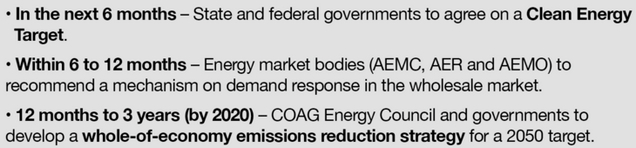
The Finkel Review at a glance

Recommendations

Next steps

From the Chief Scientist

Links

09/06/2017

Low Emissions Target: On Carbon Schemes, No One Says The Same Thing For Long

Fairfax - Peter Martin

If you don't know the difference between a carbon tax and an emissions trading scheme, or a low emissions target and an emissions intensity scheme, it's time to wise up.
On Friday Malcolm Turnbull gets the report of the Finkel review of the electricity market and later this year the report of the official review of his government's climate change policies.

What he does next will affect how much we pay, how much we use, the types of electricity we use, how quickly we cut emissions and how often the system breaks down.
But if we don't even know what the words mean, we'll be in the dark.
So here's a quick (opinionated) guide. And a warning: no one seems to say the same thing for long.

Carbon tax
It had the advantage of being simple, so simple that Tony Abbott actually backed it in his early days as opposition leader before reversing course and opposing it, and being swept to power.
"If you want to put a price on carbon, why not just do it with a simple tax?" he asked back then. "It would be burdensome, all taxes are burdensome, but it could certainly raise the price of carbon, without in any way increasing the overall tax burden."
It's what Julia Gillard did, and was martyred for. Exemptions from the tax and overcompensation in the form of income tax cuts and direct payments meant every cent it raised was handed back. And it cut emissions. Each year for more than a century through two world wars and the great depression Australia had used more electricity than the year before, until the lead-up to the carbon tax when both electricity use and electricity emissions began to fall and then fell sharply until mid-2014 when the tax was abolished by Abbott himself.
Illustration: Matt Davidson 
Turnbull gets the argument for the tax. "If you want people to do less of something, you tax it," was how he described another measure during the 2016 election campaign.

Emissions trading scheme
It's like a carbon tax (in fact, the carbon tax was designed to transition into one) except that it uses carrots as well as sticks. The government issues a limited number of pollution permits, but then leaves the polluters free to buy and sell them from each other. If one manages to cut emissions easily and no longer needs its permits it can sell them to another who needs them more, perhaps for a profit. It means the market sets the price of the permits, and the price is no higher than it needs to be.
Chief Scientist Dr Alan Finkel will deliver his electricity market report on Friday. Photo: Alex Ellinghausen
US President George H. W. Bush issued tradeable sulphur dioxide pollution permits to cheaply halve the incidence of acid rain. In his last days in office John Howard promised to use tradeable permits to cheaply meet Australia's carbon emission reduction obligations. Kevin Rudd got to work on the details with the then opposition leader Malcolm Turnbull, then Turnbull was rolled, the Greens said no, and Rudd baulked at taking the plan to an election. It would be painted as a big new tax. Voters would remember the electricity price hike but not the compensating tax cut, as Gillard later discovered.

Emissions intensity scheme
Long championed by Turnbull and independent Nick Xenophon and Greg Hunt as environment minister, an intensity trading scheme would have the advantage of raising no money whatsoever, and not pushing up prices much. Each industry would be given a "baseline" for its emissions intensity. For the electricity industry it would be a certain number of tonnes emitted per megawatt-hour produced. Plants that were above the baseline would have to buy permits from plants that were below it. As a result coal-fired plants would become more expensive to run and get less business, and gas and wind-powered plants would become cheaper and get more. All without anything that looked like a tax.
What Malcolm Turnbull does next will affect how quickly we cut emissions and how often the system breaks down. Photo: Jonathan Carroll
Critics say it would give gas a leg-up when what's needed is to move straight to renewables. This year Turnbull ruled it out partly because it could be presented as the emissions trading scheme he promised not to introduce. The real downside is that it wouldn't be an emissions trading scheme. By not moving prices much, it would do little to reduce electricity demand, working only on the sources of supply.

Low emissions target
Described by the Climate Change Authority as a second-best alternative to its preferred option of an intensity scheme, a low emissions target would operate pretty much in the same way as the current renewable energy target. Electricity suppliers would be required to source a certain proportion of their power from renewables or other very low emission sources such as highly-efficient gas or even coal plants, should they ever be built.
Its biggest drawback is that if it's all there is, there's no guarantee it won't change. The government might be lobbied to weaken it (making lobbying a very cost-effective proposition) or another government might impose a grander scheme on top of it. Potential investors in new plants might be forgiven for holding back. Given the dizzying array of changes since Howard first proposed an emissions trading scheme 10 years ago, it would be hard to blame them.

Links

Climate Change Is Real. So Why Won’t The Right Admit It?

The Guardian

From hard Brexiters to Donald Trump, nationalists who deny the existence of manmade global warming will eventually have to face the facts
‘Nationalists, gripped by an isolationist logic, are unable or unwilling to face the reality of global warming’. A protest against Donald Trump’s decision to withdraw from the Paris climate agreement in Chicago.
Photograph: Scott Olson/Getty Images 
Around 97% of climate scientists confirm the existence of manmade global warming, and public opinion is steadily catching up. In the UK, a recent poll suggested 84% of British people want Theresa May to “convince Trump not to quit” the Paris climate agreement. According to a survey spanning 40 nations, 78% of people support their country joining the global agreement.
Consensus on manmade global warming has never been stronger. Yet climate denial remains strong among a particular ideological group. Donald Trump’s withdrawal from the Paris agreement last week provides the strongest evidence yet that nationalists, gripped by an isolationist logic, are unable or unwilling to face the reality of global warming.
Yet American nationalists are not the only ones to resist action on climate change. Ukip’s general election manifesto pledges to pull the UK out of the Paris accord. More concerning, however, is that Eurosceptic Conservatives include prominent climate sceptics such as Lord Lawson.
Theresa May closed the Department for Energy and Climate Change within 24 hours of becoming prime minister. Having received £390,000 in donations from senior oil executives since she came to power, her manifesto now pledges to “build on the unprecedented support already provided to the oil and gas sector”. An entire Conservative election campaign is premised on the brand of “strong and stable”, while May keeps quiet about climate change – described by the UN as a threat to global stability “unprecedented in scale”.
Climate denial extends from the Brexit ringleaders to the voters who support them. A ComRes poll found that leave voters are twice as likely to deny manmade climate change as those who voted remain. The same poll found that Brexiters exhibit a general “distrust towards scientists”. In other words, they’ve had enough of experts.
Across the world, nationalist programmes – the French Front National, the BNP, Donald Trump, the Danish People’s party – have tried to cripple credibility in climate science, which requires collective action between states and is thus, for them, what Al Gore and others have called an inconvenient truth.
But there’s another explanation for climate denial among leave voters. Climate sceptics and hard-Brexiters share the common denominator of right-leaning free-market ideology. Over the past decade, various studies have found that conservatives and economic liberals are considerably more likely than other people to reject anthropogenic global warming, presumably because this is a problem that the market cannot solve.
Eco-nationalism, woven with contradiction, turns environmental discourse into a geopolitical blame game
The true danger from nationalist framings of climate change, however, is not denial, but the weaponisation of the environment in the service of self-interest. Trump famously called global warming a Chinese “hoax”, but less well known is that climate denial in China also arises from a nationalist distrust, in this case towards the west. A study published in the journal Environmental Sociology found that climate scepticism resulted from a patriotic “conspiracy theory that sees climate change as a western plot to constrain China’s development”. Similarly in India, the nationalism of the prime minister, Narendra Modi, is tied to the continuation of dirty coal as well as the excuse that western countries aren’t pulling their weight.
But Marine Le Pen is perhaps the politician to have taken environmental nationalism the furthest. In 2014, the Front National leader launched what she called the New Ecology movement, promising to ban wind farms and reduce France’s dependence on oil, but condemning the environmental movement as a “communist project”.
This eco-nationalism, woven with contradiction, turns environmental discourse into a geopolitical blame game. Eventually, Brexiters must come to realise this dissonance, along with the unalterable reality that air – and the carbon dioxide in it – does not respect national borders.

Links

Australians Want Focus On Renewables Not Coal, Lowy Poll Finds

Fairfax - Peter Hannam

Australians overwhelmingly want governments to favour renewable energy over fossil fuels even if it costs more, and concerns about climate change are strengthening, a new Lowy Institute poll finds.
The survey of 1202 adults during the first three weeks of March found 81 per cent of respondents wanted policymakers to focus on clean energy sources such as wind and solar, even if it costs more to ensure grid reliability.
Fossil fuels deserve less government support than renewables, a Lowy poll finds. Photo: AP
Just 17 per cent backed a focus on "traditional energy sources such as coal and gas even if this means the environment may suffer to some extent".
The finding was one of Lowy's highest results for a two-option answer and "somewhat surprising" since the poll was conducted soon after blackouts in wind-power dominated South Australia and the heatwave that stretched power supplies in coal-dependent NSW, said Alex Oliver, Lowy's polling director.
No bull: Australians strongly support more renewable energy. Photo: AP
"I wasn't expecting the response to renewables to be so positive in the context of that very heated debate," he said. 
The poll results come just days before Alan Finkel, Australia's chief scientist, is due to release his review of Australia's energy security on Friday.
The report is widely tipped to offer a range of options to support the transition away from coal-fired power including a so-called low emissions target that would reward less polluting energy sources.
The Turnbull government has touted the need to provide energy that is reliable, affordable and sustainable, particularly the first two traits. Ms Oliver said this year's poll and those in recent years suggest the government would be at odds with public opinion if it downplayed environmental outcomes.
Solar panels: Demand is expected to continue to grow with 303 gigawatts installed globally at the end of 2016. Photo: Rob Homer
For instance, some 57 per cent of those polled this year listed climate change as "a critical threat", behind only international terrorism at 68 per cent and North Korea's nuclear program at 65 per cent.
"A majority think [climate change] is a critical threat to our national interest," Ms Oliver said. "It's a policy challenge that's not going to go away."
Climate's ranking as the third-most important threat is up from sixth spot in 2014. The 11 percentage-point jump since then has raised concerns about global warming above fears over cyber attacks, foreign investment in Australia and asylum seekers.

More bang, fewer bucks
The world's nations added a record 161 gigawatts of renewable energy in 2016. But falling prices of wind turbines and solar panels meant total investment in the sector retreated 23 per cent from 2015 to $US241.6 billion ($321 billion), according to the REN21 Global Status Report released on Wednesday.
Australia added 900 megawatts of new solar photovoltaic panels last year, the eighth-most in the world, behind China's leading surge of 34.5 GW.
By accumulated capacity, Australia had 5.8 GW of solar, ranking it ninth behind such nations as Germany, Italy, Britain and France. China was easily the largest, with 77.4 GW installed in a global total of 303 GW.
​About 30 per cent of dwellings in Queensland and South Australia had solar PV at the end of last year, the report noted.
A survey by Lowy in 2015 found 43 per cent of Australians expected solar to be "our primary source of electricity 10 years from now".
That compared with 17 per cent for coal, 13 per cent for nuclear, 10 per cent for gas and 7 per cent for wind. At the time of that 2015 survey, solar provided only about 2 per cent of Australia's electricity.

Links

08/06/2017

How Scientists Reacted To The US Leaving The Paris Climate Agreement

NatureJeff Tollefson | Quirin Schiermeier

US President Donald Trump wants to boost the US coal industry. Luke Sharrett/Bloomberg/Getty
Nature rounds up reaction from researchers around the world to US President Donald Trump's decision to pull the United States out of the Paris climate agreement.

Jane Lubchenco, marine ecologist at Oregon State University in Corvallis and former administrator of the US National Oceanic and Atmospheric Administration:
Where to start? President Trump’s decision to withdraw from the Paris Agreement shows a blatant disregard for the wishes of most Americans and business leaders, an irresponsible and callous dismissal of the health, safety and economic well-being of Americans, a moral emptiness in ignoring impacts to the poorest people in the US and around the world, and gross ignorance about overwhelming scientific evidence. Far from “protecting America” as the president stated, withdrawing from Paris will make America more vulnerable and diminish its world leadership. It is terrifying that the individual who should be leading the rest of the world is so arrogant and irresponsible.
Our collective future and that of much of the rest of life on Earth depends in part on confronting climate change and ocean acidification. Doing so requires global collective action. It’s hard to imagine anyone consciously choosing to leave a legacy of impoverishment, economic disruption, increasingly bizarre weather, health impacts ranging from heat strokes to spread of diseases, rising sea levels and flooding — but that is just what the president has done. Moreover, the new path and the president’s proposed budget would forego significant economic opportunities.
Fortunately, mayors, governors, faith leaders, scientists and business executives understand what is at risk, respect the scientific evidence, and see the powerful economic potential and moral imperative in shifting to renewable energy, preparing to adapt to changes already under way, and investing in science and monitoring to guide future decisions. There is strong economic momentum to continue these actions, but they would have been accelerated and more effective with strong action and forceful leadership from the president. Alas, he has chosen instead to stick his head in the sand.

Jean-Pascal van Ypersele, climate scientist at the Catholic University of Louvain in Louvain-la-Neuve, Belgium, and former vice-chair of the Intergovernmental Panel on Climate Change (IPCC):
President Trump's decision to introduce a request to leave the Paris agreement in 2020 is regrettable. It negates both the results of (1) serious scientific analyses (many made by US scientists) about the urgency to address the climate change problem; and (2) the rigorous assessment made by the IPCC about the technical and socio-economic aspects of response options, including their significant co-benefits in other areas like air quality, energy security, health or job creation.
President Trump's speech attempting to justify his decision was an amazing concentrate of some of the worst climate confusers' and fossil lobbyists' arguments.
The United States has played a very important role over the years to foster and nurture quality scientific research about the causes and processes of climate change, the potential risks and the response options. It is a shame that this leadership by the US is temporarily lost. Others in Europe, Asia and emerging economies will most likely compensate for this loss, transforming a difficulty into an opportunity.
Almost 150 countries, representing close to 85% of greenhouse-gas emissions, have now ratified the Paris agreement. Removing the US contribution from this total still leaves almost two-thirds of the emissions covered by the remaining countries, which have confirmed their plans to honour the agreement. This means that the transition to a low-carbon economy, now seen as an opportunity by many, will continue unabated, with or without the US.

Susanne Dröge, climate-policy researcher at the German Institute for International and Security Affairs in Berlin:
The US pull-out is bad news for the international climate process. The United Nations negotiations need to focus on implementation. This will become more difficult, also because it is unclear how Trump wants to renegotiate the agreement. Political attention is absorbed due to the US move, attention that is needed for much more important issues such as bringing climate action forward.

Thomas Stocker, former co-chair of climate science for the IPCC, and climate and environmental physicist at the University of Bern, Switzerland:
Trump’s decision to ignore scientific facts of climate disruption and the high risks of climate-change impacts is irresponsible not only towards his own people but to all people and life on this planet. The US administration prefers old technology over innovation and transformation. It is rejecting the enormous benefits and returns that leadership in the next industrial revolution — decarbonization — has to offer.
The United States is the second-biggest emitter of carbon dioxide worldwide (and has contributed, with Europe, 52% of the share of cumulative carbon emissions since industrialization). It is withdrawing from its historical responsibility to reduce greenhouse-gas emissions and lead the way forward. Given the continuous commitment of most countries to reduce emissions, and the firm leadership of Europe, China and Russia in shaping the transformation towards a decarbonized economy, the United States runs the risk of being left behind and missing one of the greatest economic opportunities of our time.

Susan Lozier, oceanographer at Duke University in Durham, North Carolina:
Trump’s decision is as short-sighted as it is disheartening. The oceans already hold about 35% of the carbon dioxide that has been released to the atmosphere since the Industrial Revolution. Nothing good for the ocean and the life it contains comes from this storage. Whether you simply admire marine life or count on it for your livelihood, this decision shouldn’t sit well. An already fragile ocean is further imperilled.

Kevin Anderson, deputy director of the Tyndall Centre for Climate Change Research in Manchester, UK:
Beneath the veil of the low-carbon rhetoric of the Paris agreement, there is no evidence of a mitigation agenda even approaching the scale of our international obligations. Trump’s ostensibly reckless decision can be used either as a further excuse for continued apathy or as a catalyst for transforming our comfortable rhetoric into meaningful and timely action. In that regard, Trump’s ignorant blunderings can inadvertently be a force for good. Channelled positively, it could yet oblige the rest of us to forego our increasing reliance on speculative technologies and incremental carbon prices and begin to shape a mitigation agenda that is fit for purpose.
We need to take Trump at face value. If he is successful in returning the US to a coal-based economy (and that looks unlikely), then the European Union needs to borrow his ‘protectionist’ cloak and put in place carbon standards for imported goods.
Finally, let’s keep Trump in context. US states and cities have considerable devolved powers — and many of their leaders continue to favour climate science.

Joeri Rogelj, energy researcher at the International Institute for Applied Systems Analysis in Laxenburg, Austria:
The US withdrawing from the Paris agreement is damaging for international collaborative efforts to limit climate change, but will likely be most damaging to the US economy itself. The US has decided to sideline itself, internationally, diplomatically and morally — not to prepare itself for the future, but to gaze into the past for a few more years. Many other major economies, including China and the European Union, have indicated their strong commitment to implementing the climate agreement. This signal will spur innovation and business development in these regions. However, the US government refuses to give US businesses such a clear sense of direction and is disregarding the most robust scientific evidence by doing so. By setting research, innovation and business priorities based on misleading short-term political goals, the US will miss the boat and might become a laggard in the global technology and innovation landscape.
The climate issue is a global and a cumulative problem that was not solved in one go with the Paris agreement, but requires incremental updates and adjustments of climate action. To halt climate change, global carbon dioxide emissions need to be capped and annual emissions need to be brought to zero. One country failing on its commitments thus implies that deeper emissions cuts are required in other regions or later in the future. This makes the problem harder and less equitable to solve.

Oliver Geden, visiting research fellow at the Institute for Science, Innovation and Society, University of Oxford, UK:
The United States gave up climate leadership on the day of Trump's inauguration. In March, Trump announced his rollback of Obama-era climate regulations. So it’s been clear for some time that the US federal government is not going to act on climate change in the foreseeable future. Withdrawing from the Paris agreement is just another step, although a highly symbolic one.
For now, it seems that this step reunites the rest of the world, but only on the symbolic level. It is quite easy for a government to declare that it will stick to the Paris agreement. But in a regime of bottom-up climate policy that still aims to achieve top-down temperature targets, other governments would need to step up and declare that they increase their mitigation pledges — and act accordingly. That's obviously the harder thing to do.

Katharine Hayhoe, director of the Climate Science Center at Texas Tech University in Lubbock:
The biggest loser from the decision could be the United States itself. Why? Because although the Paris agreement is a climate treaty, a triumph for evidence-based decision-making, it’s also much more: a trade agreement, an investment blueprint and a strong incentive for innovation in the energy and the economy of the future.
Earlier this week, India broke its own record for the lowest bids for electricity from solar power. Last month, Ernst & Young listed its most attractive markets for renewables: the United States came third, behind China and India. And earlier this year, China announced a US$360-billion investment in clean energy to create 13 million new jobs. The US announcement shows that it will be doing its best to turn back the clock, while the rest of the world accelerates into the future.
It’s true that federal policy is only one piece of the pie, and not even the biggest one. Cities, states and private industry have arguably played an even more important role in shaping US technological innovation, energy mix and carbon emissions over the past ten years, even under proactive federal climate policy. But Trump’s announcement sends a strong message that the US would rather be one of only two nations in the world that is not interested in preventing “dangerous anthropogenic interference with the climate system”. That other nation? War-torn Syria. (Note that Nicaragua is also opting out of the agreement — but in that case it’s because it wants to do more, not less.)

Atte Korhola, climate-policy and environmental-change researcher at the University of Helsinki, Finland:
The US withdrawal from the Paris climate agreement is very disappointing and unfavourable for the United States and the rest of the world. Many climate scientists consider the Paris agreement insufficient for limiting warming to 2 °C, so the task will be all the harder now. However, international climate agreements have not been very effective so far in reducing emissions, so there is still hope that the United States will proceed on other fronts, such as through bilateral agreements, clean-tech development and investing in new ‘negative emissions’ technologies.
But the plans by the Trump administration to cut more than 30% from the Environmental Protection Agency’s budget and about 70% of the funding for renewable-energy research and development unfortunately don’t point in this direction. The situation in all respects is quite depressing. The only hope is that the US states, cities and companies will continue their effective work to cut emissions.

Benjamin Santer, climate scientist at Lawrence Livermore National Laboratory in California:
In Shakespeare's Julius Caesar, Brutus said these famous lines: "There is a tide in the affairs of men. Which, taken at the flood, leads on to fortune; Omitted, all the voyage of their life is bound in shallows and in miseries."
Today, the United States pulled out of the Paris climate agreement and missed the rising tide. Far from "Making America Great Again", this decision condemns the United States to becoming one of the 'has-beens' of history. We will become increasingly irrelevant to the rest of the world. They are going forward; we are going backward.

Hans Joachim Schellnhuber, director of the Potsdam Institute for Climate Impact Research in Potsdam, Germany:
It will not substantially hamper global climate progress if the US really quits the Paris agreement, but it will hurt the American economy and society alike. China and Europe have become world leaders on the path towards green development already and will strengthen their position if the US slips back at the national level. Innovative states such as California, the world's sixth-largest economy, will keep going for climate action, however. The Washington people around Trump hide in the trenches of the past instead of building the future. They fail to recognize that the climate wars are over, while the race for sustainable prosperity is on.

David Victor, climate-policy expert at the University of California, San Diego:
The odds of other countries renegotiating Paris are low to zero. The whole structure of the Paris agreement is to allow countries to set their own commitments. So there is nobody to negotiate with if a country needs to adjust. This claim that the problem with Paris is that the deal wasn’t struck properly is a disingenuous argument that is not informed by how Paris actually works, nor by any reality about how the world actually crafts big complex deals.

Glen Peters, climate-policy expert at the Center for International Climate and Environmental Research in Oslo:
It seems that Trump and his advisers have completely misconceived what the Paris agreement is. All his reasons for pulling out were basically the concessions that forged the path to the creation of the Paris agreement. Paris is the agreement that Trump desires!
The genius of Paris is to allow countries to put forward emission pledges that they feel they can meet (Nationally Determined Contributions). The US pledge was put forward by the US, alone. Countries are already enacting their emissions pledges, and — as could be expected by the design of the Paris agreement — most countries show signs of exceeding their conservative emissions pledges. China looks like it may peak its emissions a decade earlier than pledged. India has slowed down on coal consumption and sped up on solar deployment. Even the US has made great strides in the past decade, and was poised to make more.
The irony is that Paris is working, because it is designed to be flexible to the national circumstances that Trump himself champions!

Myles Allen, climate scientist at the University of Oxford, UK:
The Paris agreement is far from perfect, and one of its problems, as we are seeing now, is the lack of any real penalty for pulling out. Talk of trade sanctions is pure hyperbole and the last thing the world needs right now. But perhaps it is time to think about a simple product label: “Made in and sourced from regions that support the Paris climate agreement.” With California and Oregon insisting they will abide by the terms of the Paris agreement anyway, we could then have an interesting discussion about whether and how this could be stuck on Californian orange juice — or computers containing Intel chips.
Painful though it may be for the agreement’s supporters, acknowledging that it isn’t perfect must also be part of the response to this proposal to renegotiate the US terms of participation. Some, no doubt, will see this as just a distraction tactic. Others would argue that even to begin to negotiate would be to deliver Trump an ill-deserved political “win”. But thinking beyond 2020, we will eventually need to work out how to make the agreement both more effective and more acceptable to nations, companies and individuals that own substantial fossil-fuel reserves — or the US won’t be the last to leave.

Benjamin Sanderson, climate modeller at the National Center for Atmospheric Research in Boulder, Colorado:
Today's announcement that the US will depart from the Paris agreement is unfortunate, but it is no time for fatalism. From this point forward, there are now large uncertainties in global mitigation efforts over the coming years. The long-term evolution of the climate hinges on what other countries, and agents both within and outside of the US, do in response to the US departure from the agreement.
A complete failure of the agreement at this point, with business-as-usual growth for another decade, would almost certainly commit the planet to significantly more warming than the Paris goals, and the human consequences of this would be catastrophic. However, some major remaining signatories have expressed a commitment to increasing mitigation goals, and within the US, many states, cities and some of the country's largest companies are committed to mitigation irrespective of the US participation in the agreement.
Decisions made today are made in the context of confident projections of future warming with continued emissions, but clearly there is more to do to better characterize the human and economic consequences of delaying action on climate change and how to frame these issues in the context of other concerns. The role of the scientific community is more important than ever, both to continue to provide the best possible research to inform decisions, and to communicate any risks associated with further emissions in a publicly accessible fashion.

Links

Lethal Heating is a citizens' initiative