16/06/2017

Voters Prefer Low Emissions Target To Carbon Trading – Guardian Essential Poll

The Guardian - 

Thirty-six per cent of voters in the Guardian Essential Poll said they didn't know whether a low emissions target or a carbon trading scheme was best. Photograph: Bloomberg via Getty Images
Australian voters would back a new low emissions target over emissions trading as a policy to reduce carbon pollution, but are not sure about including "clean" coal in the mix, according to the latest Guardian Essential poll.
The latest survey of 1,785 voters, which follows Tuesday night's three-hour Coalition party room meeting in which significant concerns were ventilated about the Finkel review, also taps significant community concerns about the rising threat of terrorism in Australia.
Seventy-four per cent of the sample said the threat level in Australia had increased over the past few years, and 46% believe the Turnbull government should be spending more on counter-terrorism measures.
A new clean energy target is the centrepiece of the review of the national electricity market by Australia's chief scientist, Alan Finkel, handed to the prime minister and the state premiers on Friday.
While Coalition MPs spent Tuesday night arguing about the impact of the clean energy target on power prices in the biggest internal Coalition stoush about climate policy since 2009 – and the energy minister, Josh Frydenberg, said afterwards it was too soon to say whether the Coalition would ultimately adopt the policy – Australian voters seem sanguine about the idea.
Forty-five per cent of the Guardian Essential sample preferred a low emissions target to carbon trading, while 20% endorsed an emissions intensity scheme. Thirty-six per cent said they didn't know which option was best.
The voters most likely to prefer a low emissions target were people aged 65+ (51%), Liberal/National voters (51%) and high-income earners. Greens voters preferred carbon trading to a target.
Government conservatives, egged on by the Canberra-based lobby group representing the resources industry, are pushing to have high-efficiency coal included the new scheme, but the new poll suggests voters aren't sure.

The Finkel review - Politics over science

Asked whether they thought coal generation with 100% capture and storage should be considered a "low emission" energy source under the proposed low emissions target, 27% of the sample agreed, 29% said no, and 44% of the sample weren't sure.
In an interview with Guardian Australia this week, Finkel said it would be "surprising" if governments went on to legislate a clean energy target that "incentivised" new coal-fired power stations.
He also pointed out that modelling commissioned as part of the review did not predict any construction of new coal-fired power. "Under the modelling, none came in," the chief scientist said.
But with internal pressure mounting from conservatives, the prime minister used question time to insist Finkel had proposed a clean energy target which "does not penalise coal, [and] does not prohibit the construction of a coal-fired power station or indeed a gas-fired power station".
Turnbull said: "What he seeks to do there is to provide incentives for lower emission technologies including, but not exclusively, renewables."
Frydenberg repeated that sentiment after the internal debate at special party room meeting. "Dr Finkel has made it very clear he is not putting in place any prohibitions on coal or any form of generation capacity".
"He is putting in place incentives for lower emission generation. It is not a price on carbon or a tax on coal. Indeed, it has similarities to what John Howard put forward back in 2007".
Voters most likely to think coal should be in the mix were Coalition supporters (36%), men (33%) and older people. People most likely to have the contrary view were Greens voters (55%), people under 24 (37%), and South Australians (35%), with that state having a high proportion of wind energy.
With the energy fight expected to drag on for many weeks as the government finalises its response to the Finkel review, this week's Guardian Essential poll has Labor still ahead of the Coalition in the national political contest on the two party preferred measure, 52% to 48%.
The gap between the major parties narrowed in the month following the May budget, but within the poll's margin of error, which is 3%. This week's two party preferred result was the same as last week.
The apparent narrowing of the gap between the major parties has come at a time when terrorism has been firmly back in the headlines, both domestically and internationally.
The survey asked voters whether they approved of the way Turnbull was handling the terror threat. Forty-seven per cent approved of the prime minister's handling of the issue, down 9% since October 2015, and 24% disapproved, up 7%.
The questions in 2015 were put to voters during the Turnbull honeymoon – shortly after he took the Liberal party leadership from Abbott.
Voters most likely to approve of Turnbull's handling of the issue were Liberal/National voters (68%) and people aged 65+ (61%). Men (51% approve) were also more likely to approve than women (45%).
Interestingly, the group most likely to disapprove of the prime minister's approach were voters signalling their intention to vote independent or other (38%), followed by Labor voters.
Forty-six per cent thought the government should be spending more on anti-terrorism measures, which is up 7% from when the question was previously asked in March 2015, and 9% thought the government should be spending less (down 3%).
Voters were asked about the balance between security and personal liberty. They were asked whether they thought there should be more restrictions on rights and freedom for some people so there could be more security for others – or whether they thought laws already went too far in restricting freedom.
Fifty-four per cent thought there should be more restrictions on rights and freedom in an attempt to combat terrorism. Twelve per cent thought current restrictions went too far, and 19% thought they struck the right balance.
People more inclined to support restrictions were older voters (79%), "other" party and independent voters (68%) and Liberal/National voters (66%).
The cohort most likely to think the right balance is being struck were Greens voters (36%) and young people (29%).
Concern from voters about the threat level was roughly the same as when questions were previously asked eight months ago.
Voters most likely to think the terror threat had increased were older – 88% of 55-64 year olds, and 87% of over 65s – as well as Liberal/National voters (81%).

Links

World Coal Production Just Had Its Biggest Drop on Record

Bloomberg - Rakteem Katakey

  • Fossil fuel sees 'decisive break' from period of demand growth
  • Carbon emissions show little or no growth for third year: BP

The Coming Storm of Climate Change

It's the end of an era for coal.
Production of the fossil fuel dropped by a record amount in 2016, according to BP Plc's annual review of global energy trends.
China, the world's biggest energy consumer, burned the least coal in six years and use dropped in the U.S to a level last seen in the 1970s, the company's data show.
Coal, the most polluting fuel that was once the world's fastest growing energy source, has been a target of countries and companies alike as the world begins to work toward the goals of the Paris climate agreement.
Consumption is falling as the world's biggest energy companies promote cleaner-burning natural gas, China's economy evolves to focus more on services than heavy manufacturing and renewable energy like wind and solar becomes cheaper.


"The fortunes of coal appear to have taken a decisive break from the past," BP's Chief Economist Spencer Dale said at a briefing in London on Tuesday. The most important outcome of this "is carbon emissions, which saw little or no growth for a third consecutive year."
The shift away from coal in most of the world's major economies comes as U.S. President Donald Trump is seeking to revive the fuel, having promised during his election campaign to restore lost jobs in mining areas such as West Virginia.
Coal's decline has been driven largely by competition from cheap shale gas, prompting skepticism that the country's withdrawal from the Paris climate agreement will do much to halt the slide.
U.S. demand for coal fell by 33.4 million tons of oil equivalent last year to 358.4 million, the biggest decline in the world in absolute terms, BP data show.
Global consumption dropped 1.7 percent last year compared with an average 1.9 percent yearly increase from 2005 to 2015, according to BP. China, which accounted for about half of the coal burned in the world, used 1.6 percent less of the fuel, compared with an average 3.7 percent annual expansion in the 11 preceding years.
"At the heart of this shift are structural, long-term factors," Dale said. These include "the increasing availability and competitiveness of natural gas and renewable energy, combined with mounting government and societal pressure to shift away from coal towards cleaner, lower-carbon fuels."


Consumption of coal fell in every continent except Africa, the BP data show. Germany, Europe's biggest user, consumed 4.3 percent less coal. U.K. demand fell 52.5 percent, the biggest percentage decline among the world's major economies, according to BP's data.
In Asia, China's decline was partially offset by higher consumption in India and Indonesia, where the fuel is still so cheap and readily available that utilities prefer it over natural gas for electricity generation.
"Chinese hunger for energy is being tempered by moves to a more sustainable growth pathway and the rapid expansion of renewables, which spells even further trouble for coal in the years to come," Jonathan Marshall, an analyst at the London-based Energy and Climate Intelligence Unit, said by email.
Global carbon emissions, which grew at an annual average rate of about 2.5 percent in the 10 years to 2013, remained stagnant in the past three years, Dale said. While some of this reflects weaker economic growth, the majority reflects faster declines in "the average amount of carbon emitted per unit of GDP," he said.


Still, there needs to be a "significant fall" in emissions in order to meet the Paris climate goals, Dale said.
The world consumed 1.6 percent more oil last year, with India's use expanding 7.8 percent, or 325,000 barrels a day, and China's 3.3 percent, according to the data.
Demand from the Organization for Economic Cooperation and Development, a group of industrialized nations, grew 0.9 percent in 2016, compared with an average annual decline of 0.9 percent over the previous decade.

Links

Memo To Tony Abbott: A Clean Energy Target Will Extend Coal's Life

AFR - Ben Potter

Abbott and his followers seem determined to perpetuate the current energy policy uncertainty.
If Tony Abbott wants to preserve a role for coal power, he should embrace Alan Finkel's Clean Energy Target plan with both arms rather than declare war on it.
In fact, he should embrace the Emissions Intensity Scheme option - detested by hardline conservatives like Abbott so intensely that the Turnbull government abandoned it in December - because that is the policy option that preserves the largest role for existing coal plants out to 2050.
That's according to the modelling by energy consultants Jacobs Group (Australia) for the Finkel review of energy security.
Abbott and his followers seem determined to perpetuate the current energy policy uncertainty, under which the Renewable Energy Target tops out in 2020 (subsidies are available until 2030) and there is no other policy signal to help guide investment and meet our Paris emissions reduction goals.
Under business as usual, coal power falls to a fifth of total demand. Jacobs Group (Australia)

But Jacobs modelling clearly shows that coal would still be supplying a larger amount of power in 2050 under an Emissions Intensity Scheme (EIS) or a Clean Energy Target (CET) than it would be under the "business as usual" scenario.
Under business as usual, coal's share of grid electricity supply would fall from 137,000 gigawatt hours in 2020 to less than 50,000 GWh in 2050. By contrast, under the CET coal plants would still be pumping out 57,000 GWh by 2050, and under an EIS coal would still be supplying 61,000 GWh.

No-one wins from chaos
The result seems perverse. It comes about, according to Jacobs, because business as usual - essentially the suite of policies bequeathed to the nation by the shortlived Abbott Prime Ministership - is not good for plant owners or investors.
Uncertainty is highest, investment signals are muddy and coal plant owners have the least incentive to invest in the minimal upgrades and maintenance needed to prolong the lives and efficiency of their plant.
Under a Clean Energy Target, coal use would be higher than under business as usual. Jacobs Group (Australia)
Output and reliability fall, plants close earlier, and more costly gas generation is required to fill the gap, pushing prices for consumers and industry higher than if there were clearer investment signals under a CET or an EIS.
In short, no-one wins from chaos. Without continuing policy signals to encourage investment in wind and solar power, which increases supply and reduces wholesale prices because they have near zero marginal operating costs, retail prices are 7-10 per cent higher than they would be under a CET or an EIS. Industrial prices are more than 10 per cent higher under business as usual than under a CET or an EIS.

Coal is in decline
Old King Coal can bow out of the energy mix gracefully or disgracefully.
Coal would retain a larger role under an Emissions Intensity scheme than under business as usual or a Clean Energy Target. Jacobs Group (Australia)
The harsh reality for coal boosters like Abbott is that under any of these scenarios we are managing the decline of coal.
Total demand increases from about 200,000 GWh today to about 230,000 GWh in 2050. Coal's share of total demand falls from just more than two-thirds today to somewhere between a fifth and a quarter in 2050.
As Jacobs modelling shows, the withdrawal can be managed with optimal minimal plant upgrades and maintenance under CET/EIS policies, or the plant owners can do the bare minimum under business as usual, resulting in less efficiency, greater emissions, more unexpected failures and closures.
Hazelwood's closure in March - after just five months notice - is a good example. Owners Engie of France and Mitsui of Japan faced a $400 million bill - partly under pressure from Worksafe Victoria - to make the plant fit for use. They saw the writing on the wall and chose to close it.
Electricity prices are lowest under a Clean Energy Target, the Jacobs than under an Emissions Intensity Scheme or business as usual. Jacobs Group (Australia)
Coal plants are uneconomic
Abbott and some of his followers dismiss Finkel - and by implication Jacobs' modelling - as "magic pudding" economics, or something akin to snakeoil.
All modelling depends on assumptions, and all assumptions are open to challenge.
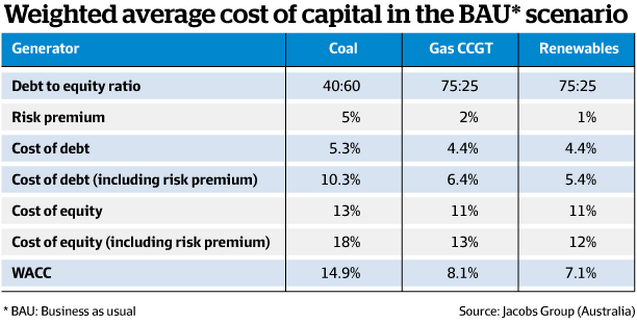
One of Jacobs' assumptions adds a 5 per cent risk premium to the cost of building new coal plants, on the grounds that it faces risks - stronger climate policies, carbon prices etc - that could curtail their lives early, before the investors or lenders have got their money back.
Coal plant has a much higher cost of capital than renewable or gas plant because of the risks. Jacobs Group (Australia)
Jacobs also assumes coal plant investors can borrow less than wind or gas plant investors, for the same reasons.
On this basis, Jacobs attributes a 14.9 per cent average cost of capital to coal pant, compared to just 8.1 per cent to gas plant and 7.1 per cent for renewable plant.
That helps to make coal plant uneconomic. Coal advocates are likely to seize on it as another reason to dismiss the modelling.
But it doesn't look all that unreasonable. No coal plants have been built in Australia for 10 years, partly because business now ascribes a carbon cost to new investments.

Clean coal is barely competitive
Jacobs' modelling doesn't include a carbon price. BHP Billiton assumes a carbon price of $US24 ($32) a tonne of carbon dioxide under current policies, and $US50 ($62) a tonne of CO2 under stronger policies aimed at limiting temperature increases to 2 degrees Celsius - the baseline Paris commitment.
That would add $22 to $43 a MWh to the $81/MWh price of power from an ultra-supercritical coal plant - the most efficient commercial plant - modelled by the Finkel Review.
The Finkel review finds new ultra-supercritical coal plant costs uncompetitive with wind even without a carbon price and even when some storage is added to a wind plant. They're barely competitive with large scale solar.
BHP applies a carbon price of $US24 ($A32) a tonne to new investments under current policies, rising to $US50 of stronger policies are implemented to limit temperature increases to 2 degrees Celsius. BHP Billiton
If anything, the risks are all on coal. It takes years to approve and build, adding to the risk. In the meantime, the cost of wind, solar and batteries is falling rapidly.
Finkel's findings on all-in costs look conservative. Other forecasters, such as Bloomberg New Energy Finance, find the cost of wind and solar even more competitive with coal than Finkel.
The latest wind farm deals confirm this. Origin Energy's sale of Stockyard Hill and AGL Energy's sale of Silverton wind farm included power purchase agreements at $52/MWh and $65/MWh respectively - less than new coal plant without a carbon price.

Links

15/06/2017

Don't Ignore Young People – We're Key To Fighting Climate Change

The Guardian - Daisy Kendrick*

Young people are consumers, employees, employers and future leaders but few NGOs take full advantage of the best space to reach us – social media
Only 11% of the globe’s NGOs employ a designated part-time or full-time social media manager. Photograph: Stephane Mahe/Reuters
For the world leaders, negotiators and advisers who gathered in Paris in November 2015, the news that the US is withdrawing from the COP 21 climate accord must have felt like a body blow.
For my generation? There’s a chance the story got scrolled past, filtered out, buried on a newsfeed, or missed altogether.
For those of us that did read it, it’s easy to feel a sort of detached but familiar disappointment. In some ways it’s just another amendment to a non-legally binding agreement that’s been written and re-written in the background for most of our childhoods, from 1995 in Berlin to 2015 in Paris.
That’s not how it should be. The news should be a starting gun for a new wave of activism, action and change. Because, while the world leaders signing accords in conference halls are important, the real change is going to come from us. Call us millennials or Gen Z or Net Gen, we’re the consumers, employees, employers and future leaders who will see the devastating effects of climate change.
We are also the most connected generation in history, with the capacity to arrange coordinated global protests like the Women’s March in a matter of days, to create a $2.5m Love Army for the Somali drought in a few weeks, or to commit to calling out #everydaysexism for half a decade.
And yet, many of the NGOs, charities and global campaigns are failing to mobilise us.
It’s easy to understand why they aren’t getting through to us – recent research shows that only 11% of the globe’s NGOs employ a designated full-time or part-time social media manager.
That means they’re losing the 28% of young people that use social media as their primary news source. It means they’re missing out on the 43% of millennials that are driven to make financial donations through social channels, the one in two who’ll share ideas with their friends online, or most importantly the one in three willing to donate their time.
Young people aren’t a “nice to have” when it comes to sustainability action and climate change. We’re 27% of the global population – how we choose to work, eat, drink and spend our money will change the whole ballgame.
Take the United Nations Ocean Conference. It’s the UN’s first ocean-focused conference, and it has come at the right time.
Henderson Island, a tiny landmass in the eastern South Pacific was found by marine scientists to have the highest density of anthropogenic debris recorded anywhere in the world.
Videos of the 18 tonnes of plastic piling up on an island otherwise untouched by humans, shared millions of time across social media, are a visceral reminder of the consequences of our one-use throw-away attitude to plastic consumption.
Plastic is deadly for fish and marine life, threatening the food supply of the 1 billion people who depend on it as their principle food source and damaging the global food chain for us all.
Yet, across the US, 500m plastic, non-biodegradable straws are used every day – for only a few minutes. In the UK, households throw out 40kg of recyclable plastic every year.
If we don’t act soon the World Economic Forum predicts that plastic will outweigh fish in the oceans by 2050.
Henderson Island has put the issue of plastics pollution on the global agenda – now it’s time for systematic behaviour change.
The key to success of the UN Ocean Conference won’t lie in agreements made or accords signed. What we need are innovative solutions – that will capture the attention and imagination of my generation.
The only way to seriously cut plastic consumption is by activating young people to bring about change. That’s change, not just as consumers, but as the people now entering management roles at the big businesses, manufacturers and retailers with the power to innovate supply chains and start evolving the world’s relationship with plastics and fossil fuels.
It might sound like an unachievable feat, but there’s good news. As the likes of Pepsi and Heineken have noticed (however controversial or limited their outputs) this generation wants to make change.
Recent research demonstrates that one in seven millennials around the world identify as “activists” and half of those recognise their activism as an important part of who they are. It’s one of the many reasons the likes of Apple, Facebook and Goldman Sachs are prioritising their environmental focus despite Trump’s actions – they know it matters to their future customers and workforce.
While many headlines have been written about the eight-second attention span of the social media-obsessed, there is another way of looking at it – it’s also a highly developed eight-second filter.
This generation has more information thrown at them in a day than people living a hundred years ago would come across in a month. We’ve become highly adept at prioritising content, and when content is important, we engage and act.
Throwing budget at social media channels isn’t a fix-all – this campaign will also be led by the brands, businesses and communities that tackle the issue with creativity and innovation.
It’s vital that we update and rethink our approach to climate and conservation, to make it the issue that mobilises this new tide of activists.
We’re probably locked into a planet that’s on track to warm by 2 degrees; temperature fluctuations are already causing widespread food shortages, unprecedented heatwaves and unpredictable weather.
The populations of small islands and developing states are faced with the prospect of becoming climate refugees, as rising seawater levels are threatening widespread flooding, contaminating drinking water supplies and destroying arable land.
My generation was born into a world where climate change is an immutable fact, not a theory to deny or accept, but a global threat, the effects of which we can see. We’ve got to make this the issue we tackle and overcome.

*Daisy Kendrick is a 23-year old environmental campaigner and founder of We Are The Oceans

Links

Clean Energy Turned Australian Politics Into A Simpsons Gag

Huffington Post - Josh Butler

The Finkel report has sent Canberra into a crazy timewarp back to 2009.
"I was elected to lead not to read!" Getty/The Simpsons
The Australian Financial Review reported 'Coalition MPs revolt against Clean Energy Target'. In the Sydney Morning Herald, the headline read: 'Tensions erupt in Turnbull government over climate and energy policy'. And News Corp headlines said, 'Backbenchers challenge Turnbull over Clean Energy Target'.
Every report on the Coalition's Tuesday afternoon party room meeting to discuss the energy report from government chief scientist Dr Alan Finkel, cast Tony Abbott as the headline act in opposition to plans for a clean energy target, with Fairfax even reporting that a Coalition MP warned: "Malcolm could lose his leadership over this".
No, we're not back in 2009, when then-opposition leader Turnbull committed to action on climate and renewable energy, and was rolled by a vocal crowd of opponents led by Abbott -- but it sure feels like it. Back then, it was Turnbull's support for an emissions trading scheme which was his downfall.
In 2017, the drama is coming from the Finkel report, which urges the government to commit to a clean energy target -- possibly up to 42 per cent of electricity production from renewable sources by 2030 -- and outlines that taking action in this area would actually be cheaper, and lead to lower power prices, than doing nothing.
IMAGE
On Tuesday, Turnbull canvassed the opinions of his party room with a special meeting running for several hours. A long afternoon and evening meeting stretched on, with reports of up to 30 MPs addressing their colleagues on the report -- most opposed to, or at least harbouring concerns about, the Finkel report, according to reports.

IMAGE


While energy minister Josh Frydenberg had been confidently asserting that the report would be supported roundly by his colleagues, it seems more than a few hold deep reservations about the Finkel report, driving another wedge into a Coalition party room already splintered on a handful of deep ideological issues.
An interesting point, however, is a small detail deep in the AFR's report. While Abbott has already been publicly vocal and critical of the Finkel report in media interviews, the AFR reported:
Mr Abbott, who had not read the Finkel report, slammed the CET on Monday as a "magic pudding" and "a tax on coal".Australian Financial Review
Abbott, the star attraction of the anti-Finkel crowd, has reportedly not even read the report he has been opposing. It smacks of the immortal line from 'The Simpsons Movie', as President Arnold Schwarzenegger confidently says "I was elected to lead, not to read!"


The chances of Abbott unseating Turnbull in another climate-fuelled coup seem infinitesimal -- Abbott is not thought to have anywhere close to the strength of numbers or party room popularity he enjoyed while prime minister, so Tony 2.0 is unlikely.
However, the schism in the Coalition over climate and energy policy cannot be underestimated.
There remains a hard core of MPs and senators resolutely opposed to phasing out coal and gas in favour of solar, wind or other renewable sources of energy, and they have support from the likes of key Senate crossbenchers One Nation and Cory Bernardi.
But while the Coalition tears itself apart again over climate and energy, one guy happy to sit back and watch it all go down is Labor leader Bill Shorten. The opposition leader spoke on Tuesday night of a new "civil war" in the government over the Finkel report.
IMAGE
"It would appear that chaos is the order of the day," Shorten said.
"Just when Australians thought that the climate change wars were over, it looks like a new civil war in the Liberal Party has taken it up to a new level."
On Tuesday, following the meeting, Frydenberg told ABC's 7.30 program it was "too early to say" whether the Coalition could agree to a clean energy target. No doubt more will unfold in coming days and weeks.

Links

Tensions Erupt In Turnbull Government Over Climate And Energy Policy

Fairfax - 

Climate-change policy has ignited tensions within the federal government, with a group of backbench MPs led by Tony Abbott confronting Malcolm Turnbull over the proposed Clean Energy Target in a special party room meeting.
As one MP in the room put it afterwards: "Malcolm could lose his leadership over this if he doesn't listen to us."

Climate policy debate intensifies
The disquiet means that Environment and Energy Minister Josh Frydenberg is likely to have little choice but to significantly modify the CET, as proposed in chief scientist Alan Finkel's review, to keep the backbench on-side as he finalises the Coalition's policy response, which is expected as soon as the end of July.
If he does, Mr Frydenberg runs the risk of putting Labor offside - particularly if the policy is too coal-friendly - and dashing the chance of the major parties striking compromise and ending the climate policy wars.
According to several MPs in the room, at least 21 backbench MPs raised concerns about the CET, while five spoke in favour of it and five were said to be non-committal.
Another senior MP in the room said while 32 people had spoken, one third of the speakers had been in favour of the Finkel review's recommendations, one third opposed them outright and one third expressed concerns but were non-committal.The special meeting to discuss the Finkel review of the electricity sector, which proposed the contentious clean energy target (CET), got underway just after 4.15pm on Tuesday and wrapped up three hours later.
Special party room meetings are rare. The last one was held under Mr Abbott and focused on a similarly fractious issue - the Coalition's policy on same-sex marriage.
The Coalition held a special meeting on climate change policy on Tuesday. Photo: AP
The length of the meeting and depth of feeling is likely to cause a re-think by the Turnbull government as it looks to implement a CET, with coal and gas likely to be given more favourable treatment.
One of the chief concerns of Coalition MPs was the declining role of coal in Australia's energy mix under a CET, while several MPs also warned that the CET - if implemented - could make things worse by further driving up energy prices.
The Finkel review found that doing nothing would drive prices up more than a CET or an emissions intensity scheme.
There were also calls in the meeting for stronger intervention in the gas market to put downward pressure on prices, despite the steps already taken by the Turnbull government.
The debate over climate change is a proxy, in some sections of the Coalition, for concerns about Mr Turnbull's leadership just as it was back in 2009 when he was replaced by Mr Abbott.
At various times in the meeting, Coalition MPs questioned the 42 per cent renewable energy target projected by Finkel, Australia's commitment to the Paris climate targets and the estimated $90 a year reduction in power bills under a CET versus business as usual.
Mr Abbott told the meeting that Australia had a huge natural energy advantage and that it should make the most of it.
The Prime Minister, who has the backing of senior conservative ministers such as Barnaby Joyce and Mathias Cormann, carefully left the door open to coal remaining in the nation's energy mix during question time.
"A clean energy target does not penalise coal, it does not prohibit the construction of a coal-fired power station or indeed a gas-fired power station," Mr Turnbull said.
Mr Joyce, who helped lead the campaign against Labor's carbon tax, said business-as-usual wasn't working and Australia needed to abide by its international obligations, which are to reduce emissions by 26-28 per cent against 2005 levels by 2030.
Mr Joyce later criticised Opposition Leader Bill Shorten, predicting the Labor leader would say no to whatever compromise policy position the government proposed.
" We are all moving to make sure we try and land this, even the National party. We are doing our bit, the Labor party should do their bit," he said.
Labor has questioned how a CET could include coal any type of coal fired power.
Senator Cormann said "the biggest cost . . . we could impose on consumers and taxpayers will be to do nothing".
The CET would provide incentives for generators to produce electricity below a certain emissions intensity baseline. The Finkel review modelled a scenario in which low emissions would be defined as below 0.6 tonnes of pollution per megawatt hour.
Generators would receive certificates for the proportion of electricity produced below that emissions level, which could then be traded.
Labor has indicated it will likely not support a government-proposed CET that sets the baseline too high, such as at or above 0.7 tonnes per megawatt hour, which would mean some forms of coal could earn partial certificates.

Links

14/06/2017

It's Hug A Climate Scientist Day. Just Remember: No Surprise Hugs!

The Guardian - First Dog on the Moon

Every 12 June a grateful planet pauses to give thanks to those brave souls who bear the burden of knowing what the rest of us can’t stand to think about 

Lethal Heating is a citizens' initiative