18/07/2017

A Mysterious Underwater Forest Warns Of Earth’s Rapidly Changing Climate

Washington PostPeter Holley

Divers inspect the remnants of an ancient forest off the coast of Alabama that scientists believe was killed by rising waters during an Ice Age. (Photo courtesy of Ben Raines)
The discovery began with a rumor about a fishing “honey hole” somewhere off the Alabama coast where the red snapper was plentiful.
By the time Ben Raines — an environmental reporter for the Mobile Press Register — heard about the location, the rumor had evolved.
Apparently, a local dive shop owner told him, the fish were congregating around an underwater forest peeking out of the sediment 60 feet below the surface.
Raines spent months persuading the man to take him to the secret location 10 miles offshore, an effort that paid off in 2011 as soon as Raines got his first glimpse of the forest.
“It was like entering a fairy world,” he told The Washington Post. “You get down there, and there are these cypress trees, and there are logs lying on the bottom, and you can touch them and peel the bark off.”
“It was an otherworldly experience where you knew you were in this ancient place,” he added.
How ancient exactly? That was the question Raines and researchers from Louisiana State University and the University of Southern Mississippi were determined to answer when they began dating chunks of wood at Lawrence Livermore National Laboratory using radiocarbon dating.
The expectation, researchers said, was that the trees would end up being around 10,000 years old. Nobody expected to find out that the trees were about five times that age, Kristine DeLong, a paleoclimatologist at Louisiana State University, told The Post.
Suddenly, DeLong said, researchers realized they had stumbled upon something extraordinary. The site was not merely a forest, but a prehistoric time capsule of the coastline and its climate during a 1,000-year period, when sea levels were much lower and much of the continent was hidden beneath a one-mile thick sheet of ice.
In terms of the bald cypress forest's age, experts say there is nothing else like it in the world.
“That 10,000- to 12,000-year time frame is one that scientists do a lot of research on,” DeLong said. “But there's just not a lot of records from 50,000 years ago because the ice sheets either covered it up or sea level has changed so dramatically that those sites are underwater now. That's one of the reasons that we're so excited about this site.”
This image shows the Gulf shoreline during an ice age 60,000 years ago. You can see the ancient shoreline, the modern shoreline, and the spot where the forest was found. Maps courtesy of Deep Time Maps.
The quest to reveal the forest's scientific secrets is captured in a newly released documentary directed by Raines and produced by the multimedia group This is Alabama and the Alabama Coastal Foundation. Raines and his team filmed the forest during dozens of visits to the site in recent years.
The forest, which stretches the equivalent of multiple city blocks, is located in the Gulf of Mexico, but was miles inland from the ancient shoreline. That estimate is partially based on pollen analysis and the fact that cypress trees cannot tolerate exposure to saltwater.
Researchers believe the area was a valley about 50,000 years ago that had rivers running through it, wildlife and swamps.
Scientists believe the forest may have remained hidden were it not for Hurricane Ivan, which caused billions of dollars in damage after it slammed into the Alabama and Florida coast in 2004. The storm produced massive waves that may have scooped out about 10 feet of sediment covering the forest.
Before it was revealed, likely by a hurricane, the forest had to be preserved, which required a number of circumstances.
When the forest was alive, it may have been part of a swamp in which the sediment had low levels of oxygen. Without oxygen, bacteria are slower to decompose organic material. If the forest was buried quickly in a flood, for example, the trees may have been preserved before they had a chance to rot.
“These trees were basically entombed or hermetically sealed,” Raines said. “They have nine feet of sediment over them, and oxygen is locked out. It's similar to peat bogs in Ireland, where scientists have found human bodies that were preserved by the unique environmental conditions.”
“This is the same phenomenon, but with trees,” he added.
When the chunks of the trees are removed from the ocean, researchers noted, ancient sap — still sticky and fragrant — oozes from the wood.
Grant Harley, a dendrochronologist who has analyzed wood collected from the site, told AL.com that he was amazed by the quality of the samples.
“When we ran those samples through the band saw, you could smell the resin just like you were cutting into a fresh piece of wood today. Same thing with when we sanded them down. They smelled fresh. Very well preserved,” Harley said. “Given the fact that these samples are thousands of years old, I was astonished.”
Removed from the water and split open, the 50,000-year-old wood is remarkably well preserved. (Photo courtesy of Ben Raines)
Researchers said one of the most interesting secrets revealed by the forest came not from the trees, but from pollen found in sediment core samples surrounding the trees. Analysis of the pollen reveals that it more closely resembles a coastal forest in modern-day North Carolina and Virginia, where the winter climate is much colder.
“The top meter of that core is just sand, like you sink your feet into the beach,” Andy Reese, a pollenologist at the University of Southern Mississippi, told AL.com. “Then, the next meter is sand and marine clay. Then, all of a sudden, it transitions to peat. That’s the weirdest thing I’ve ever seen in an oceanic core like that, just perfectly preserved peat, that runs a half a meter down.”
Peat, as AL.com noted, is a type of organic matter that is found at the bottom of swamps and bogs.
Analysis of the sediment cores shows tree pollens switching to various grass pollens as water levels rise and shoreline creeps inland, killing trees in the process. The cores have given researchers a window into ancient climate change during a period in which they suspect sea levels may have been rising as quickly as eight feet every 100 years.
In some ways, the forest is a preview that helps scientists understand what they can expect as the planet warms once again.
“It’s pretty rapid change geologically speaking,” Martin Becker, a paleontologist from New Jersey's William Paterson University who has visited the site, told AL.com. “We’re looking at 60 feet of seawater where a forest used to be … I’m looking at a lot of development, of people’s shore homes and condominiums, etc., you know. The forest is predicting the future, and maybe a pretty unpleasant one.”

The Underwater Forest, a new documentary by Ben Raines produced by This is Alabama, details the discovery and exploration of an ancient cypress forest found sixty feet underwater in the Gulf of Mexico, due south of Gulf Shores, Alabama. The forest dates to an ice age more than 60,000 years ago, when sea levels were about 400 feet lower than they are today.

Links

How to Plant a Tree in the Desert

New Yorker

A Dutch engineer has developed a cheap and easy way to restore vegetation to barren landscapes, and a for-profit business to go with it. Courtesy Land Life
President Trump’s decision to pull the United States out of the Paris climate accord was perplexing to Europeans for many reasons, not least of which was their determination that climate change represents a for-profit opportunity. In particular, the Dutch, who more or less invented water management in Europe, a millennium or so ago, have developed a specialty in climate-change-related innovation.
Four years ago, Jurriaan Ruys was a partner at McKinsey, focussing on global sustainability issues. The Dutchman had been an environmentalist since the age of eight, when he went door to door handing out stickers to save the sea turtles, but he became frustrated by the abstract nature of his work—flying around the world, advising governments on long-term climate strategy. Eventually, he up and quit. Ruys had trained as an engineer, and he was convinced that the current moment, thanks in part to instantaneous communication, was one in which grassroots solutions to yawning environmental problems could yield results. He decided to focus on desertification, which is both a symptom and an intensifier of climate change. It’s also one of the most multilayered problems on Earth, the results of which lead to human misery, political strife, and war. For the next year, Ruys hunkered down in a storage space, tinkering furiously, making frequent trips to the local hardware store.
The result of this freelance engineering is a low-tech invention that is succeeding beyond Ruys’s expectations. Three years after he emerged with his prototype, his invention has been adopted in Mexico, Cameroon, Malawi, Peru, Chile, Spain, Italy, Greece, Israel, China, Dubai, and the U.S. The company he formed, Land Life, with Eduard Zanen, an entrepreneur, has twenty employees who are working with the U.N., the World Wildlife Fund, the Los Angeles Department of Water and Power, the U.S. National Park Service, and in remote villages and refugee camps. José Luis Rubio, the vice chair of the European Soil Bureau Network, called Ruys’s invention “remarkable” in its results and told me that it represents “an innovative method” to restoring vegetation to barren landscapes.
Jurriaan Ruys’s invention, which can be buried underground, contains a sapling, water, and beneficial fungi. Courtesy Land Life
So what did Ruys invent? One way to restore degraded soil is to plant trees—lots of them. The catch is that seeds and saplings won’t grow in such soil, but if a young tree becomes large enough that its roots can reach groundwater it stands an excellent chance of thriving. Previous efforts often followed two paths: cumbersome and impractical irrigation techniques, or tossing a few million seeds out of an airplane and hoping for the best. Ruys’s innovation was to develop a doughnut-shaped waxed-paper cocoon, the base of which is buried underground. It contains the sapling, enough water to sustain the tree while it establishes a root system, and a small lozenge of beneficial fungi. The cocoon is cheap, easy to plant, scalable—a community can plant hundreds of acres of them in a short time—and biodegradable. Rubio told me that in the desert regions of Spain where his organization is working, other efforts have resulted in a success rate of ten to twenty per cent; “the cocoon,” he said, “is providing around ninety-five per cent survival rate of trees.”
In its three years of existence, Ruys’s company has planted a quarter of a million trees in twenty countries. Its current projects include reforestation in China, renewing mesquite forests that have been harvested for charcoal and reëstablishing the trees in which monarch butterflies nest in Mexico, planting forty thousand trees for shade and wood fuel at a refugee camp in Cameroon, and restoring ecosystems in Italy, Spain, and Greece.
Maybe more interesting than Ruys’s invention is the way he has worked himself into and around the bureaucratic complexities of the issue. The cheapness of the product and the ease of planting helped him to leapfrog over old-school N.G.O.s and establish direct relationships with villages. Olaf Tchongrack, an administrator with the Office of the United Nations High Commissioner for Refugees, told me that his people in the field were impressed precisely because of the cocoon’s simplicity: “It’s actually an ancient technique. What’s innovative is they’ve found a way to industrialize it and keep costs low.” Its success has gotten the attention of governments, the U.N., and private investors. At the moment, the company isn’t able to fill, or even respond to, all the requests it is getting for the cocoons.
The cocoon is a bit deceptive in its seeming simplicity: a good deal of high-tech thinking went into it. “Everyone likes biodegradable,” Ruys said, “but it’s actually a tricky concept. You want a thing to work over a period of time, then completely disappear. It’s hard to do, which is why, as consumers, we still buy plastic.” Ruys solved the problem with a particular kind of wax coating that dissolves at the right time. He also spent a lot of time developing a wick that would precisely feed water to the plant.
His company’s approach is similarly deceptive in its apparent simplicity. As a former McKinsey partner, he is used to thinking at a macro level, and his true goal, he told me, is nothing less than “to professionalize nature restoration.” Where agribusiness is highly professional, nature restoration, he said, remains “a charity.” He wants this to change. “Agriculture has developed satellite technology, G.P.S. locationing, remote sensors. We want to bring all of that to bear,” he said. Land Life is working on an app that uses Google Earth and other existing technologies to allow for real-time monitoring of every one of the trees it is planting.
Ruys and his partner insisted from the start that Land Life should be a for-profit company. As of this year, it is breaking even on revenue of approximately 2.5 million euros, with clients ranging from N.G.O.s to private companies to an Israeli businessman who has paid Land Life to plant trees on both sides of the Israel-Palestine border. Ruys is part of a generation of Europeans who believe that tackling climate change has to be commercialized if it is to succeed. And, as dire as the ecological threats are, he finds the nature-restoration field to be wide open. The big aid agencies, he said, are receptive to new ideas in ways they never were before, and so are communities in need of reforestation. “I see this as a very doable technological challenge,” he said. “And I see a generation that sees it as a no-brainer, that is ready to buy a product called ‘fix this planet.’ ”

Links

Why a Warming Arctic May Be Causing Colder U.S. Winters

National GeographicSarah Gibbens

A new study shows how a warming Arctic could negatively impact regions thousands of miles away.
A piece of ice breaks from Juneau's Mendenhall Glacier in Alaska. Photograph by Pete McBride, National Geographic Creative
When a U.S. Republican senator threw a snowball onto the Senate floor in late February of 2015, he used it to underscore his belief that human-made climate change was an alarmist conclusion. The snowball had been rolled from the Capitol grounds in Washington D.C., which, at the time, was experiencing an uncharacteristically cold winter.
If global warming was real, he posited, how could the nation's capital experience such severe cold?
Uncharacteristically cold winters, however, just might be one of the most hard felt effects of climate change, according to a study published in Nature Geoscience by a team of researchers.
The study found that unusually cold temperatures in northern North America and lower precipitation in the south central U.S. all coincided with periods of warmer Arctic weather.
To reach this conclusion, the researchers analyzed how teleconnections in the Arctic cause cooler winters in North America. Teleconnections are largescale weather anomalies that influence weather across continents and span large portions of the atmosphere. The most commonly watched teleconnection weather patterns are El Ninos/as, but teleconnections are observed around the globe.


El Niño is a series of complex weather patterns that occurs every two to seven years. It causes drastic changes in weather that can lead to billions of dollars in damages, high death tolls, and disease. Find out what causes El Niño, how it can affect you, and why it is so hard to predict it.

Anna Michalak, a researcher at the Carnegie Institution for Science, was involved in creating an ensemble of models used to support the study's findings. She explained that the massive system of climate models, called MsTMIP, creates a large dataset that allows researchers to study the changes in the Earth terrestrial biosphere.
In order to reach their conclusions, the study's authors looked at how the terrestrial biosphere (all the plants and soil on the Earth's surface) contributed to or pulled carbon from the atmosphere. They found that over the past three decades, plants pulled less carbon from the Earth's atmosphere during periods of warmer weather in the arctic.
"Even though we're talking about the Arctic, it has immediate impacts on what we experience at lower latitudes," said Michalak.

What Does It Mean?
Beyond a need for more scarves and gloves, colder winters could have serious implications for North American farms.
In an op-ed published in Nature alongside the study, noted climate scientist Ana Bastos wrote that the warming temperatures have the potential to weaken vegetation and shorten spring growing periods. The study looked at crop yields recorded by the National Agricultural Statistics Service of the U.S. Department of Agriculture and found crop production declined by an average of one to four percent during warmer Arctic years. Some states, however, saw a decline of almost 20 percent.
Bastos cautioned that the link between a warmer Arctic and harsher U.S. winters was more complex than a simple cause and effect mechanism. Weather patterns can be notoriously unpredictable, and other factors such as soil health and farming practices can impact crop growth.
The study suggests that as warmer Arctic years become more frequent, crop productivity could be increasingly hard hit. All of this could lessen the impact of carbon sinks, a term that refers to how much carbon a terrestrial biosphere is capable of pulling from the atmosphere. With fewer plants available to absorb more carbon, Arctic warming could accelerate, further weakening the carbon sink, suggested the study.
"Whether the relationship found implies a decreasing carbon sink capacity of North American ecosystems in the coming decades is unclear," wrote Bastos. She cautioned a need to study how Arctic warming affects other regions in the Northern Hemisphere.
While the specific repercussions of warmer Arctic seasons and the severity at which those repercussions will be felt requires further research, the study effectively underscores the interconnectedness of Earth's atmosphere.
Speaking about how human influence changes weather patterns, Michalak added, "Winters could be harsher; flooding is more intense; droughts are more frequent... By emitting greenhouse gasses, we're not just warming temperatures, we're perturbing the Earth's entire system."

Links

17/07/2017

Burning Fossil Fuels Almost Ended All Life On Earth

The Atlantic - Peter Brannen

A road trip through the geological ruins of our planet's worst mass extinction.
Mike Hollingshead / Corbis / Getty
“Who you with?”
“I’m a science journalist,” I said, jolted from my reverie on the shoulder of I-68 in Maryland, where a crowd of geologists had gathered on a field trip to poke at some rocks revealed by the highway department’s dynamite. The rocks, slate gray and studded with pebbles from a punishing ice age, spoke to a mysterious global die-off at the end of the Devonian period, hundreds of millions of years ago.
“I’m researching a book on mass extinctions,” I said.
“Cool, I work on the end-Permian boundary in Wyoming.”
My ears perked up. He was talking about a line in the rocks that recorded the greatest catastrophe the Earth has endured in its entire history.
“I didn’t really realize there was a—”
“Let’s go out there. Want to go out next week?”
This was my introduction to Jonathan Knapp, a PhD candidate at West Virginia University. The surprisingly bold introductory exchange, I would later learn, was not atypical for Knapp, for whom there are no half measures. A week later I was in his passenger seat on a road trip across the country to Wyoming to see the worst thing that’s ever happened in person: the end-Permian mass extinction.
Imagine you took a random spin in a time machine and ended up in the Permian. Now imagine the time machine breaks down. You slam your fists on the dashboard and a digital red “251.9 MYA” dimly flickers and dies. The view out the cockpit window reveals red sand dunes and little else. From what you remember of your geology training you know that 252 million years ago is just about the worst thing you could possibly read on your display.
You kick the door open and—holy hell is it hot. You scarcely believe your breath. As you reach for the latch to slam it shut you’re startled by a thundering roar coming from the other side of the dunes. Curious, you step out into the primeval landscape. There’s no life, save a wilting weed here or there, where the dunes give way to barren soils, cracked and crusted with salt. The sandblasted husk of some odd creature sprawls across the wastes, its fangs bared.
A sole mayfly buzzes in and out of your sight—its presence in this desolate wilderness is comforting. Scrambling over the red sand, and gasping for air, you follow the distant roar. You notice that, though the sun is out, there’s a funereal gloom to the day. As you crest the dunes you see why. A strange ocean spreads out before you, hosting the largest waves you’ve ever seen. They’re eerily backlit and slosh a sickly purple and green. Through the haze, and over the roiling ocean, a sublime darkness organizes on the horizon.
You walk down to the shoreline and take a few steps into the lapping waters, drawn toward the enveloping gloom. The seawater is almost painfully hot. There’s nothing alive under the waves. There doesn’t seem to be anything alive anywhere really. You squint and marvel at the growing terror on the horizon. You’ve seen billowing thunderclouds before, but this panoramic tempest seems to tower into eternity. Wild hot winds begin to whip in all directions. You find it difficult to breathe. Slowly baking, you know should head back to the temporary safety of the ship, but you linger here all alone on the dimming coast, transfixed by the blossoming apocalypse just over the Earth’s curve. A putrid odor begins to ride in on the swirling winds and, as you finally turn back in a panic, you pass out. Before long, this doomsday storm makes landfall, and what meager life clings to this country is stamped out for millions of years.
This is one vision of what it might have been like to visit the world as it ended a quarter billion years ago during the end-Permian mass extinction—the worst moment in the planet’s entire history. The nightmare was sketched for me by the head of geosciences at Pennsylvania State University, Lee Kump, whose “horror movie” speculation was that there might have turbocharged “hypercanes” of almost unbelievable intensity assaulting the supercontinent Pangaea—the result of runaway global warming. These mega-storms might have had 500-mph winds, filled with poisonous hydrogen sulfide sucked out of a rotting ocean that topped 100 degrees Fahrenheit.
Admittedly, this is mostly Kump’s speculation, but we do know that something apocalyptic was unfolding then, when the Earth suffered a catastrophe that nearly sterilized the planet. Once magnificent coral reefs, built of strange Paleozoic creatures, and hosting a party of tentacles, trilobites and technicolor fish, were turned into piles of bacterial slime, as oxygen-starved and rapidly acidifying seas spread out onto the shelves, killing almost everything in the ocean. The planet’s forests all but disappeared for almost 10 million years. With Earth’s vegetation destroyed, rivers stopped meandering in narrow channels, instead spilling forth in wide, sloppily braiding torrents. Even insects suffered a mass extinction, their only such misfortune across all of natural history. Meanwhile an odd menagerie of misfit proto-mammalian offshoots—some rhinolike and lumbering, others lupine and athletic—seem to have been nearly wiped out. Fungus spread across the Earth.
The cause of all this misery—a growing consensus of paleontologists and geologists believe—was burning fossil fuels. Though acid rain and a ravaged ozone layer likely played a role as well, geochemical signals in the layers of ancient rock that capture the global die-off suggest a carbon dioxide-driven global warming catastrophe—one so profound it would dwarf even the extraterrestrial disaster that cut short the dinosaurs’ reign almost 200 million years later.
Near the top of the supercontinent Pangaea in what is now Siberia, a gigantic plume of magma—enough to cover the lower 48 states a kilometer deep—was burbling through one of the most coal-rich regions in the world and covering millions of square miles of Pangaean countryside in basalt lava. As the molten rock ponded underground, seeping sideways into the crust, it incinerated not only untold seams of coal laid down by ancient forests in the hundred million years before, but huge deposits of oil and natural gas as well. The ignited oil and gas exploded at the surface, leaving behind half-mile craters. The volcanoes injected as much as 40,000 gigatons of carbon into the atmosphere. This unthinkable volcanism, and the greenhouse gases it liberated, account for the extreme global warming and ocean acidification seen in the rocks spanning the dreaded Permian-Triassic boundary. It’s even been called The Great Dying. Carbon dioxide, it seems, nearly killed the planet.
****
I was picked up at Midway Airport in Chicago in a forest-green Jeep Wrangler. Knapp, an oil geologist, had plastered a geological time scale to the center console, and the trunk was filled to the roof with rocks, camping equipment and two luxuriant, wool-lined, full-length farwa coats he had picked up in Saudi Arabia. The farwas, he said, would protect us from the brutal mid-continental Wyoming November cold.
If having a good conversation partner is the key to a successful road trip, Knapp should be inducted into the road-trip hall of fame. Not only has he accumulated an endless supply of good stories in his young but colorful life aboard oil rigs—from the Gulf of Mexico to North Dakota to Nigeria (“people would go up to the pipeline and make holes in it in and fill their Zodiac boats with crude oil”)—but he can illuminate the featureless stretches of middle America with the revelatory light of geology.
The unassuming, diffuse infrastructure of flyover land is, in fact, the country’s circulatory system.
Western Kansas is crushingly boring to drive across, but a little less so when you realize its flatness belies a former life at the bottom of the Cretaceous Interior Seaway, an inland ocean filled with 50-foot-long killer mosasaurs. Knapp can convincingly hold forth on virtually anything you point at—which is exactly what I did as we drove through the long, drawing board-flat monotony of the heartland.
“Natural gas compression station,” he said, as I pointed to an anonymous facility in the distance.
“Natural gas pipeline transfer station,” he said, when I indicated another.
And another.
“Unconventional well pad,” he said. “It probably goes down a mile and then goes over two miles.”
In the hubbub of a New York City or San Francisco one gets the intoxicating sense that the city streets and skyscrapers are where the business of the country is conducted—that that’s where the action is. But driving around the heartland with an oil geologist you realize these glitzy coastal diversions are a facade. The unassuming, diffuse infrastructure of flyover land is, in fact, the country’s circulatory system: unmarked metal boxes on the side of the highway, inscrutable pipes and polished valves behind fences at the edge of the prairie. This is the inconspicuous hardware that delivers the glowing screens and cheap meat of modernity.
The road trip reminded me that the coasts are separated by a sea, just as they were a hundred million of years ago, but this one is made of corn and soy rather than seawater. These amber waves of grain are fed by fertilizers synthesized from fossil fuels. The artificial bounty is then transformed into the millions of cows crowded on the vast, sweeping feedlots of western Kansas and eastern Colorado that we passed along a 150-mile stretch of road that smelled like shit, even with the windows rolled up. In some of these roadside tableaus the entire modern life cycle was in view, with oil pumpjacks bobbing up and down in the middle of the vast cattle multitudes, whose farts account for a more than a quarter of US methane emissions. Knapp noted that the road we were driving on was made of asphaltene, the heaviest component of crude oil. Food, livestock, electricity, pharmaceuticals, roads, plastics—it’s fossil fuels all the way down.
“ExxonMobil is a chemical company,” says Knapp. “That’s what we forget.”
Those who rail against the corporate sins of companies like Exxon tend not to appreciate the extent to which their existence, as well as the entire upside-down ecosystem of modernity, depends on it. And now that we have 7 billion people, most of whom sprang from this artificial surfeit of geological energy, it will be far harder to put that genie back in the bottle than most imagine. But the failure to do so will mean the end of the world as we know it. Knapp’s familiarity with burning hydrocarbons and coal wasn’t incidental to his study of the worst mass extinction in Earth’s history. It was the kill mechanism.
“Need petroleum?” Knapp asked me, offering chapstick.
No industry is more responsible for our knowledge of the ancient Earth than fossil fuel companies, which have funded much of the world’s geology research for over a century. It makes their calculated and coordinated misdirection on the topic of climate change all the more jarring. At a recent geology conference, sponsors like Hess and Exxon were prominently thanked for their generosity, while climate change activists and academics like Naomi Oreskes and James Hansen were invited to take center stage as honorees and keynote speakers. The energy industry is schizophrenic: at its best, staffed with brilliant geochemists who understand the carbon cycle better than anyone on Earth and, at its worst, recklessly following economic incentives into a civilization-threatening tailspin.
Knapp provided an insider’s perspective on the industry: he champions natural gas as a “bridge fuel” to a zero-carbon economy (certainly a debatable strategy at this late stage in the world’s carbon budget crisis) and is the part-owner of a drill rig in Michigan, but insists that if we burn all our coal, an end-Permian catastrophe isn’t out of the question.
Near Lawrence, Kans., at the gateway to the prairie, Knapp swerved off the highway and pulled over next to an unremarkable road cut. He invited me to look closer. There were fossil seashells everywhere and, in some of the layers, ancient plant roots dug down into the fossilized muck. He pointed toward an oval knob sticking out of the ancient strata.
“Lungfish burrow,” he said. “This was normal. This was life. There was everything here. The world was happy.”
This was before the Permian.
After driving for three more hours into south-central Kansas on the border with Oklahoma, the prairie fell away and the landscape suddenly took on an alien aspect. Everything went rusty red, and the unending flatness gave way to ragged crimson hills and buttes. Shimmering seams of salt and gypsum crystals from dried up seas slumped out of the hillsides like shattered glass. There were no more shells, no more lungfish burrows, no fossils, nothing. It didn’t look like any version of Kansas I had ever pictured, or really much like any place I’d ever seen, for that matter. Once again Knapp swerved onto to the shoulder.
“Permian?” I asked.
Knapp nodded as he stepped out of the car and pulled a thicket of tumbleweed out of a gully. He invited me to crawl under a barbed-wire fence to take a closer look at the rocks. I grumbled that I wasn’t eager to be shot for trespassing.
“Trespassing is a vital skill for geologists,” he retorted.
These were the Gyp Hills near the border of Oklahoma in central Kansas. The unusually hilly terrain (for Kansas) is a product of the enormous Permian salt layers that had dissolved underground, giving the region its strange topography. Some of the hills had crosses on them (memorials for the Permian, I liked to imagine).
This was no country for Kansas farmland. Here the earth was literally salted, from dried-up Permian seas. Some of these dissolved Permian salt layers have formed caverns underground, which are used to store reservoirs of fossil fuel.
Earlier in the trip we’d dropped by the University of Kansas core lab in Lawrence, Kans., an Indiana Jones-style warehouse of ancient wonders: cylinders of rock drilled out from the far corners of the state. Knapp pulled out a famous core from the same rocks as those we’d seen in the Gyp Hills, a core that had been drilled a half-century ago by Amoco in search of oil. The rock alternated between Martian-looking dusty reds to huge sections of pure salt. In 2013 Knapp’s advisor at West Virginia, Kathleen Benison (then at the University of Kansas) found that lake water trapped in the salt reached literally otherworldly temperatures on the day that it was sealed away in these rocks, as high as 163.4 degrees Fahrenheit.
“These are the most extreme conditions in all of Earth’s history that we have a record of,” says Knapp. Even stranger, this was happening on an Earth that, not long before, had had ice on its poles. “It’s a different planet.”
Unsurprisingly, there’s no life in these ghastly rocks (even most plant life checks out at temperatures not much more than 40 degrees Celsius), making them exceedingly difficult to date.
“There’s absolutely nothing to date in any of these rocks because everything’s dead,” says Knapp. “But what we can say is that this is definitely Permian.”
“It should be a national priority to study the Permian to figure out what the hell happened.”
The rocks most likely predate the greatest mass extinction of all time, possibly by millions of years. They may be indicative of a world that was stumbling toward its date with Armageddon, its supercontinental configuration making life on Earth increasingly unpleasant. The period is punctuated with mysterious minor extinctions, like one that might have taken out sail-backed proto-mammals—creatures like science museum star Dimetrodon, whose bones are mostly known from neighboring Oklahoma and Texas. As the Permian planet limped to its finale plants and animals would continue to thrive elsewhere and, to the south, coral reefs in Texas would blossom as well, leaving behind the Guadalupe Mountains and a trillion of dollars of oil—but here in Kansas it was hell. Rocks similar to the Gyp Hills extend all the way to North Dakota, indicating that this wasn’t some quirk of local geography like Death Valley.
“This isn’t local,” says Knapp. “This is all of central Pangaea.”
Southern Methodist University geologist Neil Tabor has dubbed these vast lethal expanses that took over the middle of the planet in the Permian the “wastelands of tropical Pangea.”
To Knapp the Kansan rocks indicated that much of the world was already getting quite weird in the run-up to the greatest mass extinction ever. One speculation, borne out by modeling, is that supercontinents promote giant arid interiors that shut down the processes of rock weathering—the planet’s most effective way of drawing down excess carbon dioxide over geological time spans. As a result, the Permian planet might have been less effective at regulating its temperature.
“So what I like to talk about is ‘the Great Weirding’ and not just the Great Dying because the Great Dying seems to have been a relatively quick event at the very end. But if you just talk about the Great Dying you’re missing all of this other crazy stuff that led up to it,” he said. “The Earth was getting really weird in the Permian. So we’re getting these huge lakes with these negative pHs, which is really weird, we don’t know why that happened. Another thing is that the whole world turned red. Everything got red. You walk around today and you’re like, ‘Hey, there’s a red bed, I bet it’s Permian or Triassic.’ The planet started looking like Mars. So that’s really weird. We don’t know why it turned red. Then you have a supercontinent, which is weird in the first place. Plate tectonics has to be acting strangely when you have all the continents together. Eventually it rifts apart and we go back into normal plate tectonics mode, but during the Permian-Triassic everything’s jammed together. So there has to be something strange going on. And then at the end, the Earth opens up and there’s all these volcanoes. But we’re not talking about normal volcanoes, we’re talking about weird volcanoes.”
As we continued north on Route 287, over the Colorado-Wyoming border, the trappings of society fell away and the sun set again over the pale grasslands. Driving through Carbon County, Wyo., the unending darkness of the barren plains was pierced by a glittering Oz on the prairie. This was Sinclair, Wyo., (named after the oil company) and an enormous, illuminated refinery twinkled like a lonely Manhattan, ceaselessly digesting carbon from the ancient seafloor day and night.
“If we understood why things got so crazy in the Permian I would be a lot more comfortable,” Knapp said, breaking the silence. To some geologists, the extraordinary nature of the end-Permian catastrophe represents a level of environmental chaos so extreme that humanity could never hope to emulate it. But Knapp wasn’t so sure.
“I see [a few] possibilities. The first is that things just really got that crazy. Shit happened. The second is that we just really don’t understand positive feedback loops yet. That’s the scary option. The third is that you can’t do it without a supercontinent. We need to be studying these time periods when carbon dioxide caused problems, because right now we don’t understand them at all. It should be a national priority to study the Permian to figure out what the hell happened.”
****
The next morning we set out from Rawlins, Wyo., for the extinction boundary. But we couldn’t look at the prototypical rock section, first described in the 1960s.
“It’s on a ranch and they won't let you access it anymore,” Knapp said, eyes blearily searching the horizon, pulling from a cup of cheap coffee. “They say it's a liability thing but I think it's because they don't like geology and global warming and think the Earth's 6,000 years old. That's been the most challenging part of my work. I can't get access to any of the outcrops because they’re all on ranches.”
The end-Permian rocks of Wyoming can be seen from space, or (more easily) from Google Maps. They appear as strange little shocks of crimson peeking out from under the faded tans of the prairie. In the northeast corner of the state they fleck the periphery of Devil’s Tower. But there aren’t many people studying these rocks. When Knapp returns to the same outcrop in central Wyoming every few years he finds his rock hammer on the same rock he left it on.
We drove over a ridge that looked out over an empty basin and pulled off the road and into a small canyon of red rocks. At the top of the canyon the rocks gave up their Martian hue at long last, and were etched with the geological traces of tranquil lakes and river channels and even dinosaur footprints. Up in those rocks the Earth was finally recovering, and the reptiles of the Earth’s most storied age—the Mesozoic—were making their tentative claims to a world that they would come to rule for more than 100 million years. But down here along the dusty trail was the end of the Permian, and the planet was still fighting for its life. In the huge stacks of red rock Knapp saw an alternating hellscape of sheet floods and red desert soils, and even some piles of bacterial slime that festered in grotesque ephemeral lakes.
“One thing I don’t see anywhere here is roots,” he said. “At the top of that rock over there in the Triassic, we start to see tons of roots. It’s the same depositional environment as here. But here everything’s dead.”
Here, at the end of my pilgrimage, I picked off a rock from this end-Permian wall and turned it over in my hand. As this pebble was forged, 90% of life on Earth was going extinct, even at the poles. Faraway in northern Pangaea volcanoes burning through fossil fuels were ruining the planet for everyone, driving global warming and ocean chemistry changes that nearly rid the planet of complex life.
****
We still had one final sightseeing adventure in Wyoming, a four-hour detour. We were off to see an open-pit coal mine. And not just any open-pit coal mine, the largest surface coal mine in North America. Though there aren’t many landmarks to lead you through eastern Wyoming—save prairie grass—the colossal open-pit coal mines of the Powder River Basin are easy to find.
“We’ve just got to follow the train tracks,” Knapp said. We kept the tracks to our left and kept pace with a ceaseless parade of empty train cars rolling headlong toward the Powder River Basin to be refreshed with coal. The train tracks they glided along were immaculately well-maintained, and why shouldn’t they be? Their precious cargo was the lifeblood of civilization. The empty train cars were returning from the nodes of civilization, like spent red blood cells, to this giant, unyielding pump of geological energy in the prairie. The train cars heading out of the basin, freshly topped off with jet black mounds of fossil jungles from the Paleocene. They were shuttled along the infrastructural aorta before branching into capillaries where they’d deliver their carbon to far off power plants to be metabolized near cities, by metropolitan mitochondria. The trains pulled in and out of the Powder River Basin all day and all night, every day, every year without interruption.
Finally, after taking some wrong dirt roads and being rebuffed by surly coal mine security workers—and even scarier signs (“ORANGE CLOUD POSSIBLE AVOID CONTACT”)—we found an overlook into the manmade chasms. As you’ve probably heard about large industrial mining operations, encountering their inhuman scale in person is stupefying. It’s the biggest thing you’ve ever seen happen. The walls of these manmade canyons were shaded mostly in dull grays and browns, but hundreds of feet down at the very bottom was a 25-foot-tall stripe of pure black that wrapped around the entire pit. Here a tiny earthmover came face-to-face with the planet’s history and dug in. It pulled out forests from 60 million years ago, when atmospheric carbon dioxide was much higher and Wyoming was a lush swampy Eden haunted by crocodiles. The little toy trucks shuffled this trapped sunlight, stored in the earth, up the sides of the pit wall to be delivered to the far corners of the world and burned.
After visiting ancient fossil reefs and lifeless rock exposures, this might have been my best view of what was happening at the end of the Permian. As far as we can tell, we’re shooting carbon dioxide up into the atmosphere ten times faster than the ancient volcanoes of Russia did during the end-Permian mass extinction, an episode that almost ended the project of complex life on Earth. Our planet is once again at a crossroads, and the tangled path to redemption is still very much open. But we now find ourselves falling towards the first steps down an older, much darker road.
“What we’re doing is the equivalent of that supervolcano going through Siberia,” Knapp said, overlooking the pit. “By stripping out all of the coal from everywhere it exists on Earth and burning it. And we’re doing it really, really fast. So we have an analog in Earth’s history. And it’s fucking scary.”
****
Related Video

A move towards sustainable energy is often talked about as an issue for big government, especially during the 2016 election. However, across the United States, progress is being made in biofuel, wind, and solar power at the grassroots.

Links

Earth Could Become ‘Practically Ungovernable’ If Sea Levels Keep Rising, Says Former NASA Climate Chief

The IndependentIan Johnston

Professor Jim Hansen says a carbon tax in which the proceeds were given to the public would leave the poorest 70 per cent better off
Low-lying Miami is particularly prone to flooding Getty
The Earth could become “practically ungovernable” because of sea level rise, NASA’s former head of climate research, Professor James Hansen, has warned.
Professor Hansen, who was among the first scientists to alert politicians and the public to the risks posed by climate change, told New York Magazine that he doubted the atmosphere would warm by four or five degrees Celsius by the end of this century – the upper end of current projections, which would likely end human civilisation as we know it.
However he said the biggest problem would be sea level rise. Professor Hanson was an author of a scientific paper published last year which warned that continued high fossil fuel emissions could increase sea levels by “several meters over a timescale of 50 to 150 years”.
This is significantly higher than the latest expert report by the Intergovernmental Panel on Climate Change, which forecast a range from about 30cm to just under a metre, depending on emissions.
Asked to consider what the world would be like if the “scarier” projections of climate change for the end of the century became reality, Professor Hansen, former director of the NASA Goddard Institute for Space Studies, said: “I don’t think we’re going to get four or five degrees this century, because we get a cooling effect from the melting ice. But the biggest effect will be that melting ice.
“In my opinion that’s the big thing – sea-level rise – because we have such a large fraction of people on coastlines, more than half of the large cities in the world are on coastlines.
“The economic implications of that, and the migrations and the social effects of migrations … the planet could become practically ungovernable, it seems to me.
“Once sea levels go up significantly, you won’t have stable shorelines. Just parts of the city will go under water, but then it doesn’t make sense to continue to build there … By the time you get to even one-meter rise, you’re going to be losing more land.”
The growing human population was a "problem", he said.
“That’s why you want to have energy that’s needed for people to eliminate poverty, because countries that have become wealthy have the population under control. But if you do begin to lose major cities [then] the planet becomes ungovernable,” Professor Hansen said.
But if the world did reach four or five degrees, the scientist said this would mean “the tropics and the subtropics are going to be practically uninhabitable”.
“It’s already becoming uncomfortable in the summers, in the subtropics, you can’t work outdoors. And agriculture, more than half of the jobs are outdoors,” he said.
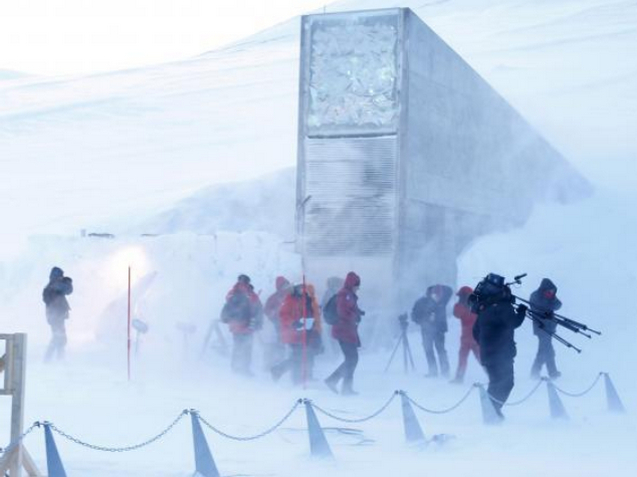
The Syrian civil war has caused the first ever withdrawal from the 'doomsday bank'
Researchers in the Middle East have asked for seeds including those of wheat, barley and grasses, all of which are chosen because especially resistant to dry conditions. It is the first withdrawal from the bank, which was built in 2008. Those researchers would normally request the seeds from a bank in Aleppo. But that centre has been damaged by the war — while some of its functions continue, and its cold storage still works, it has been unable to provide the seeds that are needed by the rest of the Middle East, as it once did.
He also reiterated the argument in favour of a carbon tax in which the proceeds were given back to the public – creating a windfall for more than two-thirds of the population.
“If you made the price of fossil fuels honest by including a gradually rising carbon fee, then it actually spurs the economy and increases the GNP as you shift toward clean energies and energy efficiency. It creates potentially millions of jobs,” Professor Hansen said.
“The way to spur the economy – to modernise the economy and modernise the energy structure – would be to give the money back to the public because a carbon fee is a progressive tax, in the sense that rich people have bigger carbon footprints.
“So if you do give 100 per cent of the money to the public, 70 per cent of the public comes out ahead.”


Links

Climate Change Doomsday Warning Of ‘Rolling Death Smog’ And 'Perpetual War' Criticised By Scientists

The IndependentIan Johnston

An article attempting to describe global warming's worst-case scenario is attacked for painting an 'overly bleak picture by overstating some of the science'
The Grim Reaper comes for us all, but when? Luke MacGregor/Reuters
As doomsday prophecies go, it was an epic, suggesting the future could bring “perpetual war”, “a rolling death smog that suffocates millions” and “the end of food”.
But this attempt to describe global warming’s worst-case scenario by American journalist David Wallace-Wells has prompted a backlash from some of the world’s leading climate scientists.
Normally found taking on so-called ‘sceptics’ and ‘deniers’, they complained the article, this week’s cover story in New York Magazine and headlined “The Uninhabitable Earth”, was at odds with the science and would actually do more harm than good.
On the Climate Feedback website, 14 scientists rated its “scientific credibility” as low with some variously suggesting the article was “alarmist”, “unclear” or “misleading”.
Professor Michael Mann, a leading climatologist at Pennsylvania State University, wrote on Facebook that it painted an “overly bleak picture by overstating some of the science”.
“The evidence that climate change is a serious problem that we must contend with now, is overwhelming on its own. There is no need to overstate the evidence, particularly when it feeds a paralyzing narrative of doom and hopelessness,” he said.
“I'm afraid this latest article does that. That's too bad. The journalist is clearly a talented one, and this is somewhat of a lost opportunity to objectively inform the discourse over human-caused climate change.”
Professor Richard Betts, of the UK’s Met Office Hadley Centre, complained that the idea the Earth could become uninhabitable “within anywhere near the timescales suggested in the article is pure hyperbole”.
Dr Daniel Swain, of University of California, Los Angeles, was more nuanced, arguing the article “accurately describes some of the most dire consequences of unabated global warming”, but he added that it failed to explain the risk of this happening.
Amid what Mr Wallace-Wells described as “this preposterously long tweetstorm”,  he interviewed Professor Mann and published a transcript of their exchange.
IMAGE
The journalist said he did not believe Earth would become uninhabitable by 2100, partly because “our complacency will surely be shaken before we get there”.
But he defended the tone of the article.
“I don’t think we’re doomed, just facing down a very big challenge. But I own up to the alarmism in the story, which I describe as an effort to survey the worst-case-scenario climate landscape,” Mr Wallace-Wells said.
He argued that scientists were being too cautious when explaining what might happen.
“Maybe that’s in part because scientists have been so anxious that the world — or at least the American public — not impugn their work as speculative or dangerous,” he said.
“And so scientists have felt a need to be a bit restrained in talking about what is possible. But to me it seems like it neglects a lot of really terrifying possibilities and that those possibilities are important to consider because they spur action.”
Professor Mann agreed there had been “quite a bit made about the so-called scientific reticence — the tendency for scientists in general to actually be conservative in what they state and the conclusions that they state, particularly when it involves the public sphere”.
This, he said, was due to a “combination of innate conservatism among scientists and also sort of this assault on science by climate-change deniers”.
“I think the intent of that assault has been to sort of cow scientists into retreating from the public discourse and frankly intimidating scientists into being very guarded and very conservative about their public statements. I think that’s been the intent, or one of the intents, of the fossil-fuel-industry-funded attack on climate science,” said Professor Mann, who describes this in his recent book with cartoonist Tom Toles, The Madhouse Effect.
Hanna Petursdottir examines a cave inside the Svinafellsjokull glacier in Iceland, which she said had been growing rapidly. Since 2000, the size of glaciers on Iceland has reduced by 12 per cent. Tom Schifanella
And he said Mr Wallace-Wells had made a “very important” point in the article.
“When it comes to societal decision-making, it’s critical to not just consider the most likely impacts, but those sort of low-probability but catastrophic sort of cost scenarios,” he said.
“What we call the so-called tails of the probability distribution. The things that may not be, we can’t conclude that they’re likely, but we can’t rule them out, and if they were to happen, they would have such a catastrophic impact that it makes sense to take them into account.”

Links

16/07/2017

The Climate Change Scare Campaign Most Politicians Won't Go Near

Fairfax

You can tell the coal-fanciers within the Coalition are panicked. Not content with scaremongering about rising electricity prices, they are now invoking the greatest carbon price of them all – death.
On Thursday morning Liberal MP Craig Kelly said people would die of cold this winter because renewable energy was putting up electricity prices.
Illustration: Joe Benke
Both elements of this outlandish statement were baseless and wrong, but instead of that disqualifying Kelly from the debate, it served only to burnish his credentials for it.
Because when it comes to climate change policy, if you're not scaring people, preferably age pensioners – a magical category of voter who can ill afford bill hikes and will never live to see the effects of dangerous climate change – you're just not doing it right.
It's not the first time Kelly has linked green policies to death – it's something of a personal brand for him.
Previously he has said high electricity prices will push up the cost of heating public pools, which will be passed on in higher prices for swimming lessons, which will deter parents from enrolling their children in them.
A generation of children will be defenceless near large bodies of water.
Result: KIDDY DROWNINGS.
Liberal MP Craig Kelly has repeatedly linked green energy and death. Photo: Andrew Meares
The final pencil strokes on Kelly's vignette of doom come in the form of a cancer warning.
Kelly says people will be forced to burn wood in their homes because they can't afford to turn on their heaters, which will lead to increased air pollution.
The effects of catastrophic climate change warrant a scare campaign of their own.
Result: LUNG CANCER. POSSIBLY SINGED FINGERS AS WELL.
Kelly's logic is spectacular in its circularity – note he is actually admitting that burning carbon is toxic to humans, but no way is he letting that sway him into thinking we might want to come up with a few alternatives to burning it globally, on a massive scale.
You really have to hand it to the Member for Hughes – he has cornered what is a very full fear-mongering market.
He knows conditions are perfect for his high-stakes play – when you have Alan Jones thundering that Energy Minister Josh Frydenberg's career is "finished" because he hasn't yet tattooed to his forehead his commitment to coal-fired power into the unending future; and Tony Abbott using his considerable spare time to remind everyone how spectacularly he came to power on the promise of lower electricity bills – well, you know you are riding the zeitgeist.
Kelly's death predictions operate in a fact vacuum – next he will be warning us of the risk of viral epidemics because the shivering masses will be forced to huddle together for warmth.
But it's not his absence of proof, or even his lack of compunction to show vague causality, which is galling.
It's the fact that he has stolen the thunder of those who urge climate change action on the basis of the extinction of the species if we leave things as they are.
Death, high cancer rates, drownings – that territory is supposed to be the environmentalists' (speedily defrosting) tundra.
Climate scientists, not by nature a rowdy crew, have, for decades now, been politely ahemming at the back of the room to get our attention, so they can warn us about all the various ways our children are going to get cooked if we don't act collectively soon.
A New York Magazine cover story published this week entitled The Uninhabitable Earth, laid out some of the terrifying scenarios that could eventuate "absent aggressive action", broken down into cheerful subheadings like "Poisoned Oceans", "Climate Plagues" and "Permanent Economic Collapse".
It was criticised as being overblown by some climate scientists and focusing on the worst, worst-case scenarios, but not before it lodged firmly in the amygdalas of hundreds of thousands of readers. It lays out what the author says are the possibilities of unmitigated climate change – including the annihilation of Bangladesh and Miami, tens of millions of climate refugees, deadly heat waves, cities like Kolkata and Karachi becoming uninhabitable for humans, and greater social conflict leading to war, not just because of the food shortages and shrinking land resources, but because everyone is so irritable from the heat.
A number of climate scientists have since objected to the piece, saying it is too dire – as Michael Mann of the University of Pennsylvania said, "the evidence that climate change is a serious problem that we must contend with now, is overwhelming on its own". But the piece also mentions a phenomenon called "scientific reticence", which describes the habit climate scientists have of being so cautious and self-censoring they fail to communicate how dire the threat is.
This is where politicians could, for once, be useful.
They are experts at fear fomentation – during any given electoral cycle they taunt us with the possibility that immigrants are taking our jobs, that immigrants are taking our welfare, that Medicare is going to be shut down like a disused kiosk, and that our preschoolers will be forced into transgender-dom if gay people are allowed to marry.
All we need is one Craig Kelly for the climate – to stand up in Parliament and, instead of brandishing a lump of coal for the amusement of the proletariat, hold up a picture of an infant with her skin peeling off, or a submerged Palm Beach mansion, or a Torres Strait Islander forced to flee his home because of rising seas, or a piece of grey coral plucked from our dying reef.
The greatest thing about this scare campaign? You don't even have to make up the facts.

Links

Lethal Heating is a citizens' initiative