15/09/2017

Almost Every Country In The World Can Power Themselves With Renewable Energy

Popular Science - Kendra Pierre-Louis

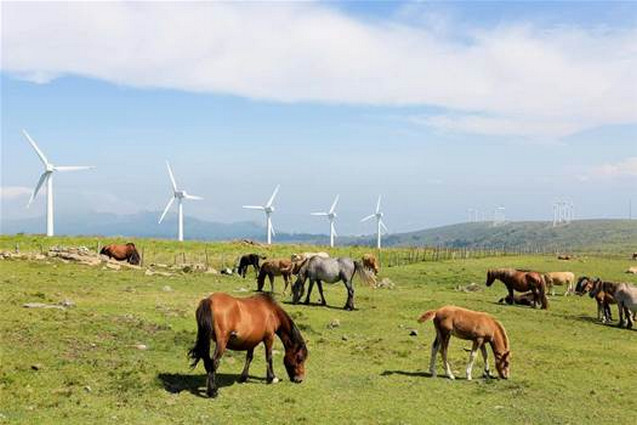
One of these horses is named Rocinante. DEPOSIT PHOTOS
Like in Australia, the USA's energy mix is under scrutiny. A report commissioned by US Energy Secretary Rick "I Once Said I Wanted to Abolish the Agency I Now Run" Perry acknowledges that low natural gas prices—not renewables—are behind the recent closure of coal energy plants, and that the grid has managed to withstand the increasing presence of renewable energy. According to an unrelated study published this week in the journal Joule, the world is poised to give up fossil fuels altogether.
The research lays out renewable energy roadmaps—the mix of resources a given country would need to transition away from fossil fuels to renewable energy—for 139 countries collectively responsible for more than 99 percent of the global carbon emissions. According to the resulting analysis, the planet is pretty much ready to go 100 percent renewable by 2050.
Fossil fuels like coal, natural gas, and oil are not renewable resources. It took an extremely long time for the Earth to produce them, and they're going to run out. And now that we know them to be significant contributors to human-caused climate change, trying to replace them is basically a no-brainer. Still, many regard renewable energy as the flighty, less dependable sibling of our go-to fossils. But according to the United States Energy Information Administration (EIA), renewable energy sources accounted for roughly 15 percent of total electricity generation and 10 percent of total U.S. energy consumption in 2016. Some of that investment in renewable energy is being led by places that we tend to associate with petroleum, like Texas, where wind energy provided more than 12 percent of that state's electricity in 2016.
Even the United States military has vowed to get 25 percent of its energy from renewable sources. And this is more practical than environmental: A hybrid electric tank uses less gas, and doesn't need to refuel as often. Also: solar panels don't explode the same way a gas tank does.But could the world really give up on fossil fuels entirely? Jacobson and his colleagues used available data to assess how much wind, geothermal, and solar energy each of the 139 countries they studied has at its disposal, and how much of that it would take to achieve 80 percent renewable energy usage by 2030 and 100 percent by 2050.
“Like anything, you don't want to change—and it's hard to change if something is working right now. But right now things are working with humongous side effects.”
“I was surprised by how many countries we found had sufficient resources to power themselves with 100 percent wind, water, and solar power,” says Jacobson. The countries could all function using the renewable energy potential contained within their own borders, and most could do it while relying mainly on technologies that already exist.
For small nation-states, like Singapore, the task of going totally renewable would be hard—but doable. Most countries could manage by mixing energy generation into existing landscapes—putting solar panels on rooftops, for example, or placing wind turbines on ranch land—while also creating dedicated renewable energy power plants like solar farms.
And according to the researchers, this process would actually decrease the amount of land dedicated to energy production overall.
“The entire renewable energy footprint [...] is on order of 1.15 to 1.2 percent of the world's land,” says Jacobson. “But keep in mind that 20 percent of the world's land is used for agriculture. In the United States, if you just look at oil and gas, there are 1.7 million active oil and gas wells and 2.3 million inactive wells. Collectively they take up somewhere between one to two percent of the U.S. land area. And that's not counting the refineries, the pipelines, or coal and nuclear infrastructure.”
And then there's the fact that we wouldn't have the oil spills and chemical leaks associated with transporting and refining fossil fuels. Renewable energies involve a relatively fixed amount of land use; wind and solar energy doesn't run out, so a solar farm erected today will still be pumping out electricity in a few decades. And even as those panels wear out, new ones can be erected on the same site. Coal seams run out and oil wells run dry, so we're constantly pressing new locations into service. Tens of thousands of new oil wells are drilled annually.
“We would reduce, we think, the footprint on the land,” says Jacobson.
The study builds on earlier research by Jacobson that analyzed the technological feasibility—and the socio-economic benefits—of switching to renewable energy. That research suggested that the gradual shift to 100 percent renewable energy would lower the social cost of energy, especially deaths associated with fossil fuel pollution.
“With oil and gas, you have to keep drilling and mining, and pollution keeps going on forever,” says Jacobson. “Worldwide, we have more than 4 million air pollution deaths from it. Things have to change—they're not sustainable as they are.”
He calculated that renewable energy could prevent 4.6 million premature deaths a year by 2050, simultaneously adding 24.3 million jobs to the economy. It would also save more than $50 trillion dollars a year in climate- and pollution-related costs.
The Solutions Project
The first major step is (literally) electrifying: if all energy sectors (including transportation, heating/cooling, industry, and agriculture) start running on electricity instead of gas and oil, a nation's overall energy usage goes down.
“When you're driving a car, only 17 to 20 percent of the energy in the gasoline goes to move the car. The rest is waste heat,” says Jacobson. “Whereas in an electric car, 80 to 86 percent of the electricity goes to move a car. You need one-fourth to one-fifth of the energy to drive an electric car than to drive a gasoline car.”
That's one reason why both France and Britain are pushing to ban all non-electric cars by 2040. Germany is working toward a ban on internal combustion engines by 2020.
“By electrifying everything, just doing that, the power demand will go down because of the efficiency of electricity,” says Jacobson. Averaged across sectors, there's a 23 percent reduction in energy demand just by switching to electricity. And when that electricity comes directly from renewable sources like solar and wind instead of coal, the savings keep getting better. According to Jacobson, 12.6 percent of global electric energy use goes toward mining, refining, and transporting fossil fuels (and uranium for nuclear power). Electrification plus a switch to renewables leads to a 36 percent reduction in demand—with no significant change in quality of life.
“We think a transition is possible and its beneficial in multiple ways, and there's little downside to a transition,” says Jacobson. “Like anything, you don't want to change—and it's hard to change if something is working right now. But right now things are working with humongous side effects.”

Links

The Coalition Attacks Environmental Groups With Advice Straight From The Mining Lobby

The Guardian - 

The lobby’s recommendations for environmental charities would set a dangerous precedent and could hamper any community group the government deems to be in conflict with its worldview
Barnaby Joyce juggles and fondles a piece of coal in parliament. Photograph: Mike Bowers/Guardian Australia
Tens of millions of dollars are spent annually on political lobbying for the interests of the fossil fuel sector. That investment serves the interests of a small amount of company shareholders in keeping a legacy industry alive, despite the availability of newer, clean technologies, at lower cost.
In the wake of these behind-the-scenes policy negotiations, the real and present impacts of climate change, such as bushfires, coastal flooding and reduced crop yields are left at the door of future generations to deal with.
As the expensive fees of industry associations like the Minerals Council of Australia are claimed as business expenses, the fossil fuel companies are then able to receive generous tax concessions – paid for from the public purse. That’s why the hypocrisy was palpable last week, when the deputy prime minister Barnaby Joyce said in an address to the Minerals Council that the charitable status of environmental groups is against the interests of Australia.
So, when there are no rules limiting the power that big mining wields over politics, why are environmental scientists being attacked by the government?
Recently, the government instituted an inquiry into Australian charities, seeking to curb the work of charities working to protect the environment. The inquiry’s most concerning recommendation, which came from the Minerals Council itself, is that all environmental charities, no matter if they are focused on research or public education, should be forced to spend 25% of their resources for on-the-ground remediation work, such as tree planting and weed control. Environmental remediation has great value, but ultimately the policy change required to solve climate change will only happen through scientifically informed policy change that allows businesses and communities to do the heavy lifting.
The Climate Council is an independent organisation dedicated to public education on climate change. We want to keep doing what we’re good at – which is providing independent, accurate information to Australians across society; from emergency services to farmers, schools and businesses. For the government to demand that the Climate Council spend 25% of its time on remediation is nonsensical and undemocratic. When it comes to Australia staying in step with the global race to address climate change, planting a few trees just won’t cut it.
The government inquiry is a cynical attempt to hamper support for charities by reducing our ability to execute on our purpose. The Climate Council’s purpose is to accurately communicate information on climate change, giving Australia the chance to be on the front foot in responding to climate change. Our information assists fire fighters, health professionals and communities. It helps journalists to report more accurately in what is a debate often awash with misinformation. Importantly, it helps the wider community make sense of what is a complex and confusing issue.
An informed public is absolutely vital to a well-functioning democracy. The science is not the only consensus on the issue. Most Aussies are worried about what climate change means for their jobs, property and families, especially the youngsters that are now stepping up to power our economy.
For the government to adopt the mining lobby’s recommendation would damage the ability of organisations protecting the environment to work effectively – and therefore damage our environment itself. It would also set a dangerous precedent for the interference of vested interests into our government. For beyond the Climate Council a broad range of charities stand to be affected should the government give itself powers to hamper any community group that they deem to be in conflict with its worldview.
The logic of curtailing an organisation like Climate Council, which fills the major chasm in public information on climate change, is unscientific and undemocratic.
Despite what we hear about the post-truth, fake news world in which we now live, the Australian public still values independent experts. When we go to the doctor, or fly in an aeroplane, we place our trust in the hands of qualified experts. Equally, for Australia to make sound decisions on our changing world, we expect to be advised by experts that operate independently of vested interests.
Past experience tells us we cannot rely on government to give us all of the facts, all of the time. Just last year it was widely reported that the Australian Department of Environment censored a Unesco report on climate change, removing the inclusion of the Great Barrier Reef, Kakadu national park and the Tasmanian forests. The objections were made on the grounds that showing the impacts of climate change on Australian world heritage sites would be bad for tourism. When Unesco agreed to remove the sections requested, Australia became the only inhabited continent on the planet with no mention whatsoever.
It would be a wonderful world if the threat of climate change could be wiped away so easily. In the absence of a magic wand, both the Australian public and the broader international community have a right to accurate information in order to tackle climate change. We have a responsibility to future generations to take action. And our best chance for action is from the standpoint of knowledge that is open, shared and freely available. I have no doubt that a government that has the best interests of the Australian public at heart is one that champions and protects access to science and does not seek to restrict it.

Links

How 90 Big Companies Helped Fuel Climate Change: Study Breaks It Down

InsideClimate News - Nicholas Kusnetz

A new study connects climate change impacts to the emissions from Exxon, Chevron and other large oil, gas and cement companies and their products. 
BP, Exxon and Chevron were among the top emitters in a new study that looks at historical emissions and climate change impacts, including sea level rise and global warming . Credit: Christopher Furlong
Can millimeters of sea level rise or increments of warming on the globe's thermometer be attributed to specific energy companies? A new study attempts to do that, and says that more than a quarter of sea level rise and about half the warming from 1880 to 2010 can be traced back to just 90 corporations.
The study comes as energy companies confront lawsuits and shareholder resolutions seeking to account for their contributions to climate change.
The new paper, published last week in the journal Climatic Change, builds on earlier research finding that nearly two-thirds of historical greenhouse gas emissions came from the products and operations of just 90 companies—mostly fossil fuel producers, plus a few cement companies.
The researchers from the Union of Concerned Scientists and two universities took the reasoning another step and calculated how much of the actual change in the climate can be tied to those extra emissions.
Using models, they calculated that the greenhouse gas emissions of these 90 companies accounted for around 42 to 50 percent of the global temperature increase and about 26 to 32 percent of global sea level rise over the course of industrial history, from 1880 to 2010. Since 1980, a time when global warming was first getting wide attention, their emissions have accounted for around 28 to 35 percent of rising temperatures and around 11 to 14 percent of rising seas.
While some of the companies are huge—Chevron, Saudi Aramco, ExxonMobil, Gazprom—even the biggest of them weren't blamed for more than about 1 or 2 percent of the rising tides or temperatures.


The next step, one of the authors suggested, would be to calculate the damages from those changes—and decide if the companies should help pay for them.
"We know climate impacts are worsening and they're becoming more costly. The question is who's responsible and who should pay the costs," said Brenda Ekwurzel, the lead author of the paper and director of climate science at the Union of Concerned Scientists. "In the United States, taxpayers are footing the bill entirely. So maybe with numbers like this you can put in the mix the producers."
In July, three local governments in California sued a group of oil and gas companies, arguing that executives knew for decades that the "greenhouse gas pollution from their fossil fuel products had a significant impact on the Earth's climate and sea levels."
The state attorneys general of New York and Massachusetts, meanwhile, are investigating whether Exxon misled investors about its risks from climate change.
Exxon and Chevron did not respond to requests for comment for this article. The American Petroleum Institute declined to comment.
Ekwurzel said the paper is only a first step for trying to sort out who is responsible for what as the costs of climate change grow. "We can calculate these numbers, and we don't expect them to directly equal responsibility," she said. "That's really for juries, policymakers, civil society conversation going forward."
Generally, state efforts to cap greenhouse gas emissions, such as California's cap-and-trade system, hold companies accountable only for their direct emissions. But just because it's fossil fuel consumers like power plants and drivers who ultimately burn the coal, oil and gas that emit greenhouse gases, that doesn't let the producers off the hook, she added.
"A common complaint is, what about utilities, what about car-driving," Ekwurzel said. "The thing is, is it the activities or is it how we've chosen to power those activities? We know there are other ways to move through space or to turn on the lights that don't rely as much on fossil fuels."

Links

14/09/2017

The Guardian View On Climate Change: See You In Court

The Guardian - 

It is possible to determine which nations and companies are responsible for damaging the climate. It’s only a matter of time before courts decide they must pay for global warming
Storms clouds move in over the skyline of downtown Orlando as Hurricane Irma makes its way up the Florida peninsula. Photograph: Joe Burbank/AP
Recent days have seen Houston, Texas literally sunk under sheer weight of rain, Carribbean islands battered by powerful storms barrelling across the Gulf and now Florida homes blasted by Irma, the largest of three hurricanes churning in the Atlantic basin. It seems almost certain that man-made climate change has a role in such events. Scientists used to be circumspect at attributing any single extreme event to global warming. No longer. Now scientists make the link between climate change and droughts in Kenya, record winter sun in Britain and torrential downpours in south-west China.
The unmistakeable fingerprint of extreme weather at the crime scene of global warming seems intuitively obvious: consider that Houston is reckoned to have been hit by three “500-year floods” in three years. A 500-year flood does not have to happen only twice a millennium. But a run of three indicates that past climate is no longer a reliable guide to the present weather. The explanation is that the climate itself is changing.
Such thinking should be a wake up call for the world, which has to understand how profoundly we must make a shift in the way we produce, distribute and consume energy, and how disruptive this will be for the real economy. While governments have, via the Paris agreement, signalled the end of the fossil-fuel era, the political processes by which states will decide how to meet their mitigation targets have been hijacked and influenced by Big Carbon.
Fossil-fuel companies, hydrocarbon billionaires and their allies, particularly in the west, have for years now been funding a massive and sophisticated campaign to mislead voters about the environmental harm caused by carbon pollution. They have good reason to: a landmark study released earlier this year revealed 50 corporations account for more than one-fifth of all carbon released into the atmosphere since the industrial revolution began. The groundbreaking research not only helps establish legal accountability for climate change, it also weakens any corporate defence of wilful blindness. A major polluter cannot say it was going ahead with its activities because it was unaware its products caused great harm. Corporations have made handsome profits as the globe ended up a degree warmer than it should be. These polluters privatised the fossil-fuel profits and socialised the cost to the world’s poor, global taxpayers and future generations. Big Carbon entities and individuals who claim their lobbying activities are just an expression of their democratic rights sound a lot like Big Tobacco when it was denying the health dangers of smoking.
Three major legal actions will test such thinking. First in the Philippines, where it is being determined whether polluters violated the human rights of Filipinos for their role in creating the conditions for Typhoon Haiyan, the strongest ever tropical storm to make landfall, which left more than 7,000 dead. Second in Germany, where a German utility company is being sued for costs associated with glacial lake flooding in Peru. Last in the US, where two California counties are suing 37 oil, gas and coal companies, claiming they knew their products would cause sea-level rise and coastal flooding, but failed to reduce their greenhouse gases.
Fossil-fuel companies should be held accountable for the effects of climate change. Legal warfare has a two-fold aim: to overhaul transgressors’ business models so that they are in line with the global commitment to phase out fossil fuels and limit temperature rises to 1.5°C; and to get them to pay for damages resulting from global warming. Climate litigation is the inevitable result of a failure of two decades of talks. But it is also an important way of reframing the climate crisis as a human rights emergency.

Links

Stop Talking Right Now About The Threat Of Climate Change. It’s Here; It’s Happening

The Guardian - 

Stop talking right now about the threat of climate change. It’s here; it’s happening. Hurricane Harvey, Hurricane Irma, flash fires, droughts: all of them tell us one thing – we need to stand up to the fossil fuel industry and fast.
Flooding caused by Hurricane Harvey, southeast Texas 31 August 2017. Photograph: UPI / Barcroft Images
For the sake of keeping things manageable, let’s confine the discussion to a single continent and a single week: North America over the last seven days.
In Houston they got down to the hard and unromantic work of recovery from what economists announced was probably the most expensive storm in US history, and which weather analysts confirmed was certainly the greatest rainfall event ever measured in the country – across much of its spread it was a once-in-25,000-years storm, meaning 12 times past the birth of Christ; in isolated spots it was a once-in-500,000-years storm, which means back when we lived in trees. Meanwhile, San Francisco not only beat its all-time high temperature record, it crushed it by 3F, which should be pretty much statistically impossible in a place with 150 years (that’s 55,000 days) of record-keeping.
That same hot weather broke records up and down the west coast, except in those places where a pall of smoke from immense forest fires kept the sun shaded – after a forest fire somehow managed to jump the mighty Columbia river from Oregon into Washington, residents of the Pacific Northwest reported that the ash was falling so thickly from the skies that it reminded them of the day Mount St Helens erupted in 1980.
That same heat, just a little farther inland, was causing a “flash drought” across the country’s wheat belt of North Dakota and Montana – the evaporation from record temperatures had shrivelled grain on the stalk to the point where some farmers weren’t bothering to harvest at all. In the Atlantic, of course, Irma was barrelling across the islands of the Caribbean (“It’s like someone with a lawnmower from the sky has gone over the island,” said one astounded resident of St Maarten). The storm, the first category five to hit Cuba in a hundred years, is currently battering the west coast of Florida after setting a record for the lowest barometric pressure ever measured in the Keys, and could easily break the 10-day-old record for economic catastrophe set by Harvey; it’s definitely changed the psychology of life in Florida for decades to come.
Oh, and while Irma spun, Hurricane Jose followed in its wake as a major hurricane, while in the Gulf of Mexico, Katia spun up into a frightening storm of her own, before crashing into the Mexican mainland almost directly across the peninsula from the spot where the strongest earthquake in 100 years had taken dozens of lives.
Leaving aside the earthquake, every one of these events jibes with what scientists and environmentalists have spent 30 fruitless years telling us to expect from global warming. (There’s actually fairly convincing evidence that climate change is triggering more seismic activity, but there’s no need to egg the pudding.)
That one long screed of news from one continent in one week (which could be written about many other continents and many other weeks – just check out the recent flooding in south Asia for instance) is a precise, pixelated portrait of a heating world. Because we have burned so much oil and gas and coal, we have put huge clouds of CO2 and methane in the air; because the structure of those molecules traps heat the planet has warmed; because the planet has warmed we can get heavier rainfalls, stronger winds, drier forests and fields. It’s not mysterious, not in any way. It’s not a run of bad luck. It’s not Donald Trump (though he’s obviously not helping). It’s not hellfire sent to punish us. It’s physics.
Maybe it was too much to expect that scientists’ warnings would really move people. (I mean, I wrote The End of Nature, the first book about all this 28 years ago this week, when I was 28 – and when my theory was still: “People will read my book, and then they will change.”) Maybe it’s like all the health warnings that you should eat fewer chips and drink less soda, which, to judge by belt-size, not many of us pay much mind. Until, maybe, you go to the doctor and he says: “Whoa, you’re in trouble.” Not “keep eating junk and some day you’ll be in trouble”, but: “You’re in trouble right now, today. As in, it looks to me like you’ve already had a small stroke or two.” Hurricanes Harvey and Irma are the equivalent of one of those transient ischaemic attacks – yeah, your face is drooping oddly on the left, but you can continue. Maybe. If you start taking your pills, eating right, exercising, getting your act together.


Hurricane Irma's path of destruction - video report

That’s the stage we’re at now – not the warning on the side of the pack, but the hacking cough that brings up blood. But what happens if you keep smoking? You get worse, till past a certain point you’re not continuing. We’ve increased the temperature of the Earth a little more than 1C so far, which has been enough extra heat to account for the horrors we’re currently witnessing. And with the momentum built into the system, we’re going to go somewhere near 2C, no matter what we do. That will be considerably worse than where we are now, but maybe it will be expensively endurable.
The problem is, our current business-as-usual trajectory takes us to a world that’s about 3.5C warmer. That is to say, even if we kept the promises we made at Paris (which Trump has already, of course, repudiated) we’re going to build a planet so hot that we can’t have civilisations. We have to seize the moment we’re in right now – the moment when we’re scared and vulnerable – and use it to dramatically reorient ourselves. The last three years have each broken the record for the hottest year ever measured – they’re a red flashing sign that says: “Snap out of it.” Not bend the trajectory somewhat, as the Paris accords envisioned, but simultaneously jam on the fossil fuel brakes and stand on the solar accelerator (and also find some metaphors that don’t rely on internal combustion).
This is a race against time. Global warming is a crisis that comes with a limit – solve it soon or don’t solve it
We could do it. It’s not technologically impossible – study after study has shown we can get to 100% renewables at a manageable cost, more manageable all the time, since the price of solar panels and windmills keeps plummeting. Elon Musk is showing you can churn out electric cars with ever-lower sticker shock. In remote corners of Africa and Asia, peasants have begun leapfrogging past fossil fuel and going straight to the sun. The Danes just sold their last oil company and used the cash to build more windmills. There are just enough examples to make despair seem like the cowardly dodge it is. But everyone everywhere would have to move with similar speed, because this is in fact a race against time. Global warming is the first crisis that comes with a limit – solve it soon or don’t solve it. Winning slowly is just a different way of losing.
Winning fast enough to matter would mean, above all, standing up to the fossil fuel industry, so far the most powerful force on Earth. It would mean postponing other human enterprises and diverting other spending. That is, it would mean going on a war-like footing: not shooting at enemies, but focusing in the way that peoples and nations usually only focus when someone’s shooting at them. And something is. What do you think it means when your forests are on fire, your streets are underwater, and your buildings are collapsing?

*Bill McKibben is a writer and the founder of the climate campaign 350.org

Links

Ignore Mt Piper's Tune: NSW Isn't About To Lose Its Newest Coal-Fired Plant

Fairfax - Peter Hannam

In Australia's self-induced and largely imagined energy crisis, it seems any ambit claim - particularly if it encourages coal - can generate immediate and unwarranted media and political attention.
For the past week or so, we have witnessed Prime Minister Malcolm Turnbull's ill-considered elevation to national urgency the closure of the decrepit Liddell coal-fired power station in the Hunter Valley in 2022. Owners AGL had given all of seven years' notice.

MPs clash over Liddell power plant closure
Now, a News Corp publication has tossed into the debate furnace the "real risk" NSW's newest power station Mt Piper faces closure because of a "green activist" group that had the temerity of asking courts (at great financial risk) to uphold NSW law.
Time for a few facts before our leadership lemmings are panicked into, say, banning renewable energy, ditching Australia's Paris climate goals, or other nefarious scheme dreamed up in some coal lobbyist's backroom.
Back in August, the NSW government was posed a dilemma after the state's appeals court deemed a coal mine in Sydney's catchment was operating without an invalid licence, as Fairfax Media reported at the time.
In short, any development - and that includes coal - can only operate in the region if it has a neutral or beneficial effect on water quality. Makes sense if you care about the water supplied to five million people.
So Centennial Coal's Springvale mine should not pump millions of litres a day of untreated mine water into the Coxs River, the second largest supply of water to Sydney's main dam, the court found.
But as Springvale, near Lithgow, happens to be the only current source of coal to EnergyAustralia's Mt Piper plant, the judges in their wisdom said, in effect, go and sort out what you need to do to everybody's satisfaction.
For the past week or so, we have witnessed the PM's ill-considered elevation to national urgency the closure of the decrepit Liddell coal-fired power station in the Hunter Valley in 2022. Photo: Alex Ellinghausen
Satisfaction, though, will come at a cost for somebody. Submissions are due from this Friday in the NSW Land & Environment Court.
Hence, some early public lobbying is now underway, dovetailing nicely with our contrived energy frenzy.
Mt Piper power station.  Photo: Supplied by Centennial Coal
The options at this stage are: Mt Piper looks for alternative coal supplies and builds a rail loader to access it; Springvale accelerates plans to pipe the waste water to a yet-to-built treatment plant; the government changes the legislation that would harm Sydney's water supplies and open the door wider to similar projects in the future.
Naturally, most money is betting on the latter outcome, with the cost borne by a largely unwitting public.
The NSW government is rightly watching the outcome of the submissions in the Land & Environment and not keen to comment. But even if it were to pursue that last option, it won't be able to do so a vacuum.
As Fairfax Media has revealed this week, a new study commissioned by the state government has found underground coal mining is having a more detrimental impact on the catchment than previously thought.
Cracks were likely reaching from the surface all the way down to the coal seam 400 metres below, permanently diverting flows to who knows where, and killing endangered wetlands above.
Indeed, WaterNSW, the government agency, is understood to be very unhappy with the findings. They confirm many of its fears about the wisdom of allowing mining in the catchment at all.
Nobody knows of another major city that allows it.
Sue Higginson is chief executive of the NSW Environmental Defender's Office which led the successful appeal against Springvale on behalf of the 4nature group. She says those seeking a quick corporate fix for Mt Piper would prefer to ignore the rule of law.
"It's as if environmental law doesn't matter," Higginson says.
In the intense heat of the wider energy debate, it's plausible that result sits happily with those keen to promote coal at any cost.

Links

13/09/2017

Wetlands Discovery Opens New Doors For Australian Climate Research

Fairfax - Tony Moore

Scientists say the surprising discovery that North Stradbroke Island's Ferngully Lagoon dated back more than 200,000 years, and other wetlands on the island more than 40,000 years, could reshape climate change research on the Australian continent.
Researchers from the University of Queensland and the University of Adelaide made the discovery after they took core samples from the 16 wetlands on North Stradbroke Island.
John Tibby and Cameron Barr take core samples from Duck Lagoon, North Stradbroke Island. Photo: Tony Moore
Previously, scientists believed Australian wetlands date back to the Ice Age, about 15,000 to 20,000 years ago.
The discovery showed North Stradbroke Island was an exception.
Researchers John Tibby, Lydia McKenzie, Jonathan Marshall and Cameron Barr take core samples from Duck Lagoon, North Stradbroke Island. Photo: Tony Moore
The science is published in the Journal of Quaternary Science, which studies Australian wetlands.
The South Australian lead researcher John Tibby released the results on Monday, with Queensland government scientist Jonathan Marshall.
Dr Marshall, the principal scientist with the Queensland Department of Science, Information Technology and Innovation, said the research demonstrated North Stradbroke Island was "an Australian exception" during those dry times.
"We cored and dated 16 wetlands on the island and found six dating to the ice age or earlier, with one being more than 200,000 years old," Dr Marshall said.
Dr Tibby, from the University of Adelaide, said there were more wetlands on North Stradbroke Island dating back to the Ice Age than anywhere else in Australia.
"Australia was much drier during the last Ice Age than it is today, as most of the water was held in large ice sheets in the Northern Hemisphere," he said.
“Right across Australia, there were few wetlands during this time, which raises the question: Where and how did plants and animals survive that needed permanent water?
"The island, and possibly even the region itself, may have been a refuge from dry climates.”
The Moreton Bay side of North Stradbroke Island has a string of wetlands.
Dr Tibby said their research showed Ferngully Lagoon, to the north of Blue and Brown Lakes on the bay side of North Stradbroke Island, was 200,000 years old.
"The instinctive thing is that you would expect that lakes and swamps that exist on sand, because North Stradbroke Island is a sand island, is that they are likely not to have existed for a long period of time," he said.
"So the fact that these lakes and swamps have existed for a long time suggests that on average it has been wet in the region for most of that period of time, which is in contrast to what we think we know about the rest of the Australian continent.
"We have very, very few locations where we have wetlands that have persisted through since the end of the last Ice Age."
The Ice Age began slowly about 100,000 years ago, reached its peak between 15,000 and 20,000 years ago and gently warmed.
The discovery would allow researchers to study the history of vegetation changes, eventually over the past 200,000 years, by looking at fossilised pollens.
This research would be compared to other research, which was "inferring" past rainfall in the region.
Dr Tibby said researchers would use core samples to look into the impact of human arrival in south-east Queensland and the impact on vegetation.
"Whether those two things together had a role in causing the extinction of the giant animals, the megafauna and then what happened to fire practices with Indigenous people using the landscape," he said.
"It has been hard to get good answers to those questions because we have had so few good sites."
The science suggested the island may have had permanent wetland areas when Australia’s climate was at its driest.
Dr Tibby said the persistence of these wetlands were linked to the island’s groundwater systems, which acted as water reservoirs during periods of rainfall deficit.
“During what was otherwise a particularly dry period in Australia’s ancient past, these persistently moist regions are thought to have played a unique role in maintaining biodiversity,” he said.
Dr Tibby said being able to research the North Stradbroke Island wetlands further would help understand longer-term climate change.
“It will greatly improve our understanding about the drivers of both local and regional climate variability.”
Quandamooka Yoolooburrabee Aboriginal Corporation traditional owner Darren Burns said the new scientific evidence confirmed the existence of local natural resources – local spring and water supplies - which the Quandamooka people used to live on the island they knew as Minjerribah.
Science Minister Leanne Enoch, herself a Quandamooka women from Minjerribah, said the research had the potential to change thinking about how climate changed in south-east Queensland.
“Until now, few Australian sites had offered detailed information about what was happening at wetlands since the last great ice age, which peaked around 15,000 years ago,” Ms Enoch said.
“...The significance of this research is that it greatly adds to our understanding of the ancient climatic changes that shaped our country, our wildlife and our first peoples.”

Links

Lethal Heating is a citizens' initiative