16/09/2017

How Antarctic Ice Melt Can Be A Tipping Point For The Whole Planet’s Climate

The Conversation - Chris Turney | Jonathan Palmer | Peter Kershaw | Steven Phipps | Zoƫ Thomas

Melting Antarctic ice can trigger effects on the other side of the globe. NASA/Jane Peterson
Melting of Antarctica’s ice can trigger rapid warming on the other side of the planet, according to our new research which details how just such an abrupt climate event happened 30,000 years ago, in which the North Atlantic region warmed dramatically.
This idea of “tipping points” in Earth’s system has had something of a bad rap ever since the 2004 blockbuster The Day After Tomorrow purportedly showed how melting polar ice can trigger all manner of global changes.
But while the movie certainly exaggerated the speed and severity of abrupt climate change, we do know that many natural systems are vulnerable to being pushed into different modes of operation. The melting of Greenland’s ice sheet, the retreat of Arctic summer sea ice, and the collapse of the global ocean circulation are all examples of potential vulnerability in a future, warmer world.
Of course it is notoriously hard to predict when and where elements of Earth’s system will abruptly tip into a different state. A key limitation is that historical climate records are often too short to test the skill of our computer models used to predict future environmental change, hampering our ability to plan for potential abrupt changes.
Fortunately, however, nature preserves a wealth of evidence in the landscape that allows us to understand how longer time-scale shifts can happen.

Core values
One of the most important sources of information on past climate tipping points are the kilometre-long cores of ice drilled from the Greenland and Antarctic ice sheets, which preserve exquisitely detailed information stretching back up to 800,000 years.
The Greenland ice cores record massive, millennial-scale swings in temperature that have occurred across the North Atlantic region over the past 90,000 years. The scale of these swings is staggering: in some cases temperatures rose by 16℃ in just a few decades or even years.
Twenty-five of these major so-called Dansgaard–Oeschger (D-O) warming events have been identified. These abrupt swings in temperature happened too quickly to have been caused by Earth’s slowly changing orbit around the Sun. Fascinatingly, when ice cores from Antarctica are compared with those from Greenland, we see a “seesaw” relationship: when it warms in the north, the south cools, and vice versa.
Attempts to explain the cause of this bipolar seesaw have traditionally focused on the North Atlantic region, and include melting ice sheets, changes in ocean circulation or wind patterns.
But as our new research shows, these might not be the only cause of D-O events.
Our new paper, published today in Nature Communications, suggests that another mechanism, with its origins in Antarctica, has also contributed to these rapid seesaws in global temperature.

Tree of knowledge
The 30,000-year-old key to climate secrets. Chris Turney, Author provided
We know that there have been major collapses of the Antarctic ice sheet in the past, raising the possibility that these may have tipped one or more parts of the Earth system into a different state. To investigate this idea, we analysed an ancient New Zealand kauri tree that was extracted from a peat swamp near Dargaville, Northland, and which lived between 29,000 and 31,000 years ago.
Through accurate dating, we know that this tree lived through a short D-O event, during which (as explained above) temperatures in the Northern Hemisphere would have risen. Importantly, the unique pattern of atmospheric radioactive carbon (or carbon-14) found in the tree rings allowed us to identify similar changes preserved in climate records from ocean and ice cores (the latter using beryllium-10, an isotope formed by similar processes to carbon-14). This tree thus allows us to compare directly what the climate was doing during a D-O event beyond the polar regions, providing a global picture.
The extraordinary thing we discovered is that the warm D-O event coincided with a 400-year period of surface cooling in the south and a major retreat of Antarctic ice.
When we searched through other climate records for more information about what was happening at the time, we found no evidence of a change in ocean circulation. Instead we found a collapse in the rain-bearing Pacific trade winds over tropical northeast Australia that was coincident with the 400-year southern cooling.
To explore how melting Antarctic ice might cause such dramatic change in the global climate, we used a climate model to simulate the release of large volumes of freshwater into the Southern Ocean. The model simulations all showed the same response, in agreement with our climate reconstructions: regardless of the amount of freshwater released into the Southern Ocean, the surface waters of the tropical Pacific nevertheless warmed, causing changes to wind patterns that in turn triggered the North Atlantic to warm too.
Future work is now focusing on what caused the Antarctic ice sheets to retreat so dramatically. Regardless of how it happened, it looks like melting ice in the south can drive abrupt global change, something of which we should be aware in a future warmer world.

Links

Massive Jump In Solar Energy Roll-Out Means Scarcity Fears Unfounded: Council

Fairfax - Peter Hannam

Official estimates of the risk of an electricity shortfall this summer are exaggerated because much more solar energy - as much as six times current large-scale capacity - is ready to be built, the Australian Solar Council says.
Completed large-scale plants total 310.8 megawatts,which will be dwarfed by the 2054 MW of large-scale solar photovoltaics (PV) plants that have secured finance and/or a power purchase agreement, the council says.
The Nyngan solar plant near Dubbo, NSW, built by AGL with government help, got the ball rolling on large-scale solar plants. Photo: Supplied
However, the project pipeline would put even that increase in the shade, with 10,266 MW in some part of the approval process.
"You have a massive build and development under way," John Grimes, the council's chief executive, said.
Solar PV plants are rolling out faster than regulators have forecast. Photo: Supplied
The short construction time for solar PV plants compared with other generation capacity - particularly coal - means the electricity market is unlikely to have the supply squeeze that the Australian Energy Market Operator (AEMO) identified in a report this month.
"You don't have an energy scarcity problem," Mr Grimes said. "What discussions you should be having is how you can have the infrastructure needed to bring the additional supply from areas such as north Queensland to major markets."
The Turnbull government this month seized on the AEMO report that indicated there was a risk Victoria and South Australia could face electricity shortages this summer.
AEMO also cited the planned closure of AGL's 1680 MW coal-fire power plant in the Hunter Valley as potentially bringing supply shortages to NSW in 2024-25 if other generation capacity were to close by then.
Critics of the AEMO forecast, though, have pointed out the shortage predictions exclude actions taken by all three states - and others - to meet electricity demand.
They also highlight that AEMO has failed to include clean energy supplies that are under construction or have financial close that will be added to the market.
Mr Grimes said economic forecasters had been wildly wrong, particularly when it came to estimating the falling cost and rising efficiency of solar PV.
For instance, the Bureau of Resources and Energy Economics forecast in 2009 that solar use would rise to 231 MW by 2017.
Instead, including rooftop PV on homes and businesses, it had reached about 6000 MW, Mr Grimes said.
Solar energy's advantages include plunging prices that make it the cheapest new capacity available, Australia's world-envied solar resource and now the support of states such as Queensland, Mr Grimes said.
The forecast failures are "a pattern that we see from our energy planners, and in the discussions in the parliamentary debate that seek to lock in coal", he said.
Walking away from renewables, as the Turnbull government seems to be doing, "is so far removed from reality",  Mr Grimes said.
Fairfax Media sought comment from AEMO.
Kane Thornton, chief executive of the Clean Energy Council, said solar's share of the renewable energy market is advancing faster than expected.
Just a couple of years ago, when the Renewable Energy Target was reset at a goal of 33,000 gigawatt-hours a year by 2020, the expected split between wind and solar was forecast at 75:25 for the 6000 MW of new capacity expected to be needed.
"But now it's looking like 50:50, and over time that spilt will just continue to grow" in solar's favour, Mr Thornton said.
"The reality is there is a real track record of this industry delivering more than forecast, more quickly," he said.

Links

China’s Renewable-Energy Revolution

Project Syndicate 

Kevin Frayer/Getty Images
BEIJING – At the start of 2017, China announced that it would invest $360 billion in renewable energy by 2020 and scrap plans to build 85 coal-fired power plants. In March, Chinese authorities reported that the country was already exceeding official targets for energy efficiency, carbon intensity, and the share of clean energy sources. And just last month, China’s energy regulator, the National Energy Administration, rolled out new measures to reduce the country’s dependence on coal.
These are just the latest indicators that China is at the center of a global energy transformation, which is being driven by technological change and the falling cost of renewables. But China is not just investing in renewables and phasing out coal. It also accounts for a growing share of global energy demand, meaning that its economy’s continuing shift toward service- and consumption-led growth will reshape the resource sector worldwide.
At the same time, various other factors are reducing global resource consumption, including increased energy efficiency in residential, industrial, and commercial buildings, and lower demand for energy in transportation, owing to the proliferation of autonomous vehicles and ride sharing.
According to Beyond the Supercycle: How Technology Is Reshaping Resources, a new report from the McKinsey Global Institute (MGI), these trends are slowing the growth of primary energy demand. If rapid adoption of new technologies continues, that demand could peak in 2025. And with less intensive energy use and increased efficiency, energy productivity in the global economy could increase by 40-70% over the next two decades.
While global growth in energy demand is slowing, China’s share of that demand is increasing. By 2035, China may account for 28% of the world’s primary energy demand, up from 23% today, whereas the United States could account for just 12% by 2035, down from 16% today.
China has already made significant progress in reducing its resource intensity: between 1980 and 2010, its economy grew 18-fold, but its energy consumption grew only fivefold. According to World Bank data, that reflects a 70% decline in energy intensity per unit of GDP.
In its 13th Five-Year Plan, the Chinese government aims to reduce energy intensity by a total of 15% between 2016 and 2020. It is already well on its way toward achieving that goal. At China's National People’s Congress earlier this year, Chinese Premier Li Keqiang reported that China’s energy intensity fell by 5% last year alone.
Renewables are one reason for China’s declining resource intensity. Hoping to become a world leader in the field, China is already investing more than $100 billion in domestic renewables every year. That is twice the level of US investment in domestic renewable energy and more than the combined annual investment of the US and the European Union.
In addition, China is investing $32 billion – more than any other country – in renewables overseas, with top-tier Chinese companies increasingly taking the lead in global renewable-energy value chains. China’s State Grid Corporation has plans to develop an energy grid that draws on wind turbines and solar panels from around the world. Chinese solar-panel manufacturers are estimated to have a 20% cost advantage over their US peers, owing to economies of scale and more advanced supply-chain development. And Chinese wind-turbine manufacturers, having gradually closed technology gaps, now account for more than 90% of the Chinese domestic market, up from just 25% in 2002.
These trends suggest that China will be a major source of both energy demand and cutting-edge technology, implying that it will have a unique opportunity to provide global leadership. Its experience in reducing energy intensity can serve as a roadmap for developing countries. And its investments in renewables at home and abroad can lead to additional technological breakthroughs that drive down costs for consumers everywhere.
But China will also face challenges as it moves from fossil fuels to renewables within a changing global resource sector. Its economy is still highly dependent on coal, implying sizeable costs as it shifts capacity to other resources such as natural gas and renewables.
Moreover, the construction of solar panels and wind farms in China has outpaced upgrades to its electrical grid, creating a great deal of waste. And Chinese producers, like most others, are feeling increasing pressure to reduce costs and improve efficiency to make up for slower demand growth worldwide.
Despite these hurdles, technological innovation should help Chinese producers realize productivity gains and deliver savings to consumers. According to MGI, by 2035, changes in the supply and demand for major commodities could result in total cost savings of $900 billion to $1.6 trillion worldwide.
The scale of these savings will depend not only on how quickly new technology is adopted, but also on how policymakers and companies adapt to their new environment. But, above all, it will depend on China.

Links

15/09/2017

Almost Every Country In The World Can Power Themselves With Renewable Energy

Popular Science - Kendra Pierre-Louis

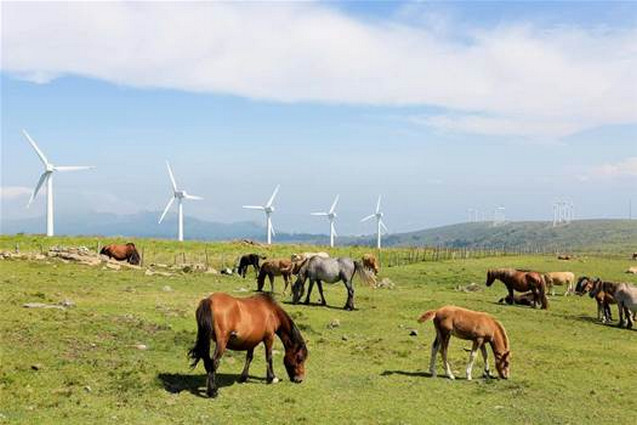
One of these horses is named Rocinante. DEPOSIT PHOTOS
Like in Australia, the USA's energy mix is under scrutiny. A report commissioned by US Energy Secretary Rick "I Once Said I Wanted to Abolish the Agency I Now Run" Perry acknowledges that low natural gas prices—not renewables—are behind the recent closure of coal energy plants, and that the grid has managed to withstand the increasing presence of renewable energy. According to an unrelated study published this week in the journal Joule, the world is poised to give up fossil fuels altogether.
The research lays out renewable energy roadmaps—the mix of resources a given country would need to transition away from fossil fuels to renewable energy—for 139 countries collectively responsible for more than 99 percent of the global carbon emissions. According to the resulting analysis, the planet is pretty much ready to go 100 percent renewable by 2050.
Fossil fuels like coal, natural gas, and oil are not renewable resources. It took an extremely long time for the Earth to produce them, and they're going to run out. And now that we know them to be significant contributors to human-caused climate change, trying to replace them is basically a no-brainer. Still, many regard renewable energy as the flighty, less dependable sibling of our go-to fossils. But according to the United States Energy Information Administration (EIA), renewable energy sources accounted for roughly 15 percent of total electricity generation and 10 percent of total U.S. energy consumption in 2016. Some of that investment in renewable energy is being led by places that we tend to associate with petroleum, like Texas, where wind energy provided more than 12 percent of that state's electricity in 2016.
Even the United States military has vowed to get 25 percent of its energy from renewable sources. And this is more practical than environmental: A hybrid electric tank uses less gas, and doesn't need to refuel as often. Also: solar panels don't explode the same way a gas tank does.But could the world really give up on fossil fuels entirely? Jacobson and his colleagues used available data to assess how much wind, geothermal, and solar energy each of the 139 countries they studied has at its disposal, and how much of that it would take to achieve 80 percent renewable energy usage by 2030 and 100 percent by 2050.
“Like anything, you don't want to change—and it's hard to change if something is working right now. But right now things are working with humongous side effects.”
“I was surprised by how many countries we found had sufficient resources to power themselves with 100 percent wind, water, and solar power,” says Jacobson. The countries could all function using the renewable energy potential contained within their own borders, and most could do it while relying mainly on technologies that already exist.
For small nation-states, like Singapore, the task of going totally renewable would be hard—but doable. Most countries could manage by mixing energy generation into existing landscapes—putting solar panels on rooftops, for example, or placing wind turbines on ranch land—while also creating dedicated renewable energy power plants like solar farms.
And according to the researchers, this process would actually decrease the amount of land dedicated to energy production overall.
“The entire renewable energy footprint [...] is on order of 1.15 to 1.2 percent of the world's land,” says Jacobson. “But keep in mind that 20 percent of the world's land is used for agriculture. In the United States, if you just look at oil and gas, there are 1.7 million active oil and gas wells and 2.3 million inactive wells. Collectively they take up somewhere between one to two percent of the U.S. land area. And that's not counting the refineries, the pipelines, or coal and nuclear infrastructure.”
And then there's the fact that we wouldn't have the oil spills and chemical leaks associated with transporting and refining fossil fuels. Renewable energies involve a relatively fixed amount of land use; wind and solar energy doesn't run out, so a solar farm erected today will still be pumping out electricity in a few decades. And even as those panels wear out, new ones can be erected on the same site. Coal seams run out and oil wells run dry, so we're constantly pressing new locations into service. Tens of thousands of new oil wells are drilled annually.
“We would reduce, we think, the footprint on the land,” says Jacobson.
The study builds on earlier research by Jacobson that analyzed the technological feasibility—and the socio-economic benefits—of switching to renewable energy. That research suggested that the gradual shift to 100 percent renewable energy would lower the social cost of energy, especially deaths associated with fossil fuel pollution.
“With oil and gas, you have to keep drilling and mining, and pollution keeps going on forever,” says Jacobson. “Worldwide, we have more than 4 million air pollution deaths from it. Things have to change—they're not sustainable as they are.”
He calculated that renewable energy could prevent 4.6 million premature deaths a year by 2050, simultaneously adding 24.3 million jobs to the economy. It would also save more than $50 trillion dollars a year in climate- and pollution-related costs.
The Solutions Project
The first major step is (literally) electrifying: if all energy sectors (including transportation, heating/cooling, industry, and agriculture) start running on electricity instead of gas and oil, a nation's overall energy usage goes down.
“When you're driving a car, only 17 to 20 percent of the energy in the gasoline goes to move the car. The rest is waste heat,” says Jacobson. “Whereas in an electric car, 80 to 86 percent of the electricity goes to move a car. You need one-fourth to one-fifth of the energy to drive an electric car than to drive a gasoline car.”
That's one reason why both France and Britain are pushing to ban all non-electric cars by 2040. Germany is working toward a ban on internal combustion engines by 2020.
“By electrifying everything, just doing that, the power demand will go down because of the efficiency of electricity,” says Jacobson. Averaged across sectors, there's a 23 percent reduction in energy demand just by switching to electricity. And when that electricity comes directly from renewable sources like solar and wind instead of coal, the savings keep getting better. According to Jacobson, 12.6 percent of global electric energy use goes toward mining, refining, and transporting fossil fuels (and uranium for nuclear power). Electrification plus a switch to renewables leads to a 36 percent reduction in demand—with no significant change in quality of life.
“We think a transition is possible and its beneficial in multiple ways, and there's little downside to a transition,” says Jacobson. “Like anything, you don't want to change—and it's hard to change if something is working right now. But right now things are working with humongous side effects.”

Links

The Coalition Attacks Environmental Groups With Advice Straight From The Mining Lobby

The Guardian

The lobby’s recommendations for environmental charities would set a dangerous precedent and could hamper any community group the government deems to be in conflict with its worldview
Barnaby Joyce juggles and fondles a piece of coal in parliament. Photograph: Mike Bowers/Guardian Australia
Tens of millions of dollars are spent annually on political lobbying for the interests of the fossil fuel sector. That investment serves the interests of a small amount of company shareholders in keeping a legacy industry alive, despite the availability of newer, clean technologies, at lower cost.
In the wake of these behind-the-scenes policy negotiations, the real and present impacts of climate change, such as bushfires, coastal flooding and reduced crop yields are left at the door of future generations to deal with.
As the expensive fees of industry associations like the Minerals Council of Australia are claimed as business expenses, the fossil fuel companies are then able to receive generous tax concessions – paid for from the public purse. That’s why the hypocrisy was palpable last week, when the deputy prime minister Barnaby Joyce said in an address to the Minerals Council that the charitable status of environmental groups is against the interests of Australia.
So, when there are no rules limiting the power that big mining wields over politics, why are environmental scientists being attacked by the government?
Recently, the government instituted an inquiry into Australian charities, seeking to curb the work of charities working to protect the environment. The inquiry’s most concerning recommendation, which came from the Minerals Council itself, is that all environmental charities, no matter if they are focused on research or public education, should be forced to spend 25% of their resources for on-the-ground remediation work, such as tree planting and weed control. Environmental remediation has great value, but ultimately the policy change required to solve climate change will only happen through scientifically informed policy change that allows businesses and communities to do the heavy lifting.
The Climate Council is an independent organisation dedicated to public education on climate change. We want to keep doing what we’re good at – which is providing independent, accurate information to Australians across society; from emergency services to farmers, schools and businesses. For the government to demand that the Climate Council spend 25% of its time on remediation is nonsensical and undemocratic. When it comes to Australia staying in step with the global race to address climate change, planting a few trees just won’t cut it.
The government inquiry is a cynical attempt to hamper support for charities by reducing our ability to execute on our purpose. The Climate Council’s purpose is to accurately communicate information on climate change, giving Australia the chance to be on the front foot in responding to climate change. Our information assists fire fighters, health professionals and communities. It helps journalists to report more accurately in what is a debate often awash with misinformation. Importantly, it helps the wider community make sense of what is a complex and confusing issue.
An informed public is absolutely vital to a well-functioning democracy. The science is not the only consensus on the issue. Most Aussies are worried about what climate change means for their jobs, property and families, especially the youngsters that are now stepping up to power our economy.
For the government to adopt the mining lobby’s recommendation would damage the ability of organisations protecting the environment to work effectively – and therefore damage our environment itself. It would also set a dangerous precedent for the interference of vested interests into our government. For beyond the Climate Council a broad range of charities stand to be affected should the government give itself powers to hamper any community group that they deem to be in conflict with its worldview.
The logic of curtailing an organisation like Climate Council, which fills the major chasm in public information on climate change, is unscientific and undemocratic.
Despite what we hear about the post-truth, fake news world in which we now live, the Australian public still values independent experts. When we go to the doctor, or fly in an aeroplane, we place our trust in the hands of qualified experts. Equally, for Australia to make sound decisions on our changing world, we expect to be advised by experts that operate independently of vested interests.
Past experience tells us we cannot rely on government to give us all of the facts, all of the time. Just last year it was widely reported that the Australian Department of Environment censored a Unesco report on climate change, removing the inclusion of the Great Barrier Reef, Kakadu national park and the Tasmanian forests. The objections were made on the grounds that showing the impacts of climate change on Australian world heritage sites would be bad for tourism. When Unesco agreed to remove the sections requested, Australia became the only inhabited continent on the planet with no mention whatsoever.
It would be a wonderful world if the threat of climate change could be wiped away so easily. In the absence of a magic wand, both the Australian public and the broader international community have a right to accurate information in order to tackle climate change. We have a responsibility to future generations to take action. And our best chance for action is from the standpoint of knowledge that is open, shared and freely available. I have no doubt that a government that has the best interests of the Australian public at heart is one that champions and protects access to science and does not seek to restrict it.

Links

How 90 Big Companies Helped Fuel Climate Change: Study Breaks It Down

InsideClimate NewsNicholas Kusnetz

A new study connects climate change impacts to the emissions from Exxon, Chevron and other large oil, gas and cement companies and their products. 
BP, Exxon and Chevron were among the top emitters in a new study that looks at historical emissions and climate change impacts, including sea level rise and global warming . Credit: Christopher Furlong
Can millimeters of sea level rise or increments of warming on the globe's thermometer be attributed to specific energy companies? A new study attempts to do that, and says that more than a quarter of sea level rise and about half the warming from 1880 to 2010 can be traced back to just 90 corporations.
The study comes as energy companies confront lawsuits and shareholder resolutions seeking to account for their contributions to climate change.
The new paper, published last week in the journal Climatic Change, builds on earlier research finding that nearly two-thirds of historical greenhouse gas emissions came from the products and operations of just 90 companies—mostly fossil fuel producers, plus a few cement companies.
The researchers from the Union of Concerned Scientists and two universities took the reasoning another step and calculated how much of the actual change in the climate can be tied to those extra emissions.
Using models, they calculated that the greenhouse gas emissions of these 90 companies accounted for around 42 to 50 percent of the global temperature increase and about 26 to 32 percent of global sea level rise over the course of industrial history, from 1880 to 2010. Since 1980, a time when global warming was first getting wide attention, their emissions have accounted for around 28 to 35 percent of rising temperatures and around 11 to 14 percent of rising seas.
While some of the companies are huge—Chevron, Saudi Aramco, ExxonMobil, Gazprom—even the biggest of them weren't blamed for more than about 1 or 2 percent of the rising tides or temperatures.


The next step, one of the authors suggested, would be to calculate the damages from those changes—and decide if the companies should help pay for them.
"We know climate impacts are worsening and they're becoming more costly. The question is who's responsible and who should pay the costs," said Brenda Ekwurzel, the lead author of the paper and director of climate science at the Union of Concerned Scientists. "In the United States, taxpayers are footing the bill entirely. So maybe with numbers like this you can put in the mix the producers."
In July, three local governments in California sued a group of oil and gas companies, arguing that executives knew for decades that the "greenhouse gas pollution from their fossil fuel products had a significant impact on the Earth's climate and sea levels."
The state attorneys general of New York and Massachusetts, meanwhile, are investigating whether Exxon misled investors about its risks from climate change.
Exxon and Chevron did not respond to requests for comment for this article. The American Petroleum Institute declined to comment.
Ekwurzel said the paper is only a first step for trying to sort out who is responsible for what as the costs of climate change grow. "We can calculate these numbers, and we don't expect them to directly equal responsibility," she said. "That's really for juries, policymakers, civil society conversation going forward."
Generally, state efforts to cap greenhouse gas emissions, such as California's cap-and-trade system, hold companies accountable only for their direct emissions. But just because it's fossil fuel consumers like power plants and drivers who ultimately burn the coal, oil and gas that emit greenhouse gases, that doesn't let the producers off the hook, she added.
"A common complaint is, what about utilities, what about car-driving," Ekwurzel said. "The thing is, is it the activities or is it how we've chosen to power those activities? We know there are other ways to move through space or to turn on the lights that don't rely as much on fossil fuels."

Links

14/09/2017

The Guardian View On Climate Change: See You In Court

The Guardian

It is possible to determine which nations and companies are responsible for damaging the climate. It’s only a matter of time before courts decide they must pay for global warming
Storms clouds move in over the skyline of downtown Orlando as Hurricane Irma makes its way up the Florida peninsula. Photograph: Joe Burbank/AP
Recent days have seen Houston, Texas literally sunk under sheer weight of rain, Carribbean islands battered by powerful storms barrelling across the Gulf and now Florida homes blasted by Irma, the largest of three hurricanes churning in the Atlantic basin. It seems almost certain that man-made climate change has a role in such events. Scientists used to be circumspect at attributing any single extreme event to global warming. No longer. Now scientists make the link between climate change and droughts in Kenya, record winter sun in Britain and torrential downpours in south-west China.
The unmistakeable fingerprint of extreme weather at the crime scene of global warming seems intuitively obvious: consider that Houston is reckoned to have been hit by three “500-year floods” in three years. A 500-year flood does not have to happen only twice a millennium. But a run of three indicates that past climate is no longer a reliable guide to the present weather. The explanation is that the climate itself is changing.
Such thinking should be a wake up call for the world, which has to understand how profoundly we must make a shift in the way we produce, distribute and consume energy, and how disruptive this will be for the real economy. While governments have, via the Paris agreement, signalled the end of the fossil-fuel era, the political processes by which states will decide how to meet their mitigation targets have been hijacked and influenced by Big Carbon.
Fossil-fuel companies, hydrocarbon billionaires and their allies, particularly in the west, have for years now been funding a massive and sophisticated campaign to mislead voters about the environmental harm caused by carbon pollution. They have good reason to: a landmark study released earlier this year revealed 50 corporations account for more than one-fifth of all carbon released into the atmosphere since the industrial revolution began. The groundbreaking research not only helps establish legal accountability for climate change, it also weakens any corporate defence of wilful blindness. A major polluter cannot say it was going ahead with its activities because it was unaware its products caused great harm. Corporations have made handsome profits as the globe ended up a degree warmer than it should be. These polluters privatised the fossil-fuel profits and socialised the cost to the world’s poor, global taxpayers and future generations. Big Carbon entities and individuals who claim their lobbying activities are just an expression of their democratic rights sound a lot like Big Tobacco when it was denying the health dangers of smoking.
Three major legal actions will test such thinking. First in the Philippines, where it is being determined whether polluters violated the human rights of Filipinos for their role in creating the conditions for Typhoon Haiyan, the strongest ever tropical storm to make landfall, which left more than 7,000 dead. Second in Germany, where a German utility company is being sued for costs associated with glacial lake flooding in Peru. Last in the US, where two California counties are suing 37 oil, gas and coal companies, claiming they knew their products would cause sea-level rise and coastal flooding, but failed to reduce their greenhouse gases.
Fossil-fuel companies should be held accountable for the effects of climate change. Legal warfare has a two-fold aim: to overhaul transgressors’ business models so that they are in line with the global commitment to phase out fossil fuels and limit temperature rises to 1.5°C; and to get them to pay for damages resulting from global warming. Climate litigation is the inevitable result of a failure of two decades of talks. But it is also an important way of reframing the climate crisis as a human rights emergency.

Links

Lethal Heating is a citizens' initiative