08/01/2018

Sydney Hits Its Highest Temperature Recorded Since 1939 With Penrith Reaching 47.3c

ABC News


Across the greater Sydney area, people are swimming, cycling, and cooking over a hot stove as temperatures soar. (ABC News)

Penrith in Sydney's west has reached a top of 47.3 degrees Celsius, the highest temperature recorded by a weather station in the Sydney metropolitan area in 79 years.
The temperature hit 47.3C at Penrith just after 3:00pm on Sunday.
The Bureau of Meteorology (BOM) early Sunday said it had confirmed preliminary data and declared it was the highest temperature ever recorded by a weather station in the Sydney metropolitan area.
However, the NSW BOM tweeted just after 4:00pm that they had missed a temperature in the north-western Sydney suburb of Richmond, at a now closed recording station.
The 1939 high was 47.8C.
A weak south-easterly change forecast to come through later on Sunday offering some relief to the coast.
Sydneysiders flocked to the beach to cope with the heat. (AAP: Glenn Campbell)
"That may just trickle into the western suburbs this evening, however the west is still expected to remain very hot for the rest of the day," said Andrew Haigh from BOM.
"Tomorrow will be another hot day in the west, a little bit less so than today in the east."
Total fire bans and severe fire danger warnings were issued by the NSW Rural Fire Service for the Hunter and Greater Sydney, with the bans continuing into the start of the working week.
Sydney's heatwave caused problems at the Sydney International tennis, with fifth seed Kristina Mladenovic retiring after being badly affected by the heat.
Extreme, severe and low-intensity heatwave ratings have been given to most of NSW over the next few days. (Supplied: Bureau of Meteorology)
The competition was out at Sydney Olympic Park, which had a top recorded temperature of 44.5C just after 1:00pm.
Bahar and Amir Kashefi were beaming bright on their wedding day despite the heat. (ABC News: David Spicer)
Bahar and Amir Kashefi were still smiling despite the heat scorching their wedding day.
"I'm sweating, my bridesmaid is sweating. The wind was not too bad around here but otherwise it was scorching hot," the bride said.
"I think I am going to cut the wedding short, go straight back to the hotel and jump in the pool."
Homeless man Charles Orchard, 43, receives water from Missionbeat van driver Patrick Crawford near Central Station. (ABC News: Emily Laurence)
Mission Australia's homeless transport service Missionbeat were out in force to keep people cool.
They organised for two heat-affected homeless people to get to the hospital and transferred several others to refuges and hostels.
Animals at Taronga Zoo on Sydney's north shore were fed a variety of iced foods to keep them cool, with Fergus the Hippo feasting on some carrot ice blocks.
IMAGE

Links

Large Climate Change Expedition To Set Sail For Antarctica

TVNZ

One of the world's top scientific research ships is heading to Antarctica with 30 scientists from 11 countries on board to investigate climate and sea changes.
The JOIDES Resolution. Source: IODP
The 140m-long JOIDES Resolution is in New Zealand waters for about 18 months for a series of expeditions.
It has just finished investigating the Hikurangi subduction zone east of Gisborne and headed off for Antarctica on Sunday with a new group of scientists on board.
It operates under the 23-nation International Ocean Discovery Programme.
Voyage leader, Rob McKay of Victoria University of Wellington, said the aim of the latest expedition was to understand how the ocean and the ice sheets interacted.
"We want to find out what happens when you put warm water next to the ice sheets. How quickly do they melt? And what's the impact of that melt on the oceans?"
By drilling down up to 1km beneath the seafloor, the team will be able to get a glimpse into "greenhouse worlds" that existed 20 million years ago when carbon dioxide levels were similar to those currently in the atmosphere.
Antarctica acts as a giant heat-sink that helps regulate the temperature of the planet.
"If you change that, you're changing a major part of the global climate system. We're trying to understand what happened the last time that was changed."
If the West Antarctic Ice Sheet was to melt, as it has in the past, Dr McKay says the global sea level would rise about three metres.
The impact from the collapse of the much larger Eastern Antarctic Ice Sheet would be even more dramatic, as it contains enough ice to cause an estimated 20m rise in global sea levels.
"The consequences of that for coastal living, globally, are obvious, but we're also trying to understand the implications for the biosphere in the Southern Ocean. This is one of the largest biological habitats on the planet and we don't know how it will respond to these changes."
When the JOIDES Resolution returns from the Ross Sea in early March, it will stop at Lyttelton again and pick up a fresh crew of scientists and head back to the East Coast for a further probe of the Hikurangi subduction zone.
The area has slow-slip events - small bursts of movement on the fault lasting from weeks to months instead of seconds to minutes as in conventional large earthquakes.
They are poorly understood and scientists want to know what causes them and what relationship they have with large earthquakes.

Links

Cooking The Books On Climate Change Policy

Fairfax

Two reports released on the same day, from the same government department with two very different sets of findings.
The Turnbull government's climate change policy review would have you believe we are well on our way to reaching our international commitment of a 26-28 per cent reduction by 2030.


Only problem is we are not.
Omitted from the final public presentation are spreadsheets the department quietly released on a separate database a week before Christmas that shows Australia will be at least 140 million tonnes above its target by 2030 at the current rate of growth.
There has been an extraordinary 7600 per cent increase in small scale solar power.  Photo: PA
While the policy review states: "we have a record of meeting and beating our emissions reduction targets and are on track to meet our 2030 target," the department's emissions report admits clearly: "Australia's emissions have risen in the past three years."
The rise has come on the back of the expansion of the liquefied natural gas sector. The report says that will be offset in the future by "flat electricity demand, the renewable energy target and the announced closures of coal power stations".
Under the government's national energy guarantee, the electricity sector – Australia's largest emitter –must achieve a proportionate decrease in emissions to meet our Paris obligations.
Slice 26 per cent of electricity emissions off the total target and the economy is still cumulatively 600 million tonnes short of meeting its 2030 benchmark.
Minister for Environment and Energy Josh Frydenberg.  Photo: Alex Ellinghausen
That means the transport, agriculture and waste sector have to somehow find more savings than an entire sector that is weaning itself off the biggest polluter of all: coal-fired power.
It will only reach its target if the closure of Liddell power station goes ahead despite the Turnbull government's best attempts to prevent it.
Australia's emissions projections as contained within the policy review.  Photo: Climate Change Policy Review
Fuel efficiency standards, electric cars and the extraordinary 7600 per cent increase in small-scale solar power driven by consumers over the past decade will help, but they wont be enough.
As the department's report says: "The key drivers of emissions to 2030 are increases in transport activity linked to population and economic growth and increases in herd numbers in agriculture linked to international demand."
Which means the economy needs to slow down or rural voters and the Nationals are likely to be gearing up for a fight over farming.
Given the choice between the two, it's likely a government of either stripe will take the third option.
Throw Paris out the window when it comes to crunch time.
An independent analysis commissioned by the Greens suggests the size of the abatement is now so great that it would require us to take all cars off the road or cows off farms, not in a decade, but tomorrow.
The laughable proposition underscores the size of the task in the decade to come.
The first step in addressing that gap is admitting that it exists. Which why the deliberate omission of a chart in a review that clearly shows Australia sailing way above its targets in the climate change policy reviews is so striking.

The department and Environment Minister Josh Frydenberg consulted no less than 270 stakeholders and received 357 submissions but the government's obfuscation in omitting the offending chart from its final policy review is remarkable.
By pretending it doesn't exist, it has given themselves room to move.
Into that space falls the government's concessions to "stakeholders", aka big business, which have been carefully worded to essentially allows companies to increase their emissions if their production does.
"One option would be to broaden access to baseline increases, so all facilities have an up-to date baseline that reflects their individual circumstances," the policy review states.
"In addition, baselines could be regularly updated to reflect actual production. This would see baselines increase with production, supporting business growth. If production falls, the baseline would automatically fall in proportion."
The concessions typify the government's unshakeable faith in the market to deliver cleaner, cheaper outcomes.
Undoubtedly, consumers are becoming more energy conscious, the rapid increase in the uptake of household solar systems from 22,000 in 2008 to 1.7 million in 2017 and the expected growth of electric vehicles to 15 per cent of all new cars by 2030 are both examples, but without another major technological revolution it is difficult to see how consumers will drive all the gains needed on their own accord.
Tellingly, the only factors not accounted for in the projections beyond the national energy guarantee, as estimated above, are the ministerial forum on light vehicle emissions and "the work of the Council of Australian Governments".
Neither have achieved much so far, and the size of the total task is now so great that it risks becoming in policy what it always was in name, a target – to be missed when the final shot is taken.

Links

07/01/2018

Climate Change Has Quadrupled Ocean 'Dead Zones,' Researchers Warn

Huffington PostBy Mary Papenfuss

Suffocating oceans could lead to ecosystem collapse, the study says.


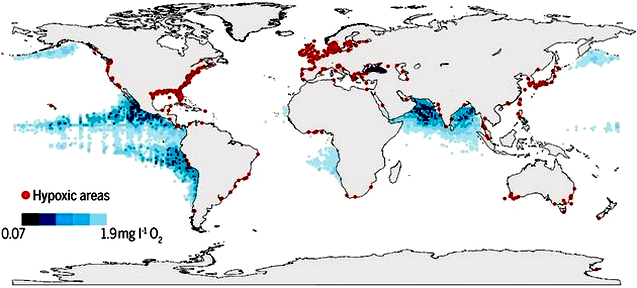
The size of oxygen-starved ocean “dead zones,” where plants and animals struggle to survive, has increased fourfold around the world, according to a new scientific analysis.
The growth of the zones is yet another consequence of global warming — including increasing ocean temperatures — triggered by greenhouse gases and, closer to the coasts, contamination by agricultural runoff and sewage.
Declining Oxygen in the Global Ocean and Coastal Waters/Science 
“Rising nutrient loads coupled with climate change — each resulting from human activities — are changing ocean biogeochemistry and increasing oxygen consumption,” says the study published in the journal Science. Ultimately, such changes are “unsustainable and may result in ecosystem collapses, which ultimately will cause societal and economic harm.”
The analysis of the oxygen-starved zones was conducted by a team of scientists from the Global Oxygen Network (GO2NE),  created in 2016 by the Intergovernmental Oceanographic Commission of the United Nations.
Researchers determined that open-ocean “oxygen-minimum” zones have expanded since 1950 by an area roughy equivalent to the size of the European Union. The volume of ocean water completely devoid of oxygen has more than quadrupled in that time, the study found. The number of hypoxic, or oxygen depleted, zones along coasts has increased up to 10 times, from less than 50 to 500.
Denise Breitburg, a marine ecologist at the Smithsonian Environmental Research Center and lead author of the study, called the plunge in ocean oxygen “among the most serious effects of human activities on the Earth’s environment.” Oxygen is “fundamental to life in the oceans,” she said in a statement.
“If you can’t breathe, nothing else matters,” Breitburg told The Associated Press. “As seas are losing oxygen, those areas are no longer habitable by many organisms.”
But the threat isn’t just to life in the oceans, which account for about half of the oxygen on the planet.
Major extinction events in Earth’s history have been associated with warm climates and oxygen-deficient oceans,” the study warns.
Consequences for ocean life can be significant even in areas where oxygen is merely low. Sea life may be stunted and immune responses impaired in such areas, resulting in poor survival rates and a decrease in healthy diversity, scientists warn.
The scientists recommend salvaging oxygen-starved areas by tackling climate change and nutrient pollution, focusing on protecting particularly vulnerable sea life with no-catch or no-fishing zones, and increasing and improving surveillance of areas where oxygen is plummeting.
Breitburg concedes that addressing global warming can seem daunting, but she says focused local efforts to protect areas can be effective. She points to changes in the Chesapeake Bay, where nitrogen pollution dropped 24 percent from its worst levels after sewage treatment and protections mandated by the Clean Air Act began. Areas of the bay with zero oxygen zones have nearly vanished, according to Breitburg.
Even with “ambitious emission reductions,” however, numerical models project “further oxygen declines during the 21st century,” the study warns.

Links

Show This Cartoon To Anyone Who Doubts We Need Huge Action On Climate Change

VoxAlvin Chang | David Roberts


This is Earth. It's a crisp fall day. So why would you believe Earth is in a dire situation?


Let's look a little deeper. The brown area below represents all the fossil fuels — oil, coal, and natural gas — that humans have identified as recoverable with current technology. The black spot is what we’re currently harvesting with mines and wells.


So what if, tomorrow, all the world leaders got together and decided to stop building new mines and wells?


And then we used all the fuel in existing mines and wells.
What would that do to Earth?


It would release about 1.1 trillion tons of carbon dioxide into the atmosphere.
Scientists have figured out that this scenario would almost certainly drive up the Earth’s average temperature by more than 2 degrees Celsius (3.6 degrees Fahrenheit), relative to preindustrial levels. That’s not a big deal, right?


Actually, it would be a massive catastrophe. The human suffering would be unthinkable.
When most of us think about Earth warming by 2 degrees, we think about it being, well, 2 degrees warmer.


But that's not quite right. First of all, it means Earth would get an average of 2 degrees warmer. This means some regions, especially on land, will get much hotter — far more than 2 degrees.
The Arctic, which houses much of the world’s ice, would warm by almost 11 degrees Fahrenheit.
The US Southwest, already suffering from increased drought, could warm by almost 10 degrees Fahrenheit, enough to create near-permanent "superdroughts."


The other problem is that Earth’s ecosystems would behave differently. For humans, it would mean rising sea levels, freshwater shortages, reduced agricultural productivity, food stress, and the conflicts and emigration that come in their wake.


A lot of people will die, and not because they burn to death. It'll be because we don't have enough food and water.
It would be like slightly heating up a fish tank, which is okay for the fish but kills the algae the fish eats.


All of this will be well underway by the time we hit 2 degrees — and the further we go past it, the worse it will get.
So we all agreed, in Paris, not to let it happen.
About 200 countries, including all the world’s major emitters, agreed at a summit in Paris in 2015 that letting the planet warm beyond 2 degrees is unacceptable, and even 2 degrees is awful. We vowed to do our best to stop warming at 1.5 degrees — although most climate researchers believe that target is no longer realistic.


That’s why we hear so much about efforts to stop warming at 2 degrees.
But how do we do it?
First, we figure out how much carbon dioxide we’re allowed to emit.

When we burn fossil fuels, we emit several harmful gases. But we focus on carbon dioxide for one reason: It stays in the atmosphere for centuries, accumulating and trapping heat.
This means we can calculate how much carbon dioxide it would take to warm the Earth a certain amount.
According to our best calculations, it would take about 843 billion tons of carbon dioxide to warm Earth about 2 degrees.


If we decide to keep using fossil fuels at the same rate, we’ll hit our limit in 21 years.
Currently we emit about 39.2 billion tons of carbon dioxide per year — and that number is only rising. But if we were able to keep it at that amount, what would happen?
After one year, our mug would look like this:


It’s not a huge hit. But after 21.5 years, we’d be here:


That’s the year 2037.
If we reduce emissions until we get to zero in the year 2065, we still need to invent world-changing technology.
Let’s say that over the next 49 years, we drive down our use of fossil fuels all the way to zero.
It’s an optimistic long shot. But this is the scenario climate scientist Joeri Rogelj proposes:


The kicker is that even in this crazily ambitious scenario, we have to rely on "negative emissions" technologies that pull carbon out of the air and bury it.
The problem: We have no clue if that’s even possible.
Negative emissions technologies have not been tested or proven at any scale. We are literally gambling our species’ future on the idea that we’re going to be able to invent it and scale it up to enormous size ... by 2065.


Let’s say, somehow, we get to no emissions in 2065 — and we invent this world-changing technology.
We’ve saved the world, right?
Not definitely. It would only give us a 66 percent chance at staying under 2 degrees.


Remember when we all agreed in Paris that 2 degree warming cannot happen? This long shot is what they were committing to.


Given the evidence, the global community has committed not to let the Earth warm by more than 2 degrees. In doing so, countries committed to rapidly reducing and eliminating all production and use of coal, oil, and natural gas and to inventing and scaling up negative emissions technology.
The problem is they don’t seem to realize that’s what they committed to.
No country is taking this long shot seriously. This means Earth will probably warm past 2 degrees. It’s terrifying.
Right now, the cool fall wind is flowing through windows, and everything feels fine. Nothing seems dire. So it’s understandable why many of us don’t feel this is an urgent political priority.


But here’s the reality: We're heading toward a global catastrophe that will cause unthinkable human suffering. The data is clear: We need to turn the ship now — or else we’ll never be able to avoid disaster.


But no country is taking this 2 degree goal seriously. It hasn’t even been mentioned in a presidential debate.
Instead, we’re focusing on threats that feel more imminent. It's just the way most humans are calibrated. So our true test is figuring out a way to comprehend that a mortal threat is on the horizon, and act accordingly.


Links

Three New Year’s Resolutions That Can Help Fight Climate Change

New York Times - Kendra Pierre-Louis

Simone Noronha
Here are three things you can do to help reduce your personal contribution to climate change while pursuing goals you might already have, like moving more, spending less and tracking your progress.

Walk the walk
If your goals for 2018 include getting more exercise, consider committing to walking or bicycling distances under a mile.
Roughly 20 percent of car trips in the United States fall into this category, and the average car produces 411 grams of carbon dioxide per mile. That’s the equivalent of the weight of a football or a can of soup.
Walking that mile instead of driving not only cuts emissions but also contributes to the 150 minutes of moderate aerobic activity that the Centers for Disease Control recommends adults get each week. Bicycling is about twice as fast as walking, so if you’re biking you might want to commit to cycling distances under two miles. Want to track your activity? Try downloading a fitness tracking app to your smartphone.
One economist caused a stir in a 2013 article by suggesting that driving could account for fewer emissions than walking because of the agricultural emissions that are generated while producing the food that fuels the walking. But the author assumes that a car gets 40 miles per gallon, not the 25 m.p.g. that is the current United States average.
And even if you drive a hybrid, it’s still worth it to walk. While the author assumed that people would need to eat more to make up the extra calories burned off while walking, Americans already eat more calories than we need. Walking is as much a doughnut offset as a carbon offset.

Waste not
This doesn’t mean we shouldn’t care about food-related emissions. Worldwide, agriculture accounts for 18 percent of greenhouse gas emissions. Luckily, we can help slash emissions — and save money — without drastically altering our diets.
One way is to waste less food. According to the Food and Agriculture Organization of the United Nations, about a third of the food produced worldwide never gets eaten. Throughout the world, some of that waste happens during production and distribution. But consumers and restaurants in North America throw away almost 40 percent of available food.
Geremy Farr-Wharton, a researcher at the Queensland University of Technology, found that color-coding our refrigerator contents (green for fresh produce, red for meat) can reduce food waste. There are even refrigerator management apps like FridgePal and Best Before that track the food in your fridge and when it will spoil. If apps aren’t your thing, a weekly refrigerator check — preferably before grocery shopping — can also help, as can monthly fridge eat-downs where you spend the last few days of the month using up everything that’s left in your fridge.
A number of businesses are also stepping up to cut waste on the production side by selling ugly produce. Producers toss about half of all fruits and vegetables in the United States, in part because they think we won’t buy “imperfect” produce that fails to meet aesthetic standards. Businesses like Imperfect Produce hope to bridge that gap by selling ugly but otherwise normal produce at a discount of 30 to 50 percent.

Measure up
There’s some truth to the saying “What gets measured gets managed,” and quantification has become something of a cultural obsession. Oroeco, an app available on both Android and iOS, takes that zeal and applies it to tracking personal carbon emissions.
Oroeco helps quantify the carbon emissions associated with purchases, investments, dietary choices and preferred modes of transport. It allows users to set goals, track performance and even compare their performance with friends. The app is still relatively new, and it isn’t perfect, but it can be a useful tool to get you moving in the right direction.
Other apps can help you lower your carbon footprint, too. My colleague Hiroko Tabuchi recently detailed the apps that she uses to stay aware of her personal contribution to global warming. The list includes the CO2 app from the International Civil Aviation Organization that she uses to track her greenhouse-gas emissions when she flies so she can invest in carbon offset credits. You can check out Hiroko’s full list here.

Links

06/01/2018

Why Snowy 2.0 Is A Write-Off From The Start

AFR - Bruce Mountain*

The Snowy scheme has the Prime Minister's eye. Alex Ellinghausen
Nine months ago Snowy Hydro, the electricity generator and retailer owned by the Commonwealth, Victoria and NSW governments, announced that it would be carrying out a feasibility study into a massive expansion of the Snowy hydro generation system to add 2000 megawatts of pumped hydro generation capacity.
Snowy Hydro's announcement of the feasibility study followed an earlier announcement from the Prime Minister that Snowy 2.0 was expected to cost $2 billion.
The feasibility study was published shortly before Christmas and the final investment decision is expected by the end of 2018. All economic analysis has been excluded from the public version of the feasibility study.
But the publicly available version does report the "base cost" of Snowy 2.0 (to Snowy Hydro) is likely to be in the range from $3.8 billion to $4.5 billion. This "base cost" excludes land and developments costs, funding and financing costs, GST, project management or hedging costs. And the feasibility study warns that there are risks, opportunities and contingency amounts that significantly affect this range.
In addition to the costs that Snowy Hydro incurs, Snowy 2.0 will be the largest point connection in the National Electricity Market's history and will require massive transmission expansion along the Great Dividing Range. TransGrid in NSW provided early estimates of transmission costs in NSW related to Snowy 2.0 of $0.6 billion to $1.4 billion. Estimates of the requirement in Victoria are not yet known but are likely to be even higher because the necessary upgrade to Victoria will be even larger.
So, in round numbers, a conservative estimate of the total capital outlay attributable to Snowy Hydro 2.0 will be at least $8 billion, four times more than the prime minister suggested when announcing this project. It would be surprising if the estimate at the time of the final investment decision is any lower than this, and the actual build cost will surely be yet higher, quite possibly significantly so.
Will it nonetheless be money well spent?
This is very unlikely. Pumped hydro is an inefficient storage technology. Australia already has significant pumped hydro capacity – 900 megawatts (MW) at Tumut 3 in Snowy and 500 MW at Wivenhoe in Queensland. Both are rarely used because they are inefficient.
The feasibility study says that at capacity, Snowy 2.0 will only produce about 1 kilowatt hour for each 1.5 kilowatt hours needed to pump water to the top reservoir. Add to that 10 per cent for losses in transmitting electricity from generators in the Hunter and Latrobe valleys to pump the water uphill. And then add another 10 per cent for losses in transmitting the stored electricity back to the main load centres in Sydney and Melbourne where most of it will be consumed.
In other words, Snowy 2.0 will use about 1.8 kilowatt hours for each kilowatt hour that it actually delivers to consumers. By comparison, a battery installed on a customer's premises or on the local grid can be expected to use about 1.1 kilowatt hour for each kilowatt hour delivered.
It is inconceivable that Snowy 2.0 will produce revenues that are vaguely close to that needed to compensate its capital outlays. This is because the volume of electricity it can produce, valued at the difference between the price paid to pump water uphill and the price received when running the water back down the hill again, will be much too small.
Experience in other countries is also instructive. The feasibility study likens Snowy 2.0 to the Dinorwig pumped hydro plant in Wales. Dinorwig, along with the smaller Ffestiniog, has comparable capacity to Snowy 2.0. In its most recent market transaction six months ago, the market value of Dinorwig and Ffestiniog was established at $236 million, a small fraction of its initial build and subsequent refurbishment costs.
It is almost certainly the case in Australia that the market value of Snowy 2.0 will be a small fraction of its likely construction cost. If they decide to proceed with Snowy 2.0, the Commonwealth, NSW and Victorian governments will be forced to substantially write down their investment, at tax payers' expense. Or, if they can not stomach that, electricity consumers will be forced to fund the deadweight.
There is time to dodge this bullet. At the very least, independent investment advisors should now be asked to opine, in publicly available reports, on likely market valuations of Snowy 2.0, before any further contemplation of this project.
More generally, unravelling the mess that is the electricity market in Australia demands independent, rigorous and impartial advice. This is always valuable but even more so when such advice is not likely to be popular with sectional political, industry or customer interests.
Deep institutional reforms are needed to ensure energy market institutions are rewarded for providing such advice rather than for telling ministers what they want to hear.

*Bruce Mountain is the director of consultancy Carbon and Energy Markets (CME).

Links

Lethal Heating is a citizens' initiative