08/02/2018

'Everything Is Made Into A Political Issue': Rethinking Australia's Environmental Laws

The Guardian

Public should be given a greater say on development plans, experts say
Pelicans rest on a small island near The Entrance, in NSW. Photograph: Arterra/UIG via Getty Images
Environmental lawyers and academics have called for a comprehensive rethink on how Australia’s natural landscapes are protected, warning that short-term politics is infecting decision-making and suggesting that the public be given a greater say on development plans.
The Australian Panel of Experts on Environmental Law has launched a blueprint for a new generation of environment laws and the creation of independent agencies with the power and authority to ensure they are enforced. The panel of 14 senior legal figures says this is motivated by the need to systematically address ecological challenges including falling biodiversity, the degradation of productive rural land, the intensification of coastal and city development and the threat of climate change.
Murray Wilcox QC, a former federal court judge, said the blueprint was a serious attempt to improve a system that was shutting the public out of the decision-making process and failing to properly assess the impact of large-scale development proposals.
“We found the standard of management of the environment is poor because everything is made into a political issue,” Wilcox said. “Nothing happens until it becomes desperate.
“We need a non-political body of significant prestige to report on what is happening and have the discretion to act.”
The legal review, developed over several years and quietly released in 2017, resulted in 57 recommendations. It was suggested by the Places You Love alliance, a collection of about 40 environmental groups that was created to counter a failed bid to set up a “one-stop shop” for environmental approvals by leaving it to the states. The panel undertook the work on the understanding it would be independent and not a piece of activism.
Its work helped inform a motion passed by 250 Labor branches calling on the Labor leader, Bill Shorten, to put stronger national environmental laws and the introduction of an independent watchdog at the centre of his election pitch.
The Australian Panel of Experts on Environmental Law convener, Rob Fowler, an environmental lawyer for more than 40 years and adjunct professor at the University of South Australia, said a key finding was that cooperative federalism – different tiers of government working together to solve common problems – had not worked in protecting the environment.
“It’s slow-moving, unwieldy and leads to compromised outcomes,” he said.
Fowler said devolving responsibility for environmental protection to the states had been popular with politicians, having been proposed by both the Gillard Labor government and the Coalition under Tony Abbott, but not the public. The 2014 constitutional values survey conducted by Griffith University found nearly 45% of respondents believed Canberra should be solely responsible for protecting the environment. Just 16% said it should be left to the states.
He said the body of expert opinion was strongly in favour of the commonwealth taking responsibility. The panel believed a future government should introduce a mechanism that required states to act in line with plans and strategies developed by a commonwealth environment commission. If they failed to comply, they could be overridden.
Wilcox, who before becoming a judge was president of the Australian Conservation Foundation from 1979 to 1984, said creating an environment commission was the panel’s most important recommendation, likening it to the Reserve Bank. “It hopefully would involve people of considerable ability and achievement,” he said.
It would develop both national strategies and regional plans to protect biodiversity, and oversee a system of environmental data monitoring, collection, auditing and reporting. Where it did not do the monitoring itself, it would be required to ensure the work was done to a higher standard than currently, backed by federal funding.
Wilcox said the national Environment Protection and Biodiversity Conservation Act, which was introduced by the Howard government in 1999, was an advance at the time but now “well and truly out of date”.
The environment minister, Josh Frydenberg, has said the existing act continues to be the best mechanism for the federal government to protect the most important and sensitive matters. The opposition environment spokesman, Tony Burke, said the push to introduce national laws would be considered at ALP conference this year, and he was consulting about updating the act.
Wilcox said the public should have a greater say in response to developments. He said state planning systems were good at handling small neighbourhood development problems but larger proposals tended to be “waved through by governments mesmerised by the corporate dollars”.
He cited the hotel and casino complex being developed at Barangaroo in Sydney. “Anything that did come out about that was released for political reasons. That story just applies again and again and again.
“If you believe in a democracy, then you believe ordinary people should be encouraged to get in and have a say, and that’s not the case at the moment. If anything the opposite is the case.”

Links

Tourism Is The Australian Industry Least Prepared For Climate Change, Report Says

The Guardian

Beaches, wildlife, the Great Barrier Reef, unspoilt natural wilderness and national parks all considered threatened
A Climate Council report says not enough is being done to prepare for damage to Australia’s greatest tourism drawcards. Photograph: Greg Torda/Arc Centre Coral Reef Studies/EPA
 Tourism is Australia’s most vulnerable and least prepared industry to deal with climate change despite the fact it is already feeling its effects, according to an advocacy group report.
The report by the Climate Council, based on 200 source documents and articles, says while tourism is growing at an extraordinary pace – an 8% jump in visitors last financial year – not enough is being done to prepare for damage to the country’s greatest drawcards.
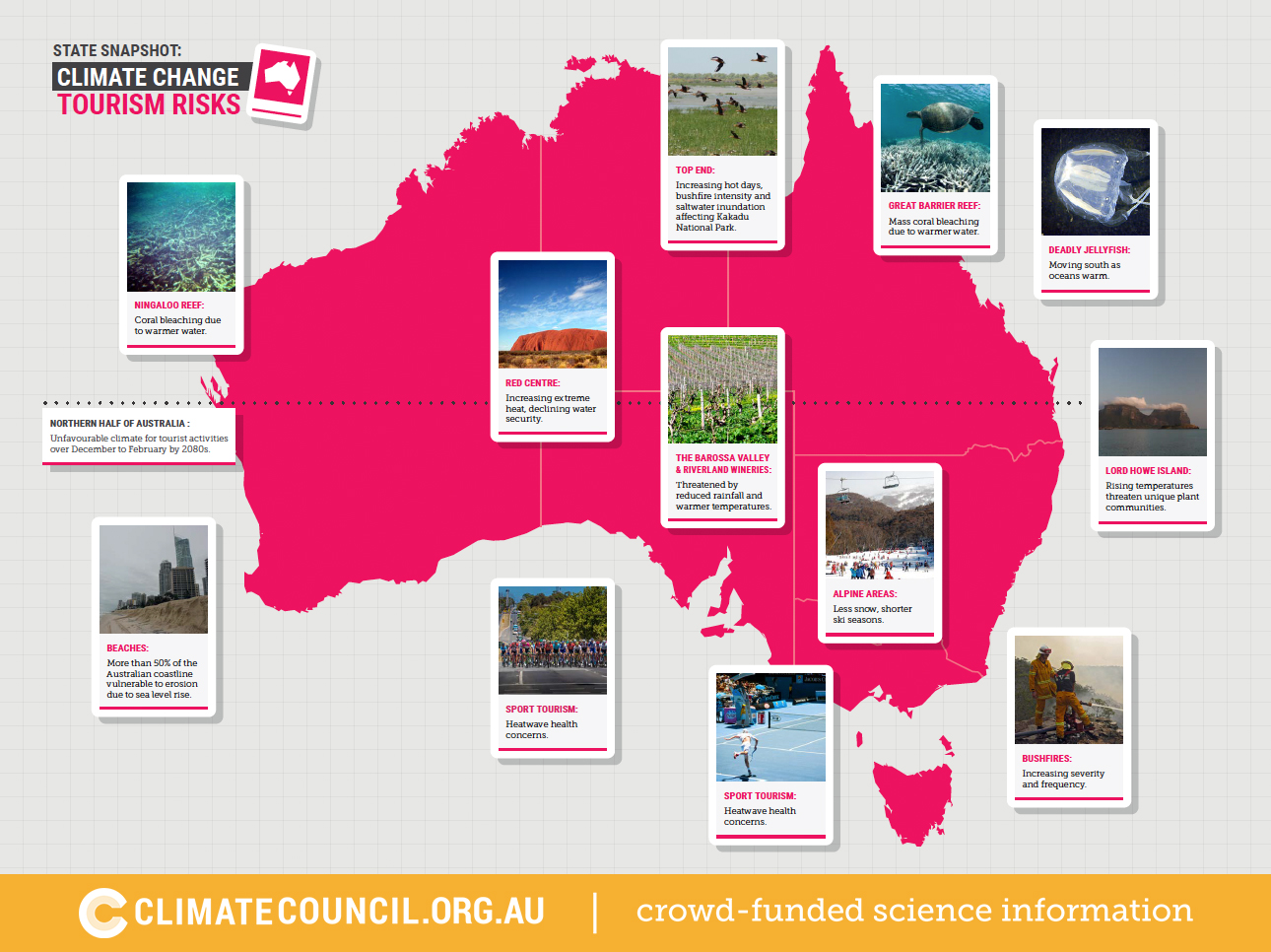
The five biggest attractions as reported by Tourism Australia – in order: beaches, wildlife, the Great Barrier Reef, unspoilt natural wilderness, national parks including rainforests and other forests – are all considered threatened by climate change.
The report says federal and state governments have mostly underplayed or ignored the risk to tourism. The government’s national Tourism 2020 plan makes no mention of the need to cut greenhouse gas emissions or improve sustainability in the industry.
Last month, the head of Queensland’s Association of Marine Park Tourism Operators, Col McKenzie, called climate scientist Terry Hughes “a dick” and urged the federal government to cut research funding due to his public comments about rising water temperatures harming the reef. McKenzie said it had turned tourists away.
Ecologist and report co-author Prof Lesley Hughes said it should not be controversial to discuss the threat climate change posed to the industry.
Beyond the often cited back-to-back years of bleaching on the reef in 2016 and 2017, she cited as examples beach erosion due to rising sea levels and a projected accelerating growth in extremely hot days in the red centre and the Top End across this century.
“Most government and industry plans on tourism are focused on growth but they don’t also look at the other side of the coin, which is the risks,” she said. “When people come here they might do other things – cultural things such as visiting the Sydney Opera House – but really the overwhelming attractions are natural icons and it’s very clear they are all already being affected.”
Government data cited in the report underlines the extent of the tourism boom. International visitors spent $40.6bn last financial year and were served by a tourism industry that employs 580,200 people, 5% of the country’s total workforce. The government estimates that, for every dollar generated by the tourism industry, a further 90c is spent elsewhere in the economy.
New Zealand provided the most visitors, though Austrade expects it will be overtaken by second-placed China this year. Britain, the United States and Singapore round out the top five. Tourism Australia this week launched a major advertising campaign in the US during the Super Bowl based on the Crocodile Dundee movie franchise. Starring actors Chris Hemsworth and Danny McBride, the campaign emphasises Australia’s natural beauty.
The industry’s growth has made tourism Australia’s second-largest export after iron ore. It is a significantly larger employer than coalmining or oil and gas extraction, which in 2014-15 employed 39,000 and 22,000 people respectively.
Hughes said, despite this, the future of fossil fuel industries and jobs received far more attention in the national conversation. “It’s cognitive dissonance at its most extreme,” she said.
Examples of industries already being affected by global warming include ski tourism, which has seen a trend of increasing reliance on artificial snow as seasons she shortened over the past 25 years.
“That’s a classic illustration that tourism industries will need to adapt and diversify to find other ways to bring people to those regions,” Hughes said.
The report highlights some hotels, resorts, airlines and zoos have taken steps to cut pollution but says a national plan is lacking. Hughes called on more tourism operators to lobby governments to help the industry adapt and diversify.
“I would also like to see operators be part of the lobby for better climate and energy policy,” she said.

Links

Icons at Risk: Climate Change Threatening Australian Tourism

Climate Council

AUSTRALIA’S MOST POPULAR tourist destinations are in the firing line, with intensifying climate change posing a significant threat to the nation’s iconic natural wonders.
The Climate Council’s Icons at Risk: Climate Change Threatening Australian Tourism’ report shows Australia’s top five natural tourist attractions could be hit by extreme heatwaves, increasing temperatures, rising sea-levels, coastal flooding and catastrophic coral bleaching.
Australia’s iconic beaches, wilderness areas, national parks and the Great Barrier Reef are the most vulnerable hotspots, while our unique native wildlife is also at risk, as climate change accelerates.

View large image

Key findings include:
Download the report
  • Australia’s top five natural tourist attractions (beaches, wildlife, the Great Barrier Reef, wilderness and national parks) are all at risk of climate change.
  • Beaches are Australia’s #1 tourist destination and are threatened by rising sea levels.
  • Sydney, Melbourne, Hobart, Cairns, Darwin, Fremantle and Adelaide are projected to have a least a 100 fold increase in the frequency of coastal flooding events (with a 0.5m sea level rise).
  • The Red Centre could experience more than 100 days above 35ºC annually, by 2030. By 2090, there could be more than 160 days per year over 35ºC.
  • The Top End could see an increase in hot days (temperatures above 35ºC) from 11 (1981-2010 average) to 43 by 2030, and up to 265 by 2090.
  • Ski tourism: Declines of maximum snow depth and decreasing season length at Australian ski resorts have been reported for over 25 years, increasing the need for artificial snow-making.
  • Tourism is Australia’s second most valuable export earner, employing a workforce of more than 580,000 people, over 15 times more people than coal mining in Australia.
Links

07/02/2018

The Science Of Global Warming And The Causes & Prevention Of Climate Change (Part 2)

CleanTechnica - 


Introduction
In Part 1 of this article, I introduced the problem of climate change and the history of the science behind it. I then went on to discuss greenhouse gases, noting that greenhouse gas emissions are still increasing and that the need for our intervention is very urgent, and our action needs to be immediate, robust, and extensive. I looked at what we need to do in general terms, so I said, “Every nation needs to introduce new legislation today, which will ensure and encourage investment in, and development of, renewable sources of energy, and which will expedite the installation of whatever renewable energy plant is currently available.”

Encourage Investment in and Development of Renewable Sources of Energy
I now cover that in more detail. Where I mention particulars, this will be for the UK, but readers from other nations will no doubt recognize parallels with their situations in their home countries.

Government Subsidies
What has worked very well has been government subsidies to either help with installation costs or to lower the price of the energy produced, in order to make it more competitive against less desirable fossil fuel-generated power. Most fossil-fueled generation is being heavily subsidized both in the unpaid costs to society of the pollution it causes (also true of nuclear power), and in government tax breaks to the fossil-fuel industry to artificially lower the price and ensure a plentiful supply. The UK government allows around £6billion per year in such tax breaks.
Renewable energy, such as wind and solar, are becoming cheaper and more efficient year after year, so that very little subsidy is needed. On-shore wind is now becoming so cheap it might eventually not need any subsidy.

Planning
Installations also need planning permission, and though planning control is needed, the approach could be adopted of allowing installations as much as possible. Solar and wind farms are generally built on less productive land not required for agriculture. Land owners could be given financial incentives for either building or allowing such energy systems to be built on their land. Central planning could be set up to identify suitable sites where new plants are most needed, and to actively identify the existing players in the industry and co-operate with them to build the energy systems there. For solar, installations can also be added to existing infrastructure such as railway lines and roads as well as on buildings. Even productive agricultural land can be used for wind farms, and even for solar, where the panels are mounted on pylons high enough to allow all normal agricultural activity to continue underneath.

Perverse UK Government Energy Policies
UK Government energy policies are unfathomable. It announced its 25-year green plan, and before that a ban on the sale of new internal combustion engine cars by 2040, but both of these have no real substance. By 2040, most new vehicles will be EVs in any case, without any grand government announcement. The 25-year plan seems mainly a way of doing nothing for 25 years, as it contains vague aims and no measures to achieve them other than to appeal to big business to play along, which is something they are not well known for. That is the thin PR veneer, but what are they are actually doing? In the UK we have energy auctions, where green-energy providers can bid for contracts to provide subsidized energy for the National Grid. The awarding of contracts is based on price, except that for some perverse inexplicable reason, since 2015, onshore wind companies are not allowed to enter into the auction. Even though their prices per megawatt hour are the cheapest thing going, they are not being allowed to compete. Also, the government has, firstly, tried to remove planning decisions from local authorities, where they normally sit, in order to turn down every onshore wind-farm proposed. Having drawn much criticism for that antidemocratic process, they then returned these decisions to local authorities, but altered the planning laws to ensure that any vociferous “NIMBY” (not in my back yard) person, not wanting the nice view from their home diminished by the installation of wind generators, could block these plans quite easily. At the same time, they corrupted the planning laws in a different way by designating fracking installations as being “nationally significant infrastructure projects,” so that even though local authorities and hundreds of local protesters have been entirely against these fracking operations, the Tory government has forced them through. As far as can be understood, the only reason for the policy against on-shore wind farms is that the NIMBY objectors are Tory voters in rural areas, where such rural constituencies tend to be safe Tory parliamentary seats.
A further general blow to renewable energy has been the freezing of a carbon tax in the 2017 budget that the government had imposed not long ago. The carbon tax added to the overall cost of energy and increased domestic energy bills, but provided better prices for renewable energy, allowing it to be commercially viable. By freezing the tax, many renewable energy projects that had relied on the price increasing have been left high and dry, causing a shutdown of renewable energy investment. The UK government talks about being green and having “green plans,” but does just the opposite in the most perverse and deceitful way possible.

Solar
Solar, unlike wind, which requires large-scale installations to be efficient, can be installed by individual households and businesses for their own independent supply. Information, encouragement, and plentiful cheap supplies and installation are what is needed there. Currently there are too many commercial organizations involved who see solar installation as yet another way of making a fast buck at the public’s expense. Non-profit installers and suppliers need setting up with central or local government endorsements and licensing, in order to give the public the lowest possible costs and guaranteed standards. At the very least, we need a licensing system for current suppliers and installers, and a centralized information website where people can get lists of licensed suppliers and clear comparisons for price and service. None of this is likely with our present Tory government.

R&D
For R&D, we used to have some government research centers in the UK responsible for the development of many new technologies before they became mainstream, but under the Tory privatization policies, these have been converted into privately-run “science parks” spending time only on projects most likely to turn an immediate profit. Universities are perhaps the only places left for pure research, and grants could be given to those already engaged in promising new developments to ease the way for them. Scotland has a special fund for green development, but Scotland does not have a Tory government, as is our misfortune in England.

Improvements to The Grid
To make better use of renewable energy systems, we need more storage on the grid. The latest wind turbines have storage built in, so that they can be self buffering for short periods, but large-scale storage, using batteries, flywheels, pumped hydro, or whatever the inventive mind can develop, needs to be added to the grid. The EU is developing an EU-wide smart grid, so that power can be distributed all across Europe from where it is being generated to where it is needed. The foolish Tory “Brexiters” in the UK might make participation in that more difficult.
All other methods of energy harvesting, such as hydro, wave, tidal, and geothermal, need to be developed and utilized as soon as possible in the UK.

Phasing-out of all Fossil Fuel Burning
We need definite plans for the phasing out of all fossil fuel burning as alternatives become available, and to make every effort to make those alternatives available as soon as possible. This would include fossil fuel burning in power stations, transport, and for domestic and industrial space heating.

Alternatives
The key phrase here is “as alternatives become available.” We cannot simply turn off the valve at the oil well, leaving people with nothing, and there is no point at all in replacing one fossil fuel, such as coal or oil, with another, such as gas, which is only slightly less damaging to the environment. When the gas is shale gas, obtained by hydraulic fracturing (or “fracking,” as it has come to be known), where the product might be slightly less damaging, the process represents huge additional risks to the environment. These risks are mainly poisoning the water table and the release of large quantities of methane into the atmosphere. Similarly, although nuclear power stations might score a point by generating electricity without the release of CO2 or methane, we ask how many more nuclear disasters will it take before people consider that this is not such a good idea after all? Also, the cost of decommissioning and dealing with nuclear waste adds enormously to the very high cost of building and maintaining these stations. The 2017 forecast is that future clean-up across the UK will cost around £119 billion spread across the next 120 years or so. See the government report. This is just for the 17 oldest sites, and does not include newer sites still operating, and those yet (if ever) to be built, such as Hinkley Point C.

Biofuels
One obvious choice is to replace fossil fuels with biofuels where they cannot yet be replaced by renewable energy sources, but there is some level of controversy about that. Biofuels release CO2 into the atmosphere, but this is CO2 that was in the atmosphere during the lifecycle of whichever plant source is being used. This could be a few weeks, in the case of algae, or months, with fast-growing grasses, or perhaps a year or two, in the case of fast-growing shrubs like willow, or even 20 years or so in the case of a tree. Fossil fuels, on the other hand, release CO2 into today’s atmosphere from the atmosphere of millions of years ago, when the organic material from which they are formed was living. Biofuels, therefore, are cycling CO2, and so are carbon neutral, whereas fossil fuels positively add to the CO2 levels in the atmosphere.
However, we rely on plants of all kinds in all places on the planet to absorb carbon dioxide and provide us with oxygen, so that biofuel production would have to be very carefully managed so as to increase, rather than reduce, the total capability of plant life to absorb carbon dioxide across the planet. Also, any process of burning produces pollutants in addition to CO2, such as carbon monoxide, particulates, and nitrous oxides such as nitrogen dioxide, so it’s not an ideal solution. Though not ideal, it would still be better to use biofuels where fuel has to be used, rather than continuing to burn fossil fuels. There are many areas, such as aviation, shipping, and heavy haulage, where currently there are no easy alternatives. Alternatives need to be developed, and are being developed right now.

Aviation
In aviation, the low energy density of batteries when compared with aviation fuel makes a straight swap between 10 tons of aviation fuel and 10 tons of batteries one that would leave an aircraft short of range. Jet engines are a mature technology, but electric propulsion systems are in their infancy. There is also a technical difficulty, in that the maximum take-off weight of an aircraft is more than the maximum landing weight. This is because the aircraft is lifting away from the ground on take-off, but falling towards the ground on landing, and so has a downward momentum which has to be absorbed in the landing gear at the point of impact. During a jet-fueled flight, many tons of aviation fuel will be burnt in the engines, but a battery-powered aircraft is exactly the same weight during both take-off and landing.
Plans for electric short-haul aircraft are already being developed, and 1- to 5-seat electric aircraft already exist, but long-distance aircraft will still need to use aviation fuel unless some as yet unknown technology is developed. Biofuels are the only current solution.

Shipping
Shipping, on the other hand, seems ripe for electrification as weight is less of an impediment, and ships have dead-weight above the keel, known as ballast, to keep the ship upright in the water, so batteries would make just as good of a ballast as concrete or lead. The old sailing clippers could do around 20 knots, which is faster than most modern cargo ships. There will not be a return to sail, however, because it was a very labor-intensive and dangerous operation. A modern version, with rigid, vertical, wing-like “sails” which are entirely motor-controlled, can be used as a supplementary power source, even on an unmanned autonomous ship. Ships are also ideally suited to take advantage of solar power out on the open ocean. It seems to me that shipping could very easily be developed toward a fossil-fuel-free fleet.

Land Vehicles
For heavy haulage, we now have the Tesla semi-truck and other contenders soon coming into the market, and smaller trucks and vans are already available as electric vehicles. Electric buses are very available and are being deployed, especially in China, where they exist in the thousands. For private cars, we are now at the stage of having, in the UK at least, good charging infrastructure and perfectly acceptable EVs for people to buy — both new and used, and to lease. We also have a reasonably good grant scheme for buying the cars, at £4,500 for a new EV. Home charging units are only £150 or so with a government grant. However, the government has not raised the fuel tax in the 2017 budget, which would have been a good way of forcing the pace of change, especially away from polluting diesel, It would not only make drivers think more urgently about changing to an EV, but would also reduce unnecessary car journeys and make walking, cycling, and public transport more appealing. It did increase the annual vehicle tax (Vehicle Excise Duty, or VED) for all diesel vehicles by moving them all up into the next tax-band, where EVs still have a VED of £0. As I mentioned earlier, the government also continues to give £6 billion in tax breaks annually to fossil fuel corporations, which somewhat dwarfs the one-off 2017 budget commitment of £500 million to encourage electric vehicle take-up. That £500 million includes the cost of the electric vehicle grant scheme which already exists, and so is not new money, and they have also said, mysteriously, that £400 million is for the encouragement and development of charging infrastructure. I say “mysteriously” because they already have the grants for home charging, and the UK already has the most comprehensive charging infrastructure on our motorways of any country in Europe, courtesy of Ecotricity. Chargers are sparse in some areas of the country, and certainly some central government planning is essential to ensure good coverage across the UK, but this requires liaison with all of the main players, rather than any new money. Like many Tory government announcements, the 2017 budget commitment of £500 million is something of a PR stunt to make a good impression, rather than doing what is needed to achieve their stated aim.

Other Considerations
In Part 1 of this article, I have already gone into sufficient detail about space heating, methane, and food production, and the production of gas from bio-materials from otherwise non-productive land. See this CleanTechnica article where Dale Vince of Ecotricity says they have the system for meeting all of the UK’s gas needs using un-productive land, if they had access to it.
I also said:
“In general, it must be made illegal to seek out any new sources of fossil fuels, or to drill any exploratory well or mine to test for the existence of fossil fuel deposits. All current fossil fuel production must cease, and wells and mines decommissioned as soon as alternative energy sources become available. To put it more simply, all fossil fuels must be left in the ground as soon and as much as is practically possible.”
I cannot see Republicans or Tories doing any such thing. In the UK, the main player in the fight against fossil fuel pollution has been Sadiq Kahn, the London Mayor, who is quite aggressively and rapidly imposing expanding zones where polluters have to pay a high premium to drive their vehicles. This has already resulted in air quality improvements, but soon the zone is to be expanded to the North and South Circular Roads, which means nearly all of London. The central UK government is doing nothing of that kind, but this needs to be adopted in all major cities. As long as people are allowed to drive their polluting vehicles where ever they want, they have no incentive beyond their own conscience to change to zero-carbon transport. They will continue to burn fossil fuels with disastrous consequences.

Energy Efficiency
I also mentioned energy efficiency, and could say more about that. It is extraordinary to me that we in the UK are mainly constructing buildings using materials and techniques which have changed little since Elizabeth I was on the throne. We now use double glazing, and double walls with an insulated cavity, and we do have insulation in the roof space, but we are still building with bricks and mortar, wood, and tiles, just as then. Buildings can and should be built in factories and erected on-site, using highly-insulating materials and designs, which eliminate the need for space heating and cooling. The buildings would have an energy-harvesting surface and an energy-retentive surface, and be positioned in relation to the direction of the Sun, which is south in the UK. The government could introduce radical new building regulations to ensure that all new houses are energy neutral, generating all the energy they will use. This could massively reduce the amount of energy required for domestic houses. It could also set up schemes to bring older houses up to standard, and although that is happening to some extent, it is hardly sufficient to make much impact. The EU has introduced some regulations for domestic appliances to encourage greater efficiency and less energy usage, such as a limit on the wattage of vacuum cleaner motors and a ban on incandescent lightbulbs. Every appliance has a label on it showing the level of efficiency represented by letters A to E, which helps consumers to make the right choices. All of these are good but could be better, and one of the worries about “Brexit” is that away from the good influence of the EU, our Tory government will not adhere even to these mild measures.

Conclusion
So in conclusion, while it is easy to note down all that could and should be done, it is not happening, and governments, especially those with a Neoliberal ideology, just seem to be pursuing a “business-as-usual” fossil fuel-loving policy with a thin veneer of PR, otherwise known in more honest circles as lies and deceit, in order to give the appearance of concern for the environment. Unless these governments change their ways, or are removed at the ballot box, there is little hope for the future of this planet for future generations. We all need to do everything in our power to wake the collective human mind from its slumber, before we sleepwalk off the cliff.

Links

Labor Pushes For Federal Investigation Into Adani

The Guardian

A protest against Adani’s Carmichael coalmine outside Parliament House. Tony Burke said the government should investigate Adani’s conduct and report publicly. Photograph: Mick Tsikas/AAP
Labor is pressing the Turnbull government for a federal investigation into Adani, arguing the commonwealth has responsibility for sensitive wetlands contaminated near the Great Barrier Reef after Cyclone Debbie.
Guardian Australia revealed last week concerns that Adani submitted an altered laboratory report while appealing a fine for contamination of the Caley Valley wetlands on the Queensland coast.
The wetlands were blackened by coal-laden water released from the Abbot Point port after Cyclone Debbie’s torrential rains inundated its coal storage facilities in March 2017.
Federal Labor has grabbed last week’s Guardian report as it hardens its public position on Adani’s controversial Queensland mine project.
On Tuesday in parliament, pressing for a federal investigation of Adani’s conduct, the shadow environment minister, Tony Burke, pointed out that environmental approvals for the Adani Abbot Point terminal placed conditions on the project, including the downstream impacts on the Caley Valley wetlands.
Burke asked, “given the minister has responsibility for the wetlands”, when would the federal government investigate Adani’s conduct and report publicly.
But the environment and energy minister, Josh Frydenberg, insisted the “primary regulatory authority” for the project was the Queensland government.
Frydenberg said Labor’s positioning on Adani was about the looming Batman byelection, where Labor faces a challenge from the Greens to hold the seat in inner-city Melbourne, rather than matters of policy substance.
Shadow cabinet discussed options for toughening Labor’s stance on the Adani mine on Monday night and the issue also dominated the Labor left caucus meeting, where differing views were expressed by MPs.
Labor is mulling legal options but some in the opposition are concerned a sharp move against the project will trigger a significant backlash about sovereign risk, and have negative implications in both Queensland and other coal regions.
Asked on Sky News on Tuesday about the implications if Labor ultimately adopted a position of reversing approvals for the Adani project, the shadow treasurer, Chris Bowen, dead-batted.
“We’re getting very far ahead of ourselves,” he said.

Links

NSW Court To Hear 'Landmark' Challenge To Coalmine Over Climate Change Impact

The Guardian

Case brought by group from Hunter Valley town, which it says has been devastated by Peabody Energy’s Wilpinjong mine
Mine owner Peabody Energy won approval last April to further expand the mine to extend its life to 2033. Photograph: Jeff Roberson/AP
In what is described as a landmark case, a New South Wales court will be asked to overturn a decision to extend the life of a coalmine on the grounds the state government failed to properly consider the impact on the climate.
The case is brought by a community group from the tiny Hunter Valley village of Wollar, which it says has been devastated by the development and gradual expansion of the Wilpinjong coalmine over the past decade.
Mine owner Peabody Energy won approval last April to further expand the mine, which sits between the towns of Mudgee and Denman, to extend its life by seven years to 2033.
In a case starting on Thursday, the Wollar Progress Association will argue the decision was unlawful as it did not properly consider the impact of the increased greenhouse gas emissions, including “downstream” emissions when the coal is burned in NSW and overseas power plants.
It says the state also did not look at whether the extension was in step with state and national climate change policies and targets, including Australia’s commitment under the 2015 Paris agreement to keep warming below 2C.
Lawyer David Morris, from the Environmental Defenders Office NSW, said the association would argue 2007 legislation covering extractive industries was explicitly designed to ensure these two points were considered before decisions were made on whether projects could go ahead.
“What is the point of commitments and targets if they are not factored into and reflected in decisions about projects which contribute to emissions?” he said.
“We say it is a landmark case. When you think about a coalmine in 2017, it is difficult to think of a more important consideration than its contribution to climate change.”
The secretary of the Wollar Progress Association, Bev Smiles, said the mine had gradually grown from approval in 2006 to mine 9.5m tonnes a year to the current 13m tonnes. She said the proposed expansion would bring it to within 1.5 kilometres of the village.
She said many landholders had sold to the company, and the population had fallen from about 300 to 70.
“The impact from noise, dust and blasting has been extreme,” she said. “What happens under government processes is we are left to our own devices up against people who have a lot more resources than we have, and the treatment of people over time by this company has been quite disgraceful.”
 A spokeswoman for Peabody Energy said the company had been through a comprehensive process and the case related to the approval process by the state’s Planning Assessment Commission, not the merits of the extension project. She said the mine generated jobs and invested in the Mudgee region, employing 413 people.
Peabody Energy is also applying for an exploration licence over more than 1,600 hectares of land east of Wollar.
The case starts in the land and environment court on Thursday. The planning minister, Anthony Roberts, declined to comment while the issue was before the court.
Separately, Smiles and two others will be in Mudgee local court on Friday facing charges relating to a protest at the mine last April.
While the case is believed to be the first time a mine approval has been been contested over its climate impact under the 2007 NSW law, at least one decision has been challenged on similar grounds under federal legislation. In 2016, the federal court dismissed a case brought by the Australian Conservation Foundation (ACF) against the federal government’s approval of Adani’s Carmichael mega-coalmine.
The ACF argued the mine’s approval was inconsistent with the country’s obligations to protect the world heritage values of the Great Barrier Reef. The court found the then environment minister Greg Hunt had considered the impact of the emissions from burning the coal on the reef, and that Australia had latitude under the World Heritage Convention as to how it carried out its obligations.

Links

06/02/2018

No Children Because Of Climate Change? Some People Are Considering It

New York Times

The Tengger Desert in China is growing because of climate change. Around the world, many would-be parents are looking at effects like this and hesitating. Credit Josh Haner/The New York Times
Add this to the list of decisions affected by climate change: Should I have children?
It is not an easy time for people to feel hopeful, with the effects of global warming no longer theoretical, projections becoming more dire and governmental action lagging. And while few, if any, studies have examined how large a role climate change plays in people’s childbearing decisions, it loomed large in interviews with more than a dozen people ages 18 to 43.
A 32-year-old who always thought she would have children can no longer justify it to herself. A Mormon has bucked the expectations of her religion by resolving to adopt rather than give birth. An Ohio woman had her first child after an unplanned pregnancy — and then had a second because she did not want her daughter to face an environmental collapse alone.
Among them, there is a sense of being saddled with painful ethical questions that previous generations did not have to confront. Some worry about the quality of life children born today will have as shorelines flood, wildfires rage and extreme weather becomes more common. Others are acutely aware that having a child is one of the costliest actions they can take environmentally.
Rising waters are threatening low-lying areas like South Tarawa in Kiribati, a Pacific island nation. Credit Josh Haner/The New York Times
The birthrate in the United States, which has been falling for a decade, reached a new low in 2016. Economic insecurity has been a major factor, but even as the economy recovers, the decline in births continues.
And the discussions about the role of climate change are only intensifying.
“When we first started this project, I didn’t know anybody who had had any conversations about this,” said Meghan Kallman, a co-founder of Conceivable Future, an organization that highlights how climate change is limiting reproductive choices.
That has changed, she said — either because more people are having doubts, or because it has become less taboo to talk about them.

Facing an uncertain future
If it weren’t for climate change, Allison Guy said, she would go off birth control tomorrow.
But scientists’ projections, if rapid action isn’t taken, are not “congruent with a stable society,” said Ms. Guy, 32, who works at a marine conservation nonprofit in Washington. “I don’t want to give birth to a kid wondering if it’s going to live in some kind of ‘Mad Max’ dystopia.”
Parents like Amanda PerryMiller, a Christian youth leader and mother of two in Independence, Ohio, share her fears.
“Animals are disappearing. The oceans are full of plastic. The human population is so numerous, the planet may not be able to support it indefinitely,” said Ms. PerryMiller, 29. “This doesn’t paint a very pretty picture for people bringing home a brand-new baby from the hospital.”
The people thinking about these issues fit no single profile. They are women and men, liberal and conservative. They come from many regions and religions.
A house party in Chicago organized by the group Conceivable Future. Credit Marya Spont-Lemus
Cate Mumford, 28, is a Mormon, and Mormons believe God has commanded them to “multiply and replenish the earth.” But even in her teens, she said, she could not get another point of doctrine out of her head: “We are stewards of the earth.”
Ms. Mumford, a graduate student in a joint-degree program at Johns Hopkins and Brigham Young Universities, plans to adopt a child with her husband. Some members of her church have responded aggressively, accusing her of going against God’s plan. But she said she felt vindicated by the worsening projections.
Smog shrouding Mexico City. When Cate Mumford, 28, saw similar pollution in China, she thought, “I’m so glad I’m not going to bring a brand-new baby into this world to suffer like these kids suffer.” Credit Josh Haner/The New York Times<
A few years ago, she traveled to China, where air pollution is a national crisis. And all she could think was, “I’m so glad I’m not going to bring a brand-new baby into this world to suffer like these kids suffer.”

‘Some pretty strong cognitive dissonance’
For many, the drive to reproduce is not easily put aside.
“If a family is what you want, you’re not just going to be able to make that disappear entirely,” said Jody Mullen, 36, a mother of two in Gillette, N.J. “You’re not just going to be able to say, ‘It’s not really good for the environment for humans to keep reproducing, so I’ll just scratch that idea.’”
And so compromises emerge. Some parents resolve to raise conscientious citizens who can help tackle climate change. Some who want multiple children decide to have only one.
For Sara Jackson Shumate, 37, who has a young daughter, having a second child would mean moving to a house farther from her job as a lecturer at the Metropolitan State University of Denver. She is not sure she can justify the environmental impact of a larger home and a longer commute.
But for Ms. PerryMiller, the Ohio youth leader, the thinking went the opposite way: Once she had her first child, climate change made a second feel more urgent.
“Someday, my husband and I will be gone,” she said. “If my daughter has to face the end of the world as we know it, I want her to have her brother there.”
Laura Cornish, 32, a mother of two near Vancouver, said she felt “some pretty strong cognitive dissonance around knowing that the science is really bad but still thinking that their future will be O.K.”
“I don’t read the science updates anymore because they’re too awful,” she said. “I just don’t engage with that, because it’s hard to reconcile with my choices.”

‘The thing that’s broken is bigger than us’
People who choose not to have children are used to being called “selfish.” But many of them see their decision as a sacrifice.
Parenthood is “something that I want,” said Elizabeth Bogard, 18, a freshman at Northern Illinois University. “But it’s hard for me to justify my wants over what matters and what’s important for everyone.”
This attitude seems particularly common among people who have seen the effects of climate change firsthand.
Hemanth Kolla is from Hyderabad, in India, where drought and scorching heat waves have been deadly. He lives in California, where the threat of wildfires is increasing and a six-year drought only recently ended. Mr. Kolla, 36, said it felt wrong to have a child when he did not believe the world would be better for him or her.
And Maram Kaff, who lives in Cairo, said she had been deeply affected by reports that parts of the Middle East may be too hot for human habitation by 2100.
“I’ve seen how Syrian refugees, who are running from a devastating war, are being treated,” Ms. Kaff, 33, said in an email. “Imagine how my children will be treated if they have to flee their country due to extreme weather, drought, lack of resources, flooding.”
“I know that humans are hard-wired to procreate,” she said, “but my instinct now is to shield my children from the horrors of the future by not bringing them to the world.”
Ms. Kallman and Josephine Ferorelli, the founders of Conceivable Future, said that the predominant emotion at their gatherings was grief — and that the very existence of these conversations should spur political action.
“These stories tell you that the thing that’s broken is bigger than us,” Ms. Ferorelli said. “The fact that people are seriously considering not having children because of climate change is all the reason you need to make the demands.”
Most of the people interviewed, parents and non-parents alike, lamented having to factor climate change into their decisions at all.
“What kind of nightmare question is that?” asked Ms. Guy, the Washington nonprofit worker. “That we have to consider that?”

Links

Lethal Heating is a citizens' initiative