24/02/2018

States Must Get Australia Back On Track, Amid Turnbull’s Climate Train Wreck

RenewEconomy - Leigh Ewbank

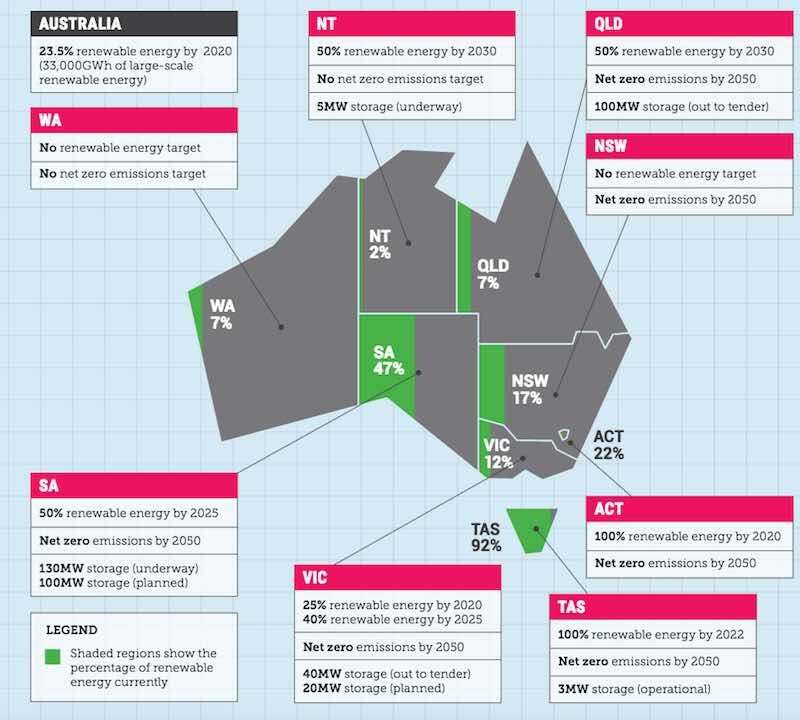
Source: Climate Council 2017 LARGE IMAGE
The slow train wreck of climate change policy is still unfolding in Australia. National emissions are rising on the Federal Coalition’s watch, and Australia will fail to meet the meagre emissions cuts it pledged to the Paris Agreement.
Regressive political forces at the national level have seen states and territories step up and lead on climate change. But they’ll have to make the most of existing initiatives and ramp up public investment to maintain the momentum.
States and territories have outshined the federal government in recent years. From the ACT adopting a renewable energy target of 100 percent by 2020 to South Australia’s enthusiasm for solar-thermal and battery storage (as well as this week’s impressive announcements). Even the NSW Liberal government has set a target of zero emissions by 2050.
Victoria is a part of this story too. A year ago today, the Andrews government strengthened the state’s climate change laws after winning the support of The Greens and crossbenchers.
The legislation brought the state’s climate change laws inline with the Paris Agreement. It enshrined a target of net-zero emissions by 2050 and requires the government to set interim Emissions Reduction Targets every five years.
The Andrews government’s 2017 legacy also includes the country’s first legislated ban on fracking and onshore gasfields as well as a Victorian Renewable Energy Target of 40 by 2025.
With state elections on the horizon, those who are concerned about climate change want to know one thing: How will the states and territories lead on climate change in 2018?
Despite alarming melting of the polar icecaps, unprecedented bleaching of the Great Barrier Reef, and parts of the country experiencing record heat, the Turnbull government’s attention is on political scandals rather than substantive policy issues.
The pace of progress on climate policy in South Australia and Tasmania will become clear after elections in March. Here in Victoria, the government has plenty of time to secure gains before the state heads to the polls in November.
In the coming months the Andrews government will, for the first time, set Emissions Reduction Targets for 2025 and 2030.
Victoria can help put Australia back on track but only with a commitment to science-based targets that are in line with the global goal of limiting warming to 1.5°Celsius. For Victoria to prepare its economy for the climate change challenge, it’s essential to do the heavy lift of cutting emissions now
In Australia’s most progressive state, a Labor government trumping Turnbull’s weak climate change targets will be popular with voters—especially environmentally conscious voters.
With global warming accelerating, progress on renewables and climate legislation must be followed by serious investment. This makes the budget the logical next step for climate change action.
There’s no ‘one-size-fits-all’ solution for climate change. Communities in rural and regional areas face qualitatively different impacts to those in urban and inner-city neighbourhoods. What unites them all is the need for government support.
The annual budget process is where governments reveal their priorities. Citizens look closely at budget allocations towards healthcare, education, and infrastructure.
When will we see governments make investing in climate change action a priority?
It will take a sizeable public investment to prepare our cities and towns for the impacts of climate change. A clear program of infrastructure investment is needed to cope with the impact of rising sea levels, increased bushfire risk, and extreme weather. And projects to rein in emissions need support too.
If preparing our communities and economy for the immediate impact and future challenges isn’t the preserve of government, then what is?
Climate change is not going away. If the Federal Coalition government won’t lead then it’ll be up to the states and territories to do the lifting.
The first government to commit to a ‘climate-focused’ budget would position itself as a national leader.

Links

Electric Vehicles No 'Silver Bullet' For Climate Change: Environment Commissioner

Fairfax

Electric vehicles will not be a silver bullet as the ACT looks to cut transport emissions after 2020, the ACT's Environment and Sustainability Commissioner has warned.
Speaking as the ACT government responded to her report on the territory's implementation of climate change reforms, Dr Kate Auty said Canberrans needed to embrace a mix of emission-cutting measures to reduce the risks associated with a warming climate.

You can't miss the ACT's new electric and hybrid buses.  Photo: Rohan Thomson
Transport will account for 60 per cent of greenhouse gas emissions once the ACT converts to 100 per cent renewable energy in 2020, with passenger vehicles contributing about 75 per cent.
Dr Auty said Canberrans needed to "move away from thinking there's a silver bullet like electric vehicles" and embrace other methods of transport like ride sharing, public transport or cycling.

The ACT's environment commissioner Kate Auty. Photo: NeCTAR.
"Electric vehicles are like everything else - one answer to a complex challenge we've been set by our own conduct in respect to greenhouse gas emissions and I'd urge people to think about all the other parts of the transport conundrum and make sure we're doing whatever we can," Dr Auty said.
Climate Change Shane Rattenbury said the ACT's upcoming 2045 Zero Net Emissions strategy would tie into other policy work on future transport planning to encourage people to move away from using private vehicles.
The government adopted 16 of Dr Auty's 17 recommendations about how it could improve on its climate change reforms, including better communicating how to make changes on an individual level.
"Everybody has a part to play, we can't make this somebody else's problem," Mr Rattenbury said.
ACT minister for climate change and sustainability Shane Rattenbury. Photo: Sitthixay Ditthavong 
"Our role as government is to make it easy for people to change their behaviour and to be aware of what they need to do.
"We've got a huge amount of work to do in that space to improve walking and cycling infrastructure, improve public transport and to transition to a electrified vehicle fleet, all of these are challenges ahead of us and that's the next horizon to get stuck into."
Overall Dr Auty said the ACT was doing "more than our share of heavy lifting" when it came to tackling climate change.
She said every action towards cutting emissions made a difference, no matter the size jurisdiction.
"Every time a sub-national government steps away from its responsibilities and says it's small beer, and I don't think I need to do it, we are saying we're happy to live with a 2- and a 4-degree future and if we're saying that it means we're giving up," Dr Auty said.

Links

Radical Change Urged Over 20 Years To Attain Climate Goals: Institute

ReutersAlister Doyle

OSLO - The world will need sweeping changes over the next 20 years ranging from energy use to food production to achieve climate goals set by almost 200 nations, the new heads of a top environmental think-tank said on Friday.
FILE PHOTO: A man walks over a bridge as smoke rises from chimneys of a thermal power plant in Shanghai February 23, 2015. REUTERS/Carlos Barria/File Photo
Both said “revolutions” were needed to tackle climate change, such as capturing greenhouse gas emissions from power plants that burn fossil fuels or by reforming agriculture, where meat production and fertilisers are big sources of greenhouse gases.
Developed nations should set an example, such as Germany where Chancellor Angela Merkel is under pressure to end the use of coal in power generation.
“When Germany is not in a position to phase out coal can we expect that Poland or Indonesia or Vietnam or Turkey ... can phase out coal?” Ottmar Edenhofer, new co-director of the Potsdam Institute for Climate Impact Research, told Reuters.
Edenhofer, formerly the institute’s chief economist, and new co-director Johan Rockstrom, a Swedish scientist, said governments were far from achieving the core goal in the 2015 Paris Agreement of limiting a rise in global average temperatures to “well below” two degrees Celsius (3.6 Fahrenheit) above pre-industrial times.
“We have just literally 20 years to either succeed or fail” in the goals of getting the planet on a more sustainable path, Rockstrom said in a joint telephone interview.
The University of Pennsylvania rated the Potsdam Institute as the world’s top environment policy think-tank this month.
The institute plans to exploit more data to try to grasp under-appreciated long-term harm from natural disasters linked to climate change such as floods, droughts or storms.
Poor families in developing nations often focus, for instance, on rebuilding their homes after a natural disaster but sometimes stopped sending their children to school even after reconstruction, Edenhofer said.
The institute could use more satellite data, for instance the amount of light emitted at night by villages in developing nations, as a gauge of local poverty and vulnerability, he said. The poorest have the least access to electricity.
Rockstrom and Edenhofer were named by the institute on Friday to succeed Hans Joachim Schellnhuber in October.

Links

23/02/2018

Bill Shorten Says There's A 'Role For Coal' And Adani Mine Just 'Another Project'

The Guardian

Labor leader’s comments come during visit to Queensland and follow CFMEU’s warning that ALP’s blocking of Carmichael mine would open divisive debate
Protesters gather in front of Parliament House on 5 February to campaign against the Adani coalmine. Labor has shown public signals it intends to toughen its position on the project. Photograph: Michael Masters/Getty Images 
Bill Shorten has declared there is a role for coal in Australia, and characterised the controversial Adani coalmine as just “another project” as he digs in for several days visiting marginal coastal electorates in Queensland, trumpeting local infrastructure commitments.
The positive public signal from the Labor leader on the future of coal followed a warning last week by the CFMEU’s national president, Tony Maher, that any move by Labor to block Adani’s controversial Carmichael coalmine would expose Labor politically in Queensland, and open a divisive debate within the ALP about the future of coalmines in Australia.
Maher told Guardian Australia last week that promising to block the Adani project would raise questions, like “what do you do with the next [coalmine], and the next one, and the one after that?”
Shorten has sent a number of clear public signals since the end of January that Labor intends to toughen its position on the Adani project, and policy work has been under way internally since before Christmas.
But despite all the signalling – which started just before the resignation of the Labor MP David Feeney, a development triggering a byelection in the inner-Melbourne electorate of Batman, where local anti-Adani sentiment is a significant issue – thus far the federal ALP has not revealed any detail about how it might move to stop the project.
In Townsville on Monday, Shorten told local reporters there was a role for mining in Australia, and “there is a role for coal in Australia” and he echoed Maher’s description of Adani as just “another project”.
Last week, Maher told Guardian Australia: “I see no reason for Labor to toughen its position. Why win Batman and lose in central Queensland?”
“The environment groups have worked themselves up into a passion about [Adani]. I don’t know why. Adani is just another project and it should be judged on its merits.”
In Adelaide the shadow infrastructure minister, Anthony Albanese, told 5AA that Labor had not taken any decision to oppose the mine.
“That’s not the decision that we have made,” Albanese said. “We have certainly been very questioning about the project, about its financial viability, whether it will go ahead.
“We’ve been quite rightly questioning about the impact on water and some of the environmental consequences of the project,” he said.
“But Labor has to stand up for Labor values and one of the things about Labor values is about jobs and making sure the economy can function.”
Shorten said in Townsville, while unveiling an expansion of the local port, that Labor would stand up for “real blue-collar jobs” and the next “pipeline of work”.
He said of the Adani project that it was highly unlikely to get finance, and the promised jobs associated with the project had not materialised. The Labor leader said his party’s position on Adani was it “has to stack up commercially and environmentally”.
There are a range of views within federal Labor about what to do about Adani. Labor sources have told Guardian Australia that internal consideration on legal mechanisms to potentially stop Adani remains ongoing, but the party is also focused on sending a clear message to Queensland that Labor will produce a regional industry policy that blue-collar workers can believe in.
The ALP and the Greens will go head to head in Batman, and anti-Adani activist groups are already active in the contest. Melbourne voters go to the polls on 17 March.

Links

Panacea for the Pacific? Evaluating Community-Based Climate Change Adaptation

Environmental Change and Security Program -  |  |  | 

The Australian government’s recent Foreign Policy White Paper has been criticized for its underwhelming climate change section.
Penny Wong, the current opposition leader in the Australian Senate, said that its acknowledgement of the need to support a more resilient Pacific region “rings hollow in light of the Abbott/Turnbull Government’s massive aid cuts.”
But despite these criticisms, the Australian government continues to support a range of climate change initiatives in the Pacific.
Increasingly, Australian Aid and its fellow donors, including USAID, JICA and GIZ, take a community-based approach to climate adaptation.
Germany’s GIZ, for example, carries out community-level adaptation activities for all beneficiaries in the Pacific; and USAID has highlighted its community-level projects as important models.
Our recent evaluation of some of these community-level adaptation programs in Vanuatu and Kiribati found that they provide some development benefits, including increased awareness, empowerment, cooperation, and self-esteem, but that it is too soon to tell whether this approach can reduce long-term vulnerability to climate change.

As the Climate Changes, So Does the Way We Respond
Even if global emissions stopped today, the IPCC predicts that we would continue to feel the impacts of climate change for centuries, so adapting to unavoidable impacts is a key component of aid programs in the Pacific.
How we will adapt, however, has evolved, with donors and practitioners shifting from ineffective “top-down” approaches driven by experts, to “bottom-up” interventions like community-based programs that involve greater participation by local stakeholders.
Researchers theorize that community-based adaptation can more effectively increase resilience, but does it actually work in practice?
To understand whether externally funded community-based adaptation programs can reduce vulnerability and increase resilience, we conducted focus groups and interviews across six communities in the Pacific island nations of Vanuatu and Kiribati to measure local perceptions of the appropriateness, effectiveness, equity, impact, and sustainability of these activities.


Appropriate Community-Based Adaptation Improves Awareness
In Vanuatu, we found that the information provided by community-based adaptation programs was especially effective.
Communities in the program gained a better understanding of climate change, recognized the need to adapt, incorporated adaptation into their daily lives, and reported an increased ability to cope.
These results show that raising awareness is critical for reducing vulnerability. On the other hand, the lack of awareness activities in Kiribati was identified as a missed opportunity and was cited as an area for improvement.
For the most part, we found that adaptation activities were appropriate for the local contexts; they were delivered in local languages and catered to existing levels of skills and knowledge. In Vanuatu, the projects also consistently addressed the communities’ most pressing needs, such as food security.
But we did find some room for improvement: Local knowledge was often not integrated into designs, and activities were not always aligned with the participants’ existing schedules. And in Kiribati, the project activity did not address the community’s primary concern, which was water insecurity.

Programs Found Lacking in Equity and Sustainability
The level of equity was highly variable across the adaptation programs—and a clear area for improvement in program design and implementation.
In Vanuatu, the communities largely perceived the programs as equitable, likely due to their gender-inclusive measures and consideration of pre-existing inequalities.
Exclusions, however, persisted; those with lower levels of education, the elderly, and members of a particular religious minority group were left out (an important reminder that we must not overlook religion when working in the Pacific). In Kiribati, men also felt excluded from activities.
Although some participants in Vanuatu believe that the programs’ trainings and practical demonstrations built their capacity to continue activities without support, we found an overall negative perception of the long-term sustainability of these programs.
The activities’ short-term nature, the projects’ insufficient agricultural output, and a lack of ongoing support from implementing organizations demotivated participants and led them to prioritize other commitments.
Furthermore, we also found that the communities were often overly dependent on outside aid to continue the projects, presenting a significant hindrance to successful community adaptation into the future.
As these activities were still relatively new when we evaluated them, it is particularly worrying that issues with sustainability emerged so soon after implementation.


Adaptation: An Effective Development Tool?
The community-based approach to adaptation—like other development-focused adaptation programs—ensures that regardless of the future climate change scenario, there are some positive, development-related improvements.
Our findings reflected this: Although project outputs included many failures, the projects always provided some benefits, including, for example, increased empowerment, community cooperation, and self-esteem, as well as short-term benefits in income and health.
However, it is too early to determine whether community-based adaptation can effectively reduce long-term vulnerability.
We need ongoing monitoring and evaluation to assess long-term performance. And due to its local nature, the impacts are highly contextual.
We also need to evaluate activities in other vulnerable regions, as well as in other countries in the Pacific, to reach a universal understanding of whether community-based adaptation works.
Sharing best practices from these studies will be crucial for the effective use of future resources by NGOs, donors and governments.
Based on our research, we recommend that donors and program designers should:
  • Better understand and integrate local contexts in design and implementation;
  • Use more participatory processes and integrate local knowledge into design stages;
  • Focus on and effectively implement awareness activities; and,
  • Support longer-term projects.
One thing is certain: We need to act on climate change in the Pacific.
By moving away from the ineffective top-down processes of the past, community-based adaptation programs offer new hope.
But are they really the panacea for effective future adaptation? Only time will tell.

Links

Why The World Is Looking To The Philippines For Climate Justice

The Conversation |  | 

Shutterstock
Corporations and governments around the world increasingly stand accused of causing or failing to prevent the damaging effects of climate change. Test cases are being filed in many countries to establish who is responsible and what action should be taken.
In 2016, after a series of particularly violent typhoons hit the Philippines, a group of Filipino citizens and civil organisations, including Greenpeace, accused 47 corporations of having significantly contributed to climate change, and called for them to be held accountable. Dubbed the “Carbon Majors”, these included the likes of Shell, BP and Chevron.
The group asked the Philippines Human Rights Commission to investigate the Carbon Majors’ responsibility for alleged breaches of Filipinos’ human rights to “life, health, food, water, sanitation, adequate housing and self determination” that are associated with climate change.
The Carbon Majors petition bases its claims on a study by climate expert Richard Heede which attributes “the lion’s share of cumulative global CO2 and methane emissions since the industrial revolution” to the world’s largest producers of crude oil, natural gas, coal and cement.
The Philippines Human Rights Commission is investigating a petition against 47 multinational corporations, dubbed the Carbon Majors, for having significantly contributed to climate change that has caused devastation in the country. Shutterstock
Taking on the big guns
In an unprecedented move, in December 2017, the commission agreed to investigate the Carbon Majors petition. Its powers are relatively modest: the commission can only make recommendations to the Filipino authorities and those found to have breached human rights, but it cannot award damages and it has no enforcement powers. Still, its decision could be a game changer for climate change litigation.
In 2005, a group of Inuit petitioned the Inter-American Commission on Human Rights to assert the United States’ responsibility for human rights violations associated with climate change in the Arctic. But the petition was dismissed on procedural grounds. So what has changed since then?
In recent years, a long string of United Nations Human Rights Council resolutions has emphasised the role of human rights in tackling climate change. The most recent international climate change treaty – the 2015 Paris Agreement – explicitly links human rights and the obligations of climate change law. These developments seem to have emboldened efforts to use human rights law as a means to tackle climate change.
Far from being an isolated complaint, the Carbon Majors petition is part of a global upsurge in climate change litigation. Yet, there are complex legal obstacles to attributing responsibility for breaches of human rights caused by climate change.
First, applicants have to demonstrate that the obligations of corporations encompass human rights violations associated with the adverse effects of climate change. Second, they have to prove that a specific corporation has contributed to climate change, in such a way that amounts to a breach of human rights.
But a balance has to be struck between environmental protection and other legitimate interests, such as providing energy for consumers. However, John Knox, the United Nations Special Rapporteur on human rights and the environment, has pointed out that this cannot result in unjustified, foreseeable breaches of human rights. He has also suggested that improved scientific knowledge, such as that used to identify the Carbon Majors, has made it easier to trace the links between particular emissions and resulting harm.
Campaigners believe that climate change caused by the Carbon Majors is breaching the rights of Filipino people to basics such as food, water and shelter whenever a typhoon strikes and destroys entire communities. Shutterstock
A petition for justice
All of these elements come together in the Carbon Majors petition, which concerns harm caused by corporations that was largely foreseeable. Recent research suggests that corporations have long known about climate change and its likely consequences, but have failed to act on it.
So the petition can be likened to ground-breaking litigation for harm caused by smoking tobacco or by driving cars. Before successful court cases were brought, liability for either of these hazardous activities was hard to establish. It was only when courts started to attribute responsibility that victims were provided with redress, and dedicated insurance schemes and liability regimes were created.
The decision of the Philippines Human Rights Commission to investigate the Carbon Majors petition is, then, potentially revolutionary. In 2018, the commission will carry out a series of fact-finding missions and public hearings in the Philippines, London and New York to establish whether multinational corporations can be held responsible for human rights violations associated with climate change and, if so, recommend ways to mitigate them.
Far from being a symbolic gesture, this acknowledgement of multinationals’ role in causing climate change would be a primer, and could potentially spark a domino effect in climate change litigation elsewhere.
Corporations are already being brought to court in the US, where the cities of New York and San Francisco are seeking to hold the world’s biggest oil companies responsible for present and future damage caused by climate change.
All eyes are now on the Philippines to see what conclusions its Human Rights Commission will draw; for many, it has already made history by deciding to investigate the Carbon Majors petition in the first place.

Links

22/02/2018

Environmental Activists Are Suing Governments Over Climate Change — And Winning

Futurism - Kyree Leary

Creative Commons
In Brief
An environmental organization has won its third court case over the UK government regarding its failure to adequately address air pollution. These cases are part of a global trend toward litigation over climate change that is expected to include several high-profile cases in the U.S. this year.     
On Wednesday, the High Court in London ruled the UK government’s current stance on air pollution is “unlawful.
The ruling came about because the government has failed to impose new policies on 45 local authority areas with illegal levels of air pollution.
According to the Royal College of Physicians, air pollution contributes to nearly 40,000 deaths in the UK each year.
This is the third court case the UK government has lost to ClientEarth, an organization of environmental activist lawyers. As reported by The Guardian, the new ruling will require clean air policies to be overseen by the courts rather than ministers and local officials.
“The history of this litigation shows that good faith, hard work, and sincere promises are not enough and it seems court must keep the pressure on to ensure compliance is actually achieved,” said Justice Garnham, the judge who heard the case.
ClientEarth lawyer Anna Heslop explained in a statement that the initial air pollution issue was meant to be solved 8 years ago, but the government’s failure to implement any solutions has allowed the problem to go unchecked.
While it would be difficult to predict whether the court case will improve the UK’s air pollution problem, it may stand a better chance being monitored by the courts — which have taken note of the government’s past failures to rectify the issue.


The UK isn’t the only country embroiled in lawsuits related to environmental issues, but ClientEarth’s third win in the country could serve as a warning to other nations. If anything, it demonstrates that legal action can successfully promote change; a precedent that could be particularly influential for groups that have, or are considering, perusing legal action against governments over climate change.
As Reuters reported in December, a number of high-profile climate change cases are expected to take place in the United States this year. Similar lawsuits in Germany and Norway could also make headlines.
Whether the lawsuits involve governments or fossil fuel companies, each case is aimed at those perceived of either knowingly causing — or failing to take action against the progression of — climate change.
Back in December, eight northeastern states moved to sue the Environmental Protection Agency. The suit sought to require the EPA to enforce new restrictions on Midwestern states generating air pollution, which the east coast states claimed was, essentially, blowing over to its cities.
In January, the state of New York, led by Mayor Bill de Blasio, sued multiple fossil fuel companies for their contributions to climate change through knowingly burning harmful fossil fuels and “intentionally mis[leading] the public to protect their profits.”
At the time, ClientEarth’s Sophie Marjanac told Reuters that there was a trend toward litigation around climate change and that “the lack of political action in the United States may increase that trend.”
One thing is clear: citizens have taken notice that those in charge aren’t doing everything in their power to curb climate change. Those that are simply aren’t making changes fast enough: if recent studies are any indication, we’re running out of time for our actions to make a difference.

Links

Lethal Heating is a citizens' initiative