06/03/2018

Revealed: The Extent Of Job-Swapping Between Public Servants And Fossil Fuel Lobbyists

The Conversation

A building full of revolving doors? Ben McCarthy/Wikimedia Commons
Last month Australia slipped further down the rankings in the international corruption index. Among a wide range of factors cited by Transparency International was Australia’s “inappropriate industry lobbying in large-scale projects such as mining”, as well as “revolving doors and a culture of mateship”.
As several high-profile cases have recently revealed, the close ties that continue to exist between senior politicians, former political staffers, and the big end of town have had a real and lasting impact on the perception of political transparency in Australia.
Two examples from 2016 and 2017 clearly illustrate the extent to which such relationships can have a toxic effect on democracy.
During last year’s Queensland election campaign, the ABC revealed that Cameron Milner, former Queensland secretary of the ALP and chief of staff to federal Opposition Leader Bill Shorten, had been the main lobbyist and go-between for Indian mining giant Adani.
Earlier in the year, it was reported that former federal trade minister Andrew Robb walked straight out of his ministerial position in July 2016 to take up a lucrative position as a “high-level consultant” for Chinese-owned company Landbridge. This was the same firm that Robb had publicly defended when it controversially acquired a 99-year lease for the Port of Darwin in 2015.
The cases of Milner and Robb not only suggest that such influence-peddling is politically bipartisan in nature, but that it can happen both during and after the relevant parties have left their positions in the public sector.

Revolving door or golden escalator?
Much has been made in recent weeks of the provisions contained in the federal parliamentary code of conduct. Among other things, the code bans former ministers from lobbying the federal government for 18 months after leaving office. But given the fact that no current or former minister has been deemed to be non-compliant (including Robb), one could be forgiven for concluding that the code is simply a cover for business as usual.
Several prominent public figures and NGOs, including The Australia Institute and urban planner Julie Walton, have argued that the mining, energy, property and gaming industries enjoy favourable treatment in exchange for their generous political donations, or at least are perceived to. There’s also widespread public acceptance that the resources industry was instrumental in removing Kevin Rudd from the prime ministership in 2010.
What is less well known is the extent to which big business has sought to bend the will of the body politic by directly influencing the formation of government policy.
This is not just done through lobbying. All of these industries have been proactive in courting individuals who hold public office in relevant portfolios as potential allies and future employees. Some are employed as lobbyists, some as advisors, some as consultants, and others as board members and company directors. This allows these industries to shape tax and regulatory regimes in their favour, and to drive major government and private sector investments in their own infrastructure.
The phenomenon we seek to highlight has previously been referred to as the “revolving door” between the political and corporate realms. But although there is ample evidence for these kinds of arrangements, on closer inspection they look more like a golden escalator. The financial rewards on offer in the private sector can dwarf anything received by senior politicians and public servants while in office.
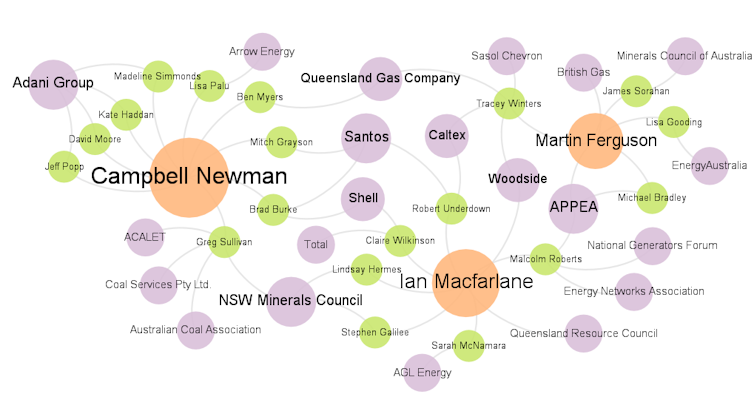
For evidence of this dynamic, we need only to look to former resource ministers Martin Ferguson and Ian Macfarlane. Ferguson took up a position as a non-executive director of British Gas just weeks after leaving federal politics in September 2013, having already become chair of an advisory board for Australia’s oil and gas peak body, APPEA in October. Macfarlane, meanwhile, was appointed chief executive of the Queensland Resources Council only four months after leaving federal politics.
Current and past resource industry employment of former staffers of Ian Macfarlane (Federal Minister for Resources and Energy, Sep 2013 - Sep 2015), Martin Ferguson (Federal Minister for Resources and Energy, Nov 2007 - Mar 2013) and Campbell Newman (Queensland Premier, Mar 2012 - Feb 2015) over the past decade, and employment for Macfarlane and Ferguson since leaving office. Corporate entities are shown in purple, staffers in green, and politicians in orange. LARGE IMAGE
The ‘service elevator’
There is another strategy that has also been used to great effect by the fossil fuel and mining industries in recent years. It is also used by powerful corporations in other economic sectors such as agribusiness, pharmaceuticals, gaming, and construction.
The industries in question either hire former ministerial staffers and policy analysts with relevant knowledge and expertise to advise them, or they encourage their own former staffers to take on positions as government advisers while maintaining close links with them. When acting as staffers, these individuals are free to operate outside of public scrutiny and regulatory reach. This allows them to move seamlessly between the offices of powerful political figures and some of Australia’s largest resource companies and industry bodies.
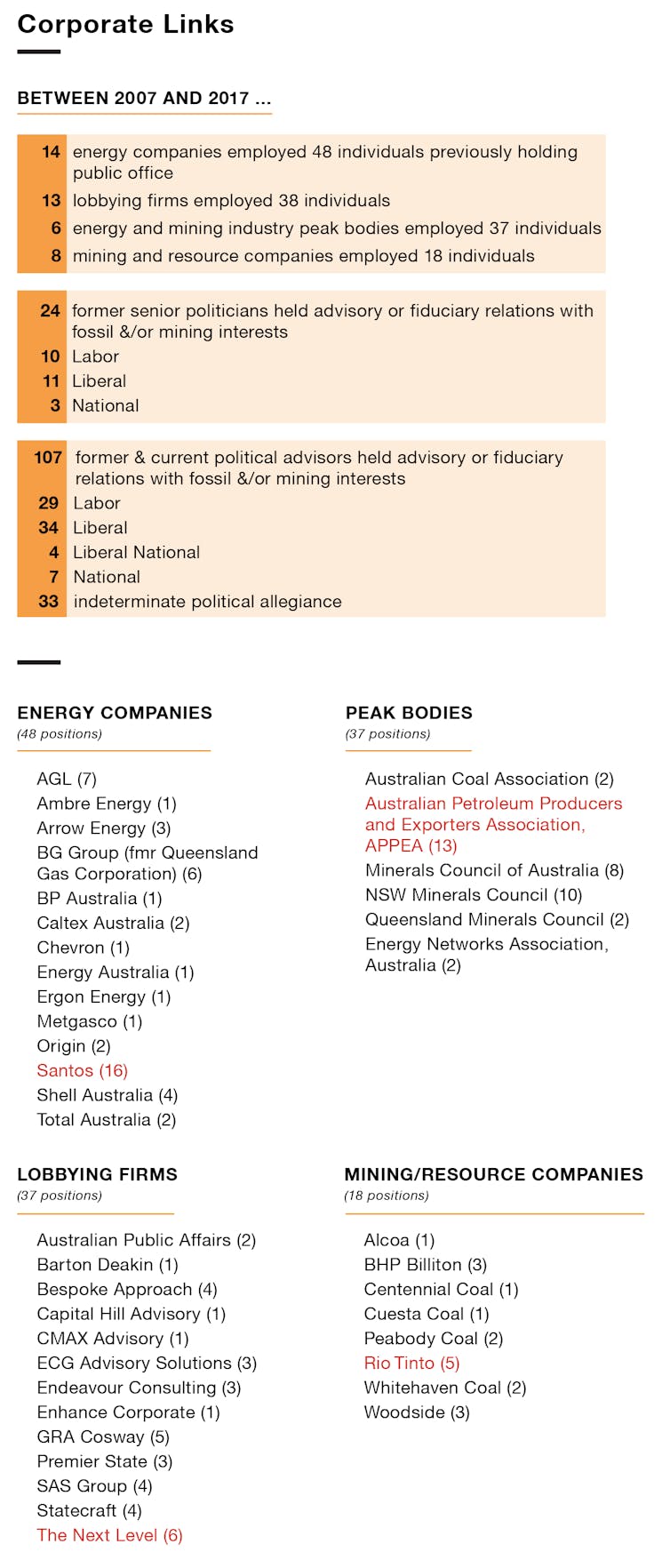
We have compiled a database of more than 180 individuals who have moved between positions in the fossil fuel and/or mining industries and senior positions in government, or vice versa, over the past decade. This includes senior political staffers working for prime ministers and state premiers. We have also found examples of key ministers hiring individuals straight from the fossil fuel and mining industries, who then return to those industries straight after leaving government. This revolving door might be better dubbed a “service elevator”, ensuring that “delivery of the goods” happens away from public scrutiny.
Organisations highlighted in red have the most former public sector employees in their company. Mai Lam/The Conversation NY-BD-CC, CC BY-ND
LARGE IMAGE
Questions of influence
Australian governments clearly need to enact laws at the state and federal levels to prevent these kinds of activities.
We know that such legislation is not without precedent, and is therefore politically feasible. For example, in Ireland, the cooling-off period was recently set at one year, whereas in Canada it is two years and in the United States, five years.
But it is not just the rules around political lobbying that require reform. Many other areas of political activity are also in dire need of attention, including much stronger disclosure laws in relation to campaign financing and political party donations, and a significant increase in public funding for political parties, apportioned on the basis of electoral support.
Most significant, however, is the need for a federal anti-corruption body with independent investigative powers. While there has been resistance from the major political parties to the creation of a federal anti-corruption watchdog, it would appear that the tide is turning. Prime Minister Malcolm Turnbull recently countenanced such a move, as did Bill Shorten.
If our political leaders are not prepared to provide more transparency and accountability with respect to government decision-making, then we can only assume the resource extraction industries will continue to call the shots on Australia’s transport and energy policies.
Our collective failure to deal with these issues will ensure that the increasingly dire predictions about planetary boundaries being breached over the next few decades will indeed be realised.

Links

Arctic Transformed Into Alien Landscape In Surreal Climate Change Photo

Inverse Science - Yasmin Tayag

The "browning" process has dramatically transformed the terrain.


Gone are the days when we could count on the Arctic landscape to be painted in shades of white. The permafrost beneath the snow and ice is no longer permanently frosty, and as it melts, write researchers in a new study, it’s muddying up the once-pristine terrain — quite literally. In a startling photo accompanying the study, an array of Arctic and sub-Arctic lakes seem to spew filth from within, making the landscape look like the surface of an alien world.
The paper, published in Limnology and Oceanography Letters on Friday, describes the visible effects the thawing permafrost has on the surface of the neighboring terrain, many feet above it. As climate change warms the Earth and coaxes the permafrost out of its continually frozen state, a process called “browning” occurs, the researchers write. During this process, organic carbon once trapped deep in the permafrost seeps upward into the region’s lakes and ponds, suffusing them with a filthy brown hue. Meanwhile, the way the permafrost cracks the landscape above it creates fissures that divide the surface into eerie polygonal shapes.
In the image below, supplied in a release by Quebec, Canada’s INRS (*Institut national de la recherche scientifique), the muddiness of the browning lakes sharply contrasts with the clear blue of the larger body of water alongside them, though even it too shows sinister brown tendrils curling up along its edges.
Here’s an aerial photo of Bylot Island, which lies off the northern side of Baffin Island in the Nunavut territory of Canada, southwest of Greenland:
Carbon seeping up from the thawing permafrost turns lakes and ponds brown.
Browning doesn’t just make the collection of lakes look like the sickly cells of an alien organism’s skin. The biggest downside of all that organic carbon seeping to the surface, INRS biologist Isabelle Laurion, Ph.D. and her co-authors write, is that this carbon is really good at absorbing sunlight, which drives up the temperature — and thus the rate of permafrost melt — even faster.
Laurion and colleagues determined this by analyzing the different types of dissolved organic matter in 253 ponds around the North Pole, which showed them that the waters affected by thawing permafrost contained much more terrestrial carbon and less algae (a key element to the food chain in these waters). “Our results demonstrate a strong terrestrial imprint on freshwater ecosystems in degrading ice-rich permafrost catchments, and the likely shift toward increasing dominance of land-derived organic carbon in waters with ongoing permafrost thaw,” they write.
In a paper published in Scientific Reports in 2015, researchers outlined the ecological effects of browning. In the lake they studied, over the course of 27 years, surface water temperatures increased by 2–3 degrees Celcius, the lakes became five times more transparent to UV light, and levels of zooplankton (near the bottom of the food chain) decreased.
Polygonal lakes created by melting permafrost on Alaska's North Slope. INSTITUT NATIONAL DE LA RECHERCHE SCIENTIFIQUE, NASA/JPL-Caltech
But perhaps the worst effect of browning is that it creates conditions even more conducive to releasing even more carbon into the air — particularly in the form of the greenhouse gas methane — which will in turn speed up the climate change process by which the permafrost melts in the first place.
“Land-derived organic carbon is having a growing influence on Arctic and subarctic ponds, which carries over into the food web,” the authors said in a statement. “The browning of these systems leads to oxygen depletion and cooler water at the bottom of the ponds, which can have a major impact on the microbial activity responsible for the production and consumption of greenhouse gases, particularly the production of methane, a powerful greenhouse gas.”
 
Links

Federal Government To Lend Money To Adani Business Associates

Fairfax - Nicole Hasham

An obscure government agency plans to indirectly support Adani’s controversial mega-coal mine by financing a business that will supply the project, it has emerged.
The Export Finance and Insurance Corporation, which provides loans to exporters, is also considering inquiries from other Adani suppliers, and held discussions with Adani representatives as recently as last month.
The Adani Carmichael project has encountered strong public opposition. Photo: AAP
The revelations raise questions over whether the government is using back-door routes to prop up the Adani project, and will fuel debate over public funding for mining projects in Australia.
EFIC did not respond to Fairfax Media’s questions over what firms would receive or had applied for funding, the level of funding provided or the implications for the loans if the mine did not proceed.
The $16.5 billion project planned by the Indian mining giant would be Australia’s largest coal mine and would open coal reserves in Queensland’s Galilee Basin to further development.
But the proposal has struggled to secure private sector backing. Adani’s bid for a concessional loan of around $900 million under the Northern Australia Infrastructure Fund to build a rail line servicing the mine, was also vetoed by the Queensland government, leaving the company to “look at other funding options”.

Labor leader Bill Shorten is under pressure to reveal what his party's policy is on the Adani coal mine, with the government saying he's playing both sides.

At a Senate estimates hearing late on Thursday night, Export Finance and Insurance Corporation general counsel John Hopkins confirmed the agency was supporting businesses supplying the Indian mining giant.
“We have helped support some SMEs [small to medium enterprises] who’ve been involved in the supply chain to Adani, so not directly to Adani itself but small [enterprises] who may have provided services to that entity,” he said.
Adani's application for a public loan to fund a rail line from the mine to its Abbot Point coal terminal was thwarted by the Queensland Labor government. Photo: Glenn Hunt
Asked by Labor senator Alex Gallacher to give an example of a business that might receive support, Mr Hopkins cited “a small SME providing mining services as a subcontractor to that project, and potentially a subcontractor to a subcontractor”.
“They would come to us seeking funds, they would show us that they have a contract to supply certain goods and services, they need working capital or they need a loan to help them provide those services and given that the end result would [mean] an export for Australia we are able to fund them,” he said.
One company supplying the Carmichael project is expected to receive funding, and several other Adani suppliers have made inquiries.
The corporation was founded with taxpayer money but is now self-funded. The government can direct EFIC to lend money if it is in the “national interest” and must reimburse the corporation for any losses. The organisation's national interest loan facility recently received a $3.8 billion funding boost for defence exports and it is unclear what funds would be available for Adani should it make an application.
Also at the estimates hearing, EFIC chief executive Swati Dave confirmed it had “fielded some inquiries from Adani representatives” in mid-February, when “two or three people from each side had a chat”.
Ms Dave did not detail the conversation, but said it broadly covered “what our function is”. Adani had not applied for finance, she said. Adani confirmed on Monday it did not intend to apply.
Adani opponents say the mine will add to global warming and worsen coral bleaching on the Great Barrier Reef. Photo: Gary Cranitch
In September last year Trade Minister Steve Ciobo instructed EFIC to start supporting onshore resource projects.
Tom Swann, researcher at progressive think-tank the Australia Institute, said providing financial help to Adani suppliers was “another way for the federal government to support the [Carmichael] project.” He called on Mr Ciobo to rule out government support for the mine, saying the world was promising action on climate change and the "last thing we should be doing is subsidising the world’s biggest new export thermal coal mine".
Mr Ciobo said EFIC “has not been asked to finance the Adani Carmichael coal project” but Adani was entitled to seek funding.
The agency’s commercial account provides finance up to about $150 million, and lending decisions are at EFIC’s discretion. Under its national interest account, finance is uncapped.
Federal Labor says it will only support the Carmichael mine if it stacks up financially. In February, Opposition Leader Bill Shorten reportedly told a Townsville crowd: "If they want to use EFIC or any other form of government funding body to get the money - no, no, no".

Links

While Politicians Question The Reality Of Climate Change, Farmers And Businesses Act

ABC Four CornersMichael Brissenden

David Bruer has been growing vines and making wine at his Temple Bruer vineyard in the Mount Lofty Ranges in South Australia since 1978. (Four Corners)

Four Corners: Weather Alert
Program and Transcript


David Bruer has been growing vines and making wine at his Temple Bruer vineyard in the Mount Lofty Ranges in South Australia since 1978.
In his vineyard laboratory, weather records for every vintage for nearly 40 years are stacked in plastic folders.
David Bruer says they've brought their harvest forward by a month. (Four Corners)
They clearly show a steady increase in maximum temperatures over that time of about 1 degree. It might seem like a relatively small change but the impact has been dramatic.
Harvested fruit is turning up hotter. The sugar levels are higher and the vintage now has to be picked earlier.
"Thirty-four years ago we used to pick in the middle of March," he said.
"We're now picking in the middle of February."

Graziers, fruit growers on the front line of change
The world is getting warmer and from the farm gate to the boardroom Australian businesses are no longer waiting for the politicians to decide if climate change is real. They're acting now.
In fact wine — one of our most celebrated crops — happens to be one of the most sensitive to environmental changes.
Last year was the third hottest year ever recorded in Australia and this year, NASA announced the five hottest years on earth on record had occurred since 2010.
It's a conclusion drawn from painstaking, technically advanced research, but increasingly Australian farmers are watching their own simpler weather charts with growing concern.
Many are now too busy adapting to this new climate reality to wait for our political leadership to deliver effective policy responses.
Over the past few months, Four Corners has travelled across the country to gauge how Australians are adapting. Graziers, fruit growers and winemakers are among those feeling the impact.

Brown Brothers were climate sceptics, once
Brown Brothers moves part of its operation to Tasmania (ABC News)

About 800 kilometres to the east of Temple Bruer, Ross Brown from Brown Brothers Wines has an even longer weather record on file.
His family has been making wine in Milawa, Victoria, for almost 130 years.
Mr Brown says he used to be a climate change sceptic but his vintage charts are indicating things have changed.
In Milawa, Brown Brothers is also picking earlier and their records show temperatures are rising.
Some of the cool climate varieties his family always used to grow here — like pinot noir and sparkling whites — have now become too unreliable so the company has moved some of its operation to cooler country in Tasmania.
"We decided that we would do our planning in future on a two-degrees increase in our vineyard temperatures and that we would have less water available," Mr Brown said.
"Making a strategic decision has really changed the way we look at our vineyards."
But if average temperature rises go beyond two degrees then, he says, the options run out.
"We don't know where to go after Tasmania," he said.
Brown Brothers is a big operation. Their winemaking is on an industrial scale and the decision to adapt to the changing weather was driven by the company's board.

Corporate Australia has been warned
It's a shift being seen in boardrooms around the country. Corporate Australia has been warned. The changing climate is something they can no longer ignore.
Last November, Geoff Summerhayes, an executive member of the Australian Prudential Regulation Authority (APRA), told businesses climate change posed a material risk to the entire financial system.
His message was that boards and directors had a fiduciary duty to their shareholders to take it into account. He cited legal opinion that found company directors who failed to consider and disclose climate risk could be in breach of the Corporations Act.
"Climate change and society's responses to it are starting to affect the global economy," he said.
"Institutions that fail to adequately plan for this transition put their own futures in jeopardy, with subsequent consequences for their account holders, members or policy holders."
That's a view that's now been backed by Reserve Bank governor Philip Lowe.
On February 16, he told a sitting of the Federal Parliament's economics committee that the Council of Financial Regulators - a body he chairs - had established a working group to look at issues about disclosure.
The RBA confirmed it believed investors needed to be given more information on climate risk.
It might seem a small move but it's seen as highly significant in the corporate world.
Former treasury economist Sam Hurley is a specialist in corporate climate risk. He says the moves by the regulators send a powerful message.
"The RBA and APRA, they're big institutions. They don't take steps lightly. They're not talking about climate on a whim," he said.
"They've studied the evidence, they've looked at what their counterparts are doing internationally, and they've looked at the trends and risks in Australia, and they've decided that now's the time to raise the bar."
For Australian business, business as usual is no longer an option.

Links

05/03/2018

'We Share The Same Backyard': The Islands Disappearing Off Australia

SBS - Kate Sullivan

Halfway between Queensland and Hawaii, 6,000 islanders are set to lose their homes. One is visiting Australia to fight for their survival.
Majuro, the capital of the Marshall Islands. Source: Getty Images
Read any backpacker’s guide to the Marshall Islands and it’ll tell you time is a loose concept in that part of the Pacific. Dinner at 7 will probably be served at 10. Your return flight may not turn up until the next day.
"Things happen when they happen, and a lot of times, they don’t happen on time,” poet and climate change activist Kathy Jetñil-Kijiner tells SBS News.
Kathy, 30, grew up in the Marshalls – an independent nation of more than 1,200 tropical islands that lie about halfway between northeastern Australia and Hawaii.
“We’re patient, everybody is,” she says.
But time is not something the locals have in droves; almost 6,000 of them live on low-lying islands that now face being swallowed up by rising seas.
Poet and climate change activist Kathy Jetñil-Kijiner. Supplied
Growing oceans
The Marshall Islands are on average only two metres above sea level.
“Some parts are also so narrow you can stand in the middle of the road and feel the ocean spray on either side,” Kathy says.
And that ocean is only getting bigger.
"Some parts are also so narrow you can stand in the middle of the road and feel the ocean spray on either side."
The Marshall Islands are made up of more than 1,200 islands. AP
The science is nothing new; global warming is causing ice to melt and seas to expand, leading to increased flooding - but the realities have hit home in recent years.
In 2014, the Marshalls experienced their worst flooding in 30 years; the capital Majuro was hit three times.
“I’ve talked to a few of my elders and they’ve never seen flooding like that happen,” Kathy says.
“It brings the threat to our feet and reminds us: you might not be here soon.”

How long have we got?
Last year, Kathy attended a conference on global warming in London – it was the first time she had shared a room with a climate scientist. Like many islanders aware of all the estimates out there about when calamity could hit the islands - she just wanted the facts.
“I cornered him [and asked] ‘do we have a fighting chance?’ and he said, 'long story short, he didn’t know, he just didn’t know'.”
Waves surge during a king tide event on Kili in the Marshall Islands in 2015. Bikini Atoll Local Government
Kathy thinks the at-risk Marshall Islands could be underwater in the next half-century: “50 years… that makes sense to me, but I’m not a scientist,” she says.
But some islands may be uninhabitable well before then.
“Something a marine biologist friend of mine said recently really struck me,” she says.
“It isn’t necessarily that our islands will go down, that they’ll disappear, but floodings that are occurring right now will happen so frequently that the islands will become unlivable.”

Collective responsibility
The Marshall Islands are home to about 53,000 people and Kathy is now a leading voice in their fight for climate justice around the world. This month she is visiting Australia.
FROM THE ARCHIVES
Obama meets with Pacific Island leaders, warns of climate refugees
The islands have close ties with the US - despite being subjected to nuclear testing in the 1940s and 50s, and President Donald Trump’s recent stalling of the Paris Climate Agreement.
But, Kathy says, Australia must also take some responsibility for the islands.
“I know some people would say ‘why is that our responsibility?’ but Australia is a huge emitter of carbon. It may not be the biggest, but every little bit counts... We contributed the least and yet, we are the ones who are getting affected first,” she says.
“I have been following the #StopAdani campaign and they [Australia] can’t keep opening any more coal mines.”
The $16 billion Carmichael coal mine proposed for Central Queensland would be one of the largest in the world.
“That’s disastrous for the rest of the Pacific and we share the same backyard.”
"[Australia and the Marshall Islands] share the same backyard."
The red marker points to the location of the Marshall Islands, which lie about halfway between Australia and Hawaii. Google Maps
In November, Marshall Islands President Hilda Heine stepped up criticism of Australia's policies on burning coal.
"We are very disappointed in Australia because we are neighbours to them," she said.
Back in 2015, Immigration Minister Peter Dutton was caught on camera appearing to mock the threat of climate change to the region.
“Time doesn't mean anything when you're about to have water lapping at your door,” he said in response to a comment about the slow pace of events at the Pacific Islands Forum in Port Moresby.
But the latest government report shows Australia gives about $4.8million in annual aid to the Marshall Islands, as well as emergency support following natural disasters.
polhn.org
'What about our identity?'
Kathy now lives in Portland, Oregon, after moving for her partner’s job, but returns to the Marshalls as often as she can to visit her parents and check in on the non-profit she has co-founded.
Jo-Jikum (meaning ‘your home’ in the local language) aims to empower Marshallese youth to seek solutions to climate change. Over 50 per cent of islanders are under 29 and they are an “untapped resource,” Kathy says.
Kathy, far right, has founded a non-profit in the Marshall Islands to empower local youth to act on climate change. JoJikum.org 
She admits she only really got to grips with climate change herself in her early twenties, after she returned to the islands after studying at university in the US.
“I was hit by how incredibly vulnerable we were,” she says.
But something bothered her, and still does today: “All these articles just assumed we would have to leave, that there was nothing we could do about it.”
“The way they spoke about us: ‘Will they have passports? Will they still be a country?’ I was like, how can they just be giving up on us already?”
"How can they just be giving up on us already?"
She was sick of being written off as “doomed” and more importantly, realised there was more at stake than just their houses: “We just lost our home. What about our identity? What about our culture?”
Kathy (pictured with her partner and daughter) at the UN Climate Summit. AFP
Kathy made a name for herself at the United Nations Climate Summit in New York in 2014. She performed a poem dedicated to her newborn daughter and received a standing ovation from world leaders. “No one’s drowning baby … no one’s gonna become a climate change refugee,” it read.
Her first collection of poetry, Iep Jāltok: Poems from a Marshallese Daughter was published in 2017.


Fight or flight
The Marshallese people have the option to leave whenever they want. “We have direct and open immigration status that allows us to freely move to the US without green cards and without visas,” Kathy says.
But many aren’t looking for a quick fix; there’s simply no place like home.
“It’s home, it’s my island,” Kathy says. “It’s somewhere that my ancestors have been in for their entire lives, it’s somewhere where I will hear Marshallese language spoken and see it written on signs, that’s what I fight for.”
"There’s still time to turn this ship around."
“We shouldn’t have to move, there’s still time to turn this ship around and do what is necessary to save our islands. Who we are is tied to that land... we can’t just leave.”
There’s a word in the local language, ‘iakwe’ (pronounced ‘yawk-way’) which islanders use to say ‘hello’, and ‘with love’.
“Literally translated, it means ‘you are my rainbow’,” Kathy says. It also has another meaning she never hopes to use: ‘goodbye’.

Kathy Jetnil-Kijiner will be speaking at WOMADelaide on 11 March.

Links

'Global Deforestation Hotspot': 3m Hectares Of Australian Forest To Be Lost In 15 Years

The Guardian

Threatened species, pressure on Great Barrier Reef and climate change all worsened by full-blown land-clearing crisis
A koala mother and joey on a bulldozed log pile in Queensland. Photograph: WWF 
Australia is in the midst of a full-blown land-clearing crisis. Projections suggest that in the two decades to 2030, 3m hectares of untouched forest will have been bulldozed in eastern Australia.
The crisis is driven primarily by a booming livestock industry but is ushered in by governments that fail to introduce restrictions and refuse to apply existing restrictions.
And more than just trees are at stake.
Australia has a rich biodiversity, with nearly 8% of all Earth’s plant and animal species finding a home on the continent. About 85% of the country’s plants, 84% of its mammals and 45% of its birds are found nowhere else.
But land clearing is putting that at risk. About three-quarters of Australia’s 1,640 plants and animals listed by the government as threatened have habitat loss listed as one of their main threats.
Much of the land clearing in Queensland – which accounts for the majority in Australia – drives pollution into rivers that drain on to the Great Barrier Reef, adding to the pressures it.
And of course land clearing is exacerbating climate change. In 1990, before short-lived land-clearing controls came into place, a quarter of Australia’s total greenhouse gas emissions were caused by deforestation. Emissions from land clearing dropped after 2010 but are rising sharply again.
“It has gotten so bad that WWF International put it on the list of global deforestation fronts, the only one in the developed world on that list,” says Martin Taylor, the protected areas and conservation science manager at WWF Australia.
In Queensland, where there is both the most clearing and the best data on clearing, trees are being bulldozed at a phenomenal rate.
About 395,000 hectares of native vegetation were cleared there in 2015-16, 33% more compared with the previous year. And despite the re-elected Labor government promising changes to rein it in, notifications of planned land clearing in Queensland have jumped a further 30%, suggesting woodlands could be bulldozed even faster in coming years.
To visualise what clearing of that magnitude looks like, Guardian Australia has created a tool that will lay an area that size over any location you choose. Mapped over Sydney, for example, 395,000 hectares covers an area stretching from the central coast in the north, to Campbeltown in the south, and the Blue Mountains in the west.
That equates to more than 1,500 football fields worth of native woodland and scrub being cleared each and every day in Queensland.
Stopping the clearing in Queensland is possible. Indeed, under its Labor premier Peter Beattie it brought its land clearing problem under control. Tough laws passed in 2004 meant that by 2010 land clearing had dropped to an all-time low of about 92,000 hectares.
But when the Liberal National party’s Campbell Newman was elected in 2012 he broke an election promise to keep the laws, gutted them, and introduced several ways for farmers to clear land easily. The bulldozers roared back into action immediately, bringing the state to the point it is at now.
Queensland clears more land each year than the rest of Australia put together, and the rate at which it is destroying its vegetation is comparable with the infamous deforestation that occurs in the Brazilian Amazon. Brazil bulldozes about 0.25% of its part of the Amazon each year; Queensland clears about 0.45% of its remaining wooded areas.
The recently re-elected Queensland Labor government has promised to change the laws. But in the meantime other states have begun to follow Queensland’s lead.
In 2016 the New South Wales Coalition government announced it was going to axe three pieces of legislation that protected native vegetation and wildlife, and replace them with a single act that would make land clearing easier.
A conservation scientist from the University of Queensland, Hugh Possingham, sat on the NSW government’s advisory board for the changes but resigned in protest, warning they could lead to a doubling of clearing rates in NSW.
Possingham says exactly how much the laws will impact clearing rates is unclear, since there are other drivers of clearing, including climate and economics. “But if you look at Queensland, their example is so dramatic,” he says of the effects of law changes there.
A cypress/eucalypt forest being bulldozed under the ‘thinning’ code in western Darling Downs in Queensland in May 2017. Photograph: WWF Australia
Daisy Barham, from the Nature Conservation Council of NSW, says the final set of laws and regulations released are even worse than those that caused the land clearing crisis in Queensland. “There are some really extreme elements in the NSW laws that don’t even feature in the Queensland laws,” she says.
Barham says the worst is the “equity code” which leaves few controls on clearing of properties under 100 hectares, and where protected vegetation makes up less than 10% of the property.
Analysis by WWF shows that could allow clearing of 8m hectares, or 38% of the remaining trees in the state, under that rule alone.
The changes took effect in August 2017 but so far the government has refused to release data on how much clearing has taken place. In fact, official state data hasn’t been released since 2013-14, when about 30,000 hectares of trees were cleared in NSW.
The area being cleared in there may seem small relative to Queensland, but NSW has a much smaller amount of remaining vegetation, with clearing there starting much earlier after colonisation.
“Only 9% of NSW is in a healthy or near-natural condition,” Barham says. “We simply don’t have much left to lose. That is why every bit of clearing in NSW is so important.”
Meanwhile, further north, vast tracts of land are being earmarked for clearing. In the relatively lawless Northern Territory, approvals for land clearing have jumped more than tenfold in the past two years, compared with the preceding 12 years, according to figures from the NT government analysed by the Wilderness Society.
Some of the clearing approved for single properties in the NT is almost unimaginable in size. A property called Tipperary station has a total of 50,687 hectares approved for clearing through a number of separate applications over the past six years, an area almost 10 times the size of Manhattan on one property. 
David Morris, a lawyer who was chief executive of the Environmental Defenders Office NT until earlier this year, says the overarching feature of the Northern Territory’s land clearing is the lack of regulation.
“It’s a totally inept regulatory regime,” says Morris, who is now chief executive of the Environmental Defenders Office NSW. He says land-clearing projects go through an environmental assessment framework, which the government has admitted is inadequate. “They’ve committed to reform it but in the meantime all approvals go through this very poor assessment regime.”
In addition, major land-clearing proposals that occur on pastoral leases are assessed by a body called the Pastoral Lands Board, which adds further problems.
“It is made up of four pastoralists and one rangelands scientist,” Morris says. “There is a very clear trend of increased approvals of broad-scale land clearing in the Northern Territory. And there is a regulatory regime that is incapable of dealing with the individual and cumulative impacts of that clearing.”
“Having a board full of agricultural business people as the ultimate decision maker is mind-boggling,” says Glenn Walker, a Wilderness Society climate campaign manager. Glenn Walker, adding: “The NT has the worst regulation for deforestation of any jurisdiction in Australia.”
And the spread of the land-clearing crisis doesn’t look set to stop in the NT. Some of Australia’s richest graziers are establishing cattle stations in Western Australia, and making claims for greater access to resources in the pristine Kimberley.
Other states have their own clearing tragedies unfolding: some of Australia’s most majestic and oldest trees are being cut down for timber by a state-owned company in Victoria, which has even less left to lose than NSW. And Tasmania has just signed up to allow more logging in its national parks until at least 2037, a move NSW and Victoria are considering following.
Combined, eastern Australia is considered a global deforestation hotspot, the only one in the developed world. According to analysis by WWF’s Martin Taylor, Australia is likely to lose 3m hectares of trees in the next 15 years.
And all that is putting things Australians care most about under threat.
“If you care about the Great Barrier Reef, then that’s what you care about,” he says. The effects of climate change on the Great Barrier Reef are multiplied by land clearing in Queensland, since it increases the amount of sediment that flows into rivers, and eventually on to the coral. That can starve them of light, and decrease their resilience to other impacts.
WWF analysis estimated that 45 million animals are killed each year in Queensland, just from the bulldozing of their habitat. “People have very strong feelings about cruelty and mistreatment of animals,” Taylor says. “So what must they think of that then? That we’re bulldozing 45 million animals to death every year?”
Both in Australia and around the world, habitat loss is by far the biggest threat to animals facing extinction.
“If you care about koalas, and if you care about Australian wildlife – if you want your kids to see them – then that’s what you care about,” he says.

Links

04/03/2018

More Than 100 Cities Now Mostly Powered By Renewable Energy, Data Shows

The Guardian

The number of cities getting at least 70% of their total electricity supply from renewable energy has more than doubled since 2015
The Nesjavellir geothermal plant in Iceland. The capital Rejkjavik gets 100% of its electricity from renewable sources. Photograph: Alamy
The number of cities reporting they are predominantly powered by clean energy has more than doubled since 2015, as momentum builds for cities around the world to switch from fossil fuels to renewable sources.
Data published on Tuesday by the not-for-profit environmental impact researcher CDP found that 101 of the more than 570 cities on its books sourced at least 70% of their electricity from renewable sources in 2017, compared to 42 in 2015.
Nicolette Bartlett, CDP’s director of climate change, attributed the increase to both more cities reporting to CDP as well as a global shift towards renewable energy.
The data was a “comprehensive picture of what cities are doing with regards to renewable energy,” she told Guardian Cities.
That large urban centres as disparate as Auckland, Nairobi, Oslo and Brasília were successfully moving away from fossil fuels was held up as evidence of a changing tide by Kyra Appleby, CDP’s director of cities.
“Reassuringly, our data shows much commitment and ambition,” she said in a statement. “Cities not only want to shift to renewably energy, but, most importantly – they can.”
Much of the drive for climate action at city level in the past year has been spurred on by the global covenant of more than 7,400 mayors that formed in the wake of Donald Trump’s decision to withdraw from the Paris accord.
Burlington, Vermont, was the only US city reporting to CDP that sourced all of its power from renewable sources after having fully transitioned in 2015. Research from the Sierra Club states there are five such cities in the US in total.
Burlington is now exploring how to become zero-carbon.
Mayor Miro Weinberger said to CDP that its shift to a diverse mix of biomass, hydro, wind and solar power had boosted the local economy, and encouraged other cities to follow suit. Across the US 58 towns and cities, including Atlanta and San Diego, have set a target of 100% renewable energy.
In Britain, 14 more cities and towns had signed up to the UK100 local government network’s target of 100% clean energy by 2050, bringing the total to 84. Among the recent local authority recruits were Liverpool City Region, Barking and Dagenham, Bristol, Bury, Peterborough, Redcar and Cleveland.

But the CDP data showed 43 cities worldwide were already entirely powered by clean energy, with the vast majority (30) in Latin America, where more cities reported to CDP and hydropower is more widespread.
In the six months to July, Latin American cities reported having instigated $183m of renewable energy projects – less than Europe ($1.7bn) or Africa ($236m). Europe topped the list for projects open for investment, but laid claim to just 20% of the 101 cities to be predominantly powered by clean energy.
The Icelandic capital Reyjkavik, sourcing all electricity from hydropower and geothermal, was among them. It is now working to make all cars and public transit fossil-free by 2040.

Links

Lethal Heating is a citizens' initiative