11/04/2018

Why Australia’s Wind And Solar Market Could Grind To A Halt

RenewEconomy - 


The lack of any policy to meet the climate targets agreed to in Paris will mean that Australia’s large-scale wind and solar boom will quickly come to an end, even as wind and solar costs fall further below the benchmark price of the grid.
Kobad Bhavnagri, the chief analyst for Bloomberg New Energy Finance in Australia, says the current investment boom to meet the federal renewable energy target – $8 billion committed in 2017, and $5 billion in 2018 – will quickly slow as the target is met.
By 2020, investment will slow to around $2 billion, and for the next decade – without any changes to stated federal policy – the only drivers for the uptake of large-scale renewables will be state schemes, such as Victoria’s, and the emerging corporate market.
The proposed National Energy Guarantee, Bhavnagri says, will add little to demand because the 26-28 per cent emissions reduction will be met almost entirely by the LRET by 2020 (23 per cent), leaving little to be done over the next 10 years.

“That’s a very weak target,” Bhavnagri said, noting that according to his company’s analysis, it will mean less in the way of new wind and solar capacity by 2030 than business as usual. (See chart above)
Bhavnagri said this would be true whatever the policy – a carbon price, an emissions intensity scheme or a clean energy target; if the ambition is low, then little new renewables would be built because there would be no driver to displace existing coal and gas.
And it is clear that the current government has every intention of trying to keep existing power generators, including ageing coal plants, in the system as long as possible, dramatically reducing the need for new supply.
This bleak assessment is broadly consistent with other analyses, most notably by Reputex, which also said last month that the emissions reduction target is actually worse than business as usual.
However, Bhavnagri said there re a couple of factors that should be cause for optimism for the renewables industry, and this was based largely around economics.


It was clear now, he said, that the cost of new renewable – large-scale wind and solar – was already below wholesale electricity prices.
Wind and solar were being built at or around $60/MWh, and would continue to fall in cost in the coming five years.
After a brief fall in wholesale prices as the current surge in wind and solar investment had its impact on the market, the course of wholesale prices would then resume their upward curve.
This meant that wind and solar would be attractive, not just for big utilities looking to loosen their reliance on fossil fuels (Origin has pledged an exit from coal by 2032), but also for the growing corporate market.
On the subject of policy choices, amid all the criticism of the proposed NEG, Bhavnagri said that if it was accompanied by meaningful remissions reductions targets, then it would do the job.

“What really matters is ambition,”Bhavnagri said. “If the NEG were to be configured to 45 per cent, recommended for 2°C pathway, which has been adopted by Labor, the outlook for investment would be much stronger.”
As this graph above illustrates, that would result in 1GW less coal, but 4GW more large-scale wind, and 10GW of large-scale solar – according to BNEF’s estimates.
The only constant through the two scenarios (ambition or no ambition) is small-scale solar – which BNEF expects to add at least 1GW a year out to 2030 – taking the total installed capacity across the nation to 19GW by 2030, overtaking coal.
Tristan Edis, from Green Energy Markets, said for the NEG to work then the policy would have to be designed the right way, and it would have to be accompanied by more aggressive emission reduction targets.
“What about the NEG? The answer to that, quite simply, is that Malcolm Turnbull needs to grow a spine on this particular issue, if it’s going to be meaningful,” Edis said.
But, as John Grimes, the head of the Smart Energy Council said, there is just no chance of that anytime soon because of the secret deal that Turnbull signed with the far right when they agreed, reluctantly, to have him replace Tony Abbott.

Links

Innovative Greenhouses Help Farmers Adapt to Climate Change

National Geographic - Janice Cantieri

In India, a simple greenhouse is transforming lives—creating jobs for women and arming growers against unpredictable weather.
A farmer tends a greenhouse in Depalle, a village about 75 kilometers southwest of Hyderabad. The village is a research and development station for Kheyti, a nonprofit group helping India's small-scale farms adapt to climate change. Photograph by Sara Hylton, National Geographic 
Yadav Bhavanth grows vegetables on family land in the south-central Indian state of Telangana. On this small farm in a drought-prone region, his crop production—and income—depend heavily on seasonal rainfall.
In 2015 and 2016, water shortages threatened his crops. And when the rains came, they were often so heavy that they damaged even the hardier plants, causing disease or infestation.
Some of the extreme weather patterns can be attributed to climate change. As global temperatures increase, extended periods of drought, heat waves, and unpredictable rainfall have intensified. The crop losses and mounting debt carry a human toll: More than 3,000 farmers committed suicide in Telangana during a three-year drought. (Learn more about this problem across India.)
But 2017 was different for Yadav. The 37-year-old farmer began using a greenhouse to conserve water and protect crops from harsh downpours. Instead of trapping heat, these greenhouses are made with breathable, aluminum-coated cloth netting that reflects some of the sunlight, reducing inside temperatures. The greenhouses are also fitted with drip-irrigation systems that allow farmers to use an average of 90 percent less water than their neighbors.

Left: Yadav Bhavanth, 37, picks moringa, also called drumsticks, on the family farm near Laxmapur, a village in the state of Telangana. Nicknamed for their shape, moringa withstand harsh conditions. Their pods, seeds, and leaves are all used as vegetables.Right: Bhavanth and wife Bujji, 32, tend tomatoes. The couple was part of pilot program for greenhouse cultivation.
Photograph by Sara Hylton, National Geographic
“Outside, we are not as sure whether the crops will dry up—there is no guarantee,” Yadav says. “Inside [the greenhouse], the plants grow very fast,” he adds. “The [produce] quantity and quality is also the best.”
Venkatesh Appala, 45, grows bell peppers in Laxmapur. He started his greenhouse operation in January 2017, and estimates a profit of 46,000 rupees (just over $700) in his first year. He's using the extra income to save for his daughter's dowry, which can run up to $10,000. Photograph by Sara Hylton, National Geographic
Grassroots Greenhouses
Yadav purchased his greenhouse for $2,500 from Kheyti, an Indian non-profit that is developing the structures and facilitating loans to buy them—through a program aimed at helping small farms adapt to climate change.
Greenhouses have long been used in India for commercial flower and vegetable production, but standard designs are too large and expensive for farmers like Yadav. Kheyti has created several scaled-down versions that range from 258 to 553 square yards, an area that takes up just two to five percent of a typical small farm there. The size reduces the investment risk—farmers are still able to grow other crops on the rest of their land.

Vikram Bhavanth, 13, peers through the family's greenhouse. Kheyti collaborated with engineering students at Northwestern University and Stanford University’s Design for Extreme Affordability course to develop a prototype. After multiple iterations, they settled on a metal-frame structure with an overlay of shade netting and insect-proof netting on the sides. Photograph by Sara Hylton, National Geographic 
Kheyti’s greenhouse costs a fraction of the $30,000-plus for a conventional half-acre greenhouse. Yet because many farmers still wouldn’t be able to afford $2,500, Kheyti works with banks to get loans on the farmers' behalf, says cofounder Saumya (she doesn’t use a surname). She started the project with support from the Institute for Sustainability and Energy at Northwestern University.
Kheyti recently partnered with the Bank of Baroda, India's second largest bank, to broaden the reach of the program. Participating farmers make a down payment of 30,000 rupees [$471 dollars] and then installments of 15,000 rupees [$233 dollars] after each growing season, typically every three months, until the greenhouse is paid off.
Some farmers have used the funds from greenhouse production to further the education of their children, including these eighth standard classes (middle school) for girls and boys, where Vikram Bhavanth is seated (center). Photograph by Sara Hylton, National Geographic
The 15 farmers who piloted the Kheyti greenhouse program have just finished their first year, growing cucumbers for three and a half months and bell peppers for eight months. Most were able to produce between five and eight times more within the greenhouse. Some used the income to advance their children’s education.
“We are able to produce inside the greenhouse [258 square yards] what we are producing outside in an acre [4,840 square yards],” said Narayana Yellabonia, one of Kheyti’s first farmers. “School has started, so the money has helped out with that.”
One of Yadav Bhavanth’s relatives, Biki Malavath holds her great-granddaughter, nicknamed Milky, the youngest member of Laxmapur Thanda. The village is home to the Lambadi people, a "scheduled tribe"—defined as one of India's marginalized and socioeconimically disadvantaged communities. Photograph by Sara Hylton, National Geographic 
Inspired by the success, there are now 50 farmers growing with Kheyti in Yadav's village, Laxmapur, and in nearby Narayanpur, and the initiative has expanded into a neighboring state. Working with the Society for Elimination of Rural Poverty (SERP), Kheyti will reach 1,000 low-income female farmers in Andhra Pradesh. SERP, a joint venture between the World Bank and the state government, will help Kheyti identify participants, provide loans, and fund training programs. These participants would make a down-payment of only 10,000 rupees [$154 dollars] to qualify for the loan. Kheyti launched the program with the first 50 farmers earlier this year.
Kheyti’s leaders hope to expand throughout India, but they’re taking it slow. “We are very proud of the culture we have built, but we don’t want to have that lost when we scale,” says cofounder Sathya Raghu Mokkapati.
Founders of the nonprofit Kheyti, Saumya (who doesn't use a surname), 28, Kaushik Kappagantulu, 31, and Sathya Raghu Mokkapati, 32, pose with Yadav. Haunted by an encounter with a destitute farmer eating mud out of desperation, Sathya had longed to find a way to help those who eke out a living from the land. Kheyti worked with nearly 8,000 farmers to test different methods and crops in order to determine what worked best for the region. Photograph by Sara Hylton, National Geographic 
Roots of Inspiration
Sathya had longed to find a way to help India’s farms since he was 17, after he encountered a destitute farmer eating mud out of desperation. The experience stayed with him, and in 2009, Sathya left his corporate job in accounting to start a project that would boost agricultural production. Over a year and a half, he visited dozens of farming villages to understand the challenges they face. He saw inequity—annual family incomes ranged wildly, from 10,000 rupees [$157 dollars] to 10 million rupees [$157,107 dollars].
The disparity was rooted in resources, including whether a farmer had access to a reliable source of water and to technologies like drip irrigation that improve growing conditions. Being able to secure the finances to invest in a farm and having the ability to transport and sell crops at a market also played a role.

Sathya runs a meeting with farmers in Laxmapur. In addition to supplying the greenhouses and training, Kheyti's services include transportation to market, loan servicing, fertilizers, and connections to vendors. The farmers also become part of a collective and gather weekly to share knowledge and challenges. Photograph by Sara Hylton, National Geographic
But across the board, Sathya saw the impacts of climate change making problems worse. Farmers faced intensifying droughts that often hit back to back, and the higher average temperatures caused an increase in pests and diseases.
To learn more, Sathya and another Kheyti cofounder, Ayush Sharma, spent the next three and a half years farming on a hundred-acre plot in Depalle, another village in Telangana. They worked with nearly 8,000 farmers to test out different farming methods and crops to determine what worked best for the region.
But some factors were out of their hands. “When we made an honest assessment of the impact of our work, we realized that while we were trying to do a lot of stuff, ultimately the impact on the farmers was limited because of climate change,” Sathya says.
Goats graze on tomatoes in an empty field. Outdoor crops are vulnerable to extended periods of drought, pests, and unpredictable rains. Photograph by Sara Hylton, National Geographic 
Confronting Climate Change
Farms had to be outfitted to face the increasing weather extremes; greenhouses could regulate the environment. “The solution has to be climate-smart farming,” Sathya says. “And it has to be full-circle, with end-to-end services to connect farmers to banks and to markets.”
In 2015 the four Kheyti cofounders (including Kaushik Kappagantula) worked with engineers and agronomists to create an affordable, water-conserving greenhouse that reduces the interior temperature by reflecting sunlight.
They tested out several designs—first, a bamboo structure, but it couldn’t withstand heavy winds. They collaborated with engineering students at Northwestern University and as part of Stanford University’s Design for Extreme Affordability course on the design and to reduce costs and make them easier to install. After multiple iterations, they settled on a metal-frame structure with an overlay of shade netting and insect-proof netting on the sides.

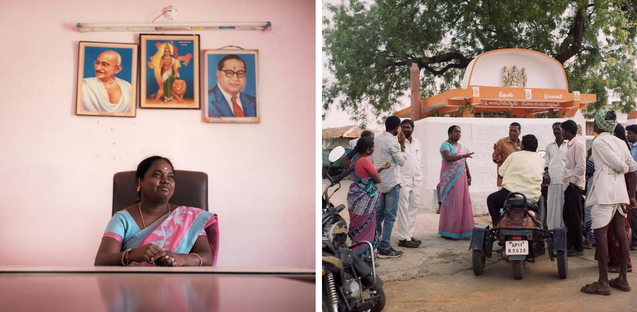
Katikala Shyamala, 43, the village sarpanch, or headwoman, is pictured in her office and out talking to villagers in Laxmapur. A widowed mother of two, she was the first woman to sign up for a Kheyti greenhouse and is now recruiting others. Photograph by Sara Hylton, National Geographic
Building Self-Reliance
Kheyti’s services go beyond simply supplying the greenhouses, including training and daily check-ins with farmers, plus help with transportation to market, loan servicing, fertilizers, and connections to vendors. The farmers also become part of a collective and gather weekly to share knowledge and discuss challenges, creating a sense of collaboration—and healthy competition.
“We discuss how to solve problems, how much each farmer produced that week, and how much money they earned,” said Katikala Shyamala, the Laxmapur village sarpanch, or headwoman.
Shyamala, a widowed mother of two, was the first woman to sign up for a Kheyti greenhouse. Even though she had little farming experience, the intensive training and support network helped her success.

Female farmers pose outside a test farm near Depalle. Kheyti is focusing on bringing more women into the program. Photograph by Sara Hylton, National Geographic
“From seed to plant, from harvest to the market, they are with us and looking after everything,” Shyamala said.
Kheyti helps transport her vegetables to market, checks on her plants, and advises on fertilizers to use. As a result, Shyamala is able to manage her farm, put her two children through school, and stay on top of her responsibilities as the village sarpanch (she’s a liaison between government officials and the community). Other women have since followed her example.
A new day dawns at Bowenpally Market in Hyderabad, a wholesale vegetable market that sells produce from Kheyti farmers to local street vendors. Photograph by Sara Hylton, National Geographic 
Promoting opportunities for women and marginalized groups is a goal of the Consortium of International Agricultural Research Centers, where Pramod Aggarwal is a program leader for the region. He points out that sustainable agriculture must build capacity to adapt to climate variability, so that farmers can conserve resources during years of good rainfall and harvests to adjust for years with poor production. A good project also involves partnering with local governments, he said, to ensure stability.
“In developing countries, climate variability has always been a challenge and will continue to be,” Aggarwal says. “Climate change has brought more focus to this issue, which is intricately linked to poverty, social tensions, and migration.”
Larger-scale innovation to make staple crops like rice, which is labor- and resource-intensive, and maize more climate-resilient is essential for the future because “not everyone can be growing vegetables—it’s not taking care of food security,” he says.
But for now, vegetables provide a simple solution.

Yadav Bhavanth's son Santosh, 11, picks moringa drumsticks. Moringa has been called a superfood by some; it's a staple in the Indian diet, used in curry dishes, sambar sauce, and to add spice. Other parts of the tree are used for medicinal purposes. Photograph by Sara Hylton, National Geographic 

Links

In The Eye Of The Firestorm: Surviving Australia's Most Extreme Bushfire

 Deutsche Welle - Stuart Braun

The driest inhabited continent on earth, Australia, has lived with bushfires for millennia. But the 2009 Black Saturday infernos were so fierce that survivors are still grappling with the consequences.

Ash carried by heavy winds had started to fall from the sky when a neighbor sent me a text message to warn us that a fire might be descending over the valley.
As my partner and I got into the car to leave, we couldn't see smoke in the immediate vicinity — but the ash was a clear sign that things were bad in the distance. Ten minutes later, we sought safety by a river and waited for the fire to engulf the mountain — and ultimately, our house.
Living mostly in the city, we had retreated to our cabin in the thickly forested mountains outside Melbourne to escape the peak of a brutal heatwave. Urban temperatures had been expected to spike at 47 degrees Celsius (117 degrees Fahrenheit), the hottest day on record, and had regularly been in the mid-40s the week before. Scientists says climate change is driving record-breaking heat waves and "bushfire weather."
The official "extreme fire danger" warning in place that day had already become commonplace. But due to the 100 kilometer-per-hour winds and a prolonged drought that had turned the region's vast forests into a tinderbox, the Premier of Victoria warned that February 7 could potentially be the "worst day in the history of the state." Many, including myself, did not get the message.
In the end, it seems a change of wind saved our valley. As we continued to watch helplessly from the sanctuary of a pub by the river where some locals had gathered waiting for the fire to arrive, towns to the northeast were burning instead. Many residents were ill-prepared. Many would not make it out alive.
In 2009, many Melbournians retreated to the forests outside the city to escape a brutal heatwave — only to bear witness to a blazing inferno

'Like half-a-dozen jumbo jets'
David Barton and his then-wife Jennifer were also riding out the extreme heat at their home in Marysville, a small town known for its quaint old guesthouses and vast surrounding expanses of tall eucalyptus forests. At around 3:45 pm, the couple noticed smoke rising from the hills in the distance.
The fire was about 35 kilometers (22 miles) away and heading south — indeed, in my direction. But then a promised shift in the winds hit and changed the course of the blaze.
The little town where David and Jennifer had started an antique business a year before would soon be in the path of a mega-wildfire that had converged along several fronts.
By now the winds were at around 120 or 130 kilometers per hour, and trees were coming down. The temperature in town was measured at 56 degrees Celsius. The couple had been helping to evacuate the elderly and infirm, and with Jennifer on the way to a hospital with an elderly woman, David finally decided to leave at around 6:45 pm.
David Barton's clapboard house before the blaze — it would be totally destroyed in the 2009 bushfires
"The sky went completely black," he tells DW of the scene he fled. "There was this incredible roar coming into town that sounded like half a dozen jumbo jets taking off."
"I looked up the main street of Marysville, and I could see this wall of flame, this big glow of bright orange flame that was about 150 or 200 feet [46 to 61 meters] high, and on top of that another 300 or 400 feet of gray, churning, swirling black smoke. I thought, 'Gee, that doesn't look very good,'" says David.
The scene was so "surreal" that he only half-registered it was happening. Apart from picking up his dog and some water, he left everything else behind, including his wallet.
It was getting harder to breath as the massive fire sucked the oxygen out of the atmosphere. Yet David still didn't really believe that the blaze would reach the centre of Marysville.
Half an hour later, virtually the entire town had burned to the ground. It was an apocalyptic scene akin to the bombed-out streets of Syria, he says. He lost literally everything; none of the 30-odd guesthouses survived.

Dealing with the aftermath
Residents and friends, who David says he warned should leave Marysville, perished in the most-deadly fire in Australian history.
Many others who believed they could "stay and defend" their property were later found dead, some holding melted hoses in their yards. They were among 34 people killed in that town — a relatively large share of the 173 who died across the state that day.
The damage for the local communities has been incalculable. Around 60 percent of Marysville residents, including David and Jennifer, decided to not return, and instead sold out and moved closer to Melbourne. The Bartons' marriage ended less than two years later.
Like many Marysville residents, David Barton initially decided to not return to the town 
David says a number of relationships fell apart in the wake of Black Saturday. Indeed, he has since written a PhD thesis on the ways survivors have experienced "attachment, loss and grief," describing his own struggles with post traumatic stress disorder.
He muses that things between him and his wife might have been different if the couple had returned to Marysville to rebuild along with the remaining community. When David did move back in 2012, he was relieved to be among friends, even if so many had left.

Warning signs and complacency
Nearly 10 years after Black Saturday, the official government policy is now to "leave early" when there is an extreme fire threat.
But David fears this means many people are not preparing for the time when escape is no longer an option — especially the "tree changers," a term for former big city residents who relocate to areas like Marysville for the quiet country lifestyle.
In January, I was back at my own place in the nearby wilds on a plus-40 degree day, working on my house. To be honest, I had no systematic plan if a fire hit. My only idea was to run.
Australian residents had been encouraged to prepare and defend their properties in a fire — but now are being advised to leave early 
Following the publication of the 2009 Victorian Bushfires Royal Commission report, advanced warning systems were much-improved — including a new "code red" alert that is sent as a text message to residents in bushfire-prone areas in case of emergency.
Still, when fires destroyed around a hundred homes in New South Wales and western Victoria in fall 2018, it seemed a miracle that no one died.
David is concerned that as time passes, people are starting to forget Black Saturday, and that complacency has set in. "The whole thing could quite simply happen all over again," he fears.
Indeed, all it takes is a change in direction of wind.
Black Saturday
Record temperatures, record fires
The Black Saturday bushfires in Victoria were the deadliest in Australia's history. They came on the heels of a record heat wave — with scorching temperatures reaching the mid-40s Celcius for several days before the blazes started. In the dry heat, all it took was a spark to ignite an apocalyptic firestorm.
Links

Climate Change: Drought Forces Farming Methods Re-Think

Weekly Times - James Wagstaff

Face facts: Peter Holding on his farm near Harden in southern NSW. He says farmers need to make big changes to deal with climate change. Picture: James Wagstaff
IT WAS the millennium drought that made Peter Holding sit up and take notice of the changing climate.
“Before the millennium drought we used to have 12-18-month droughts: around here it was pretty rare not to be able to grow a crop,” the third-generation mixed farmer from southern NSW says.
“The ’82 drought went from spring to the next spring, and then it broke. It caused all sorts of problems — there was dust flying around everywhere and dust blanketing Melbourne — but it only went for a bit over 12 months. The millennium drought started in about 2002 and just got drier and drier (until it broke in 2010).
“So instead of one drought year in 10 we suddenly had nine years (of drought) in 10. It made you realise something had to change.”
It prompted Peter to become involved with Climate Champions — an initiative of, among others, the Bureau of Meteorology, Meat and Livestock Australia and the Grains Research and Development Corporation to help farmers adapt to the shifting climate, in the form of measures such as direct drilling and controlled traffic or precision farming to make the most of valuable soil moisture.
It has since morphed into the Farmers for Climate Action group, of which Peter is on the board of directors.
He is also a spokesman for the organisation, a member of Climate Kelpie, which collates information for farmers seeking to manage the risks and impact of climate change, and addressed the recent ABARES Outlook conference in Canberra.

Solid Foundation
PETER runs a mixed cropping, Merino and prime lamb business across 283ha at Harden and 1012ha of leased country further west at Cootamundra.
The Harden property was purchased as an 810ha holding by Peter’s grandparents in 1932.
On the cropping front, Peter grows wheat, but with yields struggling in more marginal country at Cootamundra, there is more of a push to barley. Canola is also grown on some of the hilly country, as the flatter country “gets too wet in wet winters and gets too frosted in dry winters”.
The Merino flock is a Merryville-type with classed-out ewes joined to White Suffolk rams.
Peter breeds his own rams using artificial insemination and in the past has used bloodlines from The Grange in Western Australia and Centre Plus at Tullamore in NSW.
With his sheep he is focused strongly on improving genetics.
“Everyone classes their flock and takes out about 30 per cent, but if you don’t take out about 60 per cent you really can’t make any genetic gain,” Peter said.
“The ewes that come out of the bottom flock never make it back into the top flock. It keeps the genetics moving.”

Moving Forward
WHEN it comes to climate change Peter said farmers needed to look past just adaption and make some real changes to their operations.
“Adaption is a symptom of where we’ve got to in this whole debate,” Peter said.
“You can change your variety, you can do direct drilling, or you can go to controlled traffic and precision farming, and all these things will help you get a better yield and all the rest of it. But since about 2010 yields have stalled.
“Farmers haven’t stopped adapting and the only reason yields haven’t fallen is because they are adapting.”
He said farmers needed to stick their “heads up above the parapet and have a look around and say ‘we need to transform this system and we need to do it fast because we’re just going to run out of adaptive ability’.”
Peter said farmers should pay a tax on emissions to encourage them to make changes.
“There’s lot of things we can do ... we could go to electric tractors or we could go to SWARM (robotic) technology,” he said.
“Even in the ruminant sector, there are plenty of scientists out there now working on the ruminant bacteria mic­robes to change them to ones that don’t produce so much methane. And every bit of methane we stop them burping goes into meat production so we get more efficient at the same time.”
Peter said he found that the more traditional the agriculture sector, or “the more pressure it is under” the less they accepted climate change as being real.
“The Merino industry, for argument’s sake, I find impossible to talk to about climate change because nothing ever changes in that industry, so how can it be climate?” he said.
“I find the marginal areas pretty much in the same boat but I think their issue is the pressure of debt and bills and things, they don’t really want to know about climate change because if they thought about it logically they’d probably think they were finished.”

Links

10/04/2018

Is Climate Change Really Too Hard To Understand?

Washington Post - Tom Toles

Tom Toles
A lot of people wonder why we are doing so little to prevent the slow-motion catastrophe of climate change. One theory is that it’s too big a subject to understand.
It’s a big subject, all right. And a difficult one to address. But too big to understand it isn’t. Quantum physics is too big to understand. Climate change is simple. I’ll put it in one sentence: There are known heat-trapping gasses, and if we add too much of them to the atmosphere, it will cause large, foreseeable damage to humans and natural environments. That is not too big to understand.
And a majority of people understand it just fine. They are making the assumption that the political process will work normally and that the government will take the steps necessary to deal with it. Like government did with smog, and with polluted water, and with acid rain, and with ozone depletion. The thing that is hard to understand is how people in positions to do something about it do nothing. Or rather, do everything in their power to stop action.
And even this isn’t impossible to understand. People with a large financial stake in emitting heat-trapping gasses have been protecting their financial interests. People in government have allowed themselves to be swayed to inaction by these powerful financial interests.
The biggest, hardest thing to understand is how we have come to such worship of wealth that it has completely overwhelmed and paralyzed our government’s ability to do its necessary work. This is what ordinary people fail to grasp. It is this gigantic failure of ethics in the face of money that is too big to understand, because it violates everything we were taught about how government and American society work.
It is not the role of individuals to solve climate change. It is a collective-action problem, the kind of problem that governments are designed to solve. Even so, a lot of individual people have been working very hard on the climate issue. Their government has been worse than unresponsive. And now in the Trump era, government is not merely paralyzed; it is actively making it even harder for people to take action on the climate.
And government officials know full well what they are doing. Climate change is not too big to understand. Oil companies have understood it for decades. Government officials understand it, too. They. Don’t. Care. They have put short-term personal interests first. They have sold their share of Earth to the highest bidder. And your share, too.
That’s the unbelievable thing that is hard to understand.

Links

This All-Electric Plane Could Change Everything About Regional Air Travel

Fast Company - Adele Peters

Eviation’s Alice Commuter plane–the winner of the transportation category of Fast Company’s 2018 World Changing Ideas Awards–seats nine people and is entirely battery powered. 
[Image: Eviation]
In five years, if you want to take a trip from San Francisco to San Diego, it may be possible to do it on a small electric plane–and with a ticket that costs less than driving or taking the train.
The Israel-based startup Eviation, which is building a new all-electric, nine-seat airplane, called the Alice Commuter expects to begin making its first commercial flights in 2021 and scale up to hundreds of routes across the U.S. over the next few years.
The timing is right, the founders say, because of the current state of technology.
“There is a revolution happening in aviation, and it’s happening because of lightweight materials, energy density of batteries, the power of electric propulsion, and the computer power of managing this together,” says Omer Bar-Yohay, co-founder and CEO of Eviation, the winner of the transportation category of Fast Company‘s 2018 World Changing Ideas Awards.
[Image: Eviation]
While some other startups in the space (including Zunum Aero, which has the backing of the VC arms of JetBlue and Boeing) are focusing first on hybrid planes,  Eviation chose to go all-electric for its first plane because it thinks that’s what will make flights as affordable as possible.
“This will really be available to all, and [it will] make sense to take our aircraft and not drive,” he says.
The technology, he says, is cheaper than hybrid options both because electricity is cheaper than jet fuel and electric planes cost less to maintain.
“If you look at the numbers, the overall cost of maintaining the cost of complexity of a hybrid unit compared to just swapping batteries every two years or so–the batteries win hands down.”
Because electric batteries store less energy by weight than jet fuel, the tiny planes can only travel relatively short distances–650 nautical miles–and because they carry a small number of passengers, this won’t be replacing most large commercial flights.
But many flights do only fly short distances, and because of the competitive cost of the technology, Eviation saw it as a good place to begin.
The plane is designed to feel as steady and comfortable as flying on a standard private jet so that the small size won’t intimidate passengers.
At first, the company expects that regional operators will use the planes to fly people between smaller airports. But over time, it’s possible that big airlines could begin to use the planes for short flights, rather than using something like a 737.
They might also begin to shift away from the current hub-and-spoke model, in which most journeys require a connecting flight, to more direct flights between smaller cities.
“What we’re really giving here is a potential for a kind of high-speed rail–A to B–but from any A to any B,” says Bar-Yohav.
The startup has been building a full-scale aircraft since mid-2017 and expects to take demonstration flights in 2019. By 2021, it hopes to be certified and flying on a first proof-of-service route.
After the first plane comes to market, the next step may be a larger plane that can carry 19 passengers.
The company may also develop a smaller vertical takeoff plane for urban transportation, similar to those in development by Uber and others.
 “We’re trying to do this first with regional transportation, and then look to the edges of this huge market,” says Bar-Yohav.

Links

Climate Change Litigation Rising With The Seas As Victims Revert To 'Plan B'

ABC Radio - Malcolm Sutton

Many Pacific island nations are just metres above sea level and vulnerable to rising seas. (Instagram: presidentloeak)
When they first warned more than 30 years ago that human activity could create an enhanced greenhouse effect, scientists hoped it would lead to decisive action to lower fossil fuel emissions.
Instead, levels have continued to rise to a point most scientists agree that climate change accelerated by fossil fuel emissions is changing the weather and intensifying storms.
"Plan A was the hope governments would step up and social movements would be powerful enough to put pressure on governments," University of Adelaide Law School Associate Professor Peter Burdon said.
"But that hasn't happened, so Plan B is to try the courts," he said.
Across the world a shift towards climate change litigation is gathering steam as low-lying island countries and even United States' cities take aim at governments and big oil companies for failing to act proportionately on emission reductions.
One of the most recent cases involves 21 teenagers in the US state of Oregon, who have been given judiciary permission to sue the federal government for failing to uphold their constitutional rights.
"They assert that the actions of the [US] government and their delays and failure to take meaningful action against climate change has violated their generation and their constitutional rights to life, liberty and property," Professor Burdon said.
"They've gone through several layers of hearings and at every stop, the government has sought to throw it out, and have been joined by companies like ExxonMobil and Chevron, but it was decided they had a legal case and it can be heard."
Elsewhere in the US, cities such as San Francisco and Oakland have filed lawsuits against big oil and gas companies to pay damages caused by rising seas, while in the Netherlands, Friends of the Earth have threatened litigation against Royal Dutch Shell if it doesn't bring its business in line with the Paris Agreement within eight weeks.
It follows a landmark ruling in the Hague District Court during 2015, which forced the Netherlands government to reduce emissions by 25 per cent by 2020 after it was found to be breaching a duty of care.
Modelling has predicted cities like Brisbane are on track to lose large sections to the ocean by 2100. (Supplied: Coastal Risk Australia 2100)
Drawing similarities with big tobacco cases
The Hague court accepted there was a class of greenhouse gas emissions caused by human activity (anthropogenic) and therefore no dispute whether the government was contributing or causing a degree of climate change.
Professor Burdon said accusing big oil and gas companies and governments of contributing to climate change rather than blaming them outright was a similar approach to those who fought big tobacco in the past.
"That was precisely what big tobacco did in the case against them, because how do you prove that your smoking led to this particular type of cancer?" he said.
"Attribution science, drawing the link of causality between what a company did and the effect you're experiencing, is something that government and fossil fuel companies can delay or run counter arguments against.
"But if you argue that their actions perhaps didn't cause a storm event or bushfire, but exacerbated it and increased its intensity, that, I think, is a stronger argument."
The Netherlands decision of 2015 was achieved by 886 individual co-plaintiffs represented by the Urgenda Foundation, which was subsequently "inundated with requests for assistance to commence like litigations around the globe".

The forgotten islands
The Takuu group of atolls is home to a rich and historic culture, but the resilient people and their idyllic islands face an increasingly dire threat from climate change.

The National International Law Association (NILA) warned at the time that it had potential for a "significant ripple effect for establishing climate liability around the world and in Australia".
It acknowledged, however, that the Netherlands have a civil system and a constitutional requirement to keep the country habitable and to protect and improve the environment, as does the US.
"Australia has a common law system and any case must be founded first on an appropriate course of action," a NILA spokesperson said.
"There is no similar express constitutional requirement."

Low-lying countries with Australia in their sights
Australia's carbon footprint per capita is among the highest in the world — 15.4 tonnes during 2014 compared to 16.5 tonnes in the US, according to World Bank figures.
This means its citizens punch well above their weight even if the country's overall emissions are comparatively low when compared to the likes of the US, Russia and China.
The Pacific island country of Palau has sought an advisory opinion from the International Court of Justice about whether it has a case against other countries for failing to prevent, reduce or control the risk of environmental harm to other states.
It follows threats by nearby Tuvalu in 2002 to take Australia and the US to court for failing to act on emissions.

Locals say tidal flooding events have become more frequent on Marshall Island due to rising sea levels. (ABC News)

Federal Environment Minister Josh Frydenberg did not answer if he was concerned by litigation manoeuvres taking place overseas but said Australia's emissions per capita and per GDP were now at their lowest level in 28 years and were on track to beat its "2020 target by 294 million tonnes".
"We have ratified the Paris Agreement alongside 170 other countries and we are committed to a strong but responsible 2030 target of 26 to 28 per cent below 2005 levels, which will see a halving of our emission per capita," he said.
Environmental Defenders Office Queensland chief executive officer Jo Bragg said the nation's governments were taking a "huge risk" if they failed to implement measures that effectively protected or "cushioned Australian citizens from the reasonably foreseeable impacts of climate change".
"While we have not seen the breadth or number of civil suits in Australia that have been launched in other countries, government must not be complacent and assume such suits will not be run," he said.
"Certainly, over the last seven years there have been a number of legal challenges by community groups to government decision-making approval of major thermal coal mines in Queensland and New South Wales."
People from Pacific Island nations want climate change action. (Te Mana: Litia Maiava )
Secondary effect of tarnishing reputations
Professor Burdon pointed out that climate change litigation often had the secondary effect of causing reputational damage to big oil companies.
"It's well documented now that Exxon have known about the risk that their work and their extraction processes have created for climate change for more than 30 years," Professor Burdon said.
This includes media reports in 2015 about an email written by Exxon's former climate expert Lenny Bernstein — in response to an inquiry by Ohio University — that revealed the company was aware of carbon dioxide's contribution to climate change nearly 40 years ago.
ExxonMobil runs several oil platforms in Bass Strait off the Victorian coast. (Supplied: ExxonMobil)
Mr Bernstein wrote to the university's Institute for Applied and Professional Ethics director that Exxon first became "interested in climate change in 1981 because it was seeking to develop the Natuna gas field off Indonesia".
"Exxon needed to understand the potential for concerns about climate change to lead to regulation that would affect Natuna and other potential projects," he wrote.
"They were well ahead of the rest of the industry in this awareness; other companies, such as Mobil, only became aware of the issue in 1988 when it first became a political issue."
Professor Burdon said that bringing a suit against an organisation like ExxonMobil was also about "hoping you can cause some reputational damage to them, or it could be about trying to halt or delay a project that they're trying to get through".
Both BP Australia and the Australian Petroleum Production & Exploration Association declined to comment on the likelihood of facing law suits in Australia.
But even if the evidence supporting anthropogenic climate change continues to increase, Professor Burdon said the primary success of court action will depend on a judge and whether or not they were the right person to understand the science.
"While they strive to be neutral, the judges are still human beings with their own political views and ideas," he said.
"It's about trying to get the perfect storm, get the right case with the right set of data with a judge who's open to the argument."

links

Lethal Heating is a citizens' initiative