15/04/2018

Coal Has No Place In Australia’s Energy Future

Fairfax - Crispin Hull

The future is in plain sight. I saw it over the past two weekends at either end of the country: in a house in Middleton south of Hobart and on Low Island, north-east of Cairns.
A family of five lives in the Middleton house. At Easter, my wife and I made it seven. The house is off-grid and off main water. On Low Island, a caretaker and several volunteers inhabit three houses and research the reef, take weather observations and look after the lighthouse. Again it is off the grid and there is obviously no mains water. The lighthouse is also run off solar power.
Composite photos of Coaltion MPs linked to the 'Monash Forum', Craig Kelly, Eric Abetz, Tony Abbott, Barnaby Joyce and Kevin Andrews. fedpol Photos: Alex Ellinghausen Photo: Alex Ellinghausen
Imagine not getting an electricity or water bill.
There are some slight inconveniences: fewer power-guzzling appliances like hair-dryers and microwaves and a bit of battery monitoring.
The Middleton house is fairly new, so it was a no-brainer to install solar-power generation compared to the immediate and future cost of connecting to the grid and using mains power.
The trend is clear. Appliances will get more efficient. Batteries, solar panels and domestic wind turbines will get cheaper and more powerful.
Meanwhile, the absurdly named Monash Forum of climate-science denying Federal MPs wants to perpetuate coal-fired electricity generation. Led by the Triple As – Abbott, Andrews and Abetz – and joined by Barnaby Joyce, it has engaged in one of the most profound about-faces in recent Australian political history, especially the Liberal Party members.
The Liberal Party was founded on the basis of free-enterprise, respect for private property, the market, states’ rights, small government and opposition to nationalisation.
In the party’s own words: “We believe . . . that, wherever possible, government should not compete with an efficient private sector; and . . . in preserving Australia's natural beauty and the environment for future generations.”
Now some or all of the Monash MPs have argued for the Government to prevent a private company, AGL, dealing with its property as it sees fit by closing the Liddell power station when it wants to, nationalising the asset if necessary. They want the federal government to override states and territories that do not agree to its weak-emissions-target National Energy Guarantee. And they want the government to build environmentally destructive coal-fired power stations.
In short, they are violating virtually every fundamental principle of the Liberal Party.
It shows just how utterly unprincipled they are. Never let good policy or consistency get in the way of a donor’s dollar or some leadership undermining.
With 30 Newspolls lost on the trot, Malcolm Turnbull would have nothing to lose in staring them down. Any energy policy they would agree to would not be worth having. Worse, it would be better than no policy at all. Indeed, small-government advocates often say government intervention often makes things worse.
But no. Turnbull has accepted his new barrister’s brief to include coal in Australia’s energy future when it has no place there.
It was a bit like the situation we found ourselves in at The Canberra Times newsroom in the early 1990s. Two Nikon (film) cameras had broken. We had a massive supply of Australian-made film. Should we repair or replace the film cameras or should we go for the then new, relatively untested and hideously expensive digital cameras?
Unencumbered by government pressure to support the Australian photographic film industry, the answer was obvious. Despite losing the present film stock, in future there would be no film or photographic-paper costs; no environmentally destructive chemical development liquids to dispose of; and a more efficient and timely delivery of images.
We were early adopters, just as there are early adopters of solar and wind energy now. Eventually, everyone would adopt digital photography and no-one would use film.
Eventually, most houses and business will generate their own electricity and what remains of the electricity grid will be 100 per cent renewable. The only question will be how to recycle the unused poles and wires.
That is what new technology does: it replaces the old technology thereby driving down costs and raising living standards – incidentally another core Liberal Party value the Monash Forum chooses to ignore.
With any luck the new technology will also force the replacement of the MP fossils who cling to the old.
Instead of propping up coal there are more constructive actions to consider.
Only a quarter of dwellings have solar panels, despite the proven economic benefit to households who have them over the long term. ABS and other data shows wealthier households are more likely to have panels.
Why can’t renters and low-income people get a share of the action rather than being stuck with 100 percent expensive grid electricity?
Why is the resource of three-quarters of household roof space not being tapped? It should be easier and cheaper to tap than new coalmines and coal-fired power stations, aside from the fact that dangerous coal should, like asbestos, be left in the ground.
The states should use their tenancy laws to insist that a basic quota of electricity be provided to tenants. That would encourage landlords to go solar.
Next, it is now clear that solar and wind generation are cheaper from start-up than coal. As existing coal plants get more unreliable it will be cheaper to replace them with renewables, so that is what generators will do. They just want to generate and sell electricity. And more people are taking up solar.
Those trends are unstoppable. It means renewables will replace coal for baseload power generation.
The only downside to this is that coal can match demand more evenly over 24 hours (a day and a night) than renewables and so needs less instant top up from other sources (hydro, gas and now battery) than renewables.
But the answer to that is not to stick with coal but to deal with the need for more top-up capacity by building more large-scale batteries and encouraging households to buy batteries. That would overall be cheaper than sticking with coal with its high economic cost of new power stations and the provision of coal – leaving aside the environmental costs.
Even if the government does not acknowledge those realities and gives coal some undeserved advantage in the short term, in the medium and long term, coal will go the way of film cameras, as the house in Middleton and the lighthouse on Low Island show.

Links

What Is It About Coal That Makes Old White Men So Crazy?

The Guardian - 

The angry clownbabies of the Monash Forum abandon their furiously held beliefs the nanosecond it suits, and their suits are empty.


Links

14/04/2018

Avoid Gulf Stream Disruption At All Costs, Scientists Warn

The Guardian - 

How close the world is to a catastrophic collapse of giant ocean currents is unknown, making halting global warming more critical than ever, scientists say
Other research this week showed that Greenland’s massive ice cap is melting at the fastest rate for at least 450 years. Photograph: Nick Cobbing/Greenpeace
Serious disruption to the Gulf Stream ocean currents that are crucial in controlling global climate must be avoided “at all costs”, senior scientists have warned. The alert follows the revelation this week that the system is at its weakest ever recorded.
Past collapses of the giant network have seen some of the most extreme impacts in climate history, with western Europe particularly vulnerable to a descent into freezing winters. A significantly weakened system is also likely to cause more severe storms in Europe, faster sea level rise on the east coast of the US and increasing drought in the Sahel in Africa.
The new research worries scientists because of the huge impact global warming has already had on the currents and the unpredictability of a future “tipping point”.
The currents that bring warm Atlantic water northwards towards the pole, where they cool, sink and return southwards, is the most significant control on northern hemisphere climate outside the atmosphere. But the system, formally called the Atlantic Meridional Overturning Circulation (Amoc), has weakened by 15% since 1950, thanks to melting Greenland ice and ocean warming making sea water less dense and more buoyant.
This represents a massive slowdown – equivalent to halting all the world’s rivers three times over, or stopping the greatest river, the Amazon, 15 times. Such weakening has not been seen in at least the last 1,600 years, which is as far back as researchers have analysed so far. Furthermore, the new analyses show the weakening is accelerating.
Ocean circulation in the Atlantic is driven by
warm surface currents and cold deep-water return flows

Guardian graphic. Source: Nature
“From the study of past climate, we know changes in the Amoc have been some of the most abrupt and impactful events in the history of climate,” said Prof Stefan Rahmstorf, at the Potsdam Institute for Climate Impact Research in Germany and one of the world’s leading oceanographers, who led some of the new research. During the last Ice Age, winter temperatures changed by up to 10C within three years in some places.
“We are dealing with a system that in some aspects is highly non-linear, so fiddling with it is very dangerous, because you may well trigger some surprises,” he said. “I wish I knew where this critical tipping point is, but that is unfortunately just what we don’t know. We should avoid disrupting the Amoc at all costs. It is one more reason why we should stop global warming as soon as possible.”
Oceanographer Peter Spooner, at University College London, shares the concern: “The extent of the changes we have discovered comes as a surprise to many, including myself, and points to significant changes in the future.”
A collapse in the Amoc would mean far less heat reaching western Europe and plunge the region into very severe winters, the kind of scenario depicted in an extreme fashion in the movie The Day After Tomorrow. A widespread collapse of deep-sea ecosystems has also been seen in the past.
But as the Amoc weakens, it might actually increase summer heatwaves. That is because it takes time for the cooling of the northern waters to also cause cooling over the adjacent lands. However, the cooler waters affect the atmosphere in a way that helps warm air to flood into Europe from the south, a situation already seen in 2015.
Other new research this week showed that Greenland’s massive ice cap is melting at the fastest rate for at least 450 years. This influx will continue to weaken the Amoc into the future until human-caused climate change is halted, but scientists do not not know how fast the weakening will be or when it reaches the point of collapse.
“Many people have tried to check that with computer models,” said Rahmstorf. “But they differ a lot because it depends on a very subtle balance of density – that is temperature and salinity distribution in the ocean. We are not able to model this with any confidence right now.”
“We are hoping to somehow make some headway, but I have been in this area for more than 20 years now and we still don’t understand why the models differ so much in the sensitivity of the Amoc,” he said.
However, Rahmstorf said the international climate deal agreed in 2015 offers some hope if its ambition is increased and achieved: “If we can keep the temperature rise to well below 2C as agreed in the Paris agreement, I think we run a small risk of crossing this collapse tipping point.”

Links

The Shipping Industry Is Finally Going To Cut Its Climate Change Emissions. That’s A Big Deal.

Washington Post - Chris Mooney

Shipping containers and cranes April 6 at the Port of Newark, one of the largest ports in the United States, in Elizabeth, N.J. (Justin Lane/EPA-EFE)
Member nations of the United Nations body charged with regulating shipping on the high seas adopted a first-ever strategy Friday to blunt the sector’s large contribution to climate change — bringing another major constituency on board in the international quest to cap the planet’s warming well below an increase of 2 degrees Celsius (3.6 degrees Fahrenheit).
The strategy embraced by a committee of the International Maritime Organization would lower emissions from container ships, oil tankers, bulk carriers and other vessels by at least 50 percent by the year 2050 vs. where they stood in 2008. The group also said that emissions from shipping should reach a peak, and begin to decline, as soon as possible.
“IMO remains committed to reducing GHG emissions from international shipping and, as a matter of urgency, aims to phase them out as soon as possible in this century,” the group said.
But the United States “reserve[d]” its position on the strategy, with Coast Guard official Jeffrey Lantz, who headed the delegation to the London deliberations, saying that the country views “the establishment of an absolute reduction target as premature.”
The United States also objected to how responsibilities would be divided between developed and developing countries, and expressed “serious concern about how this document was developed and finalized.”
Shipping in recent years has been responsible for about 800 million tons annually of carbon dioxide emissions, according to Dan Rutherford, the marine and aviation program director of the International Council on Clean Transportation, who was in attendance for the deliberations in London this week. That means shipping’s emissions are 2.3 percent of the global total.
“If you counted it as a country, it would be the sixth-largest source of CO2 emissions,” said Rutherford, noting that 800 million tons of annual emissions is comparable to emissions from Germany.
And ships, by burning heavy fuel oil, create not only carbon dioxide emissions but also significant emissions of black carbon, or soot. Black carbon is a short-lived but powerful climate-change driver.
Moreover, if nothing is done to halt emissions growth in the industry, emissions are projected to continue to grow, and shipping would burn up a significant share of the remaining global carbon emissions allowable under the Paris climate agreement — releasing as much as 101 billion tons of carbon-dioxide-equivalent emissions between now and 2075, according to an analysis by Rutherford’s organization.
(International Council on Clean Transportation)
“The world’s shipping industry has now, for the first time, defined its commitment to tackle climate change, bringing it closer in-line with the Paris Agreement,” Tristan Smith, an expert on shipping and energy at the University College London energy institute, said in a statement.
Shipping and aviation are two major greenhouse-gas-producing sectors that have sat rather uncomfortably in the context of the global push to cut emissions under the Paris climate agreement.
Both sectors are very difficult to decarbonize, since they rely on energy-dense fuels to allow ships or planes to travel great distances without stopping.
Meanwhile, since the sectors have major international components, they are not the responsibility of any single country to regulate as part of a domestic climate-change strategy. Instead, addressing their role in climate change has fallen to United Nations bodies such as the IMO and the International Civil Aviation Organization.
Yet despite the ambition of the current strategy for shipping, Rutherford’s group’s analysis shows that it may not be strong enough. The group says that to be consistent with the Paris agreement, shipping should emit no more than 17 billion tons of carbon-dioxide-equivalent emissions from 2015 onward but that the current agreement implies emissions between 28 billion and 43 billion tons. (No action at all, meanwhile, could have meant 101 billion tons.)
Groups that were pushing for something stronger included small island nations, which have the most to lose if warming exceeds 1.5 degrees Celsius, or 2.7 degrees Fahrenheit, since sea-level rise for these countries could be devastating.
The Baltic and International Maritime Council, the world’s biggest shipping consortium, celebrated the agreement.
“IMO has done something no one has done before: set an absolute target for emission reductions for an entire industry. It is a landmark achievement in the effort to reduce emissions, and something that every other industry should look to for inspiration,” Lars Robert Pedersen, the group’s deputy secretary general, said in a statement.
For shipping to decarbonize, current fuel oils would have to be replaced by biofuels or, perhaps  ultimately, hydrogen or batteries. But such innovations so far are being tested only in smaller ships, rather than the largest vessels, Rutherford said.
“The largest container ships use a tremendous amount of energy. They’re going to be harder to electrify or put hydrogen in,” he said.
A large emphasis will also certainly be placed on more energy-efficient designs to maximize the work performed by current fuels.
The current document is referred to as an “initial strategy.” But from here, IMO is expected to move ahead with regulations for global shipping that will gradually require these carbon-saving changes to the industry. Those could include mandatory energy-efficiency requirements, speed limits or other measures.

Links

New Zealand Cites Climate Change In Banning New Offshore Drilling

New York Times - Charlotte Graham-McLay

Prime Minister Jacinda Ardern of New Zealand said that she hoped the country’s electricity system would rely completely on renewable energy sources by 2035. Credit Pool photo by Dean Lewins
WELLINGTON, New Zealand — New Zealand will stop issuing permits for offshore oil and gas exploration as it moves to combat climate change, the government announced Thursday, but it stopped short of halting exploration already underway.
The move provoked bitter responses from the petroleum industry, which said that New Zealand would be forced to rely on more expensive imports.
Prime Minister Jacinda Ardern said the move was part of the country’s efforts to reduce carbon emissions that contribute to global warming.
“When it comes to climate change, our plan is clear,” said Ms. Ardern, a member of the center-left Labor Party. “We are committed to the goal of becoming a net zero emissions economy by 2050.”
Ms. Ardern said she hoped New Zealand’s electricity system would rely completely on renewable energy sources by 2035.
The government said it would allow the existing 22 active offshore permits, covering more than 38,000 square miles, to run until their expiration, which is “as far out as 2030.”
Companies that find more oil and gas reserves where they already have permits could drill for decades, and new onshore permits could be issued.
The Petroleum Exploration and Production Association of New Zealand criticized the government for not consulting the industry, saying that alternative energy sources were not yet ready to meet demand and that oil would have to be imported from other countries at a higher cost.
“The decision is a lose-lose for New Zealand’s economy and environment, likely to threaten jobs and mean higher prices for consumers,” said Cameron Madgwick, the association’s chairman.
The mayor of New Plymouth, the largest city in Taranaki, the area where the country’s oil and gas exploration is concentrated, called the decision “a kick in the guts” for the regional economy.
“This announcement sends a message to some of Taranaki’s major investors and employers that they do not have a long-term future in New Zealand,” Mayor Neil Holdom said.
Simon Bridges, the leader of the center-right National Party, New Zealand’s main opposition party, said on Twitter that the decision to end oil and gas exploration was “a wrecking ball” that could only hurt the country.
IMAGE
The government said that “no current jobs” would be lost, as it was “honoring all agreements with current permit holders.”
Government figures show that in New Zealand’s crude oil production declined in 2016 to the lowest level in a decade, and spending on production had fallen in line with a global drop in prices stemming from the shale revolution in the United States.
New Zealand imports more oil than it exports, and it is a small player on the world stage, with industry figures putting the value of exports at $1.1 billion a year.
A page on the New Zealand Trade and Enterprise website — a government agency that promotes international trade and economic development — says the government’s aim is “to increase the value of New Zealand petroleum exports tenfold” by 2025.
In Australia, plans to drill for natural gas offshore in the Great Australian Bight, known as Australia’s Galápagos, have drawn criticism from the fishing and tourism industries, which the potential of a spill is too great a risk.

Links

Coal Industry Grapples With Change And The Challenges Of Transition

ABC News - Ben Deacon

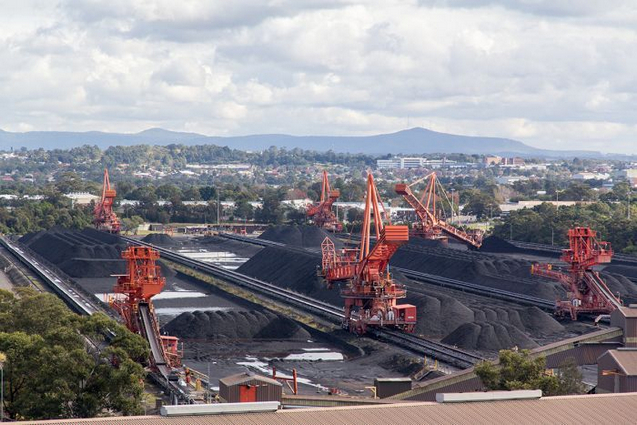
More coal is exported from Newcastle than any other port. (AAP: Dean Lewins, file photo)
When AGL CEO Andy Vesey announced a new project to convert brown coal to liquid hydrogen in Victoria's Latrobe Valley this week, transition was on his lips.
"As we transition to cleaner technologies," Mr Vesey said, "this project may spark a reinvigoration of Latrobe Valley's energy industry by generating a competitive edge in a new market."
Prime Minister Malcolm Turnbull launched the hydrogen trial at Loy Yang in Victoria's east. (ABC Gippsland: Emma Field)
Prime Minister Malcolm Turnbull was also talking transition.
"It is critically important that we invest in energy sources of the future and that we affect the transition from older forms of [energy] generation to new forms of generation and we do so seamlessly.
"Getting the transition right is critically important," he said.
The Federal and Victorian Governments are providing $100 million towards the cost of the trial.
Mr Vesey has been staring down the Federal Government in recent weeks over AGL's plans to decommission the Liddell power station in 2022.
AGL is Australia's largest owner of coal fired power stations and Australia's biggest emitter of carbon dioxide. It is also the most vocal of the big coal industry companies about transitioning out of coal.
"As Australia transitions to a carbon constrained future, creating new sources of prosperity and growth in communities which host conventional coal power stations is a critical priority," Mr Vesey said this week.
The day before, Minister for the Environment and Energy Josh Frydenberg touched on the issue of transition as he talked about the challenge of integrating climate and energy policy.
"The question is this," Mr Frydenberg said.
"How do we establish a policy framework that manages the transition; achieves the objectives of lower prices, higher reliability and lower emissions; and provides constancy and consistency through political cycles?"

New coal tax proposal
At a conference on coal transition in Canberra this week, a new tax on coal was proposed to help communities adjust to a downturn in coal production.
One of the co-authors of the proposal is Professor Frank Jotzo, the director of the Centre for Climate Economics and Policy at the Australian National University.
He said there was every possibility of rapidly declining coal demand in the coming decades.
"It's important to help the industry overall and the regions where the industries play a large role to adjust to that," Professor Jotzo said in the leadup to Coal transitions: a symposium on current research, run by the ANU College of Asia and the Pacific.
"We're looking at the economic and social aspects of the problem," he said.
Frank Jotzo is a Professor at the Australian National University's Crawford School of Public Policy. (Supplied)
"We're not framing this as a moral or ethical challenge. In our investigation of a possible coal tax, we've put those things aside and simply looked at the economic self-interest of Australia and other coal exporters."
The proposal examined the effects of taxing Australian coal exports by about $US18 ($23) a tonne, predicting the tax could raise up to $US16 billion ($20.5 billion) by 2035.
The proposal also looked at what would happen if the world's four biggest coal exporters — Australia, Indonesia, South Africa and Columbia, all applied an export tax.
In this case, global carbon dioxide emissions could drop and a collective $US125 billion ($160.2 billion) could be raised over the next 20 years.
Finally, the study looked at what would happen if the big four coal exporters put a tax on production, estimating that could raise a collective $US266 billion ($340.9 billion).
But in the wake of Australia's last short-lived carbon tax, the authors of the proposal admit that questions remained over whether coal taxes by major suppliers would be politically feasible, even if they could yield economic benefits.

Politicians at odds over a coal transition
Two weeks ago, Resources Minister Matt Canavan said he found it highly objectionable to talk about people's loss of jobs and livelihood as a transition.
"Let's be frank, that's a euphemistic term," Mr Canavan said.
"That's a term to try to hide what will be the real impacts of that happening.
"For many thousands of businesses and people in central Queensland and north Queensland and in the Hunter Valley, it won't be a transition, it'll be utter heartache for them and their families."
Resources Minister Matt Canavan says Australia's mining boom is far from over. (ABC News: Adam Kennedy)
Labor's climate change spokesman Mark Butler said unions and non-government organisations lobbied very hard at the Paris Climate Conference in 2015 to include the term "just transition" in the agreement.
"Malcolm Turnbull and other governments lobbied to try to exclude that commitment but thankfully they were unsuccessful," he said.
Mr Butler agreed with Professor Jotzo that Australian workers needed a just and orderly transition to a clean energy economy.
"What hurts workers and communities most are unplanned, ad-hoc closures that don't come with well thought out government support," Mr Butler said.

Australian coal exports could actually rise by 2040
A coal loader at the Port of Newcastle. (Supplied)
Policy decisions made at this week's COAG Energy Council meeting could affect the future of Australia's domestic coal demand.
But the majority of Australia's coal production is exported.
So the need for a coal transition depends in part on whether Australia's international coal customers keep buying.
To put domestic and export coal volumes in perspective, AGL's Liddell power station burned about 4 million tonnes of coal last year, judging by emissions figures.
A view of Lake Liddell with the Liddell power station reflected in the background. (Wikimedia Commons)
Australia exports that much coal about every four days. Australia exports nearly 400 million tonnes of coal a year.
All of Australia's coal export customers have signed the Paris Agreement, which requires them to take action to reduce emissions of carbon dioxide.
According to Adam Walters, the principal researcher of consultancy Energy Resource Insights, Australia exports more than a billion tonnes of carbon dioxide each year in coal, gas and oil exports, making Australia the world's third biggest exporter of carbon pollution.
He said only Russia and Saudi Arabia exported more carbon dioxide in fossil fuel exports. For Australia, the vast majority of that carbon is from coal.

Despite the Paris Agreement and the carbon risk to Australia's coal exports, the benchmark International Energy Agency (IEA) World Energy Outlook last year predicted Australian coal exports could actually increase from 360 million tonnes of coal equivalent (Mtce) to 425 Mtce by 2040.
The outlook predicted that Australia could expand its exports by 19 per cent over the coming 25 years.
Quoting IEA figures, Resources Minister Matt Canavan said Australia had no need to prepare for a coal transition because the export business to Asia would stay strong for decades.
"Far from a market in structural decline, demand for thermal coal has been accelerating, at a pace never seen before," he said.
However, a recent report from consultants McKinsey and Company questions that view. The report found that the acceleration of cost declines in renewables over the next 30 years could halve coal demand for power in China and India. The fall in demand could lead to lower thermal coal exports from Australia.
There is no consensus on the outlook for Australia's coal export industry. Mr Canavan summed up the fraught business of coal forecasting when he said "the only accurate forecast is probably that every forecast will be wrong".

World's biggest coal port plans a transition beyond coal
Stockpiles of coal from the Hunter Valley's mines are organised near the shores of the port. (ABC Newcastle: Robert Virtue)
Newcastle, the world's biggest coal port, exports an average 160 million tonnes a year, but the new boss is already thinking of diversifying out.
The Port of Newcastle's new chairman Roy Green said that there would be an inevitable transition to renewable energy sources around the world.
"So we have to be prepared for that," he said.
Chairman of the Port of Newcastle, Roy Green. (Supplied: Port of Newcastle)
"We're not going to change the port's business model overnight. We're committed to our coal customers and we will continue to export our very high quality thermal coal while customers internationally want to buy it.
"While committed to coal export, while the prospects exist maybe for another decade, two decades, we can't be sure. We also have to pursue in parallel a diversification strategy."
The Port of Newcastle wants to move into container shipments, which are currently dominated in New South Wales by Sydney's Port Botany.
"That will contribute to the growth of the Hunter region, which in the past was very dependent on primary commodities, but is increasingly taking up the challenge to a more knowledge based economy," Mr Green said.

Links

13/04/2018

Michael Bloomberg Takes On The Coal Industry

The New Yorker - Carolyn Kormann

The former New York City mayor lays out his vision for the future of clean energy. Photograph by Ray Tamarra / GC / Getty
On Monday afternoon, Michael Bloomberg, the billionaire businessman and former three-term mayor of New York City, escaped to a deserted ballroom at the Grand Hyatt, in midtown Manhattan, to talk about climate change. Moments earlier, he had announced to attendees of the Bloomberg New Energy Finance summit that his philanthropic organization was partnering with the Canadian and British governments to expedite the global eradication of coal mining. His two new partners—Catherine McKenna, Canada’s minister of environment and climate change, and Claire Perry, the United Kingdom’s minister of state for energy and clean growth—came along for the discussion.
As the only person not representing a country, Bloomberg, in his new role as the U.N.’s special envoy for climate action, seemed like a substitute for American leadership—an alternative to the climate-denying Trump Administration, which Bloomberg called “a meshuggener.” But he immediately brushed aside the idea that the federal government, in this country, at least, can have a major impact on fuel sources or climate policy. “Coal will go away in any place where there’s a free market, for sure, because the market just forces that, the economics force it,” he told me. “O.K., the federal government can change some environmental regulations, but companies are going to put in the environmental safeguards anyway. Their stockholders are insisting on it, their employees are insisting on it, their customers are insisting on it, and, at the state level, they’re insisting on it.” Of greater concern, he said, are countries in which “the government has set the price for coal or whatever and is subsidizing it.” Last fall, McKenna and Perry founded the Powering Past Coal Alliance, which aims, in part, to help these countries adopt cleaner fuels. Sixty nations, states, cities, and companies have so far joined its polyglot roster.
At a few points during the conversation, Bloomberg returned to the idea that future targets for eliminating coal plants—2030 for developed countries; 2040 for China; 2050 for the rest of the world—don’t resonate with the public. “Twenty-anything sounds a long ways away, and so people don’t get their heads around it,” he said. “If you want people to sign on to an environmental issue, convince them that it is not climate change, it’s the environment. You say, ‘It’s your kid who’s going to go to the hospital with an asthma attack.’ ” Bloomberg drew an analogy with another of his causes, the fight against tobacco. “If you smoke—and you’ve got to be really stupid to smoke—then Darwin is at work,” he said. “The trouble with this stuff, what we’re talking about here, is you can do stupid things that hurt everybody for a long time.” McKenna noted that, in Ontario, once coal power was entirely eliminated, the province went from having fifty smog days a year to none.
One of the summit’s speakers, earlier in the day, was Rick Perry, the Secretary of Energy, who is an unashamed supporter of the coal industry. (Last week, a former D.O.E. employee petitioned for whistle-blower status, alleging “evidence of criminal corruption, obstruction of justice, and ethics violations” related to Perry’s relationship with the coal tycoon Robert Murray.) In his remarks, Perry said that his department was currently examining an emergency request from FirstEnergy Solutions, one of the largest electric utilities in the country, for help saving its struggling nuclear and coal plants. The company recently filed for Chapter 11 bankruptcy protection, and was asking Perry to invoke an obscure provision of the Federal Power Act that would keep its plants online by guaranteeing their profits. (One of the company’s D.C. lobbyists, Jeff Miller, was the campaign manager for Perry’s 2016 Presidential run.) Critics such as Nora Mead Brownell, who served on the Federal Energy Regulatory Commission under George W. Bush, have argued that granting FirstEnergy’s request would be a heavy-handed intervention in a competitive power market. Brownell called the request a “real tragedy.”
“It does not help that our federal government is opposed to some rational things and is putting out some of the drivel that they do,” Bloomberg said. “But I would say that President Trump has been phenomenally helpful in galvanizing the pro-environmental people.” To date, Bloomberg Philanthropies has spent a hundred and twenty-five million dollars on its anti-coal campaigns, funnelling much of the money to the Sierra Club’s Beyond Coal initiative, which targets communities where coal plants are located. (Some has also gone to job-training charities in coal country, to support out-of-work miners.) Since Bloomberg first became active on the issue, in 2011, fifty per cent of this country’s coal plants have been retired. His hope, he said, is to see just a handful of coal plants left in the United States in a few years. The next thing to worry about, he continued, is the shipping industry. “They use this terrible bunker oil,” he said. He could start by addressing his own foundation’s investments: Bloomberg Philanthropies has divested its portfolios from coal but not from oil or gas.
On Tuesday, however, Perry’s old friend and campaign supporter Robert Murray, the founder and C.E.O. of Murray Energy, the biggest private coal company in the country, addressed the summit. “I’m probably the only coal guy in this room,” he said. Murray owns a large number of the domestic mines that sell coal to FirstEnergy, and he was there to make the case that coal is the only reliable fuel source that this country has—especially during extreme weather events such as this winter’s bomb cyclone. It was his opinion that the federal government must intervene. “It’s probably the only option right now,” he said. “We have the responsibility to make sure grandma doesn’t die on the operating table.” Perry, in his speech, had been more circumspect about FirstEnergy’s request. “It’s not the only way,” he said. McKenna, for her part, believes that the reliability question is a canard. “There’s this idea that you need to have coal for stability of the grid, and that’s just not true,” she said. In Canada, she noted, eighty per cent of energy is clean, meaning that the nation’s electric grid is mostly not backstopped by coal.
Murray Energy holds about three billion dollars in coal reserves. Bloomberg is worth fifty billion. Whom will the Trump Administration heed?

Links

Lethal Heating is a citizens' initiative