06/07/2018

Under Fire For Ethics Scandals, EPA Chief Pruitt Resigns

ReutersJohn Whitesides

WASHINGTON - Environmental Protection Agency chief Scott Pruitt, who had been lauded by President Donald Trump for his aggressive efforts to roll back environmental regulations, resigned on Thursday under heavy fire for a series of ethics-related controversies.


Pruitt was one of Trump’s most polarizing Cabinet members, slashing regulations on the energy and manufacturing industries, including a move to repeal President Barack Obama’s signature program to cut carbon emissions from power plants, dubbed the Clean Power Plan.
He was also instrumental last year in lobbying Trump to withdraw the United States from the global 2015 Paris climate accord to combat global warming.
But Pruitt lost favor with Trump’s inner circle after a string of controversies including first-class travel at taxpayer expense, lavish spending on security, the installation of a $43,000 soundproof phone booth in his office and accusations that he used his position to receive favors, such as a discounted rental on a high-end condo from an energy lobbyist’s wife.
“The unrelenting attacks on me personally, my family, are unprecedented and have taken a sizable toll on all of us,” Pruitt said in his resignation letter.
Trump announced the resignation on Twitter and said EPA Deputy Administrator Andrew Wheeler, a former mining industry lobbyist, will become the regulatory agency’s acting chief on Monday. Wheeler is widely expected to continue Pruitt’s efforts to roll back and streamline regulation, something that Trump had promised in his presidential campaign.
“Scott has done an outstanding job, and I will always be thankful to him for this,” Trump wrote. Trump told reporters later that Pruitt had approached him and offered to resign as opposed to being pushed out.
Wheeler said in a message to EPA employees that he was “both humbled and honored” to lead the agency. “I look forward to working hard alongside all of you to continue our collective goal of protecting public health and the environment on behalf of the American people,” he said.
Democrats and environmental advocacy groups cheered the departure of Pruitt, a close ally of the fossil fuel industry who has often questioned mainstream climate change science.
“Scott Pruitt’s reign of venality is finally over. He made swamp creatures blush with his shameless excesses. All tolerated because Trump liked his zealotry. Shame,” Democratic Representative Gerry Connolly said.
The Environmental Working Group, a public health and environment watchdog, called Pruitt “unquestionably the worst head of the agency in its 48-year history.”
Environmental Protection Agency (EPA) Administrator Scott Pruitt takes questions about the Trump administration's withdrawal of the U.S. from the Paris climate accords during the daily briefing at the White House in Washington, U.S. June 2, 2017. REUTERS/Jonathan Ernst/File Photo
Pruitt, as Oklahoma’s attorney general before heading up the EPA, had sued the federal agency more than a dozen times on behalf of his oil-drilling state.
Pruitt also rankled some Republican lawmakers, including in Midwest corn-producing states, with his efforts to overhaul a U.S. policy requiring biofuels like corn-based ethanol in gasoline.
Republican Senator Chuck Grassley of Iowa said Trump made the “right decision.”
Other Republicans, as well as coal and oil industry groups, said in statements on Thursday that Pruitt had been a good friend to industry.
“Scott Pruitt did great work to reduce the regulatory burdens facing our nation while leading the Environmental Protection Agency,” said Republican Senator Jim Inhofe, from Pruitt’s home state of Oklahoma.

“Policy Will Remain”
Pruitt’s interim replacement, Wheeler, was formerly a lobbyist for Murray Energy [MUYEY.UL], the country’s largest underground coal mining company, and also worked for Inhofe – a self-described climate skeptic - on efforts to combat climate legislation.
Matt Dempsey, an energy lobbyist at consultancy FTI, said Wheeler will be less controversial than Pruitt but without altering the agenda.
“He will be less political and more straightforward in his approach to the job, which is better for the Trump administration agenda in the long run. The politics will pass but the policy will remain,” Dempsey said.
Pruitt was facing around a dozen investigations into his tenure, including his frequent use of first-class flights and his spending on security – which the agency has defended as necessary to defend him against unprecedented threats.
Travel records showed the U.S. government spent $17,000 in taxpayer money on a December trip to Morocco to promote U.S. exports of liquefied natural gas, which is not part of the EPA’s jurisdiction. The Washington Post reported that a longtime Pruitt friend and lobbyist helped arrange the trip and later registered as a foreign agent representing Morocco.
In one of the investigations, the U.S. Government Accountability Office concluded that the EPA violated two laws by installing the $43,000 phone booth for Pruitt’s office without telling lawmakers first. Pruitt said his staff never told him the cost.
Some of the ethics accusations against Pruitt also involved jobs for his wife. Emails obtained by the Sierra Club environmental group showed Pruitt had an aide contact the chief executive of a fast-food chain about his wife becoming a franchise owner.
The Washington Post reported Pruitt had aides also try to get his wife a job at the Republican Attorneys General Association with a salary topping $200,000.
Pruitt also had an employee carry out his personal errands, including researching the purchase of an old mattress from the Trump International Hotel, according to an interview transcript released by congressional Democrats last month.
A source close to Trump said the controversy over the search for a used Trump International Hotel mattress was the last straw for Trump with Pruitt because it involved the Trump Organization.
During congressional testimony in April, Pruitt was unapologetic for the controversies, often blaming his staff for any agency missteps.

Links

All-Time Heat Records Have Been Set All Over The World During The Past Week

FairfaxJason Samenow

Washington: From the normally mild summers of Ireland, Scotland and Canada to the scorching Middle East, numerous locations in the Northern Hemisphere have witnessed their hottest weather ever recorded over the past week.
Large areas of heat pressure or heat domes scattered around the hemisphere led to the sweltering temperatures. No single record, in isolation, can be attributed to global warming. But collectively, these heat records are consistent with the kind of extremes we expect to see increase in a warming world.
Let's take a tour around the world of the recent hot-weather milestones.
The sun peaks around the Washington Monument as geese float down the Potomac River in Washington as a hot day breaks on Sunday. Photo: AP
North America
A massive and intense heat dome has consumed the eastern two-thirds of the United States and south-east Canada since late last week. It's not only been hot but also exceptionally humid. Some of the notable all-time records include:  Denver tied its all-time high-temperature record of 40.5 degrees Celsius on Thursday; Burlington, Vermont, set its all-time warmest minimum temperature ever recorded of 26.6 degrees on Monday; Montreal recorded its highest temperature in recorded history, dating back 147 years, of 36.6 degrees on Monday. The city also posted its most extreme midnight combination of heat and humidity.

Europe
People relax on Bournemouth beach in Dorset , England, on Sunday as the hot weather continued across the country. Photo: PA
Excessive heat torched the British Isles late last week. The stifling heat caused roads and roofs to buckle, the Weather Channel reported, and resulted in multiple record highs in Scotland, Ireland, and Northern Ireland.

Eurasia
A large dome of high pressure, or heat dome, has persistently sat on top of Eurasia over the past week, resulting in some extraordinarily hot weather.
In Tbilisi, Georgia, on Wednesday, the capital city soared to 40.5 degrees, its all-time record, while Yerevan, Armenia, temperatures soared to 42 degrees, a record high for July and tying its record for any month.
The foot of the Kaskad or the Cascade in Yerevan, the capital of Armenia. Photo: Michele Mossop
Several locations in southern Russia topped or matched their warmest June temperatures on record on Thursday.

Middle East
Qurayat, Oman, posted the world's hottest minimum temperature ever recorded on June 28: 42.6 degrees.
These various records add to a growing list of heat milestones set over the past 15 months that are part and parcel of a planet that is trending hotter as greenhouse gas concentrations increase because of human activity.
World temperatures were broken in Oman last week. Photo: Alamy
In late May 2017, the western town of Turbat in Pakistan hit 53.5 degrees, tying the all-time highest temperature in the country and the world-record temperature for May.
It followed the hottest temperature ever observed on Earth during the month of April — 50.2 degrees also in Pakistan.

Links

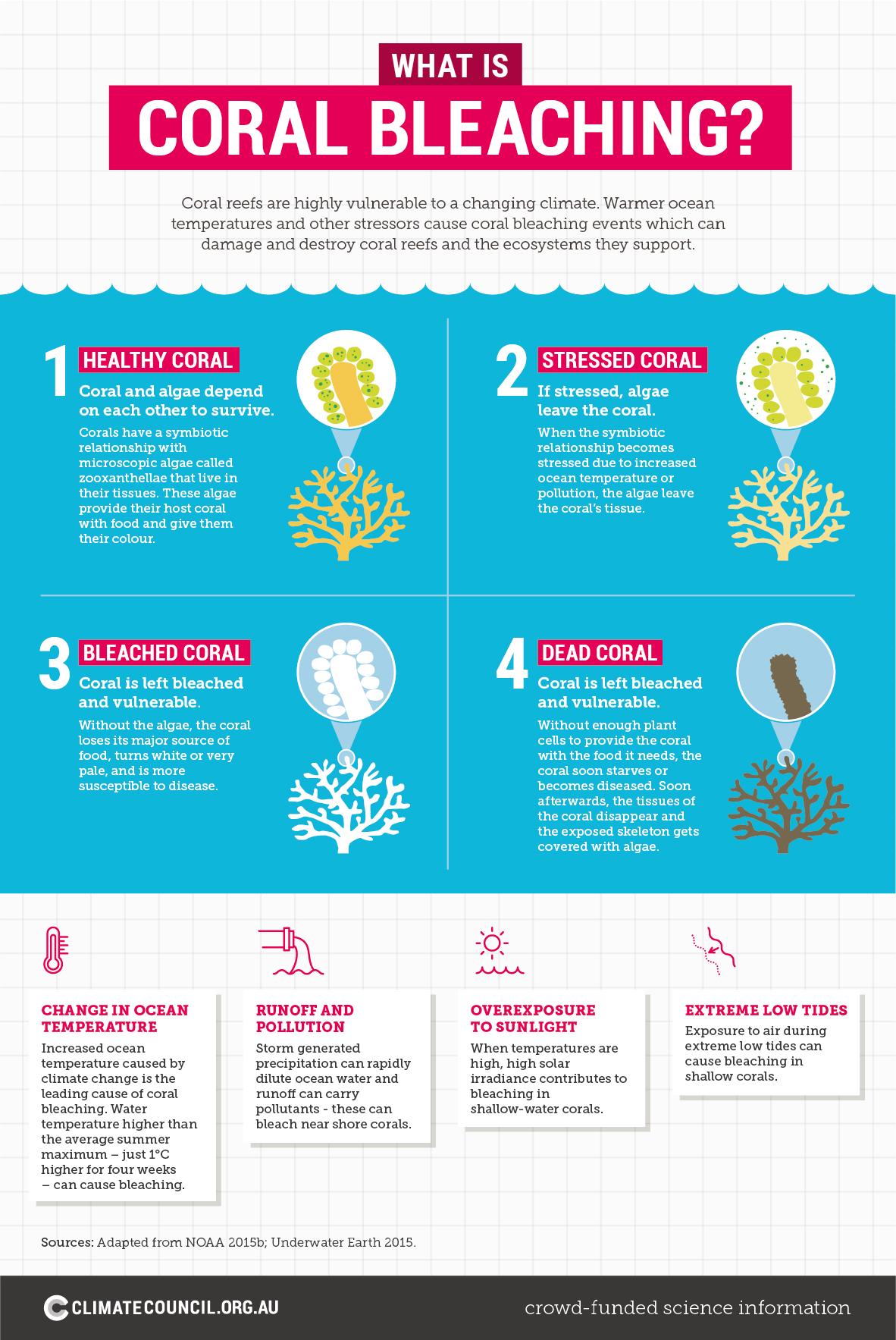
Bleaching Of The Great Barrier Reef Could Happen Every Two Years, Report Finds

NEWS.com.au - Charis Chang & AAP

Underwater vision of bleaching on the Great Barrier Reef, off Port Douglas taken on June 28, 2018. Source: Climate Council
Lethal Consequences: Climate Change Impacts on the Great Barrier Reef
THE Great Barrier Reef could be hit with catastrophic bleaching every two years unless more is done to limit climate change.
A new report from the Climate Council reveals coral bleaching is now happening on average every six years, compared to once every 27 years back in the 1980s.
Based on current rising greenhouse gas levels, bleaching will happen every two years by 2034.
In the report released today Lethal Consequences: Climate Change Impacts on the Great Barrier Reef, the Climate Council says the current rate of bleaching is not sustainable because it will continuously set back recovery of the reef.
At the same time, the reef will also need to deal with other threats caused by climate change — such as ocean acidification and tropical cyclones.
The report found average coral cover in the northern section of the reef is at its lowest point on record, and coral cover in the central section of the reef declined from 22 per cent in
2016 to 14 per cent in 2018, largely due to the 2017 bleaching event.
It said the damage to the reef may be irreversible and it has already resulted in a drop in the diversity of fish species and in the number of juvenile fish settling on the reef.
Underwater vision of bleaching on the Great Barrier Reef, off Port Douglas taken on June 28, 2018. Source: Climate Council
The damage could be irreversible. Source: Climate Council
“Intensifying marine heatwaves around the world are now occurring more often, lasting longer and are more intense than ever before,” Climate Councillor and ecologist Professor Lesley Hughes said.
Professor Hughes said the bleaching events in 2016 and 2017 resulted in mass coral mortality, with the 2016 bleaching event at least 175 times more likely to occur due to intensifying climate change.
“Unless drastic action is taken, extreme coral bleaching will be the new normal by the 2030s. We will see extreme ocean temperatures, similar to those that led to these bleaching events possibly occurring every two years, which will effectively sign the death certificate for the world’s largest natural living wonder that is the Great Barrier Reef,” she said.
LARGE IMAGE
The report makes clear that doing things like improving water quality are not the solution.
It says that unless “deep cuts in greenhouse gas emissions are made as a matter of urgency — the reef stands little chance no matter what measures are taken to enhance its resilience”.
In particular, global warming must be limited to 1.5 degrees above pre-industrial levels.
“A 2C rise in average global temperature will almost certainly mean the collapse of warm water tropical reefs around the world,” the report states.
“The decisions and actions that we take today to reduce greenhouse pollution will have a critical effect on the long-term survival of the iconic Great Barrier Reef.”
Climate Council acting chief executive officer Dr Martin Rice said the future of coral reefs around the world depended on nations including Australia doing their part to tackle climate change.
“This report shows that the Great Barrier Reef may never fully recover or return to its pre-bleaching state, which should serve as a serious warning signal for governments around the world to act now,” he said.
“We all have a part to play in cutting greenhouse gas pollution levels in order to protect these natural wonders. The only thing standing in the way is political will.”
The report comes as former prime minister Tony Abbott calls for Australia to back away from its internationally binding climate targets.
In a speech to the Australian Environment Foundation on Tuesday night, Mr Abbott said he would never have signed on to the Paris Agreement in 2015 if the United States did not also agree — the country has now walked away from the agreement under the new leadership of President Donald Trump.
But Mr Abbott has found little support for pulling out of the agreement.
Minister for Energy and the Environment Josh Frydenberg and Prime Minister Malcolm Turnbull have been trying to gain support for the government’s National Energy Guarantee. Picture: Mick Tsikas/AAP
Deputy leader Julie Bishop batted down Mr Abbott’s suggestion Australia was never meant to be bound by the target to reduce emissions by 26 to 28 per cent reduction on 2005 levels.
Ms Bishop, who was also Mr Abbott’s deputy, said Australia intended to be accountable for the targets, which were a commitment and not an aspiration.
“Australia plays by the rules — if we sign an agreement we stick to the agreement,” she said.
She said the targets were agreed by the prime minister, the cabinet and the party room.
But the Turnbull Government is still divided on its National Energy Guarantee (NEG) proposal, which would legislate the commitment and help Australia achieve its targets.
Mr Abbott’s comments have been stirring discontent about the guarantee and he claims there’s “no plausible evidence” the government’s energy policy can address reliability, price and emissions reductions altogether.
However, Mr Turnbull said there was “almost universal support across the country” for the plan, including from the minerals industry, manufacturers and unions.
“Our policies are working and the NEG is a very big part of it — it will ensure Australians have reliable and more affordable power,” he told reporters.
Mr Abbott is one of a handful of coalition MPs pushing for new coal-fired power plants.
Opposition to the NGE exists not just in the Liberals but also within the Nationals.
Some minor-party MPs are reportedly passing around a list of demands for changes to the guarantee, including a $5 billion fund to support assistance for coal, gas or traditional hydro projects that could deliver electricity around the clock, regardless of the weather.
The Australian, which obtained a copy of the document, says it’s being promoted as a “genuine and serious policy position”.
Backbencher Michelle Landry says more negotiation is needed and coal must be a part of the guarantee but Nationals minister David Littleproud told ABC he was comfortable with the NEG.

Reef Report Key Findings
  • Around 30 per cent of corals on the Great Barrier Reef died as a result of the 2016 event.
  • 75 per cent of coral mortality occurred in the northern section of the Great Barrier Reef, where 93 per cent of individual reefs between Port Douglas and the Torres Strait were affected.
  • Fast-growing corals such as staghorns and tabular species have suffered a “catastrophic die-off”.
  • Coral mortality has reduced the availability of habitat for fish, leading to a decline in reef fish diversity. Juvenile fish at Lizard Island, for example, have suffered a 40 per cent decrease in settlement.
  • Global sea surface temperatures have increased by over 0.2C from 1992 to 2010, increasing the odds of more frequent and prolonged marine heatwaves.
  • The return period for global bleaching events has decreased from 27 years in the 1980s to only 5.9 years now.
  • The likelihood that the Great Barrier Reef will ever fully recover or return to their pre-bleaching state is low.
  • There is little evidence that improving water quality can sufficiently reduce susceptibility of corals to bleaching from marine heatwaves.
Coral bleaching of the Great Barrier Reef

Links

Electricity Sector Won't Bear Brunt Of Paris Emissions Reduction, Energy Analyst Warns

The Guardian

RepuTex says the national energy guarantee leaves shortfall of close to 500m tonnes of carbon pollution
Parts of the economy other than electricity will bear the brunt of Australia’s emissions reduction effort under the Paris agreement, RepuTex says. Photograph: Dave Hunt/AAP
A leading energy market analyst has warned that parts of the economy other than electricity will bear the brunt of Australia’s emissions reduction effort under the Paris agreement – a development that will inevitably drive up the costs of abatement for high-emitting energy, materials and industrial companies.
The warning comes as Tony Abbott has escalated his efforts to scuttle the national energy guarantee despite failing during the last parliamentary sitting fortnight to trip up Malcolm Turnbull and Josh Frydenberg before a critical meeting of state energy ministers in August.
Abbott declared on Tuesday night that Australia should pull out of the Paris agreement, despite being the prime minister who signed Australia up to the agreement before being deposed from the Liberal leadership by Malcolm Turnbull in 2015.
When he signed Australia up to the Paris agreement in 2015, Abbott said there was a “definite commitment” to reduce emissions by 26% “but we believe under the policies that we’ve got, with the circumstances that we think will apply, that we can go up to 28%”.
On Tuesday night, the former prime minister told a climate sceptics group his government would have never signed up to the treaty had it known Donald Trump would pull the US out.
“Absent America, my government would not have signed up to the Paris treaty, certainly not with the current target,” Abbott said. “Knowing what we know now, we would not have made the Paris agreement. But if we wouldn’t have done it, had we known; we shouldn’t be in it, now that we do.”
While Trump has signalled his intention to withdraw, the US cannot actually pull out until November 2020, which is close to the time of the next presidential election.
Abbott has been positioning this week to attempt to make the Neg a leadership flashpoint, suggesting on 2GB it was possible he could return to lead the Liberal party if drafted, noting “let’s just see how things work out”.
He also used an interview with News Corp before his speech to declare the Liberal party had come full circle on climate change, and was now “back to where we were in late 2009, with Malcolm Turnbull trying to do a deal with the Labor party on emissions reduction”.
Abbott unseated Turnbull from the party leadership in 2009 using his support for emissions trading as a trigger. The former prime minister also declared climate and energy policy was “not a circle you can square with the Labor party … it is a fight that has to be won”.
Abbott is attempting to rally the party base and exploit divisions within the government on the Neg with his various forays. The policy divides the National party and some Liberal conservatives, including Abbott, have held out the possibility of crossing the floor.
But his efforts to stir dissent have been met internally by a show of force.
Turnbull has declared it is time to move on from the hyper-partisanship of the decade-long climate and energy wars, and a number of Liberals and Nationals have also rallied publicly in support of the policy.
Privately, there is considerable frustration from many government MPs about Abbott’s behaviour.
With Abbott again on the warpath, the respected advisory firm RepuTex has issued new guidance saying the Neg, if implemented, will only deliver 10% of the national emissions reduction effort.
The firm says the emissions reduction target for electricity under the Neg of 26% on 2005 levels by 2030 translates to cutting national emissions by 10%, leaving a shortfall across the rest of the economy of close to 500m tonnes of carbon pollution.
The government is yet to spell out any roadmap for emissions reduction in the rest of the economy.
RepuTex says, assuming emissions will need to be reduced across the economy to conform with the Paris agreement, that will double the price of carbon to $35 per tonne by 2030 “with industry – notably high-emitting energy, materials and industrial companies – bearing the brunt of the higher abatement cost”.
“With the electricity sector locked into the Neg, other sectors – particularly large energy, materials and industrials facilities – will be called on to fill the gap to 2030”, the firm’s executive director, Hugh Grossman, says.
“As this occurs, we expect carbon contract prices to rise to $35/t in 2030 – more than double current levels – behind the need for more expensive abatement from industry.”
Grossman says abatement is cheaper in the electricity sector than elsewhere in the economy: “Abatement is far more expensive for large energy, materials and industrials facilities.”
He says the firm’s advice to clients is prices will increase considerably from 2020 “in line with the need for more expensive abatement to be triggered, and greater demand for offset buying”.
“This will lead to a higher sustained price path over time, with industry expected to contribute around half of all emissions reductions to 2030”.
While consumers are beginning to see a reduction in their energy costs due to a recent fall in wholesale prices, the latest Guardian Essential poll also shows the Turnbull government has not yet convinced voters the Neg will lower power prices.
The latest fortnightly survey of 1,030 voters shows only 15% think the Neg will help reduce energy bills, 22% think it will increase them and 38% believe it will make no difference.

Links

05/07/2018

Hottest Financial Year On Record BOM Data Shows

ABC WeatherKate Doyle

Daytime temperatures have been above average across the country over the last year. (Supplied: Bureau of Meteorology )
The data has come through from the financial year and it was hot with maximum temperatures the warmest on record from July to June.
Minimums were also above average but not record-breaking, at only 0.72 degrees above the long term average.
The Bureau of Meteorology's David Jones said it was quite remarkable how consistent the temperature anomalies were.
Australia is getting warmer says Dr Jones from the Bureau of Meteorology. (ABC Regional: Rae Allen)
"The only part of Australia that saw temperatures almost average was the far north west corner," he said.
For example, places up and around Wyndham in north-west Western Australia but even there, Dr Jones said it was still pretty hot, just not much hotter than average.
"Once you got into the east it was a very warm year," he said.
"Not all, but certainly large parts of Queensland, New South Wales, and parts of South Australia saw either record hot conditions or near-record hot conditions for the year."

Why such a warm year?
Dr Jones said part of the story was the lack of rain.
"Many people in eastern Australia know we were in the grip of a drought in many areas and of course, droughts do contribute to above average temperatures, particularly during the day," he said.
"But the other story is obviously 'the trend'."
Financial year (July to June) maximum temperature anomaly for Australia from 1910-11 to 2017-18 (Supplied: Bureau of Meteorology )
You know, 'the trend'. Yes, we are talking about global warming.
"Australia is getting warmer so when you have a drought and you've got a trend you set these records," Dr Jones said.
What happened to La Nina?
But wait. It was a La Nina for a large part of this financial year! La Nina usually means wet and cold conditions for the east coast, doesn't it?
It does sometimes, according to Dr Jones.

What El Nino and La Nina
mean for Australian and world weather

"Firstly we did have a La Nina, but it was a fairly weak La Nina, so its overall influence was pretty modest," he said.
"The other thing too was, with the trend going upwards for temperatures, even La Ninas nowadays tend to often be warmer than average."
So this year's La Nina didn't have a big enough impact to compensate for 'the trend'.
'The trend' becomes apparent when you look at the data. There is proxy data going back a lot further but even just looking at the last century we can see a lot of the story, according to Dr Jones.
"We see that up until about 1950 Australian temperatures went up and down," he said.
"Droughts tend to be warmer, wet spells tend to be cooler, but then subsequently in the 1950s, it started to become warmer.
"So 'the trend' that we talk about is mainly in temperature and it's been going on now for the best part of 50 to 100 years."
Rainfall was down as well
Much of the east coast has been dry over the last 12 months but it has been a wet year for the north west thanks to all those cyclones over summer. (Supplied: Bureau of Meteorology )
"Unfortunately it was a pretty lean year for rainfall across most of those areas where people live," Dr Jones said.
"Eastern Australia in particular was pretty dry.
"I guess one thing that has been a bit unusual about this dry spell, this drought, is it's really come quite close to the coast.
"Obviously our inland areas do have these cycles of droughts and they can be very harsh."
Rainfall was below average nationally this financial year but not by much. (Supplied: Bureau of Meteorology )
But he said this one is also affected some fairly highly populated, usually quite reliable, rainfall regions.
"Areas around Sydney for example [and] the Tablelands through NSW [there were] very dry conditions and] in some spots actually record dry," he said.
It wasn't dry everywhere though.
The north-west corner of the country had a wet year thanks to all of those cyclones this wet season.
The financial year does an excellent job of capturing the northern Australian wet season; for example, 1973-74 and 2010-11, the standout years on the above graph, were the La Nina years of the big Brisbane floods.

Is there a cool change in sight? 

Are you Weather Obsessed?
If you're reading this article, it's possible the answer is yes. Then why not join the ABC-facilitated Weather Obsessed group on Facebook — thousands of others are already going troppo for the troposphere!

Dr Jones said it did not "look too good" for a cool change and there is there is an El Nino watch on at the moment.
"Basically what we are saying is there's about a 50 per cent chance of an El Nino and that's been reflected in our forecast for dryer than average conditions," he said.
"At this point, people are looking for above average rainfall [and] unfortunately, we don't think that's likely."
When you look at temperatures, the warm conditions are likely to continue, particularly during the daytime with most of Australia expected to be above average.
"No real surprises there but I guess we'd all like to see a little bit more normal coming to our climate," Dr Jones said.


Links

Ecosystems Across Australia Are Collapsing Under Climate Change

The ConversationRebecca Harris | David Bowman | Linda Beaumont

Widespread mangrove dieback in the Gulf of Carpenteria. JAMES COOK UNIVERSITY/AAP
To the chagrin of the tourist industry, the Great Barrier Reef has become a notorious victim of climate change. But it is not the only Australian ecosystem on the brink of collapse.
Our research, recently published in Nature Climate Change, describes a series of sudden and catastrophic ecosystem shifts that have occurred recently across Australia.
These changes, caused by the combined stress of gradual climate change and extreme weather events, are overwhelming ecosystems’ natural resilience.

Variable climate
Australia is one of the most climatically variable places in the world. It is filled with ecosystems adapted to this variability, whether that means living in scorching heat, bitter cold or a climate that cycles between the two.
Despite land clearing, mining and other activities that transform the natural landscape, Australia retains large tracts of near-pristine natural systems.
Many of these regions are iconic, sustaining tourism and outdoor activities and providing valuable ecological services – particularly fisheries and water resources. Yet even here, the combined stress of gradual climate change and extreme weather events is causing environmental changes. These changes are often abrupt and potentially irreversible.
They include wildlife and plant population collapses, the local extinction of native species, the loss of ancient, highly diverse ecosystems and the creation of previously unseen ecological communities invaded by new plants and animals.
Australia’s average temperature (both air and sea) has increased by about 1°C since the start of the 19th century. We are now experiencing longer, more frequent and more intense heatwaves, more extreme fire weather and longer fire seasons, changes to rainfall seasonality, and droughts that may be historically unusual.
The interval between these events has also shortened, which means even ecosystems adapted to extremes and high natural variability are struggling.
As climate change accelerates, the magnitude and frequency of extreme events is expected to continue increasing.

What is ecosystem collapse?
Gradual climate change can be thought of as an ongoing “press”, on which the “pulse” of extreme events are now superimposed. In combination, “presses” and “pulses” are more likely to push systems to collapse.
We identified ecosystems across Australia that have recently experienced catastrophic changes, including:
  • kelp forests shifting to seaweed turfs following a single marine heatwave in 2011;
  • the destruction of Gondwanan refugia by wildfire ignited by lightning storms in 2016;
  • dieback of floodplain forests along the Murray River following the millennial drought in 2001–2009;
  • large-scale conversion of alpine forest to shrubland due to repeated fires from 2003–2014;
  • community-level boom and bust in the arid zone following extreme rainfall in 2011–2012, and
  • mangrove dieback across a 1,000km stretch of the Gulf of Carpentaria after a weak monsoon in 2015-2016.
Of these six case studies, only the Murray River forest had previously experienced substantial human disturbance. The others have had negligible exposure to stressors, highlighting that undisturbed systems are not necessarily more resilient to climate change.
The case studies provide a range of examples of how presses and pulses can interact to push an ecosystem to a “tipping point”. In some cases, a single extreme event may be sufficient to cause an irreversible regime shift.
In other systems, a single extreme event may only be sufficient to tip the ecosystem over the edge when gradual declines in populations have already occurred. More frequent extreme events can also lead to population collapse if a species does not have enough time to recover between events.
But not all examples can be directly linked to a single weather event, or a series of events. These are most likely caused by multiple interacting climate “presses” and “pulses”. It’s worth remembering that extreme biological responses do not always manifest as an impact on the dominant species. Cascading interactions can trigger ecosystem-wide responses to extreme events.

The cost of intervention
Once an ecosystem goes into steep decline – with key species dying out and crucial interactions no longer possible – there are important consequences.
Apart from their intrinsic worth, these areas can no longer supply fish, forest resources, or carbon storage. It may affect livestock and pasture quality, tourism, and water quality and supply.
Unfortunately, the sheer number of variables – between the species and terrain in each area, and the timing and severity of extreme weather events – makes predicting ecosystem collapses essentially impossible.
Targeted interventions, like the assisted recolonisation of plants and animals, reseeding an area that’s suffered forest loss, and actively protecting vulnerable ecosystems from destructive bushfires, may prevent a system from collapsing, but at considerable financial cost. And as the interval between extreme events shorten, the chance of a successful intervention falls.
Critically, intervention plans may need to be decided upon quickly, without full understanding of the ecological and evolutionary consequences.
How much are we willing to risk failure and any unintended consequences of active intervention? How much do we value “natural” and “pristine” ecosystems that will increasingly depend on protection from threats like invasive plants and more frequent fires?
We suspect the pervasive effects of the press and pulse of climate change means that, increasingly, the risks of doing nothing may outweigh the risks of acting.
The beginning of this century has seen an unprecedented number of widespread, catastrophic biological transformations in response to extreme weather events.
This constellation of unpredictable and sudden biological responses suggests that many seemingly healthy and undisturbed ecosystems are at a tipping point.

Links

04/07/2018

Could Cli-Fi Help Inspire Real Climate Change Action?

ABCMonique Ross | Julie Street

Climate change fiction has become a publishing phenomenon (Getty: JcRosemann)
Climate fiction novels catapult readers into a future ravaged by the catastrophic effects of global warming.
Survival is a struggle amid dwindling food and water supplies, extreme weather and pandemics. Environmental emergencies are slowly unfolding: animals dying, forests vanishing, sea levels rising.
The genre — variously dubbed 'cli-fi', 'slow apocalypse' and Anthropocene fiction — has become a publishing phenomenon, with Margaret Atwood and Ian McEwan among those conjuring up dystopian near-futures.
"You could say it's because it resonates with a culture on the verge of collapse," says Australian author Alice Robinson, whose cli-fi novel Anchor Point was longlisted for the Stella Prize in 2016.
For some the genre is simply a new take on science fiction, but for others it's a timely wake-up call that could inspire real change.
James Bradley, whose 2015 book Clade was one of the first Australian works to be hailed as cli-fi, says it's easy to understand why many people struggle to make sense of the "incredibly difficult idea" of climate change.
"[Climate change] is huge, it spreads everywhere, it touches everything, it's completely unbounded," he says.
"It's such a big problem that we either exist in a state of denial about it… or we go into this kind of blind panic and despair. And neither of those are useful responses."
James Bradley says fiction can be a good way for people to make sense of climate change (Supplied: City of Tongues/Nicholas Purcell)
He's resistant to the term cli-fi — it's too limiting, he says, for an issue that effects all aspects of our lives — but believes in its impact.
Fiction, he says, gives us a way to push past our despair, and to start thinking about the messages conveyed by climate science in a new way.
"We're looking at a metre, probably more, [of sea rise] by the end of the century. I actually can't imagine what that means, and I don't think we as a society can get to grips with that," he says.
"One of the things that you can do with fiction is find a way of allowing people to find a way to understand what that might mean … what it might feel like to live in that, what it might feel like to experience that.
"[It gives] shape to that sense of dissonance, that sense of wrongness about the world. And often a sense of grief as well about these things."
Once people can make sense of the issue, he says, they may feel empowered to take action — even in a small way — to fight global warming.

'There's hope in that hopelessness'
For readers feeling overwhelmed in the face of climate change, cli-fi also has an important message to deliver: one of hope.
"I think it definitely can showcase a way of living beyond the collapse," Robinson says.
"In my own writing I've started to think of these narratives as classic hero stories: these people in impossible situations beyond the collapse in the case of post-apocalyptic narratives.
"And they're still enduring, in these terrible circumstances. There's something intrinsically heroic, and comforting, to me in the idea that ordinary people might go on living in unendurable circumstances.
"There's hope in that hopelessness somehow."
Alice Robinson says there's something heroic about the idea that ordinary people could go on living in apocalyptic conditions (Unsplash.com: Nick Sheerbart, CC-0)
For Bradley, the books are less about offering hope, and more about "making space for change".
"You can say the world is ending… but as soon as you have to write a story about it, you can see that that's a hopelessly simplistic response," he says.
"People will still be alive, people will still be going on with their lives and doing things, and that forces you to engage with what it might actually be like.
"The world is not actually going to end; it's going to be transformed.
"Talking about how we are going to live with that and deal with that is a much more useful conversation."

A written monument to the past?
Disappearing sea ice has put the Arctic ecosystem under threat. Could this artist impression one day be reality? (Getty: SMETEK)
When Robinson thinks about climate change and the future, she fluctuates between hope and sadness.
"The complication in that is I'm a parent; I have to remain hopeful against the odds because I've sent [my children] into the future by bringing them here," she says.
"It does create purpose: You think, 'we're in this position now, these children are here, what are we going to do about it?'
"The scariest thing in climate change is that we won't do anything; that we'll just let it all unfold and collapse."
But she finds something comforting in the idea that while she can't know what the future will hold, many authors have imagined versions of it.
Alice Robinson wonders what kind of future awaits her children (Supplied: Alice Robinson)
"The idea that a writer has sat in a room and conjured a world not dissimilar to the scary one we're facing now is really comforting to me… if someone can imagine it, how bad can it be?" she says.
"Perhaps that sounds a little bit naïve, or head in the sand, but it's a comfort."
And she wonders if the cli-fi of today will one day help readers of tomorrow understand their world — whatever it may be.
"Sometimes I wonder whether it can be a monument to the past. Whether we're making a record for future generations that we've had these ideas, that we imagined the future that our children might live in," she says.
"It's a way of saying to them: we saw it coming.
"I don't know what worth that might be to them, if that might be comforting for them in the future."

Links

Lethal Heating is a citizens' initiative