13/07/2018

Australia Falls Further In Rankings On Progress Towards UN Sustainable Development Goals

The Conversation | 

Australia’s exported greenhouse emissions are higher per person than Saudi Arabia’s. AAP Image/Richard Wainwright
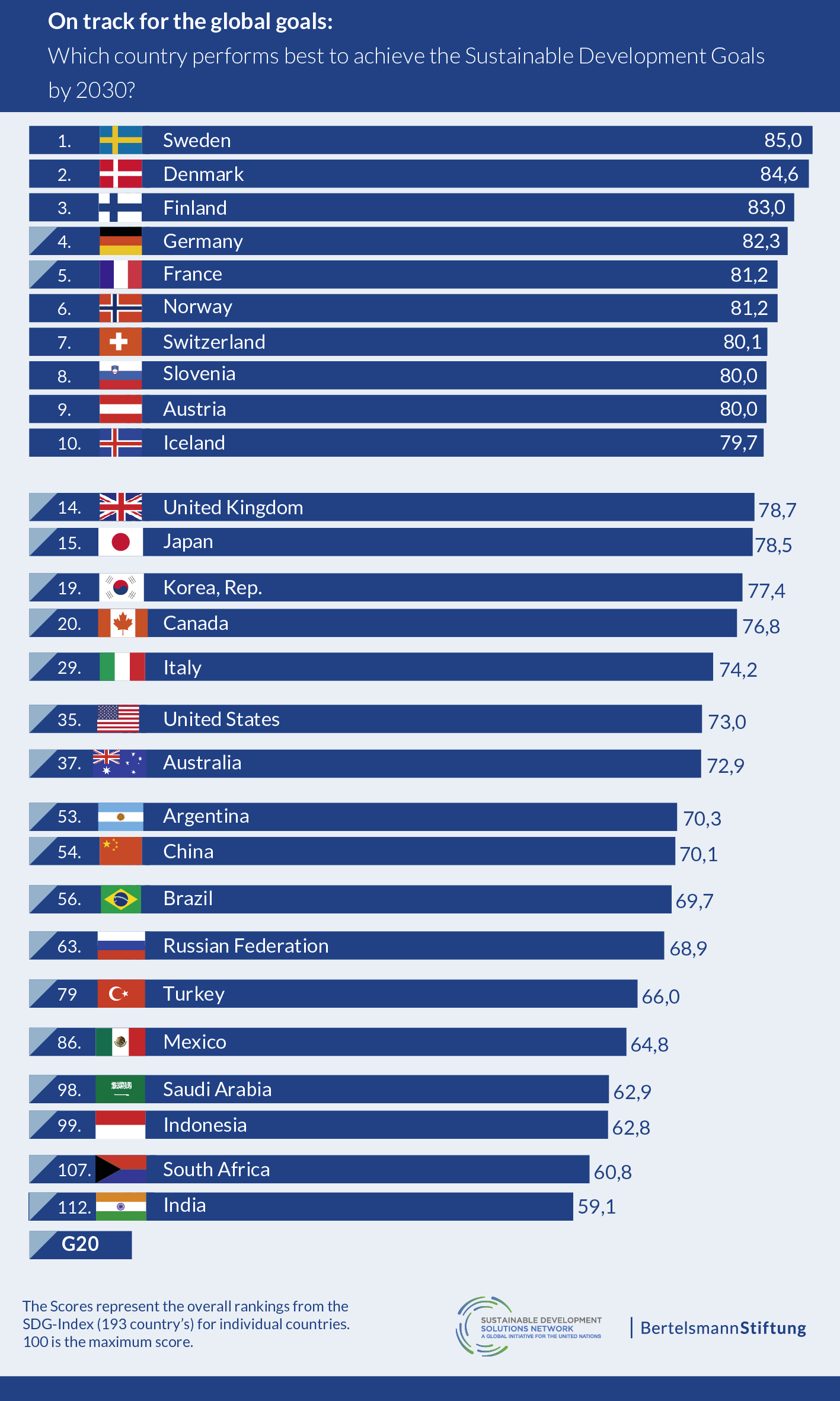
Australia is performing worse than most other advanced countries in achieving the Sustainable Development Goals (SDGs), according to the global SDG Index, which compares different nations’ performance on the goals.
According to the SDG Index, released yesterday in New York, Australia is ranked 37th in the world – down from 26th last year, and behind most other wealthy countries including New Zealand, Canada, the United States and the United Kingdom.
The best-performing countries are the northern European nations of Sweden, Denmark, Finland and Germany, all of which have a history of balancing economic, social and environmental issues.
The SDG Index measures progress against the 17 SDGs agreed by all countries at the United Nations in 2015. The goals encompass a set of 169 targets to be met by 2030 to achieve economic prosperity, social inclusion and environmental sustainability.
Yet despite the progress made by some countries, all nations still have a way to go to achieve all of the goals.

Australia: the world’s worst on climate action
The latest SDG Index shows that Australia is performing relatively well in areas such health and wellbeing, and providing good-quality education. But its results for the environmental goals and climate change are among the worst in the OECD group of advanced nations.
The new index ranks Australia as the worst-performing country in the world on climate action (SDG 13). The measure takes into account greenhouse gas emissions within Australia; emissions embodied in the goods we consume; climate change vulnerability; and exported emissions from fossil fuel shipments to other countries.
One of the reasons why Australia has slumped so far in the rankings is that the SDG Index is now taking into account the so-called “spillover” effects that countries have on other nations’ ability to meet the SDGs. These effects may be positive, such as providing development aid; or negative, such as importing or exporting products that create pollution.
The report shows that G20 nations account for the largest negative economic, environmental, and security spillover effects. Despite being among the richest nations in the world, the US, the UK and Australia are rated worst in the G20 for negative spillovers.
The UK, for instance, rates particularly badly on the tax haven score, which makes it harder for other countries to raise the tax revenue needed to provide health, education and other services to their citizens.
This year’s SDG Index also includes a key environmental spillover indicator: carbon dioxide emissions embodied in fossil fuel exports, calculated using a three-year average of coal, gas and oil exports.
Australia’s annual exported CO₂ emissions are a colossal 44 tonnes per person. This outstrips even Saudi Arabia (35.5 tonnes per person), and is orders of magnitude larger than the figure for the US (710kg per person).

G20 leading the way?
With all countries still falling short of achieving the SDGs, the SDG Index also assesses what actions G20 governments are taking to help close this gap. Most G20 countries have begun to implement the goals but there are large variations among G20 countries in how the SDGs are being embraced by political leaders and translated into action.
Composite score of national coordination and implementation mechanisms for the SDGs in G20 countries. SDSN and Bertelsmann Stiftung, 2018 SDG Index and Dashboards Report
Brazil, Mexico and Italy have taken the most significant steps among G20 countries to achieve the goals, illustrated for instance by the existence of SDG strategies, coordination units in governments, or online platforms. India and Germany have at least partially already undertaken an assessment of investment needs.
According to this assessment, Australia has taken some initial steps to support SDG implementation. Supportive actions taken by the government include setting up a cross-departmental committee, co-chaired by the Department of Foreign Affairs and Trade and the Department of Prime Minister and Cabinet, to coordinate Government SDG activities. The Senate has established an inquiry to examine the opportunities to implement the goals.
Significantly, the federal government has also prepared a Voluntary National Review report on progress in implementing the goals, which it will present to the UN’s High Level Political Forum next week. The report addresses how Australia is performing against each of the goals and includes many case studies of implementation from business, civil society, academia, youth and all levels of government. It is accompanied by a new Australian SDG case study hub. Many of these activities occurred after the cut-off period for the SDG Index, so Australia’s overall performance on SDG implementation is actually higher than the SDG Index gives it credit.
However, Australia is not taking more deliberative action to address the SDGs, such as developing a national implementation plan or setting aside funding for SDG implementation. Nor are individual departments identifying the gaps in Australia’s SDG performance and identifying what they plan to do differently to address them.
Given Australia’s poor performance on some of the SDGs there is clearly a need for targeted action if we are to achieve the goals by the 2030 deadline.

Links

Combating Climate Change Could Create 24 Million Jobs By 2030

Asian Correspondent - Max Walden

Source: William Bossen / Unsplash
CLIMATE change provides a major threat to more than a billion of workers, as well as opportunities to create employment for millions around the world if addressed correctly, according to a new report.
The World Employment and Social Outlook 2018 released in May by the International Labour Organization (ILO) claimed that at least 1.2 billion people rely on a healthy and sustainable environment in their work – particularly those in agriculture, fisheries and forestry.
Climate change poses grave risks to future employment. The ILO reported that 23 million working life years have been lost to natural disasters since 2000, and climate change will see disasters occur more frequently and with greater severity.
Around 2 percent of total working hours – the equivalent of 72 million fulltime jobs – will be lost by 2030 due to heat stress, it said.
“The effects of environmental degradation on the world of work are particularly acute for the most vulnerable workers,” it said. “Rural workers, people in poverty, indigenous and tribal peoples and other disadvantaged groups are affected the most by the impact of climate change.”


As such, climate change and environmental degradation further exacerbate global inequality, which has risen sharply in recent decades. According to the World Inequality Report 2018, the top 1 percent of individuals have captured twice as much income growth as the bottom 50 percent since 1980.
The ILO claimed that 18 million more jobs would be created if the world could meet the Paris Agreement’s goal of keeping the increase in global temperatures to just 2°C above pre-industrial levels.
It projected that while shifts away from carbon and resource intensive industries toward greener technology would see 6 million jobs lost in the short-term, it would also see the creation of 24 million jobs, “meriting complementary policies to protect workers and ensure that the transition is just.”
Demonstrators dressed as Donald Trump and as a polar bear are seen during a demonstration in Bonn against the COP 23 UN Climate Change Conference hosted by Fiji but held in Bonn, Germany November 11, 2017. Source: Reuters/Wolfgang Rattay
Some 23 countries have already succeeded in growing their economies while simultaneously reducing greenhouse gas emissions and their environmental footprint, the report’s authors said.
Cambodia, for example, since 2013 has mainstreamed green growth into its national economic development plan and employment legislation.
Mongolia, meanwhile, identifies “green employment” as a priority, aiming to provide income to 80 percent of its working age population through decent employment and to increase resilience to the negative impacts of climate change.
“Low-income and some middle-income countries need support to develop data collection, identify and adopt best practices, strengthen implementation and finance both mitigation and adaptation strategies in order to achieve a just transition to environmentally sustainable economies and societies for all,” concluded the report.

Links

Greenpeace And Getup Launch Campaign To Kill National Energy Guarantee

The Guardian

Exclusive: Television ads in Victoria and Queensland aim to get state governments to veto Turnbull’s set piece policy
A Greenpeace protest. Greenpeace and GetUp will attempt to have the national energy guarantee vetoed by the states because it is not ambitious enough in emissions reduction. Photograph: Greenpeace
The Queensland and Victorian governments will be hit with a new television advertising campaign in an effort to persuade them to torpedo the national energy guarantee at a critical meeting in early August.
The activist group GetUp has combined with Greenpeace to bankroll what it describes as hard-hitting television advertisements targeting the two Labor-held states ahead of a meeting of energy ministers in August that will make or break the Turnbull government’s signature energy policy.
Opponents of the national energy guarantee have been frustrated that the Victorian government thus far has been muted in its public criticism of the scheme, and fear the Australian Capital Territory – which has been persistently critical – won’t sink the Neg at the Coag energy council unless one of the larger states is also on board.
With the Queensland energy minister, Anthony Lynham, calling in key stakeholders on Thursday to take soundings on the policy, GetUp’s national director, Paul Oosting, told Guardian Australia the activist group “expects all states to use their veto power” in August and fight for a national energy policy that would cut pollution and assist the transition to renewables.
The Australian Conservation Foundation echoed GetUp’s stance, declaring the current policy “unsupportable” because the emissions reduction target is insufficient to see Australia meet its commitments under the Paris agreement, and the policy as drafted makes it difficult to adjust the level of ambition.
The ACF’s Gavan McFadzean said: “What every state and territory government needs to understand is that if they sign up to this Neg, they own it and its woefully inadequate 26% pollution reduction target, locked in to 2030.
“It won’t be just Malcolm Turnbull’s Neg, or Tony Abbott’s, but Daniel Andrews’ and Annastacia Palaszczuk’s as well.”
The Turnbull government needs the backing of states that are in the national electricity market to implement the Neg, with any one jurisdiction possessing the power to kill the scheme.
Business groups have lined up in support of the Neg, urging a truce in the decade-long toxic political battle over climate and energy policy. They want a settled policy mechanism to give energy market participants certainty to invest.
Privately, some business stakeholders would also be relaxed about the commonwealth legislating a scheme that would make ramping up the level of ambition in the emissions reduction target easier to achieve – understanding that could help get the Labor states over the line on the mechanism.
But adding that flexibility could sink the policy when it returns for consideration by the Coalition party room, assuming the states don’t end it first.
The energy policy fight has been complicated in recent weeks by a renewed push by some Nationals and conservative Liberals to make ongoing support for coal part of the quid pro quo for supporting the Neg.
The states are also processing a new report this week from the Australian Competition and Consumer Commission, which recommended major changes to the electricity market, including the commonwealth underwriting new generation projects in order to get more competition into the system and lower prices for consumers.
The energy minister, Josh Frydenberg, has added the new ACCC report to the agenda for discussion at the critical August meeting.
Nationals this week have attempted to front-run the debate and shape public perceptions of the report by claiming the ACCC investigation supports government backing of new coal generation, when the relevant recommendation is clearly technology-neutral.
The ACT’s climate change minister, Shane Rattenbury, told Guardian Australia the report was being used by Liberals and Nationals “shamelessly to back up each of their internal arguments about the Neg”.
He warned: “Unless the Coalition sorts out what the Neg will finally look like, it will be impossible for Coag to endorse or reject it.”
Frydenberg and the prime minister, Malcolm Turnbull, have both said the proposed government underwriting would apply to all technologies that met the criteria, including, potentially, coal projects, as well as gas and renewables with battery back-up.
But Turnbull has also pushed back against the Nationals. On Thursday Turnbull said: “We are not in the business of subsidising one technology or another. We’ve done enough of that. I mean, frankly, too much of that has been done.”
He said subsidies for various forms of energy were in the process of winding down “and we should simply allow the technologies to compete”.
Turnbull said the outcome the government was seeking was lower energy prices.
The shadow federal climate change minister, Mark Butler, has declared it is a “fantasy” that anyone would seek to build a new coal-fired power station underwritten by the commonwealth, and he warned government MPs against hijacking a useful investigation by Australia’s competition watchdog.
Butler said the idea of the government underwriting new market entrants with generation projects was an idea “very worthy of consideration, but unfortunately it’s already been hijacked by these ideological zealots in the Coalition party room”.
“Everyone in the industry has recognised that building new coal-fired power stations, one isn’t suitable for the nature of the market in the future; it’s not sufficiently flexible, it’s more expensive than other power options, but also there is very substantial carbon risk, regulatory risk, price risk, associated with building new, high polluting, or high emitting assets,” Butler said.
“That’s why the industry won’t go near it, investors, bankers, won’t go near it, because they understand quite how risky it is.”

Links

12/07/2018

From Stinky Seaweed To Sick Fish, World's Warming Oceans Threaten Livelihoods

Reuters Thin Lei Win

Climate change will reduce the productivity of fisheries in the world's exclusive economic zones by up to 12 percent by 2050
A man walks past a dead fish as sea water rises during high tide at Kali Adem port in Jakarta, Indonesia, January 3, 2018. REUTERS/Beawiharta
ROME - From a rise in aquatic diseases to a "massive" invasion of stinking seaweed that stops fishing boats going out to sea, the warming of the world's oceans is affecting the livelihoods of millions - and experts say it is going to get worse.
Changes in water temperature, acidity and circulation patterns combined with rising sea levels will increasingly impact communities that live off the ocean, according to new analysis from the U.N. Food and Agriculture Organization (FAO).
In Zanzibar, plant diseases are already destroying seaweed, a key export and a crucial source of income for women in the Indian Ocean archipelago.
Meanwhile fishermen in the Caribbean have seen their catch plummet and costs rise due to a record invasion of sargassum, a brown, stinking seaweed, linked to ocean warming.
"The sargassum is a new phenomenon, unprecedented and massive in its scale," said Milton Haughton, executive director of the Caribbean Regional Fisheries Mechanism intergovernmental agency, on the sidelines of a week-long FAO forum in Rome.
"It prevents boats from going out. When it stays on the coastal harbour areas, it rots, decays, depletes the oxygen in the water and releases toxic substances and the fish dies," he told the Thomson Reuters Foundation.
The research by the FAO and 100 collaborating scientists shows climate change will reduce the productivity of fisheries in the world's exclusive economic zones (EEZs) by up to 12 percent by 2050.
An EEZ is a 200-mile area around a country's territorial waters which it has special rights to exploit.
The analysis shows the fall in productivity in EEZs could range from less than 3 percent to 12 percent, with significant regional fluctuations.
The biggest decreases are expected in tropical countries, mostly in the South Pacific, and some regions could even see an increase in potential catch.
In Fiji, a South Pacific island nation whose EEZ is 70 times larger than its land mass and whose citizens consume more than 35 kg (77 pounds) of fish per person a year, the impact is prompting a rethink of food production and consumption.
"The obvious worry is food for our people. So what we're trying to do right now is to move to aquaculture," said Netani Tavaga, an official from Fiji's Ministry of Fisheries.
"We also have to change the eating habits of the Pacific islanders, like Sunday is fish day. Maybe we need to start thinking about transitioning to other food sources," he said, adding Fiji is now producing prawns, tilapia and other species.
Yet aquaculture is also vulnerable to climate change - the analysis said extreme weather events such as floods and storms could lead to losses in production and infrastructure, while reduced rainfall will increase competition for fresh water.
The analysis said a fall in catches was not inevitable, but actions such as curbing pollution and destructive fishing would be crucial.
CFRM's Haughton hopes cooperation, science and technology will help fishing communities adapt to changes in the Caribbean waters, including dealing with the seaweed menace.
"At the same time, we're having large quantities of other fish we're not used to," he said. "So everything is changing, and that in itself is a problem because you don't know what's happening and you can't plan."

Links

Church Of England Votes To Withdraw Funds From Companies That Contribute To Climate Change

The IndependentJosh Gabbatiss

'Today's vote by the Church of England Synod shows the bell is tolling for the fossil fuel era'
Archbishop of Canterbury, Justin Welby, has acknowledged the enormous threat posed to humanity by climate change. (Jack Taylor/Getty Images)
The Church of England has voted to withdraw investment from companies that are not pulling their weight in the fight against climate change.
Following a motion that passed with almost universal approval, the Church will sever ties with firms that do not meet the terms of the Paris climate agreement by 2023.
The General Synod – the decision-making body for the entire Church – said it broadly supported the current investment strategy, which is based on engaging with companies rather than removing investment.
However, an amendment put forward by Canon Giles Goddard of the Church’s environmental working group asked that the investing bodies assessed all companies’ progress in five years’ time.
At this point, bodies such as the Church pensions board will disinvest from any that are still not complying.
A spokesperson for the Church of England said: “Synod’s vote makes clear that the Church must play a leading role and exercise its moral leadership on the urgent issue of climate change.


Nicola Sturgeon mocks Donald Trump over climate change ahead of UK visit

“Today’s decision, including the amendment by Giles Goddard, will allow us to continue to push for real change in the oil and gas sector and use engagement, our voting rights and rights to file shareholder resolutions to drive the change we want to see.
The motion was passed in its amended form by 347 members of the Synod, with only four against and three abstentions.
Despite this widespread approval, the Synod was keen to emphasise the role the Church could have in influencing companies for the better ties were not cut.
David Walker, Bishop of Manchester and deputy chair of the Church Commissioners, said during the debate: “Unilateral, wholescale disinvestment from fossil fuel producers in 2020, or beginning in 2020 based on assessments in 2020, would leave our strategy, and influence, in tatters.”
"It would not spur companies on to change further and faster. It would do the exact opposite; it would take the pressure off them. Now is not the moment to do that."
A group of emperor penguins face a crack in the sea ice, near McMurdo Station, Antarctica Kira Morris

The vote came after the former archbishop of Canterbury, Rowan Williams, wrote a piece for the Telegraph questioning whether such engagement with high-polluting companies was having any effect.
However, the vote was welcomed by observers who were pleased to see a strict timeline for big polluters such as oil and gas companies to “fundamentally change their business models”.
“Today's vote by the Church of England Synod shows the bell is tolling for the fossil fuel era,” said Christian Aid’s head of UK advocacy, Tom Viita.
“As archbishop of Canterbury Justin Welby said last week, climate change is the great existential threat of our times, and today the church has backed up his words with a clear decision to pull its investments from fossil fuel companies that don't quickly align themselves with the Paris climate change agreement.”

Links

11/07/2018

Stronger West Winds Blow Ill Wind For Climate Change

Phys.orgUniversity of New South Wales

Credit: CC0 Public Domain
Stronger westerly winds in the Southern Ocean could be the cause of a sudden rise in atmospheric CO2 and temperatures in a period of less than 100 years about 16,000 years ago, according to a study published in Nature Communications.
The during that event strengthened as they contracted closer to Antarctica, leading to a domino effect that caused an outgassing of from the Southern Ocean into the atmosphere.
This contraction and strengthening of the winds is very similar to what we are already seeing today as a result of human caused change.
"During this earlier period, known as Heinrich stadial 1, atmospheric CO2 increased by a total of ~40ppm, Antarctic surface atmospheric temperatures increased by around 5°C and Southern Ocean temperatures increased by 3°C," said lead author Dr. Laurie Menviel, a Scientia Fellow with the University of New South Wales (Sydney).
"With this in mind, the contraction and strengthening of westerly winds today could have significant implications for atmospheric CO2 concentrations and our future climate."
Scientists know changes in atmospheric dioxide have profound impacts on our climate system. This is why researchers are so interested in Heinrich events, where rapid increases in atmospheric carbon dioxide occur over a very short period of time.
Heinrich event 1, which occurred about 16,000 years ago, is a favorite to study because alterations in ocean currents, temperature, ice and sea levels are clearly captured in an array of geological measures. This allows theories to be tested against these changes.
Until now, many of the propositions put forward for the carbon dioxide spike struggled to explain its timing, rapidity and magnitude.
But when the researchers used climate models to replicate an increase in the strength of westerly winds as they contracted towards the Antarctic, the elements began to align. The stronger winds caused a domino effect that not only reproduced the increase in atmospheric carbon dioxide but also other changes seen during Heinrich 1.
The stronger winds had a direct impact on the circulation, increasing the formation of bottom water along the Antarctic coast and enhancing the transport of carbon rich waters from the deep Pacific Ocean to the surface of the Southern Ocean. As a result, about 100Gt of carbon dioxide was emitted into the atmosphere by the Southern Ocean.
Today, observations suggest westerly winds are again contracting southwards and getting stronger in response to the warming of our planet.
"The carbon exchange in particular between the Southern Ocean and the atmosphere matter deeply for our climate. It is estimated the Southern Ocean absorbs around 25% of our atmospheric carbon emissions and that ~43% of that carbon is taken up by the Ocean south of 30S," said Dr. Menviel.
"With westerly winds already contracting towards Antarctica, it's important to know if this event is an analogue for what we may see in our own future.
"For this reason, it is vital to bring more observational networks into the Southern Ocean to monitor these changes. We need a clear warning if we are approaching a point in our climate system where we may see a spike in and the rapid temperature rise that inevitably follows."

Links

The ACCC Says Your Energy Bills Are Too High. Here's How It Thinks Prices Can Be Slashed

ABC NewsAmy Bainbridge

The ACCC says poor decisions by multiple governments have contributed to high power prices. (Pexels.com)
The consumer watchdog believes Australians are paying too much for their electricity.
A lack of competition in the energy market and policy mistakes by successive state and federal governments has added significant costs to power bills, according to the Australian Competition and Consumer Commission (ACCC).
The watchdog says power bills can be reduced by at least 25 per cent — 25 per cent! — if governments adopt a series of recommendations from its report on the energy market.
And the ACCC's chairman, Rod Sims, reckons that's a conservative saving.
Here's what you need to know from the Retail Electricity Pricing Inquiry report.

Who's to blame for high energy bills?
Everyone, and no-one.
Mr Sims said among the many reasons why bills have gone up, multiple governments have made poor decisions over the years that have contributed to ripping off consumers.
Then there's market concentration in some parts of Australia, confusing bills, and the gold-plating of the energy network.
"They've gone up because costs have increased right across the board — the costs of the poles and wires, retailer costs, retailer behaviour in the sense of deliberately confusing offers for customers," Mr Sims told the ABC.
"We've got a lot of costs imposed into the system, the market's too concentrated and we've had some unfortunate behaviour by retailers."
The ACCC says bills can be slashed by at least 20 per cent. (ABC News: Shelley Lloyd)
So how can bills come down?
The ACCC reckons if all of its recommendations are adopted, people will save at least 20 to 25 per cent on their bills.
But it says many people, including small and large businesses, could save much more.
The biggest change to ensure this would require a base or "default" price for power in each jurisdiction.
"[It's] really important. We're suggesting the default offer that's in the market be regulated by the Australian Energy Regulator and that all discounts have to come off a common base," Mr Sims said.
"That will mean you'll get clearer marketing to consumers, and therefore they'll be better placed to take up better offers.
"But for those people stranded on very high offers, those prices will automatically come down."
The ACCC says retailers have made price structures confusing and difficult to compare. (ABC News: Michael Barnett)
Mr Sims said part of the problem was that people were sold energy deals, and were then taken advantage of if they didn't stay on top of their bills or shop around.
"We are going to end that by having the Australian Energy Regulator set the price for those who don't engage in the market, and it will be the base from which discounts occur," he said.
"So when a customer sees a discount of 20 per cent from one player and 15 per cent from another player, they have every confidence the 20 per cent discount is the best offer."
The ACCC said another key way to slash bills would be for governments to fund the write-down of network assets, such as the poles and wires.
Tony Wood from the Grattan Institute said that was a good idea.
"I think this is heading in the right direction because the network prices constitute more than 40 per cent of the end-user bill, both for households and small businesses," he said.

My power bill is confusing. Will this change?
Under the ACCC's recommendations, yes it will.

Power bills need to be simpler, the ACCC says. (ABC News: Lucy Barbour)

It recommends simple pricing, minimum payment periods, and access to paper bills for any default offer set by the Australian Energy Regulator (AER).
Also, if you move house and haven't contacted an energy retailer, you would be offered that default price on power that's set by the AER.
The ACCC report also recommends changes to marketing, so headline discounts are set from the AER's default price and they must include a guaranteed discount.
This is because some electricity plans offer discounts for short periods, before going on to charge consumers a much higher price.
In other cases, discounts apply if you pay on time and if you're late you get slapped with a fee.
Mr Wood said it was a "no-brainer" to sort out misleading practices.
"The Government has been trying to embarrass the retailers to do something about it," he said.
"They've clearly failed to take real action so far and I think it's one that's going to have to be tightened up — weird advertising, confusing advertising, strange discounts no-one can understand, penalties for paying about 24 hours late, big penalties."

What if I'm facing financial hardship due to my big bills?
The report wants concession schemes improved, including applying a means test to ensure they are targeted at those most in need.
The ACCC also suggests introducing a targeted scheme to improve energy market literacy.
It recommends additional government funding to a value of $5 per household in each National Energy Market (NEM) region — or $43 million across the NEM — to assist vulnerable consumers.

What about comparison websites, do they get me a better deal?
The ACCC said there needed to be a mandatory code for comparison websites so offers were based on customer benefit, not commissions.
And it recommended the code should contain civil penalty provisions for any breaches.
"Comparator websites have a very mixed record and they are very costly, which adds cost into the system," Mr Sims said.
"The mandatory code means they would make their commissions clear and they would put the customer first."

I've got solar panels, what does this report mean for me?
It shows you've been getting a good deal.
But things might change pretty soon, with the report recommending subsidy schemes for solar eventually be scrapped.
The report found solar customers were paying on average $538 per year less than non-solar customers.

How to save on your power bill
Power bills are expensive. Really expensive. So here are some tried and tested methods to help you save.

That suggests affordability concerns are most acute for those customers who have not, and possibly cannot, install solar panels.
The ACCC recommends changes to solar panel subsidy schemes.
"If governments want to subsidise solar panels, that's absolutely fine, but they should be doing it from their budgets," Mr Sims said.
"They shouldn't be charging other energy consumers more so that those who've got solar panels receive a subsidy."
The report said households with solar energy had benefited from generous feed-in tariffs, and also received subsidies for the installation of the system itself through the Small-scale Renewable Energy Scheme (SRES).
"Meanwhile, non-solar households and businesses have faced the burden of the cost of premium solar feed-in tariff schemes and the SRES," the report said.
The ACCC recommends that any costs remaining from premium solar feed-in schemes should be borne by state governments through their budgets, as Queensland has done, rather than being recovered through charges to electricity users.
The report also recommends the SRES should be wound down and abolished by 2021 to reduce its impact on retail prices paid by consumers.
That's alarmed the Smart Energy Council, which is calling on the Government to immediately rule out abolishing the SRES in the wake of the report.

Links

Lethal Heating is a citizens' initiative