07/09/2018

Coal Does Not Have An Economic Future In Australia

The Conversation - Frank Jotzo | Salim Mazouz


The closure of the Hazelwood mine has lessons for the future of coal in Australia. Global Warming Images/AAP

Renewables are stealing the march over coal in Australia, and the international outlook is for lower coal demand. Today the international Coal Transitions project released its findings, based on global coal scenarios and detailed case studies by teams in China, India, South Africa, Australia, Poland and Germany.
Our research on Australian coal transition – based on contributions by researchers at the Australian National University and the University of Melbourne – looks into the prospects for coal use in Australia and for exports, and the experiences with local transition in the case of the Hazelwood power station closure.

Coal exports
Coal production in Australia is likely to be on a long term declining trajectory. Almost all coking coal (coal used for making steel) mined in Australia is exported, as is around 70% of steam coal (for electricity generation). Australia supplies about a fifth of the global steam coal trade.
A question mark hangs over the future of steam coal exports. Economic, technological and policy developments in other countries all point to likely falling coal use over time. The international coal transitions synthesis report expects that global coal consumption will go into reverse by the early 2020s.
In most industrialising countries, there are big concerns about local air pollution, and renewable power alternatives are becoming cost-competitive with coal. Add to that the pressure to meet Paris emissions targets.
China and India, on which much of the hopes of Australia’s coal export industry are pinned, mine coal themselves. When overall coal use in these countries falls, imports may be curbed, if only because of pressures to prop up domestic coal mining.

Coal in Australia’s power sector
Most coal used in Australia is for power generation. We are at the start of a fundamental change in the system, where coal power will be replaced by renewables, with energy storage and flexible demand-side response to firm up the system.
This change now reflects market economics. New wind farms and solar parks can now provide energy at much lower cost than any new fossil fuel powered generators. A new coal fired power plant would need subsidies, take a long time to build, and suffer exposure to future carbon policy.
The competition is now between renewables and existing coal fired power stations. Wind and solar power cost next to nothing to run once built, so they are dispatched first on the grid and tend to bring wholesale market prices down. In turn, the economics of coal power plants deteriorates. They will not be able to sell as much power, and get lower prices on average for every megawatt-hour of electricity produced. New wind and solar is now contracted at prices close to the operating cost of some existing coal plants, and renewables costs are falling further.
Coal plants will be less and less profitable. They will tend to be shut down earlier, typically when major repairs or overhauls are due. Major refurbishments will tend to become unattractive. And the system does not need coal plants to run reliably. A combination of regionally dispersed renewables, pumped hydro and battery storage, gas plants and demand response will do the job.
It is difficult to predict just when coal plants will shut down. The following graphic illustrates the difference between a flat 50-year retirement pattern (as used for example by the Australian Energy Market Operator), with plants retiring at 40 years of age, in line with the average retirement age of plants over the past decade, and two illustrative scenarios that capture the fact that coal plants will come under increasing economic pressure.
In our “moderate” scenario, remaining coal plants retire at 55 years in 2017 and progressively retire younger until they exit at age 30 by 2050. In our “faster” scenario, plants exit at 50 years now, then progressively younger until they exit at age 30 by 2030.
Coal closure scenarios from Coal Transitions Australia report.
Even more rapid closure scenarios are plausible if the cost of renewables and storage continue on their recent trends. We do not present them here, instead opting for relatively conservative assumptions.
The pace of closure makes a big difference to emissions. In the “moderate” scenario, cumulative emissions from coal use are around 2.6 gigatonnes of carbon dioxide (GtCO₂) during 2020-50, and in the “faster” scenario around 1.8 GtCO₂.
As a reference point, a “2 degree compatible” emissions budget for Australia proposed by Australia’s Climate Change Authority has a total national emissions budget of around 5.8 GtCO₂ from 2020-50. Our “moderate” scenario has coal emissions take up around 44% of that cumulative emissions budget, while the “faster” scenario takes up around 32%. By comparison, coal currently makes up around 30% of Australia’s annual net emissions.
It is no longer true that reducing emissions in the electricity sector necessarily means higher prices. These days, and in the future, having policy to guide the replacement of ageing coal capacity with cheap renewables is a win-win for consumers and the environment.

We had better get ready
We better put our efforts in preparing for the transition, rather than trying to stem the tide. That includes a meaningful policy treatment of carbon emissions, and mechanisms to allow more predictable exit pathways. The relatively sudden closures of the Hazelwood power station is an example of how not to manage the transition.
Wholesale prices jumped up because the replacement investment takes time, and governments scrambled to provide support to the local community after the fact.
We can do much better. Australia is well placed for a future built on renewable energy. The change can be painful if it’s not well managed, but the future looks bright.

Links

06/09/2018

Australia Signs Declaration Saying Climate Change 'Single Greatest Threat' To Pacific

The Guardian - 

Leaders of Pacific Forum Island countries call on United States to return to Paris agreement on climate change
Leaders at the Pacific Islands Forum in Nauru. They issued a strongly worded statement on climate change. Photograph: Jason Oxenham/AP 
Climate change is the single greatest security threat to the Pacific, and all countries must meet their commitments under the Paris climate agreement, the 18 countries of the Pacific Islands Forum said on Wednesday.
The first assertion of the strongly worded Boe Declaration says all Pacific nations, including Australia, “reaffirm that climate change remains the single greatest threat to the livelihoods, security and wellbeing of the peoples of the Pacific, and our commitment to progress the implementation of the Paris agreement.
“Leaders reaffirmed the importance of immediate urgent action to combat climate change and … called on countries, particularly large emitters, to fully implement their … mitigation targets, including through the development and transfer of renewable energy, in line with committed timeframes.
Leaders of the Forum Islands countries also called for the US to return to the Paris agreement and the commitments it made under President Barack Obama.
The Boe Declaration said the security challenges being faced by Pacific nations were broader and more complex than in previous generations. The forum committed its members to addressing humanitarian assistance, environmental and resource security, transnational crime and cybersecurity.
Australia will work with regional security agencies to establish a Pacific Fusion Centre to better share intelligence and target threats including illegal fishing, drug trafficking and other cross-border crimes.
But the forthright declaration on climate is awkward politically for Australia, with its new prime minister, Scott Morrison, apparently at odds with his own government’s Energy Security Board over whether Australia will meet its Paris targets of a 26% reduction in emissions from 2005 levels.
The government does not have any emissions reductions policies in place to achieve the target.
Morrison told a radio program on Wednesday that “the business-as-usual model gets us there [meeting the Paris targets] in a canter”.
But the Energy Security Board said business as usual – and a failure to implement the now-discarded national energy guarantee – would mean the electricity sector would “fall short of the emissions reduction target of 26% below 2005 levels”.
The Australian government’s apparent ambivalence towards a low-emissions climate policy has disquieted its Pacific neighbours.
As a region, the Pacific has produced the least carbon of any areaon Earth but its citizens have felt the impacts of climate change first, and most acutely, through rising seas, increased salinity, and more frequent and severe natural disasters.
Low-lying island Pacific countries including Kiribati are forecast to be among the first on the plant to disappear underwater if rising sea levels are not arrested.
Xavier Matsutaro, the national climate change coordinator for Palau, a small nation in the north-west Pacific, told the Guardian Australia’s relationship with the Pacific was “dysfunctional”, adding that Australia was also responsible for diluting the strength of previous regional declarations on climate change.
“Australia is a bit of an anomaly, because on the floor [of climate summits] they’re basically sometimes as far right as Trump in some of their views on climate change, at one point they even denied that it existed … But then on a regional basis they’ve actually given a lot of support to our region,” Matsutaro said.
“Sometimes the way I think about it ... it’s like you’re in a relationship and you get abused by your spouse but at the same time they feed you and clothe you and things like that,” he said. “You could say it’s a bit of a dysfunctional relationship.”
In a blistering speech in Sydney last month, Samoa’s prime minister, Tuilaepa Sailele, called climate change an “existential threat ... for all our Pacific family” and said any world leader who denied climate change’s existence was “utterly stupid”.


Australia's climate wars: a decade of dithering

Links

At '5 Minutes To Midnight', Rights Group Calls Time On Climate Change

Reuters - Laurie Goering

As disasters strengthen, it's time to recognise climate change is now a major human rights risk, says Amnesty International's new chief
Kumi Naidoo, secretary general of Amnesty International, speaks at his inaugural press conference at the Nelson Mandela Foundation in Johannesburg, South Africa, August 16, 2018. Credit: Amnesty International
LONDON - Amnesty International’s new chief, Kumi Naidoo, has little patience for U.N. climate change talks that have made slow progress for decades but left the world heading for disaster.
“The return on investment I would say should cause us to pause and reflect,” Naidoo said in an interview this week, as talks resumed in Bangkok on hammering out guidelines to put the painstakingly agreed 2015 Paris climate deal into practice.
Even now, as head of a global human rights group, the former Greenpeace executive director will keep an eye on the climate change proceedings because the threats are fast converging, he said.
“It’s abundantly clear climate change impacts are having - and will continue to intensify having - human rights impacts. So Amnesty has to embrace this,” Naidoo told the Thomson Reuters Foundation, after taking the organization’s reins in August.
Around the world, climate change is putting more people at risk from extreme heat waves, wilder storms, sea level rise and worsening droughts, floods and wildfires.
If not quickly tackled, scientists say, global warming is likely to bring large-scale food and water shortages and force more people to migrate, while exacerbating problems such as human trafficking, land conflicts and early marriage of girls.
“We are at five minutes to midnight. We’re right there at the precipice,” said the South African-born activist, who spent his youth as an anti-apartheid campaigner.
But protection for those hit by climate-related disasters is limited. People forced to leave their homes by climate pressures like recurring drought, for instance, are not classified as refugees and cannot access the same support systems.
Amnesty International has been working to get climate change recognized as a human rights issue since at least 2009, Naidoo said - and has long helped environmental activists.
“I’m not starting with a blank slate,” said the group’s new secretary general.
But with the backing of its 7 million members, Naidoo now aims to move climate threats closer to the forefront of Amnesty’s work.
“This is about securing our children and their children’s future. We must not make the mistake of framing climate change as an environmental issue only,” he said.
Kumi Naidoo, International Director of Greenpeace, arrives at a hearing at the International Tribunal for the Law of the Sea in Hamburg, November 6, 2013. The Netherlands will ask an international court on Wednesday to order Russia to release 30 people detained during a protest against oil drilling in the Arctic. REUTERS/Fabian Bimmer
Climate Lawsuits
One particularly promising avenue for action is the growing crescendo of lawsuits brought against oil companies and other climate polluters, Naidoo said.
So far more than a thousand climate-related cases have been filed, according to the Sabin Center for Climate Change Law at Columbia Law School.
Among them, 21 young plaintiffs in the U.S. state of Oregon charge that the nation’s fossil fuel-heavy energy system deprives them of their “constitutional rights to life, liberty and property”.
A separate case filed by a Peruvian farmer against a German power giant argues its emissions have contributed to flooding threats in his community.
The Philippines’ Commission on Human Rights, similarly, this year began holding public hearings on whether fossil fuel companies have violated the rights of Filipinos, hard-hit by fiercer hurricanes.
Even if they fail, the legal actions “open up public awareness, and you help contribute to development of climate law and case law around climate change”, Naidoo said.
“If you apply existing human rights conventions and the logic many courts follow in regard to human rights, we’re in pretty good shape to win some battles,” he added.

Trump An Ally?
The bearded social justice campaigner also has long advocated civil disobedience and other frontline action to bring change. He was arrested in 2012 while occupying a Russian oil platform with Greenpeace, and has engaged in hunger strikes.
Driving climate action fast enough to keep human rights risks from spinning out of control will require building new alliances, not least between climate and rights campaigners.
“There has to be a different message that speaks to the urgency of the problem, the scale of what it means for food, the economy, jobs. We need to spell that out more clearly,” he said.
He counts U.S. President Donald Trump as an ally in the effort - not least because he has spurred about 400 local governments in the United States to push ahead with their own climate action plans in defiance of Washington.
Leaders such as Canada’s Justin Trudeau and France’s Emmanuel Macron are more problematic, he said, because they talk about climate action but do too little.
“Saying the right things creates a false sense of complacency,” Naidoo said.
Meanwhile the worsening of climate impacts - from hurricanes and flooding to wildfires - in rich countries, including the United States, opens up opportunities to press ahead, he said.
“This is not an issue that respects national boundaries,” Naidoo noted. “We either get this right together or continue to drag our feet and engage in symbolic half measures - and ultimately rich countries will not be immune.”

Links

05/09/2018

'Art Can Play A Valuable Role': Climate Change Installations Appear In New York

The Guardian - 

'Art can play a valuable role': climate change installations appear in New York


Climate Signals, a public art project by Justin Brice Guariglia, in collaboration with the Climate Museum and the mayor’s office on climate change. Photograph: Justin Brice Guariglia 
The existential threat of climate change is being spelled out to New Yorkers via a selection of flashing highway signs that have been placed around the city.
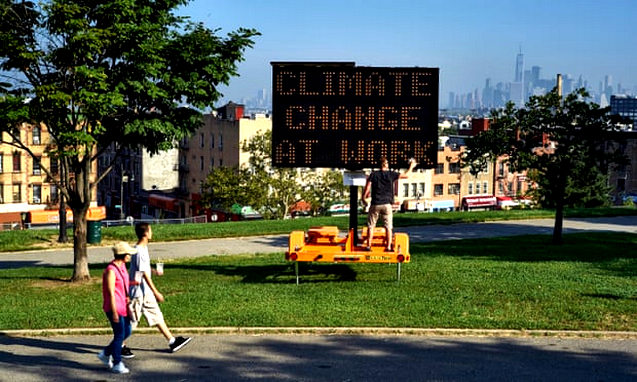
The 10 large solar-powered signs have been placed in locations in each of New York’s five boroughs, including areas deemed particularly vulnerable to the sea level rise and powerful storms associated with climate change, including the Rockaways in Queens and the west side of Manhattan.
Messages such as “Climate change at work” and “Climate denial kills” will be displayed in English, as well as in languages commonly spoken in the areas they will be deployed, such as Spanish, Russian and French.
The signs are part of a project by the Climate Museum and a host of partners, including the New York City’s mayor’s office. The installation, called Climate Signals, has been done by Justin Brice Guariglia, an artist who regularly focuses on environmental themes in his work.


Photograph: Courtesy of the artist and The Climate Museum 
“These signs sound a warning about the climate crisis and they call us to think and act on the issue,” said Miranda Massie, director of the Climate Museum. “When you see a flashing traffic signal your initial response is that there are uncertain conditions ahead, and that is exactly what climate change is. This is the perfect medium for bringing up this alert.”
Some of the sites will include elements such as voter registration and appearances by climate scientists. Massie said the work is not overtly activist in nature, despite the unfolding agenda of Donald Trump, a native of Queens, to dismiss the science of climate change and dismantle policies that reduce greenhouse gas emissions.
“Anyone who is aware of the climate crisis is appalled and alarmed by the disgraceful assault by the administration on climate progress,” she said. “But this project isn’t political in a narrow sense, it’s about social and cultural action. We need a social shift to deal with climate change. It shouldn’t be a political lightning rod.”
Daniel Zarrilli, New York City’s chief resilience officer, said: “Climate change is one of New York City’s greatest challenges and requires creative approaches to educate and engage all of us about its risks and solutions. Art can play a valuable role in this effort.”

Links

Global Warming Tops The Agenda As Climate Brings Down A Third Australian Prime Minister

Nature - Editorial

Malcolm Turnbull is merely the latest leader to discover that action on emissions remains a difficult step to take. 
Australia is suffering drought and politicians who struggle to tackle climate change. Credit: Brook Mitchell/Getty
Australia has two pressing environmental problems: climate change and finding a leader who can tackle it. Large swathes of the country are suffering the effects of a seven-year drought, the bush fire season has hit those parts two months early, and the destruction of the Great Barrier Reef grows more severe each year. Yet late last month, the country’s attempts to make some modest changes to its energy policy to help reduce greenhouse-gas emissions blew up an internal storm in the ruling Liberal party that cost Prime Minister Malcolm Turnbull his job.
To lose one prime minister to political fights about climate-change policy is unfortunate. Two would be careless, but Turnbull is actually the third Australian premier to fall in this way in under a decade. What is going on? And what does this turmoil say about attempts to rein in damaging carbon emissions elsewhere?
All politics is local, and Australian climate politics more so than most. Although Australian scientists are world leaders in several areas of climate science, including atmospheric monitoring of the Southern Hemisphere and understanding the causes of sea-level rise, the nation remains heavily reliant on coal for jobs and electricity. It mines more than half a billion tonnes of the stuff each year, and sells almost three-quarters of that abroad. The rest is burnt in Australian power stations, with electricity generation accounting for around one-third of the nation’s greenhouse-gas emissions.
It’s no coincidence that when Turnbull’s political colleague (and then-treasurer) Scott Morrison wanted to criticize environmentalists last year, he brought a lump of coal to parliament and spoke about it in glowing terms. Last week — after Turnbull confirmed he was quitting politics — his son complained about the “undue level of influence” of the coal lobby. Morrison, who replaced Turnbull as prime minister, has yet to announce the fate of the disputed policy, the National Energy Guarantee, which would force emissions generators to show they are meeting annual standards. He has at least said that the country will not withdraw from the Paris climate agreement, a move being pushed by some government members.
He should stand firm. Although the Paris agreement is weak compared with the scale of what is needed, it represents a political triumph and one that places so few binding demands on nations that any withdrawal would be little more than crowd-pleasing theatrics. And most of the crowd won’t be pleased: a June poll showed that 59% of Australians saw climate change as a pressing threat and one that needed action — the highest percentage in a decade.
A larger-scale survey last year of 38 countries showed a similar level of concern. But politicians in many of these places, even those fully behind the need for action on emissions, are also finding it difficult to follow through on pledges. Take Canada, where Justin Trudeau’s government last month announced it was scaling back plans for a carbon tax. Last week, Nicolas Hulot, the French environment minister, resigned, claiming that governments around the world are not taking sufficient steps to tackle green issues such as climate change. And the reckless stance of US President Donald Trump continues to erode climate regulations and embolden climate sceptics. New Zealand, for one, still has ambitions for emissions-reducing laws, but many of the other promises the country made in Paris — including actual cuts to carbon emissions and boosts in foreign aid to help poorer countries adapt — are weakening under political pressure.
Many of those poorer countries are on the front line and will suffer heavily as the weather worsens. So will Australia. Droughts there are projected to increase in length and severity as a result of climate change. Heatwaves, floods and bush fires are also linked to global warming, and are predicted to become more common and more extreme. The country’s island neighbours in the Pacific are likely to be inundated as sea levels rise. As a result, Australia, whose draconian refugee policy is a source of shame to many citizens, is likely to face an increase in climate refugees.
That these topics are now routinely debated amid mounting public concern about global warming is a victory of sorts for scientists, who must continue their efforts to make the case for action, and to research and speak out about the consequences. And although the current political drama in Australia paints a depressing picture, there is a glimmer of hope. A decade after the financial crash wrested away attention and momentum, climate change is once again at the top of the political agenda.
Things can change quickly in politics, and Australia has a chance to force that change. Already the opposition Labor party has promised a new emissions-reduction scheme. And next year, the country will again vote on its leader. For whoever wins that election, curbing climate change should be at the top of their to-do list — and they must be given the chance to hang around long enough to do so.

Links

Sydney's Marine Life Turning Troppo As Coral, Other Species Head South

Fairfax - Peter Hannam

Tropical corals have been identified off Sydney's northern beaches and are "absolutely proliferating", providing habitat for a range of other species typically found much further north, according to the diver who found them.
Josh Sear, an underwater naturalist and photographer, has watched branching corals - whose scientific name is Pocillopora aliciae - gain purchase on large sandstone boulders in the Cabbage Tree Bay area near Manly in the past couple of years.
Newcomers: A headband damselfish swims amid a hard coral species now found off waters near Sydney. Photo: John Sear
Initially in waters of about 13-15 metres depth, the corals have spread to the nearby popular Shelly Beach region and are found at depths of about three metres.
Remarkably, the corals are already providing habitat for a range of tropical fish and crab species not normally found this far south.
"Every year there are new ones coming down," Mr Sear said. "These are way out of their normal range."
Species are shifting globally as temperatures rise with climate change.
Corals in Japan, for instance, have been moving poleward at the rate of 14 kilometres a year. In Australia, it is the strengthening and warming East Australian Current driving species southwards along the east coast.
Coral coloniser: The Pocillopora aliciae species of coral is now proliferating off the coast near Manly. Photo: John Sear
David Booth, a marine ecologist at the University of Technology Sydney, said the corals being found off Manly had previously been recorded off Port Stephens about 120 kilometres to the north.
"As far as we are aware, this is the furthest south of any tropical coral recorded," Professor Booth wrote in a paper published last month in the Coral Reefs journal.
"There's a thermal niche that didn't exist before," he told Fairfax Media.
A trapezia crab, which typically spends its whole life within the Pocillopora species of coral, has also been found in waters off Sydney. Photo: John Sear
Corals "are the start" for species migrating since they provide shelter and food for a range of other creatures such as fish and crabs that are now showing off Sydney, he said.
"It's like new apartment blocks have arrived in town," Professor Booth said.
A mystery about the multi-species migration, though, is "how the heck they got here", he said.

Symbiotic moves
For instance, Mr Sear has identified and photographed a species of goby and shrimp that co-exist in the tropics normally 1000 kilometres to the north.
The shrimp is blind and digs holes for the goby, which in turn protects it.
Even with the symbiotic relationship, it remains unclear how both species so quickly arrived this far south, Mr Sears said.
Travelling south: a tropical goby and a shrimp that have a symbiotic relationship can now be found off Sydney’s northern beaches. Photo: John Sear
Professor Booth said the key may be the increasing ability of coral larvae and other species to survive through winters as waters warm.So far, there is little sign that the newcomers have dislodged other species in the Sydney areas at least, although it has happened elsewhere along the east coast.
"The big boulders of sandstone are just perfect for corals," Professor Booth said, noting the area is known locally as "the Barrens". They're "not so barren now", he said.
The Cabbage Tree Bay area is a protected zone, and earmarked to form part of the NSW government's proposed marine park for the Sydney region.
A damselfish swims near corals off Manly, on Sydney's northern beaches. Photo: John Sear
Reef stresses
Tropical species may be expanding their range with warmer waters but the same force - climate change - is also playing havoc where sea temperatures rise too high.
A paper out on Wednesday in Nature Communications found the mass bleaching that killed about half of the Great Barrier Reef's corals over two consecutive summers did not spare deeper reefs either.
The researchers, including Ove Hoegh-Guldberg and other Australian-based scientists, found a summer upwelling of cooler water had provided "thermal relief" for corals in 2016.
That upwelling, however, subsided, leading to severe bleaching of 40 per cent of the deep reefs and about 6 per cent mortality, the paper found.
While much less than the death rates of shallow-reef corals, the delayed impacts of the bleaching may have triggered more mortality after the surveys were done.
The researchers noted deeper corals could provide a source of larvae that can help the recovery of harder-hit shallow reefs. However, that aid would be limited since the deeper reefs are home to a relatively small proportion of species compared with those closer to the surface.

Links

04/09/2018

'Lip Service': Call For Investors To Step Up Action On Climate Risk

Fairfax - Ruth Williams

Investors have been urged to “step up the pressure” on companies to act on climate change as annual meeting season approaches, with a report arguing corporate Australia is paying lip-service to the issue.
Environmental non-profit Market Forces says many of Australia’s 100 biggest listed companies are continuing to take a "superficial" approach to disclosure and action on climate change and emissions, despite warnings by regulators and lawyers of potential business and legal risks.
Almost 40 per cent of companies examined had increased emissions over the past year, Market Forces said. Photo: Bloomberg

Market Forces research, to be released on Tuesday, suggests that of 74 ASX100 companies in sectors dubbed “high risk” for climate change impacts - as defined last year by a G20-led task force on climate risk disclosure - only 55 per cent identified climate change as a material business risk, and more than 80 per cent did not have a plan to reduce their own emissions.
Almost 40 per cent of ASX100 companies studied had increased their emissions over the past year, the Market Forces research said.
The NGO - which is affiliated with Friends of the Earth - has urged investors to “escalate” climate change as an issue in their discussions with companies, and divest shaes in companies that are “unable or unwilling” to align with the goals of the 2015 Paris climate agreement.
“There is a growing recognition of climate risk, but few companies are actually undertaking the hard yards to fully address the issue,” Market Forces analyst Will van de Pol said.
The Market Forces research comes as the new Morrison government grapples with internal divisions on its approach to climate change, emissions and the Paris agreement. New Defence Minister Marise Payne is attending the Pacific Islands Forum this week where climate change is expected to be a major topic of discussion.
Prime Minister Scott Morrison (right) and deputy Josh Frydenberg have grappled with internal divisions on carbon emissions. Photo: Mark Graham/Bloomberg
It also comes as regulators consider how climate change may impact the financial system, with the Australian Securities and Investments Commission (ASIC) assessing how ASX300 companies disclose climate change risks, and the Council of Financial Regulators - which includes ASIC, the Australian Prudential Regulation Authority (APRA), the Reserve Bank and federal Treasury - creating a working group on the issue.
ASIC has said company directors should take seriously warnings that they risk future legal action if they fail to consider risks related to climate change.

Risky business
A third of companies studied “explicitly encourage” emissions reductions through their executive or director bonus schemes, Market Forces said, a number that had doubled since Market Forces’ last examined the issue in March.
But just three companies – South32, AGL and Stockland – had started reporting climate risks in line with the so-called "TCFD" rules nailed down by the G20's task force last year, which have been endorsed by major companies and investors.
Another four companies - Commonwealth Bank, BHP, Westpac and ANZ - “came close” to fully adopting the TCFD recommendations, Market Forces said, while others had promised to do so for their 2019 reporting.
The TCFD recommendations are anchored on the Paris agreement's pledge to keep global warming to well below 2 degrees. In July, the Australian Securities Exchange's corporate governance council - in proposed new guidelines - said companies should boost their disclosure of climate change risk, including reporting with the TCFD rules if they had "material exposure".
The Market Forces research found that while 65 per cent of companies studied unequivocally accepted climate science, 27 per cent were unclear in their language and 8 per cent had not formally acknowledged the science of climate change.
In June, research from the Australian Council of Superannuation Investors found that 22 ASX200 companies had adopted or promised to adopt the TCFD rules while 10 more were "reviewing" them.

AGM focus
Mr van de Pol pointed to South32 as a company that was "getting it right, coupling detailed climate risk disclosures with action to reduce exposure".
But he questioned why ASX Ltd was not following the suggestions of its own corporate governance council in not disclosing detailed climate risk information, saying the listed company was exposed to climate risk because "high risk-exposed mining, materials and big financial companies dominate the ASX".
ASX Ltd said it was "difficult to conclude" the company had a material exposure to listed companies directly at risk to climate change, given ASX Ltd was a "diverse, service-based organisation". The technology sector was its fastest growing sector, it said.
It would comply with the corporate governance council's recommendations on an "if not why not" basis once they were finalised, ASX Ltd said.
Whitehaven Coal was among the lowest-scoring companies in the Market Forces research, which found that the coal miner - a vocal proponent of "High Energy Low Emission" (HELE) coal fired-power stations - had not disclosed any risks it may face from climate change or listed it as a material business risk.
Market Forces has launched shareholder resolutions against Whitehaven Coal ahead of its AGM in October, calling on the company to ensure its strategy was “consistent” with the Paris agreement. The vote would be a "litmus test" on investors' willingness to push companies on climate, Market Forces said.
Whitehaven has said it will recommend shareholders vote against the resolutions. "We are not going to pre-empt the proceedings of the AGM," a Whitehaven spokesman said when asked for comment. "We will recommend shareholders not support resolutions requisitioned by shareholders representing 0.0016 per cent of the company’s shares on issue for the sole purpose of supporting Market Forces’ ongoing anti fossil fuels campaign."
It did not comment on Market Forces' research.
In the past two years, Market Forces has coordinated a series of shareholder resolutions pushing companies including QBE, Santos and Oil Search to disclose more about climate risks. None of the resolutions have been successful, but they have won the backing of some major investors, with the QBE resolution in May attracting more than 18 per cent support.
The step up in the number of such agenda items, from Market Forces and others, has met with frustration from some boards and the body representing investor relations professionals, partly due to the time and resources they say it takes for companies to deal with them. Companies targeted have urged shareholders not to vote for them.

Links

Lethal Heating is a citizens' initiative