Monday, October 08, 2018

Coal Must Go To Save Great Barrier Reef, IPCC Says In Dire Climate Warning

ABC Science - Michael Slezak | Nick Kilvert

Key points
  • Greenhouse gas pollution must reach zero by about 2050 to stop global warming at 1.5 degrees Celsius, a report by the UN climate body warns
  • A 1.5C coral reefs are expected to decline by a further 70 to 90 per cent, the report says
  • Experts say coal power needs to drop to between 0 and 2 per cent of existing usage 
Australia and the rest of the world must virtually eliminate the use of coal for electricity within 22 years if there is to be a chance to save even some of the Great Barrier Reef, the world's most authoritative climate science body has warned.
In a report authored by more than 90 scientists, and pulling together thousands of pieces of climate research, the UN's Intergovernmental Panel on Climate Change (IPCC) said global emissions of greenhouse gas pollution must reach zero by about 2050 in order to stop global warming at 1.5 degrees Celsius.
At current rates, they said 1.5C would be breached as early as 2040, and 2C would be breached in the 2060s.
If that happens, temperatures over many land regions would increase by double that amount. And at 2C of warming, experts said the world would risk hitting "tipping points", setting the world to uncontrollable temperatures.
With the world already 1C warmer than pre-industrial times, experts said this report, released by the IPCC in Incheon, Korea, was likely the last warning before it would be impossible to keep warming at 1.5C.
"We're not on track, we're currently heading for about 3 degrees to 4 degrees of warming by 2100," report contributor Professor Mark Howden from ANU said.
"To limit temperature change to 1.5 degrees we have to strongly reduce carbon dioxide emissions. They have to decline about 45 per cent by 2030 and they have to reach zero by 2050.
"On a global basis, coal will have to drop between 0 and 2 per cent of existing usage."
Coral reefs are expected to decline by a further 70 to 90 per cent under 1.5C, but that rises to more than 99 per cent reef loss as temperature rises hit 2C.
In Australia, that means the vast majority of the Great Barrier Reef will undergo significant upheaval or collapse.
Combined with increased ocean acidification due to higher carbon dioxide concentrations, this is expected to heavily affect fish stocks and diversity.
A rise of 2C would mean three times as much of the earth's terrestrial ecosystems would undergo transformations compared to a rise of 1.5C, significantly increasing species extinctions.
Modern humans have never seen an ice-free Arctic, but at 2C that would happen once a decade, compared to once a century at 1.5C.
A 2C rise would mean an extra 10 centimetres of sea-level rise by the end of the century, affecting an extra 10 million people. And it would double the number of people experiencing water scarcity.
And we would be hit with more extreme hot weather events in every part of the world, more floods in most, and more drought in some.
Those extreme events would be "far worse" as temperature increases go beyond 1.5C, according to Will Steffen from ANU's Climate Change Institute.
"Loss of the Amazon forests, melting of the permafrost, loss of ice in West Antarctic and Greenland, they are much riskier at 2 degrees than they are at 1.5," Professor Steffen said.
"They could lead to a tipping cascade where the system will get hotter and hotter even if we bring our emissions down."

Coal use needs to drop to '0 to 2 per cent': expert
In 2015, almost every country agreed to stop global warming at "well below" 2C under the Paris Agreement, and to try to limit it to just 1.5C.
But 1.5C is a global average, which is dampened by ocean temperatures and doesn't represent regional extremes, according to report contributor Jatin Kala from Murdoch University.
"Even some world leaders seem to think that 1.5 degrees is a small number, why do we care?" Dr Kala said.
"Warming over the land is at a higher level of magnitude. We care because when the global average is 1.5 degrees warmer, that means that several regions of the world are warming at much higher magnitudes — they'll be a lot warmer than 1.5."
To limit warming to 1.5C, there needed to be "deep changes in all aspects of society", according to Professor Howden.
"It does actually require major transformations in many aspects of society and to do those transitions, the next 10 years is critical," Professor Howden said.
"Electricity will have to be supplied by renewables on a global basis by the tune of about 70 to 85 per cent of electricity supply.
"Coal would have to drop to within 0 and 2 per cent of existing usage, and gas down to about 8 per cent of existing usage, and only if there was carbon dioxide capture and storage associated."
Although renewables like solar and wind are rapidly disrupting energy systems around the world, freight, aviation, shipping and industry are lagging behind in emissions reduction.
LNG processing is contributing significant greenhouse gas emissions and carbon sequestration is "virtually not happening", according to contributor Peter Newman from Curtin University.
But Professor Newman said there was some movement in the right direction.
"Electric vehicles are rapidly happening around the world," he said.
"[In Australia], the industrial systems are not good, but the land systems however are a good sign. There has been significant reforesting of the landscape."

'No easy way' to avoid reaching tipping point
There is a limit to the amount of carbon we can pump into the atmosphere, after which point restricting the temperature rise to 1.5C becomes impossible.
Researchers say at current emissions rates the world will hit that point between 10 and 14 years from now. Overshooting that mark means that our only option may be to employ "experimental and untested" carbon removal technologies.
These technologies are yet to be proven at scale, and critics say they have been used to fuel "magical thinking".
"There isn't an easy way to do this," said Associate Professor Bronwyn Hayward from the University of Canterbury.
"If we don't make these really difficult, unprecedented cuts now, there's fewer options for sustainable development. We'll be forced to rely more on these unproven, risky and potentially socially undesirable forms of carbon removal."
Minister for the Environment Melissa Price released a statement in response to the report, in which she said the Government was "particularly concerned" about the implications for coral reefs.
"More than ever this report shows the necessity of the Morrison Government's $444 million investment in the Great Barrier Reef's management," the Minister said.
"While Australia only contributes about 1 per cent of global emissions, we will deliver on our commitment to reduce emissions by 26 to 28 per cent of 2005 levels by 2030."
Labor has vowed to take back the Government's $444 million Great Barrier Reef Foundation funding — which was granted without a competitive tender process and without the foundation asking for it — if it wins the next federal election.
Ms Price's statement also said that Australia's emissions intensity is at its lowest level for 28 years. But according to the Government's own data, Australia's overall emissions have increased for the third year in a row.
The Government was criticised for sitting on that data for nearly two months, before releasing it on a Friday afternoon on the eve of football grand finals and a long weekend.

Links

8 Things You Need To Know About The IPCC 1.5˚C Report

World Resources Institute - 


While all countries committed under the Paris Agreement to limit global temperature rise to 1.5˚C-2˚C (2.7-3.6˚ F), major questions remained: How can the world achieve this temperature goal? And what happens if it doesn’t?
The world’s leading climate scientists, the Intergovernmental Panel on Climate Change (IPCC), answered these questions and more in their latest report released today. Nearly 100 scientists analyzed how the world can achieve the 1.5˚C goal, as well as impacts associated with this rise in temperature.
The world is way off track from its agreed-upon goal of limiting warming to 1.5˚C-2˚C (2.7-3.6˚ F). Photo by Chistopher Michel/Wikimedia Commons
 
Here are eight findings:

1. Limiting warming to 1.5˚C requires major and immediate transformation.
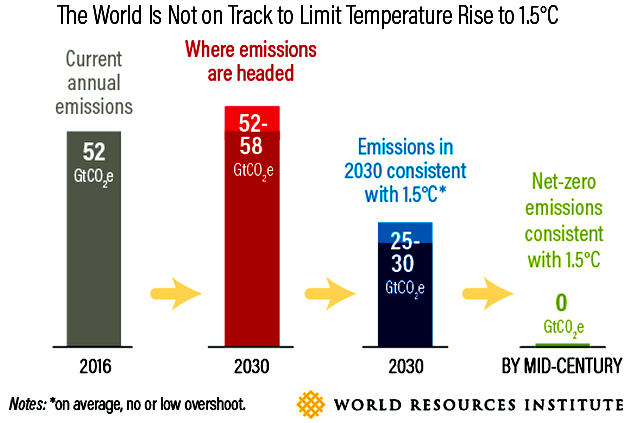
Global emissions were roughly 52 GtCO2e in 2016, and are projected to be 52-58 GtCO2e by 2030. Annual emissions need to be about half that (25-30 GtCO2e/yr on average) by 2030 to limit warming to 1.5˚C (with no or low overshoot). While it’s still technically feasible to avoid a 1.5˚C rise in temperature, behavior and technologies will need to shift across the board in order to achieve these emissions reductions. For example, by 2050, renewables are projected to supply 70-85 percent of electricity in 1.5˚C pathways. Energy efficiency and fuel-switching measures will be critical for the transportation sector.  Reducing energy demand and improving the efficiency of food production, changing dietary choices and reducing food loss and waste also have significant potential to reduce emissions.

The report also highlights how ambitious climate action brings many benefits for shared prosperity and economic stability — more jobs, increased energy access, access to sustainable transportation and health improvements, to name a few. There are also important trade-offs in the case of poorly designed policy.
And while not cited in the IPCC report, new analysis by the New Climate Economy found that bold climate action can deliver $26 trillion in economic benefits through 2030 (compared with business-as-usual) while generating more than 65 million jobs and avoiding more than 700,000 premature deaths from air pollution in 2030.

2. The scale of the required low-carbon transition is unprecedented
While there have been examples of rapid change in specific technologies or sectors in the past, there is no precedent in our documented history for the rate of change at the scale required for limiting warming to 1.5˚C.
In other words, we have never before witnessed such widespread, rapid transitions, and they will need to be made across energy, land, industrial, urban and other systems, as well as across technologies and geographies.
Making this monumental shift will require substantial new investments in low-carbon technologies and efficiency. The report finds that if the 1.5˚C goal is to be met, investments in low-carbon energy technology and energy efficiency will need increase by roughly a factor of five by 2050 compared to 2015 levels.

3. “Limiting warming to 1.5˚C” can mean different things—with different results.
The majority (81 out of 90) of the modeling scenarios for limiting warming to 1.5˚C exceed this temperature threshold before dropping back down.
The results of these scenarios are very different from those that never overshoot 1.5˚C. For example, consider the impacts of warming on a fragile ecosystem: If the 1.5˚C goal is exceeded for many years at a significantly higher temperature, irreversible impacts, such as species extinction, may result even if warming is eventually brought down to 1.5˚C.
The impacts of 1.5˚C of warming will also depend on the chosen emissions-reduction activities. For example, a more rapid reduction of black carbon can help stem the loss of snow and ice in the Arctic.
Furthermore, it is important to note that the 1.5˚C goal is for global average temperature increase. Temperature increase at any one location, as well as its resultant impacts, will vary.

4. A 1.5˚C limit to warming is not safe for all…
The report finds that significant climate impacts already occur at 1.5˚C, especially in regards to low-lying areas, human health and oceans. The impacts will hit the poor and most vulnerable the hardest due to loss of livelihoods, food insecurity, population displacement, health effects and more.

5. …but risks associated with warming are substantially lower at 1.5˚C than 2˚C
Because the Paris Agreement specifies that countries should “limit warming to well below 2˚C, and pursue efforts to limit it to 1.5˚C,” the IPCC report takes stock of how much higher the risks of a 2˚C world are than 1.5˚C.  For example, under 1.5°C of warming, the report finds it is very likely to have one sea-ice-free summer every 100 years; at 2°C, the frequency increases to at least one every 10 years. (Read more in our accompanying blog comparing the impacts of 1.5˚C vs 2˚C.)


6. Emissions will need to reach net-zero around mid-century.
In addition to large emissions cuts in the next decade, net CO2 emissions will on average need to be reduced to zero by mid-century.  If the date of reaching net-zero emissions is brought forward one decade to 2040—fewer than 15 years away—the chance of limiting warming to 1.5˚C is considerably higher. The sooner emissions peak before 2030 and the lower the level at which they do so, the less daunting the challenges will be.
All pollutants leading to climate change must be addressed. The report notes the critical role of short-lived but highly potent climate pollutants, such as methane and hydrofluorocarbons (HFCs). While carbon dioxide dominates long-term warming, reduction of other pollutants can contribute to the 1.5˚C goal in the short term, with substantial co-benefits, such as reducing air pollution.

7. All 1.5˚C emissions pathways rely upon carbon removal to some extent.
The report shows clearly that we will need to focus efforts not only on reducing emissions, but also removing and storing carbon from the atmosphere. Carbon removal is necessary for both moving to net-zero emissions and for producing net-negative emissions to compensate for any overshoot of 1.5˚C. The pathways studied in the report rely on different levels of carbon removal (ranging from 100-1,000 GtCO2 over the 21st century for scenarios with limited or no overshoot), but all rely on it to some extent. The report notes that carbon removal deployed at such a scale is unproven, and is a major risk to our ability to limit warming to 1.5˚C.The report also notes that feasibility and sustainability of carbon removal could be enhanced if a portfolio of carbon-removal approaches is pursued.

8. Everyone – countries, cities, the private sector, individuals — will need to strengthen their action, without delay.
Without transformation in society and rapid implementation of ambitious emissions cuts, limiting warming to 1.5˚C while achieving sustainable development will be exceedingly difficult, if not impossible. Even if countries fulfill their current national climate goals and make deep emissions cuts after 2030, warming would still very likely exceed 1.5˚C given the challenges associated with dropping emissions to net-zero in less than 15 years’ time. Therefore, all countries and non-state actors will need to strengthen their contributions without delay. The COP decision at Paris requested countries to submit a next set of climate commitments by 2020, so this is an important opportunity to take bolder action. At the Global Climate Action Summit last month, leaders from states and regions, cities, businesses and civil society reinforced that messaging, calling on countries to “step up ambition” and commit to strengthening their national climate plans during the UN climate summit this December in Katowice, Poland.

Turning Evidence into Action
There’s no sugarcoating it: Keeping warming to 1.5˚C will be hard. Really hard. But the IPCC report also makes it clear that the world has the scientific understanding, the technological capacity and the financial means to tackle climate change. Now what we need is the political will to precipitate the unprecedented concerted actions necessary to stabilize temperature rise below 1.5 C.
There are substantial economic and development benefits from bold climate action. And even more importantly, limiting global warming to 1.5˚ is imperative. Falling short would lock in climate impacts so catastrophic our world would be unrecognizable. Governments, businesses and others have the clarity they need. Now it’s time for them to step up to the challenge.

Links

Coal Power Finished By 2050 If Temperature Increase Kept To 1.5 Degrees: IPCC

AFR - Ben Potter

The special report by the International Panel on Climate Change lays out a stark challenge to the coal industry if the world is to limit global temperature increases to 1.5 degrees. Fairfax Media
Coal power would have to be eliminated or reduced to negligible levels and agriculture and land use changed dramatically for the world to limit temperature increases to 1.5 degrees Celsius above pre-industrial levels, a landmark report says.
The special report by the International Panel on Climate Change lays out a stark challenge to the coal industry if the world is to limit global temperature increases to 1.5 degrees - the aspirational level that nations agreed to pursue in addition to their individual national targets in the Paris climate agreement.
Australian pure coal exporters such as Whitehaven Coal, Yancoal and New Hope Corporation base their outlooks on International Energy Agency "New Policies" scenarios which allow for modest increases in global coal exports out to 2040, with larger increases in their primary Asian markets.
The Morrison government embraces these projections which make for a bullish outlook for the Australian coal export industry, and has abandoned carbon emissions reduction as a goal of energy policy. Coal companies are enjoying bumper profits and surging share prices off the back of high prices and strong demand from Asia.
Prime Minister Scott Morrison said on Monday that Australia would stick with its primary Paris commitment - to reduce carbon emissions by 26-28 per cent from 2005 levels by 2030 - but would not give any more money to a global climate fund that aims to help the world's poorest countries cope with the effects of climate change.

Pressure mounts
But the government is about to come under increasing international pressure to take more effective action to limit climate change and the IPCC report is a key step leading up to the United Nations climate conference in Poland in December at which Australia and other laggard countries will be pressed to raise the level of their ambition.
The benign scenarios for coal exports that the government and the coal industry prefer are associated with higher temperature increases that scientists say would bring more frequent instances of dangerous heat, droughts, floods and tropical cyclones and irreversible damage to coral reefs such as the Great Barrier Reef.
Forerunners were seen in the northern hemisphere summer with wildfires in the Arctic, Europe and California and near-50 degree temperatures in southern Europe and California.
Extreme weather and coral bleaching would occur more frequently under 2 degrees Celsius of global warming compared to 1.5 degrees Celsius. ACF et al. 
By contrast, the IPCC report says that in order to limit temperature increases to 1.5 degrees - a level scientists say would bring fewer dangerous climate changes and events - "the use of coal shows a steep reduction in all pathways and would be reduced to close to 0% (0-2%) of electricity". It notes this finding is one in which it has "high confidence".
Carbon emissions would need to be reduced by 45 per cent from 2010 levels by 2030 and to around net zero by 2050. These are much more ambitious than the government's target and more in line with the policy federal Labor took to the 2016 election but is yet to confirm as 2019 election policy.

Gas would need CCS
Renewable energy would supply 70-85 per cent of electricity and gas - another strong export industry for Australia - would supply 8 per cent of electricity when coupled with carbon capture and storage (CCS). CCS has been demonstrated technically but its cost is prohibitive and no commercial rollouts on existing thermal power stations have resulted from trials conducted in the US, Canada, Australia and China.
Limiting temeperature increases to 1.5 degrees Celsius will cause less damage to the Great Barrier Reef. Pictured: Green sea turtle (Chelonia mydas) resting on sandy seabed, Great Barrier Reef, UNESCO World Heritage Site, Pacific, Australia Alamy
Agriculture would be challenged by increasing competition for land for biofuels and reafforestation, which would need to be part of the global effort to reduce carbon emissions to net zero by 2050. "Such large transitions pose profound challenges for sustainable management of the various demands on land for human settlements," the IPCC report says.
Transport would have to move from 5 per cent low emissions fuel in 2020 to 35-65 per cent - a particular challenge for Australia which lags other rich countries in electric vehicle takeup.
Limiting temeperature increases to 1.5 degrees Celsius would require much steeper reductions in carbon emissions. Climate Analytics

Links

Sunday, October 07, 2018

Scientists Champion Forests As 'Unsung Hero' Of Climate Action

Reuters - Megan Rowling

BARCELONA - Scientists from around the world called for stepped-up efforts to use forests to keep global warming to the lowest limit agreed by governments in 2015, as a key report on how to meet that goal is finalised in South Korea this week.
“Forests really are the unsung hero of our struggle to address climate change,” said Deborah Lawrence, a University of Virginia professor and one of 40 scientists who backed a statement emphasizing how the Earth’s climate depends on forests.
The natural processes by which forests suck in and store carbon help reduce levels of planet-warming carbon dioxide in the atmosphere - and forests also underpin key parts of the world’s economy, the scientists said.
"Our planet's future climate is inextricably tied to the future of its forests," the international panel said. Credit: Fairfax Media
Yet humans have let forests become degraded, even as the resulting risks of disaster and the costs of repairing the damage rise, they added.
“We must protect and maintain healthy forests to avoid dangerous climate change and to ensure the world’s forests continue to provide services critical for the well-being of the planet and ourselves,” said the statement, signed by researchers mainly from the United States, Brazil and Europe.
“Our planet’s future climate is inextricably tied to the future of its forests,” they concluded.
The flagship report from the Intergovernmental Panel on Climate Change (IPCC), due to be published on Monday, will outline ways of limiting global temperature rise to 1.5 degrees Celsius (2.7 degrees Fahrenheit) compared with pre-industrial times, the most ambitious goal in the Paris climate pact.
One key route is to protect virgin forests, restore those that have suffered logging, fires or other harm, and expand the amount of land covered by trees, the report is expected to say.
In this week’s statement, scientists noted that forests remove about a quarter of the carbon dioxide humans add to the atmosphere, keeping climate change from getting even worse.
Destroying forests not only releases the carbon they contain but also eliminates their ability to take carbon dioxide out of the atmosphere, the statement said.
It noted that the world’s forests contain more carbon than exploitable oil, gas and coal deposits.
But deforestation rates are rising again in most of the tropics, due to expanded production of commodities such as palm oil, beef and grains, said Carlos Nobre, a University of Sao Paulo professor and member of the Brazilian Academy of Sciences.
Forests produce water vapor, boost rainfall and cool down local temperatures by as much as 3 degrees Celsius, Nobre noted.
“This is a critical element for growing food,” he said. “By keeping a wetter climate throughout the year, (forests) also mitigate the impacts of drought and are less vulnerable to fires.”

Diets matter
Scientists and environmental campaigners said policy makers often overlook the importance of forests in regulating the climate, meaning forest protection had received far too little funding.
But as the urgency of curbing rising temperatures increases, that is starting to change, they added, with attention shifting not just to forests but also to how land is deployed to produce crops for food and energy.
“There is a greater recognition in society as a whole that the land-use sector makes a difference - and the way that happens in people’s everyday lives is what they eat,” said Jennifer Morgan, executive director of Greenpeace International.
More people now understand the need to consume less meat and dairy products, she told reporters.
That is one strategy recommended in a separate report to be published in mid-October by the Climate, Land, Ambition and Rights Alliance (CLARA), a coalition of environment and development groups.
Its main findings, released this week, show greater efforts to move to more sustainable food systems, restore forests and secure land rights for local people can help limit global warming to 1.5 degrees Celsius.
The measures proposed - ranging from planting more trees on farms to feeding animals with agricultural leftovers and restoring major areas of forest - would cut emissions by 21 gigatonnes of carbon dioxide-equivalent per year by 2050, or about two-fifths of total greenhouse gas emissions in 2016.
The alliance said that would eliminate the need for largely untested technologies to remove carbon from the atmosphere.
Those methods include growing trees and crops to produce energy and then capturing and storing underground the carbon dioxide they release when harvested, an approach known as BECCS.
Kate Dooley of the University of Melbourne’s Climate and Energy College, and the main author of the CLARA report, said scientific models show BECCS would require a huge amount of land to be effective in meeting temperature limits, which would be “problematic”.
Opponents of BECCS argue it would take away land and water needed to end hunger and meet other global development goals, and could lead to abuses of indigenous land rights, among other risks.
“We can achieve the 1.5C pathways in the IPCC report - the safest pathways - through natural (land) sink enhancement,” Dooley told the Thomson Reuters Foundation.

Links

Earth's Climate Monsters Could Be Unleashed As Temperatures Rise

The Guardian - 

As a UN panel prepares a report on 1.5C global warming, researchers warn of the risks of ignoring ‘feedback’ effects
Fundamental questions are being raised about the ability of governments to stop the Earth from spiralling into a ‘hothouse’. Photograph: Peter van der Sleen/University o/PA 
This week, hundreds of scientists and government officials from more than 190 countries have been buzzing around a convention centre in the South Korean city of Incheon.
They are trying to agree on the first official release of a report – the bit called the Summary for Policymakers – that pulls together all of what’s known about how the world might be affected once global warming gets to 1.5C.
What will happen to coral reefs? How will extreme weather events and droughts change? What about heatwaves? And then, what are the different “pathways” that economies could choose to keep temperatures to 1.5C?
On Monday morning, the summary document is expected to be released, and there will be a cascade of headlines around the world.
The report, being pulled together by the United Nations Intergovernmental Panel on Climate Change, was one tiny part of the Paris climate change agreement.
As things stand, if you add up all the things that the 190-plus countries have committed to do as part of that Paris deal, global temperatures will probably go well above 3C.
We’re already at 1C of warming, so the extra half a degree isn’t far away – many scientists will say it’s already locked in, while others say there are plausible ways to stabilise temperatures at that level.
But in August, one of the world’s leading scientific journals – the Proceedings of the National Academy of Sciences – published a “perspective” article that has become known as the “hothouse earth” paper.
There was no new science in the paper and while it was speculative, it did raise fundamental questions about the ability of governments around the world to stop the Earth from spiralling into a “hothouse”.
I think the dominant linear, deterministic framework for assessing climate change is flawed
Will Steffen
One of the report’s authors, Professor Will Steffen, of Australian National University and the Stockholm Resilience Centre, talked me through it.
The problem lies with “feedbacks” – in the “supplementary information” attached to the paper, Steffen and colleagues actually listed 10 of them. With each, they include estimates of how much extra CO2 and temperature they could add once you hit about 2C of global warming.
For example, the ability of the land and ocean to keep soaking up CO2 could weaken, giving you an extra 0.25C of warming. Dieback of trees in the Amazon and subarctic could give us another 0.1C.
Permafrost, which is already starting to defy its name by not being all that permanent, could release ever more methane and carbon that might add a bit more warming again (0.09C is the estimate there).
The point is that once you add them all up, you get close to 0.5C of warming by the end of the century. Given we’re already at 1C of global warming, that makes the job of keeping warming “well below 2C” or even holding it at 1.5C much, much harder than it already is.
And there’s the rub.
While governments have the means to affect how much CO2 gets released through policies that radically cut the use of fossil fuels, it would be much harder to get a grip on thawing permafrosts, mass forest collapses or the loss of polar sea ice.
By failing to get a grip on a thing that’s feasibly under your control, we end up risking the release a whole gang of other monsters that we can’t.
This gets us to another big issue, says Steffen, because climate models don’t include some of these feedbacks. In essence, the warmer things get, the less reliable the models become. He tells me:
“I think the dominant linear, deterministic framework for assessing climate change is flawed, especially at higher levels of temperature rise.
So, yes, model projections using models that don’t include these processes indeed become less useful at higher temperature levels. Or, as my co-author John Schellnhuber says, we are making a big mistake when we think we can “park” the Earth System at any given temperature rise – say 2C – and expect it to stay there.”
For those who understand the idea of a carbon budget – where scientists have calculated how much CO2 you could emit before hitting certain temperature rises – it looks even meaner than before if Steffen and his colleagues are right.
But as they also point out, several of these feedbacks might have “tipping points” that then set off a cascade of other issues. Steffen says:
“Even at the current level of warming of about 1C above pre-industrial, we may have already crossed a tipping point for one of the feedback processes (Arctic summer sea ice), and we see instabilities in others – permafrost melting, Amazon forest dieback, boreal forest dieback and weakening of land and ocean physiological carbon sinks.
And we emphasise that these processes are not linear and often have built-in feedback processes that generate tipping point behaviour. For example, for melting permafrost, the chemical process that decomposes the peat generates heat itself, which leads to further melting and so on.”
For the record, Steffen thinks the assumptions in climate models that cuts in fossil fuel emissions will deliver relative cuts in temperatures “is OK for perhaps lower temperature rises of 1.5 or 2C” but beyond that, he’s sceptical.
The paper has received a bit of pushback from scientists, largely, it appears, because of the sensational headlines it attracted.
For example, Professor Richard Betts, of the UK’s MetOffice, has a measured perspective that’s well worth a look.
Dr Glen Peters, an Australian scientist and climate modeller based at the Centre for International Climate Research in Norway, also thought some of the media coverage went too far with the doomsday vibe.
But he told me that while it was true that many of the feedbacks in the paper were not well covered by climate models, this was partly because they were not that well understood. I’ll leave you with his thoughts:
“The hothouse earth paper conjectures that many of these feedbacks may interact like a domino effect, lead the Earth system to spiral out of control to reach a new steady state very different from today, and these processes may even start if we are successful at meeting the goals of the Paris Agreement.
“There is also an important timescale question, are we talking decades or millennia, and that is very important for how society may respond. While all the claims made in the hothouse earth paper are justified, we simply don’t have the data to verify if those claims are true. While the paper put in plenty of language to indicate its exploratory nature … many headlines and statements went too far, indicating we had already gone too far and there was no turning back.”
Links

From London To Shanghai, World's Sinking Cities Face Devastating Floods

The Guardian - 

Threat to major population centres is increasing as planners fail to prepare for impacts of global warming, report says
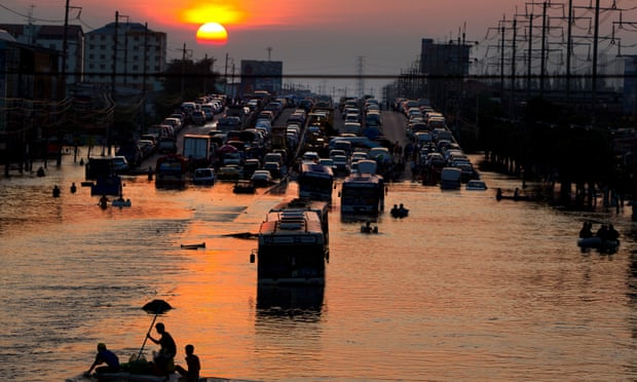
Flood victims in Bangkok, Thailand, in 2011. Like many other major cities across the globe, Bangkok is sinking – which puts it at increasing danger from sea level rises. Photograph: Paula Bronstein/Getty Images
London, Jakarta, Shanghai and Houston and other global cities that are already sinking will become increasingly vulnerable to storms and flooding as a result of global warming, campaigners have warned ahead of a landmark new report on climate science.
The threat to cities from sea level rises is increasing because city planners are failing to prepare, the charity Christian Aid said in the report. Some big cities are already subsiding – the ground beneath Shanghai, for instance, is being pressed down by the sheer weight of the buildings above – and rising sea levels resulting from global warming will make the effects worse.
The cities named in the report are sinking for a variety of reasons. Jakarta is thought to be subsiding by 25cm a year largely because of groundwater extraction, and Houston is sinking as the oil wells beneath it are depleted. Bangkok’s skyscrapers are weighing it down, while London is slowly sinking for geological reasons: Scotland is slowly rebounding after having been weighed down by glaciers during the last ice age, which is pushing southern England downwards like a see-saw.
The warning comes as the world’s leading climate scientists meet this week in South Korea to finalise a comprehensive study setting out whether and how the world can avoid temperature rises of 1.5C above pre-industrial levels. The Intergovernmental Panel on Climate Change (IPCC), the body of scientists convened by the UN, has been asked to examine the consequences of such a rise and assess what progress can be made to limit greenhouse gas emissions.
The world has already warmed by roughly 1C from pre-industrial levels, and sea levels could rise by 40cm if that increases to 1.5C, previous science from the IPCC has suggested. Sharp brakes on greenhouse gas production are expected to be needed to halt the rise.
Under the 2015 Paris agreement on climate change, governments pledged to hold warming to no more than 2C, with an aspiration not to surpass 1.5C, based on previous IPCC advice. The new IPCC report, to be published on Monday, is expected to show that remaining within the 1.5C limit is still possible but only with strong action to reduce carbon in the atmosphere.
Christian Aid, one of many organisations publishing studies to coincide with the IPCC’s judgment, looked at the consequences of a 1.5C rise for a selection of eight major cities around the world. The report concludes that poor development choices are exacerbating cities’ vulnerability to weather shocks.
Kat Kramer of Christian Aid, who wrote the report, said: “These global metropolises may look strong and stable, but it is a mirage. As sea levels rise, they are increasingly under threat and under water.”
Dozens of the world’s biggest cities are built in coastal areas and near major rivers, making them vulnerable not just to sea level rises but also to storm surges, which can send high seas inland and past maritime defences. The UK and the Netherlands experienced such a storm in 1953, when high tides and a storm surge inundated coastal regions. If similar weather were to strike today, the damage could be much greater despite sea defences, because of rising sea levels and the increased severity of storms that is likely to result from climate change.

Links

Saturday, October 06, 2018

Climate Scientists Are Struggling To Find The Right Words For Very Bad News

Washington Post - Chris Mooney | Brady Dennis

A much-awaited report from the U.N.'s top climate science panel will show an enormous gap between where we are and where we need to be to prevent dangerous levels of warming.
Higher ocean temperatures are responsible for coral bleaching at the Great Barrier Reef. Credit: Jason South
In Incheon, South Korea, this week, representatives of more than 130 countries and about 50 scientists have packed into a large conference centre going over every line of an all-important report: what chance does the planet have of keeping climate change to a moderate, controllable level?
When they can't agree, they form "contact groups" outside the hall, trying to strike an agreement and move the process along. They are trying to reach consensus on what it would mean - and what it would take - to limit the warming of the planet to just 1.5 degrees Celsius, when 1 degree  has already occurred and greenhouse gas emissions remain at record highs.
"It's the biggest peer-review exercise there is," says Jonathan Lynn, head of communications for the United Nations' Intergovernmental Panel on Climate Change. "It involves hundreds or even thousands of people looking at it."


This climate visualization shows the temperature anomalies by country from 1880 through 2017, based on data from NASA.

The IPCC, the world’s definitive scientific body when it comes to climate change, was awarded the Nobel Peace Prize a decade ago and has been given what may rank as its hardest task yet.
It must not only tell governments what we know about climate change — but how close they have brought us to the edge. And by implication, how much those governments are failing to live up to their goals for the planet, set in the 2015 Paris climate agreement.
1.5 degrees is the most stringent and ambitious goal in that agreement, originally put there at the behest of small island nations and other highly vulnerable countries. But it is increasingly being regarded by all as a key guardrail, as severe climate change effects have been felt in just the past five years — raising concerns about what a little bit more warming would bring.
Delegates and experts attend the opening ceremony of the 48th session of the Intergovernmental Panel on Climate Change in Incheon, South Korea, on Oct. 1, 2018. (Jung Yeon-je/AFP/Getty Images) (Jung Yeon-Je/AFP/Getty Images)
“Half a degree doesn’t sound like much til you put it in the right context,” said Durwood Zaelke, president of the Institute for Governance and Sustainable Development. “It’s 50 percent more than we have now.”
The idea of letting warming approach 2 degrees Celsius increasingly seems disastrous in this context.
Parts of the planet, like the Arctic, have already warmed beyond 1.5 degrees and are seeing alarming changes. Antarctica and Greenland, containing many feet of sea-level rise, are wobbling. Major die-offs have hit coral reefs around the globe, suggesting an irreplaceable planetary feature could soon be lost.
It is universally recognized that the pledges made in Paris would lead to a warming far beyond 1.5 degrees — more like 2.5 or 3 degrees Celsius, or even more. And that was before the United States, the world’s second-largest emitter, decided to try to back out.
“The pledges countries made during the Paris climate accord don’t get us anywhere close to what we have to do,” said Drew Shindell, a climate expert at Duke University and one of the authors of the IPCC report. “They haven’t really followed through with actions to reduce their emissions in any way commensurate with what they profess to be aiming for.”
The new 1.5 C report will feed into a process called the “Talanoa Dialogue,” in which parties to the Paris agreement begin to consider the large gap between what they say they want to achieve and what they are actually doing. The dialogue will unfold in December at an annual United Nations climate meeting in Katowice, Poland.
But it is unclear what concrete commitments may result.
At issue is what scientists call the ‘carbon budget’: Because carbon dioxide lives in the atmosphere for so long, there’s only a limited amount that can be emitted before it becomes impossible to avoid a given temperature, like 1.5 degrees Celsius. And since the world emits about 41 billion tons of carbon dioxide per year, if the remaining budget is 410 billion tons (for example), then scientists can say we have 10 years until the budget is gone and 1.5 C is locked in.
Unless emissions start to decline — which gives more time. This is why scenarios for holding warming to 1.5 degrees C require rapid and deep changes to how we get energy.

An iceberg melts in Kulusuk, Greenland, near the Arctic Circle. Parts of the planet, like the Arctic, have already warmed beyond 1.5 degrees. Credit: AP
The window may now be as narrow as around 15 years of current emissions, but since we don’t know for sure, according to the researchers, that really depends on how much of a margin of error we’re willing to give ourselves.
And if we can’t cut other gases — such as methane — or if the Arctic permafrost starts emitting large volumes of additional gases, then the budget gets even narrower.
“It would be an enormous challenge to keep warming below a threshold” of 1.5 degrees Celsius, said Shindell, bluntly. “This would be a really enormous lift.”
So enormous, he said, that it would require a monumental shift toward decarbonization. By 2030 — barely a decade away — the world’s emissions would need to drop by about 40 percent. By the middle of the century, societies would need to have zero net emissions. What might that look like? In part, it would include things such as no more gas-powered vehicles, a phaseout of coal-fired power plants and airplanes running on biofuels, he said.
“It’s a drastic change,” he said. “These are huge, huge shifts … This would really be an unprecedented rate and magnitude of change.”
And that’s just the point — 1.5 degrees is still possible, but only if the world goes through a staggering transformation.
An early draft (leaked and published by the website Climate Home News) suggests that future scenarios of a 1.5 C warming limit would require the massive deployment of technologies to remove carbon dioxide from the air and bury it below the ground. Such technologies do not exist at anything close to the scale that would be required.
“There are now very small number of pathways [to 1.5C] that don’t involve carbon removal,” said Jim Skea, chair of the IPCC’s Working Group III and a professor at Imperial College London.
It’s not clear how scientists can best give the world’s governments this message — or to what extent governments are up for hearing it.
An early leaked draft of the report said there was a “very high risk” that the world would warm more than 1.5 degrees. But a later draft, also leaked to Climate Home News, appeared to back off, instead saying that “there is no simple answer to the question of whether it is feasible to limit warming to 1.5 C . . . feasibility has multiple dimensions that need to be considered simultaneously and systematically."
None of this language is final. That’s what this week in Incheon — intended to get the report ready for an official release on Monday — is all about.
“I think many people would be happy if we were further along than we are,” the IPCC’s Lynn said Wednesday morning in Incheon. “But in all the approval sessions that I’ve seen, I’ve seen five of them now, that has always been the case. It sort of gets there in the end.”

Links

Lethal Heating is a citizens' initiative