Fairfax - Peter Hannam
In the not so far-off future, if your home is flooded by extreme rain
or razed by an unseasonable bushfire, the first people to turn up on
your property after the emergency crews could be bearing legal
documents.
In Australia and around the world, crack teams of
lawyers and eminent law schools are systematically exploring available
legal options to sue for climate justice - or seeking to create new ones
where they don't exist.
 |
| Chasing firefighters: How long before legal action takes the lead on climate action?Credit:QFES Media |
"The
truth is there's a huge number of people about to litigate," said
Martijn Wilder, a partner at Baker McKenzie and an author featured in a
special issue of
The Australian Law Journal devoted to climate change and the law. "What we see all of a sudden is that people are realising litigation is a new weapon."
Describing
the need to curb greenhouse gas emissions as "an existential battle",
Wilder predicts people will be able to sue for the impacts of climate
change and have a good chance of winning. "No doubt it's going to happen
- it's inevitable," he says. "Governments have a duty of care, they
have a responsibility."
Climate summit starts
Evidence of that care will be on
display over the next couple of weeks from Sunday as delegates from the
almost 200 nations that signed the 2015 Paris climate accord
gather for a UN summit in the Polish city of Katowice.
Australia
will be led by Environment Minister Melissa Price, who on Friday
released the latest emissions figures showing carbon pollution continues
to climb,
reaching seven-year highs for the end of the financial year.
Australian emissions by quarter, 2008 to 2018
 |
| Source: Department of the Environment and Energy |
The meeting also comes days after the World Meteorological Organisation released
its state of the global climate report
warning the planet was on an emissions trajectory that would lift
temperatures as much as five degrees by 2100 versus pre-industrial
times.
The year 2018 is likely to be the fourth warmest on record - trailing only the previous trio of years.
Among
the key topics of the talks will be settling on the agreed rules for
the greenhouse gas cuts promised at Paris ahead of the agreement coming
into force in 2020.
"I'm
not expecting a train wreck at all but a lot has to be done in little
time," Bill Hare, director of tracking group Climate Analytics, tells
Fairfax Media from Katowice.
Also of interest will be whether
countries that can claim credits for exceeding their pledges during the
previous accord, the Kyoto Protocol, can use them to count for the Paris
pact that runs to 2030. Australia is one of them.
But besides the bickering over national pledges, businesses, academics and activists will be
busy examining the fast developing field of climate law.
"It'll
feature in the backrooms and the siderooms, for sure," Hare says. "We
certainly see more and more companies engaging with this issue."
One thousand cases
And no wonder.
A
flurry of legal action
is under way in a host of nations, particularly the litigious United
States. The UK's Grantham Research Institute on Climate Change and the
Environment at the London School of Economics estimates as many as
1000 climate court cases have been tried or are under way.
The
Paris Agreement itself has spawned 139 framework laws addressing
mitigation (cutting emissions) and adaptation - dealing with the
consequences of the climate disruptions experienced and expected in a
warmer world.
But perhaps wary of nations keeping their promises -
the Paris targets were deliberately non-binding legally to ensure
almost all nations signed up - leading legal minds have been busy
formulating an alternative use of law.
“In
some ways, climate litigation is born out of a certain despair with the
current political process," says Matthew Rimmer, professor of
intellectual property and innovation at Queensland University of
Technology, adding there has been a "great explosion of different
forms".
Rimmer reels off a list of legal avenues from tort, such
as public nuisance and negligence, to public trust and consumer and
corporations law. He likens the process of probing to the advance of
Native Title Law in Australia, where the Mabo decision "was one of many
pieces of litigation going on" when it broke though and "was quite
transformative”.
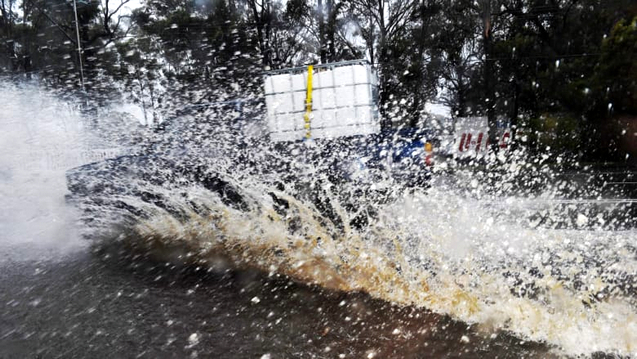 |
| Sydney's 'one-in-a-100 year' rain event this week left a damage bill of at least $10 million. Credit: Nick Moir |
Going Dutch
Brian
Preston, the chief judge of the NSW Land and Environment Court, has
helped lead global efforts to develop legal principles that could lower
the barriers to successful climate litigation with or without a Paris
accord.
He highlights perhaps the most famous climate lawsuit to date -
the 2015 Urgenda Climate Case in
which 886 Dutch citizens sued their government to roughly double
emissions cuts - as revealing the pitfalls and the promise of such
cases.
For one thing, governments will keep appealing, as Dutch authorities
have done again in November.
The fact most environmental law is based in statute now, such as
protecting clean air and clean water, also limits the roll-out of
similar Urgenda cases in places such as Australia, Preston says.
"That makes it more difficult, like the
Lord of the Rings
- to get one ring that solves it all - because it’s all going to be
statute specific," he says. Australia's lack of bill of rights also
curbs Urgenda's applicability here.
Preston has seen firsthand a
pushback from US lawyers in the past year, in part inspired by the
Trump presidency's backing of the fossil fuel industry, against
development of a "model statute" for the International Bar Association.
That
statute was designed to “find what the barriers are to successful
litigation in various jurisdictions and then lower those barriers, but
that hasn’t yet to come to light” because American lawyers blocked it,
he says.
”They
saw a wave of litigation, and said, 'we don’t want to encourage it',”
he says, adding he was "annoyed" at the intervention after working on
the model for almost three years.
Cautionary tales
Preston says the examples of tobacco and asbestos - where legal
operations were later found to be harmful and subject to damage claims -
offer what should be cautionary tales for fossil fuel firms. “They
keep looking at what is the liability risk today but that’s not what it
should be - it should be the risk in the future."
With
asbestos, the court never proceeded with 100 per cent certainty but
rather probability. Likewise, the fast-developing science of climate
change attribution, which can ascertain the odds of an extreme weather
event happening without human-induced carbon emissions.
"Attribution
science is making more probable that we will have this event,” such as
severe flooding or heatwaves, Preston says. “Therefore, you can get the
link from greenhouse gas emissions to harm here by probabilistic
reasoning."
Emma
Herd, chief executive officer of the Investor Group on Climate Change,
says international pressures are already nudging corporate behaviour, as
the
Task Force on Climate-Related Financial Disclosures.
'Obligations'
Lawsuits at home, such
as against industry super fund REST, are also similarly raising the accountability stakes.
REST is
facing claims it breached its trustee duties by failing to properly
factor climate change-related risks into its investment decisions.
Herd
recalls arguing with one director "with an engineer background" who
defiantly argued that "the climate had always changed" said he "didn't
believe the science".
Despite
personal reservations, however, this director "nevertheless recognised
the company had obligations" to identify its exposure to fossil fuel and
climate risks, and to disclose them, she says.
"There's a clear market demand for increased disclosure," Herd says. "It's happening faster than people anticipated."
Tania
Constable, chief executive of the Minerals Council of Australia, said
her organisation "expects member companies to comply with all disclosure
requirements under Australian law and international law where
applicable".
"Our member companies are not only aware of this issue, but are taking action to mitigate risks," she says.
'Chill factor'
Jacqueline
Peel, a professor of environmental law at Melbourne University, says
"eventually governments will realise the policies they have in place are
anachronistic compared to where companies are".
Barriers to
Australian climate action include the fact that, unlike in the US,
plaintiffs can be up for the government's legal costs as well as their
own if they lose. “It’s a real chill factor on litigation,” Peel says.
Kelly
O’Shanassy, chief executive of the Australian Conservation Foundation,
knows that issue well, with her organisation slapped with overall costs
of $230,000 for its 2015 failed challenge and appeal against the Adani
coal mine in Queensland. (The mine said this week it would proceed by
self-funding after banks baulked.)
“Even big not-for-profit
organisations like ACF struggle to mount public interest cases as they
often push the boundaries of the financial risk a responsible board can
tolerate," O'Shanassy says.
ACT takes advice
Among
Australian jurisdictions, Victoria has the most detailed climate
change legislation after passing an act last year that locks in a goal
of net zero emissions by 2050 and requires five-yearly reviews of
progress.
The ACT, meanwhile, wants to examine ways it can
lower barriers to climate litigation that could involving the territory
undertaking lawsuits of its own for damages and other remedies. (
See more detail here.)
"I've
asked my department about what options are available," Shane
Rattenbury, climate minister in the Labor-Greens government, says.
He's
particularly angered by the way fossil fuel companies, such as Exxon in
the US, have been revealed to have behaved. "They knew about climate
change all along, they buried the science, they fought hard to prevent
it being released, and they kept selling their health-damaging
products," he says.
Exxon has been involved in a number of legal
actions, including a case brought by New York’s attorney-general in
October, which claims the company defrauded shareholders by downplaying
the risks of climate change to its business,
the New York Times has reported.
Melbourne
University's Peel, meanwhile, says it's notable that a significant
proportion of recent cases has been brought by young people, whether by
children in the US or a law student in New Zealand.
In echoes of
the mass protests of students this week demanding governments lift their
climate game, the actions suggest "they can see pretty clearly that
it’s their future" on the line, she says.
“Litigation has the appeal of action and fighting for their rights," Peel says. "These ideas motivate them a lot.”
Links