The record for the highest overnight minimum temperature has been broken twice in one night.
Weather
stations at Noona, west of Dubbo, and Borrona Downs, west of Bourke,
recorded overnight minimum temperatures of 35.9 degrees and 35.6 degrees
respectively.
The record for hottest overnight temperature was broken overnight. Credit: John Veage
The
NSW stations both broke the record set by a remote South Australian
station almost 40 years ago, Bureau of Meteorology forecaster David
Wilke said on Friday.
"The previous record for highest minimum
temperature is 35.5, set on the 24th of January, 1982, at Arkaroola in
South Australia, and that was equalled in 2003 in a place called
Wittenoon in Western Australia on the 21st of January," he said.
Mr Wilke said that, as well as breaking national records, a number of
stations broke their own records for the hottest overnight
temperatures, including Tibooburra Airport, Cobar Airport and
Coonabarabran Airport.
Minimum overnight temperatures would be
slightly cooler over the next couple of nights, with minimums expected
to hit the low 20s on Saturday, Mr Wilke said.
Overnight temperatures are forecast to stay in the low 20s across most of Sydney, making it hard to sleep. Credit: Christopher Pearce
Thanks
to a trough moving across the state, temperatures in Sydney on Saturday
will drop to 29 degrees in the city and 33 degrees in Penrith - a
change of 13 degrees from Friday's forecast high of 45 in the west, he
said.
However, Mr Wilke said the trough was not bringing a strong change, so temperatures would climb again into next week.
"The main problem is we don’t see the humidity really clearing out significantly," he said.
"We’ll
see this relief from the heat in the next couple of days, particularly
for the south-east, but the heat will continue building next week."
Fire ban, severe fire warning issued
The
heat, combined with strong north-easterly winds on Friday have prompted
the bureau to issue a fire weather warning for parts of the state on
Friday.
The Rural Fire Service has also issued total fire bans for 13 areas.
Severe
fire danger was forecast for the Southern Ranges and Southern Slopes
regions, and a very high fire danger for areas around Canberra and the
Illawarra and Shoalhaven areas.
The total fire bans were in places including the Illawarra and Shoalhaven, the greater Hunter area, and areas around Canberra.
The prime minister says Australia's emissions reduction targets will stay the same, despite criticism from Fiji about the need for a rapid shift to clean energy sources.
Prime Minister Scott Morrison and assistant Minister for International
Development and the Pacific Anne Ruston in Suva, Fiji. Source: AAP
Scott Morrison is sticking with Australia's climate change targets
despite strong criticism from Fiji about the urgent need to move to
clean energy.
The prime minister says Australia's emissions
reduction targets will stay the same, but he did commit to spending
money to help Pacific nations tackle the efforts of climate change.
Fijian
Prime Minister Frank Bainimarama said Australia cannot put the
interests of one industry ahead of the lives of Pacific islanders.
Scott Morrison with former rugby league player Petero Civoniceva and
Executive Chair of Fiji National Rugby League Peni Musunanasi in Suva.
"We have sensible, achievable commitments that will continue to
ensure that Australia has a prosperous economy, and Australians will
have the choices that they want in the future," Mr Morrison said in
response on Friday.
"While at the same time respecting the need to
address the real impacts of climate change, both here in the Pacific
and elsewhere around the world."
Mr Morrison said Australia's emissions reduction targets were discussed in a meeting with Mr Bainimarama on Thursday.
"We
are already pursuing those policies in a way that I believe is
consistent with what the prime minister is expecting of Australia," Mr
Morrison said.
Fiji PM tells Scott Morrison 'Australian coal is killing the pacific'
Opposition Leader Bill Shorten said the coalition government has no climate policy.
"It's
a bit embarrassing that he had to go to Fiji to be told that he's doing
nothing on climate change, when in fact millions of Australians could
have told him that in Australia," Mr Shorten told reporters.
Mr
Morrison also announced funding to support a Fijian team in the NSW
rugby league super premiership, and a preseason NRL game in Fiji in
2021.
Mr Morrison will visit Black Rock on Friday, where Australia is funding an expansion of the military training centre.
The centre will be used to train militaries from around the Pacific islands.
The
announcements are part of a "vuvale" partnership - from the Fijian word
for family - that Mr Morrison and Mr Bainimarama agreed to on Thursday.
Mr
Bainimarama said the relationship had been "rocky" after his 2006
military coup, but the return of free elections in 2014 had led to a
thaw with Australia.
Climate change is "no laughing matter" and poses an "enormous" threat to
Fijians and Pacific Islanders, Fiji's Prime Minister Frank Bainimarama
has warned Australia.
In a speech during his counterpart Scott Morrison's Pacific visit, Mr
Bainimarama called on Australia to put the welfare of Pacific peoples
before the interests of any single industry.
"Here in Fiji, climate change is no laughing matter," he said.
"From
where we are sitting, we cannot imagine how the interests of any single
industry can be placed above the welfare of Pacific peoples —
vulnerable people in the world over."
It is the first time a
political leader has publicly confronted Mr Morrison on the question of
climate change during his Pacific tour.
Key points:
In the same speech, Frank Bainimarama lavished praise on Mr Morrison for his "Pacific step-up"
Scott Morrison has promised Australia will not neglect the Pacific
Fiji and Australia have committed to a "family partnership" in a sign of warming ties
In 2015, then-immigration minister Peter Dutton quipped about the fate of the Pacific Islands in the face of climate change, prompting laughter from then-prime minister Tony Abbott.
"Time doesn't mean anything when you're about to be … you know, have water lapping at your door," Mr Dutton said.
Mr Morrison, then the social services minister, pointed out to both men that a microphone was above them.
In his speech on Thursday, Mr Bainimarama said Fiji and Australia should be "good neighbours" and highlighted the searing temperatures dominating Australian cities this week.
"Prime Minister, I urged your predecessor repeatedly to honour his commitment to clean energy future, the only future that guarantees the survival of your neighbours in the Pacific," he said.
Mr Morrison's predecessor, Malcolm Turnbull, abandoned the emissions reduction target in a bid to stave off a leadership challenge last year.A
vocal proponent of climate change policy who led the UN's Climate
Change Conference in 2017, Mr Bainimarama said the issue "cannot be
written off as a difference of opinion".
"Consensus from the scientific community is clear, and existential threat posed to Pacific Island countries, a certainty."
Australia will not neglect the region: PM
But Mr Bainimarama
also lavished praise on Mr Morrison for his so-called "Pacific step-up",
and said he had "transformed" the Australia-Fiji relationship by
visiting Suva.
"While it was a short flight to Suva, your presence has already taken our relationship a very long way indeed," he said.
Mr Morrison's engagement with the Pacific set a "new precedent" and was "absolutely a step in the right direction", he added.
"When
our nation and our people have been left devastated in the aftermath of
ever-worsening cyclones, Australia has always proven to be a friend we
can count on," Mr Bainimarama said.
No Australian
prime minister has come to Fiji since 2006, and Mr Morrison's trip is
aimed at shoring up Australia's influence in the nation, which has been
courting Chinese investment.
Fiji and Australia yesterday agreed to a host of new initiatives and
committed to a "Vuvale Partnership" (or "family partnership") in a sign
of warming ties.
Both countries have agreed to more regular
ministerial meetings, while Australia has promised to send Border Force
officials to Fiji to offer local guards training.
Australia has
also pledged $84 million for a new partnership with Fiji's University of
the South Pacific, and $17 million to provide 1,000 hours of Australian
television content each year to Pacific broadcasters.
Mr Morrison declared that Australia would make sure it did not neglect the region.
"One
of the risks of close relationships is sometimes they can be taken for
granted, and there are periods in our past where that has been the
case," he said.
"Not now. And not in the future if there's anything my government has to do with it."
Some Australian diplomats were anxious that the stoush over Islamic State extremist Neil Prakash would overshadow the visit.
Fijian
officials were angered when Australia stripped Prakash of his
citizenship, arguing he was instead entitled to Fijian citizenship
through his father.
But Fiji insists Prakash and his family were never registered as citizens, and have made it clear Prakash would not be welcome.
When
questioned, Mr Morrison said Mr Bainimarama had not raised the issue at
all in Thursday's talks — indicating the two men had smoothed over the
issue before sitting down in Suva.
The Australian climate has interceded in national politics more than once.
Malcolm Fraser went to the electorate in 1983 at the height of one of the harshest droughts on record.
Tony Burke, federal Labor's environment spokesman, visited the site of the massive fish kill at Menindee.
Credit: Tony Burke
The
previous year's wheat crop had been the worst in decades for much of
the east coast, while many graziers were forced to destroy livestock
left without feed or water.
Just weeks ahead of the 1983 election,
the Ash Wednesday bushfires killed 75 people in Victoria and South
Australia, destroyed more than 3700 buildings and resulted in the death
of an estimated 340,000 sheep.
The
government could not be blamed but there were some within the Liberal
Party that argued Malcolm Fraser had been blamed for everything –
including the drought.
That was, perhaps, brought home when within
a fortnight of Bob Hawke's victory, record-breaking rains fell across
the parched landscape.
In 1991 the NSW government declared a state of emergency after a 1000km blue-green algal bloom erupted down the Darling River.
The
pictures of the bloom, and the public demand for action they elicited,
forced governments across the Murray-Darling basin to take the first
steps towards better management of our water systems.
The 2007
election was not marred by environmental disaster but climate – and the
Howard government's response to climate change – became a hammer blow
used by Kevin Rudd.
Less
than three years later it was Rudd being hammered. The man who declared
climate change the great moral, social and economic challenge was gone
after he failed rise to the challenge he had identified.
Tony
Abbott and Malcolm Turnbull continued the climate change wars, both
succumbing to wounds inflicted by themselves and others. And when Scott
Morrison replaced Turnbull, the new PM's first visit was to
drought-afflicted Queensland before assembling a "drought summit".
Now 14 weeks out from the expected May federal election, the environment has interceded in the political debate again.
The pictures, video and social media posts of the fish kill around Menindee on the Darling River have been visceral.
Images
of old and angry fishermen and farmers, holding up the rotting
carcasses of Murray cod have been beamed into the nation's lounge rooms
or on to our smart phones.
In
the face of criticism from those fishermen, farmers and locals, the
Morrison government has effectively said "let's hope for rain" and "it's
the drought".
The problem with that argument is that it may very
well be exposed by a South Australian royal commission into the
Murray-Darling and its management.
In less than a fortnight, the royal commission started by then SA Premier Jay Weatherill is due to report.
The evidence to it, particularly about the Murray-Darling Basin Authority, has been compelling.
And the findings may be as politically toxic as those rotting fish in the Darling.
In
his final address, senior counsel assisting the commission Richard
Beasley did not hold back in his criticisms of the MDBA and its
political masters who are scattered across the federal, NSW, Queensland,
SA and Victorian spheres.
Describing issues of "maladministration" and "unlawfulness", Beasley sheeted home blame to those in charge.
"The
implementation of the [Murray-Darling] basin plan has been marred by
maladministration. By that I mean mismanagement by those in charge of
the task in the basin authority, its executives and its board, and the
consequent mismanagement of huge amounts of public funds," he said.
"The
responsibility for that maladministration and mismanagement falls on
both past and current executives of the MDBA and its board."
The
commission heard evidence of how problems setting the amount of water
put aside for the environment started under the Rudd government and have
continued ever since. That includes the past six years of oversight by
the Abbott-Turnbull-Morrison government.
The
coalition, particularly the National Party, was always more interested
in modernising the irrigation systems across the Murray-Darling rather
than buying allocations direct from willing sellers.
A draft
report from the Productivity Commission found the government's preferred
process has been extremely expensive – upgrading irrigation pipes and
drains is twice the cost of buying water on the open market.
While
the PC found the upgrade irrigation system process has "lessened" the
socio-economic costs of directing water to the environment, it too was
just as damning as Beasley to the royal commission.
It noted that
the evidence so far was that while the process had provided "a number of
private benefits for irrigators" this had failed to sustain regional
farming communities.
Like those rotting fish, the PC's final
report is just waiting to go off. Delivered to the government last
month, the report has to be made public soon – almost about the same
time as the royal commission reports to the SA government.
Scott Morrison needs almost everything to go right for him to win this year's election.
There
are those things he can control directly, such as government policy;
there are those things he has to target, such as Bill Shorten and
Labor's overall policy agenda; and then there are those issues that come
from left field.
Scientists
have been warning for decades about the problems facing our most
important inland water system, so it's difficult to claim the events
playing out on the Darling are truly a surprise.
But the footage
of men holding aloft dead Murray cod while surrounded by rotting carp,
yellowbelly and bony bream was not expected. Nor the record temperatures
of recent days which has turned parts of NSW, Victoria and South
Australia into fan-forced ovens.
It may be just another sign of
how the natural environment, if ignored for too long, finds a way to
seep into the national political discourse.
Rising temperatures can be charted back to the late 1950s, and the last five years were the five hottest on record
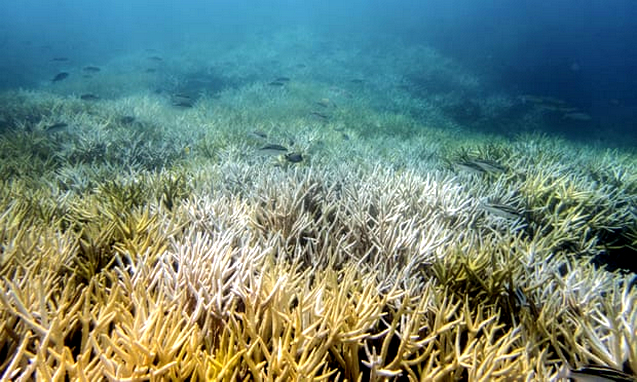
Bleached coral in Guam. The heating of oceans is causing tremendous problems for sea life. Photograph: David Burdick/AP
Last year was the hottest ever measured, continuing an upward trend that is a direct result of manmade greenhouse gas emissions.
The key to the measurements is the oceans. Oceans
absorb more than 90% of the heat that results from greenhouse gases, so
if you want to measure global warming you really have to measure ocean
warming.
There are other ways to measure climate change, but none are as
convincing as the oceans. Air temperatures are most commonly reported in
the media as evidence of global warming, but the problem with these is
they are very erratic. While there is certainly a long-term trend of
higher air temperatures, any given year may be warmer or colder than the
last.
So oceans are key, and they are telling us a clear story. The last
five years were the five hottest on record. The numbers are huge: in
2018 the extra ocean heat compared to a 1981-2010 baseline amounted to
196,700,000,000,000,000,000,000 joules. The current rate of ocean
warming is equivalent to five Hiroshima-size atomic bombs exploding
every second.
The measurements have been published in the journal Advances in Atmospheric Sciences
in an article by Lijing Cheng, the lead author, and his colleagues from
the Institute for Atmospheric Physics in China. His collaborators, of
which I am one, included researchers from around the world. The article
charts ocean heat back to the late 1950s, showing a steady increase.
2018 was the hottest year measured for Earth’s oceans compared with the 1981-2010 average
Guardian graphic. Source: Advances in Atmospheric Sciences. *Change in ocean heat content in zettajoules (1021 joules)
Ocean warming is incontrovertible proof of global warming, and there
are real consequences to a warming ocean. Firstly, warmer water expands,
and this expansion causes sea levels to rise. Approximately a third of
the rise in ocean waters is a result of the heat absorbed by the oceans.
Scientists expect about one metre of sea level rise by the end of the
century, which would be enough to displace 150 million people worldwide.
The warming waters also make storms more powerful. In the US
recently, we have seen hurricanes pass over extremely warm ocean waters,
which has supercharged them and increased the damage they cause. Other
kinds of storms are also being made stronger. Heavier downpours of
rainfall are increasing flooding around the world. Simply put, our
emissions of greenhouse gases have caused loss of life and property. We
are all responsible, but the people who have denied the science and the
solutions own a special responsibility that history will judge harshly.
It isn’t just humans that are suffering and will suffer more in the
future. The heating of oceans is causing tremendous problems for sea
life, particularly coral reefs. If we continue to warm the planet, we
can expect to lose much of these reefs. We can also anticipate
reductions in fish and sea life populations.
We scientists sound like a broken record. Every year we present the
science and plead for action. Not nearly enough is being done. We can
still tackle climate change, but we must act immediately. We have the
means to make a difference, we lack only the will.
AFR - James Fernyhough
Global business leaders have identified the potentially catastrophic
effects of climate change as by far the greatest long-term risk facing
the world, in a hard-hitting report released by the World Economics
Forum ahead of its annual meeting in Davos next week.
The Global Risks Report,
which represents the views of business, academia and government, warned
that the world was "sleepwalking into catastrophe" in its failure to
produce and implement adequate policies to address the problem.
Environmental
concerns eclipsed shorter term risks such as trade wars, social
instability and economic crises. But the report warned the current
geopolitical instability and a retreat into nationalism would make it
harder to address longer term environmental risks.
Climate change, which will likely cause more bushfires and extreme
weather events, is increasingly considered the major long-term risk by
business. Dean Sewell
"The world's ability to foster collective action in the face of
urgent major crises has reached crisis levels, with worsening
international relations hindering action across a growing array of
serious challenges. Meanwhile, a darkening economic outlook, in part
caused by geopolitical tensions, looks set to further reduce the
potential for international co-operation in 2019," the WEF warned.
"Of all risks, it is in relation to the environment that the world is most clearly sleepwalking into catastrophe."
Source: Executive Opinion Survey 2017, World Economic Forum
The 108-page report, the 14th annual report of its kind, was produced
in partnership with two global insurance giants: brokerage Marsh & McLennan Companies, and insurer Zurich. The universities of Oxford, Pennsylvania and Singapore were also involved.
About
1000 global experts and decision-makers in big business, government,
and academia were surveyed for the report about the areas they
considered the major risks. Businesspeople made up the biggest single
group of respondents.
The
prominence of climate-change risk represents a surge in concern in the
business community over an issue that 10 years ago did not even make the
top five issues.
In this year's report, three of the top five
risks – by both likelihood and impact – were environmental. Other major
risks, such as water crises and forced migration, although not classed
as environmental risks, were directly related to climate change.
An armed member of the Swiss Police watch from the roof of the Hotel
Davos in Davos, Switzerland, where the World Economic Forum will take
place. Simon Dawson
'High stakes'
The report comes a week before the forum's
high-profile annual conference in Davos, Switzerland, in which chief
executives from 1000 of the biggest companies meet with world leaders to
discuss the big political and economic issues. The report will form the
basis of discussions.
WEF president Børge Brende said the report highlighted the need for "new ways of doing globalisation".
"Renewing
and improving the architecture of our national and international
political and economic systems is this generation's defining task. It
will be a monumental undertaking, but an indispensable one. The Global Risks Report
demonstrates how high the stakes are – my hope is that this year's
report will also help to build momentum behind the need to act."
Prime Minister Scott Morrison claims Australia will meet its Paris emissions targets 'in a carter', but official government figures suggest this is not true. MICHAEL FRANCHI
Sean Walker, chief underwriting officer for general insurance at
Zurich Australia, said it was no surprise environmental risks dominated
the report "in a year that's been characterised by bushfires, heatwaves
and flooding".
"Australian businesses should be building
climate-change resilience and adaptation strategies into their broader
business plans. These plans need to be real and tangible, not treated as
some 'horizon three' or 'black swan' conceptual event but as something
to be addressed as part of a new operating environment," he said.
"This
week, heat records have been broken in Western Australia, NSW and South
Australia, and if these conditions persist there will undoubtedly be an
impact on business." Insurers have been at the vanguard
of business efforts to tackle climate change because they will be among
the first businesses to feel the financial effects of extreme weather
events and rising sea levels.
The report comes less than a month after official figures showed
the Morrison government was set to miss its 2030 carbon emissions
reduction targets by a huge margin, contradicting its claim it will meet
the Paris Agreement targets "in a canter".
The risks
Respondents
rated "extreme weather events" and "failure of climate change
mitigation and adaptation" as by far the two most serious risks in terms
of likelihood and impact.
Water crises, biodiversity loss,
ecosystem collapse, and natural disasters were also high on the list.
Source: Global Risks Perception Survey 2017-2018, World Economic Forum
The risk of cyber attacks was the only issue unrelated to climate change
to score above average in both impact and likelihood categories.
The
survey showed "weapons of mass destruction" was considered the risk
that would have the single biggest impact, but least likely to
eventuate.
Failure of national governance and profound social
instability were considered far lower long-term risks than environmental
catastrophe, scoring an average rating on likelihood, and below average
on impact.
Terrorist attacks, unemployment, state collapse and
energy price were all considered below-average risks on both likelihood
and impact scales.
Asset bubbles in major economies and data fraud
or theft were considered above average in likelihood but below average
in impact.
Breakdown of critical information infrastructure and
outbreak of infectious disease were considered high impact but below
average in likelihood.
While environmental risks dominated the
long-term outlook, the very short term – over the next year – was
dominated by concerns relating to geopolitical tensions over trade, as
well cyber security.
The sight of more than a million fish floating belly up on the
Darling River at Menindee has thrown doubt over the management of the
Murray-Darling Basin.
Experts say irrigators are taking too much
water from the system, and the Murray-Darling Basin Authority has
mismanaged water flows.
But New South Wales Water Minister Niall Blair says drought is to blame.
With more fish likely to die, here's what we know about the mass deaths and what some independent experts have had to say.
Where are fish dying? A million fish were found dead at Menindee Lakes last week.
It's a series of seven lakes fed by the Darling River, about 90 kilometres south-east of Broken Hill in western New South Wales.
What killed the fish?
A
variety of factors were at play at Menindee. Water levels were very
low, the system had stopped flowing, and temperatures were high after a
long spell of hot weather.
This created ideal conditions for blue-green algae (cyanobacteria) to grow, and it "bloomed" out of control.
But it wasn't the algae that killed the fish.
A cold front hit the region, which dropped the water temperature in the river, killing the algal bloom.
The bacteria that feeds on dying algae then exploded out of control, and sucked all the oxygen from the water.
When the oxygen levels dropped too low, the fish drowned.
So who or what is to blame?
The blame game began almost immediately after the Menindee fish kill was reported.
Farmers Rob McBride and Dick Arnold, whose video of dead Murray cod
went viral, pointed the finger at cotton growers and politicians.
But others blame mismanagement by the Murray-Darling Basin Authority (MDBA), and the NSW Government blames drought.
The big question is: why was the river in such a state that a blue-green algae outbreak of this scale could occur?
Here's what four experts working in the fields of river ecology, policy, management and economics told us.
1. Expert in water economics, environment and policy
Adjunct Professor John Williams from the Australian National University said you couldn't blame the drought.
"To manage a river you've got to be able to manage it through a drought without killing all the fish," Professor Williams said.
"We
didn't put enough environmental water aside, and then we've continually
eroded the little we did allocate with the recent amendments both in
the north and to the south."
Environmental water is water set aside to be released into the river system when needed.
In
2018, the Turnbull government won support from Labor to amend the
amount of environmental water allocated to the system, while the Greens
and some senators were opposed.
The amendments cut 605 billion
litres a year that were allocated from the southern basin's
environmental water flows, and 70 billion litres a year from the
northern basin's flows.
Professor Williams said if more
environmental water was allocated to the system, it could be used in
times of drought to help flush the system, reduce nutrient levels, help
drop water temperatures and oxygenate the water.
"Yes, it is hard to manage rivers like the Darling through drought,
but that's Australia. If you haven't got a management plan that can
manage the water through drought in the Darling, you haven't got a
plan," he said.
"We're taking a hell of a lot of water out. We had good flows 18 months ago.
"We want working rivers, we want irrigation, but we need to know how much we can take and regulate it pretty strongly."
2. Expert in conservation biology, wetland and river management
Professor Richard Kingsford from the University of New South Wales said farmers and irrigators were suffering from the drought, but water management was a big issue.
"Certainly
the drought is a contributing factor. The bigger issue is that this has
been coming for a long time in the Darling," he said.
"Over the last 20 or 30 years, we've reduced flows coming into the
Menindee lakes from upstream and down the Darling by almost 50 per cent.
And it means there's less water in the river than there used to be."
As well as extracting water from the river, licences allow some irrigators to capture overland flows.
Overland-flow
capture means diverting rainwater into storage before it reaches the
river, which in turn leads to less water entering the system.
"Some
cotton growers in the Darling River tributaries have managed to capture
some of the water in the recent rains that have occurred, and that's
part of the licencing system that allows them to do that, to harvest
those flows," he said.
3. Expert in water policy reform
Professor Michael Young from the University of Adelaide said the Murray-Darling Basin Authority had failed to plan for lean times.
"We've
put a lot of effort into debating what is called the 'sustainable
diversion limits', which is working out the maximum amount that can be
taken when the tank is full," he said.
"We've put very, very little effort into working out how to manage times of low flow and who's responsible for that."
In
the United Kingdom, there is a policy called "hands-off flow", where
water is released at the top of a system and that water cannot be
extracted as it works its way downstream.
But in Australia, things are different.
"In
much of the Darling at the moment we don't have mechanisms in place to
shepherd water through the system," Professor Young said.
"The
licences people hold are often a function of the height of the river. If
one person leaves water in the river, the next person says, 'thankyou
I'll take some more'."
4. Expert in ecology, management and restoration of aquatic ecosystems
Professor Robyn Watts from Charles Sturt University said that drought, climate change and mismanagement had all contributed to the state of the river.
"There's a lot of complexity around this fish kill," she said.
"It's
hard to know if that could be avoided because there's so much
complexity around the Menindee Lakes system in terms of who's been
taking water upstream and whether it's been taken legally."
But she said there were things that could be done in the short term to avoid more fish kills.
During previous events, locals have improvised their own aerator
systems, pumping oxygen into affected waterholes and moving cooler, deep
water to the surface.
"Where these refuges were created … we got the most adults and the most fish larvae," she said.
Yesterday, the New South Wales Government announced it would be installing aerators at a number of sites across the state.