30/01/2019

The Human Survival Summit: The Next Wave Of Climate Change Protests Is Coming

Huffington Post - Jo Confino

Greenpeace and Amnesty International unite in push for greater civil disobedience.


Students gather to demand the government take action on climate change on Nov. 30, 2018 in Sydney, Australia. Young people around the world are staging climate change protests inspired by Greta Thunberg, a 15-year-old Swedish student who has been leading a climate strike outside Swedish parliament. Mark Metcalfe via Getty Images
DAVOS, Switzerland ―Two of the world’s largest nonprofits are joining forces to spark a new wave of civil disobedience to intensify pressure on governments and business leaders to avert a climate catastrophe.
Greenpeace International, which has traditionally focused on environmental issues, and Amnesty International, which has concentrated on human rights, are co-launching a Summit for Human Survival later this year to encourage nonviolent protests and other interventions that force greater action on climate change. The event is expected to include NGOs, grassroots activist groups, as well as arts and cultural organizations from across the world.
Kumi Naidoo, secretary-general of Amnesty, said it is essential for organizations across different sectors to join forces rather than seeing issues such as the environment, human rights and international development as separate. An important aim of the upcoming summit, Naidoo said, is to mobilize non-environmental communities to recognize the seriousness of climate change.
“One of our errors has been to see climate change only as an environmental issue,” he told HuffPost at the World Economic Forum in Davos, which hosts business, political and economic leaders. “We should never have framed it that way, and I hope we have not left it too late to create that intersectionality.”
In its report published last October, the United Nations’ Intergovernmental Panel on Climate Change found that the world has only 12 years left to avoid catastrophic climate change. Both Greenpeace and Amnesty believe that direct action is essential to wake people up to the immediacy of the problem.
Sunrise Movement protesters inside the office of Nancy Pelosi (D-CA) to advocate that Democrats support the Green New Deal, at the U.S. Capitol in Washington, DC on Dec. 10, 2018. SIPA USA/PA Images
Jennifer Morgan, head of Greenpeace International, told HuffPost that it is important for people to rise up and engage in nonviolent direct action to bring the urgency of this message to corporate leaders in a different way. She highlighted that this week more than 30,000 school students went on strike in Belgium seeking greater action on climate change and children in Berlin took to the streets calling for an early coal phase-out.
“The youth are demanding to be heard. The question is, why isn’t the Davos elite responding with the scale and pace required?” she said. “We have no time to waste.”
Naidoo, who was Morgan’s predecessor at Greenpeace International, believes one focus for direct action should be to push for an end to financial investments in the most polluting industries. That should include going after the big banks, he said, as they continue to fund the fossil fuel industry and are more sensitive to consumer pressure.
The idea of the Summit, said Naidoo, is not for it to dictate or try to coordinate centralized actions but rather to unite individuals and organizations so that they can collaborate in pushing for change. He pointed to new forms of protest such as the Extinction Rebellion movement, one of the many youth-driven civil disobedience movements focused on climate change. It began in the U.K. and is now launching chapters across the globe, including in the United States. Naidoo added that big international NGOs aren’t organizing this mobilization and that this sort of decentralization should be encouraged.
Both Naidoo and Morgan used the end of the WEF to lambast the politicians and business leaders present for not recognizing the planetary emergency we face. Naidoo criticized the leaders present and accused them of only caring about maintaining the status quo, pointing to their failure to act in the wake of the 2008 global financial collapse and the Asian financial crisis a decade earlier. Discussions about the need to scrap fossil fuel subsidies and address tax havens after the last global financial crisis had taken place, he said, but nothing significant had materialized.
“We need to fundamentally rethink what structural and systemic changes are needed in the economy to make sure we address climate and dangerous inequality, which is leading to massive social tensions. Instead, all we have seen is system recovery, system maintenance and system protection.”
As the world tinkers on the brink of a climate catastrophe, Morgan said, “it is deeply disturbing that … avoiding further temperature rise is not at the very center of all of the meetings of CEOs and world leaders.”

Links

Australia's Heard Island: A Mysterious Land Of Fire And Ice

ABC

Australia's tallest mountain — with its active volcano — is one of the country's best-kept secrets, and holds clues to understanding the Earth's past and its future.
Credits
Journalist: Marty McCarthy
Graphics: Kate Doyle
Photography: supplied by Pete Harmsen, Doug Thost, Matt Curnock, Kieran Lawton, Karl Rollings, Kate Kiefer, Michael Trapp & Australian Antarctic Division
Even if you could get to Australia's most remote island, chances are you still wouldn't quite see it.
The little-known landmass, Heard Island, hides in dense cloud for around 360 days a year.
The rare few who do reach this distant wonder are more likely to hear the gurgle of molten rock bubbling up through the island's violent core.
The active volcano on Heard Island, known as Big Ben, is adorned with vast glaciers stretching to the crashing waves of the ocean far below.
At a soaring 2,745 metres, it is 517m taller than Mount Kosciuszko, giving it the little-known title of the tallest mountain in Australian-owned territory excluding Antarctica.
Heard Island takes seven days to reach by boat from Fremantle.
The 4,000-kilometre journey over rough and stormy seas is usually undertaken only by fishermen and the occasional research scientist.
A map showing the location of Heard Island and the McDonald Islands. 
Doug Thost, a former glaciologist with the Australian Antarctic Division, which administers the island, has made the journey twice. He describes it as a "danger and a privilege".
Humanity deserves to know a bit more about this place; it is a jewel in the southern Indian Ocean. I'd hate to see it loved to death, but I'd love to see it on Australia's list of things to do from a research perspective," he told the ABC.
"Being in such a remote and wild place is pretty humbling. You have to be very aware of the potential danger you could be in and how unlikely it is that you could be rescued if something does go wrong, but it's invigorating."
One of Dr Thost's colleagues almost died traversing the island. Fifteen years ago, on Christmas Eve, Dr Thost and his colleague were climbing one of the glaciers, Brown Glacier, to study how fast it was melting.
The island acts as a sentinel for a warming planet and the impacts of climate change in the Southern Ocean.
"We were at the top of the glacier and my co-researcher and I turned around to go back. We were roped up, thank God, because my colleague suddenly fell into a crevasse. He was a dead weight hanging down there for a bit," Dr Thost said.
The colleague survived but the incident highlighted one of the many perils of the remote subantarctic island.
The weather can be equally as nasty. Wind speeds at Heard Island can average about 33 kilometres per hour.
Dr Thost once recorded a 200kph gust on the glacier — equivalent to a category three cyclone. The winds can whip up a blizzard on a glacier in an instant.

Australia's Hawaii, but colder
Big Ben formed about one million years ago and now looks like a classic volcano — conical, built up over the years by layers of hardened lava, tephra, pumice and ash, with smoke billowing from the top.
It would be bigger if the cooled lava was not in constant battle with glacial ice. At the lava cools, the expanding ice on the glaciers shatters the rock, and the fragments get carried down to the sea.
While Heard Island is larger, the volcanic action on the smaller McDonald Island group, about 43km to the west, is much more violent.
A map of Heard Island and the McDonald Islands. 
"Big Ben oozes runny lava, but McDonald Island explodes," said Jodi Fox, a graduate student in volcanology at the University of Tasmania.
The lava at McDonald is thicker, which traps the gas inside until it almost reaches the surface and then when it does, the gas expands rapidly and causes the explosion.
McDonald became Australia's second active volcano when it broke its 75,000-year dormancy in 1992, according to UNESCO. A large eruption in 1996-97 saw the island double in size to 2.4 square kilometres.
"That part of Australia is growing. Heard is probably producing small lava flows every few months, so it is gradually getting bigger," Ms Fox said.
Ms Fox was part of a team of researchers aboard the CSIRO's Investigator research vessel in 2016 that mapped the seafloor around the islands in search of underwater volcanoes.
"There are features that are almost certainly volcanoes below the surface as well, they just don't have names and we don't know what the extent of their volcanic activity is yet," she said.
The McDonald Islands group has doubled in size over the past 30 years due to volcanic activity. 
Mike Coffin, the chief scientist on that trip, said it was hard to measure the growth of the islands even above the ocean surface. Access to Heard Island is largely restricted to keep it free of introduced animal pests. The volcano itself has only been successfully climbed three times.
"The height of Heard Island at Mawson Peak appears to have grown. Officially Heard is 2,745m, but we think it's now about 2,813m. We'd love to take a helicopter with a device to measure it properly, but the winds are usually too strong for drones or helicopters," Professor Coffin said.
Tom Trull, principal research scientist and marine biochemist for the CSIRO in Hobart, also studied the islands during the 2016 research trip, and said it was unlike any Australian landscape he had ever seen.
"Both islands are a contrast, and beautiful in different ways," Dr Trull said.
"Heard has its big high cone with glaciers glistening in the sun and a plume of ash coming out the top and black lava pouring down the side, and vegetation and wildlife at the bottom.
"Then you go to McDonald. It's a small, fuming, stinky, hot, covered bunch of rough rocks that you couldn't imagine stepping on. It's somewhere between idyllic and hellacious; it's like another planet," Dr Trull said.
Researchers believe the islands are formed by the Kerguelen Hotspot — similar to the way the Hawaiian Islands are forming.
A hotspot is a place where an unusually high flow of convective heat, known as a mantle plume, rises from deep within the earth. The plume melts through the earth's crust, forming a volcano.
"The source of their volcanic material is deep in the earth — about halfway down to the core — about 2,900 kilometres down," Professor Coffin said.
A hotspot under Heard Island and the McDonald Islands is responsible for the volcanic activity in the region.
Volcanoes are more common at the boundaries of tectonic plates, where plates split or collide and magma escapes. That type of volcanism is well understood and proven but hotspots are not.
"These very deep-rooted volcanoes that sit in the middle of tectonic plates, like at Heard and McDonald, would make up less than 5 per cent of the earth's volcanoes. Hawaii would be the most well-known example," Professor Coffin said.
The plume hypothesis is not universally accepted, but it is the most widely cited explanation for how volcanoes form far away from plate boundaries.
One of the reasons behind the addition of Heard and McDonald Islands to UNESCO's World Heritage List in 1997 was their potential clues to understanding this process better, and its role in the formation of ocean basins and continents.
"They [the islands] offer an active example of plume volcanism, providing direct geological evidence of the action of the longest operational plume system known in the world," UNESCO said.
The islands are mostly composed of phonolitic low-silica pumice, dikes and lava domes, and sit atop an underwater plateau known as the Kerguelen plateau. (Supplied: Matt Curnock and Australian Antarctic Division)
 Researchers also believe if it were not for the volcanoes, marine life would not exist in such an abundance in this harsh part of the world. The volcanoes act as a food source, of sorts.
"The island's volcanic activity is a source of iron. Iron enters the water and fertilises phytoplankton productivity in the Southern Ocean," Dr Trull said. "Phytoplankton are the plants of the sea."
Smaller animals, like krill, eat the phytoplankton. Crustaceans and fish then eat the krill. Birds and seals eat the fish.
"Like on land, any animal can eat another animal, but first an animal has to feed on a plant. So the whole history of volcanic activity has made the island, not just physically, but also biologically," Dr Trull said.
"Most of the Southern Ocean has very low levels of [marine life] productivity, but around these islands the levels are high. So the first question is, 'Why are they are high?'"

A forgotten gift from Britain
When Captain John Heard of the merchant vessel Oriental made the first official sighting of Heard Island in 1853, he thought it was a massive iceberg that had drifted from Antarctica.
The captain's wife wrote in her diary: "the sun seemed so dazzling on the water, and the tops of the apparent icebergs covered with snow. We were all the time nearing the object and on looking again, the captain pronounced it to be land".
The first landing happened two years later, and the island became a base for sealers who hunted elephant seal, fur seal and sometimes penguins. One hundred thousand barrels of elephant seal oil were made there before the practice ended in 1877, giving way to an era of scientific expeditions.
Britain's HMS Challenger paid the islands a visit in 1874 to collect scientific samples. Australian geologist and Antarctic explorer, Douglas Mawson, visited Heard Island in 1929.
The United Kingdom formally claimed the islands in 1910 but transferred them to Australia in 1947. However, Australia's interest in the islands' research potential dried up once Mawson Station was established on Antarctica in 1954 and the base on Heard closed the following year.
The most recent expedition to Heard was in 2016 by RV Investigator — it took a team of 40 scientists for six weeks. Mike Coffin, the expedition's chief scientist, said that trip took eight years to plan, and no-one stepped off the boat.
"I would like to see Australia set a year-round research station there and give it the attention it cries out for. It is a fascinating place geologically, biologically, chemically, and physically. But its costs would be in the millions of dollars per year," he said.
Australia's spending on subantarctic research mostly goes to Antarctica, such as the new $2-billion icebreaker vessel currently being built for reasons that are becoming increasingly political.
Despite countries like China and Russia having no territorial claims to Antarctica, both have recently started investing heavily in the region. China is building research stations and airfields and is calling for more access to the continent.
The Australian Government announced a $200 million funding boost to the Antarctic program in 2016.
Australia's new icebreaker, RSV Nuyina, is seen under construction in Romania. (Supplied: Damen/AAD)
"Science is the currency of Antarctica, that's how you make your reputation on Antarctica," Professor Coffin said.
A ban on mining in Antarctica comes up for renegotiation in 2048 when the Antarctic Treaty System (ATS) expires. Mineral exploitation aside, there is a concern countries are eyeing Antarctica for its strategic importance: it's an ideal place to build satellite receivers and global positioning systems (GPS).
Robb Clifton from the Australian Antarctic Division, who is also one of a handful of people to successfully climb Big Ben, acknowledges many scientists want a permanent research base established on Heard Island, but says doing so could taint it.
"There really is not a need for a research station now. We needed it in the past to help us get to Antarctica. But in terms of having a small ecological footprint there, there isn't a requirement to build a station there. We have a subantarctic station on Macquarie Island, which means Heard is left to be a very wild and largely untouched place."
Robb Clifton, Tim Curtis, Stu Davies and Matt Rogerson on the summit of Mawson Peak on Big Ben in 2000. (Supplied: Robb Clifton and Australian Antarctic Division)
A canary in the coal mine for climate change
Researchers argue a permanent presence on Heard Island is critical because they believe it holds clues to understanding not only the earth's formation, but also its future.
Heard Island has 12 major and several minor glaciers that together cover 70 per cent of the island. They are shallow and fast flowing, meaning they respond very quickly to a warming climate.
UNESCO said the glaciers on Heard were responding to climate change "faster than any glaciers elsewhere, making them particularly important in monitoring climate change".
When Dr Thost made his last visit to the island in 2003, that's exactly what he was doing. For four days a week over two-and-a-half months he climbed glaciers, clocking up 25 vertical kilometres by the end of the expedition.
"Based on our study of Brown Glacier over a period from 1947 to 2004, it lost 29 per cent of its original area. In 1947 the glacier stretched all the way to the ocean and ended in a 20-metre-high ice cliff, but now it has retreated by nearly 600m," Dr Thost said.
Researchers investigate glacial retreat on Heard Island caused by climate change. (Supplied: Doug Thost)
Dr Thost said from the 1940s to 2003 the temperature on Heard had increased by 1 degree Celsius in the winter months, and .8 of a degree in the summer months. He pointed to climate change.
"Heard and McDonald Islands are the frontier between cold Antarctic conditions and more temperate conditions. Heard Island is a sentinel island, like a canary in the coal mine. It is telling you that something is happening and temperatures are changing along that convergence."

Wildlife's playground
As the glaciers retreat, they create lagoons and exposed beaches, enabling wildlife to thrive.
Three species of seal live on and around the islands. There are also two endemic bird species, the Heard Island sheathbill and Heard Island cormorant. Fifteen species of flying birds breed there as well as four species of penguin.
Antarctic cod and icefish live in the shallow nearshore waters while crustaceans, skates, toothfish, and even lantern fish reside further out.
The human-sized Patagonian toothfish, which lives more than 2 kilometres below the water's surface and is prized globally for its sweet omega-3 rich flesh, is often a target of illegal fishers.
Patagonian toothfish is caught predominantly by longline in deep waters in the remote Southern Ocean, however the species is unsuitable for intense fishing. (Supplied: Austral Fisheries) 
Since 1997 Australia has operated a legal fishery in the area, for toothfish and mackerel icefish.
"It's an amazing place. You feel liked you walked into a David Attenborough special," Dr Trull said.
Part of UNESCO's decision to grant the islands world heritage status was because of their biological purity. Heard is the only subantarctic island virtually free of introduced species. That purity is reflected in the behaviour of the wildlife that inhabit it.
"The penguins are so curious, they aren't fearful of humans, so they come up to the boat and get so excited that they get silly. They dive and jump like dolphins, trying to get a look at the boat, and they just look stunned," Dr Trull said.
"The entire place is stunning, and it's ours. It's our volcano and glaciers and animals. It startles me that Australians think of their beaches and red deserts, but they don't know about this other part of their landscape."

Links

Zali Steggall Promises Climate Change Fight With Tony Abbott In Warringah

The Guardian - 

Independent candidate says she won’t direct preferences to other candidates in former PM’s seat
Zali Steggall says Tony Abbott has ‘continually denied climate change’ and that she won’t direct preferences to other candidates in Warringah. Photograph: Luke Costin/AAP
Zali Steggall has promised not to direct preferences to other candidates and says the government should be more ambitious on emissions reduction than Labor as she makes her pitch to replace Tony Abbott in Warringah.
The independent candidate told Guardian Australia that Abbott had “continually denied climate change” and the conversation had “moved on” from carbon pricing because renewables were already cheaper than coal.
Steggall’s candidacy was welcomed on Monday by Labor and the independent MP for Wentworth, Kerryn Phelps, who said people were “disillusioned by the performance of the Liberal party” on issues including climate change and marriage equality.
Abbott holds Warringah with a primary vote of 51.65% and a two-party preferred vote of 61.55% but is being challenged by independents including Steggall, who is a lawyer and former Olympic skier, the Indigenous broadcaster Susan Moylan-Coombs and Alice Thompson, a former employee of the former prime minister Malcolm Turnbull.
The dumping of Turnbull in August has caused MP Julia Banks to join the crossbench and has been a major hit to the Coalition’s vote in progressive Liberal seats such as Kooyong, where a high-profile independent is also expected to enter the field.
The Herald Sun has reported that Banks is considering moving from her marginal seat of Chisholm to take on the health minister, Greg Hunt, in Flinders.
On Monday Steggall said Warringah was a “a very savvy electorate” and “as an independent it’s important to let people make up own mind” about their preferences.
Asked if failing to direct preferences might help Abbott retain the seat, Steggall replied that “a broad part of my base are moderate Liberal supporters”.
“We’re asking voters to think carefully about how they vote and I’m asking for people’s first preference,” she said. “To succeed, we need to bring down the primary vote of the current member.”
Asked about carbon pricing, Steggall said that a multi-pronged approach was needed to fight climate change and the conversation had “moved on” because there was “no need for subsidies” now that renewables were cheaper than coal power.
“We need to set ambitious targets to accelerate the transition to clean energy and the orderly retirement of coal,” she said. “Abbott and politicians on the far right are proposing subsidising coal, to keep open something that is not cost effective.”
Steggall said she would release a full climate policy before the election but pointed to more ambitious state targets as evidence of a “clear disconnect”, where “the federal government hasn’t been hearing people’s desire to make a difference”.
Steggall said that Labor’s emissions reduction target for electricity of 45% by 2030 was “a start” but was “not enough – we need to push for more”.
The Australian has reported that Abbott will write to voters that he has “more to do” for the electorate and “no one can fight harder for you and for our area than someone with the big megaphone that only a former PM has”.
“My other pledge is to do everything I humanly can to protect you from Labor’s tax attack that will unfairly target people in Warringah with above-average incomes and assets,” he reportedly says.
Steggall expects to capitalise on grassroots organising against Abbott from local groups including Think Twice Warringah and Voices of Warringah, which she said sprung up due to “growing dissent and dissatisfaction” particularly at “the way the Liberal party conducted itself last year”.
Steggall said that Abbott – who has suggested climate change is “probably doing good” – had “continually denied climate change despite all the facts being in”.
“It’s a fair assessment to say that he’s unwilling or unable to move and not open to debate or discussion,” she said. “He’s entitled to take that far-right view but it doesn’t reflect where this electorate is at.
“Warringah wants safe, sound and stable economic policy, but it’s a caring progressive electorate.”
Labor frontbencher Andrew Leigh told Sky News the opposition would “absolutely” still contest Warringah, describing the party’s candidate, Dean Harris, a small business owner, as “a great local bloke”.
The Labor leader, Bill Shorten, said that Abbott was a “formidable and tough campaigner” who could not be written off in Warringah.
He told reporters in Melbourne that Steggall’s nomination showed the government was “lurching from crisis to crisis” as their own supporters were running against the Liberal party as independents.
“On climate change … we agree that Tony Abbott has been a block on action on climate change – but it’s not just him, it’s the whole government.”
When asked about the potential for preferencing Steggall at the election, Shorten said: “This is an independent, she’s just announced that she’s running yesterday. We’ll examine her policies.”
Phelps told Sky News she was “very very pleased” that Steggall had decided to stand as an independent because voters were “angry about a lot of the mismanagement they’re seeing”.
“What we need to see are more independents from the sensible centre who can be an antidote to the lurch to the right we’re seeing from the Liberal party and Coalition government.”

Links

29/01/2019

Davos Oils The Wheels Of An Ecological Turnaround

AFR - Ambrose Evans-Pritchard, The Telegraph London

Nowhere in global discourse do Big Oil and Big Ecology come together quite so starkly as in Davos, their two parallel universes briefly intersecting in the capital of cognitive dissonance.
In one room Al Gore gives a masterful tour d'horizon of the predicament we face.
"We are putting 110 million tonnes of man-made, heat-trapping, global-warming pollutants into the very thin shell of the atmosphere as if it were an open sewer, and we do that every single day," he tells a gathering of ministers, princes and billionaires.
Al Gore at Davos, where he gave a masterful tour d'horizon of the predicament we face.  Jason Alden
Mr Gore alerts us to a study this month from the Proceedings of the National Academy of Sciences showing that Greenland's ice is melting four times faster than assumed.
He guides us to the terrifying Hothouse Earth report: we are on track for a temperature rise of 4-5 degrees above pre-industrial levels even under the CO2 targets of the Paris Agreement.
Lethal feedback loops will kick in as permafrost melts across Siberia and methane hydrates are released from the ocean. A cascade of critical thresholds will turn the Amazon to semi-desert. The West Antarctic Ice Sheet will plunge into the water.
As the dominoes fall, sea levels could rise by 60 metres, though that might be the least of our problems. Much of the world would simply be "uninhabitable".
The Davos elites are reduced to tears by Sir David Attenborough's gruesome footage of 100,000 walruses crushed together for survival on a thin strip of the north Russia coast because their ice habitats have vanished.
The mammals are forced on to cliffs, and then slither down to their deaths in a fantastical apocalypse.
Britain's Prince William, left, listens to Sir David Attenborough, who reduced the Davos elites to tears. Markus Schreiber
The audience leap to their feet for a triple ovation. Sir David sweeps the World Economic Forum.
At the same time, Opec leaders are in another room asserting that nothing much is going to change. Fossil dominance is ineluctable.
Amin Nasser, head of Saudi Aramco, says he is not losing any sleep over peak oil or stranded assets. "I don't see it happening in 10 years or even by 2040."
Opec chief Mohammed Barkindo is less defiant, and more alert to the fast-changing mood.
Opec chief Mohammed Barkindo at Davos: "Eighty-two per cent of the world's population has never flown in an aircraft, so there is a huge demand going forward." Simon Dawson
"Our industry is literally under siege and the future of oil is at stake," he said. Yet little is actually changing.
"In our projections, the world oil outlook to 2040, oil will continue to dominate the energy basket," he said.
"The key drivers are trucks, aviation, petrochemicals.
"Eighty-two per cent of the world's population has never flown in an aircraft, so there is a huge demand going forward."
Fatih Birol, the IEA's chief, says the emerging economies of Asia are adding a new coal plant every week.  Aaron M. Sprecher
Opec thinks oil will still be 27 per cent of the global energy mix in 2040, and that fossil fuels will broadly retain the 70 per cent share they hold today. Renewables will still be just 5.4 per cent.
Mr Barkindo notes that the neutral International Energy Agency (IEA) has much the same estimates. He is right.
Oil historian Daniel Yergin from IHS thinks oil demand will peak near 2040 but at a much higher level than today. It will then plateau, held aloft by powerful economic forces.
"I don't think peak means plummet," he said. "We're going to have two billion more people than now."
Rachel Kyte, the UN's special envoy for sustainable energy: "There are still fossil-fuel subsidies in G7 countries. That is ridiculous."  Jessica Hromas
In short, Big Oil and those who know its rhythms are in utter irreconcilable conflict with the planet evangelists. It is natural for anybody with a greenish Weltanschauung to feel a sense of moral outrage.Yet as you drill deeper into the global-warming debate, the moral contours become less clear. This complexity too was in evidence at the policy panels and back rooms of Davos.

The new tobacco companies
Shell, BP, and Total are all at various stages of reinventing themselves as renewable energy companies.
Any non-state oil and gas company that digs in its heels faces a shareholder backlash and the wrath of the disinvestment movement. They are the new tobacco companies.
John Hess, founder of Hess Petroleum, said oil equities are shunned on Wall Street. There is already a fat climate discount on valuations.
"How we get back the hearts and minds of our industry is a real challenge," he said.
Vicki Hollub from Occidental says no major oil and gas company can raise capital or function properly unless it has a climate mitigation plan, and these days it must be more than superficial "greenwashing" or rebranding.
Occidental has teamed up with Net Power in Texas to push for a revolutionary form of carbon capture and storage (CCS).
This puts an oil major once decried as a climate villain on the other side of the ledger.
Net Power was founded by an ex-Goldman Sachs banker who decided to devote the rest of his life and all his money to cracking CCS. His goal was to find a commercially viable way to eliminate the CO2 emissions of coal and gas plants.
The company has built a plant based on the British-designed Allam Cycle with an "oxy-combustion" system using pure oxygen. It uses pressurised Allam Cycle itself to drive a turbine. It is a closed loop with no smokestack.
The hope is that the technology will capture 100 per cent of greenhouse gases and other pollutants at no extra running cost.
Zero-cost CCS would do more to cut emissions than electric vehicles - marvellous though they may be - even if every fossil-fuelled car on the planet were eliminated.
Fatih Birol, the IEA's chief, says the emerging economies of Asia are adding a new coal plant every week. The region has 2000 gigawatts of coal power from facilities with another 40 years of life ahead of them.
The sunk investments cannot be wished away.
"There is a gross disconnect between all the reports and targets and what people say at Davos, and what is happening in real life," he said.
"I am not saying that oil and gas are innocent, but they are not the main problem. There seems to be a blind spot about this in the climate-change debate."
The IEA estimates that coal accounts for 30 per cent of greenhouse gases.
"We have to move to CCS," he said, adding that just 8 per cent of CO2 emissions come from the 1 billion cars on the roads (to be 2 billion in another generation).

The distorting Tesla effect
Even if EVs reached 300 million by 2040 - an ambitious target - this would cut new emissions by just 1 per cent. The Tesla effect has distorted public perception.
"I don't think a lot of policymakers have an understanding of how Herculean the task is," said John Hess.
He invoked the 15 "Princeton Wedges", the combination of measures that would broadly be needed to cut emissions to zero while meeting the surging energy needs of China, India, the developing economies.
The world would have to do the following:
  • triple nuclear power to 1200 gigawatts
  • increase wind power tenfold to 2 million turbines
  • increase solar panels a hundredfold to 15,000 square miles (38,850sq km)
  • replace 1400 coal plants with gas, and fit 800 remaining plants with CCS
  • double vehicle efficiency from 30mp/g to 60mp/g (3.9 litres per 100km), and cut mileage driven by half
  • raise biomass ethanol from one sixth of the world's cropland
  • stop all tropical deforestation
  • adopt conservation tillage across all global agriculture and so forth.
Seen in this light, the vilification of the oil industry alone smacks of scapegoating.
"Climate change is real. You see it in warmer oceans where the water is acidifying, and in melting glaciers," said Mr Hess.
"I don't think anybody disagrees with the 'what'. It's the 'how' that is the real challenge."
The biggest single cause of global warming is farming and loss of forest combined, accelerated by our meat-based eating habits.
As an impassioned World Bank official told a panel, governments spend $US560 billion ($779 billion) a year on farm subsidies. Much of this promotes destructive practices.
The chief culprits are the US, Europe and the rich OECD economies. Part of the money goes into growing animal feed, a subsidy for livestock and cows (methane).

Fossil fuel subsidies 'ridiculous'
Or it goes into the production of sugar and high-fructose corn syrup, aiding and abetting our misnamed obesity "epidemic".
It is not an epidemic. It is a state-promoted and funded addiction syndrome.
A further $US250 billion goes into fossil-fuel subsidies, mostly in poorer countries.
This diverts scarce funds from healthcare and education towards the active encouragement of energy wastage and CO2 emissions.
Rachel Kyte, the UN's special envoy for sustainable energy, said everybody is to blame.
"There are still fossil-fuel subsidies in G7 countries," she said.
"That is ridiculous. We are not being consistent and coherent across our economies."
With the right policy framework the private sector will pick up the baton and run with it.
"The technology exists and it can be done affordably," she said.
If there is an enemy, it is not the oil industry. It is us.

Links

'Terrifying': Scientists Dig Deep For Missing Piece Of Climate Puzzle

Fairfax - Peter Hannam

This weekend, a crucial but barely heralded scientific mission will come to an end in a remote part of Antarctica.
A team of seven Australian and American researchers will conduct the last extraction of ancient air from ice cores drilled as deep as 240 metres.
David Etheridge, CSIRO lead scientist on the Hydroxyl project, at Law Dome laboratory in Antarctica. Credit: CSIRO
They hope to reveal answers to some fundamental questions about how our atmosphere is coping with our soaring emissions of greenhouse gases.
“We’re trying hard not to screw it up," Peter Neff, a glaciologist at the University of Washington, tells the Sun-Herald and Sunday Age from behind the wheel of a tracked snow vehicle at his icy basecamp.
"Every time we handle a sample, it’s terrifying - it only takes one mistake to ruin weeks of work.”
In fact, the findings of the six-year project - led by senior CSIRO atmospheric scientist David Etheridge and Vas Petrenko from the University of Rochester in the US - may carry their own measure of terror, depending on how they turn out.
The role of carbon dioxide, the primary greenhouse gas, has been known for more than a century, including how it is eventually removed from the atmosphere by absorption into the oceans or by terrestrial plants.
But what has actually happened to some 40 other gases, including methane, hydrofluorocarbons and ozone-depleting chemicals, over the decades since industrialisation turns out to be rather less well understood.
"We know pretty well how [these gases] are produced. We need to know how quickly they are removed," Etheridge says from the rather warmer confines of Melbourne this week.
"Without that, we’ve only got part of the puzzle, part of the equation.”
The quandary in question goes something like this.
We know hydroxyl radicals - which bond oxygen and hydrogen - act like atmospheric scrubbers, destroying non-CO2 greenhouse gases such as methane.
The ice core drilling station at Law Dome, 120 kilometres inland from Casey Station. Credit: AAP
Those gases contribute about a third of the extra warming we're inflicting on our planet by trapping additional heat from the sun in our atmosphere.
Hydroxyl is naturally produced in the atmosphere but so reactive that a radical lasts only about a second before destroying a pollutant molecule, and itself.
"Because hydroxyl is so variable, with such a short lifetime and so variable in time and space, it’s actually hard to quantify even in the modern atmosphere,” he says.
More to the point, though, we have little notion of whether this critical cleanser has increased or decreased in abundance since pre-industrial times - with implications for future emissions.
The oxidation process involving hydroxyl is actually crucial at keeping methane “in the supporting role that it’s in, rather than actually becoming the leading troublemaker for warming the atmosphere", Neff says.
The implication - depending how the results play out - could include requiring a recalibration of the major climate models that underpin the Paris climate agreement that almost 200 nations have signed up to.
"All of [the models] are making an assumption about the fundamental reactivity [of hydroxyl in] the atmosphere before the year 1990," Neff says. “This is the first actual check on that part of those models."
Making that check has been no easy feat, and involved more than the odd "touch and go moment", he says.
A savage round of cuts planned by CSIRO management, announced three years ago next week, brought the whole project within days of being axed. Public pressure at home and internationally ended up sparing many scientists from the chop, including possibly this project.
Lately, the challenges have been mostly physical, including coping with the bitter cold - temperatures often drop below minus 20 degrees - and heavy snow drifts that come with working at Law Dome, some 120 kilometres east of Australia's main Antarctic base at Casey.
Etheridge has been involved in decades of atmospheric research and knew Law Dome had special qualities the scientists would need. In particular, the site happens to have some of the heaviest snow falls anywhere.
“Right here, we have about 10 times the average snow in Antarctica - 120 centimetres a year versus five to 10 centimetres," Neff said. “It buries the ice much more quickly than anywhere else. It just piles and piles on top."
Drilling ice cores to analyse the air trapped within the compacted snow has been routine for polar ice scientists for decades. In the case of a hydroxyl hunt, however, such air samples are particularly valuable.
David Etheridge and colleague working in a blizzard at Law Dome.
The researchers won't find the radical compound because hydroxyl is not stored for any length of time in a container, let alone for hundreds of years in ice. Rather, the scientists are after a proxy molecule - the carbon-14 isotope of monoxide - that indirectly will reveal the past abundance of hydroxyl.
Carbon-14 is produced by reaction with cosmic rays from outside the solar system, but the heavy snowfall at Law Dome acts "like a shield in an X-ray".
The snow, then, protects the air in the deeper ice so that carbon-14 is not produced there by cosmic rays which would otherwise alter its level, compared with its original amounts in the atmosphere.
Neff says there are no better places to drill.
“It’s literally the only place on the planet where we can get large amounts of clean air that have not been compromised by this carbon-14 aspect that we are looking for," he says.
Of course, getting to that evidence is hardly a ski in the back country.
Scientists typically sleep in mountaineering tents, tucked in a summer sleeping bag, inside a winter one. Snow drifts are such that staff have increasing difficultly over time fighting the snow drifts, Neff says.
The crew have worked about 77 days straight to complete six drilling operations, extracting about 5 tonnes of ice. The average of the three deepest drills has secured the scientists ice dating from about 1875.
That's early enough to capture the conditions of the air before the biggest surge in greenhouse gases kicked in. Methane emissions, for instance, have risen about 200 per cent since the late 1880s, Neff says.
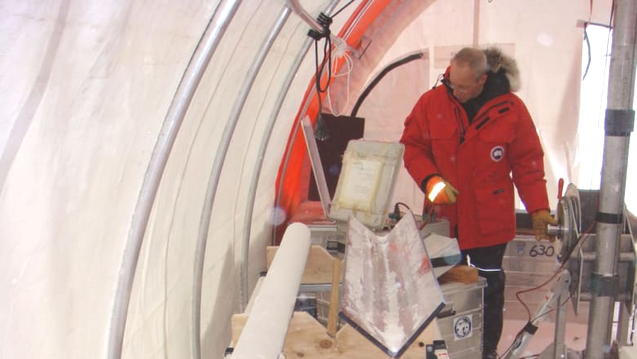
Inside the drill tent with the ice core. Credit: Joel Pedro
Humans have also released a host of industrial chemicals with various abilities to warm the planet, affect its stratospheric ozone layer, and contribute to local pollution over that time, all of which may have added to hydroxyl's cleaning load.
So delicate are the experiments, though, the drills can't use drill fluids that would otherwise have allowed them to go deeper to, say, 1750 when the industrial era roughly began.
That sensitivity to possible contamination also extends to placing the science tent some 50 metres upwind of the other buildings - basically modified shipping containers - to avoid pollution from the camp's diesel generator.
The work can be intense not least because the ice has to be treated immediately it is extracted to preserve as much as possible the purity of the cores.
“They become like hot potatoes, where all of a sudden they are at the surface and are being bombarded by the full cosmic ray flux,” Neff says.
Rather than ship the ice thousands of kilometres to distant labs, it is melted and the key evidence placed in stainless steel tanks. About 20 of them, weighing about 10 kilograms each, will make the journey to Casey and beyond when the camp packs up in coming days.
Neff, who is also a geologist, says the work has gone better than expected.
“We’ve got absolutely everything we wanted to get done," he says.  The samples "have all been absolutely perfect and cleaner than we thought”.
At least another year of testing awaits, however, including at the ANSTO nuclear facility on Sydney's south-west fringe.
Etheridge, who helped provide the Sun-Herald and Sunday Age with a tour of CSIRO's world-renowned air archive at Aspendale in Melbourne's sandbelt last week, says his "gut-feeling" is that hydroxyl abundance will be shown to be on the skids.
"From my reading of the evidence and the chemistry, I would expect to see a decline over the industrial period of hydroxyl. I would expect it to have decreased," he says, stressing that the results from the current project have not been tested.
“I’m looking forward to being found wrong."
The findings would be strengthened by similar work in the northern hemisphere, such as drilling into Greenland's ice sheets although those cores are likely to be much dirtier than in the Antarctic.
The implications, though, of proof of a reduced ability to destroy methane - which now has a life in the atmosphere of about a decade - would be profound, depending on the scale of any decline.
Apart from raising the warming potential of methane - whether released from coal mines or natural gas fields - the potential for hydrogen to serve as a "clean fuel" could also be placed in doubt. (Labor this week floated a $1 billion plan to create hydrogen export zones in Queensland to be powered by a massive increase in renewable energy.)
"Hydrogen is a very leaky molecule and we’d have to expect that there’d be some leakage in its production," Etheridge says, adding that hydrogen itself has a greenhouse gas effect.
“It may not be of any significance, but we don’t know.”
Neff says that while being away from his family for 100 days is tough, he's proud that his work is going towards answering some of climate science's biggest questions.
"We don’t want to be operating blindly, [about] how much of an impact we have on the entire earth system," he says.
Etheridge likens his team's work to that of space exploration, where scientists pick up information that proves to be useful for something later on that can't yet be anticipated.
He notes that the CSIRO and other science agencies began flagging climate change as a threat in the 1980s well before the warming signal became clear above the background noise of natural variation.
“Now the signals are everywhere," he says.
"Here we are dealing with a $1 trillion question - whether we let the atmosphere go, business as usual and don’t care, or we reel in emissions and try to manage the planet.
“We are trying to manage that question with million-dollar science - it’s not a bad payback.”

Links

Climate Change Creates A New Migration Crisis For Bangladesh

National Geographic - Tim McDonnell

The country, already grappling with the Rohingya crisis, now faces a devastating migration problem as hundreds of thousands face an impossible choice between battered coastlines and urban slums.
A woman in Bangladesh uses bales of straw to try to protect a riverbank that is eroding away from floodwaters. Much of the country is ground zero for a global climate crisis. Photograph by G.M.B. Akash, Panos Pictures/Re​dux
Dhaka, Bangladesh - Golam Mostafa Sarder starts every day before dawn, rising from a thin reed mat in the shed that he shares with fifteen roommates. Each has just enough space to lie flat. He dresses in gym shorts and t-shirt by the light of a single dangling bulb.Outside the shed’s open doorway, in the outskirts of Dhaka, the sprawling megacity capital of Bangladesh, is the brick factory where Golam and his neighbors work for fifteen hours a day, seven days a week, at least six months a year. His home in Gabura, a remote village on the country’s southwestern coast, is more than a day’s journey from the city by bus, rickshaw, and ferry.
Golam’s job is to push wheelbarrows of mud down the production line. Waist-high rows of drying bricks spiral off from a towering kiln that belches smoke over an area the size of a city block. By 6 p.m. his lanky frame is spattered in gray mud. The evening air swims with mosquitoes. He has just enough strength left to clean his bare feet and angular face, inhale a dinner of lentils and rice, and collapse back onto his mat.
A teenage boy works at a brick field in Bhola, Bangladesh. Brick fields in urban areas are a common destination for coastal climate migrants, especially young men. Photograph by Mahmud Hossain Opu
Golam has never heard of global warming. But he says he knows one thing for sure: “If the river didn’t take our land, I wouldn’t need to be here."
Bangladesh, a densely populated, riverine South Asian nation, has always survived its share of tropical storms, flooding, and other natural disasters. But today, climate change is accelerating old forces of destruction, creating new patterns of displacement, and fueling an explosion of rapid, chaotic urbanization. A report last week from the U.S. Government Accountability Office found that the State Department and other foreign aid agencies have not done enough to combat climate change-induced migration in developing countries, and highlighted Bangladesh as particularly vulnerable. And as climate change drives the migration of up to 200 million people worldwide by 2050, Dhaka offers a cautionary tale for refuge cities around the globe.
Interviews with dozens of migrant families, scientists, urban planners, human rights advocates, and government officials across Bangladesh reveal that while the country is keenly aware of its vulnerability to climate change, not enough has been done to match the pace and scale of the resultant displacement and urbanization, toppling any prospect of a humane life for one of the world’s largest populations of climate migrants.
“Right now the government’s vision is to have no vision,” says Tasneem Siddiqui, a political scientist who leads the Refugee and Migratory Movements Research Unit at the University of Dhaka. “It’s just that everything is in Dhaka, and people are all coming to Dhaka. And Dhaka is collapsing.”

Climate-driven displacement
Bangladesh holds 165 million people in an area smaller than Illinois. One-third of them live along the southern coast, a lush honeycomb of island villages, farms, and fish ponds linked by protective embankments. Most of the country’s land area is no higher above sea level than New York City, and during the rainy season more than one-fifth of the country can be flooded at once.
For tens of thousands of years, people living in the vast Ganges Delta accepted a volatile, dangerous landscape of floods and tropical storms as the cost of access to rich agricultural soil and lucrative maritime trade routes.
Forida Khatun stands behind her house in Gabura, Bangladesh, in November. Two of her sons migrated to Dhaka after the family home was destroyed by storms multiple times and agricultural jobs were lost due to salinity intrusion. “Only Allah can save us," she says. "We don’t have any power to save our children.” Photograph by Tim McDonnell
“People have always coped with flooding, and they learned how to cope with death,” Siddiqui says. “But with climate change, many of the damages are permanent. So you have to adapt to a new way of life.” (Learn about Bangladesh’s floating hospital.)
Climate change is disrupting traditional rain patterns—droughts in some areas, unexpected deluges in others—and boosting silt-heavy runoff from glaciers in the Himalaya Mountains upstream, leading to an increase in flooding and riverbank erosion. Every year, an area larger than Manhattan washes away. Meanwhile, sea-level rise is pushing saltwater into coastal agricultural areas and promising to permanently submerge large swaths.
Over the last decade, nearly 700,000 Bangladeshis were displaced on average each year by natural disasters, according to the Internal Displacement Monitoring Centre. That number spikes in years with catastrophic cyclones, like 2009’s Aila, which displaced millions of people and killed more than 200. But even in relatively calm years, there is a rising drumbeat of displacement as sea-level rise, erosion, salinity intrusion, crop failures, and repeat inundation make life along the coast untenable.
Overall, the number of Bangladeshis displaced by the varied impacts of climate change could reach 13.3 million by 2050, making it the country’s number-one driver of internal migration, according to a March 2018 World Bank report.
“On the coast, we can predict with great certainty that many people living there now will simply not be able to continue there, because their livelihoods will be lost,” says Saleemul Huq, director of the Dhaka-based International Centre for Climate Change and Development and one of the country’s leading climate scientists.
As people flee vulnerable coastal areas, most are arriving in urban slums—particularly in Dhaka, one of the world’s fastest-growing and most densely populated megacities. The city is perceived as the country’s bastion of economic opportunity, but it is also fraught with extreme poverty, public health hazards, human trafficking, and other risks, including its own vulnerability to floods. Already, up to 400,000 low-income migrants arrive in Dhaka every year.
“Dhaka is filled with people who fled their village because it was swallowed by the sea or the rivers,” Huq says. “The coming millions will be impossible to absorb.”

How migration happens
Today, city planners, policymakers, scientists, and farmers are reinforcing embankments, innovating home design, rebuilding communities, building shelters, and cultivating salt-tolerant rice seeds, among other actions. But they’re moving too slowly to help many people like Golam, who survived a series of catastrophic storms only to find that migration was the only viable path remaining.
Golam was a child the first time his family’s house was destroyed. He was too young to remember the wind ripping out his father’s fruit trees, floodwaters carrying off tea and rice from the family’s small shop, the mud walls crumbling, him taking shelter with his mother in a neighbor’s house and then, when that too washed away, falling into an empty grave as they ran from the raging riverbank in the dark.
A second storm several years later took their next house. And a third, after that: Cyclone Aila washed away not only the latest house and everything in it, but also the land on which it stood, the family’s last piece of property.
After Aila, Golam’s family was homeless, landless, with almost no possessions, and awash in high-salinity water that would silently sabotage fishing and agriculture for the next decade. For a young man with a third-grade education, the brick factory and its promise of hard cash became the only way to feed his family.
“In my childhood, no one used to come out here for work,” he says. “But now, from my village, nearly every family sends at least one person.”
Golam’s family sent two: A couple years ago, his younger brother joined him. Each earns just shy of $1,500 in six months, his total income for the year.
Their only time off is when it rains. On those days, they take a bus to the international airport and stand outside the perimeter fence to watch planes fly in and out, and imagine where they might be going.
“I hope God will look at me kindly,” Golam says, “and change my luck.” (Learn about Bangladesh’s shipbreakers.)
Young men relax on a flood gate in the booming port town of Mongla, Bangladesh. The city aims to recreate itself as a magnet for climate migrants, with investments in sea walls and other adaptive infrastructure, factories and other job opportunities, as well as public services like affordable housing, schools, and hospitals. Photograph by Mahmud Hossain Opu 
 A city of climate change slums
For climate migrants who arrive in Dhaka, life is seldom easy. Men and boys work in brick factories, drive rickshaws, and build skyscrapers. Women and girls clean houses, stitch Western fashions, and raise families—often fending off sexual violence at multiple steps along the way. Education is a luxury; rent is preposterous. Eviction can come as suddenly as a collapsing riverbank. Home feels very far away.
Sahela Begum, 34, lost her husband to a heart attack in February. She managed to support their four daughters off his life savings for a few months in a town called Naria, on the banks of the Padma River. Then she lost their house. On a sticky evening in August, the riverbank it was on crumbled, sending it downstream along with a dozen of her neighbors’ houses.
“When my house was going in the water, I felt like I was having a stroke and might die,” she says. “When we lost the house, we ran out of options.”
Within a week, she left with her daughters for Dhaka, several hours upstream. They managed to find a room in a slum called Kamrangirchar, near the city center, in a dead-end alleyway behind a cacophonous fabric market built over an old trash dump. She pays around $40 a month, seventy percent of the salary she earns doing domestic work every day, for a darkened, ten-by-ten-foot concrete room under a stairway. Her oldest daughter, 13, also does domestic work, while the 11-year-old stays home to care for the 6- and 9-year-olds. They share three toilets and one four-burner stove with twelve other families living in the alley.
Forty percent of the city’s residents live in slums like this, hundreds of which are spread across the city. According to the International Organization for Migration, up to seventy percent of the slums’ residents moved there due to environmental challenges.
Slums emerge unplanned and unsanctioned in the backyards of glassy skyscrapers, straddling railroad tracks, on stilts above water-logged floodplains, on the fringes of construction sites. Single beds are frequently shared by five or more family members. Sewage runs freely. Structure fires spread easily. Most electricity, when it’s working at all, is tapped illegally from the grid. Insect infestations are inescapable. Skin and gastrointestinal diseases transmitted by dirty water are routine, and the infant mortality rate is twice that of rural areas. Rent money flows into a real estate black market controlled by corrupt local officials and businessmen.
“It’s very hard to get a living here,” Begum says. “But my life is my childrens’ life. If I can make a good future for them, that’s the best thing I can hope for.” (Read about Bangladesh's Rohingya refugee crisis, which also has roots in environmental degradation.)

Cities for climate migrants
When Bangladesh gained independence in 1971, the population was 91 percent rural. But as the country began to pivot from an agricultural economy to one diversified into manufacturing and other urban industries, Dhaka exploded. Today, nearly one-third of the population lives in cities, and Dhaka’s population is nearly triple that of the country’s next three biggest cities combined. The city holds 47,500 people per square kilometer, nearly twice the population density of Manhattan.
Throughout that process of growth, “low-income people were totally left out of the development framework of the city,” says A.Q.M. Mahbub, an urban studies researcher at the University of Dhaka. Affordable housing, and public transit connecting the city center to suburbs as is common in megacities in India and China, were never priorities.
Local officials still tend to view slum dwellers as illegal squatters, rather than residents with a right to basic services. Tariq bin Yousuf, a senior official at the Dhaka City Corporation, a government agency that manages the city’s infrastructure, says that while the city has plans to build more affordable housing, it prefers to leave slum residents reliant on aid from local and international non-governmental organizations.
“If we invest money directly in slum areas, or give them an electricity supply, they will start to think, ‘O.K., we have these facilities, so we have the ownership of this land,’” he says. “Once we give them improved services, they become permanent.”
Many of the country’s leading public policy experts think that attitude—that climate migrants are a regrettable burden—is short-sighted.
Mohammed Kabir Hossain, who drives a rickshaw, is one of many climate migrants who were attracted to Mongla as an alternative to Dhaka. “Because of salinity and flooding, there’s not much opportunity in my village. But here, I can make good money,” he says. Photograph by Mahmud Hossain Opu 
“Climate change and migration you cannot stop,” the University of Dhaka’s Siddiqui says. “But you can turn them into an opportunity for development.”
Mongla, a booming port town on the country’s south-central coast, is testing that theory by embarking on an urban overhaul that aims to turn it into a magnet for climate migrants. It’s one of several emerging “secondary cities,” models of climate-savvy urban planning where investments in sea walls and other adaptive infrastructure are being paired with factories and other blue-collar job opportunities, as well as public services like affordable housing, schools, and hospitals.
“There’s no way to stop people coming to Dhaka unless we can attract them to other places,” Huq says. “The next ten million could go to these secondary towns. The girls and boys of today, the next generation of citizens.”
Mongla has the right ingredients, planners hope. It has a well-established deepwater port, surrounded by a sprawling industrial area with cement factories, diesel fuel mass storage facilities, and two dozen factories with jobs for 4,300 workers producing everything from luggage and electronics to packaged snacks and mannequins. Located in the center of the country’s coastal belt, it’s big enough to offer opportunities but small enough that there’s room to grow.
“We have a master plan for making the city more functional and beautiful,” says Mohammed Alauddin, Mongla’s deputy mayor. “People used to have to leave Mongla to find work. Now they’re coming to work in industry, and staying because of the good living conditions.”
So far, local officials have invested in two flood-control gates; a freshwater treatment and distribution system that Alauddin says has increased the number of houses with running water from one-third of the city’s total to one-half; eleven kilometers of pedestrian-friendly riverside brick pathways; two dozen closed-circuit security cameras; a citywide loudspeaker system that can announce inclement weather and broadcast motivational pop music; and four thousand shade trees. Several new apartment towers are under construction, as well as a watchtower from which tourists can peer into the nearby Sundarban mangrove forest.
The investments appear to be paying off. In the last five years, the population has jumped nearly sixty percent to 110,000, and the price of land has skyrocketed. The industrial area is across a river from the town center, and every evening at rush hour the river is jammed with ferries on which passengers stand shoulder to shoulder. And the town’s reputation is spreading.
“Because of salinity and flooding, there’s not much opportunity in my village. But here, I can make good money,” says Mohammed Kabir Hossain, who drives a rickshaw from the industrial area to the ferry station. He came to Mongla a few years ago from Koyra on the southwestern coast. “A lot of people are coming here from across southern Bangladesh, especially those who are unwilling to go to Dhaka.”

‘Only Allah can save us’
At Golam’s family home in Gabura, two low wooden buildings frame a courtyard that opens onto a constellation of rectangular shrimp ponds stretching to the horizon. Immediately behind it is a crumbling ten-foot embankment, no more than three feet across, paved with the same gray bricks that Golam and men from every family here labor far from home to produce. Behind the embankment, a river divides civilization from the uninhabitable Sundarbans, the world’s largest mangrove forest. The family lives in fear that their house—on a tiny wedge rented from the village—will again wash away.
Forida Khatun, Golam’s mother, shares her son’s angular face. She crouches against the exterior wall of the house wrapped in a purple sari with yellow flowers, her arms shimmering in silvery bracelets, shooing away a nosy chicken. In a high, thin voice she recalls how Golam was an energetic, devious child, always in trouble. He loved boats, and once took a canoe out into the mangroves for so long that he was too exhausted to row himself home. That time, Khatun was able to dispatch a few older boys from the neighborhood to rescue him. Now, she worries that he’s slipped away from her for good.
“If we had the land still, if the salinity was less, our sons could have managed to stay,” she says. “Only Allah can save us. We don’t have any power to save our children.”
Here, land is wealth, and the family has none left. At the same time, salinity has poisoned the job market as much as it has the water and soil: Many wealthier farmers have converted their rice paddies—a reliable opportunity for paid labor—into salt-tolerant shrimp ponds, which essentially care for themselves.
The corrosive effect of salinity on local agricultural economies could displace up to 200,000 people from coastal Bangladesh, a November study from the International Food Policy Research Institute found. That exodus is already well underway in Gabura.
“Because of climate change, the job opportunities are reducing,” says Isharat Jahan Mintu, the chairman of the village government. “And the huge risk of natural disasters makes people want to go to safer areas.”
Mintu estimates that the high tide is rising by one foot per year on average, and that one-third of the village’s farmable acres have been rendered useless by salinity. Farmers are reluctant to bring more than a fraction of their useable acres into cultivation, for fear of seeing their entire nest egg washed away at once and local banks, seeing the same risk, are stingy with loans. As a result, up to two-thirds of the village’s men, including Golam, have left to find work in Dhaka and other cities either temporarily or for good.
As a generation of young people loses faith in what was once one of the most richly productive regions of South Asia, those who remain worry that the village’s social fabric will be irreparably damaged. Families are fragmented, children grow up without fathers, and lifelong neighbors turn against one another over land. Parts of the embankment resemble ghost towns, lined with boarded-up shops. No one wants to leave, but many see no way to stay.
“Migration is very emotional,” Mintu says. “It makes an emptiness in the heart of the village.”

Links

Lethal Heating is a citizens' initiative