14/03/2019

Even In Its Dying Days, The Government Denies The Need For Climate Action

The Guardian*

The reckoning for this failure will come at the next election. And it can’t come soon enough
‘While the PM will blow his foghorn on taxes and boats, it is the climate change policy failure that leaves his government condemned in the eyes of so many of its own.’ Photograph: Richard Wainwright/AAP 
For all the skittishness of Australian politics through the years of the Abbott-Turnbull-Morrison governments there’s been one factor that has been remarkably consistent.
Amid leadership coups, cultural offensives and the revolving door of energy policy acronyms, the Australian public has remained steadfast in its belief that more needs to be done to address climate change.
Whether the focus has been an ETS, an ERF, a CET or a Neg or just a big stick, the majority of the voting public has not moved from its view that meaningful action is required by government.
After the craziness of another fortnight of Coalition energy policy where our fossil-fondling PM has whipped up some new renewable buzzwords while his National party partners are baying for taxpayers to fund new coal projects, it’s worth reminding ourselves of this baseline. Because it explains so much of why this government’s condition has reached terminal status.
For the past decade the Essential poll has asked two benchmark questions when it comes to climate change. The first is around whether people believe the climate science.


Over the past decade this split has been stable. Granted, it dipped into the high 50s at the height of Tony Abbott’s attack on the Gillard government’s so-called carbon tax, but that was after Labor had spent the best part of a term faffing around on the issue.
What’s most striking in these numbers is the disconnection between the climate sceptics within the government and Coalition voters. Indeed, on the science they are much more aligned with One Nation and conservative independent voters who make up the “other” cohort of voters. As for younger voters, the Coalition comes across every bit as much a fossil as the fuel they seek to dig up.
The second question we have regularly asked is whether people believe Australia is doing enough to address climate change. Again, a majority – including one-third of Liberal voters – say they are not.


All of which makes Barnaby Joyce’s entreaty for an election fought on coal appear delusional, as some of the more tethered members of the government have felt compelled to point out in recent days. These words of moderation come too late. Joyce’s indulgence will only provide further impetus to the swathe of moderate independents challenging the Liberal heartland in more affluent areas of Sydney and Melbourne where Sky after dark does not rate.
Meanwhile, as the Coalition’s self-inflicted wounds fester, Labor simply holds its line with a commitment to 50% renewables by 2030 and aggressively promotes battery storage. Yes, there are calls for a more rapid phaseout of coal from the left, but all the pressure on policy is currently on the Coalition.
As a separate table in this week’s report shows, one of Labor’s core brand advantages over the Coalition, alongside wages and workplace conditions, is climate change.
While Scott Morrison will blow his foghorn on taxes and boats, it is the climate change policy failure that leaves his government condemned in the eyes of so many of its own.
Perhaps it’s the ultimate revenge on a government that came to power through a cynical attempt to deny the need for climate action. As the summers have got warmer and warmer, the public’s anger at the inaction has got hotter.
The failure of this government has not just been the toppling of its leaders. It’s been the reason for the topplings, which has been more than the blind pursuit of power, but power in the name of energy.
And even in its dying days, key members of the government continue in this state of denial. Not just of the science, nor the need for meaningful action, but denial that this is the sort of leadership elected governments are expected to exhibit.
The reckoning is coming and it will be harsh. And it can’t come soon enough.

*Peter Lewis is the executive director of Essential and a Guardian Australia columnist

Links

Enough Scandalous Time-Wasting On Climate Change. Let's Get Back To The Facts

The Guardian

At this point of crisis we must bypass rhetoric and political posturing
Drought-affected pastures near Wyandra in Queensland. Photograph: Mike Bowers/The Guardian 
Over the past 30 years I have reported so many broken climate policy promises and quoted so much rhetoric that proved to be hollow, it is difficult to trace it back to the start.
I think it’s a faded press release from 11 October, 1990 headed “government sets targets for reductions in greenhouse gases”.
“The government recognises the greenhouse effect as one of the major environmental concerns facing the world,” said Ros Kelly, Bob Hawke’s environment minister. “This decision puts Australia at the forefront of international action to reduce emissions of all greenhouse gases.”
We knew we had to do something almost three decades ago. Children have grown to adulthood and had their own children during the time we have known, and done not very much.
We were then, apparently, going to meet our target through “no regrets” actions – things that made sense for other environmental reasons as well as climate concerns. We didn’t meet it. We haven’t ever met any of a succession of greenhouse gas reduction targets by actually reducing our greenhouse gas emissions, which continue to rise, still. No regrets? At the forefront? If only.
1990 was the year the first Intergovernmental Panel on Climate Change report made clear predictions – of higher temperatures, changes in rainfall patterns and impacts on agriculture.
They are no longer predictions. They are our reality now. We just endured the hottest summer on record. In Port Augusta the thermometer hit 49.5 degrees. Across the country more than 200 temperature records were broken. Nine of the 10 warmest years in Australia’s records have occurred since 2005. Communities have no water. Flying foxes are dropping dead from the trees. Up to a million fish have died in the parched Murray-Darling – an ongoing environmental, social and economic catastrophe. We have been warned that without urgent action, the Darling will die.
 The bushfire season is starting earlier and different kinds of forests are burning, one in Tasmania stands over 1,000 years old. Flooding is more frequent and rainfall patterns are changing. Our ecosystems are being driven to collapse.
For all those decades some politicians tried and failed to act, because others tried harder and succeeded in preventing it. For a brief moment we had a carbon price, and greenhouse emissions did fall, but then it was abolished, ostensibly in the name of reducing the price of groceries and services, which had never risen much in the first place, but mostly in the cynical interests of trying to win an election.
There were various other attempts at credible policy over the years, from across the political spectrum, as well as some spectacularly bad ones, but in the end effective policy was mostly washed away by political timidity, outright ignorance and the well-financed lobbying efforts of mining companies determined to delay the eventual phasing-out of coal.
But as the evidence of a changing climate defies denial, those who have spent careers delaying or refuting the need for action have untethered their arguments from fact.
Climate policy is no longer a real “debate” about the existential threat at the heart of the issue, and competing ideas about how to address it, but rather it has become a proxy for an ongoing war of attrition, in particular between the Coalition’s moderates and conservatives, stripped of policy meaning to become a vacuous argument about being “for” or “against” fossil fuels.
Those who would thwart action are also again resorting to that tired contention that would undermine any action by any nation on any global issue – we shouldn’t have to do anything because we are responsible for just a proportion of the problem, or put another way, we shouldn’t do anything because we can’t solve the problem on our own.
They sow uncertainty and sometimes they descend to farce, such as citing Dorothea MacKellar’s poetic reference to “droughts and flooding rains” in refutation of scientific fact or claiming that renewable energy will “kill” night sporting fixtures.
They ignore or misquote their own advice to persist with the blind belief that building new coal-fired power stations is the only way the nation can secure affordable, reliable power.
They claim, for example, that the energy market operator backs investment in coal-fired power, when in fact its modelling says the opposite. And, just for the record, as Guardian Australia’s Katharine Murphy has pointed out, the Australian Competition and Consumer Commission didn’t recommend it either. No one has, because underwriting a coal-fired power station and indemnifying it against any future climate measures makes no economic sense.
But the government – including its resources minister – is persisting with its faith in new plants, even as the mining and power companies that have profited richly from coal fired power for years, and spent millions on secret public relations campaigns trying to prolong its use, are conceding the gig is up.
Even more bewilderingly, it is persisting with the idea even as it seeks to build credentials with an electorate increasingly concerned about global warming, informed by what they are seeing and reading about current events, and what they are experiencing in their lives.
The prime minister who once fondled a lump of coal in the parliament, is brandishing a “climate solutions package”, the contradiction most baldly evident in the fact that he is now simultaneously advocating taxpayer support for renewable projects that rely on coal-fired power stations closing, and also taxpayer support for opening new ones.
We’ve seen this eleventh hour conversion before – when John Howard reluctantly said he would introduce an emissions trading scheme in 2007, faced with rising voter concern after the millennial drought. (He later admitted he did it only because of the political pressure, and never really believed in the idea.)
At Guardian Australia, we think it is time, a long way past time, to take a breath and go back to the facts.
We’ve tried to do this all along, of course, but at this crisis point we want to take stock of what is already happening – things we know about but need to understand better, such as the crisis in the Murray-Darling – and also consequences of climate change that are less well known or just emerging. We want to look at the latest forecasts and what they mean for our lives, our communities and our environment, and – putting the political rhetoric and posturing aside – assess the policies for emission reduction and adaptation and the broader impacts and consequences.
Regret, at this point, is unavoidable: regret that Australia has been a drag on global efforts to address climate change, regret for having scrapped so long that the cost and disruption of doing what we must has risen and will be borne largely by our kids, regret for the billions of dollars wasted on half-baked policies, regret for the scandalous waste of time and effort and opportunity.
But given what’s at stake, it can’t be too late to regroup, and assess the facts, to inform the most sensible path from here.

Links

'Change Now Or Pay Later': RBA's Stark Warning On Climate Change

Fairfax - Eryk Bagshaw | Nick Bonyhady

The Reserve Bank has warned climate change is likely to cause economic shocks and threaten Australia's financial stability unless businesses take immediate stock of the risks.
The central bank became the latest Australian regulator to tell business that they must analyse their investments on Tuesday, as the Coalition grapples with an internal battle over taxpayer-funded coal fired power and energy policy.
In a speech to the Centre for Policy Development in Sydney, the Reserve's deputy governor Guy Debelle said challenges for financial stability may arise from both physical and transition risks of climate change.
Dr Guy Debelle, deputy governor, Reserve Bank of Australia. Credit: Jessica Hromas
"What if droughts are more frequent, or cyclones happen more often?" he asked.
"The supply shock is no longer temporary but close to permanent. That situation is more challenging to assess and respond to."
Financial stability could be put at risk if businesses remained unaware of unanticipated insurance payouts, pollution driven reputational damage, legal liability and regulation changes that could cause valuable assets to become uneconomic.
"All of these consequences could precipitate sharp adjustments in asset prices, which would have consequences for financial stability," he said.
He said the current drought across large swathes of the eastern states has already reduced farm output by around 6 per cent and total economic growth by about 0.15 per cent
"We need to think in terms of trend rather than cycles in the weather. Droughts have generally been regarded as cyclical events that recur every so often. In contrast, climate change is a trend change."
That has an impact on monetary policy, Dr Debelle said, citing the temporary shock of banana prices surging after Cyclone Yasi in 2011, which in turn boosted inflation by 0.7 percentage points.
But he said future events may not be so one off, with repeated climate events and the transition of the economy likely to have a longer term impact.
"We need to be aware that decisions taken now by businesses and government may have a sizeable influence on that transition path," he said.
Dr Debelle said the transition posed challenges and opportunities.
Industries especially exposed to the consequences of changes in the climate will face lower costs if there is an early and orderly transition, some will bear greater costs from the transition to a lower carbon economy, while others such as the renewables sector, may benefit.
"There has been a marked pick-up in investment spending on renewable energy in recent years," he said.
"It has been big enough to have a noticeable impact at the macro-economic level and affect aggregate output and hence the monetary policy calculus."
In comments that are likely to be used against some pro-coal Nationals MPs urging the Coalition to build a taxpayer-funded power station, the deputy governor said the renewable sector was a good example where price signals have caused significant behavioural change.
"There has been a rapid decline in the cost of renewable energy sources," he said.
Dr Debelle said the cost of generating electricity has declined in the case of wind and solar to the point where they are now cost-effective sources of generation. He added that storage and transmission remained relevant costs.
Despite coal being one of Australia's top exports, Dr Debelle said opportunities remained as China transitioned away from coal.
"Natural gas is expected to account for a larger share of its energy mix, and Australia is well placed to help meet this demand," he said.
He endorsed comments by Australian Prudential Regulation Authority executive Geoff Summerhayes in London in January, which warned tackling climate change had become a "financial necessity".
In the speech to the UN's sustainable insurance forum, Mr Summerhayes lashed government inaction, arguing the summer's extreme weather, severe drought and floods were all fuelled by climate change, but Australia still lacked the political consensus needed to respond to the threat.

Links

13/03/2019

Striking Schoolkids Should Wear Storm Of Criticism As A Badge Of Honour

FairfaxJohn Birmingham

I hope a lot of school kids join this global children’s strike on Friday and I hope they’re mocked and traduced by their elders in politics and the media, because those elders aren’t really their betters on this issue; they’re mostly either dangerous fools or mendacious swine.
The hammer of the coming climate catastrophe will fall most heavily on these kids and eventually upon their children and grandchildren, 20, 30, 40 years from now, and it will do them no harm to take a few rhetorical knocks from a bunch of bloviating, overpaid idiots simply because they chose to step up and take action now. It’ll be good practice.
These are the people who will have to deal with the consequences of their critics' inaction. Credit: Nick Moir
They’re going to be doing this for the rest of their lives, unless they’re cool with those lives ending in famine, superstorms and wars over diminishing water supplies, and shrinking remnants of arable land.
Protest won’t directly change that of course. Only radically revised policy settings, massive expenditure on clean energy R&D, and the accelerated deployment of paradigm shifting new technologies can change that. But that change will come only when political actors feel a real sense of terror for their futures. Not the future of the planet and its inhabitants, mind you. Just for their own immediate futures. Their pay cheques.
When they feel that existential terror creeping up on them, you’ll start to see things like Tony ‘climate change is BS’ Abbott, perform the sort of tortured interpretive dance routine the electors of Warringah have enjoyed this week.
Abbott is tying himself into Yogi Master knots as he tries to fend off the challenge of Zali Steggall, a highly accomplished and impeccably conservative independent candidate for his seat, who somehow manages to believe in the free market, the primacy of the individual, franking credits for everyone and how awesome it would be if our lives didn’t end in famine, superstorms and war over diminishing water supplies etc, etc.
The only reason Abbott and his fellow travellers on the dirty great coal train to oblivion feel any need to move away from their previous embrace of pro-apocalypse energy policy is because they can see that public opinion has moved on. Year after year of worsening climate and extreme weather events will eventually do that to people.
All those kids who strike on Friday are helping to move that opinion. Yeah, they’ll be derided and ridiculed, their motives questioned and belittled. But they just need to remind themselves that those who caused this problem will soon enough all be dead, leaving them to clean up the mess.
Best they get started now.

Links

Amsterdam's First National Climate Change March Draws 40,000 People

TimeAmy Gunia


Tens of thousands of people joined a climate change protest in Amsterdam on Sunday, urging the Dutch government to take action on climate change.
The demonstration, the first of its kind in the Netherlands, drew around 40,000 people despite heavy rain, according to Agence France-Presse.
“The high turnout is the proof that people now want a decisive policy on climate from the government,” Greenpeace, one of the march organizers, said in a statement.


The waterlogged European country is expected to be especially vulnerable to the rising tides brought on by climate change. Much of the country already sits below sea level, and some of its land is sinking.
While the U.S. has been backpedalling out of global climate change agreements like the Paris accord, Dutch lawmakers have passed ambitious climate change laws, seeking a 95 percent reduction of the 1990 emissions levels by 2050. But according to some in the country, the action isn’t happening fast enough. In January, a Dutch environmental research agency said the government is lagging behind its goals.
“We are under sea level, so we really need to do something about it,” demonstrator Esther Leverstein, a 21-yer-old climate studies student at Amsterdam University, told AFP.
Students around the world have been leading protests to prompt their governments to address climate change. A worldwide school strike is planned for later this week. Greta Thungerg, a Swedish teenager widely known for her climate change activism, said on Twitter that at least 82 countries plan to participate in the upcoming protest.

Links

12/03/2019

From Antarctica To Costa Rica, Women Team Up To Build A Climate-Safe Future

ReutersMegan Rowling

Women are leading efforts to achieve the world's climate goals - but more need to be involved, leaders say
Executive Secretary of the UN Framework Convention on Climate Change Patricia Espinosa (R) and ex secretary Christiana Figueres are applauded after receiving the 2016 Princess of Asturias award for International Cooperation from Spain's King Felipe, alongside Queen Letizia during a ceremony at Campoamor theatre in Oviedo, northern Spain October 21, 2016. REUTERS/Vincent West
BARCELONA - When former U.N. climate chief Christiana Figueres spent 20 days on a boat with 80 female scientists in Antarctica in January, she observed more than icebergs, whales and penguins.
She also saw how easily those women gravitated towards a shared purpose of saving the planet.
"It wasn't about, 'How do I improve my career, how do I get to the top of my ladder?' It was, 'How do I use my skills, my expertise, my knowledge and my practice to contribute to a global issue?'," said the Costa Rican ex-diplomat, who leads Mission 2020, an international campaign to cut carbon emissions.
Figueres spoke to the Thomson Reuters Foundation ahead of International Women's Day, which this year has a theme of promoting the role of women in innovation and technology.
While those areas offer "unprecedented opportunities", women are held back by their under-representation in related professions, and by a growing digital divide along gender lines, according to UN Women.
Figueres noted that women on the "Homeward Bound" Antarctica expedition - all working in science, technology, engineering, maths or medicine - wanted to make sure their work would help address climate change.
"I do have the feeling that we women tend to be more collaborative, we tend to be more long-term, we tend to be more global in our thinking because of our innate stewardship role ... in society," she said.
That sentiment is playing out back in her home country, which last month launched an ambitious economy-wide plan to decarbonise the country by 2050, aiming to show other nations what is possible in tackling climate change.
A key figurehead of that vision is the president's wife Claudia Dobles Camargo, an architect and urban planner who has coordinated many of the country's green public transport initiatives, including an electric train project.
Andrea Meza, climate change director at Costa Rica's Ministry of Environment and Energy, said women were spearheading her country's push to produce no more emissions than it can offset through efforts such as protecting its extensive forests.
From the first female CEO of the nation's electricity utility to the planning minister and agriculture vice-minister, women in top government jobs were collaborating on a clean development vision for Costa Rica, she noted.
"We are the ones with voices, and we want to demonstrate that women can lead in this area," she said.
The same is happening at the local level too, she added, with women in rural communities driving efforts to fight climate change and improve lives into the bargain.
A woman is seen in an Ikea shop in a mall in Rome, Italy, May 19, 2017. REUTERS/Max Rossi
Feminist Design
Patricia Espinosa, the executive secretary of UN Climate Change, said women were at the heart of that same struggle around the world.
Some of their efforts are gaining wider recognition through the U.N. Momentum for Change initiative, which recognises successful climate projects run by and for women.
They range from a campaign to get women cycling on the streets of war-torn Damascus to a "feminist electrification" drive in Haiti, and Indian women making compost from ceremonial flowers while cleaning up the River Ganges.
"We must build smarter (and) we must build with the future in mind," Espinosa said in emailed comments.
"Women must not only be a 'voice at the table' but play a key role in planning, designing, building and managing how that infrastructure and those communities are built."
International Women's Day this year aims to explore, among other things, ways to build services and infrastructure that meet the needs of women and girls.
That's already happening at the world's biggest furnishings retailer IKEA Group, where the typical customer is a woman and about half of top executives are female, said its chief sustainability officer Pia Heidenmark Cook on the sidelines of a forum on climate-wise infrastructure in Barcelona this week.
survey carried out by the Swedish company of public attitudes to climate change in 14 countries, published last September, showed younger people and women were more concerned and interested in acting on the issue than men, she added.
But doing so does not require "something new and fancy" - rather it means simply acting to ensure it is safe to breathe the air, drink the water, and be secure and healthy, she noted.

Women's Money Talks
Younger women are increasingly aware of the threats global warming poses to those rights - a concern seen in their leadership of school strikes demanding climate action, many inspired by Swedish teen Greta Thunberg, observers say.
Kirsten Snow Spalding, programme director for the U.S.-based Ceres Investor Network on Climate Risk and Sustainability, believes they may start to care more about how their money is invested.
Her organisation is looking to work with wealth management firms whose prosperous clients include millennials.
"My guess is that there are many more women in that group than there were 20 years ago," she said.
For some of them, sustainability is likely to be a higher investment priority, and could lead them to accept larger risks to achieve it, she added.
For now in the United States, there is anecdotal evidence of women stepping up their influence over infrastructure investment at the country's biggest pension funds, said Snow Spalding, a priest and former chief deputy treasurer of California.
U.N. climate chief Espinosa said there was a need for more women to get involved to achieve equal participation and leadership in innovation, tech and sustainable infrastructure.
The change "must take place not only at the negotiations table, but in classrooms and communities throughout the world", she added.

Links

Climate Change And The Power Of One

Press Republican

Greta Thunberg protesting outside Sweden’s Parliament.

Those of us of a certain vintage might remember a memorable photograph/video from June 5, 1989, of an incident that took place on the north side of Tiananmen Square in Beijing, China. It was the day after the military used deadly force to break up a protest nearby.
As a long column of tanks approached down the middle of a broad avenue, an unarmed, unidentified man calmly stepped in front of the lead tank forcing it to a stop.
As the tank tried to go around him, the man moved with it in order to remain in front of the tank in a non-violent action.
Photos and a video of this event (Wikipedia, “Tank Man”) were “smuggled out to a worldwide audience. Internationally, it is considered one of the most iconic images of all time.”

Business as usual
Another, more recent image from September 2018 also stands out as a powerful visual in a peaceful protest.
The image here may be more subtle in the sense that no tanks or armed police are present.
But the cause here is for “Climate Justice.”
Greta Thunberg, who has been in a recent climate article published in this paper, positioned herself in front of the stone edifice of Sweden’s Parliament.
Based on her study of climate change, and reports from the U.N. International Panel on Climate Change, she is alarmed that the powers that be, both political and business, are not taking the threat to our planet seriously.
It is business as usual.
The image (above) of the then-15-year-old student, protesting all by herself during school hours is powerful by itself.
Her modesty, sincerity, and articulate presentation of the dangers of climate change and a warming planet, and to her future, inspired the U.N. Council of Parties — or COP24 — to give her the platform to speak to a worldwide audience.

Speaking her mind
The meeting was held in Katowice, Poland in December 2018.
She spoke for only 3-and-a-half minutes but captured the whole issue of climate change and the lack of responsibility of our leaders to address it so that she, and tens of millions of other young people, have a future.
Now 16, she was also invited to Davos, Switzerland in January 2019, to give a similar address to an audience of business leaders, the wealthy and many political leaders.
To keep her carbon footprint small and to be consistent with her beliefs, she traveled from Stockholm to Davos by train. It took about 32 hours.
She shunned an extravagant hotel room and slept in a tent.
Meanwhile 1,500 private jets landed with other attendees.

Youth movement
Her actions have since sparked interest and ignited protests around the world including the U.S.
The theme is basically keep fossil fuels in the ground, stop CO2 emissions, move to clean renewable energy, now.
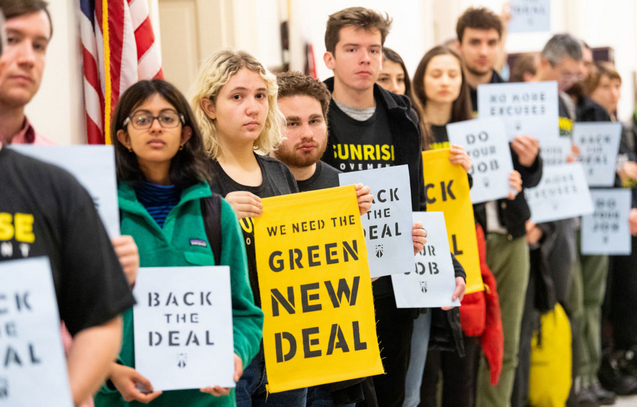
In January 2019, when the new Congress was being sworn in, many students urged our legislators to move on a “Green New Deal” which centers around clean, renewable energy.
Students and youths in a hallway of Congress. Michael Brochstein/SOPA/Images/LightRocket
Strike for change
The United Kingdom has seen a large number of protests in many cities throughout the country recently. In February thousands of young people in Britain left their classrooms to take part in “a growing movement to protest the lack of action on climate change.”
This global movement is known as “Youth Strike for Change,” with protests from Tasmania to Europe.
They want climate change to be treated like a crisis it is by their politicians.

Just 12 years
The recent Intergovernmental Panel on Climate Change report supports their contention that climate change is serious, dangerous and needs to be addressed now.
We have just 12 years to avoid the more serious consequences of catastrophic climate change.
More than 10,000 youths in Leuven, Belgium have skipped school for the fifth Thursday in a row.
Some climate change deniers claim that these events “are being manipulated by politicians and environmental organizations.”
Indeed, one Belgian Environment Minister was forced to resign after she said she had security confirmation that these recent demonstrations were staged as a plot against her.
Meanwhile, NASA just confirmed that the last 5 years are the “Hottest Years On Record Globally”.


Links

Lethal Heating is a citizens' initiative