Sunday, July 28, 2019

How Much Has Tasmania's Climate Changed In The 100 Years To Now?

ABC News - Erin Cooper

Scientists say sea levels in Tasmania are rising by 3mm a year. (Facebook: Discover Tasmania)
Key points:
  • Tasmania's average temperatures are now a degree warmer than a century ago
  • Rainfall has also decreased as climate change results in less low-pressure systems
  • Sea levels are rising by three millimetres a year
We have all heard how bad it is going to get: a million species at risk of extinction, entire island nations going under as sea levels rise and more severe weather events more often.
Scientists and international organisations have been issuing the climate change warnings for decades, saying the future of Earth as we know it is under threat.
Tasmania — renowned for its natural beauty — is not immune, suffering its fair share of natural disasters and slowly-eroding land, all attributed — at least in part — to the changing climate. But if we know a bit of how bad it is going to be, do we know how bad it already is?
The ABC investigated how much the island state's climate has changed in the past 100 years.
Usually wet rainforest wilderness areas have been scorched in the past few years. (Instagram: Fire Rescue Tasmania)
Feeling hot, hot, hot

Climate change 'unparalleled' on global scale
Scientists find global warming is being felt (almost) everywhere at the same time and the warming is unprecedented over the past 2,000 years.

Climatologist with the Bureau of Meteorology in Tasmania, Ian Barnes-Keoghan, said the bureau had been collecting temperature observations since the late 1800s — and the data paints a very clear picture.
"It doesn't matter how you cut it up, you still get the same message that temperatures over Tasmania have risen over the last century, particularly since the 1950s," he said.
"It's such a clear-cut story."
Averaged over the entire state, Mr Barnes-Keoghan said Tasmania is now about a degree warmer than it was a century ago.
But hot temperatures are also now more extreme than they used to be, with fewer very cold days.
"We're not saying that the temperature everyday is now a degree warmer than it was, but the average has moved up and we're seeing more of those extremely high temperatures, so your 35 and 40-degree days," Mr Barnes-Keoghan said.

Ian Barnes-Keoghan says a graph showing average temperatures shows the general increase of about a degree over the past 100 years, and especially since the 1950s. (Supplied: Bureau of Meteorology)

"Since 1910, there's been 12 days where somewhere in Tasmania has reported a temperature of 40 degrees or more. Four of those occurred in the first 93 years, the other eight only occurred in the last 17, and two of those were this year."
"It's often those extremes that people really notice."
As for the argument that the warming of the climate is cyclical, Mr Barnes-Keoghan said there was no reason why people should expect average temperatures will cool down again.
In fact, Scientists writing in the journal Nature this week said there was no evidence for "globally coherent warm and cold periods" over the past 2,000 years prior to industrialisation.
"We have a very good understanding of the mechanisms behind this warming, so the significant cause has been an increase in the concentration of greenhouse gasses in the atmosphere," Mr Barnes-Keoghan said.
"So just by simple physics that leads to an increase in the average temperature because more warmth is trapped close to the surface."

Tasmania is known for its freezing temperatures. (Supplied: Pat Fasnacht‎)
When it rains, it pours
Perhaps unsurprisingly, it is now also drier in Tasmania, with average rainfall across the state decreasing.
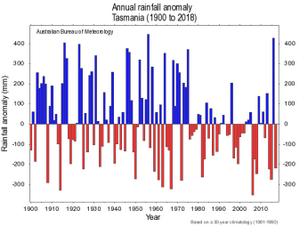
Ian Barnes-Keoghan says since the 1970s there have been fewer "wet" years, but 2016 was the second wettest on record. (Supplied: Bureau of Meteorology )
"There is less rain, on average, now than there was 40, 50 years ago, but there's a couple of things mixed in there," Mr Barnes-Keoghan said.
"One is that we still get wet years, like it rained a lot in 2016 — but the wet years have become less common and the dry years have become more common," he said.
He said the decline is strongest in late Autumn, heading into early winter.
Mr Barnes-Keoghan explained rainfall now behaves differently than it did in the past.
"[In the past,] you'd get a couple of dry years, then a couple of wet years to make up for it," he said.
"But sometime around the mid-70s, that pattern seems to have changed.
"Instead of having a mixture, it went to getting several dry years in a row, then a wettish year but not really that exciting, then a couple of dry years and just not getting those recharge years."
But explaining why is a bit more complex.
"Rainfall is complicated, but one of the reasons there's been less rainfall is there are less rain-bearing systems," Mr Barnes-Keoghan said.
"That partly comes about because of an increase in high-pressure systems — that's a known and expected consequence of increasing greenhouse gases.
"Rainfall is hugely variable from year to year, much more variable than temperature, so picking out trends in rainfall is much harder."
Mr Barnes-Keoghan also said the warmer atmosphere holds more moisture, so when it does rain, it's now often in quicker and heavier bursts.

But what about wind and snow?
No data is kept on snowfall but many believe it's not as prevalent as in the past. (Supplied: Cam Blake Photography)
So if Tasmania's drier, is it also getting less snow?
Mr Barnes-Keoghan said while it certainly seemed that way, there was no available data to back that up.

Ian Barnes-Keoghan says average temperatures are not expected to cool down again. (ABC Radio Hobart: Carol Rääbus)

"The bureau does not have a good long-term collection of snow data," he said.
That's because it doesn't snow that often over most of Tasmania and in particular, it doesn't snow that often in populated areas.
Mr Barnes-Keoghan said a lot of the historical observations really relied on somebody being there to take the measurement, which didn't always happen.
"I've been here for a long time and I get the impression that snow is less common than it was, but that's completely an anecdote," he said.
Wind is also hard to measure, though Mr Barnes-Keoghan said average windspeeds were decreasing, albeit not by much.
He said the bureau had only really collected data on wind since the 1990s, and even then, it might be skewed because equipment had been positioned in locations known to be particularly windy.
"To measure rainfall you basically need a jam jar, I mean we have very sophisticated jam jars which are calibrated, but measuring wind speed is really difficult," he said.
"The instruments we've got now were really only developed during the 1950s and only became widespread in Australia during the 80s and 90s. [They] only became really important around the 90s so we've really only got measurements since then."
Is Tasmania going under (the sea)?
Not quite yet, but sea levels are estimated to be rising 3 millimetres each year.
Retired oceanographer and sea-level-rise expert John Hunter said sea levels had risen by about 16 centimetres since 1841 — when the first sea-level benchmark was put in place at Port Arthur, on Tasmania's south-east coast, adding levels had risen by about the same amount "pretty much everywhere".

John Hunter kneels next to the 1841 sea level gauge which is carved into rock at Port Arthur. (Supplied: Frederique Olivier)

He explained that was due to two factors: the warming climate heating up water, causing it to expand "like liquid in a thermometer", and melting ice on land.
Mr Hunter said that while 3 millimetres a year might not sound like much, it had big consequences.
"The rule of thumb I use is that if you have about 10 centimetres of sea-level rise, which we've already seen last century, [the] frequency of flooding events goes up by a factor of three. So 10 centimetres trebles the amount of flooding events."
He said people tended not to notice the changes because they occurred over decades and coastal infrastructure was built accordingly, so "people just build sea walls a bit higher".
But people may see shorelines receding, which is one of the results of rising seas.
"For every metre of sea-level rise, you lose between 100 and 200 metres of shoreline," he said.

Wet years such as 2016, which saw heavy flooding, are becoming less common, according to the Bureau of Meteorology. (Copyright Neil Hargreaves)

NOTE: The ABC investigated changes in the island state's climate as part of our Curious Climate series. Curious Climate Tasmania is a public-powered science project, bridging the gap between experts and audiences with credible, relevant information about climate change. The project is a collaboration between ABC Hobart, UTAS Centre for Marine Socioecology, the Institute for Marine and Antarctic Studies (IMAS), the Tasmanian Institute of Agriculture (TIA), and the CSIRO.

Links

How To Talk Effectively About Climate Change

Scientific American - Max Boykoff

Our conversations have been stuck, but a new book lays out a number of ways to get them flowing productively
Credit: Getty Images
Lately, climate change has imposed itself on the public sphere. Through extreme events linked to changes in the climate, new scientific reports and studies, and rejuvenated youth movements (along with many other political, economic, scientific, ecological, meteorological and cultural events and issues) climate change has been increasingly difficult to ignore.
But you wouldn't really have picked up on that in the first round of the U.S. Democratic party primary debates that took place in Miami, Florida. As 20 candidates made their case to the American people, it was striking how minimally and shallowly they discussed climate change.
Sadly, this illustrates a contradiction we have been living with for some time. That is this: amid extensive research into the causes and consequences of climate change, climate communications—and thus, conversations about climate change in our lives—have remained stuck.
There are many reasons. Among them:
  • Climate change is still regularly treated as a single issue. This was clearly on display in the debates, and even during the paltry time devoted to surface-level discussions of climate change.
  • There has continued to be inadequate funding provided to support sustained and coordinated social science and humanities research into what constitutes more effective climate communications.
  • We have all been short on creativity, and we generally have stuck to ineffective climate communications approaches (e.g. merely scientific ways of knowing) as we muddle along.
Yet climate change is a collective action problem that intersects with just about every other area of life. It traverses critical issues such as public health, jobs, education, inequality, poverty, violence, trade, infrastructure, energy, foreign policy and geopolitics. While everyday people clearly have the capacity to care, they reasonably often focus on immediate concerns, such as issues of job security, local school quality, crime and the economy. In recent years, however, it has become more and more clear that these issues are interlinked with climate change.
So, in making these connections, we can more effectively get to the heart of how we live, work, play, find happiness and relax in modern life, shaping our everyday lives, lifestyles, relationships and livelihoods.
There has been an urgent need to improve communications about climate change at the intersections of science, policy and society. With that in mind, I wrote Creative (Climate) Communications. It is essentially a handbook that bridges sectors and audiences to meet people where they are on this critical 21st-century challenge. In the book I integrate research from the social sciences and humanities that has provided insights into better understanding what communications work, where, when, why and under what conditions.
I also examine how to harness creativity for more effective engagement. I integrate these lessons by assembling what I call features on a "road map" along with "rules of the road." The guide is then meant to help as researchers and practitioners proceed with both ambition and caution into struggles to effectively address the many issues associated with climate change.
Through this guidance, I seek to help maximize effectiveness and opportunities and minimize mistakes and dead ends in a resource-, energy- and time-constrained environment. In putting this together, I also emphasize that successful and creative climate communications strategies must be tailored to perceived and intended audiences and can be most effective when pursued through relations of trust. And I underscore that context is critical; cultural, political, social, environmental, economic, ideological and psychological conditions matter.
From synthesizing this work, I distill these lessons into some important "rules of the road."
  • Be authentic.
  • Be aware.
  • Be accurate.
  • Be imaginative.
  • Be bold.
From there, additional features on the road map help to navigate toward resonant and effective communications.
  • Find common ground on climate change.
  • Emphasize how climate change affects us here and now, in our everyday lives.
  • Focus on benefits of climate change engagement.
  • Creatively empower people to take meaningful and purposeful action.
  • "Smarten up" communications about climate change to match the demands of a 21st-century communications environment.
These rules and features can then help to meet people where they are in their everyday realities while opening up spaces for productive discussions and deliberations about climate change.
This approach can help to expand a spectrum of possibility for meaningful, substantive and sustained responses to contemporary climate challenges. Also, these "rules of the road" and the "road map" help make connections between climate change and other pressing issues that everyday people care about.
I also argue that an expanded approach involves processes of listening and adapting rather than winning and argument or talking people into something. Authentically considering other points of view fosters meaningful exchanges and enhances possibilities for finding common ground. Facts established through scientific ways of knowing about climate change are important, but they are not enough. We therefore need to enlarge considerations of how knowledge influences actions, through experiential, emotional, visceral, tactile, tangible, affective and aesthetic ways of learning and knowing about climate change.
Careful approaches informed by social sciences and humanities scholarship provide space and perspective for more authentic participatory engagement. They can overcome limited approaches and narrow mindsets that have blocked off these needed pathways. As a result, these approaches can then more effectively recapture what may be seen to be a "missing middle ground" on climate change in the public arena.
Through this systematic work, I hope we can better understand that a creative "silver buckshot" approach—in which different strategies are needed to reach different audiences in different contexts—will significantly improve creative climate communication efforts going forward. I hope my book catalyzes the ability of researchers, practitioners, decision-makers and everyday people to get more organized and steer our discussions and actions more productively.
As the Democratic primary debates illustrate all too well, we continue to miss opportunities to make deeper and more creative connections with climate change and related issues.

Links

Want To Do Something About Global Warming? Talk About It With Your Family And Friends

Los Angeles Times - 

Simply increasing the frequency of climate-related discussions shifted people’s perceptions of the scientific consensus around human-caused global warming, as well as their own attitudes on the matter, new research suggests. (Dreamstime)
There’s the old saying that you should never discuss politics or religion in polite company. Nowadays, it seems climate change has joined that list.
Barely more than a third of Americans broach the subject often or even occasionally, according to a recent survey by researchers at the Yale Program on Climate Change Communication.
All this not talking about climate change has given Americans a rather skewed perception of what the rest of the country thinks about the issue.
The average person estimates that only 54% of her fellow Americans believe climate change is happening. In reality, 69% do, according to the same Yale survey.
The more we talk about global warming, the more we might move the needle on public opinion, the Yale team reported Monday in the Proceedings of the National Academy of Sciences.
The researchers found that simply increasing the frequency of climate-related discussions shifted people’s perceptions of the scientific consensus around human-caused warming as well as their own attitudes on the matter.
“These findings suggest that climate conversations with friends and family enter people into a proclimate social feedback loop,” the researchers wrote.
Matthew Goldberg is a social psychologist at Yale University and lead author of the new study. He spoke with The Times about climate silence and how to break it.

What is climate silence?
Our most recent nationally representative survey shows that 69% of people find climate change to be at least somewhat important to them. But only 37% discuss it at least occasionally. So most people think it’s important yet most people don’t talk about it. This discrepancy is often referred to as climate silence.

Why don’t Americans talk about climate change more?
There are a lot of reasons. For some, the issue just isn’t salient to them. But there’s also a lot of research on perceptions about what others think. People are hesitant to talk about something that they see as contested or potentially controversial in their social network, so they remain silent.

But you found that people are often wrong when it comes to judging what others think about climate change. Does that help suppress conversation?
If you think everyone disagrees with you, or most people disagree with you, then you are not going to want to speak up. It starts this spiral of silence where people misjudge the beliefs of others, and then they remain quiet about this important issue.

Is everyone equally mistaken, or do misperceptions vary across groups?
In general, you tend to think that people around you share the beliefs that you have. So the most accurate folks were liberal Democrats. They were off by just 6 percentage points, guessing 63% instead of 69%. That’s likely because liberal Democrats know a lot of other Democrats, so they correctly believe that a lot of people around them believe climate change is happening.
Where we see the biggest discrepancy is at the opposite end of the political spectrum: conservative Republicans. If you’re only hearing from elite Republicans who are largely dismissive of climate science, then you are going to infer that a lot of people around you don’t believe it’s happening. So they were way off. They estimated the percentage was 48%.

Whether old or young, male or female, urban or rural, Americans tend to underestimate the extent to which other Americans think global warming is happening. (Yale Program on Climate Change Communication and George Mason University Center for Climate Change Communication)


It seems like this 69% must encompass a broader swath of society than just liberal Democrats. Who are the others?
There’s no doubt that it’s not just a liberal phenomenon, and I think that needs to be part of our messaging strategy.
We've been highlighting prominent Republican voices, to the best extent we can, to show that there are people across the spectrum that believe this is an important issue. It’s just that their voices aren’t loud enough.

Can you describe your new study?
We dug into data that we collected back in 2015, when Pope Francis was giving speeches across the United States talking about the importance of climate change, and there was a lot of change in public opinion because people heard about it more in the media.
In the surveys, which were taken seven months apart, people reported how frequently they talked about climate change with family and friends. We wanted to know whether talking more about it altered people’s perceptions of the scientific agreement around human-caused global warming, and we found that it did.

Why did you focus on the scientific consensus?
One reason is that past research coming out of our center has shown that it’s very influential. There’s still work to be done on why, but what I suspect it's because it's easy to communicate and it’s very powerful.

And what is the scientific consensus?
Studies show that 97% of climate scientists have concluded that human-caused global warming is happening.

When you looked at the numbers, what did you find?
We found that an increase in discussion — from rarely to occasionally, or occasionally to often — predicted a 2 to 3 percentage-point increase in the belief in the scientific consensus.
It’s a modest effect, but it matters a lot when you’re hovering around 50%, which is the most common estimate of scientific agreement. People have this false dichotomy that some scientists believe it’s happening and some scientists don’t.

What else happened when people talked more about this?
Changes in the perception of scientific consensus led to significant changes in people’s own beliefs that climate change is happening, that it’s human-caused, and in their worry about the issue. So those small changes can lead to big practical differences.

Why are family and friends so powerful?
Messengers matter very much. If a message comes from a credible communicator or one that has moral authority, then that will be very persuasive. And family and friends are the most important messengers. For one thing, they have closest proximity. They also are not easily ignored.

Your results suggest there's a kind of feedback loop. What's going on there?
We found that discussion leads to increased belief in the scientific consensus around human-caused warming and that belief in scientific consensus leads to more discussion. That could potentially start this positive cycle toward belief change.
It’s hard to say why that is. I speculate that once you have more certainty in a belief, it’s easier to go and share your belief rather than your ambivalence.

How do you suggest starting a conversation about climate change?
Start with common ground. To the extent that you can overlap the issue of climate change with the values of whoever you are talking to, the more effective your message will be.
For many people, climate change is really low on the list of issue priorities. But it’s so far-reaching that it can wrap into most other important issues. So you could take a healthcare angle, you could take a national security angle, an economic angle, or a campaign finance one. A lot of people care about these issues.
I find that taking a pollution perspective makes it very easy to talk to people about climate change. Because who is not against pollution?

What's another example?
We have a new study coming out where we engaged Christians on the issue of climate change. And we found that, of people that believe it’s happening, 19% cited protecting God’s creation as the single most important motivation for wanting to reduce global warming. That’s one in five.
We followed that study up with two experiments. We wrote messages that tried to convey that other Christians clearly care about this issue, and that it is our moral and religious obligation to deal with it. Basically, we said, "If you believe that God created this Earth, then this is something that you should want to protect and not allow to be degraded." And we found that that was a very influential message.

Isn't that kind of manipulative?
I see it more as understanding what’s most important to people. I’m trying to speak to what you care about.

Got any ice-breakers?
It’s almost comical how often weather is used for small talk. But that’s a good entry point. For instance, you could mention that there are temperature records being broken all over the world. Weather is also a good way to not touch on the buzzwords for potentially skeptical audiences.
Another approach is to weave in climate change if you’re already talking about another issue, like extreme weather or natural disasters. There’s a way to ease into it by saying something like, "Did you know that a warming climate will make hurricanes worse?"

In the big picture, how important is it that we start talking more about climate change?
I think it’s massively important, particularly because we are not doing it enough. A lot of the time, we assume that we are always going to be having these conversations with a skeptical audience. But in many cases, the other person cares about it just as much as you do.
There is the potential for it to backfire when you have people that are very strongly on the other end of this, but they are in the minority. This is why I emphasize the role of friends and family, because they are not relationships you can easily ignore.

Links

Saturday, July 27, 2019

Recent Warming ‘Unmatched In The Past 2000 Years’

Cosmos - Richard A Lovett

Events are happening globally and simultaneously, research shows.
Modern climate change is starkly different because more than 98% of the Earth is warming simultaneously, research shows. AUSCAPE / GETTY IMAGES
Climate-change sceptics sometimes argue that there is no cause for concern from global warming because in the past 2000 years the world has already gone through several natural cycles of warming and cooling from which it has always rebounded on its own.
However, new research has found that rather than being global events, these natural cycles were actually regional changes that never affected more than part of the globe at any one time.
Furthermore, these warming and cooling patterns didn’t occur anywhere close to simultaneously in the parts of the world they did affect.
The findings are published in a suite of papers in the journals Nature and Nature Geoscience.
“Traditionally, the understanding is that there were globally coherent periods of climate variability,” says Nathan Steiger, a paleoclimatologist at Columbia University’s Lamont-Doherty Earth Observatory in New York, US, who was part of a study team led by Raphael Neukom, a climate researcher from the University of Bern, Switzerland.
“There was a cold period called the Little Ice Age [1300-1850 AD], a warm period called the Medieval Warm Period [800-1200 AD], and a couple of other periods as we go back further in time [the Dark Ages Cold Period, 400-800 AD, and the Roman Warm Period, 1-400 AD].
“But what we show is that these periods weren’t globally coherent, as previously thought.”
Modern climate change, on the other hand, is starkly different, not just because of the rapid rate of warming, but because more than 98% of the Earth is warming simultaneously.
“That very much stands out in contrast to the past 2000 years,” Steiger says.
The reason this wasn’t discovered before appears to be that these multi-century warming and cooling epochs were best documented in Europe. So much so, that most of their names are tied to European history: Medieval Warming, Dark Ages Cooling, Roman Warming.
“It was easy to make the assumption that these changes were happening everywhere on the planet at the same time,” says Scott St. George, a paleoclimatologist at the University of Minnesota, US, who was not part of the study team, but wrote a supporting commentary in Nature.
“What this study has demonstrated is that less than half of the planet was being pushed in the same direction – whether warming or cooling – at the same time.”
Now, he says, “no matter where you go, everywhere is being pushed in the same direction at the same time”.
To prove this, Steiger, Neukom and colleagues turned to a newly created global database of climate records called PAGES 2k, which compiled nearly 700 measures of climate over the past 2000 years, based on such measures as tree rings, ice cores, growth patterns in coral reefs, cave deposits, and sediment records, from across the world.
From this, for example, they discovered that the coldest parts of the Little Ice Age hit the central and eastern Pacific in the fifteenth century, but didn’t hit major parts of Europe or North America until the seventeenth century – and were delayed in other parts of the world until the nineteenth.
Not that this means natural processes can’t produce simultaneous climate shifts.
But, unlike the multi-century shifts, these occur over time horizons of a decade or two, says Neukom, who led a separate study that used the same PAGES 2k dataset to look at shorter-term shifts in global climate.
What they found, Neukom says, is that in pre-industrial times these shifts were driven primarily by major volcanic eruptions, which blasted fine particles high into the atmosphere, producing a bright haze that reflects sunlight back into space, reducing the amount of heat reaching the Earth’s surface.
In yet another study, a team led by Stefan Brönnimann, also of the University of Bern, concluded that many of the impacts of even the Little Ice Age are the result of volcanic activity – specifically a cluster of five major eruptions that occurred between 1808 and 1835.
The most famous of these is the 1815 eruption of Indonesia’s Mt. Tambora – one of the most massive volcanic blasts in human history, and cause of what later became known in major parts of the Northern Hemisphere as “The Year Without a Summer”.
These blasts, Brönnimann, says, produced a “gear shift” in many parts of the world’s climate systems, producing, among other things, weak monsoons in Africa and India, and changes in ocean circulation that produced climate effects that reverberated all the way through the 1840s.
Among other things, these caused a southward shift in North Atlantic storms that dumped more snow in the Alps and contributed to advance of their glaciers, years after the last of the eruptions.
St. George adds that it’s also been suggested that the Medieval Warm Period might, in large part, have been created by a “long, quiet period” without major volcanic eruptions. “It sounds plausible,” he says.
As for the cause of the current warming period?
“We didn’t address the question of human causes,” Steiger says. “It’s implied, rather than explicit. There’s a lot of evidence that the contemporary period is human-caused. We don’t have to look at paleoclimate to look at that.”

Links

2,000 Years Of Records Show It’s Getting Hotter, Faster

The Conversation - 

European heatwaves are part of a pattern of rapid global warming. EPA/ABEL ALONSO
New reconstructions of Earth’s temperature over the past 2,000 years, published today in Nature Geoscience, highlight the astonishing rate of the recent widespread warming of our planet.
We also now have a clearer picture of decade-to-decade temperature variations, and what drove those fluctuations before the industrial revolution took hold.
Contrary to previous theories that pre-industrial temperature changes in the last 2,000 years were due to variations in the Sun, our research found volcanoes were largely responsible. However, these effects are now dwarfed by modern, human-driven climate change.

Reading the tree rings
Without networks of thermometers, ocean buoys and satellites to record temperature, we need other methods to reconstruct past climates. Luckily, nature has written the answers down for us. We just have to learn how to read them.
Corals, ice cores, tree rings, lake sediments, and ocean sediment cores provide a wealth of information about past conditions – this is called “proxy” data – and can be brought together to tell us about the global climate in the past.

Tree rings, corals and ice cores all provide ‘proxy data’ – information about changing temperatures over the centuries. Simon Stankowski/Unsplash, CC BY
Teams of scientists around the world have spent many thousands of hours of field and laboratory work to collect and analyse samples, and ultimately publish and make available their data so other scientists can undertake further analysis. 
Previously, our team, along with many other proxy experts, meticulously analysed and collated temperature-sensitive proxy data covering the last 2,000 years from around the world, creating the largest database of temperature-sensitive proxy data yet assembled. We then made all of the data publicly available in one place.

Astonishing consistency between reconstruction methods
With this unique dataset in hand, our team set about reconstructing past global temperature.
We scientists are notoriously sceptical of our own analysis. But what makes us more confident about our findings is when different methods applied to the same data yield the same result.
In this paper we applied seven different methods to reconstruct global temperature from our proxy network.
We were astounded to find that the methods all gave remarkably similar results for multidecadal fluctuations – a very precise result considering the breadth of the methods used.
This gave us the confidence to delve further into what drove global temperature fluctuations on decadal timescales before the industrial revolution really took hold.

What happened before human-induced climate change?
Our study produces the clearest picture yet of Earth’s average temperature over the past two millennia. We also found that climate models performed very well in comparison, and they succeed in capturing the amount of natural variability in the climate system - the natural ups and downs in temperature from year-to-year and decade-to-decade.
Using climate models and reconstructions of external climate forcing, such as from volcanic eruptions and solar variability, we deduced that before the industrial revolution, global temperature fluctuations from decade to decade in the past 2,000 years were mainly controlled by aerosol forcing from major volcanic eruptions, not variations in the Sun’s output. Volcanic aerosols have a temporary cooling effect on the global climate.
Following these temporary cooling periods our reconstructions show there is an increased probability of a temporary warming period due to the recovery from volcanic cooling.


Earlier this year One Nation leader Pauline Hanson suggested that volcanic eruptions may be responsible for the recent rise in atmospheric carbon dioxide levels.

Recent warming is far beyond natural variability
There are, of course, natural changes in Earth’s temperature from decade to decade, from century to century, and also on much longer timescales. With our new reconstructions were also able to quantify the rate of warming and cooling over the past 2,000 years.
Comparing our reconstructions to recent worldwide instrumental data, we found that at no time in the last 2,000 years has the rate of warming been so high.
In statistical terms, rates of warming during all 51-year periods from the 1950s onwards exceed the 99th percentile of reconstructed pre-industrial 51 yr trends. If we look at timescales longer than 20 years, the probability that the largest warming trend occurred after 1850 greatly exceeds the values expected from chance alone. And, for trend lengths over 50 years, that probability swiftly approaches 100%.
 So what do all these stats mean? The strength of the recent warming is extraordinary. It is yet more evidence of human-induced warming of the planet.

But hasn’t there been natural climate change in the past?
Our understanding of past temperature variations of the Earth contributes to understanding such fundamental things as how life evolved, where our species came from, how our planet works and, now that humans have fundamentally altered it, how modern climate change will unfold.
We know that over millions of years, the movement of tectonic plates and interactions between the solid earth, the atmosphere and the ocean, have a slow effect on global temperature. On shorter (but still very long) timescales of tens to hundreds of thousands of years, our planet’s climate is gradually influenced by small variations in the geometry of the Earth and the Sun, for example, small wobbles and variations in the Earth’s tilt and orbit.
From the Last Glacial Maximum, about 26,000 years ago, when huge ice sheets covered large parts of the Northern Hemisphere landmass, Earth transitioned to a 12,000-year warm period, called the Holocene.
This was a time of relative stability in global temperature, apart from the temporary cooling effect of the odd volcano. With the development of human agriculture, our prosperity and population grew. Before the industrial revolution, Earth had not seen carbon dioxide concentrations above current levels for at least 2 million years.

Following the industrial revolution, warming commenced due to human activity. With a clearer picture of temperature variations over the past two millennia we now have a better understanding of the extraordinary nature of recent warming.
It is up to all of us to decide whether this is the kind of experiment we want to run on our planet.

Links

Barwon-Darling River Faces 'Collapse' From Government Mistakes: Report

Sydney Morning Herald - Peter Hannam

Immediate changes are needed to avoid the "collapse" of Australia's longest river system, with a government agency finding over-extraction brought forward drought conditions for parts of the river by three years.
In a highly critical draft review of the 2012 water sharing plan for the Barwon-Darling, released on Wednesday, the NSW Natural Resources Commission found the riverine ecosystem to be "in crisis".
Some aquatic species "will take decades to recover, if they recover at all", it said, blaming in part changes that allowed irrigators greater extraction rights. Cotton alone used about 1 trillion litres in the five years to 2015-16.
The longest river system in Australia is on course for "collapse", the NSW's Natural Resources Commissioner warns in a new report. Credit: Janie Barrett
"There is clear evidence to indicate that the [water-sharing] plan rules are resulting in more frequent and longer cease-to-flow periods," said the report, which covers an area from Mungindi on the Queensland border to just south of Wilcannia in far-western NSW.\"There is an urgent need to remake the plan so the current trend of a river system heading towards collapse is reset, and the river and its dependent species, communities and industries are put on a path towards long term health and resilience," commissioner John Keniry said in a statement.
The commission makes 17 recommendations aimed at promoting three stages of reform. The first priority, though, should be for "an open, evidence based, and independently peer reviewed process to develop a new plan".
The report comes at a time when most of NSW and other parts of the Murray-Darling Basin are facing an intensification of drought with little immediate relief predicted in coming months at least.
Many towns are facing tight water restrictions, important wetlands are drying out and many farmers are facing limited, if any, water allocations for the current year. Residents of Menindee on the lower Darling fear a return of mass fish kills this summer.

'Scathing' report
Several mass fish kills in the Darling River at Menindee illustrated the plight of the river during the past summer. Credit: Nick Moir
The Berejiklian government should make "immediate" changes to the plan by next year "to rebuild social licence for water management in local communities" as the first stage of suggested changes, the report says.
The NSW Department of Planning, Industry and Environment should then remake the plan by July 1, 2023, when the current one expires, and it should also review upstream water sharing plans that affect the Barwon-Darling, it said.
Kate Smolski, chief executive of the NSW Nature Conservation Council, said it was a "scathing report which places the blame for the ecological catastrophe we have seen unfold in the Darling squarely at the feet of the NSW government for allowing over extraction by upstream irrigators".
"The report also highlights the devastating effect that climate change will have on water availability in the catchment," Ms Smolski said. "It is clear that a comprehensive review of climate change impacts on water availability across the entire Murray-Darling Basin is needed."
A commission spokesman said climate change "was not effectively addressed" in the 2012 plan.
"Latest CSIRO best estimates of climate change show that while rainfall predictions are highly uncertain temperatures will increase and evaporation rates will increase," he said.
"In-flows to the Barwon-Darling are likely to decline in the future, resulting in a 10 per cent reduction in end-of-system flows by 2030."
A cotton farm near Bourke on the Barwon-Darling in north-west NSW endures dry times. Credit: Kate Geraghty
'Near-criminal'
Jodi McKay, NSW Labor leader, told reporters the handling of the Barwon-Darling was "near-criminal", and said the report was a "significant indictment of the management of water by the National Party in this state".
"We've always said National Party ministers shouldn't be in charge of water", Ms McKay said.
A spokeswoman for Melinda Pavey, the water minister, said the government would review the draft and respond to its recommendations when the report is finalised in September.
"The government has embarked on significant water reform over the past 12 months as was recognised by the NRC in the report," she said.
‘Water is critical to everyone in our western NSW communities and their feedback on the draft report will be integral to how we respond to the recommendations."
Ms Pavey's predecessor, Niall Blair, said "at no time during my time as water minister, did I shy away from the hard decisions".
He cited his move to bring forward the review of the plan by several years, the greater protection of environmental water, and the establishment of the Natural Resources Access Regulator as examples of those measures.
Roy Butler, the Shooters, Fishers and Farmers Party member who won the seat of Barwon during the March state election, said the existing plan may have a 40 billion litre a year hole in terms of over-allocated water.
What's needed now was a careful overhaul of the plan "based on the best scientific evidence we can find", not "populist slogans for more dams", Mr Butler said.
Comment has been sought from Energy and Environment Minister Matt Kean and from the NSW Irrigators Council.
'Appropriate' urgency
Rob Vertessy, a Melbourne University hydrologist who led a federal government inquiry into the Menindee fish kills last summer, said the report was "certainly timely and infused with the appropriate sense of urgency".
Among key recommendations that matched those of his report included modifying water access arrangements to protect low flows, maintaining connectivity of the rivers and protecting environmental flow, Professor Vertessy said.
The failures of the current plan include the lack of ecological targets and a failure to allocate water in line with Native Title for the river known as the Barka to the indigenous community.
For its part, the Murray-Darling Basin Authority said it did not have powers to assess the water-sharing plan because it was made before the wider basin plan came into force.
"The MDBA welcomes the findings and looks forward to seeing the new Water Resource Plan for the Barwon-Darling give effect to these important recommendations," a spokeswoman said.

Links

Friday, July 26, 2019

'Time To Rebel': Greta Thunberg Adds Voice To New Song By The 1975

The Guardian - 

On band’s latest single, 16-year-old activist urges young people to act on climate emergency
 ‘The rules have to be changed’ ... Greta Thunberg, left, with Matt Healy of the 1975 
Greta Thunberg’s Speech

We are right now in the beginning of a climate and ecological crisis.
And we need to call it what it is. An emergency.
We must acknowledge that we do not have the situation under control and that we don’t have all the solutions yet. Unless those solutions mean that we simply stop doing certain things.
We admit that we are losing this battle.
We have to acknowledge that the older generations have failed. All political movements in their present form have failed.
But homo sapiens have not yet failed.
Yes, we are failing, but there is still time to turn everything around. We can still fix this. We still have everything in our own hands.
But unless we recognise the overall failures of our current systems, we most probably don’t stand a chance.
We are facing a disaster of unspoken sufferings for enormous amounts of people. And now is not the time for speaking politely or focusing on what we can or cannot say. Now is the time to speak clearly.
Solving the climate crisis is the greatest and most complex challenge that homo sapiens have ever faced. The main solution, however, is so simple that even a small child can understand it. We have to stop our emissions of greenhouse gases.
And either we do that, or we don’t.
You say that nothing in life is black or white.
But that is a lie. A very dangerous lie.
Either we prevent a 1.5 degree of warming, or we don’t.
Either we avoid setting off that irreversible chain reaction beyond human control, or we don’t.
Either we choose to go on as a civilisation or we don’t.
That is as black or white as it gets.
Because there are no grey areas when it comes to survival.
Now we all have a choice.
We can create transformational action that will safeguard the living conditions for future generations.
Or we can continue with our business as usual and fail.
That is up to you and me.
And yes, we need a system change rather than individual change. But you cannot have one without the other.
If you look through history, all the big changes in society have been started by people at the grassroots level. People like you and me.
So, I ask you to please wake up and make the changes required possible. To do your best is no longer good enough. We must all do the seemingly impossible.
Today, we use about 100 million barrels of oil every single day. There are no politics to change that. There are no rules to keep that oil in the ground.
So, we can no longer save the world by playing by the rules. Because the rules have to be changed.
Everything needs to change. And it has to start today.
So, everyone out there, it is now time for civil disobedience. It is time to rebel.
Greta Thunberg has made her musical debut on a single by the 1975.
 On a track called The 1975, a version of which traditionally opens each of the British band’s albums, the 16-year-old environmental activist restates her position on the need to act on the climate emergency.
Over minimal orchestral backing, Thunberg says: “We have to acknowledge that the older generations have failed.
"All political movements in their present form have failed. But homo sapiens have not yet failed. Yes, we are failing, but there is still time to turn everything around.”
She continues: “We are facing a disaster of unspoken sufferings for enormous amounts of people. And now is not the time for speaking politely or focusing on what we can or cannot say. Now is the time to speak clearly.”
Thunberg concludes: “So, everyone out there, it is now time for civil disobedience. It is time to rebel.” (Full text opposite.)
The proceeds from the track will go to Extinction Rebellion at Thunberg’s request. Thunberg is the first outside party to feature on a recording by the band.
The track was recorded in Stockholm in late June and is the first song to be released from the 1975’s forthcoming album, Notes on a Conditional Form.
The band manager and founder of the label Dirty Hit, Jamie Oborne, said the group and the label were making efforts to minimise their environmental impact.
Dirty Hit’s office has phased out all single-use plastic, will no longer produce plastic products including CD jewel cases and is working to minimise the impact of vinyl production.
“Rather than ignoring that it’s a pollutant, we’re minimising it by only doing lightweight vinyl from now on,” Oborne said.
“That isn’t very trendy, but one heavyweight LP is the equivalent of making two or three [standard thickness LPs].”
Dirty Hit’s CDs and vinyl are contained in paper packaging and not wrapped in non-degradable shrink wrap.
Oborne said they had sourced a biodegradable shrink wrap which they would integrate fully once their production plants had full access to it. The 1975’s next merchandise line will also be environmentally friendly, repurposing unsold merchandise into new garments.
Oborne dismissed peers’ suggestions that the organisation could be labelled hypocritical for taking a stance on the climate crisis before becoming 100% carbon efficient.
“That’s why we’re in this situation where everyone’s standing around and it takes a child to point out that we can make these changes,” he said, referring to Thunberg.
“We’re not going to have touring worked out in six weeks because everything’s working against you, but we are going to have it sorted out in a period of time, and 50% is better than nothing. If everyone pushes responsibility onto other people because they can’t completely solve [the issue], we’re already fucked.”
The track release follows Thunberg’s address to French politicians on 23 July, in which she urged them to “unite behind the science” of climate change.
After rightwing legislators said they would not attend her appearance at the National Assembly, she said youth climate activists have become “the bad guys” for stating “uncomfortable things”.
“Just for quoting or acting on these numbers, these scientific facts, we receive unimaginable amounts of hate and threats,” she said.
“We are being mocked and lied about by members of parliament and journalists.”
 On 20 September, Thunberg and other young environmental activists will lead a climate strike around the world.
The 1975’s new album is the second in their Music for Cars series, which began in November 2018 with A Brief Inquiry Into Online Relationships.
The group will headline this year’s Reading and Leeds festivals in August.

Greta Thunberg addresses the French National Assembly in Paris on 23 July 2019.
Photograph: JP Pariente/SIPA/Rex/Shutterstock

Links

Lethal Heating is a citizens' initiative