27/09/2019

Could Climate Change Fuel The Rise Of Right-Wing Nationalism?

The Conversation | 

When people feel threatened, they’re more receptive to politicians who espouse xenophobic rhetoric. Trybex/Shutterstock.com
Two trends have defined the past decade and both have been on display at this year’s session of the United Nations General Assembly.
One has been the escalating effects of climate change, which were the focus of the United Nations’ Climate Action Summit. Forest fires, floods and hurricanes are all rising in their frequency and severity. Eight of the last 10 years have been the warmest on record. Marine biologists warned that coral reefs in the U.S. could disappear entirely by the 2040s.
The other trend has been the surge of right-wing nationalist politics across Western nations, which includes Donald Trump’s election in the U.S., and the rise of nationalist political parties around the world.
Indeed, the first four speeches of the United Nations general debate were given by Brazilian right-wing populist Jair Bolsonaro, Trump, Egyptian dictator Abdel Fattah el-Sisi and far-right Turkish President Recep Erdogan.
These two trends are rarely discussed together. When they are, their correlation is sometimes viewed as an unfortunate coincidence, since many nationalist politicians actively obstruct climate change solutions.
However, our new research suggests that these two trends may be closely related, and not in the way you might think. The effects of climate change – and the way it makes societies feel threatened – may be one of the elements fueling the rise of right-wing nationalism.

How climate shapes culture
To understand how climate shapes culture, it’s important to step away from current events and consider the way the climate has influenced societies throughout human history.
Cultures can vary in what’s called their “tightness” – the strictness or flexibility of their rules and traditions, and the severity of their punishments for rule breakers.
The Fellahin people of Egypt, for example, were one of the tightest cultures that we analyzed. For centuries, they’ve enforced strict gender norms and strong expectations for how children should be raised.
When cultures feel threatened – whether by war, disease or economic upheaval – they tend to become tighter.
But ecological threats can be just as strongly connected to tightening.
In one analysis, we showed that rates of famine and land scarcity predicted cultural tightness in historical societies. The Fellahin people have faced a constant threat of flooding, and have endured frequent earthquakes, sand storms and rockslides.
The Fellahin have weathered centuries of environmental disaster. Brooklyn Museum
Centuries of climate catastrophe can also predict differences in the cultural tightness in societies today. In another study we found that nations that have endured the highest rates of drought, food scarcity, natural disaster and climate instability have the tightest cultures today.
Even within the U.S., the states most vulnerable to climate disasters have the tightest cultures. A 2014 study found that states like Texas, Oklahoma and Alabama – which have the highest criminal execution rates and corporal punishment rates in schools – also have the highest historical rates of natural disasters such as tornadoes, floods and hurricanes.
Evolutionary analyses suggest that cultural tightness can be functional – even necessary – in the face of climate disaster. It can make people more cooperative, and more likely to follow protocols, like rationing, during a drought.
But our latest studies examined a darker side of cultural tightness. We wanted to know whether tightness also made people less tolerant of minority religions, ethnicities or sexual orientation. In other words, we explored whether prejudice thrives in tighter societies.
This dynamic would have serious consequences for our understanding of geopolitical events. If climate anomalies such as hurricanes and forest fires have a “tightening” effect on cultures – and these catastrophes are happening more frequently – it might be driving more people toward politicians who espouse xenophobic, homophobic or racist rhetoric.

Environmental threat and prejudice
To test these ideas, we brought together a group of 19 researchers from eight different nations. With expertise in economics, psychology and anthropology, our team was well-suited to study the effect of environmental threats and culture on prejudice and political nationalism.
We ended up studying 86 historical societies, 25 modern nations and the 50 U.S. states, analyzing data on more than 3 million people.
The results were strikingly consistent across these populations. The cultures most vulnerable to climate threats had the strictest cultural norms, and the highest levels of prejudice against minorities. For example, in American states with histories of climate threat and cultural tightness, white respondents reported the highest levels of aversion to marrying someone who was black, Asian or Hispanic. Turkey and South Korea had the tightest cultures, and also showed the most aversion to living near someone who was a different ethnicity, sexuality or religion.
We next tested whether we could cultivate these social and political attitudes in a laboratory setting. We recruited 1,000 people from around the world. We had some write about a threatening event in their environment, including – but not restricted to – climate. Others wrote about a threatening event in their personal life. The final group wrote about what they had for breakfast.
Subjects who wrote about a threatening event in their environment reported the highest support for stricter societal rules and regulations. These same people also reported the most prejudice toward ethnic minorities. This study showed that even brief reminders of an ecological threat could have an effect on people’s political leanings and make them less tolerant.
Finally, we explored how these issues tied into modern elections. We recruited American and French individuals during their respective countries’ most recent presidential elections.
We found that voters who felt the most threatened were most likely to support harsher punishments for rule-breakers, more adherence to traditional norms and expressed the highest levels of prejudice. Voters who felt threatened were also most likely to vote for Donald Trump and Marine Le Pen, each of whom ran on law-and-order, anti-immigration platforms.

One feeds the other
According to just about every estimate, climate change will only worsen. Without serious and immediate reform, temperatures and sea levels will continue to rise, along with the risk of destabilizing climatic events.
The natural perils of climate change are evident to many people already. But our research underscores a less visible geopolitical peril. As climate change increases the level of environmental threat, cultures around the world may become tighter, and the exclusionary rhetoric of far-right nationalist politicians may sound more and more appealing.
Since far-right nationalists are notorious for ignoring climate change, the rise of these politicians may also exacerbate the effects of environmental threat. This may create a vicious cycle, in which the threat of climate disaster and far-right nationalism encourage one another over time.
In this way, bipartisan action on climate change may not just be necessary to save the environment. It may also be an important way to ensure values like free speech and tolerance are preserved in countries and cultures around the world.

Links

Morrison Warns Against 'Needless Anxiety' After Thunberg Climate Speech

Sydney Morning Herald - David Crowe

Prime Minister Scott Morrison has warned against fuelling "needless anxiety" among Australian children following a scathing judgment from Swedish activist Greta Thunberg about the danger of climate change.
Mr Morrison called for "context and perspective" in the climate debate after the 16-year-old activist condemned today's leaders for leaving the next generation with a ruined climate.
Greta Thunberg and Scott Morrison. Credit:Wires/Alex Ellinghausen
"You know, I want children growing up in Australia that feel positive about their future," the Prime Minister said.
"And I think it's important that we give them that confidence, that they will not only have a wonderful country and pristine environment to live in, but they'll also have an economy that they can live in as well.
"So I think we've got to caution against raising the anxieties of children in our country."
Mr Morrison made the remarks in New York on Tuesday while attending the United Nations General Assembly, after being criticised for not going to a UN summit on Monday on the need to reduce greenhouse gas emissions.

Scott Morrison says there's a need for context and perspective when it comes to the climate change debate so children don't suffer needless anxiety.

Foreign Minister Marise Payne represented Australia at the summit.
Ms Thunberg told the UN gathering her generation "will never forgive you" if today's leaders do not scale back carbon emissions and prevent catastrophic increases in temperature.
"I should be back in school on the other side of the ocean," she said. "Yet you all come to us young people for hope. How dare you. You have stolen my dreams and my childhood with your empty words."
Asked about her remarks, Mr Morrison said children should remember that Australia and others had rebuilt after existential threats in the past, citing the way the United Nations was created after World War II.
"Yes, we've got to deal with the policy issues and we've got to take it seriously, but I don't want our children having anxieties about these issues," he said.
"I say this as a parent, too: we've got to make sure that our kids understand the facts, but they also have the context and the perspective, and that we do not create an anxiety among children in how we talk about and deal with these very real issues."
Mr Morrison, who has two daughters, said he did not have deep conversations with the children about emission targets and the Paris agreement but did talk to them about fossil fuels.
"I encourage them to have a passionate, independent view about how they see the world, but I also give them a lot of context," he said.
"I don't allow them to be basically contorted into one particular view; I like them to make their own mind.
"But I also like to give them reassurance because the worst thing I would impose on any child is needless anxiety – they've got enough things to be anxious about.
"I've always liked kids to be kids. And we've got to let kids be kids.
"We can't have them growing up as mushrooms either, but at the same time I think we've got to get a bit of context and perspective into this."

Links

Scott Morrison Uses UN Speech To Slam 'Internal And Global Critics' Of Australia's Climate Change Policy

ABC NewsJames Glenday


Morrison defends Australia's action on climate change in UN speech (ABC News)

Key points
  • Scott Morrison tells the UN that critics "willingly overlook or ignore" Australia's work on climate change
  • Earlier, he suggested media was responsible for "misinformation" spread about his Government's climate policies
  • Seemingly referencing Greta Thunberg, Mr Morrison said "we should let our kids be kids"
Scott Morrison has used his biggest moment on the world stage yet to attack "internal and global critics" of his Government's climate change policies.
The Prime Minister has been slammed by scientists and a few business people for skipping a special climate conference in New York on Monday.
Some said the Government had so far failed to put forward a "credible climate or energy policy".
But during a wide-ranging address to the United Nations General Assembly, Mr Morrison hit back, claiming critics "willingly overlook or ignore" the work Australia has done to curb emissions.
"The facts simply don't fit the narrative they wish to project about our contribution," he added.
"Australia is doing our bit on climate change and we reject any suggestion to the contrary."

  Why the Coalition is misleading
on the Kyoto 2020 target
The Prime Minister pointed out that Australia is responsible for just 1.3 per cent of global emissions, said the country only accounted for 5.5 per cent of global coal production, and stated that $13.2 billion was invested in clean energy technologies in Australia in 2018.
He also declared the nation had "overachieved" on its 2020 Kyoto protocol targets and would meet its Paris emissions reduction goals too.
"We are committed to reducing greenhouse gas emissions by 26 to 28 per cent below 2005 levels by 2030," Mr Morrison said.
"This is a credible, fair, responsible and achievable contribution to global climate change action."
Earlier in the day he seemed to suggest the media was responsible for spreading "misinformation" about his Government's climate policies.

  Paris 2030: Will we make it?
"What I've found is when I've sat down with Pacific leaders is they've been quite surprised," he told reporters.
"Criticisms that have been made about Australia are completely false and they're completely misleading and people have had a prejudiced view."
"Where do they get their information from? Maybe they read it.
"Australia's got nothing to apologise for."

Children's climate anxiety being 'facelessly exploited'
During his address, the Prime Minister revealed he received many letters from children concerned about their future.
He said he welcomed "their passion, especially when it comes to the environment".
Mr Morrison also seemed to make a direct reference to Swedish teenage climate change activist Greta Thunberg's highly-publicised address to world leaders on Monday and recent global youth climate strikes.

PM's Climate Summit snub sends strong message to neighbours
"We should let our kids be kids — teenagers be teenagers," he said.
"We must respect and harness the passion and aspiration of our younger generations, rather than allow others to compound or, worse, facelessly exploit their anxiety for their own agendas."
The Prime Minister also seemed to reject a warning from UN Secretary-General Antonio Guterres, who said on Tuesday he feared the world could soon experience a "great fracture" and become divided between the United States and China.
Mr Morrison said that the planet was "complex and contested" but added that Australia would continue to work with its "great and powerful friends".
"Many fatalistically see a polarised world where countries feel pushed to make binary choices," he said.
"Australia will continue to resist this path."


Greta Thunberg delivers scathing speech at UN climate summit (ABC News)

Links

26/09/2019

Climate Change Could Stretch Our Capabilities, Defence Force Chief Speech Warns

ABC NewsMelissa Clarke

The speech, obtained under freedom of information, was prepared for General Angus Campbell. (AAP: Andrew Taylor)
Key points
  • The Defence Chief's speech warns of the threat climate change poses to Australia's military and deployments
  • The speech was prepared for General Angus Campbell for an invitation-only event in regional NSW
  • It stated that climate change disasters have required more Australian personnel than the Afghan war
Increasingly frequent natural disasters caused by climate change could stretch the capability of the Australian Defence Force (ADF), according to a speech prepared for Defence Force Chief Angus Campbell.
It warns of climate change prompting more disaster relief efforts, as well as more peace-keeping missions, given it says climate change has "the potential to exacerbate conflict".
The speech, obtained under freedom of information, was prepared for General Campbell to deliver to an invitation-only retreat in regional New South Wales in June for managers from government departments and agencies.
It's not clear how closely he followed it, with General Campbell characterising his presentation as "extemporaneous" but drawing on "key facts and vignettes" from the written speech.
The speech notes that Australia is in "the most natural disaster-prone region in the world" and that "climate change is predicted to make disasters more extreme and more common".
It sets out the level of commitment required from the ADF to respond to climate change-related events compared to more traditional deployments.
"Australia sent around 1,000 troops to support Operation Fiji Assist [after Cyclone Winston], about 1,600 ADF personnel assisted after Cyclone Debbie hit Queensland and earlier this year, close to 3,000 troops helped North Queensland clean up after the floods," the written speech states.
"At the height of our involvement, we had about 1,500 troops in Afghanistan.
"The number of troops deployed on disaster relief missions can, at times, be a significant commitment for Defence.
"Deploying troops on numerous disaster relief missions, at the same time, may stretch our capability and capacity."
The global effort to combat climate change has been discussed at the United Nations in New York this week. (AP Photo: Evan Vucci)


Warming unprecedented in 2,000 years
As well as missions to assist after natural disasters, climate change could see the ADF drawn into more conflicts around the world, the speech warned.
It considers the Syrian civil war, setting out how climate change-induced drought "added enormous pressure" to existing problems.
"Defence may also be increasingly called upon to support stabilisation, governance or peace-keeping activities."
The written speech also set out how the Federal Government's actions on climate change could affect relationships with Pacific island nations, given they are asking Australia to do more to reduce emissions.
"It could impact our ability to influence their choices for support in the region."

Labor's Pat Conroy said whether or not the speech was delivered remains irrelevant. (ABC News: Matt Roberts)
Labor's spokesman for the Pacific, Pat Conroy, described the speech as the most significant from Defence in a decade, whilst noting General Campbell's insistence he spoke off-the-cuff at the event.
"It doesn't actually matter whether it was given or not," he said.
"This was the final speech, signed off by all of Defence, including the Chief of the Defence Force, as their official views at this forum on climate change as a national security threat."


An island's race against time
The Carteret Islands were the first place in the world to require population relocations due to climate change, with predictions they would be submerged by 2015.

The Department of Defence declined to clarify what General Campbell said, however prior reporting of the presentation included remarks identical to the written speech.
"If this is in a prepared speech for an outside event, you can guarantee Defence is giving this same advice to Government," Mr Conroy said.
"I'm heartened that the ADF is thinking about this seriously, as they should, and projecting into the long term.
"[The] Government is clearly not taking it seriously, otherwise you wouldn't have a very weak 2030 target that they have no hope of achieving."
The Federal Government last year signed the Boe Declaration, a Pacific-wide declaration stating that climate change is the single greatest threat to security in the region.
However, the Coalition was slammed at last month's Pacific Islands Forum leaders meeting in Tuvalu over its refusal to take stronger action to combat climate change.

Links

Australian Government Seen Globally As Climate 'Denialist', UN Summit Observers Say

The Guardian

Experts at the meeting say Australia is seen as ‘engaging in greenwashing’ and using accounting tricks to increase emissions
Scott Morrison inspects an interactive menu in Chicago while other leaders attend the climate summit. Photograph: Mick Tsikas/AAP
Scott Morrison is increasingly seen as running a “denialist government” that is not serious about finding a global climate solution and uses “greenwash” to meet its emissions commitments, analysts and former diplomats say.
Australian observers in New York said Morrison’s failure to attend a UN climate action summit on Monday despite being in the US, and his apparent rejection of the need for Australia to do more to address its rising greenhouse gas emissions, eroded goodwill for the country on the issue.
While representatives from about 60 nations spoke at the summit, Morrison gave a keynote speech at the Chicago Institute for Global Affairs in which he challenged China to do more heavy lifting on climate change and suggested it should be treated as a “newly developed” economy rather than a developing one.
Bill Hare, the chief executive and senior scientist of Climate Analytics and a longtime adviser to countries at climate talks, said the UN summit had been “very disappointing” as most larger polluters, including Australia, had failed to meet the secretary general Antonio Guterres’ call to increase commitments, leaving ambitious strides to smaller nations.
He said country representatives at the summit were dismissive of Australia’s intentions.
“Diplomatic officials from countries that I speak with see Australia as a denialist government,” he said. “It’s just accepted that’s what it is. It is seen as doing its own promotion of coal and natural gas against the science.”
Hare said Morrison’s suggestion China should be doing more on climate, and be treated similarly to the most developed countries, while Australia’s emissions continued to increase year-on-year was a “ridiculous fake argument”.
He said China, the world’s most populous country and biggest annual polluter, was not doing anywhere near enough to tackle the crisis, but was doing more than Australia on many measures. It had national policies in a number of areas – boosting renewable energy, energy efficiency, electric vehicles and efficiency in industry – where Australia did not.
“Is that having enough of an effect in China? No. But will China peak its emissions by the end of the 2020s? Yes,” Hare said.
“Will Australia? There is no evidence that Australia will peak its emissions as far as I’ve seen in any projections that have been published.”
A report backed by the world’s major climate science bodies released on the eve of the summit found current plans would lead to a rise in average global temperatures of between 2.9C and 3.4C by 2100, a shift likely to bring catastrophic change across the globe.
Richie Merzian, a former climate diplomat who now works at progressive thinktank the Australian Institute, said Australia was seen by other countries as denying the severity of the problem and in engaging in “greenwashing” by using accounting tricks to meet targets while actual emissions increased.
While leaders from other countries did not attend – notably Japan, Brazil and South Africa, while Donald Trump made a surprise passing appearance – Merzian said Morrison’s absence was seen as condescending as he was nearby. “If prime minister Morrison thinks he has skipped this meeting and not damaged his relationship with the Pacific, he’s in denial,” Merzian said.
With Morrison absent, having not being invited to speak, Australia’s delegation was instead led by the foreign affairs minister, Marise Payne, and the Australian ambassador for the environment, Patrick Suckling.

Kevin Rudd: Australia is ‘free-riding’
The former Australian prime minister Kevin Rudd told the ABC Morrison’s failure to attend sent a message to corporate Australia it was not serious about climate action. National emissions have increased each year since the carbon pricing scheme was abolished in 2014.“When you have a prime minister of the country not stepping up to the plate, addressing the world’s forum, and indicating what Australia’s future carbon reduction commitments will be, it sends a very clear message to the Australian domestic community and the international community that the Australian government is just not serious,” Rudd said.
“We are free-riding on the rest of the world. I believe it’s unacceptable.”
Asked about criticism thrown at the Swedish teenage climate activist Greta Thunberg, who gave an impassioned address at the summit, Rudd said she represented “the anger of that generation and does so effectively”.
“It might insult a whole lot of middle-aged white guys, because it is not the way that we would talk, or we think that it is inappropriate for a young girl to speak that way, but when I speak to young people around the world, whether it is in China, here in the United States or back home in Australia, frankly there is a rising rage that our generation has failed to step up to the plate,” he said.
Greta Thunberg at the climate summit. Kevin Rudd says she represents ‘the anger of that generation and does so effectively’. Photograph: Kena Betancur/AFP/Getty Images
Dean Bialek, a former Australian diplomat to the UN, now working with the Mission 2020 campaign led by ex-UN climate chief Christiana Figueres, said Australia was increasingly perceived as a “self-interested laggard”, pointing to the Morrison government’s support for new coalmines as the mainstream science community and the UN secretary general called for thermal coal to be rapidly phased out.
He said Australia was also seen as engaging in double-speak as it claimed to be meeting its international commitments while planning to use “carryover credits” from the Kyoto protocol that did not represent new emission cuts and were not referred to in the Paris agreement.
Australia was also ignoring a key part of the Paris deal: that the targets volunteered in France, in Australia’s case a 26-28% cut below 2005 levels by 2030, were not enough and would be reviewed and ramped up.
“Not only has Australia started with a very weak target but it is now saying it is not planning to increase that very weak target next year,” Bialek said. “There seems to be complete amnesia about this big commitment made in Paris.”
Under questioning in the US, Morrison ducked questions about when Australia would develop an emissions reduction strategy for 2050, despite signing on at the Pacific Islands Forum to a communique pledging to develop one next year.
He said his government would meet the 2030 commitments made at the election. Asked what the plan beyond that was, Morrison said: “We are making our commitments to 2030, that’s what we are doing. We keep setting the targets and we keep meeting them.”

Links

2019 Arctic Sea Ice Minimum Tied For Second Lowest On Record

NASA - Maria-José Viñas

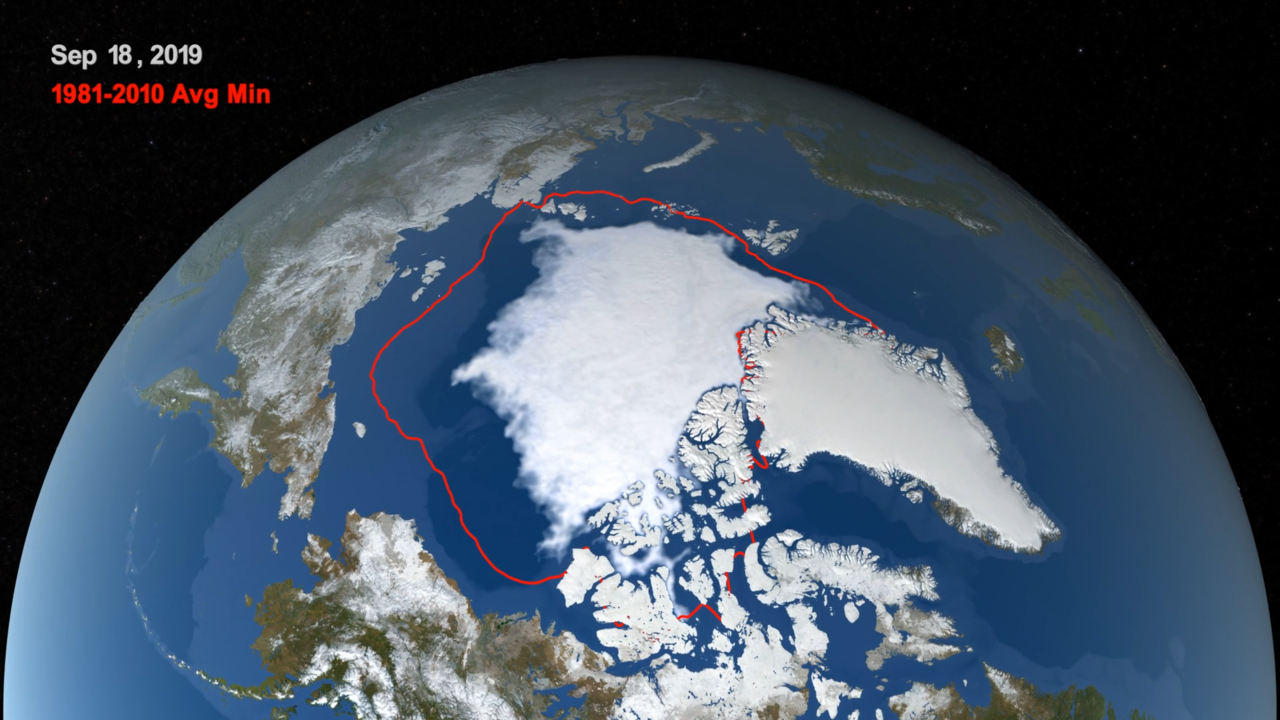
Arctic sea ice likely reached its 2019 minimum extent on Sept. 18. At 1.60 million square miles (4.15 million square kilometers), this year's summertime extent is effectively tied for the second in the satellite record, according to NASA and the National Snow and Ice Data Center. Credit: NASA/Trent Schindler
LARGE IMAGE
The extent of Arctic sea ice at the end of this summer was effectively tied with 2007 and 2016 for second lowest since modern record keeping began in the late 1970s. An analysis of satellite data by NASA and the National Snow and Ice Data Center (NSIDC) at the University of Colorado Boulder shows that the 2019 minimum extent, which was likely reached on Sept. 18, measured 1.60 million square miles (4.15 million square kilometers).


Arctic sea ice likely reached its 2019 minimum extent on Sept. 18. At 1.60 million square miles (4.15 million square kilometers), this year's summertime extent is effectively tied for the second in the satellite record, according to NASA and the National Snow and Ice Data Center. Credit: NASA/ Katie Jepson. 
This video can be downloaded at NASA's Scientific Visualization Studio.

The Arctic sea ice cap is an expanse of frozen seawater floating on top of the Arctic Ocean and neighboring seas. Every year, it expands and thickens during the fall and winter and grows smaller and thinner during the spring and summer. But in the past decades, increasing temperatures have caused marked decreases in the Arctic sea ice extents in all seasons, with particularly rapid reductions in the minimum end-of-summer ice extent.
Changes in Arctic sea ice cover have wide-ranging impacts. The sea ice affects local ecosystems, regional and global weather patterns, and the circulation of the oceans.
“This year’s minimum sea ice extent shows that there is no sign that the sea ice cover is rebounding,” said Claire Parkinson, a climate change senior scientist at NASA’s Goddard Space Flight Center in Greenbelt, Maryland. “The long-term trend for Arctic sea ice extent has been definitively downward. But in recent years, the extent is low enough that weather conditions can either make that particular year’s extent into a new record low or keep it within the group of the lowest.”
An opening in the sea ice cover north of Greenland is partially filled in by much smaller sea ice rubble and floes, as seen during an Operation IceBridge flight on Sept. 9, 2019. Credit: NASA/Linette Boisvert
The melt season started with a very low sea ice extent, followed by a very rapid ice loss in July that slowed down considerably after mid-August. Microwave instruments onboard United States Department of Defense’s meteorological satellites monitored the changes from space.
“This was an interesting melt season,” said Walt Meier, a sea ice researcher at NSIDC. “At the beginning of August we were at record low ice levels for that time of the year, so a new minimum record low could have been in the offering.
”But unlike 2012, the year with the lowest ice extent on record, which experienced a powerful August cyclone that smashed the ice cover and accelerated its decline, the 2019 melt season didn’t see any extreme weather events. Although it was a warm summer in the Arctic, with average temperatures 7 to 9 degrees Fahrenheit (4 to 5 degrees Celsius) above what is normal for the central Arctic, events such as this year’s severe Arctic wildfire season or European heat wave ended up not having much impact on the sea ice melt.
“By the time the Siberian fires kicked into high gear in late July, the Sun was already getting low in the Arctic, so the effect of the soot from the fires darkening the sea ice surface wasn’t that large,” Meier said. “As for the European heat wave, it definitely affected land ice loss in Greenland and also caused a spike in melt along Greenland’s east coast, but that’s an area where sea ice is being transported down the coast and melting fairly quickly anyway.”

Links

25/09/2019

David Attenborough Slams Australian PM On Climate Record

ABC triplej Hack

Sir David Attenborough has slammed Prime Minister Scott Morrison's support for new coal mines and lack of action on climate change, in his most damning assessment yet of Australia's environmental record.
In an interview with Hack, the world's most renowned natural historian said previous governments had been "saying all the right things" but this had suddenly changed.
"You are the keepers of an extraordinary section of the surface of this planet, including the Barrier Reef, and what you say, what you do, really, really matters."
"And then you suddenly say, 'No it doesn't matter ... it doesn't matter how much coal we burn ... we don't give a damn what it does to the rest of the world.'"


"It's their world": Sir David Attenborough praises young people protesting for climate change, and slams Scott Morrison for bringing a lump of coal into Parliament in 2017.

The veteran conservationist responded to Scott Morrison bringing a lump of coal into Question Time in February 2017, when he was Treasurer.
"I don't think it was a joke," he said.
"If you weren't opening a coal mine okay I would agree, it's a joke. But you are opening a coal mine."
He also commented on the recent federal election, which Mr Morrison won with a platform of support for new coal mines, including the proposed large Adani mine in Queensland, as well as a less ambitious emissions reduction target than Labor.Asked how politicians can carry the public with them on taking action on climate change, he said politicians had "to appeal to what people think is right."
"Do you think it's right that we go on destroying the natural world?" he said.
The Government’s own projections show Australia is not on track to meet its current Paris target.
A cardboard cutout of Sir David Attenborough with Extinction Rebellion flags in London.
Getty

The September 20 climate strike in Sydney.
Getty


But he also made an economic argument for action: "We have to convince bankers and big business that, in the end, the long-term future lies in having a healthy planet. And unless you do something about it ... you're going to lose your money."
And one for basic self-preservation: "The world is going to be running short of food, seriously short of food."
Tens of millions could be exposed to crop failure and famine in the next few decades due to climate change, according to the UN panel for assessing the science of climate change, the IPCC.

On the global climate strike and mass protest
Speaking to Hack ahead of last week's global climate strike, the 93-year-old threw his support behind young people taking to the streets in protest.
"Young people see things very clearly. And they are speaking very clearly to politicians," he said.
"They [people under 18] may not have the vote ... but it's their world that's coming along and they want to make it clear to the politicians that they know that."
Australian school students at the September 20 climate strikes. ABC News: Brendan Esposito
A cardboard cutout of Sir David Attenborough
with Extinction Rebellion flags in London.
Getty

Climate strikers in Sydney.
ABC News: Brendan Esposito
The BBC presenter, who regularly tops polls of Britain's favourite people, recently narrated a documentary on climate change titled The Facts.This, along with the Extinction Rebellion, which occupied parts of central London over two weeks in April, has been credited as the reason why the UK declared a climate emergency.
Sir David said he backed the strategy of non-violent direct action.
"If they just sit on the sidelines, and [debate] in a nice, reasonable way, you know, they'll say, 'oh kids'. But if they actually do something in the way that they have been doing in this era, then politicians have to sit up and take notice."
"And you can say, 'It gets you nowhere, just stopping the traffic'. But it gets you notice. People listen to what you say. And that you're important.
"And they are important. They are the people who are going to inherit the mess that we've made."

On the Great Barrier Reef
Sir David said his most vivid impression of climate change's human impact was returning to the Great Barrier Reef, where he had first dived in the 1950s.
"A bleached reef is a tragic sight," he said of his last dive there, 10 years ago.
"A desperately tragic sight, particularly if you've seen it before, and you know what it could have been like.
"You just see acre after acre of deathly white coral."
A diver checks out coral bleaching on the Great Barrier Reef in February 2016. Supplied: The Ocean Agency / XL Catlin Seaview Survey
David Attenborough

On climate denialism: "The world is sick, we really have to do things about it. And there's no more time for argument."

On a sustainable diet: "Maybe everybody when they get into their 70s 80s or 90s loses their taste for meat. I've certainly lost mine."

On population: "All the evidence is that wherever women are educated and literate, and have the vote, and are able to determine what they do, and when they have children, and they have medical advice to help them, then the birth rate falls."

On plastic: "I can't help feeling we invented the stuff; surely, for heavens, we are clever enough to think of a way of disposing of it."

On his least favourite animal: "I don't hate many things but I do hate rats."
Since then, the reef has had at least two more severe coral bleaching events.
Sir David has previously said Australia will face some of the worst effects of climate change. He told Hack the country has been having "a really bad time".
But the present impact of climate change paled in comparison to his description of the refugee crisis predicted to occur as the planet warms.
"The drought areas of this world, and you have more than your fair share, are due to spread, simply because of the rise in temperature.
"The front line is southern Europe."
"We're talking about tens of thousands of people who suddenly won't have a bit of land in which they can grow their food.
"And, poor souls, they want somewhere to live, and raise their kids. Now are you going to turn them away?
"And if you are going to turn them away where are you going to put them?"

On facing his own death
At 93, Sir David is working on a new BBC documentary for 2020. Extinction: The Facts looks at what mass animal and plant extinctions mean for humanity.
He says he feels blessed to be able to keep working, and to have lasted long enough to see a rising environmental consciousness.
Asked whether he was afraid of dying, he said he simply hoped it won't be "tiresome for others".
"I hope it won't be painful," he said.
On life after death, the great educator of natural selection said he remains agnostic.
"I am quite sure that the mechanism by which this world has become populated with all these different species of animals and plants we understand pretty well now," he said.
"Whether you say that means that God doesn't exist is another question.
"It may be that there is an overall creative spirit that we don't know about. I have no idea. And whether it's a life after death, I have no idea."

Links

Lethal Heating is a citizens' initiative