30/12/2019

The Year In Climate Change: Leaders Keep Ignoring The Science, And This Is Not Fine

CNET - 

Commentary: My world's on fire, how 'bout yours?

I think about the "This Is Fine" dog a lot. You know the one: Animated yellow dog, staring into the middle distance, cup of coffee in its hand, engulfed by flames. In the original webcomic, a 2013 six-panel piece by artist KC Green, the dog does nothing to avert the obviously catastrophic situation it finds itself in. Instead, it remarks "This is fine" as its skin melts away and its eyeballs seep out of its head like goo.
In 2019, it seems prescient. But the fire isn't contained to one tiny room anymore.
Now the world is on fire. In July, the Earth sweltered through its hottest month on record. The Amazon roasted in August, with more than 80,000 fires reported in Brazil alone. California was ablaze in November, cutting power and forcing residents to flee their homes. The Arctic burned. Australia suffered through unprecedented bushfires. The record books are being constantly updated.
Despite this, carbon emissions, primarily from the fossil fuel industry, continue to rise across the globe, with no signs of slowing down. If we are to limit warming to below 2 degrees Celsius by 2100, things need to change dramatically. And yet many huge emitters are not on track to meet their 2030 pledges as set out by the United Nations. Against the backdrop of fire and smoke, leaders of the biggest carbon emitting nations in the world seemingly just sip their coffees and put their feet up.
This is fine.
***
In KC Green's 2013 comic, the dog eventually melts away in the fire. KC Green/Gunshow
But in 2019 there was something of a reckoning.
It arrived in the form of a pig-tailed, 16-year-old girl with a two-by-two cardboard sign. In striking black letters, her sign read: "Skolstrejk fӧr klimatet." Starting in August 2018, Greta Thunberg began this "School Strike For Climate," sign in hand, sitting on the concrete outside the Swedish parliament, demanding action on climate change. She drew worldwide attention. By the end of 2018, students had held strikes in over 270 cities across the world.
It was the beginning of a movement that continued to gather momentum through the year. In September, 7 million people took to the streets again for global climate protests, timed to coincide with the United Nations Climate Action Summit. The protests saw Thunberg, and other student activists around the world, pleading with policymakers and governments to combat the climate crisis.
Thunberg's movement saw her named Time's Person of the Year in 2019. More importantly, it inspired discussions around climate change to escalate, becoming more urgent and more aggressive. The language began to change. We stopped talking about climate change and started talking about the climate crisis. States, countries and scientists declared a "climate emergency," leading the Oxford Dictionary to award the term its word of the year, as usage soared 10,796%.
This is not fine.
***
Firebreather
It's not fine, and I'm struggling to breathe.
As CNET's science editor, I spend many hours a month reading climate change studies, but for the first time in my life, I can feel the effects of climate change. I can look out my window and see them in the thick, gray smoke clouds settling over the horizon.
After bushfires torched 164,000 hectares of forest north west of Sydney in November, a dense veil of smoke blanketed the city for weeks. In the harbor, the white sails of the Opera House were consumed by a veil of smoke and the steel beams of the Harbour Bridge seemed to fade into the haze.
Former fire service chief Greg Mullins warned Australia's federal government the 2019 bushfire season could be "catastrophic" in April and again in May, suggesting climate change had worsened drought conditions and could cause mega fires the service "just can't put out." By spring, those fires started burning. It's now the middle of summer. They are still burning.
Scarily, this feels like the new normal. As the planet gets hotter, it makes extreme climate events like the bushfires more and more likely. I check the Air Quality Index (AQI) three or four times a day, hoping the particle pollution is rated as anything other than "hazardous." When the bushfires began in early November, Google saw a dramatic spike in searches for "air quality."
Living and working in the inner city has been giving me (and countless others) mild respiratory trouble, but it's nothing compared with where the fires have been raging. Hundreds have lost their homes. Six people lost their lives.
The Sydney Opera House, blanketed by smoke. James D. Morgan/Getty
As the crisis worsened, Australian Prime Minister Scott Morrison pushed the climate crisis to the side. "There is a time and a place to debate controversial issues and important issues, right now it's important to focus on the needs of Australians who need our help," he said in November. In December, as the intensity and scale of the fires continued to increase, Morrison fled, reportedly taking a business class flight to Hawaii for a holiday.
The Deputy Prime Minister, Michael McCormack, slammed those raising concerns about climate change during the crisis, calling senators from the left Greens party "inner-city raving lunatics."
Many of those who had lost their homes did not agree, protesting outside New South Wales' Parliament House with buckets of ash in their hand days after the statement was made. After tipping the charred remains of his two-bedroom home onto the ground, one protestor declared that now was exactly the time to be talking about climate change.
Those protestors don't believe the carbon dioxide we're pumping into the air started the fires. But they believe it is exacerbating them. Climate change is making the bushfire season longer. It seems many politicians disagree.
In the wake of the bushfires, Morrison said there was no scientific evidence linking the bushfires with carbon emissions and climate change. There is.
And former deputy Prime Minister, Barnaby Joyce, claimed the fires were the result of changes in the sun's magnetic field. At best, that's poor understanding of the science. At worst, it's a blatant lie.
None of this is fine.
***
Climate culture war
This year the United Nations' Intergovernmental Panel on Climate Change (IPCC) released two special reports focused on how climate change affects the land and how climate change affects the oceans and cryosphere. In May, the Intergovernmental Science-Policy Platform on Biodiversity and Ecosystem Services (IPBES) released a damning analysis of the world's ecosystems, suggesting the climate crisis could leave up to 1 million species extinct.
More dire warnings were heard during the UN Climate Change Summit in September and December's Climate Change Conference in Madrid. Every week -- no, every day -- there is a new peer-reviewed scientific paper in the world's most prestigious science journals. The pages of Nature, Science, The Lancet and Proceedings of the National Academy of Sciences are stacked with new reports, revised estimates and terrifying models of future calamity.
All this research features the expertise of hundreds of scientists and researchers, using tens of thousands of sources to provide the most comprehensive, up-to-the-minute examination of the planet we can muster. They keep gathering data, it keeps telling them the same things. There is a consensus: Humans are accelerating global warming.
"The world is not ending due to climate change," says Katrin Meissner, director of the Climate Change Research Center at the University of New South Wales. "The planet will survive and life on the planet will survive. But ... climate change will endanger health, livelihoods, food security, drinking water supply, and ecosystems.
"The changes won't be easily reversible, some will certainly be irreversible on the timescales of human lives, and the changes won't necessarily happen smoothly."
Almost as soon as scientists began sounding the alarm, science has been under attack. In 2019, the internet is awash with climate denialism. You only need to read the comments on CNET's coverage of the Amazon fires, or our reporting on the latest climate research, to see the extent of the pushback. My Gmail inbox is tortured. Facebook posts, Twitter threads and TikTok videos are war zones.
Worryingly, over the past 12 months, we've seen those attacks come not just from message boards and anonymous Twitter users, but from some of the most powerful people in the world.
Arguments have been weaponized on both sides of the political spectrum. US President Donald Trump is taking jabs at Greta Thunberg, sarcastically describing her as a "very happy young girl looking forward to a bright future." Extinction Rebellion activists shut down the London Underground in October, leading to nasty clashes with commuters and law enforcement. It's no longer believers versus denialists -- it's left versus right.
In 2019, the climate crisis has become firmly entrenched as a battleground in the never-ending culture wars. Environmental policies are being wound back in the US, Brazil and China. The US has pulled out of the UN Paris Agreement that calls for nations to plan and mitigate the effects of global warming.
Greta Thunberg has continued to call for action on climate change, taking her sign on a global tour. Fabrice Coffrini/Getty
Carbon emissions are irrelevant. Glacier collapse is trivial. Rising sea levels are being ignored. Science is dying a slow death and faith is being eroded by politicians looking to score points over their opposition. It's been happening for years, but in 2019 it was more obvious than ever.
When Thunberg spoke before the US congress in September, her message was simple: "I don't want you to listen to me, I want you to listen to the scientists."
The overwhelming majority of those scientists make it crystal clear: Unless we reduce our emissions -- dramatically and rapidly -- we will find ourselves living on a planet hotter than ever before. The next decade looms as one of the most important to keep global warming below 2 degrees Celsius (3.6 degrees Fahrenheit).
We are only just beginning to understand what a hotter Earth looks like, the extreme weather events we will experience, the health problems that will arise and the vast changes to the land and the ocean the children will inherit.
In 2019, their voices swelled. They started shouting. They took placards and signs and descended upon government buildings, parks, streets and cities. Their message was resoundingly clear.
This is not fine.

Links

Climate Science Discoveries Of The Decade: New Risks Scientists Warned About In The 2010s

InsideClimate NewsBob Berwyn

A decade of ice, ocean and atmospheric studies found systems nearing dangerous tipping points. As the evidence mounted, countries worldwide began to see the risk.
Researching the Petermann Glacier. Whitney Shefte/Washington Post via Getty Images
The 2010s may go down in environmental history as the decade when the fingerprints of climate change became evident in extreme weather events, from heat waves to destructive storms, and climate tipping points once thought to be far off were found to be much closer.
It was the decade when governments worldwide woke up to the risk and signed the Paris climate agreement, yet still failed to reduce the greenhouse gas emissions at the pace and scale needed. And when climate scientists, seeing the evidence before them, cast away their reluctance to publicly advocate for action.
The sum of the decade's climate science research, compiled in a series of reports by the Intergovernmental Panel on Climate Change (IPCC), suggests global warming is pushing many planetary systems toward a breakdown.
New studies showed polar ice caps melting and sea level rising much faster than just 10 years ago. Ocean researchers showed how marine heat waves kill corals and force fish to move northward, affecting food supplies for millions of people in developing countries. They tracked changes to crucial ocean currents and concluded that hurricanes will intensify faster in a warming world.
Together, the research showed how important it will be to cap the global temperature rise as far below 2 degrees Celsius—the Paris Agreement goal—as possible.

Feedback Loops on the Greenland Ice Sheet
At the start of the decade, it was unclear how fast the Greenland and West Antarctic Ice Sheets would melt. As recently as the 1990s, melting of the Greenland Ice Sheet was balanced by the buildup of new snow and ice, offering some hope that sea level rise would be slow, allowing coastal communities time to adapt.
By the end of 2019, a study published in the scientific journal Nature showed the Greenland Ice Sheet was melting seven times faster than it had been in the 1990s. That's on pace with the IPCC's worst-case climate scenario, with Greenland alone contributing 2 to 5 inches of sea level rise by 2100. Another study, looking at evidence in fossilized shells, showed temperatures are very near a threshold that will melt most of the ice sheet.


Scientists discovered feedback loops and new ways earth's systems interact to melt the ice. Global warming is expanding ice slabs beneath Greenland's snowy areas, hastening runoff and sea level rise. In Antarctica, they showed how global warming is shifting winds and pushing warmer water under floating ice shelves—both of which could contribute to rapid disintegration of ice shelves with a subsequent surge of sea level rise.
"The rate and magnitude of Greenland Ice Sheet mass loss, and of ice loss globally, has been dramatic," said Twila Moon, a climate researcher with the National Snow and Ice Data Center.

How Sea Ice Loss Influences the Atmosphere
Many studies in the second half of the decade showed how important it is to keep the global temperature rise as far below 2 degrees Celsius as possible to avoid triggering tipping points that would have cascading consequences. Arctic sea ice is one of the big concerns.
Even now, in its diminished state, the summer Arctic sea ice is a 1.6 million square-mile shield that reflects incoming solar radiation back to space. The more it melts, the more darker-colored ocean can absorb heat, speeding up the planet's overall warming.
At 2 degrees Celsius warming, Arctic Ocean sea ice will probably melt completely, said National Snow and Ice Data Center climate researcher Walt Meier. "Some ice probably will persist if warming is limited to 1.5 degrees Celsius," Meier said. He noted that research has suggested the ice could recover fairly quickly—if greenhouse gas concentrations are reduced enough to drop the temperature.


One intriguing question has been how the loss of Arctic sea ice will affect weather patterns in North America, Europe and Asia.
Melting that much of Earth's icebox could alter wind patterns that shunt weather systems around the Northern Hemisphere, scientists reasoned early in the decade. A study in 2012 suggested a mechanism: Sea ice melt alters the jet stream by reducing the temperature contrast between the Arctic and the mid-latitudes. As the jet stream weakens, it enables areas of rainy weather or hot, dry conditions to linger longer over a given area, leading to extreme rainfall or heat waves and drought.
As the decade ended, studies seemed to support that early conclusion. Research published by Michael Mann, Stefan Rahmstorf and others showed how heat waves, floods and wildfires are linked with a jet stream pattern that, in turn, is related to an over-heated Arctic. In a climate warmed by greenhouse gases, the jet stream is more likely to set up in a pattern that causes extremes to linger longer over Europe and North America.

Arctic Melting Also Effects Ocean Currents
Another major advance in climate research this decade relates to how the melting Arctic will affect a key Atlantic Ocean current that balances Earth's climate by carrying warm, salty water north in the upper layers of the ocean and colder water southward in the ocean depths.
Early in the decade, scientists were still speculating about whether such a slowdown was happening, but now, "for the first time the IPCC has confirmed that the AMOC has slowed down, as predicted by models," Rahmstorf said.
Slowing of the AMOC, the Atlantic Meridional Overturning Circulation, has been identified as one of the main tipping points in the planet's climate system. Changes in the circulation "have been responsible for some of the strongest and most rapid climate shifts during the Quaternary Period (the past 2.6 million years)," one study said.
There are already signs that the weakening of the Atlantic circulation is having an effect on U.S. fisheries and storms. Ice melting off Greenland as the Arctic warms is believed to play a key role. Credit: NASA
Total collapse of the current, still seen as unlikely, would raise sea level by 30 inches around the North Atlantic, but even a slowdown will have a similar effect, to a lesser degree.
"The current is balanced, in part, by the slope of the sea surface as it climbs away from the East coast toward the center of the North Atlantic Ocean gyre," explained Penn State climate scientist Michael Mann. "If the current slows, that slope must decrease, which is accomplished by the sea surface rising along the coast. That can add as much as an extra foot to sea level rise over the next century over parts of the East Coast."
The slowdown will likely push tropical rainfall belts southward, disrupting agriculture and ocean ecosystems. A study in 2016 showed how global warming is shifting other currents in ways that could bring more intense storms to land areas, like the rainstorms that brought record flooding to Japan.

Marine Heat Waves Drive Ecosystem Tipping Points
Scientists have long known that the oceans are absorbing about 93 percent of the heat trapped by greenhouse gases, but it wasn't until the last few years that they showed how that's manifesting in marine heat waves that are driving some ocean ecosystems to tipping points.
The most visible might be the mass die-offs of coral reefs in 2015 and 2016 as the oceans seethed at near record warmth for months on end.
The impacts of another marine heat wave, known as the Pacific warm blob, cascaded through Pacific Ocean ecosystems in 2014 and 2015, causing widespread disruption to the food chain and promoting toxic algae blooms. Another began forming in the Pacific in 2019.


Marine heat waves don't just affect the water. The Pacific warm blob was also linked with California's extreme drought that pushed some inland forest ecosystems past the brink. The large area of stagnant heat over the ocean blocked cooler marine air from reaching the coast, enabling the heat to build up.
Since the 1920s, marine heat waves have become 34 percent more frequent, and research shows about 87 percent of them can be attributed to human-caused global warming.

Potential for West Antarctic Ice Sheet Collapse
At the start of the 2010s, scientists were just beginning to understand how vulnerable parts of Antarctica are to human-caused global warming. New studies this past decade showed that what was once considered a nearly invincible fortress of ice is crumbling at the edges.
Just a little more warming could push parts of the Antarctic ice sheets past a tipping point that would raise sea level faster and higher than anticipated by the climate assessments commonly used for coastal planning around the world.
"I'd say one of the big things this decade includes the potential collapse of West Antarctica, based on new research," said University of Colorado climate scientist Mike MacFerrin. "Just this year, we have evidence that Antarctica's recent speedup of ice loss is, in fact, human-caused."


Concerns about an abrupt collapse of parts of Antarctica's ice shelves intensified in 2016 with a study suggesting that water from surface melting could seep deep into the ice, refreeze and split off huge slabs of the shelves in a relatively short time. Radar surveys showing the thinning of the Thwaites Glacier helped trigger a massive international research effort to track the melting in that area, and scientists are also watching the Pine Island Glacier for signs of disintegration.
The worst-case tipping point scenarios shouldn't be off the table, said Jason Box, a  climate scientist with the Geological Survey of Denmark and Greenland.
Box said the research showing destabilization of the West Antarctic Ice Sheet is a key climate science advance of this past decade "that should have been like a real wake-up call moment," he said.

Connecting Climate Change to Weather Extremes
Only a few years ago, scientists were reluctant to connect any specific extreme weather event to global warming.
In 2011 and 2012, Rahmstorf and other scientists triggered debates when they wrote that there was strong evidence linking specific events or an increase in their numbers to the human influence on climate. Since then, scientists who specialize in attribution research have found global warming fingerprints on nearly every heat wave they've studied.
"Looking back over the past decade, it's astonishing how firmly we've moved out to the tails of the probability distribution. Extremes are common and are commonly attributed to human activities," said Oregon State University climate researcher Philip Mote. "We're living the worst-case scenario."


One area of research during the 2010s with ominous findings was how global warming affects the intensity tropical storms, including North Atlantic hurricanes that affect the densely populated East Coast of the U.S. A 2016 study tracked a persistent shift of storm tracks toward that area.
"We've seen extreme events, with every major ocean basin having at least one big, catastrophic hurricane in the last few years," said NOAA climate scientist Deke Arndt. "We had Dorian and Michael, with rapid intensification so early in its development and close to the equator," he said. "Every basin has come up with monstrous storms."

Seeing the Risks, More Scientists Are Speaking Out
The 2010s may also be remembered as the decade when scientists cast away their reluctance to advocate for political and social changes.
The research on global warming is now so compelling that "a growing number of scientists are starting to make increasingly direct, pointed, and public statements about climate change risks to society," said Daniel Swain, a climate scientist with UCLA and the National Center for Atmospheric Research.
"My sense is that a key reason for this is the widening gap between physical reality and political reality," he said. "There is a growing sense that society is careening toward the abyss while we're collectively arguing about whether we should hit the brakes.
"Scientists who work in the climate domain are particularly, sometimes painfully, aware of the consequences that lie ahead if we continue on our current trajectory. And we're also aware that the emissions targets set forth in the Paris Agreement remain largely aspirational; we're currently still on a path to blow right past them."

Links

Satellites Show Glaciers Rapidly Shrinking From Climate Change

Space

The Earth's glaciers are in rapid retreat.
New results relying on five decades of satellite observations show extensive changes to glaciers at the Earth's north and south poles, a result of global warming.
Much of the data comes courtesy of the long-running Landsat mission, which is a series of Earth observation satellites managed by NASA and the United States Geological Survey. Having decades of data from a single line of similar satellites makes it much easier to see change over time. But other satellites are spotting changes as well, sometimes on timescales as short as a year or two.

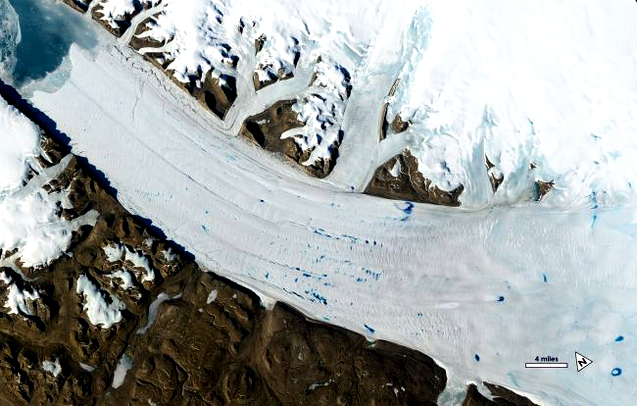
Meltwater pools on the surface of Petermann Glacier in Greenland as seen by Landsat in June 2019. (Image credit: NASA/USGS)
Landsat images of glaciers photographed between 1972 and 2019 allowed glaciologist Mark Fahnestock of the University of Alaska, Fairbanks, to create six-second time-lapse films showing changes in the ice.
"We now have this long, detailed record that allows us to look at what's happened in Alaska," Fahnestock said in a NASA statement. "When you play these movies, you get a sense of how dynamic these systems are and how unsteady the ice flow is."
Glaciers respond to global warming in different ways. For example, Alaska's Columbia glacier was pretty stable when the first Landsat satellite peered at it in 1972. It began a quick retreat in the mid-1980s; it now is 12.4 miles (20 kilometers) upstream from its first observed position nearly 48 years ago. Meanwhile, the nearby Hubbard Glacier has only moved three miles (five km) in the same 48 years, but a 2019 image showed a large area in the glacier where ice broke off. That "calving embayment," as geologists term it, is likely a sign of rapid change on the horizon.
"That calving embayment is the first sign of weakness from Hubbard glacier in almost 50 years — it's been advancing through the historical record," Fahnestock said, warning that the Columbia glacier showed similar signs of weakening before its rapid retreat decades ago.


The NASA-USGS Landsat program has been keeping its eyes on Earth's glaciers and ice sheets since 1972.
Credit: NASA's Goddard Space Flight Center


Michalea King, a doctoral student in earth sciences at Ohio State University, examined similar Landsat images from Greenland as far back as 1985 to see how global warming affected 200 glaciers there. These glaciers have retreated an average of three miles (five km) over the period of satellite observations that King studied.
"These glaciers are calving more ice into the ocean than they were in the past," King said in the same statement. "There is a very clear relationship between the retreat, and increasing ice mass losses from these glaciers, during the 1985-through-present record."
The glacial retreat is also causing different sorts of lakes to appear over time on the surface of the glacier and underground. James Lea, a glaciologist at the University of Liverpool in the United Kingdom, found surface meltwater lakes on Greenland glaciers of up to three miles (five km) across. Lea used measurements gathered by the Moderate Resolution Imaging Spectroradiometer (MODIS) on the NASA-led Terra satellite for every day of every melt season over the last 20 years.
"We looked at how many lakes there are per year across the ice sheet and found an increasing trend over the last 20 years: a 27% increase in lakes," Lea said in the same statement. "We're also getting more and more lakes at higher elevations — areas that we weren't expecting to see lakes in until 2050 or 2060."
The change is so rapid that sometimes differences show up in just a year or two. For example, Devon Dunmire of the University of Colorado, Boulder, used microwave radar images from the European Space Agency's Sentinel-1 satellite to peer beneath the ice. Dunmire spotted lakes in the George VI and Wilkins ice shelves near the Antarctica peninsula, including a few that remained liquid during winter.
"Not much is known about distribution and quantity of these subsurface lakes, but this water appears to be prevalent on the ice shelf near the Antarctic peninsula," said Dunmire, who is a graduate student in atmospheric and oceanic sciences, in the same statement. "It's an important component to understand, because meltwater has been shown to destabilize ice shelves."
The scientists presented their work at the annual meeting of the American Geophysical Union in San Francisco on Dec. 9.

Links

29/12/2019

The Big Science And Environment Stories Of 2019

BBC News - Paul Rincon

This year, millions of people around the world mobilised in protest to highlight the dire emergency facing our planet. Could 2019 prove to be the year when talk turned to action on the climate crisis? We looked back at some of the biggest stories of the year in science and the environment.


The year the world woke up?
Greta Thunberg (centre) is surrounded by demonstrators at a climate strike march in Vancouver, Canada in October. Reuters
In 2019, the reaction to the ongoing climate crisis switched up another gear. Inspired by Swedish activist Greta Thunberg, the climate strike movement exploded this year. Millions took part in mass protests during the course of the year in countries as diverse as Australia, Uganda, Colombia, Japan, Germany and the UK.
Greta chose to make a statement when she sailed - rather than flew - to a UN climate meeting in New York. Summing up the trajectory for many who have joined popular climate movements, she told chief environment correspondent Justin Rowlatt: "I felt like I was the only one who cared about the climate and ecological crisis... it makes me feel good that I'm not alone in this fight."

 Greta Thunberg: "I feel like what I am doing is meaningful."

The UK's Extinction Rebellion (XR) was making its point through non-violent direct action in 2019. The group, which aims to compel government action on climate change, occupied five prominent sites across central London in April 2019. Notably, they parked a pink boat in the middle of busy Oxford Circus bearing the phrase "Tell the Truth".
This year also saw the UK's Parliament - along with individual councils around the country - declare a climate emergency, granting what had been one of XR's key demands.
But there were also setbacks to political efforts aimed at reducing greenhouse gas emissions. The US - one of the world's top emitters - began the process of pulling out of the Paris Agreement. This deal was conceived in 2015 with the intention of keeping the global average temperature to below 2C. President Donald Trump said the pact was bad for the US economy and jobs.
This year's UN climate meeting - COP25 - ended in a deal many described as disappointing. The result means that the onus now falls on the UK to resolve many of the most challenging questions at COP26 in Glasgow in 2020.


'Ring of fire'
The first ever picture of a black hole: It's surrounded by a halo of bright gas pulled in by the hole's gravity. EHT Collaboration
In April, astronomers released the much anticipated first image of a black hole. This is a region of space from which nothing, not even light, can escape. The picture was taken by a network of eight telescopes across the world and shows what was described as "the heavyweight champion of black holes".
The 40 billion km-wide, spacetime-warping monster features an intense halo, or "ring of fire", around the black hole caused by superheated gas falling in.
The image caused a sensation and raised the profile of one computer scientist working on the project. 29-year-old Dr Katie Bouman helped develop an algorithm that allowed the image to be created. A picture of her with hands clasped over her mouth, barely containing her excitement at the astronomical picture on her laptop, quickly went viral.
But her fame led to trolling, with some accusing her of hogging credit for a male colleague's work. That team member, Dr Andrew Chael, quickly came to her defence. In an interview for the BBC 100 Women series, Dr Bouman said: "At first I was really taken aback by it. But... I do think it is important that we highlight the women in these roles."


Katie Bouman: "I wasn't expecting the attention I got."


Land and oceans under threat
Two major reports from the UN's climate science body revealed in sharp relief the extent to which humanity is ravaging Earth's land surface and her oceans. The first of these documents from the IPCC (Intergovernmental Panel on Climate Change) warned that we must stop abusing the land if catastrophic climate change is to be avoided.
The report outlined how our actions were degrading soils, expanding deserts, flattening forests and driving other species to the brink of extinction. Scientists involved in the UN process also explained that switching to a plant-based diet could help combat climate change.
Even 1.5C of warming could devastate coral reefs. Getty Images
The second report, dealing with the world's oceans and frozen regions, detailed how waters are rising, ice is melting and species are being forced to move. As co-ordinating lead author Dr Jean-Pierre Gattuso said, "The blue planet is in serious danger right now, suffering many insults from many different directions and it's our fault." The authors believe that the changes we've set in motion are coming back to haunt us. Sea level rise will have profound consequences for low-lying coastal areas where almost 700 million people live.


Far-out fly-by
NASA/JHUAPL/SWRI/Roman Tkachenko
On 1 January, Nasa's New Horizons spacecraft made the most distant ever exploration of a Solar System object. Launched all the way back in 2006, it performed its primary task - a flyby study of the Pluto system - in 2015. But with plenty of gas still in the tank, mission scientists directed the spacecraft towards a new target, an object called 2014 MU 69.
MU 69, later dubbed Ultima Thule, and more recently Arrokoth, may be fairly typical of the primitive, icy objects occupying a distant zone of our Solar System known as the Kuiper Belt.
There are hundreds of thousands of objects out there like it, and their frigid state holds clues to how all planetary bodies came into being some 4.6 billion years ago.
Earlier this year, scientists presented details of what they had found at a major conference in Houston. They had determined that Arrokoth's two lobes formed when distinct objects collided at just 2-3m/s, about the speed you would run into a wall, according to team member Kirby Runyon.


Greenland's record melt
Climate scientist Steffen Olsen took this picture while travelling across melted sea ice in north-west Greenland. Steffen Olsen
In September, former UK chief scientist Sir David King said he was scared by the faster-than-expected pace of climate-related changes. One of the most shocking examples this year of the extreme events Sir David spoke of was surely the record ice melt in Greenland.
In June, temperatures soared well above normal levels in the Danish territory, causing about half its ice sheet surface to experience some melting. As David Shukman reported on his trip to the region, during 2019 alone, it lost enough ice to raise the average global sea level by more than a millimetre.
Underlining the rapid nature of the change, he returned to a glacier he had filmed in 2004 to find that it had thinned by as much as 100m over the period.


A visit to the Sermilik glacier, which is rapidly melting.

Greenland's ice sheet stores so much frozen water that if the whole of it melted, it would raise sea levels worldwide by up to 7m. Although that would take hundreds or thousands of years, polar scientists told the American Geophysical Union meeting in December that Greenland was losing its ice seven times faster than in the 1990s.
Prof Andy Shepherd, of Leeds University, said: "The simple formula is that around the planet, six million people are brought into a flooding situation for every centimetre of sea-level rise."


Rocks from space
3D model of the asteroid Bennu, created using data from Nasa's Osiris-Rex mission. NASA
While civilisation-threatening asteroids are a staple of the movies, the probability of a sizeable space rock hitting our planet is very low. But as the dinosaurs found out, the risk does increase with time. Some 19,000 near-Earth asteroids (NEAs) are being monitored, but many lurk undetected by telescopes, so there is always potential for a bolt-from-the-blue.
In March, Nasa scientists told the Lunar and Planetary Science Conference (LPSC) that a big fireball had exploded in Earth's atmosphere at the end of 2018. The space rock barrelled in without warning and detonated with 10 times the energy released by the Hiroshima atomic bomb.
Luckily, the rock blew up over the sea off Russia's remote Kamchatka Peninsula. But an outburst that size could have had serious consequences had it occurred nearer the ground, over a densely populated area.
Then in July, an asteroid the size of a football field buzzed Earth, coming within 65,000km of our planet's surface - about a fifth the distance to the Moon. The 100m-wide rock was detected just days before it passed Earth.
Meanwhile, two robotic spacecraft have been examining different NEAs close-up. Scientists working on Japan's Hayabusa mission reported that their asteroid, Ryugu, was made of rubble blasted off a bigger object. And the US Osiris-Rex spacecraft detected plumes of particles erupting from the surface of its target, Bennu.


'Dirty secret' boosts warming
Electrical switchgear the world over often uses SF6 to prevent fires. Getty Images
The gas sulphur hexafluoride (SF6) isn't a household name. But as the most powerful greenhouse gas known to science, it could play an increasingly important role in discussions about climate change.
As environment correspondent Matt McGrath reported in September, levels are on the rise as an unintended consequence of the boom in green energy. The cheap, non-flammable gas is used to prevent short circuits and fires in electrical switches and circuit breakers known collectively as "switchgear".
As more wind turbines are built around the world, more of these electrical safety devices are being installed. The vast majority use SF6.
Although overall atmospheric concentrations are small for now, the global installed base of SF6 is expected to grow by 75% by 2030. Worryingly, there's no natural mechanism that destroys or absorbs the gas once it's been released.


Reigning supreme
Google
Quantum computers hold huge promise. The "classical" machines we use today compute in much the same way as we do by hand. Quantum computers promise faster speeds and the ability to solve problems that are beyond even the most powerful conventional types. But scientists have struggled to build devices with enough units of information (quantum bits) to make them competitive with classical computers.
A quantum machine had not surpassed a conventional one until this year. In October, Google announced that its advanced quantum processor, Sycamore, had achieved "quantum supremacy" for the first time. Researchers said it had performed a specific task in 200 seconds that would take the world's best supercomputer 10,000 years to complete.
IBM, which has been working on quantum computers of its own, questioned some of Google's figures. But the achievement represents an important step towards fulfilling some of the predictions.

Links

Report Shows 2019 Global Climate Problems

Canberra Times - Emily Beament, Press Association

Devastating Queensland floods are among climate disasters on every continent in 2019, a report says.
Australia was among every populated continent in 2019 hit by climate change-related extreme weather events, harming and displacing millions of people and costing billions, a new report by Christian Aid says.
A report from the charity identifies 15 of the most destructive droughts, floods, fires, typhoons and cyclones of the past year, which each caused damage of more than a $US1 billion ($A1.4 billion).
All of the disasters identified in the Counting the Cost report, including floods and bushfires in Australia, are linked with human-caused climate change, Christian Aid said on Thursday.
In some cases, studies have shown that climate change made them more likely or stronger, such as Cyclone Idai in Africa and floods in India and the US.
In others, the event was the result of shifts in weather patterns, such as higher temperatures and reduced rainfall making wildfires more likely, or warmer water temperatures that "supercharged" tropical storms.
"If anything, 2019 saw even more profound extreme weather events around the world than last year, including wildfires from the Amazon through to the Arctic, devastating out-of-season, simultaneous wildfires in California and Australia, winter heatwaves and devastating superstorms," Professor Michael Mann, director of the Earth System Science Centre at Pennsylvania State University, said.
"With each day now we are seemingly reminded of the cost of climate inaction in the form of ever-threatening climate change-spiked weather extremes."
Of the 15 events identified in the report, seven cost more than $US10 billion each, the charity said, and warned that the figures were likely to be an underestimate as in some cases they only include insured losses.
The most financially costly disasters identified by the report were wildfires in California, which caused $US25 billion in damage, followed by Typhoon Hagibis in Japan, which cost $US15 billion.
The next most financially costly were floods in the American Midwest in March ($US12.5 billion) and in China between June and August ($US12 billion, the report said.
The events with the greatest loss of life were floods in northern India which killed 1,900 and Cyclone Idai, which killed 1,300, Christian Aid said.
Cyclone Fani in India and Bangladesh in May displaced 3.4 million people.
The UK did not escape the weather extremes, with Storm Eberhard hitting the country along with Belgium and the Netherlands in early March, before moving east to affect Germany, Poland, the Czech Republic and Ukraine.
The storm caused damage across Europe costing $US1 billion to $US1.7 billion.
Analysis suggests severe wind storms will be increasingly likely to hit Europe as temperatures rise, and in the UK insurance claims from these kind of storms could increase by 50 per cent in some parts of the country.
The UK is set to host key UN climate talks in Glasgow in November next year.
At the talks, countries will be under pressure to increase their ambition in cutting greenhouse gases, to meet promises under the international Paris Agreement on climate change to curb temperature rises to 1.5C or 2C to avoid the worst impacts of global warming.
Dr Kat Kramer, Christian Aid's global climate lead and report co-author, said 2020 will be a "huge year" for how the world responds to the growing climate crisis.
"We have the biggest summit since the Paris Agreement was signed five years ago taking place in Glasgow, where countries must commit to further cut their emissions in line with the 1.5C temperature limit, and boost funding for poor countries suffering from the kind of impacts seen in this report.
"Last year, emissions continued to rise, so it's essential that nations prepare these new and enhanced pledges for action to the Paris Agreement as soon as possible."

The 15 climate-related extreme weather events identified in the report are:
  • January: Argentina and Uruguay, floods $US2.5 billion, five killed;
  • January-February: Australia, floods $US1.9 billion, three killed;
  • March: Europe, Storm Eberhard $US1-1.7 billion, four killed;
  • March: Southern Africa, Cyclone Idai $US2 billion, 1,300 killed;
  • March-June: Midwest and South US, floods $US12.5 billion, three killed;
  • March-April: Iran, floods $US8.3 billion, 78 killed;
  • May: India and Bangladesh, Cyclone Fani $US8.1 billion, 89 killed;
  • June-August: China, floods $US12 billion, 300 killed;
  • June-October: North India, floods $US10 billion, 1,900 killed;
  • August: China, Typhoon Lekima $US10 billion, 101 killed;
  • September-October: Japan, Typhoon Faxai $US5-$US9 billion, three killed) and Hagibis ($US15 billion, 98 killed);
  • September: North America, Hurricane Dorian $US11.4 billion, 673 killed;
  • September: Spain, floods $US2.4 billion, seven killed;
  • September: Texas, US, Tropical Storm Imelda, $US8 billion, five killed.
  • October-November: California, US, fires $US25 billion, three killed.
Links

(AU) The Bizarre, Apocalyptic Effects Of Australia’s Extreme Heat

Quartz - Alexandra Ossola

Thirsty Koala. Oakbank Balhannah CFS via AP
It’s just the beginning of Australia’s summer, and the heat has already been breaking records. On Dec. 18, temperatures rose to a national average of 40.9°C (105.6°F)—and it doesn’t look like the heat will relent anytime soon.
There are some predictable effects for extreme heat, such as drought, the increased frequency of wildfires, and poor air quality. And such heat is, of course, dangerous for humans, who risk heat stroke and dehydration.
But there are also other effects on animals and the environment that are already proving surprising. This is likely a sign of things to come, as researchers anticipate that climate change will make extremely hot periods like this one more common in Australia.

Koalas are dehydrated
The animals, of which there are only an estimated 100,000 left, live in what are now some of the hottest parts of the country. They consume water by eating leaves. As Fast Company reports, one effect of climate change is that those leaves now contain less water than they used to. Some koalas have reportedly come up to humans to drink water out of a bottle. Others have been trapped in habitats that have been subject to wildfires and have had to be treated for burns on their fur and paws.

Cows can no longer mate
In the Sydney Morning Herald, veterinarian Gundi Rhoades details the effects of extreme heat she has seen on the cattle industry in New South Wales. “They are becoming infertile from their testicles overheating. Mares are not falling pregnant, and through the heat, piglets and calves are aborting,” she writes.

Large numbers of wild animals are dying off
An incomplete list of animals that have died en masse in recent years: bats, fish, and horses. Many more were killed on purpose—after 90 feral horses were found dead next to a water source that had dried up, another 50 horses were so dehydrated that they were considered too weak to be relocated and had to be killed. Ranchers in western Australia shot at least 2,500 camels that, according to NPR, “threatened to drain ranchers’ [water] reserves for cattle.”

Birds are grounded
A garden designer told the New York Times earlier this month that he saw lots of birds seeking shade under trees instead of their typical position perched atop them. “I’ve been walking around the parklands, turning on the taps at the bottom of the trees. [The birds] with their beaks open, [were] all gasping for air,” he said.

Tropical fish are exploring new coasts
Last year, the Queensland grouper, which usually lives in the coral reefs off the coast of Australia’s northeast state, was seen off the uncharacteristically warm coast of New Zealand, 3,000 km (1,800 miles) away.

Fruit is baking on trees
It’s likely not surprising that crops aren’t doing well in the extreme heat. But earlier this year, Kris Werner, head of Dried Tree Fruits Australia, told ABC that his peaches and nectarines have been cooking on the tree branches where they grew.

A strange hot ocean blob appeared
Among the least explained phenomena is a patch of warm water, 1.5 times the size of Texas, that has appeared off the southeast coast of New Zealand. Researchers aren’t quite sure how it formed and what its effect is, according to the Guardian, but they suspect it’s a natural variation that hasn’t been dispersed because there hasn’t been much wind.

A man cooked pork in his car
Stu Pengelly, a resident of Perth, noticed that temperatures would get real hot in his Datsun Sunny. So he put a piece of pork on a pan on the seat of the car. Over the next 10 hours he monitored the temperature, which reached 81°C (178°F). “My warning is do not leave anyone or anything precious to you in a hot car, not for a minute,” he wrote on Facebook.

Links

Lethal Heating is a citizens' initiative