14/04/2020

More Than Half Of Remote Reefs In Coral Sea Marine Park Suffered Extreme Bleaching

The Guardian

Exclusive: researchers found some areas outside the bounds of the Great Barrier Reef had 90% of their shallow water corals bleached this summer

Coral Sea bleaching at Holmes Reef, about 220km east of Cairns. Extreme levels of bleaching such as this may lead to the death of many corals. Photograph: Dani Ceccarelli

More than half of the spectacular and remote coral reefs beyond the boundaries of the Great Barrier Reef suffered severe bleaching this summer, an underwater scientific expedition has found.
Several reefs in the vast Coral Sea marine park known among divers for their arrays of corals, large fish and precipitous drop offs into the deep ocean suffered extreme bleaching.

Scientists from James Cook University’s ARC Centre of Excellence for Coral Reef Studies recorded the bleaching on the reefs that are more than 200km offshore during dives in February and March.

Some reefs had 90% of their shallow water corals bleached – an extreme level likely to lead to deaths of many corals, said Prof Andrew Hoey, a co-ordinator of the expedition.

Hoey said: “It’s becoming too familiar to jump in to the water and see large swatches of severely bleached corals. It’s quite devastating.”

Even at 10 metres deep, some reefs saw half their corals bleached, with isolated bleaching seen as deep as 20 metres.

Hoey, a marine biologist at James Cook University, said the results were preliminary with further analysis to be carried out for the three-year monitoring project, which comes to a close in June.

The project is the most extensive reef survey of the Coral Sea Marine Park ever undertaken and is funded by the federal government agency Parks Australia.

Bleaching at Holmes Reef. Photograph: Dani Ceccarelli

Hoey said in 2020 they had visited “the majority of the reef complexes” across the marine park that covers almost 1m sq km. A small number of reefs in the far north and far east were not visited this year.

More than half of the reefs visited had been severely bleached, including dive tourism spots like Osprey Reef north of Port Douglas, Bougainville Reef off Cooktown and Flinders Reef off Townsville.

The Coral Sea reefs are less well known than their neighbours to the west on the Great Barrier Reef, which experienced a third mass bleaching outbreak in five years this summer.

The Coral Sea reefs were surveyed between mid-February and mid-March. Hoey said water temperatures were above 30C. Usual temperatures were 27C and 28C.

Corals bleach when they sit in unusually hot water for too long. Corals can recover if bleaching is only mild but if temperatures are very high for prolonged periods, corals can die.

On 18 March, the US government’s Coral Reef Watch program produced analysis of heat stress over the Great Barrier Reef and the Coral Sea showing “significant amounts of heat stress”.

Townsville-based Dr William Skirving, of Coral Reef Watch, told Guardian Australia: “All the Australia reefs outside of the GBR will have had significant amounts of bleaching and many would have had significant amounts of mortality.”

Hoey said unlike reefs closer to shore in the Great Barrier Reef Marine Park, the reefs in the Coral Sea were largely unaffected by pollution and fishing pressures.

“But they are extremely susceptible to climate-induced stresses,” he said.

Hoey said it was “hard to predict” how many corals would die.

These more remote reefs, he said, relied on their own corals to spawn and regrow, unlike the more tightly packed reefs of the Great Barrier Reef.

He said: “Any coral mortality will take a lot longer to recover from because there is hundreds of kilometres between these reefs and so there’s unlikely to be a lot of connectivity between them.”

“Because of their isolation we have a lot to learn about these reefs, but we would still expect any fish and other organisms relying on the reefs to have been affected, particularly those relying on the corals for food and shelter.”

Richard Leck, WWF-Australia’s head of oceans, said it was concerning that Coral Sea reefs had bleached because they were regarded as more resilient, as they benefitted from cool water upwelling and very clear water.

He said: “The fact they have bleached shows how extreme the underwater heatwave was in the Coral Sea. It shows how close we are to a tipping point with climate change and coral reefs.

“The reefs in the Coral Sea are less well known, except amongst the high-end scuba diving community. They’re a jewel in the crown for many divers around the world to come and visit.”

Craig Stephen, managing director of Mike Ball Dive Expeditions, has been visiting the Coral Sea reefs since 1995.

He said there were still many amazing places to visit on the Great Barrier Reef and the Coral Sea and “given time” he said he thought the reefs would recover.

“These [Coral Sea] reefs rise from the sheer depths in very clear water,” he said. “Large soft corals and sea fans dominate the depths and sharks abound, giving the diver a real sense of being in the abyss.

“You can hang off a wall that’s 1,000 metres and there you feel pretty insignificant. People enjoy the vastness of it.”

The 2020 bleaching was a “reset point for many of us” he said, adding: “We do need to step back and have a look at what we are doing to the planet.

“If we don’t take a good look at ourselves and do something about our CO2 emissions then things will get out of our control. There is a chance to do something about this.”

Links

Methane Levels Reach An All-Time High

Scientific American - Jeremy Deaton

New NOAA analysis highlights an alarming trend; experts call for curbing pollution from oil and gas wells

Credit: Richard Hamilton Smith Getty Images

A preliminary estimate from NOAA finds that levels of atmospheric methane, a potent heat-trapping gas, have hit an all-time high.

Methane is roughly 80 times more powerful than carbon dioxide, and while it stays in the atmosphere for only around a decade, as opposed to centuries, like CO2, its continued rise poses a major challenge to international climate goals.

“Here we are. It’s 2020, and it’s not only not dropping. It’s not level. In fact, it’s one of the fastest growth rates we’ve seen in the last 20 years,” said Drew Shindell, a climate scientist at Duke University.

To gauge methane levels, scientists regularly gathered samples of air from dozens of sites around the world and analyzed them at NOAA’s Global Monitoring Laboratory in Boulder, Colorado. By comparing measurements, they were able to determine the global average. In 2019, the concentration of atmospheric methane reached nearly 1875 parts per billion, the highest level since record-keeping began in 1983.

Even more troubling, 2019 saw the second-largest single-year leap in two decades. However, this figure may change, as preliminary estimates have trended high, said Ed Dlugokencky, a research chemist at NOAA. The final numbers will likely be unveiled in November after a more detailed analysis.

“We’re still waiting to see what the final number is going to be, and it’s going to be many months before we know that,” Dlugokencky said. “But the fact that methane is increasing means it’s further contributing to climate change.”

Methane emissions primarily come from natural sources, like wetlands, and manmade sources, like farms and oil and gas wells. In wetlands, microbes excrete methane, an issue that humans can do little about. On farms, cows and sheep belch methane—a problem that people can address by raising fewer livestock.

“Eat less beef and less dairy. That’s the most straightforward thing,” Shindell said. “For the sake of our own health, we should be doing that anyway.”

The easiest way to stem methane pollution, however, is to limit its release from oil and gas drilling sites, he said. Natural gas is mostly methane, and it is prone to leaking from wells. There are essentially two ways to deal with this problem. The first is to burn the natural gas that seeps out, which turns the methane into carbon dioxide. The second is to plug the leaks.

Companies can install recovery equipment that allows them to collect the natural gas that would otherwise seep out. They can then sell this gas, helping to offset the cost of the equipment. By one estimate, oil and gas firms could cut methane pollution by 45 percent at no net cost.

Despite this, many companies are reluctant to pay for recovery equipment. Firms will instead spend their limited capital on a new drilling site, for instance, which will yield a greater return on investment, Shindell said, though practices vary.

Major players—including Chevron, Exxon Mobil, BP and Shell—are taking steps to cap methane pollution, in part, to shore up their public image. However, smaller firms operating on thinner profit margins have less incentive to invest in recovery equipment. And the coronavirus could make the problem worse, as companies facing declining revenues could pay less attention to leaks. For this reason, advocates have called for greater regulation of the oil and gas sector.

“I think that has taken on urgency because in recent years we have witnessed a surge in production of oil and natural gas,” said Devashree Saha, a policy analyst at the World Resources Institute. “Increasing the oversight and regulation of oil and gas production is the only way to go right now.”

Methane levels were more or less flat from the late 1990s to the early 2000s. They began to rise after 2006 thanks, at least in part, to more oil and gas drilling. Their recent uptick threatens the goals of the Paris Climate Agreement, as scientists had assumed that methane concentrations would stay level and then drop off when they projected how countries would meet their climate targets. Experts say that curbing methane emissions is needed to limit warming in the short term, buying humanity much needed time to adapt to climate change.

“You see the benefits in the first decade or two that you make cuts. You see fewer people dying from heat waves. You see less powerful storms and all of the stuff that comes from climate change,” Shindell said. “As long as we’re still using fossil fuels, we should at least not be leaking out lots and lots of methane.”

Links

Australian Forest Study May Challenge Climate Change Optimism

ABC Rural David Claughton

As fires burned, researchers studied how much carbon mature trees could capture and store.
Supplied: University of Western Sydney

Key points
  • A landmark Australian study has been published by Nature
  • Study finds mature forests cannot store extra carbon if emissions go up
  • The finding could affect climate modelling assumptions
As Australia's forests burned earlier this year, people around the world worried about the impact of all that smoke on our climate.

At the same time, researchers in New South Wales were finalising a study looking at the capacity for forests to consume and store carbon from the atmosphere.

The results were not comforting.

In fact, they cast doubt over many of the climate models being used to predict carbon levels into the future.

Professor Belinda Medlyn has published a significant study into the capacity of mature trees to capture and sequester carbon.
University of Western Sydney
A forest of cranes

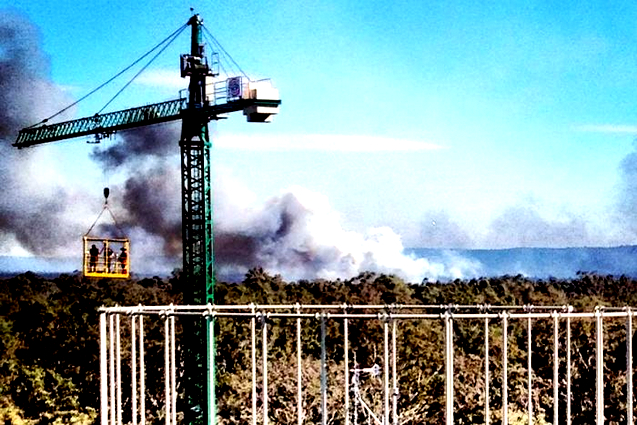
In a unique experiment, Professor Belinda Medlyn and her team from Western Sydney University pumped carbon from a commercial supplier into a forest of 90-year-old trees.

They laid pipelines and built tubular structures in the forest to deliver the carbon into the air above the canopy.

For four years they kept the carbon levels 38 per cent higher than normal while they tracked the movement of carbon through the forest ecosystem and they built cranes to take them high enough to measure the results.

They looked at how the trees and the plants in the understory take up the CO2 and found that it passes through the ecosystem in a number of different ways, according to Professor Medlyn.

"Some of the carbon stays in the plants, some of it is eaten by insects, some of it is passed onto symbiotic fungi, some of it goes into the soil where it becomes food for soil micro-organisms."

The results

Their research showed that mature trees could consume an additional 12 per cent of carbon at elevated levels, but that it wasn't sequestered.

"Instead, the majority of the extra carbon was emitted back into the atmosphere via several respiratory fluxes, with increased soil respiration alone accounting for half of the total uptake surplus," Professor Medlyn said.

The explanation, according to Professor Medlyn, was in the soil.

"The soil that they're growing on is fairly poor. It doesn't have a lot of nutrients in it," she said.

"The plants need those nutrients to grow, so it seems what they've done when they've been given extra carbon is just to use that to go looking for extra nutrients."

Implications for global climate models

If mature trees can't store the rising levels of carbon in the atmosphere, then models based on the idea that plants will respond to increased levels of CO2 with extra growth may be wrong.

"At the moment those global calculations assume that mature forests will store will store extra CO2 as concentrations go up, but our results are implying that mature forests can't keep doing that into the future," Professor Medlyn said.

Mature trees also store a lot of carbon, so old forest still need to be protected, said Professor Medlyn.

"They do have a lot of carbon stored in them, it's just they won't keep on taking up more carbon into the future," she said.

CSIRO cautious

Carbon was piped in from a commercial source and then tubes elevated it above the canopy, raising carbon levels by 38 per cent for the study.
University of Western Sydney
Pep Canadell is the executive director of the global carbon project at the CSIRO's climate research centre.

He agreed the findings of the study, published in Nature magazine, had the potential to change the global models used to predict CO2 levels into the future.

However, he said, more work needed to be done to see if other mature forests responded in the same way, and that two other studies were underway in England and Scotland.

"The big challenge is to begin research across the world to understand if it's common or not common at all," he said.

Links

13/04/2020

The Difference Between Global Warming And Climate Change

FairPlanetAma Lorenz

ELLESMERE ISLAND, CANADA: A section of a glacier is seen from NASA's Operation IceBridge research aircraft on March 29, 2017 above Ellesmere Island, Canada. The ice fields of Ellesmere Island are retreating due to warming temperatures. Photo by Mario Tama/Getty Images

‘Global warming’ and ‘climate change’ are terms that we’ve become accustomed to hearing in recent years. In fact, a simple Google search returns over one billion combined results, proving that phrases that 30 years ago were virtually unknown have now become ingrained into the English language.

However, global warming and climate change are phrases that are often confused, misunderstood or even used interchangeably.
A simple Google search returns over one billion combined results, proving that phrases that, 30 years ago, were virtually unknown have now become ingrained into the English language.
In summary, global warming describes the increase in the surface temperature across the planet, predominantly the result of high levels of greenhouse gases in the atmosphere. This is only one aspect of climate change, which is the long-term changes in regional or global climate, especially rainfall, wind and temperature.

Since the two processes are linked, and one is even the result of the other, it’s unsurprising that people often fail to understand the difference between climate change and global warming.

Global warming

The term global warming first became prominent in the media in the 1980s, although it was coined a decade or more earlier, mainly in response to growing scientific awareness of the damage pollutants — particularly chlorofluorocarbons (CFCs), commonly used in aerosols and refrigerants — were having on the Earth’s ozone layer.

The Earth’s surface heats during the daytime as it is struck by rays from the sun. At night, the energy from the sun is radiated back into space, theoretically allowing the surface of the planet to cool and the temperature to be maintained at an optimum level.

However, the presence of greenhouses gases in the atmosphere, including carbon dioxide, methane and chlorofluorocarbons, causes the heat radiated from the surface of the Earth to be radiated back, in effect creating a gaseous shield around the Earth that prevents the sun’s heat from being able to escape.

LODWAR, KENYA: A young boy from the remote Turkana tribe in Northern Kenya stands on a dried up river bed on November 9, 2009 near Lodwar, Kenya. Over 23 million people across East Africa are facing a critical shortage of water and food, a situation made worse by climate change. Photo by Christopher Furlong/Getty Images

The increase over decades of greenhouses gases in the atmosphere, combined with factors such as the orbit of the Earth and changes in the energy output of the sun, has contributed significantly to heat retention at the surface level of the planet, causing the temperature of Earth to rise.
The term global warming first became prominent in the media in the 1980s, although it was coined a decade or more earlier.
According to the National Oceanic and Atmospheric Association, since 1880 the average surface temperature of the Earth has increased by approximately 0.95 degrees Celsius (1.71 degrees Fahrenheit). While such a small rise in the temperature may seem inconsequential, the effects of such a tiny shift can be dramatic, particularly on the planet’s climate.

Climate change

The differences between climate change and global warming are, in part, commonly misunderstood because the increased temperature leads directly to a changing climate (often seen in extremes of weather). Whereas the weather is the particular conditions in the atmosphere at a specific point of time (for example, to describe a Monday morning as ‘cloudy with a little light rain’), the climate describes the conditions in the atmosphere for an extended period of time, such as over 30 years.

Weather changes very quickly, sometimes within hours, whereas climate patterns tend to last for decades. Consequently, the climate changes more slowly and long-term trends must be considered to produce an accurate understanding of them.

Climates can also be regional or global. For climate change to be established, at least one of the climatic variables — rainfall, wind or temperature — would need to fluctuate over an extended period in the same place, whether this is in a region of the Earth or across the planet as a whole.

For example, a sustained increase in rainfall in a previously arid region of Australasia for several decades would be classified as climate change, even if the climate in other parts of the world remained stable.

CAMARILLO, CA: A man on a rooftop looks at approaching flames as the Springs fire continues to grow on May 3, 2013 near Camarillo, California. The wildfire has spread to more than 18,000 acres on day two and is 20 percent contained. Photo by David McNew/Getty Images

Climate change sceptics often argue that the climate is constantly changing and, historically, the Earth has experienced extremes of weather many times before. In part, this is accurate: climate change occurs for several reasons, some of which are entirely natural and unpredictable such as the shifting of tectonic plates or volcanic activity.

Global warming causes many side effects in terms of our fluctuating climate. Melting glaciers at the poles, more frequent and violent tropical storms, above average temperatures during summer days in Europe and extended periods of drought in developing countries can all be attributed to the increase in the Earth’s surface temperature.
The differences between climate change and global warming are, in part, commonly misunderstood because the increased temperature leads directly to a changing climate.
While natural causes can sometimes be blamed for climate change, scientists have recently concluded that human activity is almost entirely responsible for global warming during the last 170 years.

To summarise the difference between climate change and global warming, global warming (the increase in the average temperature of the Earth’s surface due to the presence of gases in the atmosphere) is a significant cause of climate change. And if global warming is the cause, climate change is the effect, the long-term fluctuation in weather patterns over decades, on a regional or a global scale.

The problem of global warming should not be underestimated as it is driving a potentially catastrophic change in the world’s climates, putting the livelihoods and long-term existence of communities throughout across the planet in jeopardy.

Links

(US) No News Or Bad News? Many People Choose Ignorance Over Staying Informed, Study Finds

Grist - 

Grist / George Marks / CSA Printstock / Getty Images

Would you rather hear bad news that could help you in the long run, or remain blissfully ignorant?

That’s the question that researchers recently posed to thousands of people in over a dozen variations — including asking whether they’d want to know how badly climate change could impact their zip code. Other topics included personal health, finances, and how others perceive you. The researchers found that for every subject, there was a substantial chunk of people who preferred to not learn unpleasant information, even when they knew the information could help them over time.

It may not be a rational response, but it’s hardly shocking that we tend to avoid asking questions to which we might not like the answers: Who among us has not dodged the nutrition label on a favorite guilty pleasure food or “forgotten” to check a bank statement after a month of heavy spending? But a significant portion of respondents (20 to 75 percent, depending on the topic) chose to avoid learning helpful yet unpleasant information — a trend that held true regardless of gender, income, political leanings, and education. (Though an inclination for gambling did seem to correlate with wanting the dirty details on topics the rest of us might eschew).

To a degree, “trading off the potential pain from receiving bad news against the uncertain and delayed benefits from making more informed decisions is something we all seem to do,” said David Hagmann, one of the study’s coauthors and a postdoctoral fellow at the Harvard Kennedy School, in a press release.

The study is the latest in a long line of research exposing idiosyncrasies in how we tend to handle unwelcome information. Confirmation bias, in which people readily accept information that fits their existing worldview but reject information that challenges it, is one of the best-documented examples. It’s a major reason fake news can proliferate so freely among like-minded connections on social media. Most people, including policymakers and communicators, still struggle to understand that the mental gymnastics we perform to protect ourselves from things we just don’t want to know are not faulty tics, but deeply embedded features in the hardwiring of our minds.
“One of the reasons that nothing is being done about climate change is that it’s too painful to think about.”Study author George Loewenstein
For climate change, an issue that people understandably associate with bad news, this phenomenon presents a significant barrier to taking action. Even people who accept the science might be reluctant to learn new (and potentially helpful) information about the topic if it means having to confront the growing scope of the problem. “One of the reasons that nothing is being done about climate change is that it’s too painful to think about,” suggests study author George Loewenstein, who admits to being an information-avoider himself. Since people avoid information they even suspect could be unpleasant, even benign climate information runs the risk of being passed over.

Putting off learning about serious topics like climate change means the problems associated with those issues will likely be much worse down the line. “Making good decisions is often contingent on obtaining information, even when that information is uncertain and has the potential to produce unhappiness,” wrote the study authors. And unfortunately, they added, “people are often ready to make worse decisions.”

To get information-avoiders on board with facing the music, Hagmann proposes making problems appear more actionable in the moment, or reframing the information so that it feels, in some way, good. “That doesn’t mean downplaying the risk, but maybe [giving] information about what you can do to adapt,” he suggested. “That’s hopefully less painful to look at.”

Links

Facing The Climate Change Crisis, Three Books Offer Some Ambitious Proposals

New York Times - Kendra Pierre-Louis

John Gall
THE FUTURE WE CHOOSE
Surviving the Crisis
By Christina Figueres and Tom Rivett-Carnac

The first question to ask when reading “The Future We Choose” is, Who exactly is the “we” of the title? Figueres, who helped facilitate the passage of the Paris Agreement on climate change, and Rivett-Carnac, a lobbyist for the United Nations, position their book as presenting options for what “governments, corporations and each of us can do” about climate change. But those are three distinct groups with different motivations and pressures. That the book lumps them all together regardless of their contribution to the problem — your average person in Guatemala has contributed far less to climate change than a person in New York City, and each has contributed less than an oil company — illustrates the book’s unevenness.

Further, in pursuit of their optimistic messaging, the authors are loose with certain facts. For example, their emphasis on tree planting and reforestation (laudable goals, to be sure) relies partly on a flawed study in the journal Science that overestimated how many trees can actually be planted, because of ecosystem constraints — we don’t grow trees in the desert — and how much carbon they can pull out of the atmosphere. Similarly, they write that biofuels will replace fossil fuels in airplanes, but what those fuels will be made of, and how we might balance the required agriculture with the prescription for more forestland, is not made clear.

Perhaps most unsatisfying, the book is presented as an action guide but offers few actions the average reader can actually take. Many of the pages focus on how one can cultivate the right mind-set, an especially puzzling section because it comes after the authors have chastised us for being too individualistic. (Yet of the 10 actions they highlight, only one mentions cultivating community.) It’s not that the action statements are bad — nobody would argue with engaging with politics, or nurturing a shared positive vision for the future — but the book falls short on telling us how.
210 pp. Knopf. $US23.


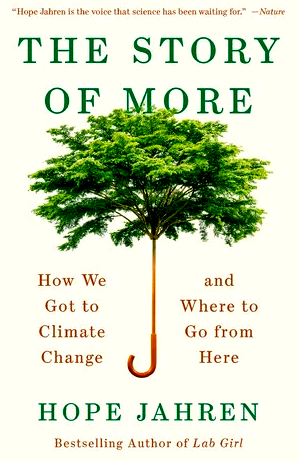
THE STORY OF MORE
How We Got to Climate Change and Where to Go From Here
By Hope Jahren

Reading “The Story of More,” you might become aware of a curious omission: Until about three-quarters of the way into the book, there is no direct mention of climate change. Instead, after introducing the problem of global warming in the first chapter, Jahren takes a step back.

She leads us on a journey across time and space, outlining thoughts and beliefs from Mesopotamia to her tiny Minnesota hometown. Along the way she discusses the impact of everything from population growth to Norwegian fishing to nuclear power. She takes this approach in order to present climate change as a result of broader dysfunctions having to do with consumption habits that, she says, don’t even make us happy. The only way to solve one problem, she suggests, is to solve both.
It’s an argument that contrasts with the recent spate of climate books, which opt to pummel readers with facts and guilt.Jahren, who first came to prominence with the best-selling memoir “Lab Girl,” instead writes delicately, like the whispery scrape of a skate tracing a figure on the ice.

“We wake in the morning and leave our homes and we work, work, work, to keep the great global chain of procurement in place,” she writes in a section focused on food waste. “Then we throw 40 percent of everything we just accomplished into the garbage. We can never get those hours back. Our children grow up, our bodies wane, and death comes to claim some of those we love. All the while, we spend our days making things for the purpose of discarding them.”
208 pp. Vintage. Paper, $US15.


THE 100% SOLUTION
A Plan for Solving Climate Change
By Solomon Goldstein-Rose

At 22 Goldstein-Rose became one of the youngest people to serve in the Massachusetts House of Representatives. Now 26 and a climate activist, he argues that only in combination can the many climate strategies — including renewable energy, energy efficiency and sequestration — reduce atmospheric greenhouse gas levels enough by 2050 to stave off the worst effects of climate change.

His message is a necessary one. Climate action is often distilled into individualistic actions that on their own aren’t sufficient. But Goldstein-Rose doesn’t provide the comprehensive plan for solving climate change that he sets out to.

While he offers five pillars of emissions reduction, he doesn’t quantify how much we can reasonably expect to bring down the level of carbon. This is probably because his solutions depend in part on highly efficient technologies that he admits don’t exist yet. To create them, he calls for a national effort on climate change akin to the one that sent humans to the moon.

Similarly, some details raise doubts as to how much Goldstein-Rose knows about existing efforts. In a section discussing the need to reduce agriculture emissions he proposes using Peace Corps volunteers to bring sustainable agricultural practices to low-income countries, as though this were a novel idea. But in some countries, they are already doing just that. Meanwhile his discussions on energy ignore the tremendous subsidies that fossil fuels receive compared with other energy sources. When discussing the risks of nuclear energy, he focuses on power plant designs that have not yet been properly piloted, and focuses on the risk with no mention of the horrors experienced by some communities, such as the Navajo Nation, that come from extracting a plant’s fuel. As a broad idea the book works, but as a road map to climate action, it skips too many details.
294 pp. Melville House. Paper, $US19.99.

Links - Books

12/04/2020

The Unholy Alliance Of Covid-19, Nationalism, And Climate Change

MIT Technology Review

When the pandemic wanes, a poorer, more divided world will still face the rapidly rising threat of global warming.

Miguel Porlan

On the early afternoon of December 15, the gavel fell at the UN COP25 conference in Madrid. The weeks of negotiations over crucial pieces of the Paris climate agreement reached four years earlier had ended in failure. Despite spending nearly two days longer than scheduled, thousands of delegates departed the convention halls deadlocked on the basic rules required to move forward.There’s plenty of blame to go around.

But by most accounts, Australia, Brazil, and the US—each now run by nationalist leaders who rose to power in part on promises to defy global demands for greater climate action—took special pains to thwart progress. Brazil immediately backed out of hosting the convention after the election of Jair Bolsonaro, and its delegates spent their time in Madrid arguing for the need to open up the Amazon for farming and mining. The US, on track to exit the accords altogether under President Donald Trump, stonewalled efforts to establish a process for providing funding and support to poor nations hit by climate disasters.

In the end, nearly every major decision at COP25 was punted to the next conference, originally scheduled for this November in Glasgow. “The can-do spirit that birthed the Paris agreement feels like a distant memory today,” Helen Mountford, vice president for climate and economics at the World Resources Institute, said at the close of the talks.

Two weeks later, researchers in China identified a deadly new coronavirus strain that had infected dozens of people, marking the start of the global pandemic. Borders slammed shut. Global trade stalled and markets crashed. Countries traded accusations and insults. In a matter of weeks, any lingering momentum behind efforts to jointly confront climate change essentially vanished.

As the worldwide death toll accelerated, countries locked down cities, banned international travel, and all but shut down their economies in a desperate effort to slow the outbreak. Under the demands of social distancing, the teenage activist Greta Thunberg shifted her swelling climate movement online—where it effectively dropped out of public sight. The UN ultimately canceled this year’s COP, killing any last hopes that nations would, as originally intended, adopt more ambitious emissions targets on the fifth anniversary of the deal.

The Paris accords had lifted hopes that after decades of dithering, the world might finally pull together to confront climate change. Nearly every nation signed on, each agreeing to take specific steps to rein in emissions. But what if, in retrospect, Paris was not the start of an era of cooperation, but its high point?

The nationalist narrative

As the covid-19 outbreak rages across the world, it’s easy to forget about the climate crisis. The priorities right now are, and should be, slowing the pandemic, saving lives, and then restarting economies left in shambles. But by that point few countries are likely to be able or especially eager to sacrifice near-term growth to help slow global warming.

In the short term, global emissions are falling, as they did during steep economic declines in the past. But carbon dioxide can stay in the atmosphere for centuries, meaning the total concentration will continue to rise even if we’re producing less of it. And emissions will bounce back as soon as economies do. They’re already nearly within normal ranges in China again.

So the threat of rapidly accelerating climate change will remain. And we’ll be living in a much poorer world, with fewer job opportunities, less money to invest in cleaner systems, and deeper fears about our health, our financial futures, and other lurking dangers.

These are ripe conditions to further inflame nationalist instincts, making our global challenges even harder to solve. Indeed, the breakdowns in international (and even intra-national) cooperation as countries race to understand and tackle the covid-19 outbreak offer a stark warning for our climate future.

By its very nature, climate change is a global problem: every country needs to nearly eliminate emissions. But they don’t all have the same incentive to do so. Regions like Europe that pumped out huge shares of historic emissions have less to lose by curbing them than nations like India that need faster economic growth to reduce poverty. Those rich countries also aren’t likely to face nearly the same level of climate disasters as poor ones. Colder nations, like Russia and Canada, could even benefit economically from warming.

“It’s not surprising that the most ardent nationalist populists—in Brazil, the US, EU skeptics in Britain—are also the most skeptical of Paris,” says David Victor, co-director of the Laboratory on International Law and Regulation at the University of California, San Diego. “But that whole agenda is deeply problematic for climate because ultimately what you need is a set of institutions and some measure of cooperation that helps diffuse good ideas and products around the global economy.”

America first

Donald Trump, a self-described nationalist who denounces “globalism,” inflicted the single biggest wound to the Paris agreement by declaring, on the very first day he could, that the US would withdraw from it. During his Rose Garden speech on June 1, 2017, he laid out a case against the deal that had little to do with the actual terms—which were self-determined and nonbinding—and everything to do with stoking simmering resentment of foreign nations, international institutions, and distant elites who would dare tell the US what to do.

He’s lambasted international treaties and trade deals along similarly zero-sum, narrowly nationalist lines, launching a bitter, costly, and divisive trade war with China.

“The Paris agreement handicaps the United States economy in order to win praise from the very foreign capitals and global activists that have long sought to gain wealth at our country’s expense,” Trump said that day. “They don’t put America first. I do, and I always will.”

For Trump, the pandemic is one more opportunity to fan fears of outsiders and push his nativist policies. He’s repeatedly referred to the coronavirus as the “Chinese virus” in a transparent attempt to pin blame overseas and deflect criticisms of his own failures in handling the public health crisis.

Using powers granted to the surgeon general, the White House said it would immediately send back asylum seekers and others who illegally cross the borders, in defiance of earlier court orders to grant them due process. Later, the administration sought to compel manufacturer 3M to stop sending respirator masks to its customers in Canada and Latin America, in a move the company warned would prompt retaliatory restrictions on critical medical supplies flowing into the US.

None of this portends well for the future of international cooperation on climate change.

The collapse of trust

Before the outbreak, the world’s largest carbon emitter, China, had made major strides to increase its solar, wind, and nuclear generation, meet the rising demand for automobiles with more electric vehicles, and build up huge domestic industries to pump out solar panels, batteries, and EVs. It still appears to be on track to achieve its central (if not particularly ambitious) Paris pledge: achieving peak emissions no later than 2030.


But there have been worrying signs more recently of a slowdown in its efforts. China’s investments in renewables fell 8% last year to the lowest level since 2013, according to BloombergNEF, even as the world total slightly increased. Moreover, it’s kicked off a new building boom in coal plants: nearly 150 gigawatts’ worth are under construction or likely to be revived, roughly the capacity of the EU’s entire fleet, according to a report late last year by Global Energy Monitor.

China may pump money into some clean energy sectors through economic stimulus efforts in the coming months, but there are few reasons to suspect it will back off its reliance on cheap coal or accelerate its timetable for cutting climate pollution in the foreseeable future.

Indeed, even before the pandemic, there were signs China was souring on climate cooperation. During COP25, it and other emerging economies made clear they have no intention of tightening their emissions targets at the next conference, whenever that now happens, asserting that rich countries first need to make good on their commitments to provide funding and support to developing nations.

A major factor in these shifts is that rising nationalist sentiments elsewhere, and related trade hostilities, were already changing how China sees its choices, says Jonas Nahm, who studies China’s energy policy at the Johns Hopkins School of Advanced International Studies. Increasingly unable to rely on predictable supplies and prices for imported fuels and parts, it seems to be turning to the energy source it can rely on—abundant domestic coal.

“I think the rise of nationalism, in the US and elsewhere, has created a degree of economic uncertainty that has strengthened the hardliners and forced them to rethink the degree to which they can rely on green energy to power their future,” Nahm says.

One other casualty of the pandemic has been our faith in a global supply chain. As countries shut down production and distribution, first in China and then around the world, essential goods are in short supply. It has become evident how vulnerable we are to trade relationships and concentrated manufacturing centers.

That too presents a challenge for climate change. China produces about a third of the world’s wind turbines, two-thirds of its solar panels, and roughly 70% of its lithium-ion batteries, as Nahm highlighted in an article in Science late last year. Even with massive government support, it took decades of growth at “a breakneck pace” for Chinese businesses to create the technologies, supply chains, and manufacturing capacity to achieve that.

“It is unrealistic to expect that another nation will be able to rival China’s capabilities ... in the time frame needed to limit climate change to below 2 ˚C,” Nahm and coauthor John Helveston of George Washington University wrote. That means countries, businesses, and researchers around the world need to figure out how to forge closer relationships and collaborate more productively with China—“the United States in particular,” they said.

Climate fascism

As the historian Nils Gilman argued in February in a persuasive essay, “The Coming Avocado Politics,” there are good reasons to worry that rising anxieties over environmental emergencies will justify a more hard-line set of solutions on the right, an “ecologically justified neo-fascism” that includes militarizing borders, hoarding resources, and bolstering national protections against climate change.

It could lead us into far darker places as well, potentially justifying “neo-imperialist” responses “where we actively seek to repress the development and ambitions of the rest of the world,” Gilman says. Specifically, the US or other nations could turn to extreme methods, from eliminating development financing to deploying military force, to prevent the carbon bombs that would go off if billions of poor people start consuming goods, services, and energy at the same levels as Americans.

The tragic trial run of the coronavirus outbreak certainly bolsters fears that sentiments could rapidly turn in this direction. In addition to Trump’s efforts to inflame foreign resentments, there have been widespread reports in recent weeks of hate crimes and harassment against those of Asian descent around the world, including brutal beatings on public streets, verbal attacks on public transit, and racist memes online.

As the virus spreads and the economic downturn deepens, people will, rightfully, focus primarily on the immediate dangers: their health and that of friends and family; the likelihood of losing work; and the plunge in their retirement savings and home values. Enhancing global cooperation and combating distant climate dangers just aren’t going to take priority for some time.

The question, of course, is what happens as the pandemic recedes. In theory, this presents a new opportunity to get climate progress back on track. Stimulus packages designed to kick-start economic growth could include funding and policies to accelerate clean energy and climate adaptation projects, for example. The world will certainly be better equipped to face both pandemics and climate catastrophes if nations choose to more readily share resources, expertise, and information.

“That interconnectedness is quite apparent when it comes to getting masks and medicine,” says Jane Flegal, program officer with the William and Flora Hewlett Foundation’s Environment Program. “And it’s also apparent when you talk about the importance of making clean energy cheap and the role of technology transfer in the climate context.”

But in the end, whether people are left feeling that we need to tighten international ties or erect higher walls may depend a lot on how ugly things get in the coming weeks and months, and the political narratives that take hold as we try to make sense of how it all happened.

Links

Lethal Heating is a citizens' initiative