06/05/2020

(AU) Australian Businesses Call For Climate Crisis And Virus Economic Recovery To Be Tackled Together

The Guardian

Innes Willox, chief executive of the Australia Industry Group, says Covid-19 and climate are ‘urgent’ challenges that overlap

Chief executive of industry group representing more than 60,000 businesses says ‘Covid-19 and climate are bigger than any economic challenge we’ve faced in the last century’. Photograph: Ashley Cooper/Getty Images

A leading Australian business group is calling for the two biggest economic challenges in memory – recovery from the Covid-19 pandemic and cutting greenhouse gas emissions – to be addressed together, saying it would boost growth and put the country on a firm long-term footing.

Innes Willox, chief executive of the Australian Industry Group, representing more than 60,000 businesses, says economic recovery from the virus and the transition required to meet net-zero emissions by 2050 are overlapping issues that should be taken on together.

“There’s a lot that we can do to rebuild stronger and cleaner,” Willox planned to say on Tuesday, according to a speech released in advance.

“The need is urgent. Covid-19 and climate are bigger than any economic challenge we’ve faced in the last century.”

Willox is among a band of community leaders and industry groups urging governments to back climate solutions in the pandemic recovery rather than projects that entrench or increase emissions.

They include the Investor Agenda, a global group of institutional investors and managers with members responsible for more than US$55tn worth of assets.

In a statement released on Monday, it said governments should avoid prioritising “risky, short-term emissions intensive projects”, and that accelerating the shift to net-zero emissions could create significant employment and economic growth while improving energy security and clean air.

“The path we choose in the coming months will have significant ramifications for our global economy and generations to come,” the group, which includes Australia’s Investor Group on Climate Change, said.

In Australia, visions for a “clean recovery” or “renewables stimulus” will be the focus of two online industry summits this week. Speakers include the Queensland premier, Annastacia Palaszczuk, and energy ministers from four states.

The emphasis of the summits differs from that of the energy and emissions reduction minister, Angus Taylor, who has backed gas, a fossil fuel, as key to driving the recovery after a slump in global oil and gas prices.

John Grimes, chief executive of the Smart Energy Council, which is hosting a summit on Wednesday, said the country needed to tackle the current economic crisis and the climate crisis at the same time or it would “lurch from one major problem to another”.

“This is Australia’s moment to modernise and grow the economy, create hundreds of thousands of new future-proof jobs and position Australia as a global renewable energy superpower,” Grimes said.

Willox planned to tell a separate forum hosted by the Clean Energy Council on Tuesday that last summer’s bushfires had been a preview of what lay ahead due to climate change. His speech notes said a successful energy transition must leave no-one behind and extend beyond electricity generation to include heavy industry, transport, agriculture, buildings “and more”.

“There is immense scope for reform and investment to support that transition, and getting started during the crisis will contribute to faster recovery,” he said.

He said the industry group had consulted widely on “the most constructive directions for recovery and transition”. Opportunities raised included:
  • improving energy management in homes and buildings by plugging drafts, modernising equipment and backing local electricity generation and storage; 
  • boosting electricity networks by rolling out smart meters and moving edge-of-grid customers on to mini-grids; 
  • helping shift heavy industry to run on clean electricity and hydrogen; and 
  • supporting large and small energy storage.
On transport, Willox said it was an excellent time to prepare cities and major corridors for mass take up of electric vehicles by installing or preparing for charging points at service stations, in public and government car parks, and at apartment blocks.

He said governments would have different preferences on whether to use regulatory reform, tax incentives, grants or other approaches. Giving the example of electricity, he said settling on a sound long-term design for market rules and climate policy could do as much to boost investment as direct public financial support.

A report by the Clean Energy Council, also released on Tuesday, estimated that 50,000 construction and 4,000 ongoing jobs could be created, and $50bn worth of renewable electricity and storage projects built, if governments backed green policies and regulatory reform to “jumpstart” the economy.

It said it would require help to overcome policy and grid transmission roadblocks that led to large-scale wind and solar investments falling 50% last year, changes to electricity market rules so the full benefits of energy storage were reflected and support for renewable hydrogen.

On a smaller scale, it would mean governments removing barriers for renters, low-income households and community groups installing solar and supporting home batteries by either reducing costs or offering low-interest loans.

Kane Thornton, the Clean Energy Council’s chief executive, said there were hundreds of large-scale wind and solar projects with planning approval that could proceed quickly, create jobs and bring down prices.

“This isn’t about a handout for industry when government is directing scarce taxpayer funding to other essential services and areas,” Thornton said.

“There is an enormous appetite for private investment in clean energy that can be unlocked through smart regulatory reform, sensible energy policy and investment in the grid and energy storage.”

The International Energy Agency last week reported a “staggering” plunge in global demand for coal, oil and gas during the pandemic, with only renewable electricity proving resilient.

Links

In The Midst Of An Economic Crisis, Can 'Degrowth' Provide An Answer?

The Guardian - Lola Seaton

Degrowthers are susceptible to caricature – but their ideas raise important questions about how, how much, and why we work

‘Reading the current moment as a repudiation of degrowth is premature and unjustified.’ Photograph: Michael Brochstein/Sopa/Getty Images

Amid the misery and chaos caused by the coronavirus pandemic, there are some short-term consolations.

The precipitous drop in road and air traffic has left the air cleaner and the skies clearer.

For advocates of a Green New Deal (GND) – a vast, state-funded green infrastructure project, including a total transition to renewable energy and the construction of mass transit systems – there are reasons to be optimistic.

As the severity of the unfolding global recession becomes clear – the IMF predicts a 3% global contraction – the GND looks like the best route to recovery.

The GND had been growing in popularity before the outbreak – including among establishment politicians, with all the leading Democratic presidential candidates expressing support for some form of it.

But with with 26 million Americans filing for unemployment benefits in the past five weeks alone, and given that green industries are more efficient job creators than fossil-fuel ones, there is a powerful, immediate economic rationale for some kind of “green stimulus”.

That is without even taking into account the longer-term economic case for decarbonizing: a 2018 US climate report calculated that the devastating effects of unchecked global warming will shrink the US economy by as much as 10% by the end of this century.

But the economic fallout of Covid-19 has cast a harsher light on another strand of the climate movement, commonly termed “degrowth”.

Influential among Extinction Rebellion activists, but often regarded as unrealistic by mainstream policymakers, degrowthers, as their name suggests, argue that uncontrolled economic growth is ecologically unsustainable and that to avert climate catastrophe we need to not only shut down the fossil-fuel industries but to reduce consumption overall.

Degrowthers insist that we must find ways of living and working that do not require our economies to endlessly expand.

Degrowthers have been particularly susceptible to caricature in recent weeks.

“The coronavirus crisis reveals the misery of degrowth,” the Spectator predictably argued.

 But current living conditions – sudden mass joblessness, confinement and isolation, widespread food and income insecurity – are not a meaningful foretaste of greener things to come.

The nightmare we are currently enduring is not degrowth’s secret dream come true; it is at most a grotesque parody of it, and one which is now liable to be weaponized by opponents of the movement.

Reading the current moment as a repudiation of degrowth is premature and unjustified. It overlooks the distinction between what we are experiencing now – an unplanned, abrupt cessation of vast swaths of economic and social activity – and what advocates of degrowth envisage: a thoughtful, democratic, managed and equitable downsizing of the economy.

Most degrowth advocates do not champion economic contraction as such, but argue for the necessity of adapting to the continuing, long-term global stagnation sometimes called “secular stagnation”.

 The fact that we can only think of slowing down our economies in terms of recession and austerity – with the associated cuts to public spending, growth in inequality and decline in real earnings – says much more about our political landscape than the economic facts.

Yet there is one important criticism of degrowth that has been decisively bolstered by the sharp reversal in global economic fortunes resulting from the coronavirus lockdowns: the consequences for jobs.

GDP is a notoriously crude and partial measure of a society’s wellbeing, failing to account for a whole host of indicative factors including equality, access to energy, the quality of healthcare, education and social support systems.

But when GDP falls or slows because workers cannot produce goods or offer services, unemployment surges.

Coronavirus has brought that reality dramatically home.

As the economist and energy adviser Robert Pollin has written: “the immediate effect of any global GDP contraction would be huge job losses and declining living standards for working people and the poor.

During the Great Recession, global unemployment rose by over 30 million. I have not seen a convincing argument from a degrowth advocate as to how we could avoid a severe rise in mass unemployment if GDP were to fall by twice as much.”

The twin crises besetting us – the public health emergency and the unfolding economic trauma triggered by the measures to contain it – have laid bare much about the configuration of our world that we already knew but rarely fully apprehend: its interconnectedness, its fragility, its stark inequalities.

But these crises have also brought into visceral relief the fact that employment is the heart and soul of the economy. As the British economist James Meadway has argued, the economic depression now upon us threatens “the most fundamental institution of all in capitalism: the labor market itself”.

Since we have so little time left in which to stabilize the climate, we must be ruthlessly pragmatic in assessing the limitations of green strategies. Degrowth is no exception.

The scale and speed of investment required to completely renovate the energy and transportation sectors does not seem conceivable without growth continuing, at least for the time being.

Politically, as long as a steadily rising GDP remains an electoral necessity, it is difficult to imagine a recovery that doesn’t involve desperate efforts to restore growth – and not necessarily through greener means – by politicians anxious to revive flagging ratings.

Yet to fixate on the question of growth risks exaggerating the differences between the Green New Dealers and degrowthers – elevating the former as practical-minded technocratic capitalists who want a return to normal economic activity, just motored by a different energy source, and dismissing the latter as abstemious, back-to-the-land utopians who want to deprive of us most of the luxuries of modern capitalist life.

This in turn could lead to our learning only some of the lessons of the current predicament, and taking only some of the opportunities it offers.

What both strands of climate thinking ask us to consider – and what the current crisis poses with special, brutal force, as phrases like “key workers” and “essential services” enter common parlance – is the question of what kinds of jobs we need, and what kinds our planet needs of us.

Which goods and services are indispensable, and which would we be better off without? Degrowth and the GND offer different answers to this question – from green infrastructure construction to the care economy – but they both pose it, as well as raising important broader questions about how, how much and why we work.

Once it is safe to emerge from economic survival mode, I hope we will have the wisdom to follow the lead of both movements by systematically reflecting on which kinds of productive activity actually enrich our lives – and which among these our planet can sustain.

Links

05/05/2020

(AU) Government Offers $300m To Boost Hydrogen Investment Under Clean Energy Financing

The Guardian

Investment mandate of the Clean Energy Financing Corporation will be changed, but no guarantee hydrogen will be produced from renewables

The energy minister, Angus Taylor, has announced the Clean Energy Finance Corporation will provide $300m for investment in the hydrogen industry. Photograph: Bianca de Marchi/AAP

The Morrison government will change the investment mandate of the Clean Energy Finance Corporation, directing it to make up to $300m available for a new Advancing Hydrogen Fund as part of the national hydrogen strategy.

The Coalition’s move to create a dedicated hydrogen financing fund will be confirmed on Monday, and comes ahead of other changes the government intends to make to the CEFC’s investment program, including requiring it to support new investments in grid reliability.

Requiring the CEFC to support grid stability will require legislative change. It is unclear when that legislation will be introduced, given parliament is currently working on a reduced sitting schedule. The government will need to table a legislative instrument to update the investment mandate to facilitate the new hydrogen fund.

The independent MP Zali Steggall has recently asked the auditor general to investigate the Coalition’s scheme to underwrite gas, hydro and coal power, saying it lacks transparency and citing legal advice that the Coalition had no constitutional or legislative authority to introduce it.

In a joint statement, the energy minister, Angus Taylor, and finance minister, Mathias Cormann, said the CEFC would provide concessional finance for projects to support a national hydrogen industry.

It would consider new investments in advancing hydrogen production, developing export and domestic supply chains, establishing hydrogen hubs and backing projects that build domestic demand for hydrogen.

Australia’s energy ministers signed off on a national hydrogen strategy in November at the Coag energy council meeting – the first meeting of the federal/state decision-making body for more than 12 months.

Hydrogen has been championed by Australia’s chief scientist, Alan Finkel. In a joint statement after the November meeting, ministers noted markets for hydrogen were growing in Asia and Europe, and said Australia could replicate its success “in becoming a leader in the global LNG market over the past 40 years”.

“We have the resources, technology, workforce and experience needed to be a world leading hydrogen producer and exporter,” the joint statement said. “Australia’s renewable energy generation capacity provides particular advantages in the production of green hydrogen.”

The ACT attempted to amend the national hydrogen strategy at the meeting to support only hydrogen produced from renewable electricity, but that amendment was not supported by other jurisdictions.

Taylor said the government had “a strong commitment to building a hydrogen industry which will create jobs, many in regional areas, and billions of dollars in economic growth between now and 2050”.

“Importantly, if we can get hydrogen produced at under $2 a kilogram, it will be able to play a role in our domestic energy mix to bring down energy prices and keep the lights on,” he said.

Separately to the hydrogen strategy, Taylor has been spruiking a gas-led economic recovery as Australia slowly recovers from the economic shock associated with Covid-19. But the government is yet to release a technology roadmap it was developing before the pandemic hit, which will guide the transition to lower emissions.

Links

Inside Clean Energy: 6 Things Michael Moore’s ‘Planet Of The Humans’ Gets Wrong

InsideClimate NewsDan Gearino

The documentary's "facts" are deceptive and misleading, not to mention way out of date

Filmmaker Michael Moore released the documentary "Planet of the Humans" last week, a critique of the movement to renewable energy. Credit: Rich Fury/Getty Images

Dan Gearino covers the U.S. Midwest, part of InsideClimate News' National Environment Reporting Network.
His coverage deals with the business side of the clean-energy transition and he writes ICN's Inside Clean Energy newsletter.
Filmmaker Michael Moore's new documentary purports to expose hypocrisy at the heart of the renewable energy movement.

But the video, released on YouTube last week, is a mess of deceptive and outdated anecdotes, and a succession of ridiculous arguments. It will almost certainly do far more harm than good in the struggle to reduce carbon emissions.

As a reporter who covers renewable energy and has a background in covering the business of energy, watching "Planet of the Humans" was a slog, the equivalent of being cornered at a backyard barbecue by someone who wants to share conspiracy theories.

The writer and director, Jeff Gibbs, and the executive producer, Moore, have put together something that is woefully dated—the kind of commentary that was more common years ago, when renewable energy was more expensive and less efficient and we knew much less about what an energy transition might look like. Today we know more and we know better, but to watch this film you'd think it was about 2010.

I reached out to the producers, but did not get a response. Here are some questions that the film raises, and my answers:

Are EVs Just as Polluting as Gasoline Vehicles?

The time-capsule quality of the film is underscored by a scene filmed in Michigan about a decade ago showing an event tied to the rollout of the Chevrolet Volt, a plug-in hybrid vehicle that began production in 2010. The narrator makes the point that the vehicle was powered by a local utility that runs almost completely on coal, as if to say that the environmental benefits of an EV are illusory.

The film is recycling an old argument: that the use of fossil electricity means electric vehicles have about the same emissions as gasoline vehicles. But researchers have looked closely at this and found that there is a clear emissions benefit of using an EV.

For example, the Union of Concerned Scientists has found that EVs have lower emissions—including emissions from generating electricity—than typical gasoline models, even in the parts of the United States that still rely the most heavily on fossil fuels for electric power.

The environmental benefits of EVs will increase as utilities continue to reduce their emissions and as batteries used in the vehicles become more efficient.

Do Solar Panels Only Last 10 Years?

Planet of the Humans shows an unidentified man at a solar trade show who says, "Some solar panels are built to last only 10 years, so it's not as if you get this magic free energy."

I can only guess that this comment is from years ago, when panels were less durable and efficient than they are today. I know of no solar panel on the market today with such a short life span.

A workman installs solar panels in Colorado. Credit: John Moore/Getty Images

The National Renewable Energy Laboratory has done extensive work to determine how much solar panels degrade over time. Researchers there have found a median degradation rate of 0.5 percent per year, which means a median panel is still producing at 90 percent of its capability after 20 years.

Most solar systems come with warranties of at least 20 years.

How Much Wind and Solar Does Germany Generate?

The narrator of the movie makes the point that Germany's substantial spending on renewable energy has had almost no effect. A graphic appears on screen showing that Germany's solar energy consumption is 1.5 percent and wind energy consumption is 3.1 percent. It doesn't list the year.

As you can see from my story published today about the German energy transition, this is a subject I've followed closely, and I knew something was awry with the film's statistics.

The filmmakers appear to be using percentages that include energy used for home heating and transportation to arrive at such low numbers for wind and solar, without making clear that this is what they're doing. It is, at best, misleading.

German Chancellor Angela Merkel walks past wind turbines while visiting a wind farm in 2010 in Krempin, Germany. Credit: Sean Gallup/Getty Images

Last year, renewable sources generated more than 40 percent of the electricity in Germany, more than double the share in the United States. Onshore wind energy is the country's leading renewable power source, with 17 percent of generation. Solar accounts for 8 percent. The other leading renewable sources are biomass (7 percent), offshore wind (4 percent), and hydroelectric (4 percent).

Germany's success in developing renewable energy and maintaining a reliable grid is a compelling counterpoint to much of what the film is arguing.

Do Solar and Wind Energy Components Have a Carbon Footprint as Large as Fossil Fuels?

This question gets at the issue of "life-cycle emissions" of power plants, which takes into account the carbon emissions of every part of the life of a plant, including obtaining and manufacturing its components.

There is a deep body of research showing that wind, solar and nuclear power have much lower life-cycle emissions than natural gas and coal.

One example is a 2017 paper published in the journal Nature Energy that showed very small carbon footprints for wind, solar and nuclear, while coal and natural gas power plants had much larger carbon footprints, even if they were using carbon capture equipment to store their emissions. Carbon Brief wrote about this research at the time.

An older, but still widely cited, example is a 2013 report from the National Renewable Energy Laboratory that analyzed previous research on the subject to date and used it to produce ranges of findings. It showed a wide gap between life-cycle emissions of fossil fuel power plants compared to wind, solar and nuclear. For instance, the report showed that the median estimate of life-cycle emissions for a coal-fired power plant was about 100 times per unit of electricity than that of a utility-scale wind farm.

Tesla's Factories Generate 100 Percent of Their Own Electricity. So Why Are They Connected to the Grid?

The film shows Tesla officials boasting about how their factories get 100 percent of their electricity from renewable sources. Then the camera pans from a factory to the power lines connecting it to the grid.

Credit: Spencer Platt/Getty Images 

There are many reasons that a building needs to be connected to the grid even if it has access to its own electricity sources. First, the power lines can be used to export any excess electricity. Second, the grid is available as a backup whenever needed.

This doesn't mean that Tesla's claim of 100 percent renewable energy is incorrect. Most of the time, when companies make this claim, they mean that they buy or generate enough megawatt-hours of renewable energy to meet their needs over the course of a year, not that they have gone off-grid.

Do the Environmental Concerns about Biomass Energy Mean that All Renewable Energy is Suspect?

The short answer is an emphatic "No," but there's a longer answer that gets to the heart of one of the film's biggest shortcomings.

The film spends much of its time criticizing energy systems that use biomass, including those that use wood chips to make electricity or corn to make ethanol for motor fuel.

There are some well-documented concerns with using biomass in terms of land use to produce feedstocks, and emissions related to the burning of the fuels. Many environmental advocacy groups do not support the expansion of biomass energy systems, and see a clear difference between biomass and other renewable technologies like wind and solar.

But by lumping together biomass with wind and solar in an argument about renewable energy, the film is oversimplifying. While biomass is clearly a form of renewable energy, the better question is whether it is clean energy. I'm not going to attempt to answer that one today other than to say it is a source of fierce disagreement.

Links

(AU) Decline In 'Successful' Bird Species Like Magpies And Kookaburras Rings Alarm Bells

ABC Central West - Micaela Hambrett

Typically a bird that does well in built-up areas, the decline in magpie numbers across the country has shocked experts. (Supplied: David Flannery)


Key points
  • BirdLife Australia is concerned magpie and kookaburra numbers are declining
  • Theories include the use of second-generation rodenticides, changing agricultural practices, climate change and more frequent droughts
  • One positive, though, is coronavirus shutdowns mean more people may be free to participate in the annual Birds in Backyard survey this year
Sean Dooley describes magpies as being one of the few native bird success stories of European settlement.

So when dwindling observations were recorded across 15 years of Birdlife Australia surveys, alarms bells started ringing.

Mr Dooley, BirdLife Australia's national public affairs manager, said magpies were "open grassland and woodland birds".

"With agricultural and urban areas we've actually created pretty amenable habitat for them in that there's a lot of open space with scattered trees so they can nest in, roost in and survive in the landscape," he said.

But BirdLife Australia data shows that Australian magpies declined by 31 per cent in the East Coast region — including Sydney and Brisbane — between 1998 and 2013.

"They declined by roughly 20 per cent in the South East Mainland Region, which includes Melbourne, Canberra and Adelaide [for the same period]," Mr Dooley said.

The data also reflected a dramatic decline in kookaburras and birds of prey, suggesting carnivores were potentially more vulnerable to these unknown environmental changes.

Kookaburra numbers have declined by up to 40 per cent on the east coast of Australia. (Supplied: David Flannery)

Agriculture, climate change and drought

One possible theory was that the use of second-generation rodenticides was having a bigger toll on birds through secondary poisoning.

"Birds like boobook owls, other birds of prey, and magpies are actually eating rats that have been affected by the poison and it can actually kill them, whereas the earlier rodenticides didn't seem to affect the birds as much." Mr Dooley explained.

Other factors the group was considering included changing agriculture practices, climate change and more frequent droughts.

Although this did not mean magpies or kookaburras were endangered yet, it did indicate food and habitat conditions were under serious pressure.
"It's a huge wake-up call. If these really successful birds are starting to suffer, something's going on in the environment," Mr Dooley said.
With the next report due out next year, he said he expected the downward trend to continue.

"The additional five years [since the last report] have just been more drought conditions. I can't imagine things would be bouncing back," he said.

Largest natural history data set

BirdLife Australia's data is critical to painting a large scale, real-time picture of Australia's bird populations providing insight to researchers and academics.

BirdLife Australia's Sean Dooley hopes unique insights into backyard birds will emerge from the coronavirus lockdown. (Supplied: BirdLife Australia)

The data that made up these reports was nearly all gathered by volunteers.

"We have literally thousands of people sending in tens of thousands of surveys every year. It's probably the biggest citizen science project in Australia and one of the biggest natural history data sets in the country," Mr Dooley said.

Urban and suburban observational data was critical to "filling in the gaps" for common birds that share our spaces, as birdwatchers typically head to more pristine environments seeking rarer species.

Although an entry level survey, Mr Dooley said backyard bird observational data had been able to reflect nuanced trends, such as population decline between regional and metro areas indicating widespread environmental degradation.

Take cover! A young cyclist takes evasive action as a magpie swoops in Casino, New South Wales. (ABC Open contributor Dee Hartin)

This year, the coronavirus lockdown has coincided with the organisation's annual autumn Birds in Backyard survey and it might provide an accidental boon for BirdLife's data sets.

"One bit of positivity is with everybody at home, if we can get them to do their surveys, we're going to get a huge boost in our knowledge of what birds are using urban, suburban and town areas," Mr Dooley said.

Links

04/05/2020

(AU) Want An Economic Tonic, Mr Morrison? Use That Stimulus Money To Turbocharge Renewables

The Conversation |  |  | 

Chris Fithall/Flickr


  • Elizabeth Thurbon, Scientia Fellow and Associate Professor in International Relations / International Political Economy, UNSW
  • , Associate professor, University of Newcastle
  • , Professor Emeritus, Macquarie Business School, Macquarie University
  • , Senior Lecturer in the Department of Modern History, Politics & International Relations, Macquarie University
The chaos of COVID-19 has now hit global energy markets, creating an outcome unheard of in industrial history: negative oil prices.

With the world’s largest economies largely in lockdown, demand for oil has stagnated.

Essentially, the negative prices mean oil producers are willing to pay for the oil to be taken off their hands because soon, they will have nowhere to store it.

Federal energy minister Angus Taylor has proposed a partial solution: Australia will spend A$94 million buying up oil, to bolster domestic supplies and help stabilise global prices.

That strategy is a fool’s path to energy security.

Right now, the best way to shore up Australia’s future energy supplies is to invest economic stimulus money in renewables – essentially to manufacture our own energy security.

Prime Minister Scott Morrison with Angus Taylor, right, who wants Australia to buy surplus oil. Mick Tsikas/AAP


A flawed plan

Australia’s oil reserves have for years languished well below the International Energy Agency’s recommended 90 days. Taylor says his plan would address this, and help stabilise (read: push up) oil prices and restore faith in the global oil market on which Australia depends.

But the plan is undermined by a simple fact: unstable global oil prices have been a recurring problem for decades, largely for political reasons well beyond Australia’s control. We need look only to the price shocks triggered by the Yom-Kippur war of 1973, the Iraq war of 2003, and the Saudi drone attack of 2019 - to name just a few.

Price instability is all but guaranteed to increase in future, as climate change concerns drive insurers and investors away from fossil fuels and towards green energy.

The current chaos actually creates a much better opportunity for Australia: use the massive COVID-19 economic stimulus to manufacture real energy security in the form of renewables.

Buying large volumes of surplus oil will not ensure stable prices. Flickr


Renewables: a win-win

The price and supply of energy from fossil fuels is vulnerable to natural resource depletion, geopolitical tensions and climate change concerns. This is true not just for oil, but coal and gas too.

The only real path to energy security is manufactured energy such as solar panels, wind turbines, electrolysers, batteries and smart grids.

These technologies can turn infinite natural resources into energy, then store and distribute it to ensure stable supply.

Victoria and South Australia now enjoy higher levels of energy security thanks to large-scale stationary batteries that even out electricity peaks and troughs.

For example, a large-scale battery in Victoria stores energy produced by the Gannawarra solar farm. The battery provides energy during peak times when there is no sun.

Manufacturing energy is also important from an economic security perspective, promoting the creation of high-tech, high-wage industries.

These industries can create thousands of skilled jobs and open up massive new export markets – all while helping to mitigate climate change. This reality has been accepted by major East Asian economies, including China to South Korea, for more than a decade.

The Australian government must use its enormous stimulus to help local companies dramatically expand their wind, solar, hydrogen and energy storage investments. This would satisfy domestic energy needs and grow the new green export markets ready and waiting in Asia.

Asia presents huge export potential for Australia’s renewable energy. DAN HIMBRECHTS/AAP


A jobs boon

There is no shortage of projects waiting to be turbocharged. The government could start with Sun Cable, linking Australia’s and Singapore’s clean energy markets via an undersea cable.

It could also kickstart Australia’s clean hydrogen industry. According to the government’s own National Hydrogen Strategy, developing hydrogen would dramatically reduce Australia’s oil import reliance and energy costs and vastly expand its clean energy exports.

By simply following its own strategy, the government could create about 7,600 skilled and semi-skilled jobs and add about A$11 billion each year to Australia’s gross domestic product to 2050.

The cheaper energy prices that follow could help Australia revive its techno-industrial base by making energy-intensive manufacturing a viable proposition once again.

According to leading economist Ross Garnaut, Australia could then bring home its long-lost materials-processing industries and re-emerge as a world-leading exporter of (clean) steel and aluminium.

Geopolitical benefits would also flow from Australia becoming a green hydrogen superpower, such as reducing our worrying export dependence on China.

An investment injection in renewables would be a huge jobs boost. Flickr


Seize the moment

The idea of using the COVID-19 stimulus to turbocharge Australia’s clean energy shift is not pie in the sky. Indeed, doing so is the explicit recommendation of the International Energy Agency, which this week noted:
These huge spending programmes are likely to be once-in-a-generation in scale and will shape countries’ infrastructure for decades to come… Governments can … achieve both short-term economic gains and long-term benefits by making clean energy part of their stimulus plans.
COVID-19 has undoubtedly been disastrous for Australia and the world. But it creates new opportunities in energy, economic security and climate action. To seize these opportunities, the Morrison government must chart a new industrial course for the nation by manufacturing Australia’s energy security.

Links

'This Pandemic Is Nothing Compared To What Climate Change Has In Store'

TheJournal.ie - John Gibbons

John Gibbons lays out the stark climate facts and urges us to take coronavirus as a warning that it’s now time to act, or perish.


Protesters in Paris waiting for the Paris Climate Agreement in 2015. Source: Apaydin Alain

John Gibbons is an environmental writer and commentator who specialises in covering the climate and biodiversity emergency.
He is a contributor to The Irish Times, The Guardian and DeSmog.uk and is a regular guest environmental commentator on broadcast media.
He blogs at Thinkorswim.ie and also runs the website Climatechange.ie.
IMAGINE FOR A moment that our government and others around the world had been given detailed information and warnings about the coronavirus years, even decades before it finally erupted.

Imagine also that experts had shown the path to minimising or even avoiding this global disaster, but our political and business leaders, uneasy about the costs of taking action and possible disruption to commerce, chose to ignore the expert warnings as alarmist and carried on regardless.

In reality, full-blown pandemics are vanishingly rare. Almost no human is alive today who lived in the time of the ‘Spanish Flu’ pandemic of 1918-19.

In the modern era, our collective cultural experience is that of taming, rather than being at the mercy of, nature in general and deadly diseases in particular. Consider smallpox: during the 20th century, it killed an estimated 300 million people worldwide. A global vaccination campaign eventually led to its eradication in 1980. Likewise, polio, another dreaded disease, has been almost completely vanquished by vaccination.

The damage done

Until very recently, premature death had been the norm for most humans. However, in the last five decades, largely freed from the threat of predators, large and small, our numbers on this earth have more than doubled, to over 7.8 billion, while average life expectancy in the same period has increased by well over a decade per person.

That’s the good news. The bad news is that this unprecedented global expansion of the human footprint has brought the biosphere, our living planet, to the brink of collapse. There are many ways of measuring this, such as the precipitous decline in biodiversity, the average annual loss of 15 billion trees, many of them from razed ancient rainforests.

A major report on biodiversity and ecosystems published last May found that the natural world is declining globally ‘at rates unprecedented in human history – and the rate of species extinctions is accelerating, with grave impacts on people around the world now likely’.

The Intergovernmental Science-Policy Platform on Biodiversity and Ecosystem Services (IPBES) report concluded that around one million animal and plant species now face extinction in the coming decades. ‘The essential, interconnected web of life on Earth is getting smaller and increasingly frayed…this loss is a direct result of human activity and constitutes a direct threat to human well-being’, the IPBES report warned.

The unavoidable warming

We face an equally daunting and arguably more intractable challenge from climate change. In October 2018, the Intergovernmental Panel on Climate Change (IPCC) issued a special report on the likely impacts of global warming at and beyond 1.5ºC over pre-industrial temperatures.
Arising from this landmark report, it emerged that in order to keep global temperatures within relatively safe limits, carbon emissions would have to fall by at least 45% by 2030, which is just ten years from now.
This is in line with commitments made by almost all the world’s leaders, including Ireland, when we signed up for the 2015 Paris Agreement, which legally committed us to doing everything possible to avoid extremely dangerous climate change at 2ºC and beyond.

This commitment was underlined in January 2020 by the all-party Oireachtas Committee on Climate Action when it agreed a minimum targeted emissions reduction of 7%+ per annum and this, in turn, has become the Green Party’s key precondition for entering into a coalition government.

virus-outbreak-germany-fridays-for-future
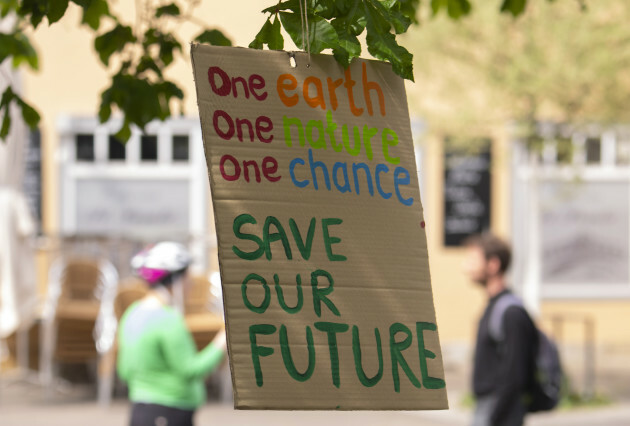
Activists of the fridays for future movement placed a poster at a tree in Erfurt, Germany, April 24, 2020. Source: Jens Meyer

According to the World Meteorological Organisation (WMO), the economic impact of the coronavirus is likely to see global carbon emissions fall by some 6% in 2020.
We need to flatten both the pandemic and climate change curves; we need to show the same determination and unity against climate change as against Covid-19”, according to WMO Secretary-General Petteri Taalas. Action, he added, would be needed “for many generations ahead".
What this underlines is that to achieve a compound 7% annual emissions cut every year from now until 2030 would require the most radical rethink of how we organise our society and economy since the foundation of the state.

Can you see it happening?

Many are deeply sceptical. Former ‘Climate Action’ minister, Denis Naughten dismissed the 7% target as ‘unachievable’, claiming it would equate to banning every private car and slaughtering every (farm) animal in the country.

Naughten is at least being consistent. Back in 2017, he threatened to block implementation of the Paris Agreement at the EU level, claiming it was ‘unaffordable’ for Ireland to implement.

Since 2011, a succession of Fine Gael-led governments has stymied meaningful climate action. As a result, Ireland has now the third-highest per capita emissions in the EU, with the average Irish citizen accounting for more than double the emissions of their high-income Swedish counterparts.

As Sweden shows, ultra-low carbon solutions in transport, energy, home heating, agriculture and industry are indeed possible, but in Ireland, these have been held back by vested interest groups pursuing short-term agendas and TDs engaged in parish pump politics.

climate-change-protest-in-london-uk-14-feb-2020
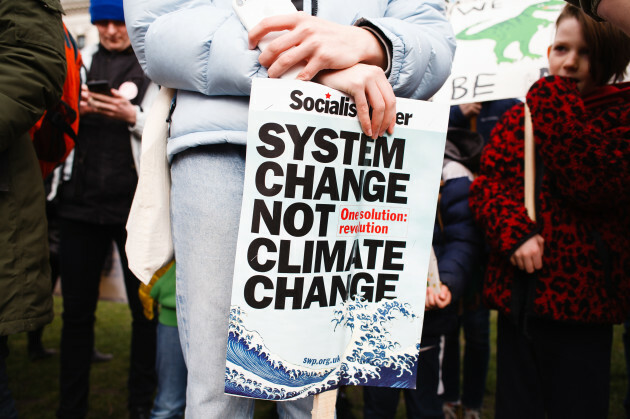
A young environmentalists holds a placard during the protest at Parliament Square in London. Source: SIPA USA/PA Images

Even Taoiseach Leo Varadkar has had to concede he was “not proud of Ireland’s performance on climate…as far as I am concerned, we are a laggard”.

At what cost?

Apart from constant lobbying by commercial and agri-industrial groups, another reason politicians have run scared of climate action is that the issue is consistently framed in the Irish media in terms of the cost of tackling climate change. However, international studies have shown repeatedly that the price of inaction far outweighs the costs of addressing the crisis.

It is estimated that the cost of the coronavirus to the global economy is in the range of $2–$4 trillion this year. A 2018 report calculated that failure to rein in climate change would deliver a devastating $34 trillion hit to the global economy – many times greater than the economic chaos arising from the pandemic.

Other estimates are even less sanguine. An Australian study published in 2019 argues that ‘climate change represents a near to mid-term existential threat to human civilisation’.
Should global temperatures reach 3C over pre-industrial by mid-century, ‘the scale of destruction is beyond our capacity to model, with a high likelihood of human civilisation coming to an end’, the report warns.
So, the next time someone asks if we can ‘afford’ to tackle climate change, a better question might instead be: what price isn’t worth paying to avoid the collapse of civilisation?

Links

Lethal Heating is a citizens' initiative