13/05/2020

Australians Want Industry, And They’d Like It Green. Steel Is The Place To Start

The Conversation |  | 

Shutterstock

Australia has an historic opportunity to build a new, export-focused manufacturing sector based on renewable energy.

As a bonus, it could enable a less politically fraught conversation about climate change. Global action on climate change is in Australia’s national interest.

The changing climate is already reducing profits for Australian farmers. Tens of thousands of jobs depend on the again-bleached Great Barrier Reef.

But for too long, political leaders have struggled to balance the national interest with the legitimate concerns of Australians who live and work in regions that host coal mining and other carbon-intensive industries – most notably central Queensland and the Hunter Valley in NSW.

Source: Grattan Institute (2020)'Start with steel: A practical plan to support carbon workers and Out emissions.


This climate conundrum has greatly complicated the national debate about climate change: neither commitments to a “just transition” to a low-emissions future, nor promises of coal exports in perpetuity, have proven convincing, leaving regional jobs in the lurch.

Australians want industry

In the 2019 federal election, voters in these carbon regions, perhaps fearing for their livelihoods, seemingly rejected Labor’s more ambitious climate policies.

But with 85% of our black coal exported each year, decisions made in Beijing and New Delhi matter more to these communities than decisions made in Canberra.

Australia needs a credible plan to replace carbon jobs as the world decarbonises, and ideally the new jobs will offer similar salaries, need similar skills, and be located in similar places.

This is the key to cracking the climate conundrum: a plan based on sound economics that can offer hope to communities that currently depend on carbon-intensive activities.

A new Grattan Institute report, Start with steel, finds that manufacturing green steel for export is the largest job opportunity for these regions of Australia.

We can start with steel

Green steel can be made by using renewable energy to produce hydrogen, and then using that hydrogen in place of metallurgical coal in the steelmaking process.

The byproduct is water, rather than carbon dioxide.

Winding back the 7% of global emissions that come from steel production will require creating demand for low-emissions steel.

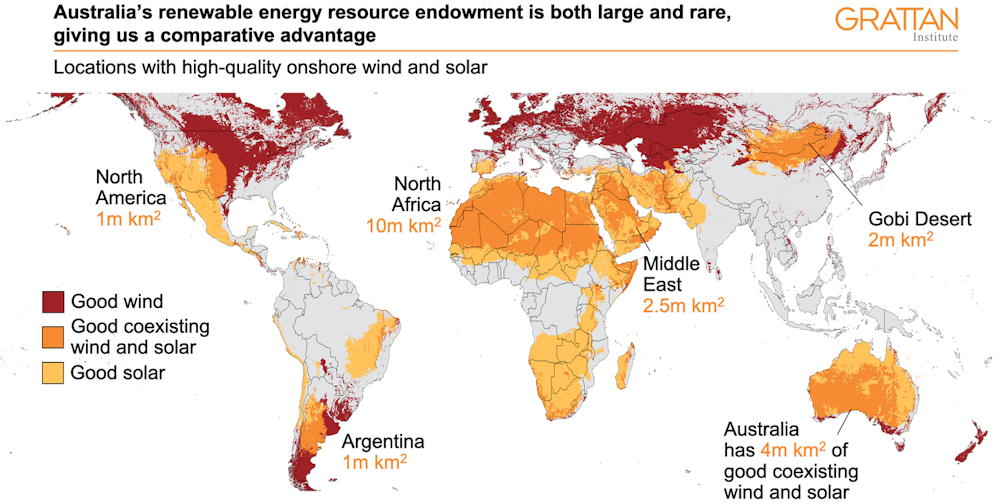
Australia has far better renewable resources than many of our major Asian trading partners, allowing us to make low-emissions hydrogen more cheaply, and therefore to make cheaper green steel.

And because hydrogen is expensive to transport, it makes sense to use it to make green steel here rather than exporting it to make green steel somewhere else.

Notes: Land higher than 3,000 metres is excluded because renewable energy resources are harder to use when they are in mountainous terrain. High-quality resources are defined to be areas with average wind power-density of at least 450 W/m2 and average daily solar photovoltaic potential of at least 4.5 kWh/kWp. North Africa includes the Horn of Africa. Sources: Grattan analysis of Global Wind Atlas (2020), Global Solar Atlas (2020) and U.S. Geological Survey and National Geospatial-Intelligence Agency (2010)

The Pilbara in Western Australia is the world’s largest iron ore province, which makes it look like the natural place to make green steel.

But it is difficult to attract workers to remote Western Australia. Making green steel for export would require large industrial workforces like those in central Queensland and the Hunter Valley.

Our calculations suggest that the availability of reasonably-priced labour on the east coast of Australia more than outweighs the cost of shipping iron ore from Western Australia to turn it into green steel there.

If Australia captured just 7% of the global steel market, it could create 25,000 ongoing manufacturing jobs.

Seven per cent is much higher than the 0.3% of globally-traded steel that Australia produces today – but it is much less than our share of iron ore production, which is 38%.

Crucially, the opportunity does not rely on leaps of faith or endless subsidies – it is one of the few economically-credible ways to make the low-emissions steel the world will need if it gets serious about tackling climate change.

We should act quickly

There are also opportunities for Australia’s regions to manufacture biofuels for aviation and use renewable hydrogen to make ammonia.

The markets for these products are less certain, but if the world moves decisively to limit emissions, the projects that respond will deliver thousands of jobs.

Governments cannot single-handedly create these industries, and nor should they.

Instead, they should focus on bringing down the cost of the key intermediate product – hydrogen – by funding pre-commercial studies of geological structures suitable for storing hydrogen cheaply.

And they should invest in Australia’s low-emissions steel making capabilities by partly funding a flagship project that uses the direct reduction technology needed to use hydrogen to make steel.

The politics of climate change skewered a decade’s worth of prime ministers. And an inability to communicate the costs of action – and why they’re justified – contributed to a would-be prime minister losing an unlosable election.

Green steel offers Australia a reset button: a chance to get bipartisan cooperation to tackle a wicked problem that threatens our national interest.

We’ve heard plenty about the climate crisis. It’s time to talk about the opportunities.

Links

A Silver Lining In The Global Pandemic: The Beginning Of The End For Oil?

SalonMichael T. Klare

Energy in a post-pandemic world

 Pump jacks are seen on the Bakken Shale Formation, near Williston, North Dakota, September 6, 2016. (Robyn Beck/AFP/Getty Images) 

Energy analysts have long assumed that, given time, growing international concern over climate change would result in a vast restructuring of the global energy enterprise. The result: a greener, less climate-degrading system. In this future, fossil fuels would be overtaken by renewables, while oil, gas, and coal would be relegated to an increasingly marginal role in the global energy equation.

In its World Energy Outlook 2019, for example, the International Energy Agency (IEA) predicted that, by 2040, renewables would finally supersede petroleum as the planet's number one source of energy and coal would largely disappear from the fuel mix. As a result of Covid-19, however, we may no longer have to wait another 20 years for such a cosmic transition to occur — it's happening right now.

So take a breath and, amid all the bad news pouring in about a deadly global pandemic, consider this: when it comes to energy, what was expected to take at least two decades in the IEA's most optimistic scenario may now occur in just a few years. It turns out that the impact of Covid-19 is reshaping the world energy equation, along with so much else, in unexpected ways.

That energy would be strongly affected by the pandemic should come as no surprise. After all, fuel use is closely aligned with economic activity and Covid-19 has shut down much of the world economy. With factories, offices, and other businesses closed or barely functioning, there's naturally less demand for energy of all types. But the impacts of the pandemic go far beyond that, as our principal coping mechanisms — social distancing and stay-at-home requirements — have particular implications for energy consumption.

Among the first and most dramatic of these has been a shockingly deep decline in flying, automobile commuting, and leisure travel ' activities that account for a large share of daily petroleum use. Airline travel in the United States, for example, is down by 95% from a year ago. At the same time, the personal consumption of electricity for telework, distance learning, group conversations, and entertainment has soared. In hard-hit Italy, for instance, Microsoft reports that the use of its cloud services for team meetings — a voracious consumer of electricity — has increased by 775%.

These are all meant to be temporary responses to the pandemic. As government officials and their scientific advisers begin to talk about returning to some semblance of "normalcy," however, it's becoming increasingly clear that many such pandemic-related practices will persist in some fashion for a long time to come and, in some cases, may prove permanent.

Social distancing is likely to remain the norm in public spaces for many months, if not years, curtailing attendance at theme parks and major sports events that also typically involve lots of driving. Many of us are also becoming more accustomed to working from home and may be in no rush to resume a harried 30-, 60-, or 90-minute commute to work each day. Some colleges and universities, already under financial pressure of various sorts, may abandon in-person classes for many subjects and rely far more on distance learning.

No matter how this pandemic finally plays out, the post-Covid-19 world is bound to have a very different look from the pre-pandemic one and energy use is likely to be among the areas most affected by the transformations underway. It would be distinctly premature to make sweeping predictions about the energy profile of a post-coronavirus planet, but one thing certainly seems possible: the grand transition, crucial for averting the worst outcomes of climate change and originally projected to occur decades from now, could end up happening significantly more swiftly, even if at the price of widespread bankruptcies and prolonged unemployment for millions.

Oil's dominance in jeopardy

As 2019 drew to a close, most energy analysts assumed that petroleum would continue to dominate the global landscape through the 2020s, as it had in recent decades, resulting in ever greater amounts of carbon emissions being sent into the atmosphere. For example, in its International Energy Outlook 2019, the Energy Information Administration (EIA) of the U.S. Department of Energy projected that global petroleum use in 2020 would amount to 102.2 million barrels per day.

That would be up 1.1 million barrels from 2019 and represent the second year in a row in which global consumption would have exceeded the notable threshold of 100 million barrels per day. Grimly enough, the EIA further projected that world demand would continue to climb, reaching 104 million barrels per day by 2025 and 106 million barrels in 2030.

In arriving at such projections, energy analysts assumed that the factors responsible for driving petroleum use upward in recent years would persist well into the future: growing automobile ownership in China, India, and other developing nations; ever-increasing commutes as soaring real-estate prices forced people to live ever farther from city centers; and an exponential increase in airline travel, especially in Asia.

Such factors, it was widely assumed, would more than compensate for any drop in demand caused by a greater preference for electric cars in Europe and a few other places. As suggested by oil giant BP in its Energy Outlook for 2019, "All of the demand growth comes from developing economies, driven by the burgeoning middle class in developing Asian economies."

Even in January, as the coronavirus began to spread from China to other countries, energy analysts imagined little change in such predictions. Reporting "continued strong momentum" in oil use among the major developing economies, the IEA typically reaffirmed its belief that global consumption would grow by more than one million barrels daily in 2020.

Only now has that agency begun to change its tune. In its most recent Oil Market Report, it projected that global petroleum consumption in April would fall by an astonishing 29 million barrels per day compared to the same month the previous year. That drop, by the way, is the equivalent of total 2019 oil usage by the United States, Canada, and Mexico.

Still, the IEA analysts assumed that all of this would just be a passing phenomenon. In that same report, it also predicted that global economic activity would rebound in the second half of this year and, by December, oil usage would already be within a few million barrels of pre-coronavirus consumption levels.

Other indicators, however, suggest that such rosy predictions will prove highly fanciful. The likelihood that oil consumption will approach 2018 or 2019 levels by year's end or even in early 2021 now appears remarkably unrealistic. It is, in fact, doubtful that those earlier projections about sustained future growth in the demand for oil will ever materialize.

A shattered world economy

As a start, a return to pre-Covid-19 consumption levels assumes a reasonably rapid restoration of the world economy as it was, with Asia taking the lead. At this moment, however, there's no evidence that such an outcome is likely.

In its April World Economic Outlook report, the International Monetary Fund predicted that global economic output would fall by 3% in 2020 (which may prove a distinct underestimate) and that the pandemic's harsh impacts, including widespread unemployment and business failures, will persist well into 2021 or beyond.

All told, it suggested, the cumulative loss to global gross domestic product in 2020 and 2021, thanks to the pandemic, will amount to some $9 trillion, a sum greater than the economies of Japan and Germany combined (and that assumes the coronavirus will not come back yet more fiercely in late 2020 or 2021, as the "Spanish Flu" did in 1918).

This and other recent data suggest that any notion China, India, and other developing nations will soon resume their upward oil-consumption trajectory and save the global petroleum industry appears wildly far-fetched. Indeed, on April 17th, China's National Bureau of Statistics reported that the country's GDP shrank by 6.8% in the first three months of 2020, the first such decline in 40 years and a staggering blow to that country's growth model.

Even though government officials are slowly opening factories and other key businesses again, most observers believe that spurring significant growth will prove exceedingly difficult given that Chinese consumers, traumatized by the pandemic and accompanying lockdown measures, seem loath to make new purchases or engage in travel, tourism, and the like.

And keep in mind that a slowdown in China will have staggering consequences for the economies of numerous other developing nations that rely on that country's tourism or its imports of their oil, copper, iron ore, and other raw materials. China, after all, is the leading destination for the exports of many Asian, African, and Latin American countries. With Chinese factories closed or operating at a reduced tempo, the demand for their products has already plummeted, causing widespread economic hardship for their populations.

Add all this up, along with a rising tide of unemployment in the United States and elsewhere, and it would appear that the possibility of global oil consumption returning to pre-pandemic levels any time soon — or even at all — is modest at best. Indeed, the major oil-exporting nations have evidently reached this conclusion on their own, as demonstrated by the extraordinary April 12th agreement that the Saudis, the Russians, and other major exporting countries reached to cut global production by nearly 10 million barrels per day.

It was a desperate bid to bolster oil prices, which had fallen by more than 50% since the beginning of the year. And keep in mind that even this reduction — unprecedented in scale — is unlikely to prevent a further decline in those prices, as oil purchases continue to fall and fall again.

Doing things differently

Energy analysts are likely to argue that, while the downturn will undoubtedly last longer than the IEA's optimistic forecast, sooner or later petroleum use will return to its earlier patterns, once again cresting at the 100-million-barrels-per-day level. But this appears highly unlikely, given the way the pandemic is reshaping the global economy and everyday human behavior.

After all, IEA and oil-industry forecasts assume a fully interconnected world in which the sort of dynamic growth we've come to expect from Asia in the twenty-first century will sooner or later fuel economic vigor globally. Extended supply lines will once again carry raw materials and other inputs to China's factories, while Chinese parts and finished products will be transported to markets on every continent.

 But whether or not that country's economy starts to grow again, such a globalized economic model is unlikely to remain the prevailing one in the post-pandemic era. Many countries and companies are, in fact, beginning to restructure their supply lines to avoid a full-scale reliance on foreign suppliers by seeking alternatives closer to home — a trend likely to persist after pandemic-related restrictions are lifted (especially in a world in which Trumpian-style "nationalism" still seems to be on the rise).

"There will be a rethink of how much any country wants to be reliant on any other country," suggests the aptly named Elizabeth Economy, a senior fellow at the Council on Foreign Relations. "I don't think fundamentally this is the end of globalization. But this does accelerate the type of thinking that has been going on in the Trump administration, that there are critical technologies, critical resources, reserve manufacturing capacity that we want here in the U.S. in case of crisis."

Other countries are bound to begin planning along similar lines, leading to a significant decline in transcontinental commerce. Local and regional trade will, of course, have to increase to make up for this decline, but the net impact on petroleum demand is likely to be negative as long-distance trade and travel diminishes. For China and other rising Asian powers, this could also mean a slower growth rate, squeezing those "burgeoning middle classes" that were, in turn, expected to be the major local drivers (quite literally, in the case of the car cultures in those countries) of petroleum consumption.

A shift toward electricity — and a greater reliance on renewables

Another trend the coronavirus is likely to accelerate: greater reliance on telework by corporations, governments, universities, and other institutions. Even before the pandemic broke out, many companies and organizations were beginning to rely more on teleconferencing and work-from-home operations to reduce travel costs, commuting headaches, and even, in some cases, greenhouse gas emissions. In our new world, the use of these techniques is likely to become far more common.

"The COVID-19 pandemic is, among other things, a massive experiment in telecommuting," observed Katherine Guyot and Isabel Sawhill of the Brookings Institution in a recent report. "Up to half of American workers are currently working from home, more than double the fraction who worked from home (at least occasionally) in 2017-2018."

Many such workers, they also noted, had been largely unfamiliar with telecommuting technology when this grand experiment began, but have quickly mastered the necessary skills. Given little choice in the matter, high school and college students are also becoming more adept at telework as their schools shift to remote learning. Meanwhile, companies and colleges are investing massively in the necessary hardware and software for such communications and teaching. As a result, Guyot and Sawhill suggest, "The outbreak is accelerating the trend toward telecommuting, possibly for the long term."

Any large increase in teleworking is bound to have a dramatic dual impact on energy use: people will drive less, reducing their oil consumption, while relying more on teleconferencing and cloud computing, and so increasing their use of electricity. "The coronavirus reminds us that electricity is more indispensable than ever," says Fatih Birol, executive director of the IEA. "Millions of people are now confined to their homes, resorting to teleworking to do their jobs."

Increased reliance on electricity, in turn, will have a significant impact on the very nature of primary fuel consumption, as coal begins to lose its dominant role in the generation of electrical power and is replaced at an ever-accellerating pace by renewables. In 2018, according to the IEA's World Energy Outlook 2019, a distressing 38% of world electricity generation was still provided by coal, another 26% by oil and natural gas, and only 26% by renewables; the remaining 10% came from nuclear and other sources of energy.

This was expected to change dramatically over time as climate-conscious policies began to have a significant impact — but, even in the IEA's most hopeful scenarios, it was only after 2030 that renewables would reach the 50% level in electricity generation. With Covid-19, however, that process is now likely to speed up, as power utilities adjust to the global economic slowdown and seek to minimize their costs.

With many businesses shut down, net electricity use in the United States has actually declined somewhat in these months — although not nearly as much as the drop in petroleum use, given the way home electricity consumption has compensated for a plunge in business demand. As utilities adapt to this challenging environment, they are finding that wind and solar power are often the least costly sources of primary energy, with natural gas just behind them and coal the most expensive of all.

Insofar as they are investing in the future, then, they appear to be favoring large solar and wind projects, which can, in fact, be brought online relatively quickly, assuring needed revenue. New natural gas plants take longer to install and coal offers no advantages whatsoever.

In the depths of global disaster, it's way too early to make detailed predictions about the energy landscape of future decades. Nonetheless, it does appear that the present still-raging pandemic is forcing dramatic shifts in the way we consume energy and that many of these changes are likely to persist in some fashion long after the virus has been tamed.

Given the already extreme nature of the heating of this planet, such shifts are likely to prove catastrophic for the oil and coal industries but beneficial for the environment — and so for the rest of us. Deadly, disruptive, and economically devastating as Covid-19 has proved to be, in retrospect it may turn out to have had at least this one silver lining.

Links

Stop! French Philosopher Latour Urges No Return To Pre-Lockdown Normal

ReutersBenoit Van Overstraeten

PARIS - What if rather than hurrying back to a pre-lockdown “business as usual” to revive economies hammered by the coronavirus pandemic, countries built a new normal where the fight against climate change was paramount?

French philosopher, anthropologist and sociologist Bruno Latour poses at his home during the coronavirus disease (COVID-19) outbreak in Paris, France, May 7, 2020. REUTERS/Benoit Tessier

French philosopher Bruno Latour, a life-long environmental activist, is advocating just this, inviting people to resist a return to the old ways as governments ease restrictions.

Latour, 72, says the pandemic has unexpectedly showed it is possible to shut down global economic activity, despite leaders saying for decades that the train of progress could not be stopped.

The lockdowns have showed “we could actually take immensely drastic measures in a matter of days to counter a threat. So in that sense, when people say we cannot do anything, it’s clearly wrong,” Latour told Reuters in an interview.

However, he noted that the scale of changes and decisions to be made to stem climate change are “many times more complicated and more drastic than the ones we have (with the coronavirus)”.

France has been one of countries worst hit by COVID-19, with nearly 26,000 deaths to date. With new infections slowing, the government announced this week that a gradual easing of its nearly two-month lockdown would start from Monday - signalling a slow return to business as usual.

“We should not miss the chance of doing something else”, said Latour, who has built himself an international reputation with his case studies of scientists, notably French biologist Louis Pasteur, and his philosophical work to show nature and society are not opposites but closely intertwined.

Latour’s call echoes a study published on Tuesday in which a group of top U.S. and British economists said massive programmes of public investment targeting green issues would be the most cost-effective way to both revive economies and strike a decisive blow against climate change.

New ‘Protective Measures’

Just as people around the world have been asked to adopt new behaviours to stop the spread of the virus - social distancing, wearing masks, coughing in your sleeve - Latour says all individuals should think of “protective measures” against a return to the pre-crisis production model.

“Let’s try to see if we can imagine in advance what we want to keep (...) and what we want to stop”, Latour said.

He has issued a questionnaire on his website, translated into at least a dozen languages, asking people to describe how they would like the world to evolve, what they want to be definitely dropped or what should be developed.

He said he had received hundreds of responses and was organising workshops.

“Maybe, if it works, we’ll link them to groups of people who can actually (...) stop something”, he said, adding, “Can we do it politically? One way is to stop buying the things we don’t want. The power of the consumer is immense”.

That said, Latour does not overstate the importance of his initiative.

He said he is concerned that the scale of the crisis, which has put millions of people out of work around the world, will in fact send environmental concerns onto the back-burner.

Links

12/05/2020

Climate Crisis: Sea Level ‘On Course To Rise By One Metre By 2100’ If Global Emissions Targets Are Missed

The IndependentKate Ng

Projected ocean surge would 'devastate' coastal areas, researchers warn


NASA Scientific Visualisation Studio

Sea levels could rise by more than one metre by the year 2100 and 5m by 2300 if global emissions targets are not achieved, according to a study.

Scientists at Nanyang Technological University (NTU) in Singapore modelled projections from over 100 international experts for the global average sea level changes based on two climate scenarios.

In the low emissions scenario, in which global warming is limited to 2C above pre-industrial levels, experts estimate a rise of 0.5m by 2100 and 0.5m to 2m by 2300.

In a high emissions scenario where global warming rises by 4.5C, the estimates surged between 0.6m and 1.3m by 2100 and 1.7m to 5.6m by 2300.

The study, which was published in science journal Nature, notes that melting ice shelves in the Antarctic and Greenland ice sheets are the “largest potential contributors” to global mean sea level rise, as the biggest reservoirs of land-based ice on earth.

“Reference postulates that ice cliffs become unstable at elevations higher than 90 metres above sea level, facilitating the collapse of ice sheets during warm periods” the study states, noting that the Antarctic ice sheet is "particularly vulnerable to this process".

It adds: “The multimeter global mean sea level rise (GMSL) rise projected by some experts… would expose up to hundreds of millions of people to coastal flooding and devastate coastal ecosystems.

“However, the expert projections also clearly illustrate the potential for evading such large GMSL rise through successful reduction of emissions.”

The study was a collaboration between researchers from NTU, the University of Hong Kong, Maynooth University in Ireland, the UK's Durham University, Roward University and Tufts University in the US, and the Potsdam Institute for Climate Impact Research in Germany.

Professor Benjamin Horton, who led the survey, said: “The complexity of sea level projections, and the sheer amount of relevant scientific publications, make it difficult for policymakers to get an overview of the state of the science.

“To obtain this overview, it is useful to survey leading experts on the expected sea level rise, which provides a broader picture of future scenarios and informs policymakers so they can prepare necessary measures.”

Co-author Dr Andra Garner, an assistant professor of environmental science at Rowan University, said: “We now that the planet will see additional sea level rise in the future. But there are stark differences in the amount of sea level rise experts project for low emissions compared to high emissions.

“This provides a great deal of hope for the future, as well as a strong motivation to act now to avoid the more severe impacts of rising sea levels.”

Dr Niamh Cahill, of Maynooth University, added: “This international study is based on the informed opinions of 106 sea level experts and underlines the critical importance of pursuing a low emissions policy to limit sea level rise.”

Current global emissions targets under the Paris Agreement seek to limit global warming to 1.5C and aim to strengthen participating countries’ abilities to deal with the impact of climate change.

But a number of countries are not on track to meet their obligations, while Donald Trump has withdrawn the US - one of the world's leading carbon emitters - from the agreement entirely.

Links

Even If Climate Change Wasn't Happening, Phasing Out Coal Is A 'No-Regret' Solution

ScienceAlert -  Carly Cassella

John W Banagan/Stone/Getty Images

The benefits of phasing out coal far outweigh the real-world costs, scientists say, and that's the case even when climate change is left out of the equation entirely.

Of all the fossil fuels in the world, coal is the biggest source of carbon dioxide, and its impacts on air pollution and public health are profound.

Since the beginnings of the Industrial Revolution, large-scale coal burning has cost lives, yet we've been struggling to kick it. Our global reliance on coal runs deep, so deep that even though we know it's bad for us, we continue to burn it at unprecedented levels.

Now, new computer simulations on the regional effects of phasing out coal suggest that continuing on this trajectory is a big mistake, with negative impacts not only on the environment and human health, but also the economy.

"We're well into the 21st century now and still heavily rely on burning coal, making it one of the biggest threats to our climate, our health and the environment," says Sebastian Rauner who researches climate impacts at the Potsdam Institute for Climate Impact Research (PIK).

"That's why we decided to comprehensively test the case for a global coal exit: Does it add up, economically speaking? The short answer is: Yes, by far."

The simulation the team has created incorporates information on the full extent of a 'coal exit' scenario, accounting for air pollution as well as the impact on the energy sector as a whole.

Using this thorough modelling, researchers have now examined the direct and indirect effects of three different scenarios: one, where we meet our current emission-cutting pledges by 2030; another, where we limit global temperature rise by the end of the century to 2 °C through carbon pricing; and a third, where we almost completely phase out coal by 2050.

This, of course, would be a substantial transformation of the energy system as we know it, but it may well be worth it.

Monetising the environmental and human health costs for the first time - including how much it would cost to re-wild areas and invest in transforming our energy systems - the authors have come to a stunning 'no-regret' decision.

Cutting off our reliance on coal will be hugely beneficial for most regions in the world, even when you don't take into account the global benefits of slowing down climate change.

In the simulations, the effects on air pollution in the coal exit scenario are at almost similar levels to the 2 °C scenario, improving global public health exponentially, especially in Asia.

In fact, in almost all regions of the world, the direct policy cost of exiting coal was nothing compared to the human health and environmental benefits that will be reaped come 2050.

Only sub-Saharan Africa, Latin America and Japan faced higher costs than benefits, and the authors think that might be because air pollution isn't as much of a problem in these parts.

Under the scenario where nations put a price on carbon to limit a temperature rise to 2 °C, a somewhat scattered picture emerges. Asia benefits from improved air quality, while Europe, Japan, and the US save on policy costs. The rest of the world, however, falls short of reaping the same direct societal benefits.

But keep in mind, that's only for regional effects. The minute we zoom out and consider climate change on a global level, everyone appears to win.

"We find that, based on all countries' current climate pledges under the Paris Agreement, humanity is so far not on track to keep global warming below 2 degrees," says Rauner.

"Yet, if all countries would introduce coal exit policies, this would reduce the gap to fulfilling the goal by 50 percent worldwide. For coal-heavy economies like China and India, quitting coal would even close the gap by 80-90 percent until 2030."

The authors argue exiting coal is a particularly valuable strategy going forward, because it reduces carbon dioxide emissions at a relatively low cost while also reaping huge local benefits, such as a reduction in air pollution.

Still, even then, coal is just a start, or, as the authors say, a "crucial early entry point." Phasing out our use of it is a way to buy us some time so we can create further climate policies that turn us away from other fossil fuels and towards more renewable forms of energy. Exiting coal is not a solution to the whole problem.

"[A] holistic response to the climate and environmental crisis will eventually have to achieve almost full-scale decarbonization of power supply," the authors conclude, "and thus also entail a deep reduction of not only coal but also oil and gas and address non-electric energy demands in transportation, buildings and industry sectors as well as resource efficiency."

The study was published in Nature Climate Change.

Links

Can Covid-19 Response Be A Model For Climate Action?

Lowy InstituteNoah Yim | Natasha Kassam

Mass behaviour change, policies guided by science, acting for the greater good: just what the climate crisis needs.

An empty street in San Francisco, 25 April (Liu Guanguan/China News Service via Getty Images)

In 2020, the world will see the largest annual drop in carbon dioxide emissions in history.

The havoc wreaked by the coronavirus and its accompanying lockdowns has seen fleets of planes grounded and factories shudder to a halt.

Levels of mobility in the world’s largest cities have fallen below 10% of usual traffic.

The International Energy Agency predicts that Covid-19 could wipe out international demand for coal, oil, and gas, with only renewable energy showing resilience.

The preliminary data from some of the world’s biggest economies shows that global emissions are in for a sharp, if temporary, decline. Early numbers from Europe suggest that the continent could see a 24% drop in EU Emissions Trading Scheme (ETS) emissions for the whole year. Global emissions will likely only fall by 5% – a reminder that most of the world’s emissions do not come from transportation.

But economies around the world are lifting their lockdowns. China, the world’s largest carbon emitter, saw a 25% decrease in emissions over its four-week lockdown. Factories in China are back online, and as in previous economic disruptions, stimulus packages and increased targets could outweigh the short-term impacts on energy and emissions.
With a few notable exceptions, most politicians and leaders are engaging in informed, rigorous discourse based on scientific advice. This is precisely the kind of discourse the climate crisis has lacked for so long.
Publics recognise the challenge ahead. In China, 87% say that climate change is as serious a crisis as Covid-19 in the long term. While the number in Australia is much lower, the majority – 59% – agree. Given the significant personal and economic sacrifices many publics have made to combat Covid-19, will these concerns finally translate into real progress in addressing climate change, once the current crisis has subsided?

The prospects look good. Covid-19 has put science front and centre. With a few notable exceptions, most politicians and leaders are engaging in informed, rigorous discourse based on scientific advice – whether about sending children to school or the need for onerous social-distancing guidelines. This is precisely the kind of discourse the climate crisis has lacked for so long – an ability to make effective socioeconomic policy arguments on the basis of sound scientific modeling.

And COVID-19 has been met with a resurgence in bipartisanship and political function in many parts of the world, the likes of which haven’t been seen in decades. There are conservative governments instituting utilitarian, Keynesian economic measures that social democrats like Bernie Sanders are praising. Spending bills of historic proportions are passing through legislatures as if they were uncontentious, everyday appropriation bills.

Finally, this pandemic has energised society into acting with consideration for greater public good. Despite the tragic but relatively low numbers of infections and deaths in Australia, the public has galvanised to comply with otherwise illiberal stay-at-home orders, out of recognition for public good.

Science, bipartisanship, and public will: we’re going to need all three to crest the climate crisis. It will need deep, complex engagement with genuinely difficult policy decisions based off rigorous scientific advice, paired with commitments from all political camps to rise above meaningless “gotcha” point-scoring, and acceptance from all members of society to incur relatively small costs today to avoid far greater ones tomorrow.

However, as has been the case in the past few years, this may be too much to ask in a post-coronavirus world. The 1918 flu pandemic has undoubtedly been the most frequently used historical analogy this year.

However, it did not receive this much attention in its immediate aftermath. Gina Kolata, in Flu, writes, “… the flu was expunged from newspapers, magazines, textbooks, and society’s collective memory. … the epidemic simply was so dreadful and so rolled up in people’s minds with the horrors of the war that most people did not want to think about it or write about it once the terrible year of 1918 was over.”

It is entirely possible that after the present pandemic is over, society will want to forget about it as quickly as possible. It is a perfectly understandable reaction. Already, a healthy appetite for escapism exists to distract us from the banality of every day.

So we may forget the overriding public good that we are all so diligently considering in our day-to-day behaviours. There may be antipathy towards wide-scale social mobilisation or aversion to governments calling upon society to incur even more costs for greater public good.

Furthermore, the low price of fossil fuels may see countries revert to less sustainable methods of energy generation to jump-start their economies, relegating the climate crisis to the bench in the name of economic restoration.

Nonetheless, Covid-19 will likely lead to permanent changes, whether in tax policy, the arts industry or the nature of work.

Will the post-Covid world see our rekindled respect for scientific fact, bipartisanship, and a more robust social contract help us confront climate change?

Or will crippling economic burdens and hard borders see more isolationism and environmental destruction for short-term economic benefit?

Some governments are already flagging the need to alter environmental standards to boost economic activity.

But business groups are suggesting that the rebuilding of virus-rattled economies can be done hand-in-hand with the transition to net-zero emissions.

Perhaps climate policy – historically relegated to the “too-hard” basket – stands a chance in the new world.

Links

11/05/2020

Unsuitable For 'Human Life To Flourish': Up To 3B Will Live In Extreme Heat By 2070, Study Warns

USA TODAYDoyle Rice

Climate change: How a warmer Earth could mean more snow
Climate change is making winters colder despite rising temperatures and hotter summers. Here’s why.
Just the FAQs, USA TODAY

Key Points
  • By 2070, up to 3 billion people are likely to live in climate conditions 'deemed unsuitable for human life to flourish.'
  • Rapid reductions in greenhouse gas emissions could halve the number of people exposed to such hot conditions.
  • The study was prepared by an international research team of archaeologists, ecologists and climate scientists.
If global warming continues unchecked, the heat that's coming later this century in some parts of the world will bring "nearly unlivable" conditions for up to 3 billion people, a study released Monday said.

The authors predict that by 2070,  much of the world's population is likely to live in climate conditions that are "warmer than conditions deemed suitable for human life to flourish."

The study warned that unless greenhouse gas emissions are curtailed, average annual temperatures will rise beyond the climate "niche" in which humans have thrived for 6,000 years.

That "niche" is equivalent to average yearly temperatures of roughly 52 to 59 Fahrenheit. The researchers found that people, despite all forms of innovations and migrations, have mostly lived in these climate conditions for several thousand years.

"We show that in a business-as-usual climate change scenario, the geographical position of this temperature niche is projected to shift more over the coming 50 years than it has moved (in the past 6,000 years)," the study warned.

These brutally hot climate conditions are currently experienced by just 0.8% of the global land surface, mostly in the hottest parts of the Sahara Desert, but by 2070 the conditions could spread to 19% of the Earth’s land area. LucVi, Getty Images/iStockphoto

The future scenario used in the paper is one in which atmospheric concentrations of greenhouse gases are high. The burning of fossil fuels such as coal, oil and gas releases “greenhouse” gases such as carbon dioxide (CO2) and methane into Earth’s atmosphere and oceans.

The emissions have caused the planet’s temperatures to rise to levels that cannot be explained by natural factors, scientists report.

Temperatures over the next few decades are projected to increase rapidly as a result of human greenhouse gas emissions.

Without climate mitigation or migration, by 2070 a substantial part of humanity will be exposed to average annual temperatures warmer than nearly anywhere today, the study said.

These brutally hot climate conditions are currently experienced by just 0.8% of the global land surface, mostly in the hottest parts of the Sahara Desert, but by 2070 the conditions could spread to 19% of the Earth’s land area.

This includes large portions of northern Africa, the Middle East, northern South America, South Asia, and parts of Australia.

"Large areas of the planet would heat to barely survivable levels and they wouldn’t cool down again," said study co-author Marten Scheffer of Wageningen University in the Netherlands.

"Not only would this have devastating direct effects, it leaves societies less able to cope with future crises like new pandemics. The only thing that can stop this happening is a rapid cut in carbon emissions.”

Rapid reductions in greenhouse gas emissions could halve the number of people exposed to such hot conditions. “The good news is that these impacts can be greatly reduced if humanity succeeds in curbing global warming,” said study co-author Tim Lenton, a climate specialist from the University of Exeter in the United Kingdom.

“Our computations show that each degree warming (Celsius) above present levels corresponds to roughly 1 billion people falling outside of the climate niche," Lenton said. "It is important that we can now express the benefits of curbing greenhouse gas emissions in something more human than just monetary terms.”

The study, which was prepared by an international research team of archaeologists, ecologists and climate scientists, was published Monday in the peer-reviewed journal Proceedings of the National Academy of Sciences.

In our current climate, the most extreme heat is restricted to the small black areas in the Sahara Desert region. But by 2070, that area will expand to the shaded areas across portions of Africa, Asia, Australia and South America, according to the study. Proceedings Of The National Academy Of Sciences

Links

Lethal Heating is a citizens' initiative