29/05/2020

(NZ) The Climate Case For The Four-Day Work Week

Gizmodo - Brian Kahn

Photo: Getty

Jacinda Ardern has won a lot of rightful praise for New Zealand’s handling of the coronavirus pandemic.

The nation has stood as an outlier with cases that have stayed low, and the country is beginning to reopen in what it hopes is a safe way. So maybe we should also be paying attention to what their ideas are for a recovery plan.

Last week, Ardern suggested switching to a four-day work week. Yes, the reasons she listed were largely focused on stimulating the New Zealand economy, particularly its hard-hit tourism sector. But a four-day work week — like the one Americans will enjoy this week thanks to Memorial Day — would do more than juice the economy and make workers happy. It could also help lower emissions and protect the climate.

Less work is a dream that’s been kicking around for a while if you, like me, are a fan of things like “free time,” “chilling,” and “bettering oneself.” History is ripe with examples of workers and even companies pushing for fewer working hours. That includes economist John Maynard Keynes’ prediction of a 15-hour work week in 1930 and Kellogg’s shift to a 30-hour work week during the Great Depression. The U.S. Senate even went so far as to pass a bill codifying a 30-hour week in 1933 (the House never took it up).

With a similar economic crisis gripping the world today and Ardern putting the idea of a four-day week front and centre as a possible recovery measure, it’s worth reconsidering just why it has potential to be such a good idea.

Giving people an extra day of time to do their own thing doesn’t seem to have the negative impact on work life that you might expect. There’s ample proof that even under a four-day week, productivity doesn’t drop (in fact, it can go up). Really, what’s standing between us and doing less work is a fetishization of putting in the time, rising inequality that keeps people struggling, and, as University of Iowa historian Benjamin Hunnicutt put it in a 2014 piece for Politico, “a failure of imagination.”


 Four-day weeks could be key to New Zealand's Covid-19 recovery, says Prime Minister Ardern. The Guardian

Ardern’s idea is pretty straightforward. Tourism accounts for 5.8 per cent of New Zealand’s GDP, and the sector has basically come to a standstill. With coronavirus cases extremely low and the pandemic seemingly under control, cutting the work week by a day would mean folks can spend time travelling and helping the sector pick back up.

But even leaving out the coronavirus recovery part, the four-day work week would also set us on a pathway to a safer climate. A white paper published in 2006 made the case clearly: If the U.S. adopted European work hours, American carbon emissions in 2000 would have been 7 per cent below its actual 1990 levels. That would have been enough for the U.S. to meet the targets set forth in the Kyoto Protocol, a 1997 climate treaty the country failed to ratify.

Working longer hours means heating and cooling offices, more electricity use, and more energy spent commuting. In places without public transit, that means more local air pollution as well. Reducing commuting could be a huge benefit in the U.S. in particular, where transportation accounts for the biggest chunk of carbon pollution.

Prior to the pandemic, there was a relatively small portion of telecommuters in the U.S. Yet these 3.9 million people working from home reduced emissions as much as taking 600,000 cars off the road each year. The impact of more work-from-homers due to the pandemic is likely to have an even bigger impact.

The effects aren’t limited to work-related commutes and office energy use. A 2011 study found that longer hours worked are also associated with “energy-intensive consumptions and favour conspicuous expenditure and non-sustainable lifestyles.”

While the four-day work week could offer a way to reduce environmental harm, it’s not necessarily a slam dunk absent major government intervention. For one, there’s the state of the economy in the year of our Lord, 2020. In the U.S., in particular, there are huge issues around inequality, gig work, and private health care tied to employers and working a set number of hours.

David Rosnick, an economist at the Centre for Economic and Policy Research who authored the 2006 white paper, told Gizmodo that in the U.S., “there are serious problems with inequality once we impose effective policies toward hours reduction. Many of these low-end workers already scramble with unpredictable schedules and side-gigs to make up for short hours and even shorter incomes. At the higher end, there’s the question of employer-provided health coverage: Are employees going to have to cover an additional 20 per cent of those costs?”

Rosnick also raised concerns that some employers would just end up asking employees to cram more hours into fewer days, and asked what it would mean for those who don’t work Monday through Friday. Cutting down to a four-day work week without wage and benefits protections isn’t going to fly. For Ardern’s plan to be equitable, let alone implemented elsewhere, everyone has to be taken care of.

The U.S. and elsewhere could also do a hell of a lot to improve access to low-carbon leisure, or else people could end up just burning through carbon in other ways, like cruising. In cities, that could mean opening streets (lots of them) to pedestrians and bikes and providing outdoor dining that can allow people to social distance while enjoying downtime. And for travel beyond city limits, it means building out affordable mass transit. None of this will be enough to completely stave off the climate crisis, but overlooking at as a solution would be a huge folly.

All of which is to say we need big structural changes to take place in order for working less to work. That may sound like a tall order, but then it’s worth stepping back to remember what we’re fighting for in the first place, something that’s easy to do in even the most normal of times when we’re all just trying to make ends meet.

“We’ve forgotten that the purpose of life is to be happy, and to pass that happiness on to future generations,” Hunnicutt wrote in Politico.

To have a chance at passing on the good life, we need to address the climate crisis. And the time to do it is now.

Links

28/05/2020

(AU) Hundreds Of Species At Risk Of Extinction After Australia's Black Summer Bushfires

SBS - SBS | AAP

More than 300 animal and plant species listed as threatened nationally were in the path of the Black Summer bushfires, with many at risk of extinction now.

Hundreds of species are now at risk of extinction following the summer's bushfires. Source: AAP

Hundreds of animal and plant species have been impacted by Australia's devastating Black Summer bushfires, with some now at increased risk of extinction because of the ecological disaster.

More than 300 nationally-listed threatened species were in the path of the fires, the bushfires royal commission has been told.

"The impact of the 2019-20 bushfires on threatened species and other flora and fauna has been severe," Commonwealth threatened species commissioner Dr Sally Box told the inquiry on Wednesday.

An expert advisory panel has labelled the bushfires an ecological disaster.

"The fires covered an unusually large area and in many places they burnt with an unusually high intensity," Dr Box said.

"The entire known range of some species was burnt."

More than 1,800 animals and plant species and ecological communities are listed as threatened nationally.

Of the total, 327 threatened species were in the path of the fire, 49 had more than 80 per cent of their habitat burnt and a further 65 had more than half of their known or likely range in the fire area.

It includes plants, mammals, birds, frogs, reptiles, fish and invertebrates.

Many parts of Australia are still recovering from one of the worst bushfire seasons on record. AAP

"So for some species that were considered threatened before the fires, the fires have now likely increased their risk of extinction," Dr Box said.

"But there are also many other fire-affected species that were considered secure before the fires, who have now lost much of their habitat and might be imperilled."

Dr Box said the expert panel, which considered both threatened and non-threatened species across a range of taxa, had so far identified more than 750 taxa that are in need of urgent management intervention.

She said a large number of species will be considered for listing as threatened under the act, possibly numbering in the hundreds.

"There certainly are hundreds that have been impacted by the fires and need help."

The impact of the 2019-20 bushfires on threatened species and other flora and fauna has been severe. Image by Wolter Peeters/AAP PHOTOS

Fire chiefs 'gagged' on climate

A former NSW fire boss believes serving fire chiefs are being "gagged" from voicing their views on climate change for political reasons.

Greg Mullins, representing Emergency Leaders for Climate Action, told the inquiry on Wednesday that he hopes the climate wars end.

He says the ELCA group chased meetings with Prime Minister Scott Morrison last year before the deadly bushfire season to brief him on climate change risks.

Mr Mullins says he and the other members held their tongues while in their roles.

"I know from my own experience and other members of ELCA, in a sense we self-censored because we knew what would be acceptable and what would not, to certain political masters," he said on Wednesday.

"And if you went outside those bounds, life could be made very unpleasant for you."

Liberal senator James Paterson then asked: "So do you think the fire chiefs are gagged in some way?"

"Yes," Mr Mullins replied.

The former fire boss believes it's dangerous for policy not to acknowledge the risks of climate change.

"I think the fires may have woken some people up - it should have."

Links

Australia Heading Into New 'Fire Age', Warns Global Fire Historian

ABC RN - Gregg Borschmann

Some have called the 2019-2020 fire season the Black Summer. (Supplied: Jochen Spencer)

Key Points
  • This summer’s bushfires have been described as "forever fires" by fire historian Stephen Pyne
  • March 2 was the first time in 240 days that not a single wildfire was burning in Australia
  • The royal commission into last summer's bushfires has begun its hearings
Australia could be at the beginning of a new "epoch of fire", driven by humans and climate change.

Fire historian Stephen J. Pyne told RN Breakfast humans were pushing the planet to the opposite of an Ice Age — a new age of fire that he calls the Pyrocene.

"I think Australia is on one hand part of the leading edge of this new fire epoch, the Pyrocene," he said.

Yesterday, the bushfires royal commission started public hearings with a focus on climate and resilience.

Mr Pyne, an emeritus professor at Arizona State University, said Australia had been a fire continent for millions of years but that the Black Saturday fires in 2009 and the most recent 2019-2020 fire season marked a new era.

"The Black Saturday Fires seemed to hit Australians as a special trauma, not just a tragedy but a trauma, almost as if it was a terrorist attack [with] the source of the terror coming out of the very land you live on," he said.

"That seemed different, in a way qualitatively different, than what had happened before and then last summer's fires were just so overwhelming and went on and on forever."

On March 2 this year, not a single wildfire was burning in Australia for the first time in 240 days.

Australia can look to some positives

Thirty years ago, Mr Pyne wrote the definitive history of fire in Australia and has just released an updated version of his book, Still Burning Bush.

He said despite climate modelling predicting longer, more dangerous fire seasons, he was optimistic Australia did have positives we could look to.

A helicopter water bomber fighting fires near Bilpin. (Supplied: Jochen Spencer)

"Australia is a real fire power, not just because you have lots of fires and lots of explosive fires from time to time, but you have an extraordinary fire culture," he said.

"You've got a political engagement [with the future of fire] I can't think of any other place in the world that has it. You also have world-class science."

He said humans had become the "keystone species" for fire, turbo-charging the coming together of industrial fire and wildfire.

"When you add it all up, we've got changes in sea level, we've got mass extinctions, we've got huge changes in biogeography underway and in many ways fire is an index and mover of [this new] age."

Back burning and hazard reduction not the only answer

In the United States, Mr Pyne said firefighters were now developing a combination of strategies, protecting people and high-value assets, but also backing off.

Two weeks after the backburn the Mt Bell landscape was ravaged. (Supplied: Jochen Spencer)

He warned that strategies like back burning, which use fire to fight fire, were of limited use under emergency conditions.

Jochen Spencer, a tour guide and manager of the Wollemi Cabins at Berambing told RN Breakfast many communities along the Bells Line of Road in the Blue Mountains were burnt out by a back burn that had gone wrong in December last year.

"It was pretty shocking," Mr Spencer said.

"The community that I've spoken to are pretty upset about this because a lot of people knew that as soon as they lit up that backburn in that location, it was going to be a serious threat and very likely to hit Berambing, Mt Tomah and Bilpin.

"It was high fire danger for that day, It only takes one ember to go onto the wrong side of a containment line and you've got chaos, and that's exactly what happened."

Mr Spencer also said the Fires Near Me app was unreliable and not up to date during the crisis.

Jochen Spencer says locals at Bilpin, Berambing and Mt Tomah feared the back-burn would hit their villages.(Supplied: Jochen Spencer)

He said he wanted the royal commission to look at better communications on fire days.

"It seemed like there was some big differences between what the app was actually showing, like where the fire was, compared to where the fire actually was," Mr Spencer said.

"It was about 5 kilometres difference; I mean, that's a big difference when you've got flames approaching built-up areas.

"There were vulnerable people in the neighbourhood who were panicking.

"They hadn't experienced a fire. Having that communication on those official sources up to date is really critical for people like them, where they don't know what's going to happen and they're relying on that information for their safety."

Links

(AU) High-Speed Rail On Australia’s East Coast Would Increase Emissions For Up To 36 Years

The Conversation - 

Piqsels

Greg Moran is a Senior Associate at the Grattan Institute (energy, health, transport and cities programs).
Previous employment includes the Reserve Bank (policy and regulation relating to payment systems and financial market infrastructure), and the Australian Energy Regulator (economic regulation of electricity and gas networks).
Bullet trains are back on the political agenda. As the major parties look for ways to stimulate the economy after the COVID-19 crisis, Labor is again spruiking its vision of linking Melbourne, Sydney, Canberra and Brisbane with high-speed trains similar to the Eurostar, France’s TGV or Japan’s Shinkansen.

In 2013 when Labor was last in government, it released a detailed feasibility study of its plan. But a Grattan Institute report released today shows bullet trains are not a good idea for Australia. Among other shortcomings, we found an east coast bullet train would not be the climate saver many think it would be.

Anthony Albanese releasing a high-speed rail study in 2013. The idea has long been mooted. AAP/Lukas Coch

The logic seems simple enough

Building a bullet train to put a dent in our greenhouse gas emissions has been long touted. The logic seems simple – we can take a lot of planes and their carbon pollution out of the sky if we give people another way to get between our largest cities in just a few hours or less.

And this is all quite true, as the chart below shows. We estimate a bullet train’s emissions per passenger-kilometre on a trip from Melbourne to Sydney would be about one-third of those of a plane. We calculated this using average fuel consumption estimates from 2018 for various types of transport, as well as the average emissions intensity of electricity generated in Australia in 2018.

If we use the projected emissions intensity of electricity in 2035 – the first year trains were expected to run under Labor’s original plan – the fraction drops to less than one-fifth of a plane’s emissions in 2018.

It should be remembered that while coaches might be the most climate-friendly way to travel long distances, they can’t compete with bullet trains or planes for speed.

Notes: Average occupancy estimates are 38.5 (coach), 320 (bullet train), 119 (conventional rail), 2.26 (car), and 151.96 (plane). Plane emissions include radiative forcing. For more detail, see 'Fast train fever: Why renovated rail might work but bullet trains won’t'.

There’s a catch

So, where’s the problem? It lies in construction. A bullet train along Australia’s east coast would take about 15 years of planning, then would be built in sections over about 30 years. This construction would generate huge emissions.

In particular, vast emissions would be released in the production of steel and concrete required to build a train line from Melbourne to Brisbane. These so-called “scope 3” emissions can account for 50-80% of total construction emissions.

Scope 3 emissions are sometimes not counted when assessing the emissions impact of a project, but they should be. There’s no guarantee the quantities of concrete and steel in question would have been produced and used elsewhere if not for the bullet train.

And the long construction time means it would be many years before the train actually starts to take planes out of the sky. This, combined with construction emissions, means a bullet train would be very slow to reduce emissions. In fact, we found it would first increase emissions for many years.

Slow emissions benefit

As the chart below shows, we estimate building the bullet train could lead to emissions being higher than they otherwise would’ve been for between 24 and 36 years.

This period would start at year 15 of the project, when planning ends and construction starts. At the earliest, it would end at year 39. This is the point at which some sections of the project would be complete, and at which enough trips have been taken (and enough plane or car trips foregone) that avoided emissions overtake emissions created.

This means the train might not actually create a net reduction in emissions until almost 40 years after the government commits to building it – and even this is under a generously low estimate of scope 3 emissions. If scope 3 emissions are on the high side, emission reductions may not start until just after the 50-year mark – 36 years after construction began.

Notes: Estimates derived from the 2013 feasibility study of the Melbourne-to-Brisbane bullet train, and other sources. The feasibility study assumed that government would commit to the project in 2013. For more detail, see 'Fast train fever: Why renovated rail might work but bullet trains won’t'.

The bullet train would create a net reduction in emissions from the 40- or 50-year mark onwards. But the initial timelines matter.

The world needs to achieve net zero emissions by about 2050 if we’re to avoid the worst impacts of climate change. All Australian states and territories have made this their goal. Unfortunately, a bullet train will not help us achieve it.

The way forward

Hitting the 2050 net-zero emissions target implicit in the Paris Agreement remains a daunting but achievable task. Decarbonising transport will play a big part, including the particularly tricky question of reducing aviation emissions.

But during the most crucial time for action on emissions reduction, a bullet train will not help. Our efforts and focus ought to be directed elsewhere.

Links

27/05/2020

(AU) Bushfires Left Estimated 445 Dead From Smoke And A Nation Traumatised

Sydney Morning Herald - Nick O'Malley

An estimated 445 people were killed by exposure to bushfire smoke over the Black Summer fires, while 3340 were admitted to hospital due to heart and lung problems and 1373 people attended emergency departments due to complications to asthma.

The extra health costs associated with the premature loss of life and admissions to hospitals was estimated to be $2 billion, Professor Fay Johnston, a specialist in environmental health at the University of Tasmania, told the Royal Commission into National Natural Disaster Arrangements.

Bushfires scorched through some 12 million hectares across Australia last summer. Credit: Nick Moir

The estimates, presented in evidence to the royal commission, are based on modelling of the impact of ultra-fine particles - those smaller than one 1000th of a millimetre - suspended in bushfire smoke over Australian populations during the bushfires season.

The cost estimates did not include further costs to society such as loss of time at work or school.

A fire at Orangeville in NSW in December. Credit: Nick Moir

Professor Johnston said the cost estimate was about 10 times higher than the fluctuations researches would normally see from year to year when studying bushfire seasons.

"That was a major departure from anything we have seen in the previous 20 years," she said.

Nor did the estimated health impacts include the longer-term effects on individuals who would have had their stress increased or disruption to their medical treatments plans, or the impact of a lack of exercise on the community as the smoke lingered for days and weeks over cities.

Leading scientists have warned of more frequent and hotter bushfire seasons on the first day of hearings in the Royal Commission into Natural Disasters.

The royal commission also heard that natural disasters are hitting Australia so much more frequently due to the impact of climate change that survivors no longer have the benefit of a sense of safety during their recovery.

"[Disasters] are no longer perceived as rare events, they are often seen as climate change, and they're part of our new reality," Professor Lisa Gibbs, a child welfare expert with the University of Melbourne, said.

"We don't know how that is going to affect recovery because the seeds of hope… are [a] really important part of people's ability to deal with what has happened and [to] get back on track."

Some children who survived the Black Summer bushfires would have been traumatised by learning from the experience that their parents cannot always keep them safe, she said.

Links

(AU) Climate Change In Deep Oceans Could Be Seven Times Faster By Middle Of Century, Report Says

The Guardian - 

Uneven heating could have major impact on marine wildlife, as species that rely on each other for survival are forced to move

 ‘Marine life in the deep ocean will face escalating threats from ocean warming until the end of the century, no matter what we do now,’ report author says. Photograph: BBC/Jo Ruxton

Rates of climate change in the world’s ocean depths could be seven times higher than current levels by the second half of this century even if emissions of greenhouse gases were cut dramatically, according to new research.

Different global heating at different depths could have major impacts on ocean wildlife, causing disconnects as species that rely on each other for survival are forced to move.

In the new research, scientists looked at a measure called climate velocity – the speed at which species would need to move to stay within their preferred temperature range as different ocean layers warm.

The study, published in the journal Nature Climate Change, found different parts of the ocean would change at different rates as the extra heat from increasing levels of greenhouse gases moved through the vast ocean depths.

By the second half of the century, the study found “a rapid acceleration of climate change exposure throughout the water column”.

The study used climate models to first estimate the current rates of climate velocity at different ocean depths, and then future rates under three scenarios – one where emissions started to fall from now; another where they began to fall by the middle of this century; and a third where emissions continued to rise up to 2100.

Prof Jorge García Molinos, a climate ecologist at Hokkaido University and a co-author of the study, said: “Our results suggest that deep sea biodiversity is likely to be at greater risk because they are adapted to much more stable thermal environments.”

At present, the world’s heating was already causing species to shift in all layers of the ocean from the surface to more than 4km down, but at different speeds.

But even under a highly optimistic scenario, where emissions fell sharply from now, the ocean’s mesopelagic layer – from 200m to 1km down – climate velocity would change from about 6km per decade to 50km by the second half of the century. But over the same period, climate velocity would halve at the surface.

Even at depths of between 1,000 and 4,000 metres, climate velocity would triple current rates, even if emissions dropped sharply.

Prof Anthony Richardson, of the University of Queensland and the CSIRO and one of the study’s 10 authors, told Guardian Australia: “What really concerns us is that as you move down through the ocean, climate velocity moves at different speeds.”

This could create a disconnect for species that rely on organisms in different layers.

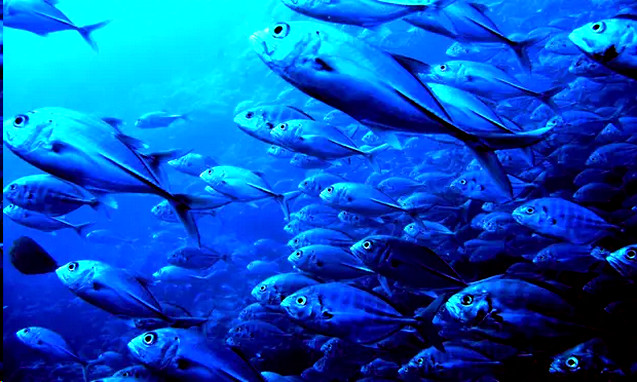
For example, Richardson said tuna lived in the mesopelagic layer between 200 and 1,000 metres deep, but they relied on plankton species near the surface.

He said because the planet’s oceans were so large and stored so much heat, “warming already absorbed at the ocean surface will mix into deeper waters.”

“This means that marine life in the deep ocean will face escalating threats from ocean warming until the end of the century, no matter what we do now.”

Isaac Brito-Morales, the study’s lead author and a researcher at the University of Queensland, said: “Because the deep ocean has a more stable temperature, any small increase will have an impact on species – they’re more at risk than those at the surface.”

Richardson added it was “concerning” their results showed, as well as different rates of climate velocity at different depths, the direction that species would need to move wasn’t uniform either.

This could mean that marine park areas designed to protect different species or habitats could become compromised as species moved out of the protected areas into unprotected areas.

Links

A First Dog On The Moon Live Action Cartoon! Will The Coronavirus Save Us From Climate Change?

The Guardian - First Dog On The Moon

No it will not!


Will the coronavirus save us from climate change?
A First Dog on the Moon live action cartoon!

Links

Lethal Heating is a citizens' initiative