19/06/2020

(AU) West Australian Dry Spell Worsens With Record Water Deficiency Declaration In Cascade

ABC Esperance - Emma Field | Isabel Moussalli

A water deficiency declaration will ensure adequate water supplies for livestock. (ABC Esperance: Emma Field) 

Key Points
  • Cascade near Esperance has been declared water deficient for the first time
  • Water will be carted to the townsite for animal welfare reasons
  • It marks an unprecedented 12 water deficiency declarations across WA in a year
The West Australian Government will begin carting emergency water supplies to another dry agriculture region in the state's south-east today after it made its 12th water deficiency declaration in a year.

The small town of Cascade, about 100 kilometres north-east of Esperance, was yesterday declared water deficient for the first time in its history.

It means the State Government will cart about 640 kilolitres of water a week to temporary tanks at the Cascade townsite.

This water must only be used for animal welfare and emergency firefighting.

For Cascade farmer, Scott Pickering, it has been the driest period his family has seen for five decades and last year he only recorded 169 millimetres of rain, well under half his average annual rainfall.

He said the declaration decision was "fantastic" for farmers who had been struggling with dry conditions for the past few years.

"We've only got about 25 dams; there's only three that have water in it at the moment," Mr Pickering said.

"So we've been carting water internally for probably 18 months and we've been carting water from the town dam since December."

Scott Pickering is one of the farmers affected by water shortages in Cascade. (ABC Esperance: Emma Field)

'The outlook is very grim'

At Kanga Downs, Cascade farmers Ray and Bonnie Arnold recorded two consecutive years of well-below average rainfall and said recent rain did not produce enough runoff into dams.

"It seems to be if we don't get the summer rain … the outlook is very grim," Mr Arnold said.

"We've got an average of 420 [millimetres], but we haven't had that for three years, and it's really showing in the [crop] yields; we are suffering."

The emergency water is not allowed to be accessed by farmers who need water for crop spraying, something that makes Cascade farmers worried.

The Cascade declaration comes after Salmon Gums received the same declaration in March, and Grass Patch was declared in December, both of which are also in the Shire of Esperance.

Ray Arnold carting water from the Cascade standpipe, before the declaration this week. (ABC Esperance: Emma Field)

WA Agriculture Minister Alannah MacTiernan said the unprecedented dry conditions due to climate change had affected water supplies in the area.

"This 12th water deficiency declaration highlights the climatic challenges facing our farmers, who are doing their best to employ sustainable land use strategies to remain viable," she said.

Last week, Gairdner in the Shire of Jerramungup received water deficiency declarations, adding to other declarations in the shires of Ravensthorpe, Lake Grace, Kent, and Dumbleyung.

The WA Government spent more than $2.8 million in the 12 months to June carting water to areas which are classified water deficient.

Links

(AU) Two Dry Wet Seasons Spark Early Start To NT's Grass Fires, Leaving Experts Worried

ABC News - Laetitia Lemke

Bushfires NT lighting a series of fires for a mitigation burn at Acacia Hills. (ABC News: Laetitia Lemke)

Key Points
  • Bushfires NT says there have been more fires than usual this year
  • It is worried about a bad fire season because of fuel loads in the bush
  • One of the tools for managing fires in northern Australia is under funding threat
In Australia's tropical savannas, property owners are accustomed to the risk of wildfires in the long months of the dry, but one specialist team is warning of an early start to this year's fire season.

Bushfires NT works with firefighters and landowners to help manage the environment to protect lives and property from fire.

One of the greatest challenges is gamba grass, a quick-burning savannah grass introduced in the NT in the 1930s and originally from Africa.

"Over 50 per cent of the fires that I've been to this year would have been impacted by Gamba," Bushfire NT's Fire Management Officer Nathaniel Staniford said.

"It means a faster-moving fire that's more intense [and] a greater spotting potential, which is where embers will fly ahead of the fire front," he said.

"So we are constantly having to be vigilant and look beyond the control lines."

Bushfires NT run mitigation burns in Australia's Top End. (ABC News: Laetitia Lemke)

And it's not just gamba grass changing the risks.

After two record-breaking dry wet seasons in the NT, Mr Staniford said the landscape had received just enough rain to deliver grass and shrub growth, but that flora was now drying much earlier in the season.

"The fuel is curing at a rapid rate, we are already at 90 per cent cured across most of the Top End, so we are very close to reaching a level where we will start seeing fire ban days declared," he said.

Mr Staniford, who is part of the team that helped fight the recent bushfires in the Shoalhaven Region in New South Wales, is now back in the Territory, moving the Bushfires NT into its new purpose-built facility in Rural Darwin's Acacia Hills area.

The team is working to achieve total compliance on firebreaks and encouraging mitigation burns.

"It's really important to have these mitigation burns in place," he said.

The North Australia Fire Information website can show up a fire within an hour of it starting across parts of Queensland, Western Australia, South Australia and the NT. (ABC News: Laetitia Lemke)

"The firebreaks that people put in might be the 4-metre depth but with a mitigation burn on top of that, it increases the strength of that containment line and gives us more options when we are out fighting a wildfire."

Bushfires NT Chief Fire Control Officer Andrew Turner said the strong message was that the window of opportunity to do that work safely was closing quickly.

"We've had 16 wildfires to date just in the last two weeks predominantly and a number of those have caused some significant damage to properties," Mr Turner said.
"Our fires are every bit as dangerous as those down south.
"Every year, there are many cases of people losing property, losing their livelihood and potentially putting themselves in a great deal of danger."

But as preparations ramp up, one of the key resources used to manage blazes in northern Australia is under threat because of a lack of certainty over funding.

Bushfires NT staff create a fire plan. (ABC News: Hamish Harty)

The North Australia Fire Information (NAFI) website can detect a fire within an hour of it starting.

It covers 5 million square kilometres of land stretching across parts of Queensland, Western Australia, South Australia and all of the NT.

Dr Andrew Edwards is a research fellow at the Darwin Centre for Bushfire Research that runs the NAFI website at Charles Darwin University.

Dr Edwards said NAFI could show where fires had burned and when, which he said was vital information for large property owners and Indigenous rangers.

"We've gone from huge figures of fire frequency down to 20 or 25 per cent of what was going on before," Dr Edwards said.

"We're talking about hundreds of millions of tons of greenhouse gas emissions abatement in Northern Australia over the last seven or eight years."

A back-burn underway in the NT. (ABC News: Laetitia Lemke)

"It's world's best practice, there is not another website like it in the world."

"In fact, we are about to export it to Africa and to South America, where they are hoping to implement similar programs in their savannas," Dr Edwards said.

"We are not for profit, we are not out to make squillions of money, we're just out to help a lot of people do really good fire management."

The University said as of this week it may have secured another 12 months of funding from the Federal Government for the NAFI site.

But with a growing focus on fires across Australia and around the world, the University said it hoped more permanent funding could be secured.

Links

Climate Worst-Case Scenarios May Not Go Far Enough, Cloud Data Shows

The Guardian - 

Modelling suggests climate is considerably more sensitive to carbon emissions than thought

Experts say the projections have the potential to be ‘incredibly alarming’. Photograph: Alamy

Worst-case global heating scenarios may need to be revised upwards in light of a better understanding of the role of clouds, scientists have said.

Recent modelling data suggests the climate is considerably more sensitive to carbon emissions than previously believed, and experts said the projections had the potential to be “incredibly alarming”, though they stressed further research would be needed to validate the new numbers.

Modelling results from more than 20 institutions are being compiled for the sixth assessment by the United Nations Intergovernmental Panel on Climate Change, which is due to be released next year.

Compared with the last assessment in 2014, 25% of them show a sharp upward shift from 3C to 5C in climate sensitivity – the amount of warming projected from a doubling of atmospheric carbon dioxide from the preindustrial level of 280 parts per million. This has shocked many veteran observers, because assumptions about climate sensitivity have been relatively unchanged since the 1980s.

“That is a very deep concern,” Johan Rockström, the director of the Potsdam Institute for Climate Impact Research, said. “Climate sensitivity is the holy grail of climate science. It is the prime indicator of climate risk. For 40 years, it has been around 3C. Now, we are suddenly starting to see big climate models on the best supercomputers showing things could be worse than we thought.”

He said climate sensitivity above 5C would reduce the scope for human action to reduce the worst impacts of global heating. “We would have no more space for a soft landing of 1.5C [above preindustrial levels]. The best we could aim for is 2C,” he said.

Worst-case projections in excess of 5C have been generated by several of the world’s leading climate research bodies, including the UK Met Office’s Hadley Centre and the EU’s Community Earth System Model.

Timothy Palmer, a professor in climate physics at Oxford University and a member of the Met Office’s advisory board, said the high figure initially made scientists nervous. “It was way outside previous estimates. People asked whether there was a bug in the code,” he said. “But it boiled down to relatively small changes in the way clouds are represented in the models.”

The role of clouds is one of the most uncertain areas in climate science because they are hard to measure and, depending on altitude, droplet temperature and other factors, can play either a warming or a cooling role. For decades, this has been the focus of fierce academic disputes.

Previous IPCC reports tended to assume that clouds would have a neutral impact because the warming and cooling feedbacks would cancel each other out. But in the past year and a half, a body of evidence has been growing showing that the net effect will be warming. This is based on finer resolution computer models and advanced cloud microphysics.

“Clouds will determine humanity’s fate – whether climate is an existential threat or an inconvenience that we will learn to live with,” said Palmer. “Most recent models suggest clouds will make matters worse.”

In a recent paper in the journal Nature, Palmer explains how the new Hadley Centre model that produced the 5+C figure on climate sensitivity was tested by assessing its accuracy in forecasting short-term weather. This testing technique had exposed flaws in previous models, but in the latest case, the results reinforced the estimates. “The results are not reassuring – they support the estimates,” he wrote. He is calling for other models to be tested in a similar way.

“It’s really important. The message to the government and public is, you have to take this high climate sensitivity seriously. [We] must get emissions down as quickly as we can,” he said.

The IPCC is expected to include the 5+C climate sensitivity figure in its next report on the range of possible outcomes. Scientists caution that this is a work in progress and that doubts remain because such a high figure does not fit with historical records.

Catherine Senior, head of understanding climate change at the Met Office Hadley Centre, said more studies and more data were needed to fully understand the role of clouds and aerosols.

“This figure has the potential to be incredibly alarming if it is right,” she said. “But as a scientist, my first response is: why has the model done that? We are still in the stage of evaluating the processes driving the different response.”

While acknowledging the continued uncertainty, Rockström said climate models might still be underestimating the problem because they did not fully take into account tipping points in the biosphere.

“The more we learn, the more fragile the Earth system seems to be and the faster we need to move,” he said. “It gives even stronger argument to step out of this Covid-19 crisis and move full speed towards decarbonising the economy.”

Links

18/06/2020

(AU) The Number Of Climate Deniers In Australia Is More Than Double The Global Average, New Survey Finds

The Conversation - | 

Shutterstock

Authors
  • Assistant Professor Caroline Fisher is Co-author of the Digital News Report: Australia 2020, and Deputy Director of the News and Media Research Centre, and Assistant Professor of Journalism, University of Canberra.
  • Dr Sora Park is Lead Author of Digital News Report: Australia 2020, and Associate Dean of Research, Faculty of Arts & Design, University of Canberra.
Australian news consumers are far more likely to believe climate change is “not at all” serious compared to news users in other countries. That’s according to new research that surveyed 2,131 Australians about their news consumption in relation to climate change.

The Digital News Report: Australia 2020 was conducted by the University of Canberra at the end of the severe bushfire season during January 17 and February 8, 2020.

It also found the level of climate change concern varies considerably depending on age, gender, education, place of residence, political orientation and the type of news consumed.

Young people are much more concerned than older generations, women are more concerned than men, and city-dwellers think it’s more serious than news consumers in regional and rural Australia.

15% don’t pay attention to climate change news

More than half (58%) of respondents say they consider climate change to be a very or extremely serious problem, 21% consider it somewhat serious, 10% consider it to be not very and 8% not at all serious.

Out of the 40 countries in the survey, Australia’s 8% of “deniers” is more than double the global average of 3%. We’re beaten only by the US (12%) and Sweden (9%).

Percentage of climate change deniers by country
Australia ranks third in the world

Source: News and Media Research Centre, University of Canberra Get the data

While most Australian news consumers think climate change is an extremely or very serious problem (58%), this is still lower than the global average of 69%. Only ten countries in the survey are less concerned than we are.

Strident critics in commercial media

There’s a strong connection between the brands people use and whether they think climate change is serious.

More than one-third (35%) of people who listen to commercial AM radio (such as 2GB, 2UE, 3AW) or watch Sky News consider climate change to be “not at all” or “not very” serious, followed by Fox News consumers (32%).

This is perhaps not surprising when some of the most strident critics of climate change science can be found on commercial AM radio, Sky and Fox News.

Among online brands, those who have the highest concern about climate change are readers of The Conversation (94%) and The Guardian Australia (93%), which reflects their audiences are more likely left-leaning and younger.

More than half of Australians get their information about climate change from traditional news sources (TV 28%, online 17%, radio 5%, newspapers 4%).

However, 15% of Australians say they don’t pay any attention to news about climate change. This lack of interest is double the global average of 7%. Given climate change impacts everyone, this lack of engagement is troubling and reflects the difficulty in Australia to gain political momentum for action.


The polarised nature of the debate

The data show older generations are much less interested in news about climate change than news in general, and younger people are much more interested in news about climate change than other news.

News consumers in regional Australia are also less likely to pay attention to news about climate change. One fifth (21%) of regional news consumers say they aren’t interested in climate change information compared to only 11% of their city counterparts.

Given this survey was conducted during the bushfire season that hit regional and rural Australia hardest, these findings appear surprising at first glance.

But it’s possible the results simply reflect the ageing nature of regional and rural communities and a tendency toward more conservative politics. The report shows 27% of regional and rural news consumers identify as right-wing compared to 23% of city news consumers.

Perceptions of climate change reporting
How people believe news media performs on providing accurate information about climate change, by political orientation.
Source: News and Media Research Centre, University of Canberra Get the data

And the data clearly reflect the polarised nature of the debate around climate change and the connection between political orientation, news brands and concern about the issue. It found right-wing news consumers are more likely to ignore news about climate change than left-wing, and they’re less likely to think reporting of the issue is accurate.

Regardless of political orientation, only 36% of news consumers think climate change reporting is accurate. This indicates low levels of trust in climate change reporting and is in stark contrast with trust in COVID-19 reporting, which was much higher at 53%.

Perceptions of climate change reporting
How people believe news media helps them know what they can do about climate change, by political affiliation.
Source: News and Media Research Centre, University of Canberra Get the data

The findings also point to a significant section of the community that simply don’t pay attention to the issue, despite the calamitous bushfires. 

This presents a real challenge to news organisations. They must find ways of telling the climate change story to engage the 15% of people who aren’t interested, but are still feeling its effects.

19% want news confirming their worldview

Other key findings in the Digital News Report: Australia 2020 include:
  • the majority of Australian news consumers will miss their local news services if they shut down: 76% would miss their local newspaper, 79% local TV news, 81% local radio news service and 74% would miss local online news offerings
  • more than half (54%) of news consumers say they prefer impartial news, but 19% want news that confirms their worldview
  • two-thirds (62%) of news consumers say independent journalism is important for society to function properly
  • around half (54%) think journalists should report false statements from politicians and about one-quarter don’t
  • news consumption and news sharing have increased since 2019, but interest in news has declined
  • only 14% continue to pay for online news, but more are subscribing rather than making one-off donations
  • TV is still the main source of news for Australians but continues to fall.

The ‘COVID-trust-bump’

In many ways these findings, including those on climate change reporting, reflect wider trends. Our interest in general news has been falling, along with our trust.

This changed suddenly with COVID-19 when we saw a big rise in coverage specifically about the pandemic. Suddenly, the news was relevant to everyone, not just a few.

We suspect that key to the “COVID-trust-bump” was the news media adopting a more constructive approach to reporting on this issue. Much of the sensationalism, conflict and partisanship that drives news – particularly climate change news – was muted and instead important health information from authoritative sources guided the coverage.

This desire for impartial and independent news is reflected in the new report. The challenge is getting people to pay for it.

Links

How Much Do People Around The World Care About Climate Change? We Surveyed 80,000 People In 40 Countries To Find Out

The Conversation -  

ra2 studio / shutterstock

Authors
  • Simge Andı is a Postdoctoral Research Fellow, Reuters Institute for the Study of Journalism, University of Oxford.
  • James Painter is a Research Associate, Reuters Institute, University of Oxford.
New survey results from 40 countries shows that climate change matters to most people. In the vast majority of countries, fewer than 3% said climate change was not serious at all.

We carried out this research as part of the University of Oxford’s Reuters Institute annual Digital News Reports. More than 80,000 people were surveyed online in January and February of this year.

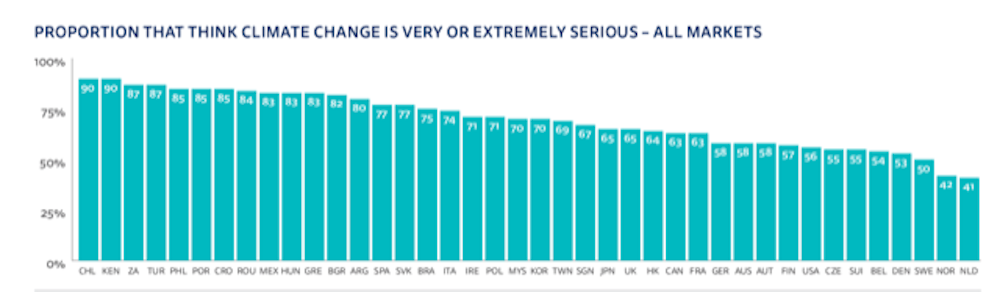
Almost seven in ten think climate change is “a very, or extremely serious, problem”, but the results show notable country differences.

Lack of concern is far higher in the US (12%) as well as in Sweden (9%), Greta Thunberg’s home country. Despite disastrous bush fires at the time of our fieldwork, 8% of respondents in Australia report that climate change is not serious at all. These groups with low levels of concern tend to be right wing and older.

Four of the five countries showing the highest levels of concern (85-90%) were from the global south, namely Chile, Kenya, South Africa and the Philippines. However, in countries with lower levels of internet penetration, our online survey samples over-represent people who are more affluent and educated.

Almost everyone in Chile and Kenya thinks climate change is serious. But that’s not the case in Scandinavia and the Low Countries. Reuters Institute Digital News Report, Author provided
LARGE IMAGE

Perhaps surprisingly, the five countries with the lowest levels of concern are all in Western Europe. In Belgium, Denmark, Sweden, Norway and the Netherlands, only around half (or less) think that climate change is a serious problem.

It is the first time that results from survey questions on climate change have been included in the Reuters Institute’s reports, so it is difficult to draw out historical trends. However, results in 2015 from the Pew Center based on surveys in 40 countries (with different questions and countries to those in our survey) found that 54% of those surveyed thought that climate change was “a very serious” problem.

So it looks like concern for climate change may be rising globally. There is certainly strong evidence that it is increasing in some countries. In the US, in November 2019 two in three Americans (66%) said they were at least “somewhat worried” about global warming, an increase of 10 percentage points over the past five years.

In the UK, data from the CAST centre at Cardiff University showed that in 2019 levels of “worry” about climate change were at their highest recorded point. Extreme weather events, media reporting and wider publicity were mentioned by respondents as reasons for their increase in concern.

In our survey, across countries and markets, individuals who identify as left-wing tend to report higher levels of concern. This finding is even more visible in more polarised societies such as the US where 89% of those who self-identify on the left note that climate change is serious, compared to only 18% of those who self-identify on the right.

Right-wingers tend to take climate change less seriously – especially in the US and Sweden. Reuters Institute Digital News Report, Author provided

We also find a similar divide in Sweden. As Sweden is widely considered one of the world’s most progressive nations, these results surprised us and we asked Martin Hultman, a researcher in climate denialism at Chalmers University in Gothenburg, what to make of them.

“These figures do not surprise me”, he told us in an email. “Since 2010, the leadership of the far-right political party Sweden Democrats has been against all types of policies to tackle climate change, including the Paris Agreement.”

“And we know that the spread of climate change denial ideas and rhetoric is widespread in Sweden – not least when digitally-born far-right media sites spread conspiracy theories about Greta Thunberg.”

TV news still dominates

Across all countries, people say they pay most attention to climate news on television (35%). Online news sites of major news organisations are the second most popular news source (15%), followed by specialised outlets covering climate issues (13%), then alternative sources such as social media and blogs (9%).

Figures from the UK, US and Australia are broadly in line with these preferences. Printed newspapers and radio are way down, with only around 5% saying each was the source they paid most attention to. In Chile, where the concern is high, specialised outlets covering climate issues (24%) as well as alternative sources such as social media (17%) are nearly as popular as television (26%).

The differences in climate news consumption are also visible among different age groups. Younger generations, more specifically the so-called Generation Z (aged 18-24), are more likely to report paying attention to alternative sources on climate change (17%) as well as TV (23%) and online news sites from major news organisations (16%). Older people, however, rely more heavily on TV (42%) and use less of the online news sites (12%) or alternative sources such as social media (5%).

Respondents from both sides of the political spectrum criticise the media for either being too doom-laden, or not bold enough, in their coverage of climate change. That said, our survey shows that almost half of our respondents (47%) think that news media generally do a good job of informing them about climate change, and 19% think that they do a bad job.

However, those who have low levels of concern are much more inclined to say that the news media are doing a bad job (46%). This might indicate a lack of trust in climate change coverage or a more general loss of confidence in the news media.

Links

Fast-Growing Mini-Forests Spring Up In Europe To Aid Climate

The Guardian - Hannah Lewis

Miyawaki forests are denser and said to be more biodiverse than other kinds of woods

A Miyawaki forest being planted on the outskirts of Paris, France. Photograph: Courtesy of Boomforest

Tiny, dense forests are springing up around Europe as part of a movement aimed at restoring biodiversity and fighting the climate crisis.

Often sited in schoolyards or alongside roads, the forests can be as small as a tennis court. They are based on the work of the Japanese botanist Akira Miyawaki, who has planted more than 1,000 such forests in Japan, Malaysia and elsewhere.

Advocates for the method say the miniature forests grow 10 times faster and become 30 times denser and 100 times more biodiverse than those planted by conventional methods. This result is achieved by planting saplings close together, three per square metre, using native varieties adapted to local conditions. A wide variety of species – ideally 30 or more – are planted to recreate the layers of a natural forest.

Scientists say such ecosystems are key to meeting climate goals, estimating that natural forests can store 40 times more carbon than single-species plantations. The Miyawaki forests are designed to regenerate land in far less time than the 70-plus years it takes a forest to recover on its own.

“This is a great thing to do,” said Eric Dinerstein, a wildlife scientist who co-authored a recent paper calling for half of the Earth’s surface to be protected or managed for nature conservation to avoid catastrophic climate change. “So this could be another aspect for suburban and urban areas, to create wildlife corridors through contiguous ribbons of mini-forest.”

The mini-forests could attract migratory songbirds, Dinerstein said. “Songbirds are made from caterpillars and adult insects, and even small pockets of forests, if planted with native species, could become a nutritious fast-food fly-in site for hungry birds.”

In 2017, researchers at Wageningen University in the Netherlands monitored newly planted mini-forests and concluded that they “increase the biodiversity compared to the nearby forest. Both the number of species groups and the number of individuals is generally higher than in the reference forests.”

The higher biodiversity is due partly to the forests’ young age and openness, explained Fabrice Ottburg, an animal ecologist who led the Wageningen study. This allows more sunlight to reach flowering plants that attract pollinators. Diversity is also boosted by planting multiple species, which “provide more variety in food and shelter for a higher diversity of animals like insects, snails, butterflies, amphibians, bugs, grasshoppers”, Ottburg said.

In the Netherlands, the conservation group IVN Nature Education has helped cities and households to plant 100 Miyawaki-style forests since 2015. It is on track to more than double that number by 2022 and is working on similar efforts in a dozen other countries. Assorted groups in Belgium and France have recently created at least 40 mini-forests.

A three-year-old forest in Ormeignies, Belgium. Photograph: Urban Forests

The first in France was planted in March 2018 beside a busy four-lane road on the edge of Paris. The dense thicket was intended to reduce noise and filter air for the adjacent neighbourhood. On the day of planting, 40 people gathered with 31 species of saplings to bring new life to ground that had been prepared with compost from local horse stables.

Two years earlier, Enrico Fusto and Damien Saraceni had applied for funding from Paris’s participatory budget, a scheme that asks residents for ideas about how to spend 5% of the city’s funds. The pair proposed mini-forests, saying they could help increase the level of tree cover in the city, which is currently less than 10%, much lower than many other major cities. “Each community can be the protagonist of its own restoration story,” said Fusto.

In Toulouse, a mini-forest group planted 1,200 saplings on a 400 sq metre patch in March.

Nicolas de Brabandère, a Belgian naturalist and founder of Urban Forest, began planting Miyawaki-style forests in 2016, organising volunteers and local authorities to plant 300 saplings on a grassy strip of land near a road. Now his first forest is 3 metres tall, its floor a thick layer of humus.

De Brabandère believes the participatory nature and speed of a mini-forest is what appeals to people, and he predicts a bright future for the movement. “Every time I tell the story, everybody likes it,” he said. “So I have a good feeling the trend will continue.”

Links

17/06/2020

Researchers Argue That Earth Is In The Midst Of A Modern, Human-Made, Sixth Extinction

Forbes - David Bressan

Bramble cay melomys Melomys rubicola. In 2016 declared extinct on Bramble cay, where it had been endemic, and likely also globally extinct, with habitat loss due to climate change being the root cause. State of Queensland

An estimated 99% of all species ever living on planet Earth are now extinct.

Extinction is part of life's history, and the extinction of single species happens all the time.

Over time lost species are eventually replaced as natural selection acts on the survivors, evolving new species. Mass extinctions in the geological record are defined by the loss of a large part of biodiversity in a (geologically speaking) short interval, like a few hundred to thousands of years.

Paleontologists recognize five big mass extinction events in the fossil record. At the end of the Ordovician, some 443 million years ago, an estimated 86% of all marine species disappeared. At the end of the Devonian, some 360 million years ago, 75% of all species went extinct.

 At the end of the Permian, some 250 million years ago, the worst extinction event so far happened, with an extinction rate of 96%. At the end of the Triassic, some 201 million years ago, 80% of all species disappeared from the fossil record.

The most famous mass extinction happened at the end of the Cretaceous, some 65 million years ago, when 76% of all species went extinct, including the dinosaurs.

Scientists are still debating the factors driving mass extinction. Factors contributing to the disappearance of a species can be natural disasters, like volcanism, meteorite impacts, or climate change, but also biological ones, like competition, diseases, or depletion of resources.

In the last 400 years, many mammal, bird, amphibian, and reptile species went extinct. Research comparing recent extinctions with past extinctions shows that the current extinction rate is higher than would be expected from the fossil record. Researchers argue that the Earth is in the midst of a modern, human-made, sixth extinction.

A newly published study in the Proceedings of the National Academy of Science evaluated the extinction risk of 29,374 land-based vertebrates. The study identified 75 mammal, 335 bird, 41 reptile and 65 amphibian species on the brink of extinction, with populations of fewer than a thousand individuals.

More than half of the species on the list have fewer than 250 individuals remaining. The majority of these critically endangered animals are concentrated in tropical and subtropical regions, where biodiversity is highest.

Critically endangered species include the Javan rhino (Rhinoceros sondaicus), one of the rarest mammals in the world, of which fewer than 100 individuals survive in the wild. Of New Zealand’s flightless, nocturnal, kakapo (Strigops habroptilus), only 200 individuals survive, after the introduction by humans of foreign predators, like rats, and habitat destruction caused a population crash.

According to a summary report from the United Nations, amphibians are among the most vulnerable group among vertebrates, with 40% of the studied species at risk of extinction. Most studies investigating drivers of extinction risk have focused on vertebrates. The conservation status of invertebrates is still poorly studied, and some estimates put 27% of known species are at risk. Recent surveys have also shown a dramatic decline in insect populations.

According to the report, only a quarter of Earth's surface is still largely untouched by humans, but human activities spread wide and fast. Even the most remote corners of Earth are no longer pristine, as plastic debris found on the bottom of the 36,000 feet (11.000 meters) deep Mariana Trench shows.

On June 14, 2016, the Bramble Cay mosaic-tailed rat (Melomys rubicola) became the first mammal species to be declared extinct as a consequence of human-caused climate change. Living only on a vegetated coral reef located at the northern tip of the Great Barrier Reef in Australia, now inundated by rising sea-levels, living individuals have last been seen in 2009.

Humans contribute to the current extinction crisis by habitat destruction and fragmentation, poaching, illegal trade, overharvesting, the introduction of non-native and domesticated species into the wild, pathogens, pollution, and climate change. “The ongoing sixth mass extinction may be the most serious environmental threat to the persistence of civilization, because it is irreversible,” the authors of the most recent study write.

Links

Lethal Heating is a citizens' initiative