03/08/2020

(LEGAL) Climate Change: 'Huge' Implications To Irish Climate Case Across Europe

BBC News

PA Media

A ruling by the Irish Supreme Court on climate change policy could have "huge ramifications" across Europe, the group which took the case has said.

On Friday the Supreme Court quashed the government's 2017 National Mitigation Plan.

Judges ruled that it did not give enough detail on the reduction of greenhouse gases.

The case was brought by the environmental group Friends of the Irish Environment.

The Irish government welcomed the ruling and said it would "carefully examine the decision".

Friends of the Irish Environment spokeswoman Clodagh Daly told BBC News NI the verdict was "crystal clear" and would have implications across Europe.

She said: "It shows governments have to do more to protect their citizens from the worst impact of the climate crisis.

"We know that the transition to the low-carbon economy is technologically feasible - there is no legal basis for a lack of political will.

"Governments around the EU have no excuse now."

She said she hoped it would put pressure on the Northern Ireland Executive to follow a similar approach.

Ms Daly added that while "climate change knows no borders" and emissions were counted on an all-island basis, she noted "how we respond to the climate crisis is separate".

She said it meant the Republic of Ireland's government could "no longer make promises it will not fulfil" and had a legal obligation to protect citizens from the worst impact of climate change.

'No climate act'

James Orr, the Northern Ireland director of Friends of the Earth, said the decision was a "wake-up call for politicians to take effective climate action both here and across the world".

"Not only do we have a moral duty to stop the climate crisis but we now have a legal duty as well," he said.

"The argument for decisive climate action has become a lot stronger as a result of this epic court case."

The ruling was made by Ireland's Supreme Court

What was the case about?

Bringing the case, Friends of the Irish Environment argued the Irish government had a responsibility to reduce greenhouse gas emissions within the next couple of years or face the serious impacts of climate change.

It contended the increase in greenhouse gas emissions allowed in the 2017 National Mitigation Plan was contrary to the 2015 Climate Action and Low Carbon Development Act.

These pieces of legislation make it a requirement to have a published plan for transitioning to a low carbon climate resilient and environmentally stable economy by 2050.

The unanimous judgment of the Supreme Court ruled that more specificity was needed about how objectives laid out in the 2015 legislation were going to be met by 2050.

This was decided on the grounds that a reasonable and interested person could make a judgment both as to whether the plan in question was realistic and as to whether they agree with the policy options.

It was ruled that this standard for specificity was currently not met.

Judgement welcomed

Climate Action Minister and Green Party leader Eamon Ryan said in a statement: "I welcome the judgment of the court and congratulate Friends of the Irish Environment for taking this important case.

"We must use this judgment to raise ambition, empower action and ensure that our shared future delivers a better quality of life for all."

Climate Action Minister Eamon Ryan welcomed the ruling. Green Party

The statement said the new government was "now committed to an average 7% per annum reduction in overall greenhouse gas emissions from 2021 to 2030, equivalent to a 51% reduction over the decade and to achieving net zero emissions by 2050".

The department will now "carefully examine the decision and consider its implications".

Legal

Pacific Islands Must Stop Relying On Foreign Aid To Adapt To Climate Change, Because The Money Won’t Last

The Conversation -  | 

Patrick Nunn, Author provided

The storm of climate change is approaching the Pacific Islands. Its likely impact has been hugely amplified by decades of global inertia and the islands’ growing dependency on developed countries.

The background to this situation is straightforward. For a long time, richer developed countries have been underwriting the costs of climate change in poorer developing countries, leaving them reliant on Western solutions to their climate-related issues.

But as rising sea water continues to encroach on these low-lying Pacific islands, inundating infrastructure and even cemeteries, it’s clear almost every externally sponsored attempt at climate adaptation has failed here.

And as the costs of adaptation in richer countries escalate, this funding support to developing countries will likely taper out in future.

We’ve researched climate change adaptation in the Pacific for more than 50 years. We argue this trend is not merely unsustainable, but also dangerous. Pacific Island nations must start drawing from traditional knowledge to adapt to climate change, rather than continue to rely on foreign funds.

High waves destroyed this sea wall on Majuro Atoll (Marshall Islands). Patrick Nunn, Author provided

Western solutions don’t always work

On a global scale, climate adaptation strategies have largely been either ineffective or unsustainable.

This is especially the case in non-Western contexts, where Western science continues to be privileged. In the Pacific Islands, this is often because these Western strategies invariably subordinate, even ignore, funding recipients’ culturally grounded worldviews.

A good example is the desire of foreign donors to build hard structures, such as sea walls, to protect eroding coasts. This is the preferred strategy in richer nations.

However it does not embrace nature-based solutions such as replanting coastal mangroves, which can be more readily sustained in poorer contexts.

A likely scenario

The availability of external financial assistance means developing countries have become more dependent on their richer counterparts for climate change adaptation.

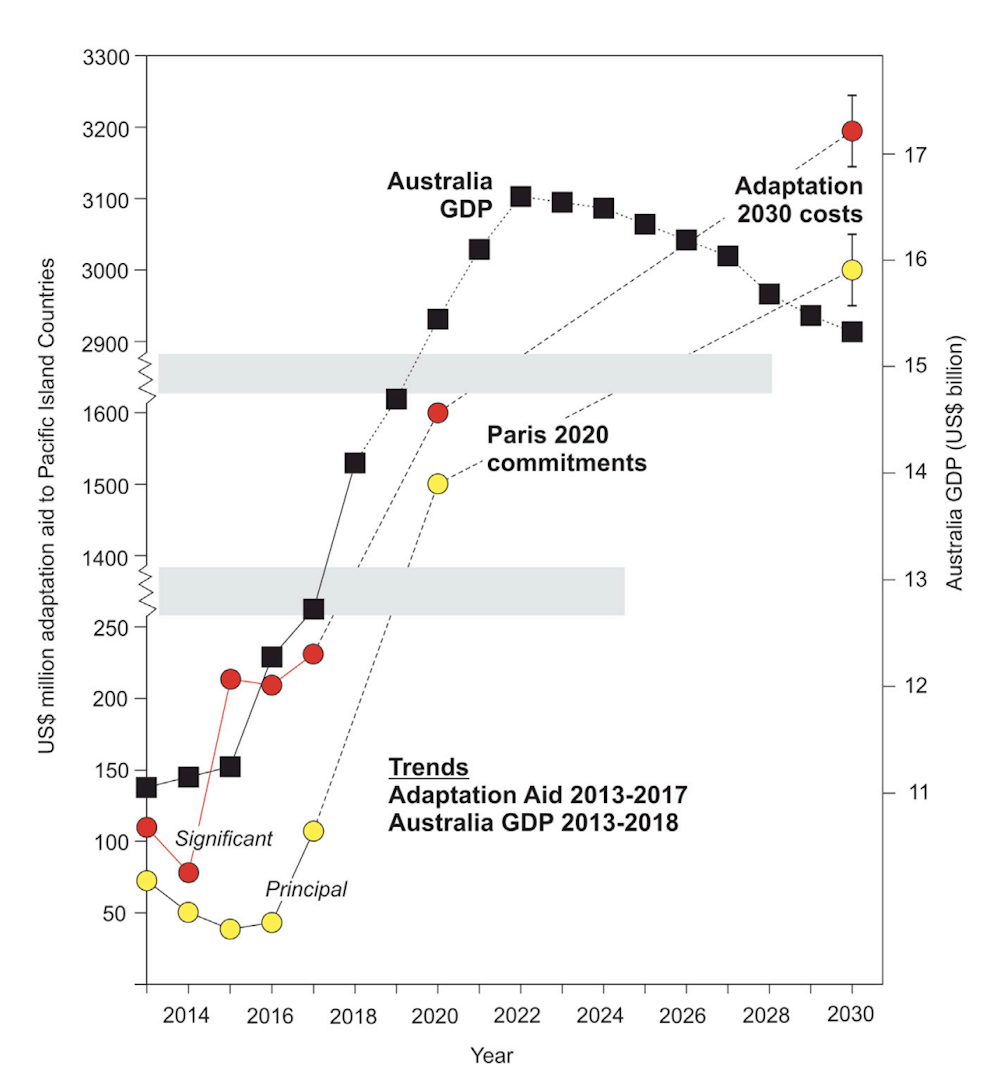
For example, between 2016 and 2019, Australia provided A$300 million to help Pacific Island nations adapt to climate change, committing to a further $500 million to 2025. This left little need or incentive for these countries to fund their own adaptation needs.

But imagine this climate change scenario. Ten years from now, unprecedented rainfall is dumped on Australia’s east coast over a prolonged period. Several cities become flooded and remain so for weeks.

In the aftermath, the Australian government scrambles to make recently flooded areas liveable once more. They build a series of massive coastal dikes – structures to prevent the rising sea from flooding populated areas.

The cost is exorbitant and unanticipated – like COVID-19 – so the government will look for ways to shuffle money around. This may well include reducing financial aid for climate change adaptation in poorer countries.

Plunging international aid

Economic modelling shows nations will incur massive costs this century to adapt to climate change within their own borders. So it’s almost inevitable wealthier countries will rethink the extent of their assistance to the developing world.

Recent and projected Australian GDP and adaptation aid to Pacific Island. countries. Patrick Nunn, Author provided


In fact, even before the pandemic, Australia’s foreign aid budget was projected to decrease in real terms by nearly 12% from 2020 to 2023.

These factors do not bode well for developing countries, which will be facing higher climate adaptation costs and dwindling foreign aid assistance.

Building autonomy with ‘cashless adaptation’

Leaders of developing countries should anticipate this situation now, and reverse their growing dependence on outside assistance.

For example, rural communities in regions like the Pacific Islands could revive their use of “cashless adaptation”. This means developing ways of adapting livelihoods to climate change that cost nothing.

These methods include the intentional planting of surplus crops, the use of traditional methods of food preservation and water storage, the use of free locally-available materials and labour for constructing sea defences. And it perhaps even includes the recognition that living along coastal fringes exposes you unnecessarily to weather-related change.

Prior to globalisation, this is how it was for decades, even centuries, in places like the rural Pacific islands. Then, adaptation to a changing environment was sustained by cooperation with one another and the use of freely available materials, not with cash.

The floods in Sydney earlier this year is a taste of things to come under global warming. AAP Image/Joel Carrett

Researchers have also argued for such “looking forward to the past” strategies regarding Hawaii’s climate adaptation.

And research from last year in Fiji showed more rural communities still have and use a stock of traditional methods for anticipating and withstanding disasters, such as flood and drought.

Dirak faluw (‘men’s house’) at Wanyaan Village on Yap (Micronesia) was constructed by community labour using local-available materials. Roselyn Kumar, Author provided

We can take this argument further. Perhaps it’s time for Pacific Island nations to rediscover traditional medicines, at least for primary health care, to supplement western medicine.

Greater production and consumption of locally grown foods, over imported foods, is also an important and valuable transformation.

The future of the developing world

The need for nations to adapt to unanticipated phenomena like climate change and COVID-19 encourages de-globalisation – including that countries depend less on cross-border aid and economic activity. So it seems inevitable that under current global circumstances, smaller economies will be forced to become more efficient and self-reliant.

Restoring traditional adaptation strategies would not only drive effective and sustainable climate change adaptation, but also would restore residents’ beliefs in their own time-honoured ways of coping with environmental shocks.

This not only means finding ways to reduce costs through cashless adaptation, but also to explore radical ways of reducing dependency and increasing autonomy. An appeal to past practice, and traditional ways of coping, is well worth considering.

Links

Are Young Trees Or Old Forests More Important For Slowing Climate Change?

The Conversation - 

Jeremy Kieran/Unsplash, CC BY-SA

Author
 is Reader in Biosphere-Atmosphere Exchange, University of Birmingham     
Forests are thought to be crucial in the fight against climate change – and with good reason. We’ve known for a long time that the extra CO₂ humans are putting in the atmosphere makes trees grow faster, taking a large portion of that CO₂ back out of the atmosphere and storing it in wood and soils.

But a recent finding that the world’s forests are on average getting “shorter and younger” could imply that the opposite is happening. Adding further confusion, another study recently found that young forests take up more CO₂ globally than older forests, perhaps suggesting that new trees planted today could offset our carbon sins more effectively than ancient woodland.

How does a world in which forests are getting younger and shorter fit with one where they are also growing faster and taking up more CO₂? Are old or young forests more important for slowing climate change? We can answer these questions by thinking about the lifecycle of forest patches, the proportion of them of different ages and how they all respond to a changing environment.

The forest carbon budget

Let’s start by imagining the world before humans began clearing forests and burning fossil fuels.

In this world, trees that begin growing on open patches of ground grow relatively rapidly for their first several decades. The less successful trees are crowded out and die, but there’s much more growth than death overall, so there is a net removal of CO₂ from the atmosphere, locked away in new wood.

As trees get large two things generally happen. One, they become more vulnerable to other causes of death, such as storms, drought or lightning. Two, they may start to run out of nutrients or get too tall to transport water efficiently. As a result, their net uptake of CO₂ slows down and can approach zero.

Eventually, our patch of trees is disturbed by some big event, like a landslide or fire, killing the trees and opening space for the whole process to start again. The carbon in the dead trees is gradually returned to the atmosphere as they decompose.

The vast majority of the carbon is held in the patches of big, old trees. But in this pre-industrial world, the ability of these patches to continue taking up more carbon is weak. Most of the ongoing uptake is concentrated in the younger patches and is balanced by CO₂ losses from disturbed patches. The forest is carbon neutral.

New trees absorb lots of carbon, old trees store more overall and dead trees shed their carbon to the atmosphere. Greg Rosenke/Unsplash, CC BY-SA

Now enter humans. The world today has a greater area of young patches of forest than we would naturally expect because historically, we have harvested forests for wood, or converted them to farmland, before allowing them to revert back to forest. Those clearances and harvests of old forests released a lot of CO₂, but when they are allowed to regrow, the resulting young and relatively short forest will continue to remove CO₂ from the atmosphere until it regains its neutral state. In effect, we forced the forest to lend some CO₂ to the atmosphere and the atmosphere will eventually repay that debt, but not a molecule more. But adding extra CO₂ into the atmosphere, as humans have done so recklessly since the dawn of the industrial revolution, changes the total amount of capital in the system.

And the forest has been taking its share of that capital. We know from controlled experiments that higher atmospheric CO₂ levels enable trees to grow faster. The extent to which the full effect is realised in real forests varies. But computer models and observations agree that faster tree growth due to elevated CO₂ in the atmosphere is currently causing a large carbon uptake. So, more CO₂ in the atmosphere is causing both young and old patches of forest to take up CO₂, and this uptake is larger than that caused by previously felled forests regrowing.

The effect of climate change

But the implications of climate change are quite different. All else being equal, warming tends to increase the likelihood of death among trees, from drought, wildfire or insect outbreaks. This will lower the average age of trees as we move into the future. But, in this case, that younger age does not have a loan-like effect on CO₂. Those young patches of trees may take up CO₂ more strongly than the older patches they replace, but this is more than countered by the increased rate of death. The capacity of the forest to store carbon has been reduced. Rather than the forest loaning CO₂ to the atmosphere, it’s been forced to make a donation.

As the world warms, wildfires are becoming more frequent and severe. EPA-EFE/PAULO CUNHA

So increased tree growth from CO₂ and increased death from warming are in competition. In the tropics at least, increased growth is still outstripping increased mortality, meaning that these forests continue to take up huge amounts of carbon. But the gap is narrowing>. If that uptake continues to slow, it would mean more of our CO₂ emissions stay in the atmosphere, accelerating climate change.

Overall, both young and old forests play important roles in slowing climate change. Both are taking up CO₂, primarily because there is more CO₂ about. Young forests take up a bit more, but this is largely an accident of history. The extra carbon uptake we get from having a relatively youthful forest will diminish as that forest ages. We can plant new forests to try to generate further uptake, but space is limited.

But it’s important to separate the question of uptake from that of storage. The world’s big, old forests store an enormous amount of carbon, keeping it out of the atmosphere, and will continue to do so, even if their net CO₂ uptake decreases. So long as they are not cut down or burned to ashes, that is.

Links

02/08/2020

(AU) Unwelcome Sea Change: New Research Finds Coastal Flooding May Cost Up To 20% Of Global Economy By 2100

The Conversation -  | 

Darren Pateman/AAP

Authors
  • Ebru Kirezci, PhD candidate, University of Melbourne
  • Ian Young, Kernot Professor of Engineering, University of Melbourne
Over the past two weeks, storms pummelling the New South Wales coast have left beachfront homes at Wamberal on the verge of collapse. It’s stark proof of the risks climate change and sea level rise pose to coastal areas.

Our new research published today puts a potential price on the future destruction. Coastal land affected by flooding – including high tides and extreme seas – could increase by 48% by 2100. Exposed human population and assets are also estimated to increase by about half in that time.

Under a scenario of high greenhouse gas emissions and no flood defences, the cost of asset damage could equate up to 20% of the global economy in 2100.

Without a dramatic reduction in greenhouse gas emissions, or a huge investment in sea walls and other structures, it’s clear coastal erosion will devastate the global economy and much of the world’s population.

In Australia, we predict the areas to be worst-affected by flooding are concentrated in the north and northeast of the continent, including around Darwin and Townsville.

A clean-up after flooding last year in Townsville, an Australian city highly exposed to future sea level rise. Dan Peled/AAP

Our exposed coasts

Sea levels are rising at an increasing rate for two main reasons. As global temperatures increase, glaciers and ice sheets melt. At the same time, the oceans absorb heat from the atmosphere, causing the water to expand. Seas are rising by about 3-4 millimetres a year and the rate is expected to accelerate.

These higher sea levels, combined with potentially more extreme weather under climate change, will bring damaging flooding to coasts. Our study set out to determine the extent of flooding, how many people this would affect and the economic damage caused.

We combined data on global sea levels during extreme storms with projections of sea level rises under moderate and high-end greenhouse gas emission scenarios. We used the data to model extreme sea levels that may occur by 2100.

We combined this model with topographic data (showing the shape and features of the land surface) to identify areas at risk of coastal flooding. We then estimated the population and assets at risk from flooding, using data on global population distribution and gross domestic product in affected areas.

Many coastal homes, such as these at Sydney’s Collaroy beach, are exposed to storm surge damage. David Moir/AAP

Alarming findings

So what did we find? One outstanding result is that due to sea level rise, what is now considered a once-a-century extreme sea level event could occur as frequently as every ten years or less for most coastal locations.

Under a scenario of high greenhouse gas emissions and assuming no flood defences, such as sea walls, we estimate that the land area affected by coastal flooding could increase by 48% by 2100.

This could mean by 2100, the global population exposed to coastal flooding could be up to 287 million (4.1% of the world’s population).

Under the same scenario, coastal assets such as buildings, roads and other infrastructure worth up to US$14.2 trillion (A$19.82 trillion) could be threatened by flooding.

This equates to 20% of global gross domestic product (GDP) in 2100. However this worst-case scenario assumes no flood defences are in place globally. This is unlikely, as sea walls and other structures have already been built in some coastal locations.

In Australia, areas where coastal flooding might be extensive include the Northern Territory, and the northern coasts of Queensland and Western Australia.

Elsewhere, extensive coastal flooding is also projected in: - southeast China - Bangladesh, and India’s states of West Bengal and Gujurat - US states of North Carolina, Virginia and Maryland - northwest Europe including the UK, northern France and northern Germany.

Bangladesh is among the nations most exposed to coastal flooding this century. SOPA

Keeping the sea at bay

Our large-scale global analysis has some limitations, and our results at specific locations might differ from local findings. But we believe our analysis provides a basis for more detailed investigations of climate change impacts at the most vulnerable coastal locations.

It’s clear the world must ramp up measures to adapt to coastal flooding and offset associated social and economic impacts.

This adaptation will include building and enhancing coastal protection structures such as dykes or sea walls. It will also include coastal retreat – allowing low-lying coastal areas to flood, and moving human development inland to safer ground. It will also require deploying coastal warning systems and increasing flooding preparedness of coastal communities. This will require careful long-term planning.

All this might seem challenging – and it is. But done correctly, coastal adaptation can protect hundreds of millions of people and save the global economy billions of dollars this century.

Links

(AU) We Can't Beat The Planet Into Submission. We Can Retreat

Sydney Morning Herald - Elizabeth Farrelly

Author

Elizabeth Farrelly is a Sydney-based columnist, essayist and award winning author with a PhD in architecture.
The floods have gone but the storm images remain, burned onto our collective retina. Up and down the NSW coast, clifftop mansions teeter beside the abyss. Living rooms are torn open, decks and stairs sail vainly into space and concrete foundations dangle like bloodied stumps. It looks so wrong. What was hidden is now exposed, what was support is now a liability, what was enviable, an object of pity. Above all, like some emblem of our times, what was certain is now precarious.

On the beach ... the scene at Wamberal. Credit: James Brickwood

The old beachcomber in the news clip has seen it all. “Like the Bible says,” he notes drily, “build on rock, not sand.” It’s solid practical advice. But this is no simple practical question. The biblical injunction is meant as a parable, a learning opportunity. And so, perhaps, is this. Sure, storms happen. But in a year that has seen unprecedented catastrophes pile up faster than bodies in a cheap crime novel, it may be time to ask: Are we doing something wrong?

In any relationship, you can respond to crisis by trying to change the other, or by trying to change yourself. Usually it’s a power thing. The dominant partner gets to carry on regardless. The subservient one gets to work on themselves. The ironic effect of this dynamic is that the powerful remain unenlightened while the underdogs are forced, however painfully, into wisdom.

Our relationship with the planet is no exception. For centuries, humans have regarded themselves as dominant. We routinely assume that nature should change to accommodate us, not vice versa. But how sure are we that this is still valid? More disturbingly, has our cumulative unwisdom reached such depths we can now no longer even ask the question?

In Australia, the pandemic has killed 189. The Christmas bushfires, if you include the 445 smoke-related deaths, killed more than twice that, plus 11 million hectares of bush and, it is now estimated, almost three billion animals. Both events, like the recent storms, were intensified by a presumption of dominion reminiscent of Tony Abbott’s 2017 climate policy speech which cited our biblical task of “subduing the earth and all its creatures”.

So when the residents of Narrabeen or Wamberal insist on being allowed to build seawalls and revetments to protect their houses against huge surging waves, the question is, should they? When bush communities are determined to rebuild after cataclysmic fire, when the NSW government allows development in the notorious floodplains of the Hawkesbury – envisaging a doubling of that population by 2050 – then proposes to mitigate this flood risk by raising the level of the Warragamba Dam by 12 metres, the same question applies: should they?

The kneejerk response is understandable. We all want to protect ourselves from nature. We all want to protect our property. And we all want to do it, if possible, by changing nature, not ourselves. But is it, on the evidence, wise? Or is it time we all, as a species, pulled our heads in?

The standard terminology puts this as a choice between “armouring” the shore or “planned retreat,” as if our relationship with the oceans were some kind of high-risk military campaign. And perhaps it is but, if so, who do we expect to win? Cnut?

These risks – storm erosion, bushfire and flood - are voluntary at two levels. One, we don’t have to live there. Two, living there may feel as though it’s about loving nature – the sea view, the bush, the river. In fact, though, it can only exacerbate both the power imbalance between us and nature, and the destructive impact on, first, her, then us.

You live in the bush, you end up felling trees to reduce fire danger. You live on a floodplain, you end up building massive dams which, like the Warragamba project, will cost $700 million and threaten indigenous heritage, threatened species and 65 kilometres of wild river. You live on a coastal cliff, you end up wanting to armour the coastline with seawalls and revetments that change local currents, diminish biodiversity and merely shift the erosion to either end of the new wall.

One answer is just to keep building, create a wall without end, armour the entire inhabited coast. But even if that made sense – in a nutty way like Trump’s wall – it doesn’t deal with the fact that just living in such places exacerbates the problem.

When you live close to nature you’re necessarily remote. Not Tibooburra-type remote. Remote as in spread out, incapable of public transit, eternally car-dependent and wasteful of other resources such as roads, sewers and reticulated services. This all hastens climate change, increasing the likelihood, frequency, duration and intensity of fire, flood and storm. It can only get worse.

My purpose here is not to apportion individual blame. Admittedly, I’ve long regarded the Australian coastline as a repository for its ugliest buildings and greediest culture and look with some nostalgia upon New Zealand’s habit (since 1892) of reserving the 20-metre “Queen’s chain” for public health and access.

But this does seem an opportune moment to dwell less on individual rights and more on collective responsibilities. We need to select the greater good for the greater number, and governments prepared to deploy carrot and stick in that direction. Because if we really love nature the best we can do for her is stay right away.

Links

(AU) Local Community Needs Must Not Be Overlooked As We Adapt To Climate Change

Australian Academy of Science

Retrofitting existing housing and preparing for coastal inundation and storms are just a few of the issues that need to be considered in community-led approaches to climate change adaptation in Australia. Photo: Pixabay

The needs of local communities are at risk of being overlooked as Australia grapples with how to adapt to climate change, according to leading climate change adaptation experts.

The finding follows a series of recent meetings of national leaders hosted by Future Earth Australia, a program of the Australian Academy of Science.

Leaders from across the private and finance sectors, all levels of government, Indigenous communities, land management, social services and universities in all states and territories gathered from 13 to 16 July 2020 for ‘Securing Australia’s Future: Reimagining Climate Adaptation’.

The meetings, which come ahead of a planned National Adaptation Summit in 2021, took stock of Australia’s successes, failures, opportunities and pathways for adapting to a changing climate, with a focus on the role of community-led approaches to adaptation.

Australian National University Emeritus Professor Stephen Dovers said there has long been a national focus on climate science, when what was needed was a shift to also prioritise the social adaptation needs for local communities.

“One example is the need to retrofit housing for variable climates,” said Emeritus Professor Dovers, who is past Chair of the Steering Committee of Future Earth Australia.

“Some local communities feel resilient and well-adapted to looming climate change shocks, but not others. We know that there is a desire among local communities to engage in the planning that is underway to adapt to a future that will see a drastically different climate and environment.”

University of Sydney Professor David Schlosberg said meeting participants found that a forward-looking approach to adaptation requires engaging community values and vulnerabilities, in addition to climate risks, and to be working towards an actionable and tangible agenda that benefits local communities.

“Good adaptation policy requires recognition of both the variety of knowledge types necessary to build adaptation pathways, and the role of different sectors—economic, social, environmental and cultural—in developing and implementing policy and action,” said Professor Schlosberg.

Meeting participants also found:
  • there is a clear role for top down leadership from the Australian Government, in conjunction with well supported and financed local or regional ‘bottom up’ initiatives
  • a strong policy framework is necessary from governments at all levels, to enable the necessary and broader social and community engagement.
Future Earth Australia Director, Dr Tayanah O’Donnell, said adaptation had come into sharp focus in the wake of the unprecedented bushfire season experienced in the summer of 2019–20, and now the COVID-19 pandemic, with both having ongoing, profound impacts on our wellbeing and economy.

“Effective adaptation in Australia acknowledges that increasing bushfire risk is only one dimension of climate change adaptation. Coastal inundation, storms, drought, heatwaves, business viability in a low carbon economy, biosecurity issues, and increased threats to human health, also demand coordinated attention,” Dr O’Donnell said.

“The bushfires and COVID-19 are major disruptions which have presented an unusual opportunity to consider how Australian society can prepare and act to adapt to these complex challenges.

“These roundtables are the start of a longer conversation and national agenda setting strategy being led by Future Earth Australia at the Australian Academy of Science.”

The National Adaptation Summit in 2021 will be hosted by the University of Sydney, Western Sydney University and Future Earth Australia.

Future Earth Australia has opened public submissions on this topic. The consultation, which is open until 30 October 2020, seeks contributions on the successes, failures, opportunities and pathways for adaptation, with a particular interest in learning about community-led approaches taking place.

Links

01/08/2020

Carbon Emissions Are Chilling The Atmosphere 90km Above Antarctica, At The Edge Of Space

The Conversation -  |  | 

Ashleigh Wilson

Authors
  • John French is Atmospheric Physicist at the Australian Antarctic Division, University of Tasmania
  • Andrew Klekociuk is Principal Research Scientist, Australian Antarctic Division, and Adjunct Senior Lecturer, University of Tasmania
  • Frank Mulligan is Associate Professor, Maynooth University, Ireland
While greenhouse gases are warming Earth’s surface, they’re also causing rapid cooling far above us, at the edge of space. In fact, the upper atmosphere about 90km above Antarctica is cooling at a rate ten times faster than the average warming at the planet’s surface.

Our new research has precisely measured this cooling rate, and revealed an important discovery: a new four-year temperature cycle in the polar atmosphere. The results, based on 24 years of continuous measurements by Australian scientists in Antarctica, were published in two papers this month.

The findings show Earth’s upper atmosphere, in a region called the “mesosphere”, is extremely sensitive to rising greenhouse gas concentrations. This provides a new opportunity to monitor how well government interventions to reduce emissions are working.

Our project also monitors the spectacular natural phenomenon known as “noctilucent” or “night shining” clouds. While beautiful, the more frequent occurrence of these clouds is considered a bad sign for climate change.

‘Night shining’ clouds photographed by the lead author John French from Davis station in 1998. Author provided (No reuse)

Studying the ‘airglow’

Since the 1990s, scientists at Australia’s Davis research station have taken more than 600,000 measurements of the temperatures in the upper atmosphere above Antarctica. We’ve done this using sensitive optical instruments called spectrometers.

These instruments analyse the infrared glow radiating from so-called hydroxyl molecules, which exist in a thin layer about 87km above Earth’s surface. This “airglow” allows us to measure the temperature in this part of the atmosphere.

Spectrometer in the optical laboratory at Davis station, Antarctica. John French

Our results show that in the high atmosphere above Antarctica, carbon dioxide and other greenhouse gases do not have the warming effect they do in the lower atmosphere (by colliding with other molecules). Instead the excess energy is radiated to space, causing a cooling effect.

Our new research more accurately determines this cooling rate. Over 24 years, the upper atmosphere temperature has cooled by about 3℃, or 1.2℃ per decade. That is about ten times greater than the average warming in the lower atmosphere – about 1.3℃ over the past century.

Untangling natural signals

Rising greenhouse gas emissions are contributing to the temperature changes we recorded, but a number of other influences are also at play. These include the seasonal cycle (warmer in winter, colder in summer) and the Sun’s 11-year activity cycle (which involves quieter and more intense solar periods) in the mesosphere.

One challenge of the research was untangling all these merged “signals” to work out the extent to which each was driving the changes we observed.

Surprisingly in this process, we discovered a new natural cycle not previously identified in the polar upper atmosphere. This four-year cycle which we called the Quasi-Quadrennial Oscillation (QQO), saw temperatures vary by 3-4℃ in the upper atmosphere.

Scientists used sensitive equipment to monitor the upper atmosphere from Davis station. John French, Author provided (No reuse)

Discovering this cycle was like stumbling across a gold nugget in a well-worked claim. More work is needed to determine its origin and full importance.

But the finding has big implications for climate modelling. The physics that drive this cycle are unlikely to be included in global models currently used to predict climate change. But a variation of 3-4℃ every four years is a large signal to ignore.

We don’t yet know what’s driving the oscillation. But whatever the answer, it also seems to affect the winds, sea surface temperatures, atmospheric pressure and sea ice concentrations around Antarctica.

‘Night shining’ clouds

Our research also monitors how cooling temperatures are affecting the occurrence of noctilucent or “night shining” clouds.

Noctilucent clouds are very rare – from Australian Antarctic stations we’ve recorded about ten observations since 1998. They occur at an altitude of about 80km in the polar regions during summer. You can only see them from the ground when the sun is below the horizon during twilight, but still shining on the high atmosphere.

The clouds appear as thin, pale blue, wavy filaments. They are comprised of ice crystals and require temperatures around minus 130℃ to form. While impressive, noctilucent clouds are considered a “canary in the coalmine” of climate change. Further cooling of the upper atmosphere as a result of greenhouse gas emissions will likely lead to more frequent noctilucent clouds.

There is already some evidence the clouds are becoming brighter and more widespread in the Northern Hemisphere.

The new temperature cycle is reflected in the concentration of sea ice in Antacrtica. John French

Measuring change

Human-induced climate change threatens to alter radically the conditions for life on our planet. Over the next several decades - less than one lifetime - the average global air temperature is expected to increase, bringing with it sea level rise, weather extremes and changes to ecosystems across the world.

Long term monitoring is important to measure change and test and calibrate ever more complex climate models. Our results contribute to a global network of observations coordinated by the Network for Detection of Mesospheric Change for this purpose.

The accuracy of these models is critical to determining whether government and other interventions to curb climate change are indeed effective.

Links

Lethal Heating is a citizens' initiative