26/08/2020

(AU) Australia's Chief Scientist Is Wrong On Gas, Say Leading Experts

Sydney Morning Herald - Nick O'Malley

A group of leading Australian scientists has taken the unusual step of writing to the Chief Scientist, Dr Alan Finkel, saying his support for gas as an energy source "is not consistent with a safe climate".

"We are making a definite and profound statement that the advice the Chief Scientist is giving is in opposition to the evidence the Australian scientific community has gathered about the climatic system and the way it is changing," Professor Will Steffen, the founding director of the Australian National University's Climate Change Institute, said of the decision to write the letter.

Scientists have taken the rare step of speaking out about Chief Scientist Dr Alan Finkel's support for the use of gas as a transition fuel to a cleaner energy system. Credit: Attila Csaszar

The letter's signatories include many world-leading Australian experts and lead authors with the Intergovernmental Panel on Climate Change. They include professors John Church, Matthew England and Steven Sherwood from the University of NSW's Climate Change Research Centre, Professor Mark Howden of the Australian National University and Professor Graeme Pearman of the University of Melbourne.

"We are writing to you as Chief Scientist with our concerns about your strategy for dealing with climate change, and to offer any scientific advice that you might find useful on climate change issues," begins the letter, which is signed by 25 scientists.

Professor Steffen said the scientists' decision to take the unusual step of speaking out about the Chief Scientist was prompted in part by elements of Dr Finkel's address to the National Press Club in February, as well as other public comments he has made about gas.

Professor Steffen said more would have signed the letter but could not as they were employed by government agencies such as the CSIRO and the Bureau of Meteorology.

In the speech Dr Finkel outlined how Australia needed to electrify its energy system to meet Paris climate goals.

He said that as renewable energy generation, storage and transmission technologies are scaled up to decarbonise the economy, gas would play a "critical role", and that the transition could take decades.

The speech, made shortly before the government embraced a gas-led economic recovery from the economic crisis caused by COVID-19, caused concern among elements of the scientific community who see gas as an increasingly destructive global warming agent.

"He seems to be speaking in ignorance of or [to be] ignoring the overwhelming amount of evidence gathered by his own scientific community about the impact of the gas industry on the climate," said Professor Steffen.

Professor Steffen said that Australia's Paris climate targets were weak, set politically and had no scientific basis; that even if they were to be met Australia would still not be doing its fair share to mitigate global warming under the agreement, and that the use of gas as a transition energy source was quickly making the situation worse.

In the letter the scientists applaud Dr Finkel's support for a transition to renewable energy, but take issue with his support for the government's advocacy for an ongoing role for gas.


"Our concern ... relates to the scale and speed of the decarbonisation challenge required to meet the Paris Agreement, and, in particular, your support for the use of gas as a transition fuel over ‘many decades'," they write.

"Unfortunately, that approach is not consistent with a safe climate nor, more specifically, with the Paris Agreement. There is no role for an expansion of the gas industry."

"The combustion of natural gas is now the fastest growing source of carbon dioxide to the atmosphere, the most important greenhouse gas driving climate change.

"On a decadal time frame, methane is a far more potent greenhouse gas than carbon dioxide.

"In Australia, the rapid rise in methane emissions is due to the expansion of the natural gas industry. The rate of methane leakage from the full gas economy, from exploration through to end use, has far exceeded earlier estimates."

Energy and Emissions Reduction Minister Angus Taylor as well as the National COVID-19 Coordination Commission support gas as an energy source that is less carbon intensive than coal and that can quickly be ramped up or down to support renewable energy sources in the grid.

A spokeswoman for the Office of the Chief Scientist said Dr Finkel was considering his response and would comment in due course.

A spokesman for Mr Taylor said that the International Energy Agency has estimated that coal-to-gas switching has avoided more than half a billion tonnes of emissions between 2010 and 2018.

"A separate CSIRO assessment of Queensland LNG production found that gas alone can reduce emissions from electricity production by up to 50 per cent. When gas backs up solar and wind, the emissions savings are even greater.

"Australia's gas exports are reducing emissions in importing countries overseas where they displace more emissions-intensive alternatives or backup renewables.

Dr Pep Canadell, executive director of the Global Carbon Project and a chief research scientist at the CSIRO said greenhouse gas emissions from the gas industry in Australia were "skyrocketing".

"They are not taking Australia in the direction it needs to go."

Links

AU) Corporate Climate Risk Disclosures Must Show More: IGCC

Financial Standard - Annabelle Dickson


Investors using companies' climate change risk disclosures to manage investment decisions and portfolio risk want more changes to understand how the risk information translates into action.

The latest report by the Investor Group on Climate Change (IGCC), Full Disclosure: Improving corporate reporting on climate risk, found that improvements are needed in climate risk disclosure to make it more useful for risk assessment and portfolio management.

Since the Task Force on Climate-related Financial Disclosure released its recommendations in 2017, there has been increased reporting on climate-related risks however gaps remain between the information provided and that required by investors.

IGCC surveyed 50 investors from 22 organisations in Australia and New Zealand with more than $1.1 trillion in collective funds under management.

The investors are calling for companies to discuss how climate change risk informs strategy and planning, evidence the board understands climate-related risks and assessment of the impact of actions taken to manage these risks.

Furthermore, investors want companies to provide data evidence for claims they make about climate-related risks such as evidence of relevant expertise in executives and board, discussion of input and assumptions made in scenario analysis and disclosure of the assumptions underpinning a business model.

Australian Ethical head of ethics research Stuart Palmer said: "Improved disclosure is needed for investors to manage climate change risk in their portfolios and make accurate assessments of the performance and prospects of companies."

"Critically, investors want companies to show not just that climate risk is being assessed but how this is informing and changing their strategies and decision-making from board governance to capital expenditure to future business opportunities."

Just over half the respondents represented asset/fund managers and a third represented institutional investors.

The majority consider climate change a financial risk in investment analysis and around 40% use climate disclosures on a daily or weekly basis.

Nearly all investors (84%) use disclosures as a basis for engagement with companies, followed by using them as a part of environmental, social and governance integration (76%).

IGCC chief executive Emma Herd said: "Around the world different jurisdictions are working out how to ensure consistent, clear and investable climate risk disclosure that translates to action in capital markets."

"Some markets are using voluntary guidance developed by regulators. Others, like New Zealand and Canada, are moving to mandatory disclosure regimes, something which should now be considered in Australia given the systemic risks climate change poses to our economy."

Links

(AU) Consumers Push Corporate Agriculture To Move Quickly On Zero Emissions, Leaving National Farmers Federation Target Behind

ABC Rural - David Claughton

Livestock are responsible for 70 per cent of greenhouse emissions from agriculture but changes to feed, management and genetics is helping to reduce the impact. (Supplied: Jon Wright, Blue-E)

The National Farmers Federation (NFF) has announced its support for zero carbon emissions from agriculture by 2050, but is it too little, too late?

Corporate agriculture is acting with greater urgency, while the red meat industry has adopted a much more ambitious deadline of 2030.

There have been a series of big announcements on emissions from large agricultural corporations in recent weeks, driven by changing consumer demand around the world.

US retailers are reporting a doubling in demand for plant-based food during the pandemic and that trend is being replicated in Australia.

Brazilian giant JBS has established a plant-based range of food products to go alongside its massive abattoir business to improve its credentials and respond to growing demand for alternatives.

Woolworths, along with billionaire pastoralist Andrew Forrest, is backing a $15-million CSIRO project to put seaweed into cattle feed which can reportedly reduce emissions by more than 80 per cent.

Despite that, farm lobby groups like the New South Wales Farmers Association have announced only conditional support for the NFF target of net zero emissions by 2050.

They want clarity on how farmers will be expected to do it, and a guarantee it will not cost them more to comply.

Queensland lobby group Agforce abstained over its concerns about the lack of work underpinning the NFF target.

Meat industry facing the biggest challenge

Agriculture is responsible for 14 per cent of Australia's emissions and cattle make up the 70 per cent of those.

When cows burp and fart, they convert grass into methane which is a potent greenhouse gas.

The most effective way to bring those emissions down is to change what the animal eats and to improve the animal's ability to convert feed to protein through breeding and genetics.

Cattle breeder Jon Wright has cut methane emissions from his cattle by 30 per cent through genetics and management systems. (ABC News: Tim Fookes)

NSW grazier Jon Wright has been breeding "low-emission" cattle for decades but he is sceptical about the industry's ability to achieve that goal.
"To actually set some goals is a huge, huge challenge and if you want me to put money on when will we get there, I'm probably not going to," he said.
Mr Wright said the problem for the industry is that most of Australia's meat supply comes out of rangelands in Queensland and the Northern Territory and he does not think it will be easy for those graziers to change their practices or access low emissions food and genetics.

He said retailers may need to reconsider sourcing beef from those areas.

"Now that's pretty horrible to say and pretty hard to think about, but people up in those areas have to prove how they can produce a lower emissions product if they're going to stay in business," Mr Wright said.

Changes to nutrition could help significantly reduce emissions from cattle in feedlots but it may be much harder on the rangelands of inland Australia. (ABC Rural: Matt Brann)

Nuffield scholar Ellen Litchfield, from Wilpoorinna Station in South Australia, travelled the world looking at ways to reduce emissions in the rangelands grazing areas.

She believed they were actually much better placed to reduce emissions and care for the planet generally than livestock in feedlots or other production systems.

"We're still in the process of doing a carbon footprint for the station and I think there needs to be some research into the carbon footprint of extensive grass fed systems, but the emissions from these cattle are so much lower and we're not using grain that could be used for something else," she said.

Changing cattle feed a big part of the solution

Global animal nutrition company Alltech signed up to the United Nations Sustainable Development Goals and started its own initiative to reduce emissions, called the Planet of Plenty.

It set benchmarks to monitor its progress on lowering greenhouse gas emissions and reducing energy and water consumption.

Alltech produce and distribute animal feed to 120 countries, including Australia, so they are in a position to make a difference with low emissions feed.

Global animal feed company Alltech have conducted more than 9,000 farm assessments and found that environmentally efficient farms are often the most profitable as well. (Supplied: Alltech)

They are focussing on rumen modifiers that can directly reduce methane emissions by altering the biochemistry of the rumen to inhibit methane-producing microbes in the rumen.

Vice president Matthew Smith said livestock emissions are going down globally, even though beef and dairy production is going up and that is because animal production is becoming more efficient.

"If a cow produces more milk or if a beef animal is heavier, has higher daily live weight gain, there are more kilos to divide that methane across," he said.

Genetics could drive emissions in cattle down

Jon Wright thinks it is possible to reduce emission by about 30 per cent, using genetics and cattle management systems.

He has been breeding cattle that need less feed to gain weight and his focus is on early weaning his calves.

That gives his cows time to put on weight before they get pregnant again and then his focus is on halving their usual rations in order to halve their emissions.
"They will eat 15kg day if you let them, [but] they will maintain weight and maintain their condition in pregnancy on half that."
Are Australian targets ambitious enough?

Alltech vice president Matthew Smith says Australia is on track to meet the Paris Accord target for agriculture, other countries have more ambitious targets. (Supplied: Alltech)
Australia is on track to meet the Paris Accorde to reduce emission from agriculture to 26 to 28 per cent of 2005 levels, according to Matthew Smith from Alltech

"In 2020 Australia is on track to do that, levels have dropped 5-6 per cent," he said.

While some countries were not so successful, Mr Smith still believed a much more ambitious goal was achievable for Australia.
"New Zealand isn't far away from you, they have a bold target, and there are many countries in Europe looking at 40 and 50 per cent reductions," he said.
But Mr Smith said measurement systems still varied and that was a problem.

"Unless there is one clear system in place to do that measurement it becomes really difficult to say 'what system do I use?'" he said.

Links

25/08/2020

We Pieced Together The Most Precise Records Of Major Climate Events From Thousands Of Years Ago. Here’s What We Found

The Conversation - Ellen Corrick | John Hellstrom | Russell Drysdale

Markus Rex/Alfred Wegener Institute via AP

Authors


Between 115,000 and 11,700 years ago, the Earth would have been almost unrecognisable. 


Massive ice-sheets covered northern Europe and northern Asia, and about half of North America, and global sea-levels were as much as 130 meters lower than today.

In this period, known as the “last glacial period”, the climate was much cooler and drier than today. It was punctuated by some of the largest and most rapid climate change events in Earth’s recent geological history.

For a long time, scientists have pondered how closely timed these abrupt climate change events were between Greenland and other regions of the world — far beyond the Arctic.

In our research, published today in Science, we’ve shown abrupt climate changes across the Northern Hemisphere and into the southern mid-latitudes occurred simultaneously, within decades of each other, throughout the last glacial period. We’ve also determined exactly when the abrupt changes occurred, much more precisely than before.

This can help us predict how abrupt climate changes might play out in the future.

A series of abrupt climate changes

Scientists can peer into Earth’s climate history through long ice cylinders, called “ice cores”, drilled from the Greenland ice sheet. Changes in the chemical composition of these ice cores reveal that the surrounding atmospheric temperature repeatedly warmed by 8-16℃, and each time within just a few decades.

An ice core. Ancient ice can reveal what the surrounding climate was once like. AAP Image/ACECRC

Each warming event was followed by a more gradual period of cooling. These abrupt warming and cooling events happened more than 25 times throughout the last glacial period, and are known as Dansgaard-Oeschger events.

They reflect changes in circulation patterns of the Atlantic Ocean.While we have records of climate changes from many regions, the relative timing of these changes between Greenland and across the northern hemisphere into the southern sub-tropics is not well understood.

This has been difficult to resolve because we need very precisely dated records to make exact comparisons in timing. Ice cores provide a wealth of information about Dansgaard-Oeschger events. But while they faithfully reproduce the patterns of past climate, they are difficult to date very precisely.

Crystal time capsules beneath our feet

For our study, we turned to more precisely datable climate records: those from cave stalagmites.

Stalagmites are cave mineral deposits, which build up layer-by-layer on the cave floor. Their growth is fed by water dripping from the cave ceiling, which carries with it a chemical signal of temperature and rainfall conditions above the cave at that time. This signal is trapped in the crystal structure of the growing stalagmite.

Stalagmites can be dated very precisely, by measuring the decay of minute amounts of uranium trapped in them. This key feature enables us to compare the timing of climate events from place to place.

Stalagmites hold chemical signals that reveal what the climate above the cave was like thousands of years ago. Shutterstock

However, long, high-quality stalagmite records are rare. Scientists from around the world have been working for more than 20 years to produce these records. Only now that enough records are available, we are able to make precise comparisons of the timing of Dansgaard-Oeschger events between different regions.

We collated and compared 63 published stalagmite records from caves in Asia, Europe and South America, and we determined the timings of abrupt climate changes in each.

What we found

Our results show that during each Dansgaard-Oeschger event, climate changes felt in Asia, South America and Europe occurred within decades of one another. Being able to determine this level of synchrony is remarkable, given we are looking at events that occurred many tens of thousands of years ago.

This means that as large temperature increases were occurring in Greenland, abrupt changes were also occurring in air temperature and rainfall in Europe, and in the monsoon systems in Asia and South America.

So why is this important? First of all, finding that climate change events occurred in lots of different parts of the world within decades provides clues as to how they started in the first place.

It tells us the changes were likely propagated from the North Atlantic region to these locations through the re-organisation of patterns in atmospheric circulation. And knowing this can help scientists narrow down the underlying triggers, which are still not conclusive.

And our findings mean the precise ages from the stalagmites can be used to better date ice cores, enhancing one of the most important records we have of the last glacial climate.

In the last glacial period, vast ice sheets covered much of the world. Shutterstock

Implications for the future

The abrupt climate changes we studied occurred under very different conditions compared to the climate of today.

While our ancestors lived through the last glacial period, humans are unlikely to experience Dansgaard-Oeschger events for many thousands of years, until the earth has again cooled to glacial temperatures.

However, piecing together the puzzle of how abrupt climate changes took place in the past will help us to understand how abrupt climate changes might occur in the future. For example, our findings will help validate climate models used to predict climate changes.

Showing that profound changes in climate can occur simultaneously across large regions of the Earth highlights just how unstable and interconnected our climate system can be.

Links

Earth Has Lost 28 Trillion Tonnes Of Ice In Less Than 30 Years

The Guardian - 

‘Stunned’ scientists say there is little doubt global heating is to blame for the loss

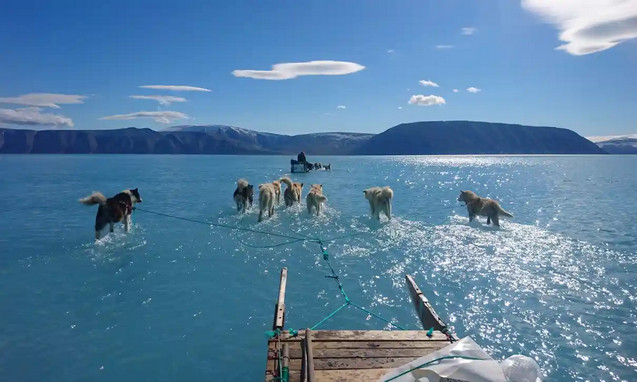
Husky dogs wade over sea ice during an expedition in north-western Greenland, where ice loss has been triggered by rising sea levels and atmospheric temperatures. Photograph: Steffen Olsen/Centre for Ocean and Ice /AFP/Getty Images

A total of 28 trillion tonnes of ice have disappeared from the surface of the Earth since 1994.

That is stunning conclusion of UK scientists who have analysed satellite surveys of the planet’s poles, mountains and glaciers to measure how much ice coverage lost because of global heating triggered by rising greenhouse gas emissions.

The scientists – based at Leeds and Edinburgh universities and University College London – describe the level of ice loss as “staggering” and warn that their analysis indicates that sea level rises, triggered by melting glaciers and ice sheets, could reach a metre by the end of the century.

“To put that in context, every centimetre of sea level rise means about a million people will be displaced from their low-lying homelands,” said Professor Andy Shepherd, director of Leeds University’s Centre for Polar Observation and Modelling.

The scientists also warn that the melting of ice in these quantities is now seriously reducing the planet’s ability to reflect solar radiation back into space. White ice is disappearing and the dark sea or soil exposed beneath it is absorbing more and more heat, further increasing the warming of the planet.

In addition, cold fresh water pouring from melting glaciers and ice sheets is causing major disruptions to the biological health of Arctic and Antarctic waters, while loss of glaciers in mountain ranges threatens to wipe out sources of fresh water on which local communities depend.

“In the past researchers have studied individual areas – such as the Antarctic or Greenland – where ice is melting. But this is the first time anyone has looked at all the ice that is disappearing from the entire planet,” said Shepherd. “What we have found has stunned us.”

The level of ice loss revealed by the group matches the worst-case-scenario predictions outlined by the Intergovernmental Panel on Climate Change (IPCC), he added.

The group studied satellite surveys of glaciers in South America, Asia, Canada and other regions; sea ice in the Arctic and Antarctic; ice sheets that cover the ground in Antarctica and Greenland; and ice shelves thatprotrude from the Antarctic mainland into the sea. The study covered the years 1994 to 2017.

A glacier melting in Svalbard archipelago. Photograph: Jan Tove Johansson/Getty Images

The researchers’ conclusion is that all the regions have suffered devastating reductions in ice cover in the past three decades and these losses are continuing.

“To put the losses we’ve already experienced into context, 28 trillion tonnes of ice would cover the entire surface of the UK with a sheet of frozen water that is 100 metres thick,” added group member Tom Slater from Leeds University. “It’s just mind-blowing.”

As to the cause of these staggering losses, the group is adamant: “There can be little doubt that the vast majority of Earth’s ice loss is a direct consequence of climate warming,” they state in their review paper, which is published in the online journal Cryosphere Discussions.

“On average, the planetary surface temperature has risen by 0.85C since 1880, and this signal has been amplified in the polar regions,” they state. Both sea and atmospheric temperatures have risen as a result and the resulting double whammy has triggered the catastrophic ice losses uncovered by the group.

In the case of the melting ice sheet in Antarctica, rising sea temperatures have been the main driver while increasing atmospheric temperatures have been the cause of ice loss from inland glaciers such as those in the Himalayas. In Greenland, ice loss has been triggered by a combination of both sea and atmospheric temperatures increasing.

Meltwater rushes from Boyabreen glacier in Fjaerland, Norway – a process accelerated by global heating. Photograph: Sean Gallup/Getty Images

The team stressed that not all the ice that was lost over that period would have contributed to sea level rises.

“A total of 54% of the lost ice was from sea ice and from ice shelves,” said Leeds University researcher Isobel Lawrence. “These float on water and their melting would not have contributed to sea level rises. The other 46% of meltwater came from glaciers and ice sheets on the ground, and they would have added to sea level rise.”

The group’s results were published 30 years after the first assessment report of the IPCC was published, at the end of August 1990. This outlined, in stark terms, that global warming was real and was being triggered by increasing emissions of greenhouse gases from the burning of fossil fuels.

Despite warnings from scientists, these emissions have continued to rise as global temperatures continued to soar. According to figures released by the Met Office last week, there was a 0.14C increase in global temperatures between the decade 1980-89 and the decade 1990-1999, then a 0.2C increase between each of the following decades.

This rate of increase is expected to rise, possibly to around 0.3C a decade, as carbon emissions continue on their upward trajectory.

Links

The Observer View On The Climate Catastrophe Facing Earth

The Guardian - 

Thirty years ago we were warned. Now is our last chance to listen

Icebergs off the south-east coast of Greenland, a region that is exhibiting an accelerated rate of ice loss. Photograph: Andrew Bossi/Goddard Space Flight Center/NASA

Thirty years ago this week, the population of Earth was given official notification that it faced a threat of unprecedented magnitude.

Emissions of carbon dioxide and other greenhouse gases, spewed into the atmosphere from factories and vehicles burning fossil fuels, were pinpointed, definitively, as triggers of future climate change.

Melting icecaps, rising sea levels and increasing numbers of extreme weather events would be the norm for the 21st century unless action were taken, warned the authors of the first assessment report of the Intergovernmental Panel on Climate Change (IPCC).

The scientists had been charged by the IPCC, which had been set up two years earlier, with establishing whether climate change was a real prospect and, if it was, to look at the main drivers of that threat. They concluded, in a report released in August 1990, that the menace was real and that coal, gas and oil would be the principal causes of global heating.

Unless controls were imposed on their consumption, temperature rises of 0.3C a decade would be occurring in the 21st century, bringing havoc in their wake.

Three decades later, it is clear that we have recklessly ignored that warning. Fossil fuels still supply 80% of the world’s energy, carbon dioxide levels in the atmosphere continue to rise and global temperatures are still increasing.

According to Met Office statistics, there was a 0.14C increase in global temperatures in the decade that followed publication of the first assessment report. This was then followed by a 0.2C increase in each of the following two decades. The world could easily heat by 3C by the end of the century at this rate, warn scientists.

The impact on the world will, by then, be catastrophic. As the Observer reveals this week, our overheating planet has already lost a staggering 28tn tonnes of ice from its ice sheets and glaciers, triggering sea level rises that are now accelerating at a rate that matches the worst-case scenario predictions of the IPCC.
Such an event would have been impossible in a world with limited, pre-industrial carbon dioxide levels in its atmosphere
Or consider the heatwave that struck Siberia this year, bringing forest fires, permafrost melting and pest invasions in its wake. Such an event would have been impossible in a world with limited, pre-industrial levels of carbon dioxide in its atmosphere.

It would therefore be tempting to blame IPCC scientists for this troubling state of affairs. Should they not have guided us more adroitly through these worrying times? Could they not have acted with more precision? Certainly, the organisation is not without its critics who have claimed, on occasions, that it is overstaffed and sometimes slipshod in its work.

However, we should be careful when apportioning blame for the world’s failure to act over climate change. It is the government members of the IPCC who are at fault for ignoring their own scientists’ warnings.

They have allowed lobbying by the fossil fuel industry to play havoc with attempts to limit carbon emissions, while nations such as Canada, Saudi Arabia and the United States have blocked all attempts to limit global fossil fuel consumption.

By contrast, the IPCC has at least made the world aware of the impending crisis, a task of considerable complexity. Getting scientific experts from 195 nations to agree anything can be likened to the herding of a similar number of bad-tempered cats.

Thanks to the IPCC, we are at least aware of the problem that now faces our world. We know exactly how much fossil fuel we have left to burn if we want to limit global temperature rises to a relatively safe rise of 1.5C.

Individual nations have until next year – at the United Nations climate change conference in November – to announce how they will achieve those reductions in oil, gas and coal burning in order to make that target possible and to halt global heating.

It is an achievable aspiration even at this late date. We still have hope, in other words.

Links

24/08/2020

(AU) Queensland Locations Break August Temperature Records, Earlier Wet Season On The Cards

ABC News - Sharnie Kim | Kier Shorey

Cooktown had its warmest August day in 146 years. (ABC Far North: Charlie McKillop)

Parts of Queensland have broken August temperature records and much of the state is in for a warmer and wetter spring than average, but the Bureau of Meteorology (BOM) says it is too early to tell if it will be a scorching summer.

Mareeba and Cooktown in Far North Queensland and Yeppoon in Central Queensland had their hottest August day in decades this week.

Meteorologist Felim Hanniffy said it was due to a ridge of high pressure along the east coast, and northerly winds preceding a trough approaching from the west.

"Mareeba hit 34 degrees, which is actually the warmest August day in over 68 years," he said.
"Cooktown, the airport site only goes back 20 years but when you take in a couple of sites, 34.6 was actually their hottest August temperature for over 146 years."
Cooktown’s weather records only date back 146 years to 1874.

The temperatures for the two sites were about eight degrees Celsius above average for the time of year.

The mercury hit 30.7C in Yeppoon on Wednesday, making it the hottest August day since 2000, when it reached 30.1C.

No more records were expected to fall in the coming days, but conditions were expected to remain warmer than average, with elevated fire danger across most of the state.

 The chance of above median maximum temperature for September to November 2020.(Supplied: Bureau of Meteorology)

'Not good news'

Forecaster Kimba Wong said the record temperatures aligned with global warming trends.

"The Bureau and CSIRO's State of the Climate report says Australia can expect to see more extremely hot days in the future as our climate continues to warm," she said.

"So I guess it's something we should maybe expect to happen more and more often, which is not particularly good news."

Bureau of Meteorology's guide to El Nino and La Nina

She said North Queensland could expect a warmer than average spring.

"Across the far north of Queensland there is an 80 per cent or higher chance of exceeding the median maximum temperature," Ms Wong said.

"For October to December it's a similar story — maybe slightly less of a signal there, but still above a 70 per cent chance of exceeding the median maximum temperature across most of the tropical north."

Eastern and central Australia were forecast to have more rainfall than average between September and November.

Chance of earlier, rainier wet season

This week the BOM declared a La Nina alert, which is typically associated with more rainfall, heightened risk of cyclones and cooler daytime temperatures.

It said the odds of a La Nina in the coming months had increased to a 70 per cent chance — about three times more likely than normal, in other words.

But Ms Wong said how the weather played out would depend on other climate drivers.

"The La Nina generally tends to be an earlier onset of the wet season, a wetter wet season, and potentially more cyclones than you would normally get," she said.

"The north still looks to be quite a high chance of above average maximum temperatures coming into summer.

"I'm not too sure what happens beyond then, but it seems to be in line with longer-term projections of continuing to warm."

Links

Lethal Heating is a citizens' initiative