14/10/2020

(AU) Australia's Summer Forecast – Intense Heatwaves And More Cyclones

 - Josh Dutton

NSW and Victorian residents are going to have to brace for sweltering summer weather with more intense heat waves forecast.

The Bureau of Meteorology released its severe weather outlook for the rest of October until April on Monday.

The bureau last month said Australia will experience La Niña in the coming months. BOM manager of Climate Operations Dr Andrew Watkins said it means we’ve got warmer ocean water near Australia with cooler water off the south.


Much of Australia is in with a good chance of exceeding the median minimum temperature in December. Source: BOM

It tends to favour rainfall and cloudiness, he said. And while there will be fewer days of extreme heat in southern states, they will be more intense this summer.

The severe weather outlook forecasts longer heat waves for South Australia, Victoria and NSW.

Meteorologist Diana Eadie said Australia “is warming”.

“Extreme heat days are more likely than compared to the past due to the impacts of climate change,” she said.

“This summer, rain and increased humidity, thanks to La Niña, means we face a reduced number of extreme heat days compared to recent years.

“But while heatwaves may not be as severe in southern areas, they may last longer and be more humid both of which can increase the risk to human health.”

Victoria could see longer heatwaves over the next few months. Source: BOM

Hot temperatures for late October

By BoM’s definition, a heatwave occurs when maximum and or minimum temperatures “are unusually hot over a three-day period” in a specific location.

According to BoM’s climate outlook maps, most of Australia, if temperatures do exceed the average, most of the searing heat will occur between December and February.

However, the two weeks from October 19 through to November 1 promise to be hot too with southern NSW, South East Queensland, Darwin, Canberra, Melbourne and Perth all a 60-80 per cent chance of exceeding the median minimum temperature.

For Darwin and Hobart, it’s at 70-80 per cent.

A man paddle-boards at Glebe's Blackwattle Bay in Sydney last summer as smoke haze fills the air. Source: AAP


Cyclones and flooding await

The La Niña event also brings more cyclones. In fact, in 2011 when Australia experienced La Niña South East Queensland was pummelled by flooding.
BoM believes eastern Australia and parts of the north will experience more rain over the coming months. It could lead to more mosquitoes too.
Climatologist Greg Browning said past years have seen less cyclones but the upcoming weeks and months will buck that trend.

"On average Australia sees nine to 11 tropical cyclones each year, with four crossing the coast. With La Niña this year we are expecting to see slightly more tropical cyclones than average, and the first one may arrive earlier than normal," Mr Browning said.

"Every northern wet season has had at least one tropical cyclone cross the Australian coast, so we can never be complacent. We know that cyclones can develop at any time throughout the tropical cyclone season, which runs from November to April.

"This means that communities right across northern Australia need to be prepared now, and stay informed from the very start of the tropical cyclone season in October, right through until April."

Residents look on after the Balonne river floods in St George in Queensland's southwest in February. Source: AAP

The Northern Territory could be hit with an earlier onset of monsoons while Queensland could see more cyclones bringing widespread flooding.

While spring through to summer is normally a dry period for South Australia it’s also likely to see more rain than usual while Tasmania, NSW, northern WA and the ACT could also see widespread flooding.

North Queensland might see an earlier start to the wet season too.

November through to January looks to be the wettest period though with parts of NSW’s north across the Queensland border to the Sunshine Coast, according to BOM’s climate outlook.

A man soaks up the heat at Sydney's Coogee Beach. Source: Getty Images


October 19 through to November 1 has parts of northern NSW, South East Queensland and Darwin at about 65-70 per cent chance of surpassing median rainfall.

November could be a wet month for Sydney, Melbourne, Canberra and Adelaide too with a 65-75 per cent chance of exceeding median rainfall.

Links

'An Uninhabitable Hell': UN Says Climate Change 'Doubled The Rate' Of Disasters

Sydney Morning Herald - Olivia Rudgard

Climate change is largely responsible for a doubling in the number of natural disasters since 2000, the United Nations said Monday, as it warned that the Earth was becoming uninhabitable for millions of humans.

Three quarters of a billion more people were affected by catastrophic events of nature over the past two decades than in the 20 years before, the UN's office for disaster risk reduction said.

Calling humanity "wilfully destructive", it said the data was a wake-up call to governments that had failed to take the threat of climate change seriously or to prepare for more natural disasters.

A helicopter prepares to drop water at a wildfire in Yucaipa, California, in September. The UN says the number of natural disasters has doubled this century. Credit:AP


"It is baffling that we willingly and knowingly continue to sow the seeds of our own destruction, despite the science and evidence that we are turning our home into an uninhabitable hell for millions of people," the authors said.

The report found that there were 7,348 major recorded disaster events between 2000 and 2019, compared with 4,212 between 1980 and 1999.

Climate-related disasters explained the bulk of the rise, increasing from 3,656 to 6,681. Floods and storms were the most common events. The incidence of flooding more than doubled, from 1,389 to 3,254.

A boy uses half of a fiber tank to navigate a flooded street after heavy monsoon rains, in Karachi, Pakistan, Thursday, Aug. 27, 2020. Credit: AP

Mami Mizutori, the UN's representative for disaster risk reduction, said that NGOs and emergency services were "fighting an uphill battle against an ever-rising tide of extreme weather events".

She added: "The odds are being stacked against us when we fail to act on science and early warnings to invest in prevention, climate-change adaptation and disaster-risk reduction," she said.

Asia was the worst-hit continent and China the worst-affected country, followed by the US. Overall, more than 4 billion people were affected by disasters, a rise from 3.25 billion.

Though mobile phone technology and improved weather forecasting limited the lives lost to natural disasters, as the death toll grew from 1.19 million to 1.23 million over the past 20 years, the economic impact grew significantly, with agriculture in particular disrupted.

While they were less common, geophysical disasters such as earthquakes and tsunamis were the most deadly, with the 2004 Boxing Day tsunami, which killed 226,400, recorded as the largest single event by death toll, followed by the 2010 earthquake in Haiti.

2020 was not included in the data, but has so far seen one of the most active fire and hurricane seasons the US has ever experienced, as well as significant flooding across Asia.

Climate scientists warned that a warmer climate makes hurricanes and severe storms more likely, and promotes the conditions that allow forest fires to start and spread.

Links

More Than 7,000 Extreme Weather Events Recorded Since 2000, Says UN

The GuardianReuters

Sharp rise in number of droughts, floods and wildfires has claimed 1.23 million lives and affected 4.2 billion people

Wildfires in California last month. The US recorded 467 disaster events from 2000 to 2019, second only to China with 577. Photograph: Gene Blevins/Reuters

Extreme weather events have increased dramatically in the past 20 years, taking a heavy human and economic toll worldwide, and are likely to wreak further havoc, the UN has said.

Heatwaves and droughts will pose the greatest threat in the next decade, as temperatures continue to rise due to heat-trapping gases, experts said.

China (577) and the US (467) recorded the highest number of disaster events from 2000 to 2019, followed by India (321), the Philippines (304) and Indonesia (278), the UN said in a report issued on Monday, the day before the International Day for Disaster Risk Reduction. Eight of the top 10 countries are in Asia.

Globally, 7,348 major disaster events were recorded, claiming 1.23 million lives, affecting 4.2 billion people and causing $2.97tn (£2.3tn) in economic losses during the two-decade period.

Drought, floods, earthquakes, tsunamis, wildfires and extreme temperature fluctuations were among the events causing major damage.

“The good news is that more lives have been saved, but the bad news is that more people are being affected by the expanding climate emergency,” said Mami Mizutori, the UN secretary general’s special representative for disaster risk reduction. She called for governments to invest in early warning systems and implement disaster risk reduction strategies.

Debarati Guha-Sapir of the centre for research on the epidemiology of disasters at the University of Louvain, Belgium, which provided data for the report, said: “If this level of growth in extreme weather events continues over the next 20 years, the future of mankind looks very bleak indeed.

“Heatwaves are going to be our biggest challenge in the next 10 years, especially in the poor countries,” she said.

Last month was the world’s hottest September on record, with unusually high temperatures recorded off Siberia, in the Middle East, and in parts of South America and Australia, the EU’s Copernicus Climate Change Service said.

Global temperatures will continue to warm over the next five years, and may even temporarily rise to more than 1.5C (2.7F) above pre-industrial levels, the World Meteorological Organization said in July. Scientists have set 1.5C as the ceiling for avoiding catastrophic climate change.

Links

13/10/2020

(AU) Net Zero Emissions Target For Australia Could Launch $63bn Investment Boom

The Guardian - Lisa Cox

Modelling shows moving towards a net zero emissions economy would unlock financial prospects in sectors including renewables and manufacturing

Analysis finds if Australia keeps to its current climate policies, investment worth $43bn would be lost over the next five years, growing to $250bn by 2050. Photograph: Carly Earl/The Guardian

Australia could unlock an investment boom of $63bn over the next five years if it aligns its climate policies with a target of net zero emissions by 2050, according to new economic modelling.

The analysis, by the Investor Group on Climate Change (IGCC), finds the investment opportunity created by an orderly transition to a net zero emissions economy would reach hundreds of billions of dollars by 2050 across sectors including renewable energy, manufacturing, carbon sequestration and transport.

However, if the country keeps to its current targets and climate policies, investment worth $43bn would be lost over the next five years, growing to $250bn by 2050.

The Investor Group on Climate Change represents investors in Australia and New Zealand who are focused on the effect of the climate crisis on the financial value of investments.

Among its membership are institutional investors with funds under management worth more than $2 trillion.

The organisation commissioned the consultancy Energetics to examine the domestic investment opportunities that would arise from an orderly transition to net zero emissions by 2050.

The report finds a net zero scenario would unlock $63bn in investment over the next five years, including $15bn in manufacturing, $6bn in transport infrastructure such as charging stations, and $3bn in domestic green hydrogen production, as companies and governments moved towards the stronger emissions goal.

Carbon sequestration – or carbon farming – would emerge as a major investment asset class, with estimated investment worth $33bn in nature-based solutions such as tree planting and assisted regeneration of deforested land.

The investment potential would reach hundreds of billions of dollars over the longer term to 2050, including $385bn in clean electricity, $350bn in domestic green hydrogen, $104bn in transport infrastructure and $102bn in carbon sequestration.

“What it shows is that the investment opportunities extend well beyond just the renewables industry,” said Erwin Jackson, the IGCC’s director of policy.

“Renewables are the backbone of the transition but there are massive opportunities in other sectors such as manufacturing, restoring the land, and electrification of transport.”

The report, which targets governments, companies, investors and financial regulators, says its estimates are conservative because they do not factor in the export potential of industries such as clean hydrogen.

It argues that if governments set stable policy, and companies and investors collaborate to align their decisions with the goals of the Paris agreement, then billions of dollars over the short and long term could support the jobs and wealth of millions of Australians, particularly in regional areas.

The Morrison government has refused to commit Australia to a net zero emissions target and has focused its climate policy on a new technology roadmap covering hydrogen, energy storage, “low carbon” steel and aluminium, carbon capture and storage, and soil carbon.

Under the roadmap, the government claims it will invest $18bn in technologies over 10 years.

The IGCC report notes that more than half of Australia’s two-way trading partners have set targets to reach net zero emissions by mid-century.

It warns that a business as usual “hothouse” scenario in Australia – with no net zero emissions target – would produce $43bn less in investment over five years and $250bn less by 2050 than what would be possible with a net zero target.

“Put bluntly, capital is global and it wants to invest in climate change solutions because they see it as delivering more on their long term investments,” Jackson said. “They’re going to invest more in countries that have durable, credible policies to achieve net zero emissions by 2050.”

John Connor, the chief executive of the Carbon Market Institute, said the reality Australia faced was its economy was running “below capacity and it needs a new direction”.

He said clean technologies like renewable energy and transport represented significant opportunities for Australia in a post-carbon world and the country’s vast land mass, with landscapes in need of regeneration, gave it a competitive advantage in carbon sequestration.

“We can either coast off the cliff into the hothouse of economic and climate disaster, or we can turn a corner towards an orderly transition and the opportunities that are there,” Connor said.

Links

(AU) Nullarbor Stations Are Doing It Tough Already, But Some Are Adapting For Even Worse Conditions

 ABC Esperance - Emma Field | Rhiannon Stevens

Russell Swan spends his days carting what little water is left to his cattle. (ABC Goldfields-Esperance: Rhiannon Stevens)

The Nullarbor, which stretches from the border of South Australia across the treeless plains of Western Australia to the mining town of Norseman, is in the middle of its worst drought on record.

While some pastoralists are taking the traditional path of cutting costs and destocking, others are dealing with the dry by investing in technology, diversifying, and gearing up for even tougher conditions in the future.

At Madura Plains, one of the largest sheep stations in the world, the owners are investing hundreds of thousands of dollars in infrastructure.

The South Australian-based Cooper family bought the vast 728,000-hectare station in 2016, and the upgrades they have made mean the station has been able to hold on to valuable Merino ewes.

Despite the drought, the station is carrying about 25,000 sheep.

Station manager Tom Austin says last year's rainfall was the lowest ever recorded since Madura Plains was settled by Europeans in the late 1800s. (ABC Goldfields-Esperance: Rhiannon Stevens)

It is less than the 70,000 they want to run in ideal conditions, but maintaining some sheep through the drought has paid dividends when prices for ewes soared after the eastern states drought broke earlier this year.

The infrastructure upgrades included replacing most of the station's fences — which was no mean feat as holes for every fence post had to be rock drilled.

They also reduced the size of paddocks and put new water stock troughs in the middle of the paddocks to stop overgrazing near the water points.

Water infrastructure was upgraded with the addition of nine new water bores, giving the station access to fresh stock water rather than the previous salty water, and 800 kilometres of new water pipes were laid.

Madura Plains station manager Tom Austin says technology is changing the way they work, but they're not throwing out all the old traditions. (ABC Goldfields-Esperance: Emma Field)

"It's made a huge difference. With the drought the sheep are living on saltbush and blue bush which both have very high salt content," station manager Tom Austin said.

"To have good clean cool water, it's been the game changer."

They also installed remote water monitoring, done via a smart phone app.
"Wherever [we] are in the world we can do a water run on Madura Plains and see what's going on," Mr Austin said.
Tom Austin inspects a water tank at Madura Plains Station. (ABC Goldfields-Esperance: Emma Field)

"It's a great labour saver to get around this place because the roads are terrible, it's hard on vehicles, and it ties up staff.

"To be able to know you've got a problem and go straight to it before it comes in issue it's just invaluable."

Keeping Madura Plain's vast stock water system running is water overseer Bess Harrison.

She says the adoption of technology and upgrades, which includes solar pumps instead of old-fashioned windmills, has benefitted the stock.

"The difference in the health of the stock really has just been incredible in the last three years," she said.

Water Manager Bess Harrison at Madura Plains Station on the Nullarbor. (ABC Goldfields-Esperance: Rhiannon Stevens)

The Cooper family have more plans for the station, which include using large drones to replace aerial mustering and mapping vegetation on the property.

They also want to start a Boer goat program on their less arable country.

"It's not throwing out all the old traditions, but it's looking towards how we can improve and use technology," Mr Austin said.

Hard time for smaller stations

Technology may go a long way to surviving droughts and a warming climate, but it requires big capital investment.

For Russell Swan on nearby Virginia Plains Station, this kind of investment is out of reach.

Mr Swan moved to the Nullarbor as a young child and this is the driest he has ever seen it.

"We are going into year six of pretty dry conditions," he said.
"[We're] just jumping from next last option to next last option at the moment."
Last year, a lack of water forced him to completely destock.

"We were spending probably $6,000-7,000 a week … just keeping cattle in water," he said.

After promising summer rains earlier this year, Mr Swan brought 150 head of cattle back to the property — a far cry from the 1,500 head of cattle he had six years ago.

But without underground bore water, he relies solely on a series of dams, most of which are almost all dry because winter and spring rains have not come.

Now he spends his days carting what is left of his water to the cattle.
"You get very tired, you get a bit despondent, but it doesn't do you any good, yeah. It's just a case of chin up," he said.
Russell Swan has lived on the Nullarbor since he was a small child. (ABC Goldfields-Esperance: Rhiannon Stevens)

But as he faces another summer, Mr Swan is not planning on leaving anytime soon.

"I know it breaks eventually, it's just a case of hanging in until it does," he said.

Diversity key to survival

Towards the western end of the Nullarbor at Fraser Range Station, diversity has been the key to survival.

Owner Ben Holman only has about 250 female cattle left on his 202,000ha station, and he has been forced to hand feed since the start of the year.

Mr Holman and his partner also run a tourism accommodation business, but this has been closed because of COVID-19 and the WA border closure.

Their third business venture, an earthmoving contract business, has been their saviour.

Ben Holman says his earth moving business has saved him. (ABC Goldfields-Esperance: Rhiannon Stevens)

"We do a lot for the [mining] exploration industry and we do a fair bit in the fire season fighting bushfires," Mr Holman said.

"With COVID and the last three years of drought, the contracting business is what's saved us," he said.

"We wouldn't be here now without it because we've lost the other two aspects of the business."

Council body lobbies for drought support


Despite the extremely dry conditions across the Nullarbor and other parts of the Southern Rangelands in WA, these regions do not have access to all government drought funding programs.

Last February, the Federal Government announced 35 local government areas in Western Australia were eligible to apply for the Drought Communities Program — a funding scheme where eligible councils can apply for up to $1 million in grants.

It was the first time WA councils were included on this list, but none were from the pastoral regions.

In response, the WA Local Government Association (WALGA) passed two motions from the Shire of Dundas, which incorporates the Nullarbor stations, agreeing to lobby the federal and state governments over drought funding.

Shire of Dundas president Laurene Bonza said the way the Federal Government measures if a region is dry does not accurately capture the situation for pastoralists along the Nullarbor.

For the Drought Communities Program, the Federal Government uses weather data from Norseman to determine if the region is rainfall deficient.

Fraser Range Station, on the Western Edge of the Nullarbor. (ABC Goldfields-Esperance: Rhiannon Stevens)


But Ms Bonza says using this weather information is inaccurate as the Nullarbor pastoral stations are up to 600 kilometres away from the Norseman airport Bureau of Meteorology station.

"That rainfall figure doesn't really have any bearing on what's happening out there," she said.

"Some of our guys on the pastoral stations are heading in to their seventh year of well below-average rainfall."

She also claimed some Federal Government drought assistance depended on state governments making a drought declaration.

The Western Australian Government no longer makes drought declarations.
"Our State Government doesn't recognise the word 'drought'," she said.
Drought Communities Program under review

WA Agriculture Minister Alannah MacTiernan disputed Ms Bonza's claim, saying there were no Federal Government drought schemes that relied on state government drought declarations.

Despite being in a six year dry spell WA's Nullarbor region doesn't qualify the Federal Government's Drought Communities Fund. (ABC Goldfields-Esperance: Emma Field)

"The last Federal assistance scheme that relied on a state declaration of exceptional circumstances ended in 2008 at the agreement of all states and territories," Ms MacTiernan said.

She said the WA Government provided some assistance to farmers and pastoralists in drought, such as additional rural financial counselling and water carting in WA's eastern Wheatbelt.

But she urged her federal counterpart "to reconsider its decision to exclude Southern Rangelands local governments from its Drought Communities Program and to review the eligibility criteria that saw these areas miss out."

Federal Agriculture Minister David Littleproud said the Drought Communities Program was under review.

"The Federal Government, as a result of an EY review into the program, is now considering whether it will continue with that program into the future," he said.

However, he said, other drought support available to farmers and pastoralists included the Farm Household Allowance income support program and the Farm Management Deposits scheme.
Posted Yesterday, updated Yesterday

Links

(AU) NT Bushfire Scientists Research Controlled Burns And Their Impacts On Darwin's Biodiversity

ABC NewsJane Bardon

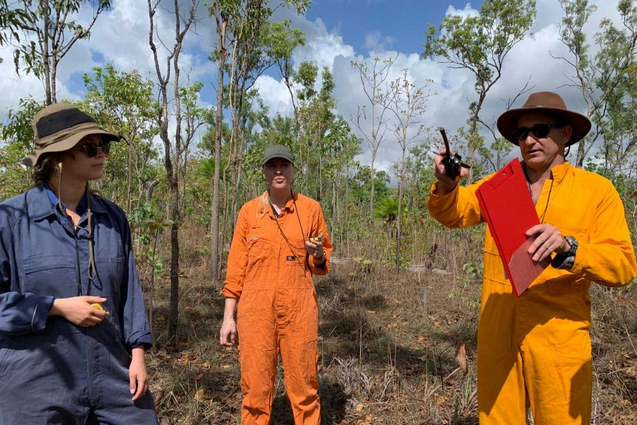
The scientists stand by and monitor the speed at which the fire spreads as part of their study. (ABC News: Jane Bardon)

There aren't many people who go to stand in the middle of a bushfire on purpose.

But Charles Darwin University associate professor of ecology Brett Murphy, his colleagues and students have been doing this for 17 years.

Associate Professor Murphy is studying how more frequent and intense bushfires are threatening small mammals.

"One of the ways fire affects small mammals is by opening up the understorey, by killing shrubs and small plants, making it easier for feral cats to hunt them," he said.

"We've seen big declines in northern Australia in species including the black-footed tree-rat and brush-tailed rabbit-rat."

On a study site north of Darwin several times a year, the scientists set fire to some of a series of 1 hectare plots of bushland.

They stand inside each plot timing how quickly the fire moves towards them.

Brett Murphy (right) is studying how bushfires threaten small mammals. (ABC News: Jane Bardon)

Then in the following weeks and months, they record how much of the vegetation is burnt and how many animals have survived and returned.

"So you can see a lot of the trees here have been tagged over the last 17 years, to track their fate, whether they die, how much they grow over time and how fire affects that," Associate Professor Murphy said.

As the threat from wildfire has intensified in Northern Australia over a series of hot dry seasons, rural fire services, Indigenous ranger groups and pastoralists are carrying out more controlled burning to protect communities and reduce carbon emissions.

They burn networks of firebreaks into the landscape in the cooler part of the early dry season, when bushfires as less destructive, to prevent hotter out of control wildfires in the late dry season.

As prevention burning has expanded, so has community concern, one of the study's founders Alan Anderson said.

On a study site north of Darwin, the scientists set fire to some of a series of 1 hectare plots of bushland and stand inside each plot monitoring how quickly the fire moves towards them. (ABC News: Jane Bardon)

"There is widespread community concern that we are burning too much and so we are providing the information to inform them on the extent to which that is the case," he said.

So the scientists have studied how regularly, and what times of the year, areas should be burnt to achieve the best balance between protecting communities, preventing the release of greenhouse gases and preserving biodiversity.

"On our site here we have six different ways of burning, including not burning at all and keeping fire out, and then burning other plots every two, three or five years, early in the year and then we also burn other plots in the late dry season," Professor Anderson said.

The area is rich with biodiversity, aiding the scientists in their respective studies. (ABC News: Jane Bardon)

While for small mammals, too much fire can be fatal, other animals, including ants, depend on fire, and like more open habitats, Professor Anderson said.

He said the research has found that the best way to protect against wildfires while protecting biodiversity is to burn different areas within a large landscape at different intervals.

"That's the real challenge is to get the balance right to cater for different plant and animal groups that prefer different ways of burning and to make sure that you have those different ways of burning represented somewhere in the landscape," he said.

"So that all the plants and animals can be maintained in the broader region."

Research shows different levels of burning various areas broadly helps balance biodiversity and carbon. (ABC News: Jane Bardon)


At the same time, CSIRO research scientist Anna Richards has been studying how much carbon is being stored in the plants, trees and soil on the different plots.

Her work has helped to prove that Indigenous ranger groups across Northern Australia, who were already earning Federal Government carbon credits from stopping wildfires, are also preventing carbon being released from dead trees.

As a result, the Federal Government has just changed its Emission Reduction Fund rules to allow saving these trees to qualify for carbon credits.

"So as fire managers alter the way they burn, burning less frequently and less intensively, that's creating a store of carbon through accumulating carbon in this dead wood on the ground," Dr Richards said.

"That creates an additional source of income for land managers where there's not much other opportunities for economic development in these areas.

CSIRO research scientist Anna Richards is researching how much carbon is being stored in the plants. (ABC News: Jane Bardon)

"I really hope that this science can help land managers like ranger groups show that their careful management of their land is having a positive impact on biodiversity and carbon."

Dr Richards said finding a good balance between maintaining biodiversity and carbon across whole landscapes will become even more important as climate change intensifies.

"We're lucky that in the study period we've had three cyclones, and two of the driest wet seasons on record," she said.

"With climate change, as we get more frequent shorter dry seasons or more intense cyclones, that could change carbon and biodiversity stored in the landscape.

"So that's the real benefit and specialness of running these long term experiments over many years."

Links

12/10/2020

Campaign Seeks 1bn People To Save Climate – One Small Step At A Time

The Guardian

Count Us In urges actions such as eating local, making clothes last or buying an electric car

Some of the actions are as simple as opting for a portobello mushroom vegan burger instead of beef. Photograph: count_kert/Getty Images/iStockphoto
If a billion people around the world were to take a few small steps and make them into permanent lifestyle changes, global greenhouse gas emissions could be significantly reduced, a new campaign argues.

These actions can be as simple as eating local food, forgoing meat at some meals, and wearing clothes to last instead of throwing them away after a few outings.

The campaign, which is backed by businesses including Ikea, HSBC, BT and Reckitt Benckiser (owner of brands such as Cillit Bang, Gaviscon and Durex), is urging people to sign up to take at least one simple step that would reduce emissions.

Count Us In invites people to sign up online for the steps they want to take and a level of commitment, such as moving permanently to a different diet or promising not to fly over a specified period.

There are 16 steps on offer, of varying levels of difficulty. These range from having your house insulated, buying an electric car or solar panels and opting to fly less, to writing to political representatives and reusing and repairing belongings rather than buying new ones.

Some of the measures – such as turning down the thermostat and buying fewer new clothes – are ones that many people do routinely out of necessity rather than choice. However, the campaign aims to raise awareness among consumers that patterns of high consumption are unsustainable.

People signing up for the service will receive email reminders of further steps they could take: for instance, someone signing up to drive an electric vehicle would receive information about solar panels. A spokeswoman said people would not receive marketing material from specific companies.
Count Us In calculates that 20% of global emissions could be reduced if 1 billion individuals take the steps it advocates.

“Imagine what the world would look like if a billion people took action to fight climate change,” said Chris Anderson, the head of TED, the online talks platform that is one of the backers. “We can all make a difference by taking simple practical steps.”

Pia Heidenmark Cook, the chief sustainability officer at Ingka Group, the largest Ikea franchisee, said: “We believe that urgency and optimism create action, and we need to act now. Many solutions already exist and if we all do our part, we can solve the climate crisis.”

Emissions dropped by about 17% on average globally in April, as many countries imposed coronavirus lockdowns that left roads deserted, grounded flights and stopped much industrial activity. Experts said at the time that the fact the majority of emissions remained intact showed the need for systemic change to counter the climate crisis.

Some climate activists not involved with the campaign privately expressed reservations to the Guardian, saying that large companies and governments must shoulder more responsibility.

Joel Lev-Tov, a youth climate activist, said: “[I find it] absolutely disgusting. It’s blaming the consumers for their choices instead of the fossil fuel companies and big business who are emitting more CO2 than I could ever emit in my lifetime in a few hours. While I appreciate the intention behind their campaign … individual change won’t help us solve the climate crisis.”

Eric Levine, a partner at the social enterprise Leaders’ Quest, one of the campaign’s backers, said: “We are trying to get to citizens who don’t think of themselves as climate change activists. If we don’t get that mass audience we won’t get the change we need [from governments]. These are steps that matter and we need everybody to be involved.”

Levine said Leaders’ Quest and Do Nation, which runs the project, would have access to the data of people who sign up, but that consumers could choose whether to give access to their details to the businesses participating. The pledges taken by participants will be made public but the user can choose whether to reveal their name.

The 68 business and cultural organisations backing the initiative include the football clubs Tottenham Hotspur and Forest Green Rovers, which will publicise the campaign to their supporters, and the Earthshot prize launched by Prince William this week.

Links

Lethal Heating is a citizens' initiative