29/10/2020

(AU/UK) Australian PM's Office Omits Net Zero Emissions From Account Of Morrison's Talk With Johnson

The Guardian - 

UK record of conversation stresses ‘ambitious targets to cut emissions and reach net zero’, but account released by Australian PM’s office does not mention the target

Scott Morrison’s office has put out an account of his conversation with the UK prime minister, Boris Johnson, that leaves out any reference to emissions targets. Composite: Mike Bowers/Matt Dunham/The Guardian/AP

Scott Morrison’s office has put out an account of his conversation with the UK prime minister, Boris Johnson, that leaves out any reference to emissions targets.
 
Scott Morrison has declared the British government understands that Australia’s mid century emissions reduction targets will not be set by London or by Europe, because Boris Johnson embarked on his own act of “sovereignty” by withdrawing the UK from the European Union.

The Australian PM’s comments followed the release of official readouts – with different emphases – after a conversation about climate change between the two leaders on Tuesday night.

According to the British readout, Johnson “stressed that we need bold action to address climate change, noting that the UK’s experience demonstrates that driving economic growth and reducing emissions can go hand in hand”.

“Looking ahead to the Climate Ambition Summit on 12 December and Cop26 in Glasgow next year, [Johnson] emphasised the importance of setting ambitious targets to cut emissions and reach net zero.”

The British account said the two leaders agreed to intensify the partnership between the UK and Australia on developing and scaling up green technologies.

The Australian record has a different emphasis.

It said Johnson had “welcomed our significant increase in emissions reduction programs announced through the budget, and strongly endorsed our focus on unlocking practical pathways to reducing emissions”.

“Both countries agreed to work closely together to accelerate research and deployment of low-emission technologies ahead of Cop26.”

Australia has thus far declined to adopt a net zero target. Morrison told reporters he was “very aware of the many views held around the world, but I tell you what, our policies will be set here in Australia”.

While implicitly referencing the differences, Australia’s prime minister said “one thing the British prime minister and I agree on is that achieving emissions reductions shouldn’t come at the cost of jobs in Australia or the UK”.

The foreign affairs minister, Marise Payne, also played down the significance of the difference in wording, saying the Morrison statement had been prepared “in response to media requests” and Australia was strongly committed to the Paris agreement.

Under questioning at a Senate estimates committee hearing on Wednesday, Payne said it was not reasonable to expect her to “interpret between the lines” but she understood it was “a very good and positive call”.

Payne said the Morrison readout referred to their discussion about responding to the Covid-19 challenge, whereas the Johnson readout did not – but she was not about to suggest the British readout was inaccurate or misleading.

Labor’s Senate leader, Penny Wong, told Payne that “no amount of words and no amount of adjectives … can hide the fact that your government is increasingly isolated internationally on climate”.

Climate change in Britain is not the divisive issue it is in Australia, and has not created ructions for the Conservative party in the same way it has with the Liberal and National parties in Australia.

The UK has prioritised climate action, and in 2019 became the first G7 country to legislate a target of net zero greenhouse gas emissions by 2050. Since 1990, the UK has reduced emissions by more than 40%, while the economy has grown by around 70%.

The British government has privately appealed to senior Coalition figures – including the energy minister, Angus Taylor, and Payne – to develop a more ambitious climate policy.

The Morrison government is a signatory to the Paris agreement, and has a 2030 emissions reduction target of between 26% and 28% on 2005 levels by the end of the decade.

But the government is continuing to resist pressure to sign up to a target of net zero emissions by 2050 – even though net zero is an increasingly uncontroversial abatement target.

More than 70 countries and 398 cities say they have adopted a net zero position. Every Australian state has signed up to net zero emissions by 2050, and these commitments are expressed either as targets or aspirational goals.

Net zero has also been adopted by business groups in Australia who only a few years ago opposed Labor’s carbon pricing scheme.

The Australian Climate Roundtable, which includes the Australian Industry Group, the Business Council of Australia, the ACTU, the National Farmers’ Federation and the Australian Council of Social Service, issued a statement late last year supporting policies requiring “deep global emissions reductions, with most countries including Australia eventually reducing net greenhouse gas emissions to zero or below”.

Morrison says the government’s approach to abatement will be based on technology rather than “taxes” and the government is developing a roadmap to guide the transition. The government has identified “clean” hydrogen, energy storage, “low-carbon” steel and aluminium, carbon capture and storage and soil carbon as priority technologies.

The prime minister said on Wednesday the most important element of the conversation on Tuesday night was a joint agreement with the UK on technology sharing “to ensure that these technologies won’t only work in Australia, and in the United Kingdom, but they can work in India, that they can work in China, that they can work in Vietnam – that they can work in those countries, which will have rapidly rising emissions over the next decade”.

The Australian readout characterised the conversation between the two leaders as “warm” and the British record referred to the “longstanding friendship and partnership between the UK and Australia”.

Apart from the conversation about climate change, the British record said the leaders “agreed on the importance of like-minded states working together to tackle global issues, including building open societies, strengthening democratic values and boosting free and fair trade”.

The Australian record referred to the “critical importance of likeminded countries working much more closely together – bilaterally, in other groupings and multilaterally – in the face of sharper geostrategic competition and a more uncertain strategic environment”, and also contained a reference to discussing “increasing cooperation on multilateral candidacies”.

The outgoing finance minister, Mathias Cormann, is Australia’s candidate to be the next secretary-general of the Paris-based Organisation for Economic Co-operation and Development.

The OECD has previously criticised Australia for its performance on climate change. Its membership is dominated by European countries and Australia’s climate change contribution has been queried by those with more ambitious emissions reduction commitments.

Cormann last week talked up the importance of pursuing “a green recovery with an increased reliance on renewables” in remarks to a business conference organised by the German government.

Links

(AU) Climate Change Worrying More Australians Than Ever Before, Australia Institute Report Reveals

ABC News - Michael Slezak

The report found bushfires were the impact of climate change respondents were most concerned about. (ABCMyPhoto: Martin Von Stoll)


Key Points
  • The survey shows Australians greatly overestimate the economic impact of the gas industry
  • Half of the respondents said fossil fuel producers should pay for climate action
  • Nearly three-quarters thought Australia should be a global leader in combatting climate change
Despite a global pandemic dominating headlines, concern about the impact of climate change is at a record high in Australia, with 80 per cent of people thinking we are already experiencing problems caused by climate change and 83 per cent supporting the closure of coal-fired power stations.
    In addition, 71 per cent of Australians now think Australia should be a world leader on climate action, according to The Australia Institute's Climate of the Nation report, which has been tracking Australian attitudes to climate change since 2007.

    The progressive think tank polled nearly 2,000 adults over a week in July.

    It said the results showed Australians wanted a speedy transition to a zero-emissions economy.

    "Our research shows that, far from dampening the call for climate action, the COVID-19 crisis has strengthened Australian's resolve for all levels of government to take action on climate change," Richie Merzian from the Australia Institute said.

    This year, more respondents have agreed climate change "is occurring" than at any other time over the survey's history, with 79 per cent agreeing with the statement. 

    The number of respondents who agree climate change "is occurring" is higher than at any other time over the survey's history. (ABC News)


    While the number of people saying they are "concerned" about climate change has remained steady for the past three years, a growing number of people believe we are experiencing the impacts of climate change "a lot" — up from 33 per cent in 2016 to 48 per cent this year. 

    The number of respondents who say they are already experiencing the impacts of climate change has increased in recent years. (ABC News)


    Bushfires were the biggest impact that respondents were concerned about, jumping from 76 per cent last year to 82 per cent this year.

    That was followed by droughts, extinction and the destruction of the Great Barrier Reef, all with about 80 per cent of people expressing concern.

    Rebecca Colvin, from the Australian National University, researches public attitudes to climate change. She said the poll showed COVID-19 had not made people forget about climate change.

    "I think it's surprising," she said.
    "It shows climate change isn't just a fad that people care about when everything else is stable."
    Competing polls

    The results came just weeks after the Lowy Institute released polling on climate change that showed a dip in another measure of concern: the number of people saying we should take action now, even if it came at a significant cost.

    Dr Colvin said the results told two sides of the same story.

    "We have a remarkable level of scientific consensus on climate change and the weight of public opinion both pointing toward the need for action on climate change," she said.

    "What I take from the combination of them both is possibly that the Lowy Institute polling is showing that in the immediate term our resources are thin because of the recession and COVID — but it's not like that's erased climate change from the agenda altogether."

    In the Lowy poll, despite a dip in the number of people urging action even if it came at a high cost, concerns about some climate impacts were at record-high levels.

    "Droughts and water shortages" and "environmental disasters such as bushfires and floods" were considered critical threats by 77 per cent and 67 per cent of people, respectively. That was despite only 59 per cent saying the same of climate change itself.

    Dr Colvin said that could be a result of people seeing the immediacy of the impacts of climate change — but not being able to see the cause: a rise in greenhouse gas concentrations.
    "It tells us one of the stories about climate change — we can always put it off until the next day — but we've done that for more than 30 years and we're now reaping the outcomes of that with the fires."

    A pocket guide to climate change

    The first step to being able to speak about climate change is to understand it. Not everyone learned about it in school, so here are the basics everyone should know. Read more 

    Energy misconceptions

    With electricity generation, the largest source of greenhouse gas emissions in Australia, the Australia Institute survey probed Australians' attitudes to energy.

    It found support for renewables rose over the past year, and support for coal, gas and nuclear fell or remained stable.

    Fifty-two per cent of respondents thought coal-fired power stations should be gradually phased out, while 31 per cent thought they should be phased out as soon as possible, even if that cost more.

    The Government has trumpeted plans for a "gas-led" economic recovery from the COVID-19 recession, so the poll looked at the public's knowledge and attitudes to gas.

    The survey found Australians greatly overestimated the number of jobs in the gas industry, believing about 8 per cent of Australian jobs came from the sector. But the Australian Bureau of Statistics suggests just 0.2 per cent of all jobs are involved in the extraction of oil and gas.

    The response mirrored similar results on the public's overestimation of the number of jobs in the coal industry, which has remained steady since last year. "When it comes to employment in the gas industry, Australians overestimate the gas workforce by a factor of 40," Mr Merzian said.
    "So what that means is that Australians think there are over a million working in the industry, when in reality it's more like 28,000."
    When it came to action on climate change, the poll found 63 per cent of Australians thought governments were not doing enough, and half thought fossil fuel producers should pay for more action.

    There was a jump in support for Australia going further than other countries, with 71 per cent saying Australia should be a global leader — up from 62 per cent last year.

    And 68 per cent of respondents agreed Australia should have a target of net-zero emissions by 2050 — something already in place in the UK and New Zealand.

    Links

    How Women And Girls Are Ending The Fossil Fuel Era

    Ms. Magazine - 

    “Right now, women and girls the world over are leading the way to the end of the fossil fuel era. Our challenge is to be brave enough to follow their leadership and to have their backs and support their hard work on all of our behalf.”

    18-year-old Rossmery Zayas of Southeast Los Angeles protesting in Paris during COP15, December 2015. From “The Women Taking on Climate Change,” by Antonia Juhasz. (Antonia Juhasz)

    Author
    Antonia Juhasz is an award-winning investigative journalist.
    She is the author of three books, most recently, Black Tide: The Devastating Impact of the Gulf Oil Spill.
    How Women And Girls Are Ending The Fossil Fuel Era is an edited and shortened version of a TEDx Talk Antonia delivered this month (see video).

    We face a global climate crisis; its cause is as well-known as its cure.

    We are destroying our home by the way that we produce and use fossil fuels. 

    The solution? Produce and use less fossil fuels—better still, use none.

    Right now, women and girls the world over are leading the way to the end of the fossil fuel era. 

    Our challenge is to be brave enough to follow their leadership and to have their backs and support their hard work on all of our behalf.

    VIDEO How women and girls are leading the way to the end of the fossil fuel era | Antonia Juhasz | TEDxCU

    I’m an investigative journalist specializing in oil. I’ve reported from the front lines of conflicts over fossil fuels and the climate crisis from Afghanistan to Alabama and from Alaska to the Amazon. I have been astounded by the continuity of the stories of the women and girls I have reported on who are today’s climate justice leaders.

    Their stories often begin with a debilitating fear—of the climate crisis, the oil company where they live, the politician controlling their fate, for the health of their children, or for what the future may bring. They describe overcoming their fear through action.

    Joining together in broad social movements, they’ve achieved tangible solutions. This gives them hope and a new vision for the future, one that is free of fossil fuels.

    They also face a common hurdle: invisibility. In fact, women are quoted as experts in less than 20 percent of all global news stories.

    I share a few of their stories with you below.

    Women and Girls Take on Fossil Fuels

    In January, I reported from the near Northernmost tip of Norway in the Arctic Circle on a meeting of Arctic nation military and political leaders (mostly all male) debating whether the Arctic is set to become “the new Middle East”—an area defined by conflict, even war, over the pursuit of oil.

    As one speaker put it: “I’m just not seeing how we can survive without fossil fuels.”

    Mayor Lucy S. Nelson. (NWABOR)
    Politely raising her hand from the audience, Inupiat Native Alaskan Lucy Nelson, expressed no such fear. 

    The mayor of Alaska’s Northwest Arctic Borough, Nelson described innovative ways that she’s leading her community away from fossil fuels, implementing small-scale solar and wind solutions replacing diesel generators for homes and saving on both air quality and energy bills. She asked for help to expand her local program.

    Outside of the conference, 11-year-old girls Lina and Runa stood boldly beside a banner protesting against new Arctic oil drilling.

    They reminded me of 12-year-old Angelika Soriano, a self-described “Warrior for Justice” who I interviewed in Oakland, Calif., for Ms. as she protested against a proposed coal terminal. Soriano argues her asthma—that of her sister and far too many of their friends—is caused by fossil fuel pollution.

    It is this same air pollution from cars and trucks, refineries and the like, that is today increasing the likelihood of death from COVID-19, and disproportionately so in low income communities of color like Sorianos.

    At first, Soriano was terrified to speak out. But she described looking out at the faces of those who had come to protest with her she and a feeling coming over her that “they were all one.” “I became very brave and courageous,” she told me.

    She then said to the crowd: “I know I might be little, but I can make a huge impact on this earth.”

    Keep It In The Ground

    Angelika, Lina and Runa are advocating for “keep it in the ground” policy, an approach supported by the findings of the United Nations Intergovernmental Panel on Climate Change. Its 2014 report revealed that to avert the worst of the climate crisis, some 80 percent of fossil fuels must stay in the ground.

    New York City Youth Climate Striker, September 20 2019. (Antonia Juhasz)


    In 2013, I reported from Ecuador for CNN. In Quito, I interviewed Esperanza Martinez, president of Acción Ecológica and the recognized grandmother of “keep it in the ground” policy.

    Nearly 25 years ago, Martinez joined partners in Nigeria to release a first-of-its kind declaration demanding the end of oil extraction and to “leave the oil in the soil” worldwide. Doing so is fundamental to confronting environmental racism, they argue, as communities and nations of color disproportionately bare the harms of oil extraction while others enjoy the benefits.

    Martinez told me,

    “What you lose with oil is life and nature. What you reclaim without it is imagination… The challenge is to unsoil your brain; wring the oil out and make room for the ability to embrace alternatives. … It is absolutely possible to live without oil. More than that, it is absolutely necessary.”

    I left Quito traveling deep into the heart of the Amazon rainforest with Native Waorani tribal leader, Alicia Cahuilla. Cahuilla was born in Yasuni, one of the most biologically diverse places left on earth. It also sits atop Ecuador’s largest largely untapped oil reserves. Alicia is often told that exploiting this oil will end poverty, bring jobs and wealth. She replies, “We have the richness of the forest and the river. We need for nothing, except what the oil companies destroy.”

    Cahuilla has unlikely allies in her fight against the oil companies—the Kichwa tribal community. There is a long history of conflict between the Waorani and Kichwa, yet the women are joined today in this struggle. Many seek a new internationally recognized category of conservation, “the Living Forest,” which would allow for the permanent protection of native forest lands as sacred sites free from extraction.

    The past fall, I reported from St. James Parish, Louisiana, for Rolling Stone Magazine. I interviewed 67-year-old Sharon Lavigne who lives in “Cancer Alley,” where some 150 fossil fuel and petrochemical facilities operate. Most of these operations—which are increasingly dedicated to plastics production—are concentrated in areas with the highest percentage of black and poor residents.

    Sharon Lavigne leads protest through Cancer Alley in St. James Parish, Louisiana, October 2019. (Antonia Juhasz)

    A retired special education teacher, at first, Lavigne was terrified to speak out. But she says, she had little choice. The industry promised jobs but instead brought pollution, treating residents as if “we’re not human beings.” It is racism that allows the industry to target her black community founded by former slaves.

    Lavigne said, “They’re killing us. And ­­­that is why I am fighting.”

    Over gumbo, Lavigne and a small group of friends formed RISE St. James to take on the industry. They’ve already forced out two petrochemical companies and are demanding a full moratorium on any new facilities. They want a Green Economy built on local green jobs.

    Why Women and Girls Lead

    One reason why women and girls lead these efforts is the disproportionate harms they face from climate change and fossil fuels. Women and children are, for example, 14 times more likely to die in a climate disaster then are men. While living near oil and gas operations increases the likelihood that women will suffer preterm births—the leading cause of infant death in the U.S.

    San Francisco Youth Climate Striker, March 15, 2019. (Antonia Juhasz)

    Women and girls are also responsible for up to 80 percent of the world’s food production.

    Emem Okon, founder and executive director of Kebetkache Women Development and Resource Centre in Nigeria, helped me understand these interwoven threads. I interviewed Okon for Ms. as she protested against Chevron. Its persistent oil spills and gas flaring, she explained, pollute the streams and the soil, leaving them unfit for the fishing and farming on which women disproportionately rely.

    Half a century of oil spills by Chevron and other companies has left southeastern Nigeria one of the most polluted places on earth. Worsening drought and floods brought on by climate change further erode the women’s ability to harvest these resources.

    Last December, Okon organized a national Niger Delta Women’s Day of Action mobilizing over 3000 women and young girls from across the Delta to achieve environmental and climate justice.

    The women I’ve interviewed abound in solutions, but they are virtually nonexistent among the leadership of the global energy industry. Many oppose having those same companies shift from fossil fuel to renewable energy corporations. Fossil fuels are not renewable, but they are natural, humans have cohabitated with these resources for millennia.

    Sunrise Movement blocks the San Francisco Federal Building entrance, December 2018, demanding action by Rep Nancy Pelosi on a Green New Deal. (Antonia Juhasz)

    The damage these companies have done in just the last 150 years through their control over oil, natural gas and coal leads many to question whether we should entrust these same companies today with the sun, wind and waves. Women I’ve interviewed from Afghanistan to North Dakota to Ethiopia are instead far more focused on building localized, small-scale, renewable, sustainable and equitably owned and distributed energy and transportation solutions.

    Yet, just a miniscule amount of the money that has gone to climate change finance globally targets the local level where women are more likely to exert influence. Money instead flows to multibillion-dollar investments, most often led by men and even oil companies, seeking the “next big technology fix” to the climate change problem.

    What Should Come Next?

    Arundhati Roy, writes:

    “Historically, pandemics have forced humans to break with the past and imagine their world anew. This one is no different. It is a portal, a gateway between one world and the next.”

    She then joined with Naomi Klein to launch an initiative for a Global Green New Deal.

    Upon my return from Norway in January, I was in Denver covering a protest led by a young woman of color, Michelle Weindling, calling for a Green New Deal for Colorado and a Just Transition embracing the state’s rich wind and solar power and an end to oil and gas drilling. The election of Donald Trump had initially left Weindling with a debilitating fear.

    Then, in 2018, the United Nations released its most dire warning on the climate crisis to date, giving humans just twelve years to bring down global average temperature rise. Yet, Weindling found hope in the report’s assertion that action today could avert the worst of climate catastrophe tomorrow. When she learned of the youth and female-led Sunrise Movement, she was ready to act.

    Michele Weindling (left). (Antonia Juhasz)


    Sunrise had joined with other groups to demand that candidates take a no fossil fuel money pledge to end “the corrupting influence” of the industry on politics and to release detailed plans for fossil fuels, environmental and climate justice. Former Vice President Joe Biden and Senator Kamala Harris agreed. They even embraced Keep It In the Ground policy, committing to end new leasing for oil and gas drilling on federal lands and waterways.

    Sen. Harris went further—as an original co-sponsor of The Green New Deal and pledging to pursue the managed decline of fossil fuel production around the world.

    Weindling was arrested for the first time that day. As she was being placed into handcuffs, I was reminded of something she had said to me: “When all of us are pushed to our breaking point and we feel like we cannot breathe, something has to emerge. For us, it is a voice and a path to take action, together. We are acting and we will solve the climate crisis.”

    Women and girls are leading the way to the end of the fossil fuel era. Will the rest of us follow?

    Links

    28/10/2020

    (AU) Government Wants Military Response To Climate Change Breakdown

    Michael West Media - 

    A bill being rushed through federal parliament is raising concerns that the Government is preparing for a militarised response to climate breakdown. Lawyer, researcher and human rights advocate Kellie Tranter reports.

    Image: Courtesy ABC

    The hypocrisy is extraordinary. On the one hand the Coalition Government reluctantly concedes that climate change exists at all and does little of substance to try to counteract it .

    Yet on the other hand it is dedicating substantial resources to establish a wide-ranging and powerful authority to tackle what it sees as the perceived threats of disaster from climate change.

    A bill being rushed through parliament – the Defence Legislation Amendment (Enhancement of Defence Force Response to Emergencies) Bill 2020 – is raising concerns that the Government is preparing for a militarised response to climate breakdown.

    Freedom of Information requests show that Defence is already planning towards extreme climate change impacts.

    References are made in the document of the need to “prepare for significantly more disaster support operations and potentially operations involving support to the civil power such as policing the population under exaggerated stresses such as food and water security”.

    Concerns about a militarised response were heightened when it was reported in September that a new civil defence agency will be housed under the Department of Home Affairs to lead a national response to emergencies such as bushfires, pandemics and large-scale cyber attacks.

    Shortly afterwards Home Affairs secretary Michael Pezzullo said that climate change risks and pandemics warrant a security rethink.

    And now it has emerged that national security risks sparked by climate change have prompted the Bureau of Meteorology to forge ties with the Five Eyes intelligence alliance and that the Bureau is now part of an international group sharing weather information with an impact on national security.

    Last year General Angus Campbell gave a speech in which he warned what the world could expect to see from climate change:

    “In about 10 years from now global warming above pre-industrial levels is set to rise by 50%. At 1.5 degrees of warming we can expect more significant impacts. Particularly in regards to oceans, low-lying areas and human health. The poor and most vulnerable will be hardest hit. Livelihoods lost. Food scarce. Populations displaced. Diseases spreading. And this now looks like our best-case scenario.”

    It’s time the Government came clean. Is it preparing for an increase of 1.5 degrees of warming by 2030? If so, that has huge ramifications for all of us in terms of food and water security.

    The global trend is that countries are preparing for a military response rather than a humanitarian response to climate change and Australia seems to be adopting that same approach.

    The bill’s official mantra

    The official mantra is that this bill amends ‘the: Defence Act 1903 to: streamline the process for calling out members of the Australian Defence Force (ADF) Reserves, including for the purposes of responding to natural disasters or emergencies; and provide ADF members, other Defence personnel and members of foreign forces with immunity from criminal or civil liability in certain cases while performing duties to support civil emergency and disaster preparedness, recovery and response.’

    But the rushed time frame of getting this bill through parliament is hugely concerning because it is not an innocuous bill.

    It was only introduced to parliament seven weeks ago (3 September), progressed to the Senate on 6 October, was referred to the Senate Foreign Affairs, Defence & Trade Legislation Committee two days later, and has allowed just seven days for public written submissions to be received by 15 October, with the final report to be handed down on 4 November.

    In its current form the ramifications of the bill are alarmingly wide-reaching. Its constitutional validity is questionable, it creates the potential for the politicisation of the Australian Defence Force, and it does not enshrine in legislation the non-use of force.

    Proponents of the bill have tried to assure members of parliament that this bill does not permit the use of force.

    Yet it was reported on 14 August, before the draft legislation was introduced to parliament, that:

    “While states and territories would still need to make a request for ADF support, government sources with knowledge of the potential legislation say the changes will make it easier to deploy the military and clearly set out its roles and responsibilities. This would likely include giving defence personnel greater legal protections in the event they have to help police search a property or detain someone”. [underline emphasis added]

    The Bill also fails to properly define ‘other emergencies’. It delegates too much responsibility for the call out to a single minister. It foresees foreign armies and police forces being called in, and extends to them and to local defence forces an unreasonable level of immunity from criminal and civil penalties.

    Karen Elphick, from the Laws & Bills Digest Section of the Parliamentary Library, rightly points out in the Bills Digest that: ‘The removal of criminal liability for actions taken in good faith performance of duty while providing certain assistance is likely to have the practical effect of expanding the circumstances in which the ADF can use force when deployed within Australia.’ In other words, if there are no consequences, force will inevitably be used and used more widely.

    We saw after the 2019-20 bushfires all along the east coast and into South Australia the desperation and anger of highly stressed communities. What might happen if you throw into such communities ADF soldiers who have been given immunity? The potential for things to go wrong is high.

    Instead of taking action to prevent the worst of climate change impacts from happening, the Government is pumping money into agencies to prepare them militarily.

    And if the Government possesses information or credible predictions about what’s coming does it not have a responsibility to genuinely reduce emissions and prepare its citizens for all potential eventualities?

    Links

    (AU) It's Your Regular Arctic Death-Spiral Update With Brenda The Civil Disobedience Penguin

    The Guardian - First Dog On The Moon

    This just in blah blah blah disaster disaster who is even listening any more? Hello?!

    Cartoon by First Dog on the Moon
    LARGE IMAGE
    Links

    (AU) One Year Since The Catastrophic Gospers Mountain Bushfire Started, Victims Say Australia's Climate Change Inaction Is 'Unforgivable'

    SBS - Gavin Fernando

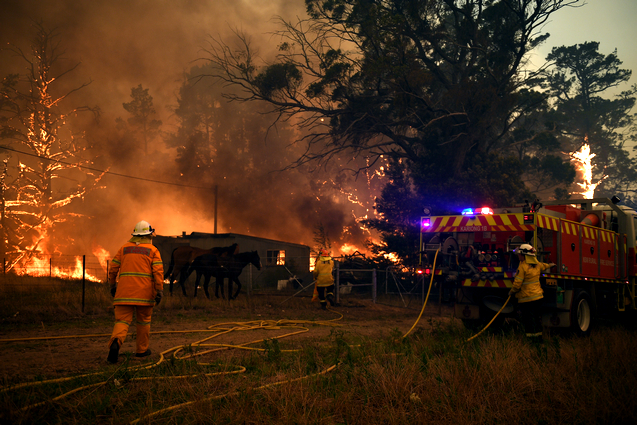
    Over a million hectares of land were destroyed when the mega-blaze ripped across NSW on 26 October last year, leaving dozens of communities traumatised.

    Firefighters watch on as the Gospers Mountain fire approaches a property at Colo Heights, north west of Sydney. AAP


    It's been exactly one year since a single bolt of lightning at Gospers Mountain started one of the most devastating bushfires in Australian history.

    In total, the Gospers Mountain fire on 26 October burnt 512,626 hectares across the Lithgow, Hawkesbury, Hunter Valley, Lower Hunter, Cudgegong, Blue Mountains and Central Coast districts – an area more than twice the size of the ACT.

    It also joined the Kerry Ridge, Little L Complex, Grose Valley and Three Mile fires.

    By the time torrential rain extinguished the megablaze in early February, it had burned through over a million hectares, killed millions of animals, destroyed a hundred homes, and left dozens of communities fearful and traumatised.

    One year on, residents and community leaders are calling for more action to be done to reduce climate change, to ensure such a catastrophe never takes place again. 

    NSW Rural Fire Service crews fight the Gospers Mountain Fire as it impacts a property at Bilpin, Saturday, 21 December, 2019. AAP


    'I still get triggered when I smell smoke'

    Luca Saunders, a Year 9 student at Blue Mountains Grammar School, said she gets triggering flashbacks to this day when she smells smoke or sees a fire truck.

    Her house in Blackheath was in the middle of four different bushfires raging at the time, including the destructive Gospers Mountain fire.

    “We were heavily affected by the Grose Valley fire and the Gospels Mountain fire, both of which came incredibly, incredibly close to my house on both sides.”

    Luca Saunders says she still gets triggering flashbacks to the bushfires. Climate Media Centre


    Luca evacuated to Victoria with her sister, and the pair were separated from their parents for three days, who stayed back to defend their house against apocalyptic conditions.

    “I remember ash falling from the sky, everything being white and then at night-time there was always a red glow on the horizon,” Luca said. “It was an absolutely terrifying time, and we were never sure whether we’d see our house again tomorrow. We were never sure whether our livelihoods would be sustained into the coming year.”

    “I personally get triggering flashbacks, if I see a fire truck or hear a siren,” she added. “Or if I smell smoke in the air.

    Luca said it was “incredibly frustrating” for bushfire survivors to see how the federal government responded to the crisis.

    “With the COVID-19 pandemic their response was incredibly quick, and it was very frustrating for survivors to see that that didn't happen when our lives are being affected by the climate crisis, and these bushfires,” she said.

    “It's also incredibly difficult to see that a year on from this crisis that we face in this country. The government still has not advanced in its climate regulation, because it's widely publicly understood that the climate crisis was the root cause of the bush fires.”

    An image taken from a plane window, captures smoke from the Gospers Mountain bushfires in December, 2019. AAP


    'Lack of action on climate change is unforgivable'

    Jim Casey, who has been a Sydney firefighter for more than 20 years, attended the Gospers Mountain blaze multiple times.

    “The scale of the fire is what really sticks with me,” he said. “This fire had its own ecosystem in terms of the amount of heat it was generating. But it wasn’t alone - we had fires burning, really from the Queensland border to the Victorian border, and thousands and thousands of men and women trying to deal with it as best they could.”

    Jim Casey has urged the federal government to do more to tackle climate change. Climate Media Centre


    Mr Casey said climate change was “beyond doubt” what kicked the fires into overdrive, and the extreme weather associated with climate change.

    “We had a short and warm winter which narrowed the window in which we could do hazard reduction burning, and then summer was unseasonably hot, with dry lightning strikes at the tail end of the drought,” he said. “And so you end up with the climate catastrophic firestorm that characterised the last fire season.”

    He said managing fire risks to a substantial degree requires “political action” on fossil fuel burning, and on climate change itself.

    “What is unforgivable in my opinion is the failure of the government to act upon the root causes of these fires,” he said. “Every inquiry, all of the bushfire scientists, the ex-fire chiefs all agree that it was climate change that pushed these fires into overdrive.

    “And for that to be addressed we must start talking about the burning of fossil fuels, exports of fossil fuels and moving towards some kind of carbon-neutral future.

    “Instead our government warns to start mining gas and selling that. It simply isn’t good enough. It’s fiddling while Australia burns,” Mr Casey said.

    Links

    Lethal Heating is a citizens' initiative