04/12/2020

'Mock Cop26' Activists Vote On Treaty Ahead Of 2021 Climate Summit

The Guardian

Young people from 140 countries presented policies to UK climate action champion

Mitzi Jonelle Tan, 22, from Manila, Philippines, one of the student organisers of Mock Cop26. Composite: Jessica Murray/Guardian Design Team

Young people from 140 countries who attended an online “mock Cop26” climate summit have presented a treaty of 18 policies to Nigel Topping, the UK’s high level climate action champion.

After two weeks of negotiations, delegates from the international youth-led conference presented their formal treaty to Topping during the event’s closing ceremony on Tuesday, and called on world leaders to prioritise the policies during Cop26, which was postponed for a year because of the pandemic and is now due to be held in Glasgow in November 2021.

Their demands include climate education at every level of formal education, tougher ecocide laws, stronger regulation on air quality, banning the offshoring of emissions and a commitment to limiting global heating to below 1.5C above pre-industrial levels.

Suphane Dash-Alleyne, a delegate from Guyana, South America, said: “Mock Cop26 sends a strong message to world leaders that young people can coordinate global negotiations and we have the solutions. Now is the time for us to have a seat at the table.”

A legal team, including lawyers from the legal charity ClientEarth, worked with delegates to formalise the statement into a treaty, which countries could adopt into law.

James Thornton, chief executive and founder of ClientEarth, said: “The youth behind Mock Cop26 have created a powerful statement calling on governments to take action to protect future generations from the worst impacts of climate change. Decisions taken by governments now will affect the youngest generation for many years to come.”

Mock COP26 was organised at short notice to fill the void left by the postponed Cop26 conference.

The Mock Cop26 policies were voted on by 330 young people across the globe who attended the event, with priority given to countries most affected by the climate crisis – people from the global south made up 72% of delegates.

Sainey Gibba, a 23-year-old delegate from the Gambia, said: “My country is very vulnerable to the impact of climate change, particularly rising sea levels and coastal erosion, so I feel like Mock Cop26 has really helped us raise our concerns and speak for the voiceless.

“Cop26 should never have been postponed, they should have done it virtually like how we have done it. They should really learn from us because there is so much urgency.”

The student staff team who organised Mock Cop26 is made up of 18 students from Australia, Brazil, Burkina Faso, Canada, Ecuador, India, Japan, Kenya, Nigeria, Philippines, Solomon Islands and the UK. Photograph: Mock Cop26

The Mock Cop26 organisers grouped delegates by time zones to ensure they could attend the two-week schedule of talks and discussions around their studies, and they hope the online conference could become a model to help future major conferences produce less carbon emissions.

“If we have been able to organise a conference online where we got more than 300 delegates from more than 140 countries to come together and make policies, I think our leaders could too,” said Sonali, a 21-year-old event organiser from Patna, India. “It reduces the carbon footprint massively when people don’t have to travel.”

The delegates and volunteers involved in Mock Cop26 now plan to spend the next 12 months urging politicians to implement their policies nationally to raise ambition on the run up to Cop26.

Links

Climate Change: 2020 Set To Be One Of The Three Warmest Years On Record

BBC News - Matt McGrath
The Sun shining through the heat haze from a wildfire in California. Getty Images

The Earth continued to endure a period of significant heating in 2020 according to the World Meteorological Organization (WMO).

Its provisional assessment suggests this year will be one of the three hottest, just behind 2016 and 2019.

The warmest six years in global records dating back to 1850 have now all occurred since 2015.

The most notable warmth was in the Siberian Arctic, where temperatures were 5C above average.

How do we know the temperature for 2020 when the year isn't over yet?

To work out the annual rise in temperatures for their State of the Climate report, the WMO uses information from five different global datasets.

They then compare modern readings to temperatures taken between 1850-1900. This baseline figure is sometimes referred to as pre-industrial levels.

With data available from January to October this year, the WMO says 2020 is set to be around 1.2C above the baseline, but with a margin of error of 0.1C.

All five datasets currently have 2020 as the second warmest, behind 2016 and ahead of 2019, based on comparisons with similar periods in previous years.

However the expectation from scientists is that the temperature data from November and December will likely see enough cooling to push 2020 into third spot.

That's because a La Niña weather event has developed in the Pacific Ocean and this normally depresses temperatures.

The biggest differences from the long term average temperature were seen in the Siberian Arctic.

Despite this, the WMO is certain that 2020 will remain one of the warmest three.

"Record warm years have usually coincided with a strong El Niño event, as was the case in 2016," said Prof Petteri Taalas, WMO Secretary General.

"We are now experiencing a La Niña, which has a cooling effect on global temperatures, but has not been sufficient to put a brake on this year's heat."

Are these small temperature differences important?

These relatively similar global temperature figure recorded over the past few years hide considerable differences at local level.

In 2020, Siberia saw temperatures around 5C above average, which culminated in a reading of 38C at Verkhoyansk on the 20th June, which is provisionally the highest known temperature recorded anywhere north of the Arctic Circle.

Icebergs off Greenland as the Arctic summer melt was second largest on record. Getty Images

January to October was also the warmest such period on record in Europe.

But some places were below average including parts of Canada, Brazil, India and Australia.

Overall though the 2020 figure reinforces the view that climate warming, driven by human activities is persisting. The decade from 2011 to 2020 is the warmest yet recorded.

Where 2020's heat went

The majority of the excess heat generated from warming gases in the atmosphere ends up in the oceans.

This is putting added strain on the seas, with around 80% of global waters experiencing at least one marine heatwave this year. These events, similar to heatwaves on land, see prolonged exposure to high temperatures which can have devastating impacts on marine creatures and ecosystems.

A long-running heatwave off the coast of California, known as "the blob", was said to have killed up to a million seabirds in 2015-16.

Researchers say that these events have become more than 20 times more frequent over the past 40 years.

"About 90% of the heat accumulating within the climate system from anthropogenic climate change is stored in the ocean," said Prof John Church from the University of New South Wales in Sydney, Australia.

"This latest update from WMO clearly shows the oceans are continuing to warm, and at an accelerating rate, contributing to sea-level rise. This means climate change has significant momentum committing us to further change over the coming decades."

Ongoing warming

The WMO says that warming continues to drive melting in many parts of the world, including Greenland where around 152 billion tonnes of ice was lost from the ice sheet in the year to August 2020.

There were 30 named storms during the North Atlantic hurricane season, breaking the record for the number of such events.

Europe saw another record-breaking summer in 2020, making life uncomfortable for travellers. Getty Images

As well as record numbers, new evidence suggested that hurricanes get stronger when they hit land because of rising temperatures.

Other impacts noted by the WMO this year included wildfires in Siberia, Australia and along the US West Coast and South America, which saw plumes of smoke circumnavigate the globe.

Floods in Africa and South East Asia displaced large numbers of people and undermined food security for millions.

What has been the reaction to this report?

The findings of the WMO report won't come as a surprise to most observers.

"The state of the global climate? Parlous," said Prof Dave Reay from University of Edinburgh, UK.

"These annual updates of deteriorating planetary health always make for bleak reading; this year's is a full red alert. Surging heat, intensifying droughts and rampant wildfires all speak of the acute impacts of climate change in 2020. They also warn of the chronic undermining of global carbon sinks - the oceans, trees and soils around the world - that is underway.

"Throw yet more emissions and warming at them and they will rip the Paris climate goals from our grasp forever. The year ahead will be defined by our recovery from Covid-19, the centuries ahead will be defined by how green that recovery actually is."

Hurricane Iota left destruction in its trail in Nicaragua. Getty Images

Environmental campaigners say the report adds urgency to calls for the recovery, post-Covid, to focus on climate change and the environment.

"Although the pandemic will have been the biggest concern to many people in the developed world in 2020, for millions in climate vulnerable places the climate emergency remains the biggest threat and sadly there is no simple vaccine to fix the climate. But keeping fossil fuels in the ground would be a good start," said Dr Kat Kramer, from Christian Aid.

"These findings show just how important it is to ensure the government's economic recovery measures don't entrench the fossil fuel economy but act to accelerate the transition to a zero-carbon world."

Impact on nature

According to a new report from the International Union for the Conservation of Nature (IUCN), climate change is now the biggest threat to the most important world heritage sites.

The IUCN says that 83 such sites are now threatened by rising temperatures, including the Great Barrier Reef where ocean warming, acidification and extreme weather have all contributed to a dramatic decline.

It has been rated as having a "critical" outlook for the first time. 

Links

(AU) Great Barrier Reef Outlook 'Critical' As Climate Change Called Number One Threat To World Heritage

The Guardian

The outlook for Australian sites including the Blue Mountains and the Gondwana rainforests has deteriorated, report says

The outlook for the Great Barrier Reef has worsened from ‘significant concern’ to ‘critical’, the International Union for Conservation of Nature says. Photograph: James Cook University/AFP via Getty Images

The outlook for five Australian world heritage sites including the Great Barrier Reef, the Blue Mountains and the Gondwana rainforests, has deteriorated, according to a global report that finds climate change is now the number one threat to the planet’s natural world heritage.

The International Union for Conservation of Nature, the official advisory body on nature to the Unesco world heritage committee, has found in its world heritage outlook that climate change threatens a third of the world’s natural heritage sites. The outlook has been published every three years since 2014.

It finds the conservation outlook for the Great Barrier Reef has worsened from “significant concern” to “critical” – the most urgent status under the IUCN system. The reef suffered its third mass coral bleaching in five years during the 2019-20 summer.

In the aftermath of the 2019-20 bushfire disaster, the Gondwana rainforests – comprising 40 separate reserves between Newcastle and Brisbane – and the Greater Blue Mountains world heritage area have seen their outlook move to “significant concern” in 2020 from “good with some concerns” in 2017.

The fires affected more than 80% of the Blue Mountains world heritage area and more than 50% of the Gondwana rainforests, with the bushfire royal commission finding the disaster was just a glimpse of what climate change would deliver to the country in the future. 

 Western Australia’s Shark Bay and Ningaloo Coast world heritage sites have deteriorated in the IUCN outlook from “good” to “good with some concerns”.

Other Australian world heritage sites remained in the same categories from previous reports including the Kakadu National Park and Queensland’s wet tropics, which are both listed as “significant concern”.

The renowned coral reef scientist, Terry Hughes, said it was logical the IUCN had moved the Great Barrier Reef into the critical category after three bleaching events in five years.

But he said it didn’t make sense that others, such as the Ningaloo Reef that fringes the Ningaloo Coast, were not also considered critical given the scale of the threat climate change posed to coral reefs worldwide.

“It’s not really credible to say the Barrier Reef is now super vulnerable to climate change but other coral reefs around the world aren’t,” he said. “Unesco have actually made that case very clearly.”

Australia has 12 natural world heritage sites, four cultural world heritage sites and four mixed world heritage sites.

The report finds climate change is either a very high or high threat to 11 out of the 16 natural and mixed sites and that the “manifold” effects of the climate crisis – including increased frequency and severity of fires, droughts and coral bleaching – were often accompanied by other threats, leading to a poorer outlook overall.

K’gari/Fraser Island, which was ranked “good with some concerns”, is the latest world heritage area to suffer the effects of catastrophic fire, with half of the island burnt in a bushfire that has been alight for six weeks.

On Wednesday, the chair of the next major UN climate summit pointedly thanked Australia’s state and territory governments – but not the Morrison government – for committing to targets of net zero emissions by 2050.

Last month, the IUCN World Conservation Congress passed a motion moved by an alliance of Australian environment groups that called on the Morrison government to show leadership and ensure its planned reforms of Australia’s national environmental laws delivered more for the environment, including world heritage areas.

“Australia’s World Heritage sites are places of outstanding global significance and it is our privilege – and responsibility – to lead in protecting these values, including from the impacts of climate change,” said Rachel Lowry, WWF-Australia’s chief conservation officer.

Lowry said a stronger government plan to address the climate crisis and reduce emissions was “essential for these special places to remain”.

“There is no doubt that if we are to learn from the recent devastating bushfires, as well as the findings in this report, we must commit to regenerating Australia and setting our nation on a pathway where both people and nature benefit,” she said.

The Australian Marine Conservation Society’s Great Barrier Reef campaign manager, Dr Lissa Schindler, said: “The federal government’s refusal to act decisively on climate change is unforgivable when they know that global heating is so dangerous for our reef.

“We call on the federal government to take its role as custodians of our international icon seriously by committing to a pathway compatible with 1.5C of heating in a wide-ranging national climate change policy,” she said.

A spokesman for the federal environment minister, Sussan Ley, said the report reflected the extreme weather events Australia had experience over the past 12 months.

He noted the IUCN had reviewed Australia’s protection and management of world heritage sites favourably, which he said was due to the “significant work” of federal, state and territory governments at those sites.

“Australia is committed to playing its role in a global response to climate change, it is investing unprecedented amounts protecting the reef, in bushfire wildlife and habitat recovery and in supporting our world heritage places,” the minister’s spokesman said.

The IUCN’s director general, Bruno Oberle, said countries owed it to future generations to protect the world’s “most precious places”.

He said the report showed “the damage climate change is wreaking on natural world heritage, from shrinking glaciers to coral bleaching to increasingly frequent and severe fires and droughts”.

Links

03/12/2020

(AU) Pacific Leaders Condemn Australia's Climate Target As 'One Of The Weakest' In Open Letter

SBS - Tom Stayner

In an open letter to Scott Morrison, Pacific Island leaders have urged Australia to implement a range of changes to its 'weak' climate policies and targets.

Pacific Island leaders have written an open letter urging Prime Minister Scott Morrison to take stronger action on climate change. Source: AAP

Pacific Island leaders have written an open letter urging Prime Minister Scott Morrison to take stronger action on climate change, warning Australia is failing to take enough leadership initiative in addressing the global challenge. 

A total of 15 Pacific leaders, including former prime ministers and presidents, condemned Australia's emissions reduction target as "one of the weakest amongst wealthy nations".  

They called on Australia to increase the ambition of its commitments to responding to climate change ahead of the international United Nations Climate Ambitions Summit on 12 December.

Former Kiribati President Anote Tong. AAP

Former President of Kiribati Anote Tong told SBS News that Australia must review its commitment to tackling climate change, or risk failing to take leadership against the "existential threat". 

"What we’ve always been hoping to happen is to have Australia take greater leadership from our part of the world to try and influence the global agenda on climate change," he told SBS News. 

"Right now Australia is lagging behind."

In their letter, the Pacific leaders recommended Australia follow international allies in committing to a net-zero emissions target by 2050 and develop a long-term strategy to lower greenhouse emissions by 2021. 

They also want the Australian government to rule out using "carry-over credits" to achieve existing climate targets, casting doubt over the legal and moral justification for embracing the method.

They warned that homelands and cultures in the Pacific are facing "certain devastation" from climate change, and that the challenge remains the region's greatest security threat. 

"Pacific Island nations have long been leaders in driving global progress to combat climate change," the letter reads.

"However, Australia’s current Paris Agreement emission reduction target remains one of the weakest amongst wealthy nations."

The United Kingdom, Canada, Japan, South Korea and the incoming administration of US president-elect Joe Biden have committed to a net-zero emissions target by 2050.

The Australian government has resisted adopting the goal, with Mr Morrison instead saying he wants to reach the target as quickly as possible through a technology-driven approach. 

A spokesperson for the Australian government said it is a steadfast partner in building climate change and disaster resilience in the Pacific.

"Australia is committed to reaching net zero emissions as soon as possible, and focused on driving down the costs of key technologies to achieve this global goal," the spokesperson said. 

"We are committed to the goals of the Paris Agreement. Our targets are meaningful and ambitious and we implement action to achieve them."

Former Prime Minister of Tuvalu Enele Sopoaga told SBS News he has been disconcerted and disappointed by Australia's response to the global challenge. 

"Right now I am very very concerned that there are no clear actions, or commitment to actions, coming out of Australia," he told SBS News. 

"It is a feeling of betrayal and also it is a sense of seeing the denial by Australia of the seriousness of climate change and its catastrophic impacts.

"This is an existential threat to the security and survival of Pacific Island countries."

Tuvalu's Prime Minister Enele Sopoaga addresses the Pacific Islands Forum in Funafuti. AAP

Pacific Island nations have long urged Australia to take a stronger leadership in combating the global challenge, fearing they are most at risk of its potential devastating impacts.  

But at last year’s Pacific Islands forum, Fiji’s prime minister Frank Bainimarama accused Australia of lacking commitment to the cause.

"We cannot allow climate commitments to be watered down at a meeting hosted in a nation whose very existence is threatened by the rising waters lapping at its shores," he said.

This included reports Mr Morrison had resisted including references to coal and reaching net-zero emissions by 2050 in the final communique of the forum.

Mr Tong said Australia should reconsider its approach to climate change in line with the ambition foreshadowed by Mr Biden, who has said he plans to be a global leader on the issue.

"If the science is saying that things are going to get worse ... the Australian government needs to review its policy on climate change," he said. 

"Particularly when Australia knows very well the implications of what happens in Australia [and] to neighbouring Pacific island countries."

The federal government's current goal is for a 26 to 28 per cent reduction on 2005 emissions levels by 2030.

It has reduced the nation's total emissions by 16.6 per cent since 2005, according to government data. 

But Australia has faced international pressure over its intention to use Kyoto carryover credits in order to meet its commitments under the Paris agreement.

This involves claiming credit for exceeding emissions targets under the previous climate agreement.  

Mr Morrison last month said the government only intended to use them to the extent it is required, and that ideally "we will not need them".

The Prime Minister has long touted the importance of ties to the region, committing to a "Pacific Step-up" campaign including assisting them in addressing climate concerns. 

Amid the challenges of the COVID-19 pandemic, Australia has committed some $300 million to assist with economic and social recovery in the Pacific region. 

It has also pledged $80 million to the COVAX global alliance, designed to help distribute a vaccine to help countries less capable of accessing the health resources. 

Mr Tong said the Black Summer of bushfires in Australia should have also reaffirmed the need for strong action to limit the effects of climate change.

"It is a clear message that Australia is not immune to the effects of climate change and the leadership needs to take action on this," he said.

Links

(AU) Australia Endures Hottest Spring Ever, With Temperatures More Than 2C Above Average

The Guardian

Maximum heat in November was average of 2.9C above long-term mean, despite a La Niña event, which typically brings cooler patterns

Clouds over Sydney after heatwave
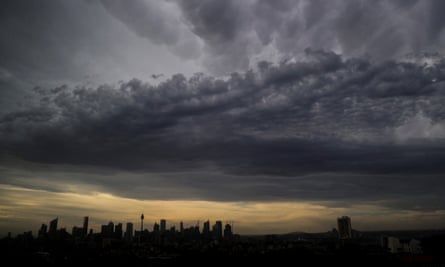
Clouds over Sydney’s skyline as a cool change moves in after two successive days of temperatures above 40C. Australia broke numerous records for heat in spring 2020, despite the La Niña climate event. Photograph: Jenny Evans/Getty Images

Australia has sweltered through its hottest spring and November on record, with both the season and the month more than 2C (3.6F) warmer than the long-term average.

Temperatures in spring were 2.03C hotter than average across night and day. In November, they were 2.47C above the long-term mean, which is measured across the years 1961-90.

Maximum heat in November went even further beyond what Australians are used to, on average reaching 2.9C above the historic mark. The previous record average was 2.4C above the long-term mark, set in November 2014.

Large areas in the east and south-east experienced maximums more than 10C above average on a number of days late in the month, with many weather stations in New South Wales breaking their record for the hottest day and night on 28 or 29 November.

Australian spring mean temperature anomaly (1910-2020). Illustration: Bureau of Meteorology


The rise in heatwaves is consistent with a recent state of the climate report by the Bureau of Meteorology and the Commonwealth Scientific and Industrial Research Organisation (CSIRO), which said Australia had entered a new era of sustained extreme weather events linked to increasing atmospheric concentrations of carbon dioxide.

Dr Andrew Watkins, the bureau’s head of climate operations, said the record-breaking temperatures were particularly remarkable as they had been recorded during a La Niña, a climate event in the Pacific Ocean that typically brings cooler and wetter weather.

“As a climatologist, it is really not what you would expect during a La Niña,” he said.

Watkins said the heat spike in November could partly be explained by the La Niña temporarily weakening, tropical rainfall patterns being “stuck” in the Atlantic and Indian Oceans and a weakening of the southern annular mode, which moved weather systems northwards. Together, they reduced cloud cover and contributed to higher air pressure and lower rainfall than expected during a La Niña.

These changes occurred against a backdrop of climate change. Australia has on average warmed by 1.44C since 1910, and a La Niña year was now as warm as an El Niño year was in the last century, Watkins said.

The records in the most recent climate data include new highs for minimum night-time temperatures across the continent: 1.91C above average for spring and 2.04C for November.

The extraordinary heat last weekend broke heat records for November in South Australia, Victoria and NSW. Smithville, in north-west NSW, reached 46.9C, Andamooka, in the far north of South Australia, hit 48C and Ouyen in Victoria equalled the previous high for the month of 45.8C.

The only national measurement not to set a new record was for the average maximum temperatures in spring. It was the fifth hottest recorded, 2.15C above the long-term benchmark.

Australian November mean temperature anomaly (1910-2020). Photograph: BOM

Temperatures in Western Australia in November were also an exception. The average maximum temperature in the state’s south-west was cooler than average.

Rainfall in spring was slightly below average across much of the continent, though not as low as the incredibly dry spring last year, which set the scene for the worst bushfires on record over spring and summer.

Total rainfall was 8% below average, and notably down in significant parts of Queensland, north-east NSW and western Tasmania. It was above average in the Kimberley and Pilbara in Western Australia, much of South Australia, western NSW and far south-west Queensland.

Despite the extreme heat in spring, Watkins said summer was expected to be more benign on average than the past couple of years. A strengthened La Niña was likely to bring warm muggy nights and increase the likelihood of tropical cyclones, but daytime temperatures were likely to be lower than last summer, he said.

Links

(AU) World Awaits Action By 'Suicidal' Australia, Says Former Climate Chief

Sydney Morning HeraldNick O'Malley

The world is waiting for a " suicidal" Australia to reverse its stance on climate change, says one of the world's most senior diplomats.

Christiana Figueres, who was executive secretary of the United Nations Framework Convention on Climate Change through the Paris Agreement talks, said the world expected more from Australia in the lead-up to the so-called COP26 climate talks to be held in Glasgow next November.

Former UN executive secretary for climate change, Christiana Figueres. Credit: Dominic Lorrimer

"The climate wars that have been going on in Australia for over a decade now are just – honestly they are such a suicidal situation because Australia... holds such promise with renewable energy," she told John Connor, chief executive of the Carbon Market Institute, in a conversation recorded for the Australasian Emissions Reductions Summit, which begins online on Wednesday.

"There is no other country that has as much sun potential as Australia," said Ms Figueres, who is now the director of the global climate movement Mission 2020.

"I've been pretty vocal about my frustration for so many years of a completely unstable, volatile, unpredictable stand and position on climate change in Australia."

She likened the possibility that Australia might use what the government calls carry-over credits from the Kyoto agreement to using points scored in one sporting match towards the results of another.

"It is just a total lack of integrity and not something that does Australia proud," she said.

Prime Minister Scott Morrison has pledged to work closely with the US President-Elect Joe Biden on key issues such as climate change.

Last month Prime Minister Scott Morrison said that he believed Australia may be able to reach Paris targets without relying on Kyoto credits.

In a second conversation for the conference, United Nations Principles for Responsible Investment chief executive Fiona Reynolds said anyone who failed to accept that climate sustainability had now moved into the mainstream and was being embedded in financial regulations would soon be left behind.

She said that soon it would not be enough to ask individual companies to set net-zero targets, because investors were now demanding such targets across their whole portfolios.

She predicted that the next frontier in investing would be in so-called negative emissions technologies and practices, which reduce the amount of greenhouse gas already in the atmosphere.

Climate solutions based on avoiding deforestation and other "viable near-term opportunities" in removing carbon could generate $US800 billion in revenues by 2050 and assets valued at well over $US1.2 trillion, more than the current value of the major oil and gas companies.

The conference is being held in the lead-up to a December 12 United Nations meeting in which national governments will be invited to present more ambitious climate plans – including COVID-19 recovery plans – designed to limit global warming to 1.5 degrees celsius.

Others to address the first day of the conference on Wednesday include Alok Sharma, president of COP26 and British Secretary of State for Business, Energy and Industrial Strategy and Jim Skea of the Intergovernmental Panel on Climate Change, as well as Australian business leaders Shayne Elliott from ANZ and Mike Cannon-Brookes of Atlassian.

Links

02/12/2020

The Ministry For The Future: A Novel By Kim Stanley Robinson

 Yale Climate Connections

Readers will develop a better understanding of the puzzle humanity must confront to meet challenges of climate change.

Kim Stanley Robinson inset photo: Gage Skidmore

Author
Michael Svoboda Ph.D. is an Asst. Professor of Writing in the University Writing Program at George Washington University. In his writing classes he alternates between the related themes of communicating climate change and political psychology.
In The Ministry for the Future, his twentieth novel, science fiction author Kim Stanley Robinson creates something truly remarkable: a credible, very-near future in which humans effectively solve the problem of climate change.

Climate lukewarmers may be tempted to interpret this upbeat summary as support for their technological optimism. That would be a mistake. Though it ends well, the story Robinson tells is harrowing.

That story starts in January 2025 in Bogota, Colombia, at the 29th Conference of the Parties to the United Nations Framework Convention on Climate Change. Frustrated by their failure to meet the goals of the Paris Agreement, representatives of the 189 ratifying countries form a new sub-agency “to advocate for the world’s future generations of citizens” and “to defend all living creatures present and future who cannot speak for themselves.” Although it is given a large budget for a UN agency, The Ministry for the Future, as it comes to be known, can achieve these lofty objectives only by leveraging its influence.

Just six months later a heat wave strikes Uttar Pradesh, the state along India’s border with Nepal. Not an uncommon occurrence. This time, however, instead of tempering after a few weeks, the wave intensifies. Night brings no relief. A young American aid worker, Frank May, does what he can to help, inviting his neighbors into his air-conditioned offices to cool themselves. Then the power goes out. Then the agency’s generator and window units are stolen by a gang of armed young men who curse Frank for the West’s pillaging of their country and of the planet’s climate.

The only way to cool off now is a plunge into the lake at the edge of town. By immersing themselves in its waters, they hope, they can escape the pulsing heat of the air. Instead the water feels like a hot bath. But having stepped into it, they now feel too weak and too muddled to step out.

The heat wave kills millions – in a fortnight. (If that seems incredible, consider that the temperature and humidity levels Robinson imagines are only modestly worse than the levels India actually experienced in 2019.) The 1.3 billion Indians who survive to witness this climatic atrocity are shaken – and outraged.

Robinson has long made a point of expanding the political geography of science fiction and cli-fi. The Arab world played a key role in his Mars trilogy. Nepal and Bangladesh provided political counterpoints in his Science in the Capital trilogy. And China shared the top billing with the United States in Robinson’s 2018 novel Red Moon. In Ministry, India has its turn.

The heatwave sparks a political upheaval, forcing old parties out of power and western corporations out of the country. India decides to conduct a geoengineering exercise to reduce the amount of sunlight heating the subcontinent, an operation its military carries out proudly and publicly. In secret, however, another group of Indians seeks to avenge the deaths of their innocent compatriots and to change the calculus of global capitalism. The eager recruits of the Children of Kali, a group named after Hinduism’s goddess of death and destruction, become the world’s newest, and most determined, eco-terrorists.

In Robinson’s  new ‘Ministry’ novel, different chains of choices point humanity in new directions … and ultimately to health and happiness.

In Zurich, Mary Murphy, the Irish ex-diplomat who runs the Ministry, looks for ways to shape and direct the instabilities created by India’s public and covert actions. Now, on page 27 of this 563-page book, the real plot begins, a plot that entwines the lives of the Irish director of the Ministry and the traumatized American aid worker who survived the Indian heat wave.

No one event or action changes the world in this novel, not even the deaths of millions; rather it is the different sequences of choices that nudge humans, individually and collectively, in new directions. The first choices force the next choices. The Ministry succeeds when it finds subtle ways to tip the scales toward the more sustainable options.

Robinson’s account of these decades of change resembles the selective public memory of the civil rights era, in which the non-violent protests of Martin Luther King, Jr., and the kindred groups around him take center stage while black power organizations and activists, like Malcolm X, are usually consigned to the margins.

In The Ministry for the Future, acts of eco-terrorism are clearly major drivers of the changes that first slow and then halt the centuries-long rise in greenhouse gas emissions, but Robinson keeps these actors offstage. The results of their actions – bombed power plants, downed jetliners, infected CAFOs – are reported third hand, in brief summaries of newscasts. Although each of these daring actions could be the plot of a thriller, Robinson does not spin out their stories, likely because he does not want to valorize violence even when it’s clearly necessary to his plot.

For reasons that are less clear, the protagonists, too, are often kept at a distance, presented in abbreviated form in minutes from meetings or in surveillance reports.

And then there are the digressions. Many of the book’s 106 chapters are devoted to such technical topics as the history of central banking, modern monetary theory, the Gini index, blockchain technology, Mondragon, carbon taxes, clean energy technologies, Jevon’s Paradox, different forms of geoengineering, population biology, and wildlife corridors.

With these many different pieces, Robinson assembles a Rube Goldbergian machine for social change that ultimately delivers the goods: a more equitable social economy and a more stable climate, one in which CO2 levels are actually falling from the peak level (478 ppm) reached in the 2040s. The Ministry finally achieves its goals when complex, interconnected social and economic processes are repurposed to direct power and money away from the production of fossil fuels, away the conspicuous consumption – and waste – of other goods, and toward health, human interconnection, and happiness.

The Ministry for the Future, then, is both an optimistic and a difficult work. Morally difficult for the role it envisions for violence, and sometimes a slow read for the many complex topics that must be explained along the way. But precisely because of the extra effort required, readers will finish Ministry with a clearer view of the big picture and a much better understanding of the many different pieces humanity must puzzle together to meet the challenge of climate change.

Links

Lethal Heating is a citizens' initiative