Monday, February 15, 2021

(AU) The Government Is Stuck In The Fallacy Of Debt And Deficit While Ignoring The Climate Crisis

The Guardian - 

Do we really want to say in a decade’s time that we couldn’t spend money on lowering emissions because we were worried about interest rates?

‘We are ... at a crucial moment, which requires massive investment in order to lower emissions.’ Photograph: David Crosling/AAP

Despite a year in which there was a massive increase in government debt that had no discernible impact on interest rates or inflation, our politics remains stuck in the fallacy of debt and deficit, even in the face of the great crisis of climate change.

One of economist John Maynard Keynes’ most repeated aphorisms is “when the facts change, I change my mind. What do you do, sir?” There is no evidence he ever said such a thing, which is just as well because while many utter the line, few follow through.

Usually, the change of mind is brief, until the facts can once again be dismissed.

For all of my lifetime, the Liberal party has sowed fear of government debt and budget deficits because they said it would increase inflation and interest rates.

In 2010 Mathias Cormann told parliament that GFC stimulus “has delivered record levels of debt and record levels of deficit and which has been putting upward pressure on interest rates and inflation”.

At that time the cash rate was 4.75%. Since then government net debt has gone from 3.7% of GDP to 34% and yet the cash rate is now 0.1%.

But hey, “facts”.

Then when the pandemic hit, the facts changed and so did their minds.

Last year, Cormann responded to questions about the massive increase in the budget deficit by saying “what is the alternative? Are you suggesting that we should not have provided the support we did to boost our health system, to protect jobs, to protect livelihoods? I mean, in the circumstances what was the alternative.”

It was a good answer and remains so even though this week the parliamentary budget office revealed government net debt has increased by 42% in one year from $430bn to $611bn.

And yet there has been no increase in the amount the government needs repaying because interest rates have actually fallen.


The PBO estimated that in the December quarter last year debt interest repayments were $4.1bn – the same amount it was in December 2016 when total debt was half the current level.

Imagine doubling your mortgage, but not your fortnightly repayments.

In December 2016 the government paid around 2.8% interest on a 10-year bond; right now it is paying around 1.2%.

And yet despite this, the fear of debt and deficit has returned.

On Friday the man who took over Cormann’s role as finance minister, Simon Birmingham, said in a speech to the Australia-Israel Chamber of Commerce that if interest rates converge to their long-run level the “increase in interest payments alone would add a further $44.5bn to gross debt in a decade’s time”.

He further suggested that “you don’t run an Australian economy on crisis settings when you’ve got through the crisis”.

Except, of course, we currently are in the greatest crisis to face the world’s economy – climate change.

We are also at a crucial moment, which requires massive investment in order to lower emissions.

The EU are moving towards imposing a carbon import levy, and Australia now finds itself utterly struggling to make the cuts required to keep temperatures from rising 2C above pre-industrial levels.

The Coalition only sees a crisis when it wants to. It refused to admit the GFC was one, and has never treated climate change as anything other than something to be mostly ignored.

But despite all contrary evidence, they keep saying rising debt is a crisis.

Do we really want to be telling people in a decade’s time that we couldn’t spend money needed to lower our emissions because interest rates were 1.2% and we were worried they might rise?

The Coalition reacted to the economic impact of Covid-19 by dismissing concerns about debt. And yet when faced with a much greater impact of climate change they remain wedded to old canards that have been shown not to hold.

But, to paraphrase Cormann, what is the alternative? Are you suggesting that we should not provide the support we need to get to net zero emissions to protect jobs, to protect livelihoods?

Unless you deny climate change, there is no alternative.

Links

(AU) Climate Change Inaction Spurs Berowra Residents To Take Some Action Themselves With Local Ideas

ABC Radio - Amanda Hoh

Kate Friend installed solar panels last year and hopes other Berowra residents will follow her lead. (ABC Sydney: Amanda Hoh)

Key points
  • The Berowra Climate Change Action Group was established after the 2019/2020 bushfires
  • Founder Kate Friend hopes to introduce a solar hub to reduce the suburb's carbon footprint
  • The local council is looking to set up similar infrastructure in other local villages
In late 2019 when
Australia's first "mega-blaze" tore through Gospers Mountain in northern Sydney, all Kate Friend felt was hopelessness.

If the fire had managed to cross the valley into the bushland shire at Berowra Heights it would have been at her doorstep.

Smoke wafted over her home for weeks, the sky was tinged orange for days, and Ms Friend's husband was on standby with the Rural Fire Service.

But rather than cower from the experience it sparked Ms Friend, a scientist who works as a business development consultant, to make a change.

"I was really frustrated about the lack of [government] action and the hopelessness that we all felt [during the bushfires]," she said.

"The problem of climate change is so huge that it's almost unattainable.
"However, I do think there are steps we can do as a community and as individuals that can make an impact and a change."
Anatomy of a 'mega-blaze'
As the first Black Summer inquiry prepares to report, we reveal the inside story of Australia's biggest bushfire. Read more...

With the drive to make that impact "from home", Ms Friend launched the Berowra Climate Change Action Group.

The first meeting at the local pub last year saw 30 residents show up to lend their support.

The pandemic stalled any further activities for the group, however Ms Friend relaunched it last week with the backing of Hornsby Shire councillor Nathan Tilbury and NSW Energy and Environment Minister Matt Kean who attended the meeting.

There are now at least 60 local residents that have signed up to the group.

Kate and her family have lived in Berowra for about eight years. (ABC Sydney: Amanda Hoh)

"The community has my back," Ms Friend said.

"I'm surprised there are more people interested in actual action on climate change.

"Like me, they are all frustrated, wondering what we can do, so they are all on-board with being a part of the change that's happening."

What do they hope to achieve?

Ms Friend is focused on setting up a solar hub for the suburb.

That would involve putting solar panels on council owned buildings, schools, sporting precincts, churches, and residential houses, and harvesting excess electricity to feed into the grid and back into the suburb.

She also wants incentives to encourage residents to install a water tank in their home and believes this could be established within three months.

The Berowra Climate Change Action Group has council backing to establish local sustainability projects. (ABC Sydney: Amanda Hoh)

Both ideas are backed by Hornsby Shire Council.
"It is on the agenda already and we know at council that if we have the community behind us it gives us a lot better chance at being successful," Cr Tilbury said.
"I believe state and federal [governments] have grants for that sort of thing.

"We have a couple of isolated communities like Brooklyn and Cowan who are also looking to do something similar."

Is there a precedent?

 Berowra is not the first suburb to take the battle against climate change into their own hands.

The NSW town of Tyalgum has been working for the past few years to take themselves off the grid entirely.

Since the devastating bushfires in 2019 and 2020, electricity companies have trialled standalone solar systems in rural and regional towns.

NSW Energy and Environment Minister Matt Kean was a guest speaker at the launch of the group. (ABC Sydney: Amanda Hoh)

Mr Kean said everyone had a role to play — from government down to grassroots community action groups.

"It starts with government, it starts with government leadership putting strong policy settings in place, and that's what I've done in NSW," he said.

"Working with people who care about their community, people who care about the planet, is exactly how we're going to solve this problem."

While setting up the infrastructure for a solar hub in Berowra could still be some time away, Ms Friend is determined to see it through.

"In terms of a timeline it might take us a while, but I have no doubt we can achieve this," she said.

Links

Sunday, February 14, 2021

(AU) ‘Real Struggle’: Map Shows Silent Crisis Threatening Australia

Yahoo News - Nick Whigham

Australia is facing an uncertain future when it comes to our continent’s most precious resource – water.

That’s the daunting warning laid out in a draft report on Thursday by the government’s Productivity Commission which highlights the immense challenges facing the nation as it looks to reform national water policy.

If not, a grim future awaits.

The twin trends of population growth and climate change mean Australia’s drying continent will struggle to cope with our future needs as water scarcity becomes an increasingly pressing issue, the major review finds.

In a worst case scenario imagined in the report, demand for water in the city of Melbourne could outstrip supply in just seven years.

Water has to be stored, distributed as needed and carefully managed. Water is heavily used in some areas while in others the percentage used is fractional. Source: PC      LARGE IMAGE

“In major cities where readily-available supply sources have already been accessed, ongoing population growth is likely to create significant pressure on water supplies,” the report says.

“Scenarios developed for Melbourne, for example, include a worst case of demand outstripping supply by around 2028.”

Signed in 2004 during the Millennium drought, the National Water Initiative (NWI) has been credited with positive changes in water usage by placing caps on how much water can be taken from river and groundwater systems, improving industry efficiency, and allocating water for the environment. However, the review found the NWI had “reached its use-by date”.

“If we look at the current NWI, it really will struggle in the face of our future challenges,” Commissioner Jane Doolan said.

Climate change central to Australia’s looming water woes

The draft report into the NWI, a federal-state reform agreement which has informed water policy for 17 years, urged governments to make climate change a top consideration with severe droughts and floods set to increase.

“Climate projections point to hotter, drier and more extreme weather — particularly in southern Australia. This will likely mean material reductions in water availability for most of the country and an increase in the frequency and severity of droughts and floods across the nation,” the report says.

Median projections of percentage change in average annual rainfall, potential evapotranspiration and run-off in the coming decades show a drier continent. Source: PC       LARGE IMAGE

Planning will need to include climate and population growth, which are set to sap the amount of water available for the environment, urban populations and farmers.

Ms Doolan said an estimated additional 11 million people would be living in Australia's capital cities by 2050.

“The NWI needs to be refocused to provide strong guidance on how to adapt water management to best meet our needs in a changing climate,” she said.

“The droughts and water scarcity experienced during the past 20 years are likely to be a harbinger of things to come.”

Urban water management will become increasingly important in the years ahead. Source: Getty

The report insists on a greater focus on urban water management, a more stringent economic criteria for projects, and the end of special treatment for mining and fossil fuel companies.

Among the recommendations is a call for mining and petrol companies to no longer be exempt from planning requirements faced by farmers and other water users.

The report also calls for Indigenous people to be given a greater say in water use to support cultural objectives and economic development.

Federal government slammed for inefficient water strategy

The draft report also launches a scathing assessment of governments' funding decisions around dams, weirs, pipelines and other water infrastructure projects.

It finds seven projects received federal funding without businesses cases or environmental approvals.

The Rookwood Weir in Queensland is used as an example of a funding commitment at odds with Infrastructure Australia's independent project evaluations.

The harshest criticism is reserved for the $484 million Dungowan dam near Tamworth in NSW, which is being funded on a 50-50 basis by the federal and state governments.

Dungowan dam near Tamworth was declared an expensive option to improve water supply. Source: WaterNSW

The dam is estimated to provide an extra six gigalitres of water a year with a current market value of $11 million.

Directly purchasing the same amount of water would cost two per cent of the dam.

Based on the cost of the dam, the extra six gigalitres would be valued at 44 times the current market rates for irrigators.

Prime Minister Scott Morrison and Nationals leader Michael McCormack have made separate funding announcements for the dam over the past 18 months.

The commission warns maintaining the same approach to funding water infrastructure will unnecessarily burden taxpayers.

Links

(AU) Carbon Tariffs: What Are They And What Could They Mean For Australia?

The Guardian - 

Several major economies and Australian trading partners are looking at introducing them. Adam Morton explains why

Countries that have pledged to be more ambitious in combating the climate crisis are looking at charging some products from countries not taking similar steps. Photograph: Dean Lewins/AAP

Countries that have pledged to be more ambitious in combating the climate crisis are looking at charging some products from countries not taking similar steps. Carbon tariffs, and what the Morrison government thinks of them, are in the news.

We know the minister responsible for emissions reduction, Angus Taylor, is “dead against” them. The trade minister, Dan Tehan, is concerned they may be a “new form of protectionism”.

But some experts say it is a matter of when, not if, they are introduced – and the Australian government and business community should be prepared.

What is a carbon tariff? Is it a carbon tax?

In simple terms, it is a charge imposed on overseas businesses that make products that lead to greenhouse gases being pumped into the atmosphere but don’t face a cost for them at home.

Countries that have pledged to be more ambitious in combating the climate crisis are looking at imposing greater carbon costs on their own businesses to drive emissions cuts. But they don’t want locally made goods to be unfairly disadvantaged against overseas competitors.

The answer in some cases is likely to be a carbon tariff – or, if you like, a tax – charged on some products coming in from countries that are not taking similar steps to deal with climate change.

The idea is not to penalise the overseas companies or – as the Morrison government appears to be suggesting – to embrace old-school protectionism.

It is to level the playing field so local businesses in countries applying a tariff can compete while this vast global problem is addressed.

Who is doing it?

No one just yet, but that may soon change.

The idea of carbon tariffs is not particularly new – there have been studies and proposals dating back years – but the global push to cut emissions has accelerated in recent months.

Several of the world’s biggest economies are now planning much deeper cuts in emissions under plans to reach net zero emissions by 2050.

The European Union and Britain both made commitments late last year to make significant cuts by 2030 (55% and 68% compared with 1990 levels, respectively).

Joe Biden has promised a 2030 target for the US before he hosts a leaders’ summit on climate on 22 April.

Australia’s major trading partners in Asia – Japan, South Korea and China – have set net zero goals for either 2050 or 2060 and each is considering what they will do by 2030, with announcements expected this year.

The EU is the most advanced in its carbon tariff thinking, with plans to introduce a system no later than 2023.

The European Commission president, Ursula von der Leyen, proposed a tariff – known as a carbon border adjustment mechanism, or CBAM – as part of a green deal put forward in 2019. The plan was strongly endorsed by the European parliament’s environment committee earlier this month, and is due to be tabled in parliament in June.

As explained above, the goal is to avoid emissions cuts on the continent being undermined when it brings in goods from countries that are not acting on climate in the same way.

The rationale is if it didn’t go down this path there would be a risk of “carbon leakage” – local production shutting down and moving to countries without strong climate policies. Obviously enough, this would do nothing to cut global emissions.

Revenue raised from the charge would be largely used to help pay for the EU’s green transition.

The EU has pledged its system will comply with World Trade Organization rules that aim to ensure fair treatment for all.

It means the tariff will be levelled only on big emitting industries that compete directly with local industries paying a carbon price. Those affected in the short term are likely to be steel, cement, chemicals and fertilisers.

The tariff is not initially expected to apply to industries that do not currently face a carbon cost under the EU emissions trading scheme, such as agriculture. That could change as steps are introduced to make deeper emissions cuts in the years ahead.

A short paper by advisory firm RepuTex noted the current EU carbon price is now about A$60 per tonne of emissions – more than twice what Australia’s carbon price reached before it was repealed in 2014 amid bad faith claims about its catastrophic impact.

It is forecast to hit more than $70 a tonne next year and keep rising.

What about countries outside the EU?

The issue has had a flurry of attention in recent days after reports the British prime minister, Boris Johnson, is considering using the presidency of the G7 this year to forge an alliance on carbon border taxes.

Bloomberg reported the proposal was in its early stages, and Johnson was more likely to push for an agreement in principle at a meeting in Cornwall in June than a binding commitment. The UK is pushing hard for stronger global action on climate in line with what scientists say is necessary on climate ahead of a major climate conference in Glasgow in November.

Johnson has been emboldened by Biden’s election. The new US president has promised to make climate a major priority this year, and already made a raft of executive orders that experts have described as “breathtaking”.

Biden’s election platform included a commitment to introduce a “carbon adjustment fee against countries that are failing to meet their climate and environmental obligations”. It is early days in his presidency and he is facing no end of major domestic issues, but watch this space.

The suggestion the G7 may reach an agreement on a carbon border tax accelerated further on Thursday when the Nikkei newspaper reported that Japan was looking at introducing one, with a decision expected by the middle of the year.

Are the proposed tariffs aimed at Australia?

Not specifically. They appear mainly designed to deal with emissions-intensive goods from emerging economies, notably China and India.

But to stand up under the WTO they will need to be applied equally, so don’t expect Australia-specific exemptions.

What will it mean for Australian government and business? Tennant Reed, a climate policy expert with the Australian Industry Group, expects the EU carbon tariff to have little direct impact here in the short term for the simple reason the country sells few goods to the continent that compete directly with local industries that are caught by the EU emissions trading scheme.

Australia’s biggest single export to the continent is coal for use in steelmaking. It could be affected, but the actual cost would likely be quite small as the EU scheme does not cover “fugitive” methane emissions released during coalmining.

If Japan was to follow the EU’s lead it is possible some industries could be affected – agriculture, for instance – but coal and gas exports are less likely to be charged. Japan overwhelmingly relies on imported energy and there is very little local fossil fuel extraction to level the playing field with.

If China, which buys Australian coal and has its own substantial coal industry, were to head down the carbon tariff path it would be a different story.

The world is moving increasingly rapidly on climate, and what happens in the years ahead will turn largely on how the Morrison government (and its successors) act.

If Australia maintains its current increasingly isolated stance – claiming that climate change will eventually be solved through technology alone, and that businesses and consumers should not face anything that might be described as a tax or regulation that forces emissions cuts – the pressure from the international community is likely to grow.

It stands to reason that if more countries adopt carbon tariffs, more Australian industries will be hit. In the case of the US, aluminium imports could be affected if Biden follows through on his pledge.

But in the short term, the most clear impact if countries make good on their emissions pledges will be shrinking demand for Australia’s fossil fuels and carbon-intensive goods.

Thermal coal, used in power plants, is already in decline and that is expected to accelerate. Metallurgical coal for steelmaking and gas are not as immediately at risk but may follow sooner than the Australian political debate suggests.

Planning for that – and a world in which the global community expects the cost of emissions to be reflected in government policy – may be a good idea.

Links

Shift To Green Energy 'Could Cost Oil States $13 Trillion' By 2040

BBC News - Andrew Walker

Getty Images

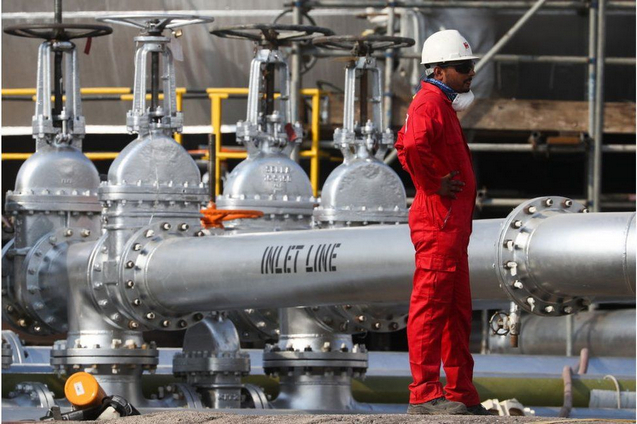
A new report says that oil and gas producing countries face a multi-trillion-dollar hole in their government revenue.

The report from the think-tank Carbon Tracker looks at the financial impact as the world cuts back on fossil fuels.

It says some countries could lose at least 40% of total government revenue.

It estimates the cumulative total revenue loss for all oil-producing countries by 2040 will be $13 trillion (in 2020 dollars).

That is as efforts to contain the rise in global temperatures drive the decarbonisation of energy supplies.

Carbon Tracker describes its report as a wake-up call to oil producing countries and international policymakers. It says they have planned on the basis that demand for oil will increase until 2040.

But the agency warns that demand will have to fall to meet climate targets, and oil prices will be lower than oil producers and the industry currently expect.The report looks at what would happen to government revenues if the increase in global temperature is limited to 1.65C.

The $13 trillion figure for lost revenue is compared with what it calls "business as usual" expectations of continued growth. It includes countries whose economies are not dominated by oil - such as the UK, the US, India and China.

The main focus of the report, however, is a group for which the loss of oil income will be much more challenging, 40 countries it calls "petrostates".

Saudi Arabia relies of oil for 60% of its revenue. Getty Images

The predicted damage to government finances in these nations is stark; an average loss of 46% of oil and gas revenue.

The dependence on oil and gas revenue is very marked for some countries - more than 80% for Iraq and Equatorial Guinea. For another seven including Saudi Arabia the figure is more than 60%.

Some countries face very large losses of total revenue. For seven countries, including Angola and Azerbaijan the predicted loss is at least 40%. For another 12, including Saudi Arabia, Nigeria and Algeria it is in the range of 20% to 40%.

For some in the Middle East and North Africa, the effect is moderated somewhat because their low production costs would give them a more prominent role in global oil and gas supply.

There is also a concern about what the report calls emerging petrostates. What they have to confront is a loss of potential revenue from oilfields where development is planned in the coming years. Ghana, Uganda and Guyana are among the countries facing this risk.

'Diversification'

Some of the countries facing severe losses - from existing or potential oil and gas production - are among the poorest.

The report says diversification - of government revenue and national economies - is an urgent task. That will need to be tailored to the needs of each individual country but there are some steps it suggests will be of widespread use.

These include investing in education and improving the quality of government and the climate for business. Capital that is not invested in oil and gas can instead be used to invest in industries that are more resilient to the energy transition.

The report also says there is a strong case for the rest of the world to support this transition. It says there are moral reasons to do so as many of the countries concerned are so poor.

It would help get better climate outcomes. It could also help address the risk of petrostates becoming less stable. They could see social unrest as spending is cut or underfunded security services struggling to contain existing threats. 

Links

Saturday, February 13, 2021

Former Australian PMs Put Murdoch In The Hot Seat On Climate Change

Financial Times - 

The media magnate’s empire, offering a platform to sceptical voices, is accused of holding significant sway in this arena

© Harry Haysom

“Citizens around the world need to take consumer action against [Rupert] Murdoch’s products,” says Kevin Rudd, former Australian centre-left prime minister. “This guy is one of the greatest enemies of climate change action on the planet.”

Australia’s former centre-right prime minister Malcolm Turnbull, who has allied with Rudd against Murdoch, tells me: “The most effective voice for climate denialism in the English-speaking world has been Murdoch’s.”

The mogul’s son James, speaking more broadly, recently criticised unnamed “media property owners . . . who know the truth but choose instead to propagate lies”.

For all the anxiety about fake news on social media, disinformation on climate seems to stem disproportionately from one old man using old media. 

This is the most hopeful moment yet for global action on climate. The world’s three biggest powers have set targets for net-zero carbon emissions: the US and EU by 2050, China by 2060. Yet Rudd and Turnbull believe action requires confronting Murdoch. How central is he to climate inaction, and can he be confronted? 

Murdoch probably does shape rightwing views on climate. In an Ipsos Mori survey of 20 countries in 2014, the three countries with least belief in man-made climate change were his main markets of the US, Britain and Australia.

British attitudes have since improved, but the US and Australia retain large fringes of climate deniers, reports YouGov. These two countries have helped block consensus in international summits on climate.

Murdoch, says Rudd, “isn’t just an Australian problem, or even an Anglosphere one. Murdoch has become a planetary problem.” 

The mogul owns more than half of Australia’s newspaper industry, plus the TV channel Sky News. Rudd says Murdoch’s media try to intimidate opponents into silence.

“They target you individually, as a political leader, or even a Swedish schoolgirl. They seek to eviscerate your character. My response is: ‘Bugger you, we’re fighting back.’”
Disinformation on climate seems to stem disproportionately from one old man using old media
But how much can Murdoch influence the US, where his Fox News averaged just 3.6 million primetime viewers in 2020?

Rudd replies: “In both Australia and the US, he has progressively moved centre-right parties to the far right” by radicalising their base. Murdoch’s media also help set agendas for rightwing social media.

The approach taken varies, from downright climate denial to cheerleading for hydrocarbon industries to casting climate as a cultural-economic issue.

Rudd says Murdoch’s Australian tabloids follow the line that “politically correct centre-left politicians who try to act on climate change are going to take your jobs”. 

A News Corp Australia spokesperson insists its publications recognise climate change “is real” and reflect “the different viewpoints being expressed”. They reject the criticisms of News Corp, adding it has not sought to silence anyone on these issues, nor moved Australian politics to the far right.

They accuse Rudd and Turnbull of past political failings, saying: “They are now seeking to rewrite history — and why they did not achieve climate action — to hide their own shortcomings.” 

Murdoch faces rising scrutiny in Australia. Jamie Smyth

Turnbull says Murdoch’s media treat climate “not as a matter of physics, but a matter of identity or belief”. He summarises Murdoch’s recent legacy as “Donald Trump, Brexit and climate denialism”.

When Turnbull saw the president and the mogul together, he found Trump “deferential, almost obsequious, to Murdoch”. Trump even wanted to invite Murdoch to his bilateral discussion with Turnbull. Perhaps Trump is just another radicalised Fox viewer. 

What motivates Murdoch?

Rudd says: “He is an ideologist of the far-right on climate but also in terms of a view of what the Anglosphere should be in global politics. Look at how he campaigned in the Iraq war. He is a tax minimalist, a regulation minimalist, and he’s fatally addicted to the aphrodisiac of power.” 

Though Murdoch turns 90 in March, Rudd doesn’t expect a biological solution. “The succession’s determined and it’s going to be [his son] Lachlan Murdoch. And [he] is stitched at the hip to far-right politics in the US and Australia.” 

Newer far-right media, such as QAnon conspiracy sites, may leave Murdoch behind. Fox has shed viewers since its recent separation from Trump. January’s Trumpist attack on Washington happened without Murdoch’s support. His decades of propaganda have unleashed forces he cannot control. Fox risks ending up inside the far-right tiger.

The Rise of the Murdoch Dynasty

Now the Australian senate is holding an inquiry into media ownership and bias, after Rudd launched a popular online petition calling for a royal commission into media diversity. Turnbull and Rudd want more.

Turnbull says advertisers in Murdoch’s media should be asked “how they justify supporting platforms that have done so much damage to democracy”.

Rudd is campaigning for a boycott of what he calls “Murdoch’s major cash cow in Australia”, the housing website realestate.com.au. He says: “That’s a concrete course of action, which I believe is causing a level of anxiety within News Corporation headquarters.”

I point out to him that extending that principle worldwide might mean boycotting Murdoch’s sports broadcasters.

Rudd says: “We’ve joined the fight. Who will win, not sure, but we’re going to give them a run for their money.”

Links 

(AU) Productivity Commission Says New Australian Water Deal Must Recognise Climate Change

The Guardian - 

Federal and state governments are being urged to respond to the effects of the climate crisis and to Indigenous rights to water

File photo of the Darling Barka river. The Productivity Commission says governments need to acknowledge climate change will challenge existing water sharing agreements. Photograph: Jenny Evans/Getty Images


States and the federal government should forge a new compact on water policy that explicitly recognises climate change, and which sets “triggers” for rapid policy responses, the Productivity Commission has said.

Releasing its draft report on national water reform, the commission has called for a substantial overhaul of the 17-year-old National Water Initiative, a bedrock document that commits the states and federal government to working together on water policy as well as outlining a work program for the future.

In particular, the commission wants explicit recognition that climate change will challenge existing agreements on sharing water between states and between users, towns, agriculture and the environment.

The commission has also called for much more meaningful recognition of Indigenous rights to water.

Commissioner Dr Jane Doolan said: “It is time for our governments to once again lead the way on developing a new national water policy and agree a pathway to meet these challenges.

“We can expect an estimated additional 11 million people living in capital cities by 2050, and climate change is likely to mean significant reductions in water availability for most of the country and an increase in the frequency and severity of droughts and floods across the nation.”

The commission wants to see governments commit, by way of a new National Water Initiative, to plans and policies for responding to the effects of climate change.

It also wants governments to agree to climate change triggers that would prompt a review of water agreements and policies.

The Murray-Darling Basin plan, one of the outcomes of the 2003 National Water Initiative, has been criticised because it does not contain any mechanisms to acknowledge the impact of climate change.

While it is said to be a dynamic plan, most of the changes over its 13-year lifespan have involved giving more water to agriculture and halting buybacks of water for the environment because of its socio-economic impact, which is a recognised reason for adjusting the plan.

But without an explicit mechanism to take account of climate change, the plan has struggled to deal with evidence of environmental disasters such as the fish kills in the Darling. The plan has not been adjusted to take account of the more frequent droughts, longer periods when the Darling ceases to flow, and the new reality of lower inflows into the river system.

The current plan is scheduled to run until 2027.

Doolan said the science on the likely impacts of climate change on water supplies had established more variable rainfall was likely in the north, and hotter, drier conditions in the south of eastern Australia, where much of the country’s agribusiness is located.

“There needs to be a mechanism to reassess the balance between environmental and consumptive uses when it is clear that this is required – for example, if climate change means that the previously agreed balance no longer meets the objectives for either the environment or consumptive users,” the report says.

It suggests that this could be a hydrological trigger, such as a fall in streamflows and groundwater resources, or an ecological trigger, where agreed long-term ecological outcomes are clearly not being achieved. Both would require monitoring and evaluation.

But the critical finding of the Productivity Commission is that this needs to be agreed in advance by the states and the commonwealth.

It also wants all states to commit to drought management plans.

“The millennium drought and recent drought in New South Wales and Queensland revealed a number of shortcomings in the current water management arrangements in information, planning and compliance that exacerbated the impact of these droughts on environmental assets and other water users,” the report says.

The report suggests states need to commit to plans to deal with water scarcity, priorities for water sharing and actions relating to meeting critical human and environmental needs. These could include rules to limit water extraction, protecting critically low flows to protect critical habitats and protecting flows when it does rain again.

In addition, there needs to be a clear hierarchy of water uses, prioritising critical human needs, then critical environmental needs. Consideration must also be given to water quality, it says.

Doolan also wants the next agreement to put detailed plans around how the states and the federal government will deliver on earlier, more vague commitments to recognise cultural water rights.

“It needs to recognise the importance of water in the lives of Aboriginal and Torres Strait Islander people ,” Doolan said.

“All states have signed up to Closing the Gap,” she said. “The aspirations of First Nations people on water have grown and are now much better articulated.”

She said the new National Water Initiative should include an entire section that deals with how states will deliver on cultural values by providing a much bigger say for Indigenous people in water policy. But she also flagged the need for economic rights to water, which can likely only be achieved by buying back water for Indigenous communities.

The federal government committed $40m to establish and support First Nations investment in cultural and economic water entitlements in 2018 but it was part of a deal that saw environmental water recovery targets for the northern basin of the Murray-Darling cut by 70GL, following pressure from farmers.

A committee has been established to work with Indigenous groups on concrete proposals for the National Water Initiative.

The Productivity Commission also wants to see governments commit to a more rigorous process for water infrastructure projects.

The NSW and federal governments have committed $1bn to the Wyangala and Dungowan dams without a business case or an environmental assessment of their impact on river systems.

The $500m pipeline from the Murray to supply water to Broken Hill was commenced without any business case.

Doolan said the federal government had earmarked $3.5bn for the National Water Infrastructure Development Fund and had already spent $1.6bn.

“We need to get the best bang for our buck,” she said, including for regional “town water supplies as well as for agriculture”.

In the face of growing urban populations, the Productivity Commission also wants to see the states commit to better and more science-based development of urban water resources, with all options on the table.

In the past some state governments have ruled out recycling of wastewater for drinking supplies, fearing a voter backlash, even though recycling is done safely around the world.

The commission is seeking comment on its draft report.

Links

Lethal Heating is a citizens' initiative