23/06/2021

(Yahoo News) From Burgers To Chocolate To Beer: How Climate Change Will Affect What We Eat

Yahoo NewsDavid Knowles


Unless climate change can be greatly minimized, rising temperatures will disrupt food production around the world and potentially alter the way we eat, a new study finds. 

The continued buildup of greenhouse gases in the atmosphere could imperil "nearly one-third of global food crop production and over one-third of livestock production" by 2081-2100, the peer-reviewed study, published in May by researchers at Aalto University in Espoo, Finland, concludes. 

The findings put a fine point on what climate scientists have warned for decades: that climate change will render certain parts of the globe incapable of producing food for the people who live there. 

The study notes that if greenhouse gas emissions continue at their current rate, the most vulnerable areas will be South and Southeast Asia, as well as Africa's Sudano-Sahelian zone. But the vast majority of land on earth will be affected. 

There is hope, however: If the world's nations are successful in their goal of limiting global mean temperatures to warming between 1.5° and 2°C, the impacts on food production will be lessened. 

Numerous other studies have looked at how climate change will affect individual crops or growing areas, and some have concluded that global warming is already wreaking havoc on food production. Others make the case that dietary changes are imperative to prevent temperatures from rising even further. 

The following is a sample of the growing body of research on how climate change will affect the world's diet. As certain food industries feel the impact, their products won't go away, but prices could rise and change behaviors.

Wine

A worker picks grapes at a vineyard in California's Napa Valley. (Robert Galbraith/Reuters)

In early April of this year, following an unusually warm March, France experienced several days of severe frost that devastated grape crops, resulting in an estimated $1.7 billion to $2.3 billion in losses. A study released by the research consortium World Weather Attribution concluded that climate change had made the "false spring" event 60 percent more likely. 

Previous studies have concluded that rising temperatures will shrink the area in California's Napa Valley and other vaunted wine-growing regions in the U.S. that will be able to continue producing premium grapes. 

"Over the next century, the area suitable for premium wine grape production is likely to shrink and shift," a study by the Union of Concerned Scientists concluded. "According to the higher emissions projections, premium wine grapes could only be grown in a thin strip of land along the coast of California, with premium wine-producing regions shifting northward to coastal Oregon and Washington."

Beer

Beer mugs in Abensberg, Germany. (Michael Dalder/Reuters)

A 2018 study published in the journal Nature found that weather disruptions spurred by climate change will also affect the production of beer, thanks to the impact on barley crops. 

"Beer is the most popular alcoholic beverage in the world by volume consumed, and yields of its main ingredient, barley, decline sharply in periods of extreme drought and heat," the study's authors wrote.

Depending on the severity of drought and rising temperatures, barley yields are forecast to decline anywhere from 3 to 17 percent annually. As a result, the Chinese and American researchers concluded, beer prices could double in some parts of the world by the end of the century. 

Coffee and chocolate

Coffee beans in the window of a store in Dublin, Ireland. (Artur Widak/NurPhoto via Getty Images)

Alarm bells went off in Europe, which accounts for one-third of global coffee consumption, when research released this month found that 35 percent of the regions where the EU imports crops, including coffee beans, will be threatened by severe drought brought on by climate change that will likely disrupt food production. 

An April study found that coffee production in Ethiopia will be especially vulnerable. "We conclude that depending on drivers of suitability and projected impacts, climate change will significantly affect the Ethiopian speciality coffee sector and area-specific adaptation measures are required to build resilience," wrote the authors of the study, published in Nature

Cocoa beans, which are used to make chocolate, face a similar threat due to rising temperatures and drought. A 2018 study published in the journal PLOS One concluded that "drought effects on cocoa agroforestry could be a ‘canary in the coal mine’ warning of problems to come both in agriculture and in semi-natural and natural vegetation due to increased intensity and frequency." 

Meat

Cattle at a ranch in Tomales, Calif. (Justin Sullivan/Getty Images)

According to the United Nations Food and Agricultural Organization, meat and dairy production accounts for 14.5 percent of annual greenhouse gas emissions.

Citing deforestation that is carried out to create grazing land for livestock, the Intergovernmental Panel on Climate Change included a section in its landmark 2019 special report that declared that the prospect of eating less meat could "present major opportunities for adaptation and mitigation while generating significant co-benefits in terms of human health." 

“We don’t want to tell people what to eat,” Hans-Otto Pörtner, an ecologist who co-chairs the IPCC’s working group on impacts, adaptation and vulnerability, told Nature. “But it would indeed be beneficial, for both climate and human health, if people in many rich countries consumed less meat, and if politics would create appropriate incentives to that effect.”

Beef is, by far, one of the worst food sources in terms of its impact on climate change, in part because of the methane gas that cows produce. Beef production generates 60 kilograms of greenhouse gas emissions per kilogram of meat, more than double that of lamb, which ranks second, Forbes reported

Wheat and corn

A damaged corn crop in Kansas in 2012. (Jeff Tuttle/Reuters)

A staple of the global diet that accounts for 20 percent of all calories consumed by people, wheat is one crop that humans need to ensure survives in the coming decades. While wheat yields have, in some countries, increased in the short term as the concentration of carbon dioxide has risen in the atmosphere, a major concern is the prevalence of drought in parts of the world where it is grown. 

A 2019 study published in Science Advances found that unless global mean temperatures can be kept from rising, major droughts will affect 60 percent of areas where wheat is grown. That is dramatically higher than the current 15 percent of wheat-growing areas affected by drought conditions. The backdrop to the rise in the prevalence of drought, the study noted, is that demand for wheat was projected to increase 43 percent from 2006 to 2050. 

A similar dynamic is at play with corn, 30 percent of the world's supply of which is grown in the U.S. Weather patterns resulting in drought or widespread flooding that can overlap with the growing season for corn are projected to reduce yields by 20 to 40 percent over the decade spanning 2046-2055, a study released in April concluded. 

"That poor weather can take the form of extremes in temperature such as cold snaps or heat waves during the growing season," the authors wrote. "It can also be expressed as excessive variation in rainfall resulting in drought or flood, including floods before a crop’s growing season that prevent the planting of that crop in the first place."

Almonds

A field of dead almond trees next to a field of growing almond trees in California's Central Valley in 2015. (Lucy Nicholson/Reuters)

California, which is currently in the grip of a mega-drought, is the world's leading producer of almonds, growing roughly 80 percent of the global supply. Thanks to rising temperatures and the drought, which has depleted groundwater and deprived the state of a robust snowpack, the future of the water-intensive crop has been made more precarious. 

Yet, as with many other crops, climate change may present the opportunity for almonds to be grown in latitudes currently too cold to support them. 

Researcher Lauren Parker of the University of California, Davis, is studying whether, as temperatures continue to rise, almond trees could thrive in states like Oregon and Washington. 

"Under climate change, what we anticipate is seeing a reduction in the frost risk even for almonds, which bloom pretty early in the year," Parker told Yale Climate Connections.  

Pet food

Fly larvae waiting to be harvested at a farm near Cape Town, South Africa. (Mike Hutchings/Reuters)

What people feed their pets, it turns out, also has a big impact on climate change. A 2020 study published in the journal Global Environmental Change found that the annual production of pet food worldwide resulted in average greenhouse gas emissions of 106 million metric tons of CO2. In terms of emissions, that is the equivalent of a country the size of the Philippines, the study noted. 

In part, that's due to the rise in "premium" pet food, according to the study, which more closely mirrors a meat-heavy human diet. At present, pets consume roughly 20 percent of the meat and fish in a given country. But what if humans changed what they fed their pets, substituting insect protein for meat? While that idea may sound lifted from a dystopian science fiction film, it's already happening in many countries. 

In fact, a 2017 study recommended that insect protein replace that of meat for humans, too, as a way to fight climate change, though with some caveats attached.

"Insect production has great potential with respect to sustainably providing food for the growing population," the study authors wrote. "However, further technological development of this sector and monitoring of the effects of these developments on the environmental impact of insect production are needed."

Links

(AU The Guardian) Guardian Essential Poll: Majority Of Voters Fear Australia Will Be Left Behind On Climate Change

The Guardian

Poll finds 59% believe Australia needs to follow the lead of other countries and make action a priority

A majority of respondents (59%) believe Australia needs to follow other countries’ lead on climate change action or risk being left behind. Photograph: Kirsty Wigglesworth/AP

A majority of voters fear Australia will be left behind unless the Morrison government follows the lead of other countries in prioritising serious action to combat global heating, according to the latest Guardian Essential poll.

The findings from the fortnightly survey of 1,087 respondents come as Barnaby Joyce deposed Michael McCormack and returned to lead the National party after a week where senior Nationals expressed open hostility about the government adopting a net zero emissions target by 2050. Scott Morrison says achieving net zero as soon as possible is Australia’s preference.

Joyce was asked on Monday whether or not he would make fresh climate policy demands when he renegotiated the Coalition agreement with Morrison. The returning National party leader and deputy prime minister deflected. “I’ll be talking with my party room, about what they believe is best for them, and then fighting on that premise,” he said.

The new Guardian Essential poll suggests over half (56%) of Australians now believe climate change is happening and that heating is caused by human activity – which is similar to results earlier in 2021 (58%) and in 2020 (56%).

The issue of whether or not the Morrison government is taking sufficient action to combat the threat divides the Guardian Essential sample but the largest group (45%) thinks the Coalition isn’t taking enough action. Fewer people now think Australia is doing enough to address climate change (30%) than they did in January (35%).

The government is allocating $600m through Snowy Hydro for a new gas peaking plant in the Hunter Valley but a strong majority now favour supporting renewable energy rather than fossil fuel alternatives. Some 73% of respondents want renewables to replace the ageing coal fleet, while only 12% want gas-fired power, and 15% think Australia should persist with coal-fired power stations.

A majority of respondents (59%) believe Australia needs to follow other countries’ lead and make climate change action a priority, or we will risk being left behind, while 67% sees the transition as an economic opportunity – believing Australian businesses have the opportunity to develop expertise in renewable energy and innovative technologies that other countries will demand.

Voters also know that renewable power means cheaper energy, with 65% of the sample saying Australian manufacturing could benefit from cheap electricity if more solar and wind farms were built, while 59% agree with the statement: “Australia cannot afford to be locked out of the European Union or other trade markets for failing to adopt a net zero emissions target by 2050.”

There are nuances in the survey. Acceptance that climate change is real, and induced by human activity, is highest among self-identified progressive voters, and respondents who think what the world is experiencing is normal fluctuation in the earth’s climate are more likely to vote Coalition, to be male, and aged over 55 years.

People who vote for Labor or the Greens are more likely to worry Australia is not doing enough to deal with the threat of runaway heating, while Coalition voters are more likely to think that enough is being done. Women are also more likely to worry than men, although this consciousness among men in the sample is higher than it was at the start of the year.

Women and voters aged under 55, as well as progressive voters, are significantly on board with renewables being the future, but a clear majority of Coalition voters also prefer the government to support renewable energy sources over gas or coal (61%).

With Scott Morrison away for much of last week at the G7 summit, and with China’s rise a significant talking point among the leaders of the developed world, voters were asked to prioritise various issues in Australia’s foreign policy relationships.

Only 12% of respondents want closer ties with China, and 50% want Australia to become less close with China, while a further quarter (24%) think our relationship with China should stay the same at most, and 13% don’t know.

Compared with results in the survey back in August 2019, Australians are less likely to rate China’s influence on Australia as positive – particularly in respect of international trade (the percentage has gone from 59% to 28%), and Chinese corporations operating in Australia (from 41% to 22%).

When asked to compare Australia’s most important security ally, the United States, with our largest economic partner, China, Australians in the survey say they want closer relations with the US, with 57% of the Guardian Essential sample wanting to deepen the relationship, while only 14% think Australia should strengthen our relationship with China over the US (which is a decrease from 28% in 2019).

Links

(AU ABC) Environment Minister Says Government Will Challenge UNESCO Move To List Great Barrier Reef As 'In Danger'

ABC News

Sussan Ley says UNESCO's report on the Great Barrier Reef '"singles out" Australia.

Key points
  • The World Heritage Committee will consider the recommendation at a meeting in China next month
  • Ms Ley says the draft decision was made without the latest information on the health of the Reef
  • A marine expert says the government should not be surprised by the recommendation
Environment Minister Sussan Ley says Australia has been "blindsided" by a draft recommendation to list the Great Barrier Reef as "in danger", suggesting the decision was politically motivated.

The World Heritage Committee, which sits under UNESCO, has proposed moving the reef to the list because of the impact of climate change, and will consider the decision at a meeting in China, which is the chair, next month.

Ms Ley described the decision as a "backflip" and said United Nations officials had assured the government the reef would not face this kind of recommendation before the July meeting.

"We were blindsided by a sudden late decision," she said.

"It is almost unheard of for a site to be added to the endangered list, or recommended … without the necessary consultation leading up to it.

"It is a deviation from normal process."

Ms Ley said the draft recommendation was based on a "desktop review" that did not have the latest information on a range of measures taken to protect the reef, including work on restoring corals and water quality management.

She also said there were dozens of other World Heritage-listed sites considered at risk that had not been subject to draft recommendations, saying Australia had been "singled out".

"For us to be singled out in a way that completely distorts the normal process was something we were very strong about," she said.

"We made the point that we will challenge this decision when it comes before the full committee later on in July.
"When procedures are not followed, when the process is turned on its head five minutes before the draft decision is due to be published, when the assurances my officials received and indeed I did have been upended. What else can you conclude but that it is politics?
"The decision has not been transparent in my view."

The Environment Minister said there was no doubt climate change was one of, if not the, greatest threat to the reef, but argued the government was taking extensive action to mitigate that as much as possible.

Experts say the potential listing of the Reef as "in danger" should not come as a surprise. (Unsplash: Daniel Pelaez Duque)

But Imogen Zethoven, an environmental consultant to the Australian Marine Conservation Society, said the potential listing should not come as a surprise.

"There is no doubt at all that the Great Barrier Reef is in danger from climate change," she said.

"Last year the [International Union for Conservation of Nature or IUCN], which is the advisory body to the World Heritage Committee, identified that because of climate change the outlook for the Great Barrier Reef was now critical.

"So I don't think anyone could be surprised that UNESCO has come up with this draft decision to put [it] on the 'in danger' list."

Experts reject claim that listing is political

Ms Zethoven said there was no guarantee the draft recommendation would be adopted but she disputed the idea that it was a politically motivated move by China.

"It is 100 per cent an environmental decision," she said.
"The only agencies that had any involvement in this recommendation are the World Heritage Centre and the IUCN, and any other claim is just a complete fabrication."
Queensland Treasurer Cameron Dick said the state government would continue advocate for the work being done to protect the reef.

But he said yesterday's National leadership spill and the return of Barnaby Joyce, who is vocally against a net zero emissions by 2050 target, sent the wrong message about the government's plan for tackling climate change.

"On the day that a climate change denier and sceptic, a man that wants to wreck our climate change ambitions, Barnaby Joyce, becomes Deputy Prime Minister again, we find out we've got this very serious decision about the Great Barrier Reef," Mr Dick said.


Great Barrier Reef deemed 'critical'
The Great Barrier Reef's classification worsens to "critical", with climate change named the biggest threat to the planet's natural world heritage by a new report. Read more
"I just think it's absolutely retrograde, it's selfish and self-indulgent to bring on this spill … who are these people to turn climate policy upside down, to turn the federal government upside down, and send a message internationally that climate change deniers … are now in charge of the federal government."

Mr Joyce defeated Michael McCormack in a leadership vote yesterday and was sworn in as Deputy Prime Minister this morning.

One of the issues that led to the leadership spill was ongoing disquiet in the Nationals about the Prime Minister's increasing support of a net zero by 2050 emissions target.

Mr Joyce said he would be guided by his party room when it comes to pushing against the government's plan to reach net zero emissions "preferably" by 2050, despite his open opposition to the policy.

Labor's spokesperson for climate change, Chris Bowen, said the government has been too slow to recognise the reef was under threat.

"The government says they are surprised, but they shouldn't be surprised about the fact the reef has encountered three bleaching events in the last five years," he said.

"I'm not aware of how this decision came about or what motivated it. Of course it should only be motivated by environmental concerns about the reef."

Links

22/06/2021

(AU SMH) Dangerous Disclosures: Risks Abound With ASX Climate Reporting

Sydney Morning HeraldSarah Danckert

In January 2020, investment titan and Blackrock boss Larry Fink rocked the corporate world by using his yearly letter to the CEOs of large listed companies to call on groups to disclose their environmental credentials alongside a key global standard.

Many of Australia’s largest companies have spent the past two years improving their disclosure of environmental risks and governance to investors.

The pathway to net zero emissions by 2050 includes no new coal or gas developments from 2021.

This year, Coles Group has committed to deliver net zero emissions by 2050 and Santos has introduced new emissions reduction targets.

Macquarie Group has also joined a group of asset managers working towards “net zero”, though a recent report by The Age and The Sydney Morning Herald questions how the financial behemoth would account for its investments in a wide range of funds exposed to the oil and gas industry.

Against this backdrop, a recent report by top corporate law firm King & Wood Mallesons into the environmental social corporate governance (ESG) disclosure practices of the ASX50 shows the huge steps forward in reporting by large corporates but also highlights the risks for companies delving into this area face.

The law firm, which has one of the biggest corporate advisory businesses in the country, found that 82 per cent of top ASX companies have taken on board the advice of the corporate watchdog and have started to report against a set of recommendations from the Task Force on Climate-related Financial Disclosures (TCFD).

Will Heath, King & Wood Mallesons partner Mergers & Acquisitions
But despite this huge effort, there is a “mishmash” of standards – via a blaze of initialisms like TCFD, SASB, CDSB – being applied by Australian companies looking to meeting increasing institutional investor expectation of ESG disclosures.

“It’s a battle of the codes, or a battle of the standards,” says Will Heath, King & Wood Mallesons partner mergers and acquisitions, who praises the companies involved as their reporting has been a voluntary response to investor needs.

“I think all stakeholders would like to see more direction from regulators and governments as to what the reporting standard should be and how they should work.”

Heath says the law firm’s report also tried to unpack some increasingly ubiquitous phrases in the business lexicon, such a “carbon neutral”, “net zero” and “net zero carbon” and what impact the differences in various targets have on company reporting.

‘Tricky things’

“How are you actually going to measure that? Are you talking about CO2? Are you talking about all greenhouse gases? Are you taking into account abatement actions that you do here in Australia or overseas? Are you looking at the impact of the product you’re exporting or just what happens onshore? All those really tricky things start to come into play.

“The policy vacuum here is frustrating, but also really interesting, as to what regulators will do in this area.”

The law firm’s report highlights the variation in company disclosures and stress test scenarios. Some companies are sticking to stress testing their business to 1.5 degree increases in temperatures and others to testing for 2 degrees.

But disclosure and regulation can create significant danger for companies, says Heath.

“As companies disclose more about what they’re doing on ESG, and particularly what they’re doing on climate change, that disclosure opens the companies and their boards and management teams up to potentially more litigation, because most of the litigation we see in a company law context is related to disclosure.
‘People who don’t disclose and get left behind and then are pushed to make disclosure.’
Will Heath, King & Wood Mallesons partner mergers and acquisitions
“And you’re damned if you do and you’re damned if you don’t because as the market gets more disclosures, people who don’t disclose and get left behind and then are pushed to make disclosure.

“And that’s dangerous.”

Heath says that, conversely, disclosing can be dangerous where regulators and governments haven’t put in “guard rails” around what that disclosure should say. This is particularly so when the law generally imposes strict liability for inaccurate disclosure, meaning a company is liable for ensuring its public statements are accurate.

“People can make inadvertent mistakes, which hopefully don’t have consequences and that’s understood as being a learning thing,” he says.

“And on the other hand, some guard rails will help curb greenwashing disclosures where companies are trying to hide practices that aren’t reflective of the company’s best interest, but they’re dressing it up using all these acronyms.”

Heath says this is particularly important once you start looking at below the ASX50 and into the ASX100 and beyond.

“I think in the rest of the market, there are going to be some people who will see opportunities to leverage the grey and the opaqueness,” he says.

“That’s where regulators do have a role to play to set standards and enforce and equally make sure those standards are clear so that people can report against them.”

Links

(AU SMH) Grim Climate Forecasts Point To Shrivelling Rivers In Northern NSW

Sydney Morning HeraldPeter Hannam

Dams will fill less frequently, farmers will face water cuts and rivers will cease flowing more often in areas across northern NSW as the climate warms and dries, putting at risk communities and wildlife alike.

The grim outlook is contained in a slew of draft regional water strategies for major river systems over the next 20 to 40 years, released by the Planning Department. It said it used “the best available evidence including new climate data and updated modelling”.

An aerial view of the southern Macquarie Marshes during the height of the recent drought. Image was taken in August 2019. Credit: Wolter Peeters

Dubbed “deliberately conservative...to give us an idea of the possible climate risks and allow us to begin planning to mitigate these risks if they arise”, the projections for eight major systems released so far point to shorter periods between droughts and less reliable flows when rivers run.

Under a worst-case scenario, for instance, annual volumes in the Peel River are projected to dive by 47 per cent and those in the rest of the Namoi River, into which it flows, would drop by 44 per cent.


Murray-Darling Basin
‘Irrigation hunger games’: Battle over Australia’s food bowl soon to heat up
One consequence is the Barwon-Darling River, which now gets about one-quarter of its water from the Namoi system, will stop flowing more often. “Under a dry climate change scenario, there could be no end of system flows for 40 per cent of the time,” one of the reports said.

The stark warnings follow renewed alerts this month from the Murray-Darling Basin Authority Authority that flows into the Murray River in the basin’s south had dropped about 40 per cent in the past two decades compared with the average of the century before it.

The state’s findings also raise fresh concerns about the viability of the Berejiklian government’s plan to increase dam capacity or build new ones. For instance, while the government wants to raise the Wyangala Dam wall by 10 metres at a cost that has blown out to as much as $2.1 billion, the regional water strategy for the Lachlan River suggest flows in that system will dwindle.


“The probability of levels in Wyangala Dam decreasing below the critical drought trigger could increase from 7 per cent using the long-term paleoclimate records to 14 per cent using near future climate projections [and] to 43 per cent using long-term climate projections,” the report said.

Wyangala Dam when it all but dried out towards the end of the Millennium Drought in 2009. The NSW government wants to lift the dam wall in a project that may end up being triple the initial estimated cost. Credit: Kate Geraghty

Similarly, total flows along parts of the Gwydir River are forecast to drop by as much as 35 per cent. High flow events, which are important for trigger fish movement and spawning could shrink by a similar proportion.


Water
‘Unacceptable’: Labor joins other MPs to block flood plain harvesting rules
“It is possible for inflows into Copeton Dam [on the Gwydir River] to be half the volume of 27 gigalitres over 24 months” seen during the recent drought, the report said.

Upper House independent MP Justin Field said the reports should prompt the government to rethink its approach to managing rivers.

“Water Minister Melinda Pavey spectacularly fails to provide any meaningful plan for dealing with the impacts of this decrease in water availability, instead offering up the same discredited strategies of more dam building and turning our coastal rivers inland,” Mr Field said.

“These climate realities also raise yet more concerns about the government’s plan to licence billions of litres of water for floodplain harvesting in the northern Murray-Darling Basin,” he said. “Issuing these licences based on historical take when we know that water simply won’t be there in the future is a recipe for disaster.”

A spokeswoman for Ms Pavey said farmers and regional communities were on the frontline of climate extremes.“This is the first time any NSW government has embarked on long-term planning for water security and drought resilience.”

Menindee Lakes in far-western NSW have been filling for the first time in five years. Future climate predictions suggest the Barwon-Darling River which feeds them may cease to flow about 40 per cent of the time. Credit: Wolter Peeters

“The 12 Regional Water Strategies will consider a full range of options to address current and future water challenges, including infrastructure options, water recycling and reuse, and improved water efficiency, to secure water during extreme events and... the toughest droughts,” she said.

Matt Colloff, a former CSIRO scientist now at the Australian National University, said different NSW agencies were producing varying outlooks.


Murray-Darling Basin
The fish and bird species at risk from Australia’s failure to manage wetlands
For instance, another part of the Planning Department predicted in a hydrology report that “across much of NSW, surface runoff is projected to increase in both the near and far future”.

“Largest increases are evident in the central west through to the northern tablelands. Large reductions in surface runoff are projected in both the near and far future for alpine areas in the south of the state,” it said.

Dr Colloff said the new batch of reports “present no data on range, variation or uncertainty, only the worst case scenario”.

”Call me a cynic, but this says to me they are intended to carry a message that ‘we can’t implement the [Murray-Darling] Basin Plan because of climate change,‘” he said. “And ‘because of climate change, irrigators in the Northern Basin should be allowed to continue with floodplain harvesting’.“

Links

(Scientific American) The Delusion of Infinite Economic Growth

Scientific AmericanChirag Dhara | Vandana Singh

Credit: Getty Images

Authors
  • Chirag Dhara is a climate physicist and a research associate at the Indian Institute of Tropical Meteorology.
  • Vandana Singh is a professor of physics at Framingham State University working on transdisciplinary climate pedagogy.
The electric vehicle (EV) has become one of the great modern symbols of a world awakened to the profound challenges of unsustainability and climate change.

So much so that we may well imagine that Deep Thought’s answer today to Life, the Universe and Everything might plausibly be “EV.”

But, as Douglas Adams would surely have asked, if electric vehicles are the answer, what is the question?

Let us imagine the “perfect” EV: solar powered, efficient, reliable and affordable. But is it sustainable? EVs powered by renewable energy may help reduce the carbon footprint of transport.

Yet, the measure of sustainability is not merely the carbon footprint but the material footprint: the aggregate quantity of biomass, metal ores, construction minerals and fossil fuels used during production and consumption of a product.

 The approximate metric tonne weight of an EV constitutes materials such as metals (including rare earths), plastics, glass and rubber. Therefore, a global spike in the demand for EVs would drive an increased demand for each of these materials. 

Every stage of the life cycle of any manufactured product exacts environmental costs: habitat destruction, biodiversity loss and pollution (including carbon emissions) from extraction of raw materials, manufacturing / construction, through to disposal. Thus, it is the increasing global material footprint that is fundamentally the reason for the twin climate and ecological crises.

The global material footprint has grown in lockstep with the exponentially rising global economy (GDP) since the industrial revolution. This is largely because of egregious consumption by the super-affluent in a socioeconomic system founded on growth without limits. Can we resolve this fundamental conflict between the quest for limitless growth and the consequent environmental destruction?

Industrial era exponential rise in the use of primary and derived physical resources:
cropland (a), fossil fuels (b), freshwater (c), metals (d), plastic (e).
a)


b)


c)


d)


e)


ENTER TECHNOLOGY

Technological innovation and efficiency improvements are often cited as pathways to decouple growth in material use from economic growth.

While technology undoubtedly has a crucial role to play in the transition to a sustainable world, it is constrained by fundamental physical principles and pragmatic economic considerations. 

Examples abound. The engine efficiency of airplanes has improved little for decades since they have long been operating close to their theoretical peak efficiency. Likewise, there is a hard limit on the efficiency of photovoltaic cells of about 35 percent because of the physical properties of the semiconductors that constitute them; in practice few exceed 20 percent for economic and pragmatic reasons.

The power generation of large wind farms is limited to about one watt per square meter as a simple yet utterly unavoidable physical consequence of wake effects. The awesome exponential increase in computing power of the past five decades will end by about 2025 since it is physically impossible to make the transistors on the computer chip, already roughly 5 percent of the size of the coronavirus, much smaller.

Whether it is principles of classical, quantum or solid state physics or thermodynamics, each places different but inexorable constraints on technological solutions. Basically, physical principles that have allowed incredible technological leaps over the past century also inevitably limit them.

We might consider that extensive recycling of materials would offset efficiency limits. Recycling is crucial; however, while glass and metals can be recycled almost indefinitely without loss of quality, materials such as paper and plastic can be recycled only a few times before becoming too degraded.

Additionally, recycling itself may be an energy- and materials-intensive process. Even if physical laws could be broken (they cannot) to achieve recycling with 100 percent efficiency, added demand from the imperative for economic growth would necessarily require virgin materials.

The key point is that efficiency is limited by physics, but there is no sufficiency limit on the socioeconomic construct of “demand.”

Unfortunately, the situation is even more dire. Economic growth is required to be exponential; that is, the size of the economy must double in a fixed period. As referenced earlier, this has driven a corresponding increase in the material footprint.

To understand the nature of exponential growth, consider the EV. Suppose that we have enough (easily extractable) lithium for the batteries needed to fuel the EV revolution for another 30 years. Now assume that deep-sea mining provides four times the current amount of these materials.

Are we covered for 120 years? No, because the current 10 percent rate of growth in demand for lithium is equivalent to doubling of demand every seven years, which means we would only have enough for 44 years.

In effect, we would cause untold, perhaps irreversible, devastation of marine ecosystems to buy ourselves a few extra years’ supply of raw materials. 

Exponential growth swiftly, inevitably, swamps anything in finite supply. For a virus, that finite resource is the human population and in the context of the planet it is its physical resources.

The inescapable inference is that it is essentially impossible to decouple material use from economic growth. And this is exactly what has transpired. Wiedmann et al., 2015 did a careful accounting of the material footprint, including those embedded in international trade, for several nations.

In the 1990–2008 period covered by the study, no country achieved a planned, deliberate economywide decoupling for a sustained length of time. Claims by the Global North to the contrary conceal the substantial offshoring of its production, and the associated ecological devastation, to the Global South.

Recent proposals for ecocidal deep-sea and fantastical exoplanetary mining are an unsurprising consequence of a growth paradigm that refuses to recognize these inconvenient truths.

WHAT IS SUSTAINABILITY?

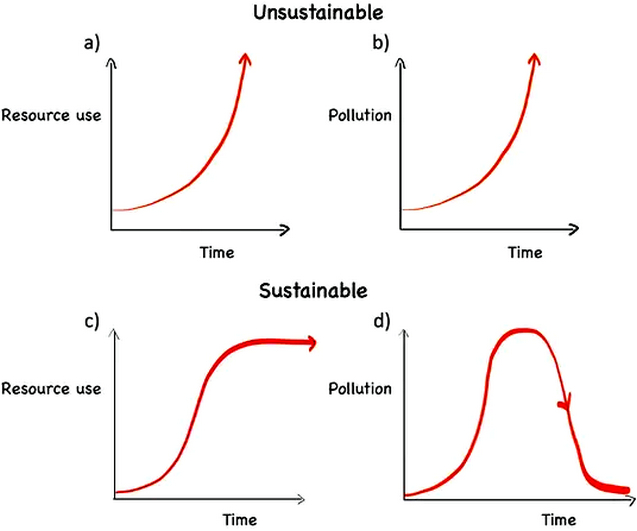
These observations lead us to a natural minimum condition for sustainability: all resource use curves must be simultaneously flatlined and all pollution curves simultaneously extinguished.

It is this resource perspective that allows us to see why EVs may help offset carbon emissions yet remain utterly unsustainable under the limitless growth paradigm. 

Sustainability from a resource perspective: Exponentially rising resource use and pollution (a and b) are unsustainable. We define sustainability as flatlined resource use (c) and extinguished pollution (d). Credit: Aditi Deshpande


THE REAL QUESTION

We have argued that the inextricable link between material consumption and GDP makes the infinite-growth paradigm incompatible with sustaining ecological integrity.

Thus, while EVs constitute a partial answer to the climate question, within the current paradigm they will only exacerbate the larger anthropogenic crises connected to unsustainable resource consumption. 

The real question is this: how do we transition to alternative economic paradigms founded on the reconciliation of equitable human well-being with ecological integrity? 

Links

21/06/2021

(AU The Conversation) Three Weeks Without Electricity? That’s The Reality Facing Thousands Of Victorians, And It Will Happen Again

The Conversation

James Ross/AAP

Author
 is Researcher and Teacher, Centre for Urban Research, RMIT University     
Last week’s storm system wreaked havoc across Victoria. Some 220,000 households and businesses lost power, and residents in the hills on Melbourne’s fringe were warned yesterday it might not be restored for three weeks.

The extreme weather severely damaged the poles and powerlines that distribute electricity, particularly in the Mount Dandenong area. Senior AusNet official Steven Neave said of the region this week, “we basically have no network left, the overhead infrastructure is pretty much gone. It requires a complete rebuild”.

That leaves about 3,000 customers without electricity for weeks, in the heart of winter. The loss of power also cut mobile phone and internet services and reportedly allowed untreated water to enter drinking supplies.

So, could this disaster have been avoided? And under climate change, how can we prepare for more events like this?

Fallen trees brought down power lines across Melbourne. Daniel Pockett/AAP

An uncertain future

The Mount Dandenong area is heavily forested, and the chance of above-ground power infrastructure being hit by falling trees is obviously high.

Without electricity, people cannot turn on lights, refrigerate food or medications, cook on electric stoves or use electric heaters. Electronic banking, schooling and business activities are also badly disrupted. For vulnerable residents, in particular, the implications are profound.

Such disruptions are hard to avoid, at least while the electricity network is above ground. Good management, however, can prevent some trees coming down in storms.

The more pertinent question is: how can we prepare for such an event in the future?

Scientists warn such extreme weather will increase in both frequency and severity as climate change accelerates. The Australian Energy Market Operator is acutely aware of this, warning climate change poses “material risks to individual assets, the integrated energy system, and society”.

However, it’s challenging to predict exactly how future heatwaves, storms, bushfires and floods will affect the power network. As AEMO notes, many climate models related to storms and cyclones involve an element of unpredictability. So, plans to make the electricity system more resilient must address this uncertainty.

As researchers have noted, there is no “one future” to prepare for – we must be ready for many potential eventualities.

Under climate change, extreme weather is predicted to become more severe. Daniel Pockett/AAP

Yallourn – the bigger problem?

Meanwhile, in Victoria’s LaTrobe Valley, a situation at the Yallourn coal-fired power station which may have even greater consequences for electricity supplies.

A coal mine wall adjacent to the station is at risk of collapse after flooding in the Morwell River caused it to crack. If the wall is breached and the mine is flooded, as happened in 2012, there will be no coal to power the station and almost a quarter of Victoria’s power supply could be out for months.

Victoria’s energy needs are increasingly supplied by renewables. However, losing Yallourn’s generation capacity would reduce the capacity of the network to adapt to other possible disruptions.

If further disruptions seem unlikely, it’s worth noting the Callide Power Station in Queensland is still operating at reduced capacity after a recent fire.

A wall adjacent to the Yallourn power plant may collapse. Julian Smith/AAP

Look beyond the immediate crisis

The Victorian government has offered up to A$1,680 per week, for up to three weeks, to help families without power buy supplies and find alternative accommodation.

Welfare groups say the assistance could be improved. They have called for changes to make it quicker and easier for people to access money, cash injections to frontline charities and more temporary accommodation facilities for displaced people and their pets.

While no doubt needed, these are all reactive responses targeted at those without electricity. When any system is disrupted, however, the effects can be widespread and felt long after the initial problem has been addressed.

Take dairy farmers in Gippsland, for example, who could not milk their cows without electricity. Cows must be milked regularly or else they stop producing milk – they cannot be “switched back on” when electricity is restored. Longer-term assistance may well be required for farmers facing such ripple effects.

And as welfare groups have noted, power companies should support affected customers over the long-term, with electricity discounts, deferrals and payment plans.

Relief centres offer affected residents a hot shower and electricity access, but longer-term solutions are also needed. Daniel Pockett/AAP

A call for backup

So, what else can be done to prepare for future power disruptions? Those with backup options, such as portable fuel-powered generators, or off-grid household batteries connected to solar panels, will undoubtedly be more resilient in such events.

These are examples of “system redundancy”, providing alternative electricity until the network is restored.

But it costs money to invest in household batteries or a generator that may never be used. Resilience is often a function of wealth, and the less well-off risk being left behind.

Certainly, governments can act to make society as a whole more resilient to power outages. For example, mobile phone towers have backup battery life of just 24 hours. As Victoria’s Emergency Management Commissioner Andrew Crisp said this week, extending that is something authorities “need to look at”.

Power and communications infrastructure could be moved underground to protect it from storms. While such a move would be expensive, it has been argued not doing so will lead to greater long-term costs under a changing climate.

The recent challenges at Yallourn and Callide show the risks inherent in a centralised electricity network dominated by coal.

Certainly, integrating renewable energy sources into the power network comes with its own challenges. However, expanding energy storage such as batteries, or shifting to small, community-level microgrids will go a long way to improving the resilience of the system.

Links

Lethal Heating is a citizens' initiative