Saturday, July 03, 2021

(AU SMH) From Drying Rainforests To Heavier Downpours, Australia’s Climate Is Changing

Sydney Morning Herald - Peter Hannam

Australia’s tropical rainforests will dry out, marine and land heatwaves will become more frequent and intense, and thunderstorms will dump more rain and worsen floods as the globe heats up.

These are among the many impacts from climate change that will blight the nation further unless atmospheric levels of greenhouse gases stabilise, according to the final report of the federal government’s Earth Systems and Climate Change Hub.

’Hub research has shown a clear link between climate change and worsening bushfire weather conditions over the past 70 years,” the centre’s final report finds. Credit: Nick Moir

The work of more than 100 researchers, to be expanded in a new Climate Systems Hub that began operations on Thursday, made advances across fields ranging from bushfire prediction to the rapid identification of the role climate change rather than natural variability plays in an extreme weather.

“It’s clear that climate change is already happening and having impacts,” said David Karoly, the leader of the Earth Systems Hub that ended its work on June 30.

Hub achievements include the “massively successful” improvements to the main ACCESS climate model used by Australian governments and agencies to hone future predictions to a smaller scale than before, he said.

Ancient Gondwanan rainforests in Queensland and NSW, which get as much as 40 per cent of their moisture from being shrouded in clouds, face a drier and hotter future with climate change. Credit: Brian Cassey

The final report said there was “a clear link between climate change and worsening bushfire weather conditions over the past 70 years”, and singled out the World Heritage-listed Gondwana Rainforests as one area of concern.


Extreme weather
‘Hazards are many’: Millions found to be at risk from sea level rise
The forests, which stretch from north of Newcastle in NSW up to southern Queensland, were hard hit by the 2019-20 Black Summer bushfires and are likely to become drier as clouds and fog that provide as much as 40 per cent of moisture rise in a warmer climate.

“Higher cloud height, especially during the dry season, could lead to a dry climate that is beyond the tolerance of some species, resulting in rainforest community changes,” the report found, adding “even moderate increases in cloud height were found to have significant implications for cloud-water dependent species”.

Professor Karoly said that, while the lineage of the forests dates back many millions of years, changes were underway in a matter of a hundred years, far faster than species could adapt.

Similarly rapid changes were underway in the oceans around Australia although their remoteness from most people’s experiences meant they were not well known.

The Tasman Sea is warming at four times the global average, placing at risk giant kelp forests off the Tasmanian coast. Credit: Craig Sanderson

The Tasman Sea, for instance, is warming four times faster than the global average in part because the East Australian Current is strengthening and dragging tropical water much further south.

Key ecosystems, such as the giant kelp forests off Tasmania, are at risk from more frequent heatwaves.

“A marine heatwave [in the Tasman Sea] similar in intensity to those in 2015–16 and 2017–18 is currently expected to occur approximately once every 20 years,” the report said.

“Under [a global] low-emissions scenario, it is expected to occur once every 15 years by the end of the century, and under the high-emissions scenario, a marine heatwave is projected to occur almost every year.”

Marine heatwave days per year
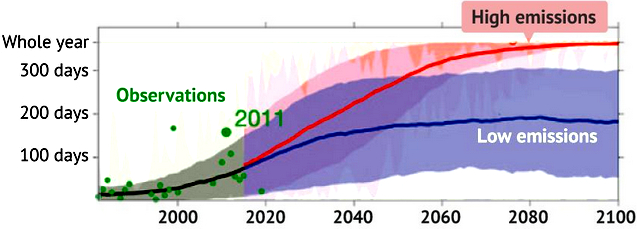
Source: The Earth Systems and Climate Change Hub

Thunderstorms were another area of interest, including how the number of danger so-called “pyrocumulonimbus” clouds formed out of bushfire plumes.

At least 35 of them were detected during Black Summer, increasing the risk of erratic winds on unpredictable fire behaviour and ignite new blazes ahead of the fire front, the report noted.

Cumulative observed number of fire-generated thunderstorms
Source: The Earth Systems and Climate Change Hub

East coast lows, another big weather event affecting coastal areas from Queensland to Victoria, were among phenomenon undergoing change.

The Hub developed new ways to analyse the complex storms and found the most extreme rainfall near eastern Australia was frequently caused by such low-pressure systems combining with a front and a thunderstorm.

The researchers found short-duration events produced by thunderstorms could potentially increase in intensity by about 15 per cent per degree of global warming.

A line of storms associated with an east coast low sweeping over the Hawkesbury River north of Sydney in July 2020. Credit: Nick Moir

Andy Pitman, head of the ARC Centre of Excellence for Climate Extremes and a Hub advisor, said east coast lows were “one of the least effectively studied phenomena in Australia” even though their impacts can be huge in terms of floods, storm surges and wind damage.

“I worry about how ill-prepared we are for any climate signal for east coast lows,” he said.

Drone vision of Lake Burrendong in the central-west region of NSW in January 2020 when water levels fell to a couple of per cent of capacity. Credit: Nick Moir


Extreme weather
Hundreds of deaths as Canadian heatwave shatters records
At the other end of the weather spectrum was so-called flash droughts, another of the Hub’s research areas.

These are triggered by lower-than-average rainfall, accompanied by abnormally high temperatures, a dry atmosphere, clear skies and more sunshine, and can be perilous for crops.

The researchers showed the sudden dry spells could be forecast, and they can happen even in winter.

The outgoing Hub cost $23.4 million, with matching contributions from CSIRO, the Bureau of Meteorology and five universities including the University of Melbourne and the University of NSW.


Bushfires
Storms, tornadoes and explosions: How bushfires are getting stranger
Its successor has been allocated federal funding of $38 million over six years.       

While welcomed, “we are not investing remotely enough given the scale of the risk”, Professor Pitman said, adding the new funding was “not even one year’s salary of a top soccer player”.

Simon Marsland, a CSIRO senior scientist who will lead the new Climate Systems Hub, said how communities could adapt to the warming impacts still to come will be one priority as will efforts to work closely with Indigenous populations that are often particularly exposed to extreme weather.

Dr Marsland noted the current record-shattering heatwave in Canada, with near 50-degree temperatures recorded even at a latitude as far as 50 degrees north, were “a good reminder that climate change is here now and not something in the far future”.

Links

(CA CBC) Western Canada's Heat Wave Is 'Unprecedented.' Scientists Say It Will Become More Common With Climate Change

CBC News - Alex Migdal

'There's going to continue being new normals until we stop emitting greenhouse gases,' says climate scientist

A woman wipes her face after cooling off in the water at a temporary misting station in Vancouver's Downtown Eastside on Monday. (Darryl Dyck/The Canadian Press)

Smoky skies. Polluted air. Sweltering heat. 

During three of the past five summers, British Columbians have endured extreme weather events, rewriting a season long known for its mild, sunny forecasts. 

This week's historic heat wave, which unleashed punishing temperatures on the Pacific Northwest and is now moving eastward to Alberta, has brought the realities of climate change into even sharper relief.

Climate scientists are cautious about citing climate change as the cause of any specific weather event. But some say evidence suggests extreme events are intensifying and becoming more common because of global warming.

"I'm shocked by this," said Simon Donner, a professor of climatology at the University of British Columbia. 

"As a climate scientist, we expect to see more extreme heat waves going forward into the future because we're adding greenhouse gases to the atmosphere. But this is even beyond my expectations. To have a heat wave last this long and be this hot in Canada is completely unprecedented in history."

'It really feels like dangerous heat'

The village of Lytton in B.C.'s Interior shattered Canada's all-time weather record over three consecutive days, surpassing an eye-popping 49 C on Tuesday. B.C.s Fraser Valley recorded temperatures in the mid 40s. Vancouver, which usually benefits from cool ocean air, recorded an overnight low of 24 C on Monday night, the type of heat often felt in the tropics. 

"There's something that feels a bit different about this one and I can't quite put my finger on it," said Joseph Shea, a professor of environmental geomatics at the University of Northern British Columbia.

"I was trying to come up with a word on the weekend and I think the word is menacing. It really feels like dangerous heat."

The 'heat dome' explained
David Phillips, senior climatologist for Environment Canada, says the high-pressure heat dome over parts of Western Canada creates an effect that's like 'putting a lid on boiling water.' 3:52

The global temperature has increased by 1.2 C since industrialization, according to the World Meteorological Organization.

A 2019 report commissioned by Environment and Climate Change Canada found Canada is warming twice as fast, with the highest rates occurring in the North, the Prairies and northern British Columbia. And temperatures in the Arctic are increasing three times the global rate. 

"That doesn't sound like very much, but it shifts the whole system. And so when you get big spikes, they get higher," said Deborah Harford, executive director of Adaptation to Climate Change, a policy planning initiative at Simon Fraser University. 

CBC metereologist Johanna Wagstaffe said jet streams — which essentially move weather patterns — are stalling much longer due to the shrinking temperature difference between the Arctic and mid-latitudes. 

"You get great waves, like what's happening over B.C., that stick around for longer," she said.
 
B.C. vulnerable to extreme weather

The heat wave has also underscored how British Columbians have yet to adapt to the changing climate conditions and are vulnerable to its impacts.

Roughly one-third of B.C. residents use air conditioning, according to a B.C. Hydro survey from last year, with the number jumping to 72 per cent in the southern Interior. 

The heat wave, which came with only days of warning, saw stores in B.C. sell out of air conditioners and fans. Hotels in Vancouver were fully booked Monday, drawing locals desperate for escape. Police in Metro Vancouver said Tuesday they had responded to more than 100 sudden deaths since the heat wave took hold. 
  
Vancouver doctor explains what he's seeing during the heat wave
Vancouver emergency room physician Dr. Daniel Kalla on the precautions, warning signs and potential remedies for heat-related illnesses as temperatures reach record highs, and how to cool down. 2:26

Record overnight temperatures made matters worse, with a low of 22 C in Victoria on Monday — close to the typical daytime high for that time of year. 

"We need those evenings to recover from the hot days that we experience," said Faron Anslow, a climatologist with the Pacific Climate Impacts Consortium in Victoria. 

While the heat wave was unusual in its intensity, Wagstaffe anticipates B.C.'s baseline will shift in the coming years. 

"We'll see more days, over 30 degrees. We'll see way more days, over 20 degrees," she said.

"And we'll really start to notice a change in our seasons. We'll see the extreme weather events l

ike fires and severe storms and flooding start earlier and last later." 

Mountaintops that never melt are thawing as a result of the heat wave, Wagstaffe said, raising questions about flood risk and the impact on water reserves through the summer and into the early fall. 

The wildfire risk also looms large. Forests are drying out and are rapidly turning into tinder for when a lightning storm strikes or a cigarette is tossed. 

"I think we've all learned in the past few years, the forest fire doesn't have to be anywhere near your home for you to be affected by it," Donner said.

What next?

While British Columbians have grown accustomed to wildfires, the severity of the heat wave has renewed awareness around the climate emergency. 

"I've covered a lot of weather events that have been connected to climate change," Wagstaffe said. 

"And I've got to be honest, I think this one is the one that really made me consider my future and my two-year-old's future. We were literally trying to think of an emergency plan for the forecast that had heat that would be too dangerous for my family to be in our own home." 

Shea said the only way to stop climate change is to stop pumping emissions into the atmosphere. 

"It's simple to say that but very hard to do because of the systems we have in place," he said. "At this point, there's nothing else we can do except really make that push." 

The Paris climate agreement aims to keep the global temperature increases this century below 2 C — and ideally 1.5 C — to stave off the worst effects of climate change.

A construction worker uses a misting fan to cool down at a work site in Vancouver on Monday. Vancouver police say they have responded to more than 100 sudden deaths since the heat wave took hold. (Ben Nelms/CBC)

Anslow said change on a personal level can mean reducing your emissions by curtailing vehicle use, reconsidering what you eat and cutting down on energy use at home. 

"These all will seem like pretty small drops in the bucket when you're doing them, but they do add up," he said. 

Donner said people need to push their politicians for stronger action, such as regulations around electric vehicles and energy-efficient homes and buildings.

"This is not the new normal," Donner said.

"There's going to continue being new normals until we stop emitting greenhouse gases because the baseline, or what we think of as normal, is constantly moving upwards now." 

Links

(AU The Guardian) Australia Ranks Last For Climate Action Among UN Member Countries

The Guardian - 

Nation scores just 10 out of 100 on tackling fossil fuel emissions in new report on sustainable development goals

The Loy Yang Power Station in Traralgon, Victoria. A UN-backed report has ranked Australia last on climate action. Photograph: David Gray/Getty Images

Australia has been ranked last for climate action out of nearly 200 countries in a report assessing progress towards global sustainable development goals. The Sustainable Development Report 2021, first reported by Renew Economy, scored Australia last out of 193 United Nations member countries for action taken to reduce global greenhouse gas emissions.

A database shows Australia received a score of just 10 out of 100 in an assessment of fossil fuel emissions, emissions associated with imports and exports, and policies for pricing carbon.

Second last was Brunei, which was ranked behind Qatar and Norway.

Guardian Essential poll: majority of voters fear Australia will be left behind on climate change.  Read more
Richie Merzian, a climate expert at the Australia Institute, said the result was unsurprising.

“Australia has received similar rankings from other comparable studies, including the Climate Change Performance Index, which last year ranked Australia second last behind only Trump’s America,” he said.

“The federal government has no climate and energy policy and instead has cherry-picked technologies, many of which support the fossil fuel industry.”

The report noted Australia had not committed to achieving netzero carbon emissions by 2050. Scott Morrison has instead signalled Australia wants to achieve carbon neutrality as soon as possible and “preferably” by 2050.

The most recent emissions data, released by the government in late May, showed Australia’s greenhouse gas emissions were at the lowest levels in 30 years as the coronavirus pandemic put a handbrake on fossil fuel burning in the transport sector and slowed economic activity.

In a statement at the time, the energy minister, Angus Taylor, said those levels were despite “upward pressure from growth in exports and industry”.

The Sustainable Development Report tracks countries’ progress towards the UN’s 17 sustainable development goals, which include quality education, gender equality, wiping out poverty, creating sustainable cities and communities, and affordable and clean energy.

Australia ranked 35th overall, performing strongly on health and wellbeing, economic growth, education and clean water and sanitation.

For clean energy, Australia was listed as having “major challenges” but recorded a moderate improvement over the past 12 months.

The report says countries should not allow the Covid-19 pandemic to lead to a prolonged reversal in progress towards the goals.

“International commitments, for instance towards climate neutrality, must be rapidly accompanied by transformative actions and investments,” the report says.

“Large fiscal packages of major economies present an opportunity to foster a green, digital, and inclusive recovery.”

Links

Friday, July 02, 2021

(Al Jazeera) The Climate Crisis Is A Crime Story

Al Jazeera - Mark Hertsgaard

Fossil fuel companies lied for decades about climate change, and humanity is paying the price. Shouldn’t those lies be central to the public narrative?

 
Author
Every person on Earth today is living in a crime scene.

This crime has been going on for decades.

We see its effects in the horrific heat and wildfires unfolding this summer in the American West; in the megastorms that were so numerous in 2020 that scientists ran out of names for them; in the global projections that sea levels are set to rise by at least 20 feet (6 metres).

Our only hope is to slow this inexorable ascent so our children may figure out some way to cope.

This crime has displaced or killed untold numbers of people around the world, caused billions of dollars in economic damage and ravaged vital ecosystems and wildlife.

It has disproportionately affected already marginalised communities around the world, from farmers in coastal Bangladesh, where the fast-rising seas are salting the soil and slashing rice yields, to low-income residents of Houston, Chicago and other cities, whose neighbourhoods suffer higher temperatures than prosperous areas across town.

 This crime threatens today’s young people most of all and calls into question the very survival of the human civilisation. And yet, the criminals responsible for this devastation are still at large. Indeed, they continue to perpetrate their crime, and even make money from it, not least because their crime remains unknown to most of the public.

This is enough to make your blood boil, especially if you are a parent. My daughter just turned 16, and I have been thinking about the safest place she can spend her adult life since she was a baby and I first started writing about adapting to climate change. The orange skies blanketing her hometown of San Francisco after last summer’s record wildfires were a heartbreaking, infuriating sign that California will not be that safe haven.

A pump jack operates in front of a drilling rig owned by Exxon near Carlsbad, New Mexico on February 11, 2019 [File: Reuters/Nick Oxford]

The crime in question is the fossil fuel industry’s 40 years of lying about climate change. Arguably the most consequential corporate deception in history, the industry’s lies have had the effect of blunting public awareness and governmental action against what scientists say is now a full-fledged climate emergency.

As a candidate in the 2020 US presidential elections, Joe Biden said he would support efforts to prosecute the oil giants for their lies. It remains to be seen whether he will keep that promise.

Journalists have dedicated years to documenting the crime scene evidence. In 2015, an investigation by the Columbia Journalism School and the Los Angeles Times blew the case open by tracing the crime link to ExxonMobil, then the world’s largest oil company.

Internal records showed that by the late 1970s, Exxon’s own scientists were briefing its top executives that man-made global warming was real, potentially catastrophic, and caused mainly by burning fossil fuels. Climate activists seized on the revelations, launching the hashtag #ExxonKnew.

Further investigations found that Chevron, Shell, and other oil giants likewise knew that their products threatened to render the earth’s climate uninhabitable. In short, it was not just Exxon that knew. They all knew.

And they all chose to lie about it.

Beginning in the 1990s, oil companies spent millions upon millions of dollars on public relations campaigns to confuse the press, the public, and policymakers about the dangers posed by burning fossil fuels.

Their aim was “to reposition global warming as theory, not fact”, one planning document stated. Front groups and friendly politicians spread the companies’ lies.

News outlets, especially in the United States, swallowed and regurgitated those lies to an unsuspecting public.

Humanity ultimately wasted precious decades arguing about whether global warming was real rather than defusing the threat. Instead of launching a transition to renewable energy, the consumption of fossil fuels increased.

More than half of the total greenhouse gases now overheating the planet were emitted after 1990 – after Exxon and other fossil fuel giants privately knew what havoc they were seeding.

Exxon “could have ended the pretend debate over climate change as early as the 1980s”, author and activist Bill McKibben later wrote. “When scientists like NASA’s Jim Hansen first raised public awareness of climate change [in 1988], think of what would have happened if Exxon’s chief executive had gone to Congress, too, and said that their internal scientific efforts show[ed] precisely the same thing.”

Firefighting vessels attempt to extinguish the blaze aboard the supertanker Mega Borg in the Gulf of Mexico in June 1990, near Galveston, Tex. The vessel, which carried more than three times as much oil as the Exxon Valdez, burned uncontrollably for two days. (Paul S. Howell / Liaison)

While pockets of the American public may already know about big oil’s crime, the vast majority of its victims almost certainly do not. How could they?

Big Oil’s record of lying never became part of the public narrative about climate change, largely because most news outlets did not incorporate it into their continuing coverage of climate change.

The initial “Exxon knew” revelations in 2015 received relatively little follow-up coverage beyond the outlets that published them. Television, which even in the internet era remains the primary source of news for most people, ignored the revelations entirely. There were a few stories in the business press and independent media, especially years later when New York state and other local governments began suing oil companies for damages. But the media as a whole seems to have forgotten that Big Oil’s climate lies ever happened.

It is long past time to right these wrongs. To date, the oil companies, the executives in charge of them, the propagandists they have employed and the politicians they have funded have largely escaped blame, much less had to pay – whether through financial penalties or prison time – for the immense damage they have done.

News outlets also owe the public an apology for mishandling this story, along with a commitment to doing much sharper coverage in the future.

Humanity cannot get back the 40 years lost to Big Oil’s climate lies. It is now beyond urgent that rich and poor countries alike quit fossil fuels in favour of renewable energy and other climate-smart practices.

Equally crucial is that we fortify our communities against the fearsome climate impacts that, because of our decades of delay, can no longer be avoided.

All this will cost money – lots of it. The world’s governments will be arguing from now through the make-or-break UN climate summit in November about who pays how much.

Restoring Big Oil’s lies to their rightful place at the heart of the climate story would offer an answer to that riddle, one that Biden should be pressed on: Big Oil knew – shouldn’t Big Oil pay?

Links

Greening Australia And WWF-Australia Announce New Climate-Ready Restoration Partnership In Response To Increasing Natural Disasters

 Business Insider - PR Newswire


Key Points

The Climate-ready Restoration partnership between Greening Australia and the World Wide Fund for Nature takes a science-led approach to developing large-scale, practical action to help nature adapt to a changing climate.

Climate-ready Restoration solutions include (but are not limited to):

  • Practical, nature-based solutions such as 'climate-ready seed'
  • Planting designs that measurably reduce climate-induced risk for plants, animals and people
  • Exploring new technologies, partnerships and funding models to deliver restoration at the scales required to build nature's resilience in a changing climate
SYDNEY -- Two of the country's leading environmental organisations, Greening Australia and World Wide Fund for Nature (WWF)–Australia, today announced a strategic partnership galvanised during the 2019-20 Australian bushfire season, with the primary goal to mainstream innovative, nature-based and scalable solutions that will build nature's resilience in a changing climate.

The partnership will experimentally test, validate and scale practical climate-ready restoration approaches nationally, designed by eminent scientists across Australia.

In an example of just one of the series of innovative projects within the partnership, Greening Australia and WWF-Australia will employ eco-evolutionary approaches to identify 'super seed' that has enhanced climatic and fire-tolerant traits to replant trees in bushfire-affected areas. 

Climate-ready restoration activity will be experimental in nature, informed by existing scientific and Indigenous ecological knowledge, and delivered using scientific methodology that sets and tests hypotheses through data collection, modelling and on-ground experimentation.

Importantly, these science-led projects will be tested for their feasibility and ability to mainstream on-ground delivery across the restoration sector.

The two organisations have committed a total of $20 million in initial climate-ready restoration projects and are calling for an additional $30 million in funding from the Australian public and private sectors to enable delivery of the total proposed program of work. 

Brendan Foran, CEO, Greening Australia said, "We are now living with recurring natural disasters across Australia that are affecting people and nature in ways and at scales that we have not previously witnessed – including the devastating bushfires of 2019-2020.

"Our partnership for Climate-ready Restoration is designed to improve the long-term resilience of the Australian environment in the face of climate change. It is focused on biodiversity and ecosystem restoration, with an emphasis on supporting communities and strengthening the economy.

"To help us prepare for and adjust to both the current effects of climate change and the predicted future impacts, we urgently need to mainstream new, practical, nature-based solutions. This is the driving mission of our partnership."

After the NSW south coast bushfires

Dermot O'Gorman, CEO, WWF-Australia said, "This program is not business as usual. We are already witnessing the impacts of a changing climate and need to urgently think and act differently.

Science and innovation that translates into on-ground delivery are at the heart of our climate-ready approach. Many of the projects that will be funded by this program will trial innovative technology or science-led approaches that aim to accelerate delivery, amplify data collection and fast-track outcomes."

"This partnership is an example of how the environmental sector can lead collaboration between other strategic partners, universities, business, government and the community and find new ways to work together to ensure the Australian environment is climate-ready and our flora, fauna and communities are resilient to the changing climate," O'Gorman continued.

Adrian Turner, CEO Fire and Flood Resilience initiative, Minderoo Foundation and one of the first partners to come onboard said, "We are pleased to be part of this program, to pilot new ways to regenerate landscapes in Australia's most vulnerable regions so that they can be more resilient against fires.

"It is essential that we work together across sectors to optimise our environments so that we can reduce the devastating impact of these climate induced extreme weather events in the future.

"The Climate-ready Restoration program is directly aligned with the Healthy Landscapes Mission, which is part of a national blueprint to reduce the harm caused by fires and floods and lift resilience by 2025."


Links

(AU ABC) These Electorates Have The Highest Climate Risk. So Why Are They Less Likely To Demand More Action?

ABC Science | James Purtill | Matt Martino

Sea-level rise will be one of the main drivers of climate risk in Australia after 2050, experts say — but that doesn't necessarily mean people want the government to take action on it. (Fairfax Media: Peter Rae)

Australia Talks

Australia Talks is a research-based initiative developed by the ABC, in collaboration with social and data scientists from Vox Pop Labs.

The University of Melbourne is the Australian academic partner on the project. An advisory panel of academics from other Australian universities has also helped shape the initiative.

The 2021 Australia Talks National Survey asked more than 60,000 Australians from across every state and territory and every federal electorate about their attitudes, behaviours and experiences.
Australians in electorates that are generally more exposed to the impacts of climate change are less likely to demand more action, according to a comparison of survey results and climate risk data.

The Australia Talks National Survey 2021 asked a cross-section of Australians: "How much should the federal government do to tackle climate change?"

The answers ranged from "more" to "less" to "about the same", but when these results were cross-referenced with the estimated climate risk in each electorate, the results were surprising.

People in electorates threatened by the impacts of climate change — such as those in Queensland's Sunshine Coast and Gold Coast — were less likely to say climate change is a threat, or demand government action.

So why is that the case?

Understanding the estimated climate risk

Climate risk data is used to estimate the future impact of climate change on property and infrastructure.

The data we compared with the Australia Talks National Survey 2021 results has been calculated by the firm Climate Risk, whose work is widely used by banks and other organisations that rely on accurate predictions of threats.

Karl Mallon, director of science and systems at Climate Risk, said the calculations "combine engineering data about buildings with weather data, climate change data, data about forests, soils, elevation, and height above sea level".

"And that all goes into like a washing machine of computer code," he said, and the computer spits out a raw figure: the climate risk.

This climate risk figure (on the x- axis) isn't a monetary value, but simply quantifies the combined risk to all properties in the designated area as a result of the predicted impacts of climate change.

Electorates above the graph's dotted horizontal line are more likely to say the government should do "about the same" or "less" to tackle climate change, while those electorates to the right of the dotted vertical line have a higher climate risk than most.

You might expect electorates with a high climate risk to want more action on climate policy, but that's not always the case.

Look at the upper-right quadrant: about a dozen electorates (mostly in Queensland) have both a higher climate risk than others, and a lower appetite for climate action.

This is a national trend. The diagonal line running through the centre shows the relationship between risk and attitude for all electorates.

It angles up, which points to something counter-intuitive: Australian electorates generally tend to be less likely to demand more action, as the climate risk within their electorate increases. 

City-country divide in climate attitudes

To understand why this is the case, we asked John Henstridge, chief statistician at Data Analysis Australia and former president of the Statistical Society of Australia, for his opinion on the data.

Dr Henstridge confirmed the relationship shown in the trend line appeared to be "statistically significant".

But not wanting more government action doesn't necessarily mean a person is sceptical about climate change; they may simply doubt the government's ability to mitigate the threat.

However, a second question asked by the Australia Talks National Survey 2021 shows a clear city-country divide in whether people see climate changes as a threat.

Floods in Queensland's Western Downs in early 2020. (Supplied: Queensland Fire and Emergency)

Australians in rural areas are generally more exposed to the impacts of climate change, including extreme weather events and more frequent and severe natural disasters.

Yet according to the Australia Talks National Survey 2021, they're also generally less likely to say climate change is a threat.

The survey asked respondents: "To what extent do you consider climate change a problem for you personally and Australia generally?"

In inner-metro areas, 73 per cent said it was a personal problem, compared to 61 per cent in rural areas.

Rebecca Huntley, a researcher on social trends, said this phenomenon of concern declining "inverse to the actual impacts of climate change" was almost unique to climate change.

With an issue such as emergency department wait times, for example, concern generally increases with impact, Dr Huntley said.

"There wouldn't be a person in regional or rural Australia who isn't doing some kind of climate mitigation in the work that they do," she said.

"They're at the frontline of extreme weather events."

Why do some electorates have such high climate risks?

According to the Climate Risk data, several electorates most threatened by the impacts of climate change but less likely to demand government action are on Queensland's Gold Coast and Sunshine Coast.

They include the "outer-metro" electorates of Moncrieff, McPherson, Fisher, Fadden and Fairfax.

 
"The Gold Coast is a bit like our Florida Keys," Dr Mallon said.

"We've got flood risk, forest fires, and we've obviously got coastal inundation."

The answer to why people here are less likely to say climate change is a threat is complex, but one factor may be what Dr Mallon calls the "Noosa effect".

A high-profile group of Noosa residents is currently fighting the local council's plan to prepare for sea-level rise, saying this climate action will hurt property prices and insurance costs.

"You've got short-term versus a long-term interest," Dr Mallon said.
"The long-term self-interest says I should protect my property, but the short-term says these warnings on my sales certificate will devalue my property."
An aerial general view of the Gold Coast skyline. (Getty: Mark Kolbe)

Dr Mallon added that there was "probably a point" where the sentiment will flip from "suppression" to "protection".

"In Miami, the Republicans are pro-climate action," he said.

"It's undeniable now."

He said flooding was currently the most important driver of climate risk in Australia.

"After about 2050, coastal inundation will start to become one of the dominant causes of risk," he said.

Does education affect attitudes?

Another important factor in attitudes to climate change is education.

The Australia Talks National Survey 2021 data revealed that respondents who had completed a higher level of education were more likely to say climate change was a serious problem.

Among respondents with a level of education of "high school or below", 61 per cent said that "climate change is a serious problem and immediate action is necessary".

For Australians with a bachelor degree, that figure was 70 per cent; those with a graduate degree were even more likely to hold this view at 75 per cent.


The NSW communities standing
in the path of climate change
The forests of the NSW south coast are shooting green new leaves — but local residents face a dangerous, expensive and uncertain future. Read more
Dr Huntley said this correlation had been picked up in other surveys.

"It's got nothing to do with intelligence," she said, instead attributing it largely due to the fact climate change is typically communicated by people who come from a higher education.

"Regardless of whether people esteem climate scientists or not they don't always identify with them."

In addition to this, people with a higher education tend to consume a wider range of media and be less likely to be swayed by fringe views.

"When we look at people who are climate deniers or disengaged, their media diet is very narrow," Dr Huntley said.

Did the Black Summer bushfires shift attitudes?

Experts say the idea that a succession of climate-related natural disasters will eventually convince the doubters is flawed. (AAP: Dean Lewins)

Climate risk data aside, more Australians say climate change is a serious problem that requires immediate action now than it did two years ago.

The  Australia Talks National Survey 2021 revealed 64 per cent say this is the case, compared to 60 per cent in the previous survey, conducted in 2019.

According to Dr Huntley, that's a fairly large shift in a relatively short space of time, especially "given how long it takes to shift people on climate".

One cause of this shift may be the Black Summer bushfires, she said.

The worst fire season on record destroyed more than 3,000 properties, killed more than three billion animals and exposed 80 per cent of the country's population to unhealthy smoke.

A royal commission confirmed that climate change had intensified the fires.

But the idea that a succession of climate-related natural disasters will eventually convince the doubters is a flawed one, Dr Huntley said.

"Natural disasters don't shift all people in the same way," she said.
"If you were already really concerned about climate change, the fires made you tip over into something else.
"It creates activists, but it doesn't move mountains."

Links

Thursday, July 01, 2021

(AU ABC) Victorian Government Commits $14 Million To Battery Facility, Regional Hydrogen Hub

ABC News - Jackson Peck

All levels of government are pumping hundreds of millions of dollars into the hydrogen industry. (Supplied)

Key Points
  • The Victorian government has announced a $14 million investment in two Deakin University alternative energy projects
  • The projects will focus on new battery and hydrogen technologies
  • The facilities are expected to host nearly 300 jobs, while nearly 80 jobs are expected to be created during construction
The Victorian government has committed $14 million to a battery facility and a regional hydrogen hub at university campuses in Melbourne and regional areas.

The Hycel Technology Hub at Deakin University's Warrnambool campus will receive $9m to develop and test hydrogen fuel technologies.

Meanwhile, $5.2m will go to the Battery Technology Research and Innovation Hub 2.0 at Deakin's Burwood campus.

Deakin Energy director Adrian Panow said the funding for the hydrogen hub would help make the fuel a feasible option for industry.

"To really make that step change where hydrogen becomes a viable option," he said.

"Particularly for those sectors that are very difficult to decarbonise, so heavy transport in particular, finding a substitute for natural gas with the low carbon footprint.
"It's a small factory that will house equipment to manufacture, to trial and to test fuel cell equipment.
"Importantly, it'll be a facility that will interface directly with communities, and particularly regional communities, to build that social licence so that when hydrogen becomes a viable large scale economy that the community is ready to accept it and we have a trained workforce that knows how to implement safely."

The federal government has committed $2m to the Hycel Technology Hub.

Local Federal Member Dan Tehan at a groundbreaking event at the Hycel Technology Hub in November 2020. (Supplied: Alice Miles)

'Viable, safe and can be implemented'

Dr Panow said the funding would help the development of hydrogen technology at scale.

"What we've heard very clearly from our global collaborators is that the research out of a laboratory can't enter global supply chains unless it's been demonstrated at scale," he said.

"That's why the investment needs to be substantial — so you can manufacture, you can build the small and medium enterprise sector to convert the fantastic science into a scale that a manufacturer can pick up and realise it's viable, it's safe and it can be implemented.

"The regional location is perhaps often underestimated in its importance.

"Hydrogen lends itself very well to that long distance travel and the local industry in the south west of Victoria — dairy, forestry and manufacturing in that area.
"Hydrogen enables that whole sector at alternatives in how it's going to decarbonise."

Will 'green hydrogen' live up to the hype?
It's been identified as the clean energy source that could help bring the world to net-zero emissions, but green hydrogen's future is not yet assured. Read more


Deakin University is also aiming to transition its Warrnambool campus from gas to hydrogen and will convert the Warrnambool Bus Lines fleet to renewable energy.

The battery facility will include a testing lab and pilot production line to research and make batteries using lithium and sodium.

The advanced batteries are expected to be used in defence, agriculture, disaster zones and the health industry.

The state government said the facilities would host 290 jobs in research and manufacturing, while 78 jobs were expected to be created during construction, which was slated for next year.

Minister for Higher Education Gayle Tierney, who helped launch the project funding this morning, said it was a great investment in future industries.

"These projects will create world-class training and research facilities right here in Victoria, with huge benefits not just on skills and training but also industry and our economy," she said.

Links

Lethal Heating is a citizens' initiative