07/09/2021

(AU The Conversation) Climate Change Means Australia May Have To Abandon Much Of Its Farming

The Conversation -  | 

A dust storm engulfs a farm in Forbes, NSW. This image won the National Photographic Portrait Prize for 2021. Joel B. Pratley/National Portrait Gallery,

Authors
  • Andrew Wait is a Professor in the School of Economics at the University of Sydney. He has a PhD from the Australian National University and a Bachelor of Economics (Honours) from the University of Adelaide.
  • Kieron Meagher is a Professor, Research School of Economics, Australian National University. He has an MA (Hons.) in pure mathematics from Waikato University and a PhD in Economics from the Australian National University.
The findings of the Intergovernmental Panel on Climate Change suggest Australia may have to jettison tracts of the bush unless there is a massive investment in climate-change adaptation and planning.

The potential impacts of climate change on employment and the livability of the regions have not been adequately considered.

Even if emissions are curtailed, Australia likely faces billions of dollars of adaptation costs for rural communities.

As the IPCC’s Sixth Assessment Report (published last month) makes clear, the climate will change regardless of any mitigation actions taken now.

Even under its modest conservative projections, worldwide temperatures will rise by 1.5℃.

That may not sound like much, but it will double the frequency of droughts — from once every 10 years to once every five.

Worse still, a 2℃ temperature rise — also a likely outcome without substantial emission reductions — will make droughts 2.5 times more frequent.

Farm profits are falling

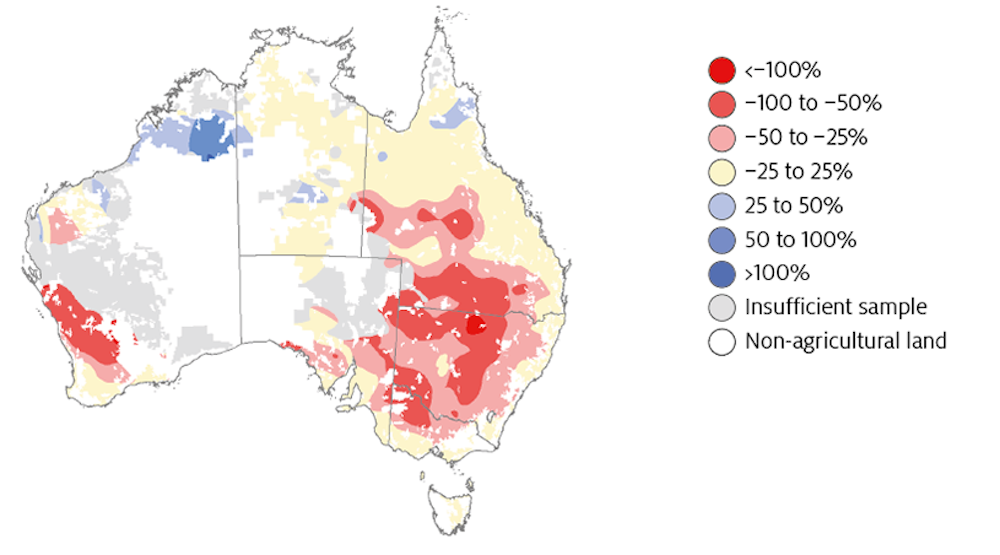
Climate change is already hurting Australian farmers. Compared with historical averages, agricultural profits have fallen 23% over the 20 years to 2020. This trend will continue.

The Australian Bureau of Agricultural and Resource Economics and Sciences (ABARES) predicts a likely scenario is that overall farm profit will fall by 13% by 2050. There will be significant differences between regions. Cropping profits in Western Australia, for example, are predicted to drop 32%.

Effect of 2001-2020 seasonal conditions on farm profit
ABARES

With higher emissions, the reductions will be worse. Estimates of the fall in farm profits range from 11% to 50%.

These changes go beyond the cycles of weather with which Australian farmers have always had to cope. Inconsistent water supplies, increased natural disasters and greater production risks will render agricultural production in many areas uneconomic.

Due to these climatic changes agricultural assets, both land and infrastructure, could become virtually worthless – so-called stranded assets.

No future without water

Vibrant regional communities aren’t just about farms. They are interdependent networks of businesses, towns, public infrastructure and people.

The effect of falls in farm income will ripple throughout these communities. Lower output will mean fewer jobs. If farms close, so will other regional businesses, leading to more stranded assets. Those affected could face displacement along with an inability to sell their homes and businesses.

And of course these communities can’t survive without water.

A water canal between Pooncarie and Menindee in western New South Wales in February 2019. At the time more than 98% of New South Wales was in drought. Dean Lewins/AAP

So far development planning in Australia has not adequately considered the potential impacts of the climate on livability, especially in rural communities. This failure to account for climate change exacerbates the potential for stranded assets.

For example, the NSW Auditor General reported in September 2020 that the state government had “not effectively supported or overseen town water infrastructure planning in regional NSW since at least 2014”. This contributed during the intense drought of 2019 to at least ten regional NSW cities or towns coming close to “zero” water.

Population pressures

In some areas these water problems are being compounded by population growth.

Consider, for instance, the NSW townships surrounding Canberra. In January 2020 the town of Braidwood (about halfway between Canberra and Batemans Bay) had to start trucking in water when its own water source, the Shoalhaven river, stopped flowing. Yet nearby Bungedore (about 50 km away) is building a new high school due to population growth.

Farmer Ian Cargill stands in a middle of a dam on his property near Braidwood, NSW, in August 2018. At the time 100% of the state was drought-affected. Lukas Coch/AAP

This “tree-change” trend, with people leaving cities in search of a better lifestyle and more affordable housing, is widespread. It appears to have been amplified by the COVID-19 pandemic, with figures showing net internal migration of people out of Sydney and Melbourne.

More investment in adaptation needed

There is an urgent need for a comprehensive assessment by all levels of government of risks to livelihoods in agriculture and regional communities, and of the default risk on stranded assets.

Budget projections need to account for climate-change adaptation and economic structural change.

In last year’s budget the federal government committed to investing A$20 billion “to ensure Australia is leading the way in the adoption of new low-emissions technologies while supporting jobs and strengthening our economy”.

As important as this is, we must start planning and spending on adaptation.

The A$1.2 billion over five years the federal budget allocated for natural disasters is just the beginning. In some regions changed farming practices, subsidised insurance and investment in water infrastructure may be enough. But proper infrastructure takes many years to plan, and to build.

Some areas are going to become unviable. We will need deal with the loss of entire communities, and internal climate refugees.

It is time to start budgeting for the costs of living with climate change, not just the costs of cutting emissions.

Links

(AU SMH) Top UN Official Calls For Australia To Urgently Dump Coal

Sydney Morning Herald - Nick O'Malley

The United Nations’ top climate official has urged Australia to have a “more honest and rational conversation” about urgently abandoning coal power, which he said was in the nation’s and the world’s best interests.

Selwin Hart, UN Assistant Secretary-General and Special Adviser to the Secretary-General on Climate Action, said wealthy nations must stop using coal power by 2030 and the rest of the world must dump it by 2040 if the world is to keep global warming to within the agreed target of 1.5 degrees Celsius.

Poland’s Belchatow plant is the world’s largest lignite coal-fired power station. Credit: Getty

“Market forces alone show coal’s days are numbered, as many investors increasingly abandon it in favour of renewables, which are now cheaper in most places,” said Mr Hart during a speech recorded for an Australian National University leadership forum.

“We fully understand the role that coal and other fossil fuels have played in Australia’s economy, even if mining accounts for a small fraction - around 2 per cent - of overall jobs.

“But it’s essential to have a broader, more honest and rational conversation about what is in Australia’s interests because the bottom line is clear.

“If the world does not rapidly phase out coal, climate change will wreak havoc right across the Australian economy: from agriculture to tourism, and right across the services sector,” he said.

Climate policy
Political forces back independent candidates in climate change power bid
Mr Hart also called on Australia to increase its 2030 greenhouse gas emissions reduction target from the current commitment of 26 to 28 per cent, saying collectively the world must reduce emissions by 45 per cent by the end of the decade if we are to hold warming to 1.5 degrees.

And he called on Australia to adopt a net zero target by 2050, noting that all Australian states and territories had already done so, as well as Australia’s island nation neighbours, along with nations representing 73 per cent of the world’s economy.

The federal government has said its preference is to reach net zero before 2050, but it has not made a formal commitment to reaching the target.

Coal
How Germany closed its coal industry without sacking a single miner
Mr Hart’s speech comes as high-level calls to end the world’s thermal coal industry intensify in the lead up to the COP26 climate talks in Glasgow in November, and are likely to be raised during the United Nations General Assembly later this month.

Alok Sharma, the Conservative United Kingdom cabinet minister who is to be the formal host of COP26 has spent much of his time in recent months travelling the world in a diplomatic push to have countries agree to a timeline to end coal use.

“If we are serious about 1.5°C, Glasgow must be the COP that consigns coal to history … we are working directly with governments, and through international organisations to end international coal financing,” he said in a speech in May.

“The days of coal providing the cheapest form of power are in the past. And in the past they must remain … The coal business is going up in smoke. It’s old technology. So let’s make COP26 the moment we leave it in the past where it belongs.”

In his speech for the ANU Mr Hart said the nation faced increased droughts, heatwaves, fires and floods, while Pacific island nations could be “wiped from the map” by climate change.

“Mass relocations of entire national populations would be among the catastrophic results.”

A spokeswoman for Energy and Emissions Reduction Minister Angus Taylor said that Mr Hart was, “right to point out that action and achievement this decade matter more than future aspirations and ambition.”

“Australia has a strong 2030 target and a clear plan to meet and beat it.

“By contrast, Labor have no 2030 target and no plan to achieve their 2050 aspiration.”

A spokesman for the Energy Council of Australia said the group was on record as supporting net zero by 2050.

Future Power
What's a 'just transition' and can you switch to green energy without sacking coal workers?
The chief executive of the Minerals Council of Australia, Tania Constable, said its members supported the Paris Agreement and the transition to a net zero economy, and were accelerating exploration for metals and minerals needed for new zero emission technologies.

“Mining directly employs 256,000 – triple the number 20 years ago – and the mining and METS [mining, equipment, technology and related services] sector directly employs 480,000 people, indirectly employs 650,000 through purchases from other sectors, and in total supports 1.1 million jobs, or 10.8 per cent of national employment,” she said.

Links

Ghostly Satellite Image Captures The Arctic ‘Losing Its Soul’

Atlas Obscura - Gemma Tarlach

In the aftermath of an extreme melt event, what do scientists see in the Greenland Ice Sheet’s swirls of white, blue, and ominous gray? 

In a satellite image of the Greenland Ice Sheet's southwestern corner, captured on August 21, 2021, pale blue meltwater streams across ice or collects in slushy depressions. The deeper blue areas are meltwater lakes with depths up to about 30 feet. European Union, Copernicus Sentinel-2 imagery

“We started hearing a noise, like breaking, or coins falling,” says Marco Tedesco, a climate scientist at Columbia University’s Lamont-Doherty Earth Observatory.

He makes a loud, sustained crunching sound, recreating what he and his team heard, years earlier, while doing fieldwork on the Greenland Ice Sheet.

Below the surface of the ice near where they were standing, a flood had begun. “The water below starts to move but you still have snow on top,” Tedesco says of the phenomenon. As the flowing water gains momentum, overlying snow and ice give way and reveal a meltwater stream or river.

What Tedesco describes is a small-scale seasonal melt event, one of many that occur every summer at the lower-elevation edges of the Greenland Ice Sheet, an expanse of more than 650,000 square miles that’s second only to the Antarctic Ice Sheet in size. This year, however, things were different.

Following a mid-August heatwave that led to the first-ever recorded rainfall at Summit Camp, at the ice sheet’s highest point, torrents of meltwater streamed across its surface. Climatologists recorded daily melt rates seven times higher than normal.

In the satellite image above of the southwestern corner of the ice sheet, captured on August 21, pale blue water carves extensive channels around islands of bright white ice, or collects in slushy depressions. The left side of the image is darker and, like storm clouds on the horizon, it’s a warning of what’s to come.

The Greenland Ice Sheet, like the rest of the Arctic, is trapped in a feedback loop caused by climate change: As more ice melts, it creates conditions for even faster, more extreme melt events.
“Summer melt is getting bigger and bigger and bigger.”
“The Arctic is losing its soul,” says Mark Serreze, director of the National Snow and Ice Data Center. “The Arctic in so many ways is defined by its snow and ice, in all its forms.”

He adds that, while meltwater runoff at lower elevations is a natural process that has been happening each summer for millennia, “what the image really conveys is how that process of summer melt is getting bigger and bigger and bigger.”

University of Lincoln climate scientist Edward Hanna says the “quite dramatic” surface meltwater shown in the image is a scene that’s likely to be repeated because “Greenland is breaching a crucial tipping point driven by human-induced climate change.”

For Serreze, who has been studying the Arctic since 1982, the dramatic events in Greenland aren’t a surprise. “We have long known the Arctic would be the place raising the red flags first, and that’s exactly what has happened,” he says.

But it’s still a shock. “To see a rain event at the top of the Greenland Ice Sheet?” He shakes his head in disbelief.

Each summer, meltwater around the edges of the ice sheet carves channels as it travels to the sea, as shown in this 2017 image. The process has been accelerating for decades. Martin Zwick/REDA&CO/Universal Images Group via Getty Images

Tedesco, author of The Hidden Life of Ice: Dispatches from a Disappearing World, sees something else in both the Summit Camp rain event and the stunning satellite image taken the following week: opportunity.

“To me, it’s really important that we had an unprecedented rain event, to show that these things can happen,” says Tedesco. The Summit Camp rain may help bring wider recognition of something he and his colleagues have known for years.

“These events are strongly connected to the changes we’re imposing on the planet,” says Tedesco, calling Earth “a thermodynamic system so delicate, but powerful.”

Thanks to the satellite image’s “fantastic” quality, Tedesco says, “you can really see the story that’s going on here,” including extensive meltwater ponding on the right side that’s “very likely slush.”

Researchers working on the Greenland Ice Sheet have observed meltwater streams and even rivers forming along its lower-elevation edges in summer months, though the intensity of the activity is increasing. Joe Raedle/Getty Images

The left side of the satellite image, Tedesco says, sits close to Greenland’s western coast, and is colored by rock, dust, and other particles deposited by wind, as well as bacteria and other microorganisms. Its darker color accelerates melting because of a phenomenon known as ice-albedo feedback.

“Albedo is a fancy word for how reflective the surface is,” says Serreze. As highly reflective snow and ice melt, the darker surface exposed—rock, open water, or older ice, depending on the location—absorbs more of the sun’s energy and spurs even more intense melting.

“We’re seeing this across the Arctic as we’re losing the sea ice cover and we’re losing the snow cover,” he says.

The vast Greenland Ice Sheet is second only to Antarctica’s in size, and is experiencing unprecedented stress. Photo by Mario Tama/Getty Images

There’s an unexpected wrinkle revealed in the darker portion of the satellite image, however. Tedesco has studied this particular part of the ice sheet; because of the underlying topography and other factors, he and many colleagues believe that at least some of the material staining the ice was originally deposited elsewhere on the sheet, long ago.

“People think this stuff could have been buried in the ice in other places and, with the flow of the ice and increased melting, it’s now exposed,” he says, noting the idea remains largely unstudied. For him, the possibility of ancient material returning to the surface is poignant.

“This image is basically a time machine,” he says, studying the swirls and ripples of white, blue, and gray on his computer monitor with a pensive expression.

“You have, on the right, the future: a patchy, wet, slushy ice sheet. You have in the middle the present, which is basically your ice now, frozen. And you have a very deep past on the left, which is also driving the future because, of course, the darker it is, the more it absorbs sunlight and the faster it melts.”

Links

06/09/2021

(USA The Hill) Too Hot For Climate Change: Limiting Population Growth

The Hill - Joseph Chamie

Too hot for climate change: Limiting population growth
© istock

Author
Joseph Chamie is an international consulting demographer, a former director of the United Nations Population Division and author of numerous publications on population issues, including his recent book, "Births, Deaths, Migrations and Other Important Population Matters."
Limiting population growth appears simply too hot to handle for many who are concerned about climate change, global warming, environmental degradation and biodiversity loss.

Whether it’s in Washington, D.C., Beijing, Moscow, New Delhi, Paris, Tokyo, or the upcoming UN Climate Change Conference in Glasgow, limiting population growth is not part of climate change negotiations. 

With the world now approaching 8 billion human inhabitants, limiting the demographic growth of nations is not only ignored, but many countries continue to push for the interminable growth of their populations.

The latest landmark report by the Intergovernmental Panel on Climate Change (IPCC) predicts a devastating future for the world. Recently the United Nations Secretary-General Antonio Guterres announced that climate change is a “code red for humanity” and the alarm bells, which have been ringing for years, are deafening.

And in addition to droughts, floods, hurricanes, heatwaves, water scarcity, wildfires, air pollution and other climate-induced changes, the hottest month for the planet in 142 years of recorded measurement was July 2021. Nevertheless, governments and others continue to maintain a solid green light for the growth of their populations.

Some have made the claim that the climate emergency is a result of an increase in greenhouse gas emissions from burning fossil fuels and not population growth. However, a universal agreement exists that birds, fish, insects, other wildlife, and plant life on the planet are not responsible for burning fossil fuels and increasing greenhouse gas emissions. 

Logically then, it seems reasonable to conclude, as the IPCC has done, that human populations are responsible for burning fossil fuels and the increases in greenhouse gas emissions. It also seems reasonable to conclude that while certainly not the entire solution, limiting the growth of populations would make it easier to reduce the burning of fossil fuels, cut greenhouse gas emissions and address other environmental concerns. 

Despite widespread recognition that humans are “unequivocally” to blame for climate change, limiting the growth of populations is largely taboo and, with few exceptions, remains off the table during negotiations of climate change, global warming, environmental degradation and biodiversity loss. 

In 1988, when the IPCC, James Hanson and others warned the world about greenhouse emissions, climate change, rising sea levels and biodiversity threats, the world population was 5 billion.

Today, approximately a generation later, the world population has reached nearly 8 billion. Also over that period, the populations of today’s top three contributors to greenhouse emissions, China, the United States and India, increased by 27, 35 and 66 percent, respectively. 

In both developed and developing countries continue to adopt policies, establish measures, and promote messages encouraging the growth of their populations. Most aim to raise low birth rates, but also, in some cases, increase immigration levels.  

For example, China, with a population of 1.4 billion and a fertility rate of 1.3 births per woman, recently introduced a three-child policy with supporting measures directed at raising the country’s birth rate and avoiding population slowdowns.

In addition to China, more than 50 countries have policies to increase their fertility rates, including Australia, France, Germany, Hungary, Iran, Israel, Italy, Japan, Poland, Russia, Singapore, South Korea, Spain, and Turkey.

The United States, with a population of 333 million and a fertility rate of 1.6 births per woman, is proposing policies to facilitate child-rearing as well as increasing immigration to the levels of the recent past, approximately 1.1 million per year.

With limited future immigration, the size of America’s population is projected to remain largely stabilized over the next 40 years. A stabilized U.S. population would make it far easier to deal with climate change and other critical environmental concerns.

In addition, African countries are expected to contribute 60 percent of world population growth over the next three decades, with a dozen of them projected to have their populations double by midcentury, including Angola, Democratic Republic of Congo, Mozambique, Nigeria, Somalia and Tanzania.

Increased national efforts and international assistance, in such areas as education, employment, nutrition, health, gender equality and family planning, will be needed to expedite the demographic transition from high to low death and birth rates in sub-Saharan African countries.

It is important to recognize that continued population growth is basically a Ponzi scheme. It is a demographic pyramid strategy for interminable population growth that benefits some people at the expense of human wellbeing and sustainability. Prominent among the factors behind Ponzi demography are the three Ps: profits, power and politics.

Profits from population growth largely benefit businesses and the wealthy while the many costs of demographic growth are socialized and passed on to the public.

Power, governments and others believe, is derived in part from expanding, larger and youthful populations.

Politics lead to partisan calls from political and other leaders for more of us and fewer of others for voting power, leadership authority, ethnic preeminence, sociocultural dominance and economic gain.

Certainly, the findings and recommendations of the IPCC, the Paris Agreement, the International Energy Agency and others need to be seriously considered by governments and the public when dealing with climate change, global warming, environmental degradation and biodiversity loss. 

Some of the measures to address those issues include eliminating fossil fuels, shifting to renewables and low-emissions energy, a carbon tax, restoring ecosystems, switching to mostly plant-based diets and adjusting economic growth to reflect the true environmental costs of goods and services. To those measures, limiting the growth of human populations should be added.

The United States, China and India, which together contribute 50 percent of global greenhouse emissions, could provide leadership and be exemplary models for countries worldwide by moving away from the continued growth of their populations. 

Simply stated, while not the entire solution, stabilized and declining national populations across the entire planet will make it far easier for countries to reduce the burning of fossil fuels and cut greenhouse gas emissions as well more effectively address environmental degradation, biodiversity loss, natural resource depletion, and pollution.

Links

(France 24) Nearly 30% Of 138,000 Assessed Species Face Extinction, Says IUCN Report

France 24 - AFP

A Komodo dragon is seen on Komodo island, Indonesia, April 30 2009. © Dita Alangkara, AP

Nearly 30 percent of the 138,374 species assessed by the International Union for the Conservation of Nature (IUCN) for its survival watchlist are now at risk of vanishing in the wild forever, as the destructive impact of human activity on the natural world deepens.

Trapped on island habitats made smaller by rising seas, Indonesia's Komodo dragons were listed as "endangered" on Saturday, in an update of the wildlife Red List that also warned overfishing threatens nearly two-in-five sharks with extinction.

But the latest update of the Red List for Threatened Species also highlights the potential for restoration, with four commercially fished tuna species pulling back from a slide towards extinction after a decade of efforts to curb overexploitation. The most spectacular recovery was seen in the Atlantic bluefin tuna, which leapt from "endangered" across three categories to the safe zone of "least concern".

The species - a mainstay of high-end sushi in Japan - was last assessed in 2011.

"These Red List assessments demonstrate just how closely our lives and livelihoods are intertwined with biodiversity," IUCN Director General Bruno Oberle said in a statement.

'Clarion call'

A key message from the IUCN Congress, taking place in the French city of Marseille, is that disappearing species and the destruction of ecosystems are no less existential threats than global warming.

At the same time, climate change itself is casting a darker shadow than ever before on the futures of many species, particularly endemic animals and plants that live uniquely on small islands or in certain biodiversity hotspots.

Komodo dragons -- the world's largest living lizards -- are found only in the World Heritage-listed Komodo National Park and neighbouring Flores.

The species "is increasingly threatened by the impacts of climate change" said the IUCN: rising sea levels are expected to shrink its tiny habitat at least 30 percent over the next 45 years.

Outside of protected areas, the fearsome throwbacks are also rapidly losing ground as humanity's footprint expands.

"The idea that these prehistoric animals have moved one step closer to extinction due in part to climate change is terrifying," said Andrew Terry, Conservation Director at the Zoological Society of London.

Their decline is a "clarion call for nature to be placed at the heart of all decision making" at crunch UN climate talks in Glasgow, he added.

'An alarming rate'

The most comprehensive survey of sharks and rays ever undertaken, meanwhile, revealed that 37 percent of 1,200 species evaluated are now classified as directly threatened with extinction, falling into one of three categories: "vulnerable," "endangered," or "critically endangered".

That's a third more species at risk than only seven years ago, said Simon Fraser University Professor Nicholas Dulvy, lead author of a study published on Monday underpinning the Red List assessment.

"The conservation status of the group as a whole continues to deteriorate, and overall risk of extinction is rising at an alarming rate," he told AFP.

Five species of sawfish - whose serated snouts get tangled in cast off fishing gear - and the iconic shortfin mako shark are among those most threatened.

Chondrichthyan fish, a group made up mainly of sharks and rays, "are important to ecosystems, economies and cultures," Sonja Fordham, president of Shark Advocates International and co-author of the upcoming study, told AFP.

"By not sufficiently limiting catch, we're jeopardising ocean health and squandering opportunities for sustainable fishing, tourism, traditions and food security in the long term."

The Food and Agriculture Organization reports some 800,000 tonnes of sharks caught -- intentionally or opportunistically -- each year, but research suggests the true figure is two to four times greater.

Conservation tracker

The IUCN on Saturday also officially launched its "green status" -- the first global standard for assessing species recovery and measuring conservation impacts.

"It makes the invisible work of conservation visible," Molly Grace, a professor at the University of Oxford and Green Status co-chair, said at a press conference on Saturday. The new yardstick measures the extent to which species are depleted or recovered compared to their historical population levels, and assesses the effectiveness of past and potential future conservation actions.

Efforts to halt extensive declines in numbers and diversity of animals and plants have largely failed.

In 2019 the UN's biodiversity experts warned that a million species are on the brink of extinction - raising the spectre that the planet is on the verge of its sixth mass extinction event in 500 million years.

"The red list status shows that we're on the cusp of the sixth extinction event," the IUCN's Head of Red List Unit Craig Hilton-Taylor told AFP.  

"If the trends carry on going upward at that rate, we'll be facing a major crisis soon."

World Conservation Congress

Links

(UK The Guardian) Doctors Stage XR Die-In Outside JP Morgan Offices In London

The Guardian - 

Sixty medical professionals including nurses hold protest to highlight fossil fuel investments

'A duty of care': medics stage XR die-in outside JP Morgan in London

Sixty doctors, nurses and other health professionals have staged a die-in protest outside JP Morgan’s Canary Wharf headquarters in London to highlight the bank’s investment in fossil fuels.

The protest on Friday was organised by one of Extinction Rebellion’s groups, Doctors for Extinction Rebellion. The climate activist medics said this was their biggest protest so far and that JP Morgan was the biggest funder of coal, oil and gas extraction.

The demonstration was part of a two-week series of XR protests against organisations supporting fossil fuels.

The medics delivered a letter referring to the recent Intergovernmental Panel on Climate Change report and the International Energy Association’s “net zero by 2050” report.

The words “code red” were sprayed on low walls in front of the building with chalk spray as medics called for the bank to stop investing in fossil fuels, the biggest driver of climate change.

They warned the climate emergency and ecological breakdown was driving a public health crisis.

The group called on JP Morgan to fit its pledges to the IEA report and set an absolute emissions target rather than its current carbon intensity target.

Protesters were told they were not allowed on the pavement ‘because it is private property’. Photograph: Gareth Morris

Canary Wharf’s private security guards swiftly removed the protesters who sat or lay on the pavement. The die-in was staged to symbolise the deaths caused by fossil fuel investment.

Dozens of uniformed police observed while the security guards told protesters and observers they were not allowed to stand on the pavement “because it is private property”.

It is the second time this week JP Morgan has been targeted by protesters. On Wednesday eight female activists used hammers and chisels to break two windows at the bank’s Victoria Embankment office in central London.

On Friday, the group of health professionals, who have received public support from the World Health Organization’s director general, Dr Tedros Adhanom Ghebreyesus, and the editor of the Lancet, Dr Richard Horton, delivered a letter addressed to JP Morgan’s chief executive, Jamie Dimon.

They read extracts from a report by the Rainforest Action Network that condemns JP Morgan’s targets to tackle the climate emergency as “flatly insufficient”.

Dr Chris Newman, a GP and co-founder of Doctors for Extinction Rebellion, said: “Climate change is at our door, and has entered our hospitals. JP Morgan is risking the lives of vulnerable children around the world, as well as my patients and my family.”

Dr Grace Thompson, a Gloucestershire GP, said: “These people are killing our kids and killing kids in the global south. We just need to stop investing in fossil fuels. JP Morgan need to make their money in a different way.”

Andrew Stevenson, a consultant trauma surgeon from Somerset, said: “It’s beholden on me to act when I see there’s a risk to my patients and to alert others to that damage. The climate crisis is a public health emergency that even with our best efforts will escalate. If we continue to burn fossil fuels we will burn our children’s future and that of our children’s children.”

JP Morgan has been approached for comment.

'A duty of care': medics stage XR die-in outside JP Morgan in London – video 01:37

Links

Lethal Heating is a citizens' initiative