07/11/2021

(SMH) Thunberg Calls COP26 A ‘Failure’ As Summit Chief Warns Of A Long Week Ahead

Sydney Morning HeraldNick O'Malley

Glasgow: On what was billed as youth day at COP26, some of the old men of the movement took to centre stage inside the United Nations “blue zone” to consider the week that had passed and call for more action and haste in the climate effort.

Most notable was the former US vice-president Al Gore, who quoted Winston Churchill, saying: “The era of procrastination, of half measures, of soothing and baffling expedients, of delays, is coming to a close.

“In its place, we are now entering a period of consequences.”

Mr Gore said a political tipping point had been reached, and that a green revolution larger in scale than the industrial revolution and in pace with the digital revolution was now under way.

Greta Thunberg addresses protesters outside the climate summit in Glasgow on Friday, local time. Credit: PA

Outside the wire, Greta Thunberg dismissed the rhetoric of older generations at COP as she addressed thousands of young people who rallied in central Glasgow.

“It is not a secret that COP26 is a failure,” she said. “It should be obvious that we cannot solve a crisis with the same methods that got us into it in the first place.

“We need immediate drastic annual emission cuts unlike anything the world has ever seen.

“The people in power can continue to live in their bubble filled with their fantasies, like eternal growth on a finite planet and technological solutions that will suddenly appear seemingly out of nowhere and will erase all of these crises just like that.

“All this while the world is literally burning, on fire, and while the people living on the front lines are still bearing the brunt of the climate crisis.” 

Al Gore told the conference the world was entering a “period of consequences”. Credit: Getty Images

Back in the blue zone, the success – or failure – of the first week of COP is still a matter of live debate.

Another old man of the movement, US climate envoy John Kerry, told reporters he detected a great sense of urgency at the meeting compared to previous UN climate talks, but warned that the “the job is not done yet”.

Climate demonstrators gather in Glasgow during COP26 on Friday. Credit: AP


The COP’s organisers have been relieved that outside analysts have projected that, if all the commitments so far made as part of the UN negotiations and in the so-called “Glasgow package” of side-deals that the UK has been pursuing for months in the lead-up to this meeting are kept, warming will peak at less than 2 degrees this century.

Before the COP, that figure was 2.7 degrees, and before the Paris talks it was 6 degrees, COP president Alok Sharma reminded a press conference.

A brief history of climate science and global climate negotiations. By Tom Compagnoni.

But echoing the message of the protesters outside the wire, Mr Sharma said he did not believe “populations would accept it” if leaders returned from the meeting at the end of next week and their pledges and agreements did not bring those projections down to 1.5 degrees, and demonstrate how such new ambitions might be met.

Delegates and negotiators have focused on hammering out the fine print of what is hoped will become a document some are already calling the “Glasgow pact”.

Though Mr Sharma would not say what the sticking points were in tens of different negotiating tracks, there is no secret that some states, like China, do not want 1.5 degrees locked in as the target.

Others are resisting calls from blocs of nations such as the so-called High Ambition Coalition – a caucus of both small island states and powerhouses such as the United States – to make the reporting of new reductions targets annual rather than a five-yearly responsibility for signatories of the Paris Agreement.

The arduous work of negotiating so-called article 6 – the rules governing a future global carbon market – grinds on, as it has now for six years.

Glasgow summit
How the world ran out of time
Without proper transparency, the positive projections celebrated this week could retreat into fantasy.

In the coming days, ministers will begin to return to the blue zone to check on the progress of their negotiators.

Mr Sharma is already demanding more from them, issuing a statement to the teams saying he expected work to start early and move quickly on Monday, and that he did not want COP to bleed on into its second weekend as it has in the past.

Glasgow Climate Summit
Explore
Links

(AU ABC) Morrison's Glasgow Trip Raises Troubling Questions About Climate Change, National Security And How The Government Should Be Judged

ABC NewsLaura Tingle

Scott Morrison's disastrous overseas trip has seen him portrayed as a significantly reduced figure on both the domestic and international stages. (ABC News: Adam Kennedy)

Author
Laura Tingle is ABC 7.30's chief political correspondent.
Scott Morrison believes in miracles.

This is perhaps why he expected us all to ignore what we had seen with our own eyes this week and instead believe him when he quivered with outrage that French President Emmanuel Macron had questioned "Australia's integrity".


It was the Prime Minister, of course, who was in Macron's sights in Rome this week — not the Australian nation — when he was questioned about the cancellation of a $90 billion submarine contract — the largest in Australia's history.

Did he think Scott Morrison had lied to him about the future of the deal, Macron was asked by reporters in Rome. "I don't think, I know," he had replied.

By the time Morrison got to Glasgow, the PM's dander was in full dudgeon mode, on a scale that only someone who had once been an amateur musical theatre thespian could muster.

"I must say that I think the statements that were made questioning Australia's integrity, and the slurs that have been placed on Australia, not me, I've got broad shoulders, I can deal with that," he said. "But those slurs, I'm not going to cop sledging at Australia. I'm not going to cop that on behalf of Australians."

Emmanuel Macron calls Scott Morrison a liar following nuclear submarines spat. Youtube

This unedifying spectacle, along with the PM's apparently approved leaking of text messages from another national leader, have this week been analysed in two very different ways which reflect two strands of national conversation about politics that have perhaps never seemed to diverge quite as much as they do right now.

On the one hand, there is the strand of discourse about what are Australia's underlying national interests. On the other is the strand shaped by politics, character tests, pragmatism, spin and popularity.

A spotlight on two important issues

Morrison's disastrous overseas trip has seen him portrayed as a significantly reduced figure on both the domestic and international stages. There were two important issues under the spotlight on this trip: climate change and the credibility of our national security strategy.

On climate change, the UN conference in Glasgow — like the ones that have preceded it — was seen as a test against which all governments would be judged in terms of what they are doing to reduce greenhouse emissions.

A lot of governments scored very mediocre results in those tests, none more so than Australia.

But something that has changed since the Paris conference in 2015 is that it is not just Australia's failure to meet the targets set down for the Glasgow conference that has been on display this time around, but that government policy isn't even meeting the targets set down by the broader Australian leadership: everyone from our scientists to now even the business and financial communities.

Scott Morrison puts faith in technology for decarbonisation

Instead of making an assessment of where Australia's national interest might lie — not just in terms of reduced emissions but in helping the transition which is being forced upon us by markets and the rest of the world — the government took a policy position to Glasgow completely framed by wedge politics and internal government political problems.

On national security, what we have witnessed is even more troubling.

In announcing in September the decision to dump the French submarine contract, and instead pursue nuclear submarines in a new pact with the United Kingdom and the United States, Australia was realigning its strategic view, we were told.

This view meant we needed to have nuclear submarine capability, as well as a range of different forms of technology and armaments that only the US and the UK could provide.

Jo Dodds wants Scott Morrison to do more about climate change, so she went to Glasgow. Read more
Bolstering this case was a campaign to portray the French as a partner that was not delivering on time or on budget, and that we would be "safer" with the US, firmly entrenched in a partnership in the region.

Yet evidence to Senate committee hearings in the past fortnight have emphasised the French were indeed delivering what they had promised. 

Meanwhile, the Australian mishandling of the relationship with the French saw the US President publicly disowning the process; the Prime Minister was not able to have a meeting with Joe Biden at two major international summits; and Australia leaked an American national security document in an effort to try to prove the US was "in" on the deceit of the French.

This was all in addition to the PM apparently leaking a text message from Macron which will do little to make other world leaders trust him in future.

A seriously alarming development

All this is of particular concern when the passage of just of a couple of months has left grave doubts about the outlook for our strategic capability in the wake of the decision to so significantly rewrite our strategic policy.

Not only do we now have a widely acknowledged "capability gap" in our submarine fleet until 2040 — on the off chance that we ever actually see these nuclear submarines.

But no analyst will put up their hand to say these submarines will be built in Australia, and too many doubt whether there is the capacity to actually build them anywhere else, given the demands of other nations to build their own submarines.

Can the submarines even be built in Adelaide? (AP: Jack Sauer)

This should be a seriously alarming development. Yet instead, submarines and security strategy, like climate change, are fought out in that other strand of the national discourse, a strand where some of our most senior journalists say that "of course" Morrison had to lie to the French, and senior ministers say it is journalists' fault that the relationship with the French has gone downhill because they "pressured" Macron by asking him questions.

The 18-month review of the plan to go nuclear puts the answer to the question on the other side of the election, including an answer we know already but which the government won't admit to until then because of what it means for seats in Adelaide: submarines will not, cannot, be built there.

Why aren't the disturbing aspects of both the climate change and strategic positions of the government under more intense pressure?

Biden says AUKUS pact was 'clumsy'

Labor is keeping itself purely in the political strand of the conversations here: it doesn't want to challenge the government on national security, or find itself exposed by making a major point of difference on emissions reduction policies.

It attacks the Prime Minister on character grounds over the debacle over the submarine strategy, revelling in claims on the international stage that he is a liar, rather than raising the alarm about how his actions have exposed our national security and that, just maybe, the Opposition should be rethinking its original endorsement of the change of strategy.

So many threads of the Prime Minister's political strategy — as well as the national interest — have started to fray in recent times: a campaign fought on national security grounds; a "who do you trust" campaign. That's just for starters.

But somewhere along the way, the idea that he and his government should be judged in terms of how they are protecting the national interest, rather than playing the political game, seems to have been well and truly lost.

Links

(AU Canberra Times) Climate Warriors Counting Their Legal Wins

Canberra TimesGreta Stonehouse | AAP

Legal cases are mounting as climate change devastation is felt in places like the NSW south coast.

As far as Jan Harris is concerned, the Australian government's perceived brochure-waving in lieu of real climate action feels like "an absolute slap in the face" after losing her home in a 2018 bushfire.

 She was again forced to evacuate by last year's catastrophic Black Summer fires that tore through her beloved Tathra, on the NSW south coast.

In the aftermath, Harris looked on in dismay as a cavalcade of "car after car, after car" hit town.

"I just assumed it was a major drugs bust," she says. "There were dudes with guns all over the place".

She later found out it was Scott Morrison's security detail, out in force during the prime minister's ill-fated trip to Cobargo.

"Platitudes, that's all we get from him," she says.

"That 2050 target is just an absolute slap in the face to everything that this community has gone through."

The frustration of Harris and others who have witnessed firsthand the devastation of natural disasters made worse by climate change, is naturally palpable.

Because of it, she joined the Bushfire Survivors for Climate Action.

The group recently had a monumental win in the NSW Land and Environment Court, with the help of the Environmental Defenders Office.

It was determined the NSW Environment Protection Authority had a duty to take serious action on greenhouse gas emissions and climate change.

"I was absolutely ecstatic," Harris says.

EDO Legal Strategy Director Elaine Johnson says many people like Harris are turning to the courts for redress as governments and corporations repeatedly fail to take proper action.

The body is fast gaining traction in this space since opening its doors in 1985 to assist those advocating for the environment.

She asserts the recent bushfire survivors' success on behalf of farmers, residents and firefighters was a significant moment.

"It's the first time an Australian court has ordered a government to take meaningful action on climate change," she says.

"What we're seeing around the world and in Australia is an explosion of climate litigation."

The caseload numbers continually grow as people experience in real-time, the impacts of severe bushfires, coastal erosion, loss of land and culture, Johnson says.

The EDO has come a long way since its first climate action case in 1994 on behalf of GreenPeace, challenging the approval of a Hunter Valley power station.

The court held that the law back then did not restrict the building of new power stations.

This week the EDO represented The Environment Centre NT against Federal Resources Minister Keith Pitt, over his granting of public money for gas exploration in the Northern Territory's Betaloo Basin.

While the extraction and consumption of gas from the precinct would equate to a 13 per cent increase on Australia's 2020 greenhouse gas emissions, according to one expert report, the minister made no inquiries into the project's climate change impact.

The Federal Court was told of accusations the contract was expedited to stymie the legal challenge and lock it in before it could be ruled unlawful.

Justice John Griffiths described the outcome as "a very dark day for the Commonwealth," with its lawyers accepting it represented "a departure from model litigant standards".

The first case to challenge government funding of a new gas and fossil fuel project is also a test case for public expenditure on the Morrison government's "gas-led recovery" from the pandemic.

Acting chief executive Rachel Walmsley, who has been with the EDO for more than 18 years, says climate change litigation requires stamina.

"Climate change debate in Australia at the moment is unfortunately 98 per cent about politics instead of 98 per cent about the science and innovative solutions," she says.

In 2008 when she headed off for maternity leave while the emissions trading scheme got underway, she couldn't have envisaged there would still be "squabbling over the details of legislation" in 2021.

In so many countries where there is real climate action and has been for years "the sky doesn't fall down," Walmsley adds.

She blames short-term election cycles thinking and political self-preservation.

But with environmental law lagging and "not fit for purpose," the EDO continues to bring successful cases against fossil fuel projects.

Johnson says a challenge of the Gloucester Valley's Rocky Hill coal mine, on the NSW mid north coast, was a watershed.

The EDO argued that if the state allowed a new greenfield coal mine to be developed in this day and age, the emissions that would arise from the burning of that coal would contribute unacceptably to global emissions.

"It was the first time really that on climate change that evidence and argument broke through, leading to a judgment that stopped that coalmine going ahead," Johnson says.

The seminal decision sits alongside another recent Federal Court ruling the EDO did not have a hand in - that federal Environment Minister Sussan Ley has a duty of care to protect children from future personal injury caused by climate change.

Eight children took action against Ley in 2020, challenging an expansion of NSW's Vickery coal mine project. She is appealing the historic decision.

This week Australia prominently positioned fossil fuel company Santos on its pavilion at the COP26 climate summit in Glasgow.

The federal government's "hollow and empty" climate rhetoric was criticised by France and at home following confirmation it would not join some 90 countries in backing a pledge to reduce emissions of methane by 30 per cent by 2030.

As Harris meanwhile rebuilds while living in her fourth rental, she continues to rail against climate inaction and the "mood orientated" language leaders use.

"'Rebuilding', 'we're moving forward', 'you're recovering'. You know what? I was never sick," she says.

Through time Harris has realised her "small and personal" voice is what it's all about.

"It's pretty f***ing personal when your house burns down," she says.

Links

06/11/2021

(AU SBS) Interactive: How Australia Compares To The Rest Of The World On CO2 Emissions

SBS

With Australia's climate policies in the international spotlight, the interactive graphic below shows how the country's carbon dioxide output compares with others, and sees it rank as the highest emitter among OECD member countries.


As world leaders flex their environmental credentials and urge one another to better them amid the 2021 United Nations Climate Change Conference in Glasgow, Australia has come under fire. Its climate policies have been criticised by allies Britain and the United States, as well as Pacific neighbours that are highly vulnerable to the impacts of climate change.

And while Australia’s total carbon emissions are not as significant as those of other nations, they rise further when taking into account fossil fuel exports and other trade. Furthermore, when looking at emissions on a per capita basis (to account for population size), Australia’s annual footprint stands out.

Per capita emissions are calculated by dividing a country's total emissions by its population.

How does Australia compare?

According to 2019 figures from Our World in Data - the most recently available per capita data - each person in Australia emits 16.3 tonnes of CO2 annually. The data finds the international average to be 4.72 tonnes annually per capita, meaning Australia’s footprint is more than three times above that.

In terms of the per capita emissions of all nations, Australia sits in 13th place. But when ranked among countries that are members of the Organisation for Economic Co-operation and Development (OECD) – a group of 38 nations generally regarded as being developed and high-income – Australia ranks first as the bloc’s highest emitter per capita.

The interactive graphic below shows how Australia's citizens compare to those in other nations across the globe, and how each country has improved things over the past 30 years.

Which countries are the highest emitters per capita?

The Our World in Data figures looked at production-based emissions – or those produced within boundaries without accounting for trade. According to the data, the world’s highest annual emitter per capita is Qatar with 38.6 tonnes. The Caribbean countries of Curacao (31.8 tonnes) and Trinidad and Tobago (27.1) were second and fourth, while Kuwait (25.6), Brunei (21) and Bahrain (20.9) also ranked high on the list.

The Pacific island of New Caledonia was third with 29.9 tonnes.

Australia's 13th position is just ahead of the United States (16.1 tonnes) and Canada (15.4) in 14th and 16th place respectively, and marginally behind Saudi Arabia (17) in 11th spot.

Which countries are the lowest emitters per capita?

According to the data, African nations make up the vast majority of the world’s lowest emitters. Afghanistan, with 0.28 tonnes of annual emissions per capita, was the only non-African country to sit among the 22 lowest emitters.

The Central African Republic, Chad, Burundi, Somalia, and the Democratic Republic of Congo each had annual emissions per capita of 0.06 tonnes or less.

Why does measuring 'per capita' matter?

Malte Meinshausen, an associate professor at The University of Melbourne’s School of Earth Sciences, said while looking at emissions through a per capita lens doesn't tell the whole story of what happens inside a country, it is a good way of comparing countries with each other. “It gives you a good indicator about what the average lifestyle is [in that country],” he said.

“You can have some countries where you have rich people being very high emitters and a lot of people being rather poor and not emitting much. However, if you compare different countries, it does tell you a great deal.

“There are multiple more dimensions that you want to look at if you want to have a complete picture, but per capita is the best starting point.”

Ahead of COP26, Energy Minister Angus Taylor defended Australia’s emissions reduction efforts, saying they were down by 20.8 per cent on 2005 levels.

He also said Australia was on track to reach up to 35 per cent reductions by 2030 with the support of the government’s technology-focused roadmap.

“That's better than New Zealand, better than Canada, the two other big developed countries who are commodity exporters [and] better than the United States, Japan, and the OECD average,” he told reporters in Canberra.

Interactive by Ken Macleod. Lead artwork by Jono Delbridge and Karin Zhou-Zheng.

Links

(The Conversation) Climate Change Is A Justice Issue – These 6 Charts Show Why

The Conversation -

Street flooding has become a common problem in some communities. wokephoto17/Moment via Getty Images

Author
is Associate Professor and Senior Global Futures Scientist, Arizona State University
Climate change has hit home around the world in 2021 with record heat waves, droughts, wildfires and extreme storms.

Often, the people suffering most from the effects of climate change are those who have done the least to cause it.

To reduce climate change and protect those who are most vulnerable, it’s important to understand where emissions come from, who climate change is harming and how both of these patterns intersect with other forms of injustice.

I study the justice dilemmas presented by climate change and climate policies, and have been involved in international climate negotiations as an observer since 2009. Here are six charts that help explain the challenges.

Where emissions come from

One common way to think about a country’s responsibility for climate change is to look at its greenhouse gas emissions per capita, or per person. For example, China is currently the single largest greenhouse gas emitter by country.

However, Saudi Arabia, the United Arab Emirates, the U.S., Australia and Canada all have more than twice the per capita emissions of China. And they each have more than 100 times the per capita emissions of several countries in Africa.


These differences are very important from a justice perspective.

The majority of greenhouse gas emissions come from the burning of fossil fuels to power industries, stores, homes and schools and produce goods and services, including food, transportation and infrastructure, to name just a few.

As a country’s emissions get higher, they are less tied to essentials for human well-being. Measures of human well-being increase very rapidly with relatively small increases in emissions, but then level off. That means high-emitting countries could reduce their emissions significantly without reducing the well-being of their populations, while lower-income, lower-emitting countries cannot.


Low-income countries have been arguing for years that, in a context in which global emissions must be dramatically reduced in the next half-century, it would be unjust to require them to cut essential investments in areas that richer countries already have invested in, such as access to electricity, education and basic health care, while those in richer countries continue to enjoy lifestyles with high consumption of energy and consumer goods.

Responsibility for decades of emissions

Looking at current emissions alone misses another important aspect of climate injustice: Greenhouse gas emissions accumulate over time.

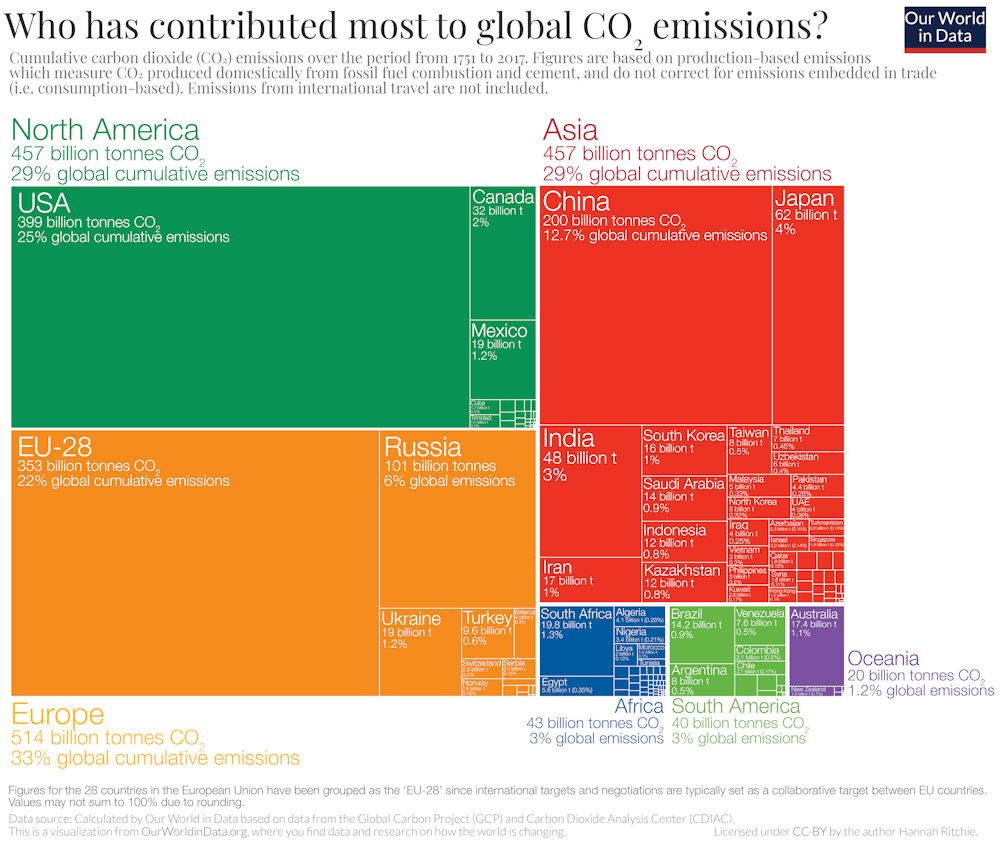
Carbon dioxide stays in the atmosphere for hundreds of years, and this accumulation drives climate change. Carbon dioxide traps heat, warming the planet. Some countries and regions bear vastly more responsibility for cumulative emissions than others.

For instance, the United States has emitted over a quarter of all greenhouse gases since the 1750s, while the entire continent of Africa has emitted only about 3%.

Cumulative emissions, 1751-2017, by country. Hannah Ritchie/Our World in Data, CC BY
People today continue to benefit from wealth and infrastructure that was generated with energy linked to these emissions decades ago.

Emissions differences within countries

The benefits of fossil fuels have been uneven within countries, as well.

From this perspective, thinking about climate justice requires attention to patterns of wealth.

A study by the Stockholm Environment Institute and Oxfam found that 5% of the world’s population was responsible for 36% of the greenhouse gases from 1990-2015. The poorest half of the population was responsible for less than 6%.

Share of emissions growth by wealth rank. Stockholm Environment Institute and Oxfam, CC BY-ND

These patterns are directly connected to the lack of access to energy by the poorest half of the world’s population and the high consumption of the wealthiest through things like luxury air travel, second homes and personal transportation. They also show how actions by a few high emitters could reduce a region’s climate impact.

Similarly, over one-third of global carbon emissions from fossil fuels and cement over the past half-century can be directly traced to 20 companies, primarily producers of oil and gas. This draws attention to the need to develop policies capable of holding large corporations accountable for their role in climate change.


Who will be harmed by climate change?

Understanding where emissions come from is only part of the climate justice dilemma. Poor countries and regions often also face greater risks from climate change.

Some small island countries, such as Tuvalu and the Marshall Islands, face threats to their very survival as sea levels rise. Parts of sub-Saharan Africa, the Arctic and mountain regions face much more rapid climate change than other parts of the world. In parts of Africa, changes in temperature and precipitation are contributing to food security concerns.

Many of these countries and communities bear little responsibility for the cumulative greenhouse gas emissions driving climate change. At the same time, they have the fewest resources available to protect themselves.


Climate impacts – such as droughts, floods or storms – affect people differently depending on their wealth and access to resources and on their involvement in decision making.

Processes that marginalize people, such as racial injustice and colonialism, mean that some people in a country or community are more likely than others to be able to protect themselves from climate harms.

Strategies for a just climate agreement

All of these justice issues are central to negotiations at the United Nations’ Glasgow climate conference and beyond.

Many discussions will focus on who should reduce emissions and how poor countries’ reductions should be supported. Investing in renewable energy, for example, can avoid future emissions, but low-income countries need financial help.

Wealthy countries have been slow to meet their commitment to provide US$100 billion a year to help developing countries adapt to the changing climate, and the costs of adaptation continue to rise.

Some leaders are also asking hard questions about what to do in the face of losses that cannot be undone. How should the global community support people losing their homelands and ways of life?

Some of the most important issues from a justice perspective must be dealt with locally and within countries. Systemic racism cannot be dealt with at the international level. Creating local and national plans for protecting the most vulnerable people, and laws and other tools to hold corporations accountable, will also need to happen within countries.

These discussions will continue long after the Glasgow conference ends.

Links

(BBC) COP26: More Than 40 Countries Pledge To Quit Coal

BBC

Coal produced around 37% of the world's electricity in 2019. Reuters

More than 40 countries have committed to shift away from coal, in pledges made at the COP26 climate summit.

Major coal-using countries including Poland, Vietnam and Chile are among those to make the commitment.

But some of the world's biggest coal-dependent countries, including China and the US, did not sign up.

In a separate commitment, 20 countries, including the US, pledged to end public financing for "unabated" fossil fuel projects abroad by the end of 2022.

Such projects burn fossil fuels, like coal, oil and natural gas, without using technology to capture the CO2 emissions.

Coal is the single biggest contributor to climate change.

What is the coal pledge?

Signatories to the agreement have committed to ending all investment in new coal power generation domestically and internationally.

They have also agreed to phase out coal power in the 2030s for major economies, and the 2040s for poorer nations, the UK said.

Dozens of organisations also signed up to the pledge, with several major banks agreeing to stop financing the coal industry.

"The end of coal is in sight," UK business and energy secretary Kwasi Kwarteng said.

"The world is moving in the right direction, standing ready to seal coal's fate and embrace the environmental and economic benefits of building a future that is powered by clean energy."

But UK shadow business secretary Ed Miliband said there were "glaring gaps" from China and other large emitters, who have not committed to stop increasing coal use domestically. He also noted that there was nothing on the phasing out of oil and gas.

Mr Miliband said the UK government "has let others off the hook".

Although progress has been made in reducing coal use globally, it still produced around 37% of the world's electricity in 2019.

Countries like South Africa, Poland and India will need major investments to make their energy sectors cleaner.

Juan Pablo Osornio, head of Greenpeace's delegation at COP26, said: "Overall this statement still falls well short of the ambition needed on fossil fuels in this critical decade."

"The small print seemingly gives countries enormous leeway to pick their own phase-out date, despite the shiny headline," he added.


Analysis: Digging the grave for coal?
Matt McGrath, Environment Correspondent

There's been such a flurry of announcements on the world's most polluting fossil fuel, that it's hard to see the light for all the (coal) dust.

There are many questions outstanding.

One of the biggest is the list of countries missing from this bonfire of coal commitments - including the US, China and India.

The time scales for phase-out are also a bit woolly - with richer countries promising to end coal by the 2030s, with developing nations in the 2040s.

None of these commitments are binding - again there is no big stick to force countries to do this.

And how many of the plans to stop using coal in developing countries will need financial support from the developed world?

We've already seen the UK, Germany and the US step up to pay South Africa's $8.5bn (£6.2bn) to move away from coal. Other countries are said to be interested in following in South Africa's footsteps.

So is there also a question of the rich countries paying others to do what they struggle to do at home?


What about fossil fuels?


While the US was notably absent from the coal commitments, it joined 19 other countries - including the UK, Canada and New Zealand - in pledging to stop financing unabated overseas fossil fuel projects.

"Investing in unabated fossil-related energy projects increasingly entails both social and economic risks… and has ensuing negative impacts on government revenue, local employment, taxpayers, utility ratepayers and public health," the signatories of the UK-led initiative said in a joint statement.

The deal saw countries and financial institutions vow to steer their spending into clean energy instead.

It allowed for exemptions in unspecified "limited" circumstances, but said these must be consistent with efforts to limit global temperature rises to 1.5C.

"Ending international finance for all unabated fossil fuels is the next critical frontier we must deliver on," UK energy minister Greg Hands said. "We must put public finance on the right side of history."

However, major financers of such projects, such as China, Japan and South Korea, did not sign up.

The countries did join G20 nations last month in agreeing to end financial support for new unabated coal plants overseas.

Links

05/11/2021

(BBC) COP26: UK Firms Forced To Show How They Will Hit Net Zero

BBC News - Robert Plummer | Beth Timmins

Getty Images

Most big UK firms and financial institutions will be forced to show how they intend to hit climate change targets, under proposed Treasury rules.

By 2023, they will have to set out detailed public plans for how they will move to a low-carbon future - in line with the UK's 2050 net-zero target.

An expert panel will set the standards the plans need to meet to ensure they are not just spin.

Any commitments will not be mandatory. Green groups say this is not enough.

Net zero is when a business or a country achieves an overall balance between the amount of carbon it is emitting and the carbon that it's removing from the atmosphere.

Firms and their shareholders will be left to decide how their businesses adapt to this transition, including how they intend to decarbonise.

And although the plans will need to be published, the government said "the aim is to increase transparency and accountability" and the UK was not "making firm-level net-zero commitments mandatory".The market will decide whether firms' plans are credible, the Treasury said.

Speaking at the COP26 climate summit, Chancellor Rishi Sunak claimed the UK was leading the world in becoming the "first-ever net zero aligned global financial centre".

He said the changes would mean: "Better and more consistent climate data; sovereign green bonds; mandatory sustainability disclosures; proper climate risk surveillance; and proper global reporting standards."

In total, 450 firms controlling 40% of global financial assets - equivalent to $130tn (£95tn) - have agreed to commit to limit global warming to 1.5C above pre-industrial levels.

'Not fast enough

'
However, campaign group Global Witness said that without regulation the pledges were "doomed to fail".

"Banks and financiers are the lifeblood of the fossil fuel companies and destructive agribusinesses fuelling the climate crisis - so it's right that focus should be on them at COP26.

"However, today's announcement by banks risks amounting to more greenwashing if it's not legally binding," said Veronica Oakeshott, head of forests policy and advocacy at Global Witness.

David Barmes, senior economist at the campaign group Positive Money, said the intention was positive, but that financial firms were still "pouring billions into environmentally harmful projects."

Mark Campanale, founder and executive chair of Carbon Tracker Initiative, praised the ambition of the plans, but said details of how it would work were still unclear.

"None of the financial assets announced are currently aligned with net-zero and no group of companies can say they are meeting the Paris target by continuing to invest in fossil fuels, so that needs to change considerably before London can be lauded as the world's first net-zero financial centre and a model for the world," he said.

Shaun Spiers, executive director of environmental think tank Green Alliance, said that more UK public sector funding was needed.

"Private sector investment is vital, but it will be much easier to achieve on the back of serious investment by the chancellor," he said.

However, a coalition of finance groups led by former Bank of England governor Mark Carney said there was enough finance committed to keep global warming to 1.5C.

The Glasgow Financial Alliance for Net Zero (GFANZ) said more than $130trn (£95trn) of private capital "is now committed to transforming the economy for net zero".

In practice, this means that bank loans which would go to an oil field, or a coal mine, are diverted to renewable energy or to a mortgage product that subsidises highly efficient homes.

Bank bosses will also be expected to have tough conversations with their customers who want to build coal power stations, pulling funding in advanced nations now, and developing countries beyond the next decade.

Transition plans

Under the proposed Treasury rules, financial institutions and companies with shares listed on the London Stock Exchange must come up with net-zero transition plans, which will be published from 2023.

The strategies will need to include targets to reduce greenhouse gas emissions, and steps which firms intend to take to get there.

A taskforce made up of industry leaders, academics, regulators and civil society groups will set a science-based "gold standard" for the plans in order to guard against so-called "greenwashing" - where environmental initiatives are more about marketing than substance.

However, the government said there was "not yet a commonly agreed standard for what a good quality transition plan looks like".

Meanwhile, Mr Sunak also pledged that a target for developed countries to send $100bn (£720m) a year to those that are less developed - to help support their transition to net zero - will be achieved by 2023.

Alison Rose, chief executive of Natwest, told the BBC Radio 4 Today programme that the bank had started measuring the emissions on its balance sheet to help it track progress, saying "transparency was critical".

She said the bank was working with the oil and gas industry "to develop credible transition plans so we can track progress and work with our customers".

But Ms Rose said its main focus was helping small firms where there were "real business opportunities" in "adopting sustainable supply chain [and] sustainable business practices".

Kay Swinburne, vice-chairman of financial services at KPMG UK, said the announcement on UK firms would provide the financial services industry with a "valuable set of unified metrics to measure progress towards decarbonisation".

"It is brave to put a gold standard in place for all companies raising funding," she added.

And Dr Ben Caldecott, director of the UK Centre for Greening Finance and Investment, said the plans would "spur demand for green finance and accelerate decarbonisation, not just in the UK but wherever UK firms do business".


Analysis
Faisal IslamEconomics editor

Follow the money to net zero. That is the plan unveiled today, with two-fifths of the world's financial assets, $130 trillion, under the management of banks, insurers and pension funds that have signed up to 2050 net-zero goals including limiting global warming to 1.5C.

This means that the giant laser beam of global finance will be fired towards technologies that lower and eradicate carbon emissions, and away from "brown holdings" of investments in coal, oil and gas.

The aim of the initiative chaired by former Bank of England Governor Mark Carney is to change the plumbing of the whole financial system forever.

What does this mean in practice?

Essentially the easy cheap bank financing that naturally flows to, say, an oil field, or a coal mine, is diverted to renewable energy or to a mortgage product that subsidises highly efficient homes.

In fact all of this is already happening in niches, with loans raised for environmental investments attracting a flood of money, and so cheaper funding - something referred to as a "greenium".Bank chiefs say they are having tough conversations with their customers who want to build coal power stations, pulling funding in advanced nations now, and developing countries beyond the next decade. So that is the grand hope.

Promisingly, the Chinese, whose public banks have been huge backers of coal around the world, have also said they will step back from such investments.

But the negotiations in Glasgow will fall short of setting a global carbon price - the sort of measure that could really guarantee the path to net zero.

They have also so far not come up with a globally consistent way for bank regulators to force the financial system to increase the risk and the cost of lending to carbon intensive industry.

And then there is the really fundamental question about COP26's climate finance agenda: can such fundamental ecological, economic and social change really be achieved more through financial carrot than by regulatory stick?

This position suits politicians who don't necessarily want to tell their voting public to consume or travel less than they are used to.

By changing the financial system, their hope is that the trajectory of every economic sector, from energy to transport, food to clothing, how we live, work and what we consume will decarbonise of their own accord.

Links

Lethal Heating is a citizens' initiative