21/11/2021

(The Conversation) COP26 Left The World With A Climate To-Do List: Here Are 5 Things To Watch For In 2022

The Conversation - 

John Kerry, the U.S. presidential special envoy for climate, surrounded by other negotiators during COP26. UNFCCC, CC BY-NC-SA

Author
is Dean of the Fletcher School, Tufts University.
How much the world achieved at the Glasgow climate talks – and what happens now – depends in large part on where you live.

In island nations that are losing their homes to sea level rise, and in other highly vulnerable countries, there were bitter pills to swallow after global commitments to cut emissions fell far short of the goal to keep global warming to 1.5 degrees Celsius (2.7°F).

For large middle-income countries, like India and South Africa, there were signs of progress on investments needed for developing clean energy.

In the developed world, countries still have to internalize, politically, that bills are coming due – both at home and abroad – after decades of delaying action on climate change. The longer the delay, the more difficult the transition will be.

There were also signs of hope as coalitions of companies, governments and civil society and indigenous peoples groups forced progress on issues such as stopping deforestation, cutting methane, ending coal use and boosting zero-emissions vehicles. Now, those promises must be acted upon.

As a former senior U.N. official, I’ve been involved in the climate negotiations for several years. Here are five key elements to watch over the coming year as countries move forward on their promises.

Bending the curve to 1.5°C

Going into the Glasgow summit, countries’ commitments had put the world on a trajectory of warming about 2.9°C this century, well beyond the 1.5°C goal and into levels of warming that will bring dangerous climate impacts.

Indian Prime Minister Narendra Modi’s announcement in the first days (much to the surprise of Indian observers) that India would reach net zero emissions by 2070 and generate 50% of its energy from renewables by 2030 helped lower that trajectory to 2.4°C.

Countries agreed to return for the next round of climate talks in November 2022 in Sharm el-Sheikh, Egypt, with stronger commitments to put the world on track for 1.5°C.

The Climate Action Tracker estimates the global average temperature increase based on national policies. New Climate Institute and Climate Analytics

That turns the spotlight back on national action. China reminded everyone, while throwing shade at the U.S., that goals must be backed with plans for implementation.

U.S. Cabinet members and Congressional leaders had much to say in Glasgow about being “back,” after the previous administration withdrew from the Paris climate agreement. Yet they had little to offer in terms of the U.S. share of the finance, and the world cast a worried eye over its continued partisan politics.

More South Africa deals, please

While all countries are important for reaching the world’s climate goals, some are more important than others.

Countries that are high emitters and heavily dependent on coal will be a focus of international attention in the coming months, not just to phase down coal but importantly to fund a just transition to green sources of energy and the necessary electricity infrastructure.

The poster child for this approach is South Africa, where a presidential commission has worked for three years to develop a just transition plan and has been able to attract US$8.5 billion from the U.K., the EU, the U.S. and others to help them execute on it. That, coupled with guarantees and other financial aid that could help draw further private investment, could become a replicable model.

The key was national ownership. In the year ahead, look for plans to come together in Indonesia and Vietnam and other countries needing to fast forward away from coal.

Getting climate finance flowing

Many developing countries already have national platforms to deliver on their commitments, but throughout Glasgow’s conference halls, officials complained that finance wasn’t flowing to help them succeed.

This isn’t just a climate finance problem. Many countries are also facing economic disruption from the COVID-19 pandemic and have chafed at the way international financial institutions fail to address issues of access to finance and trade.

Advanced economies didn’t come to Glasgow ready to provide even the $100 billion a year in finance promised a decade ago, which shrank the landing zone for agreement on all issues.

The Chinese calculate the value of growth lost through a few measures, such as floods and heat. Unsurprisingly it amounts to trillions of dollars. It may be a useful exercise whenever a government balks at the “cost” of climate action.

In the end, governments agreed to reach the $100 billion annual climate finance target within the next two years and agreed that adaptation funding should double. But with the U.N. Environment Programme estimating that adaptation funds will need to quadruple by 2030 from today’s $70 billion, there’s a long way to go.

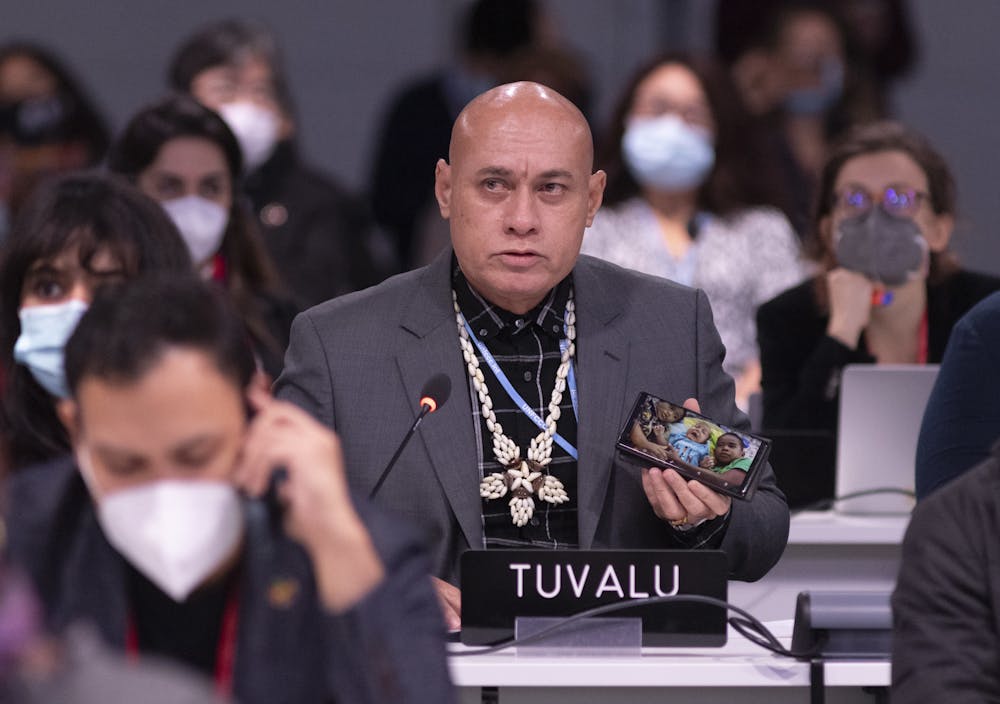
Tuvalu Finance Minister Seve Paeniu gave an emotional speech as the conference ended.

The Glasgow Climate Pact also criticized the traditional channels of public funds that set the conditions for finance to flow, including the International Monetary Fund and the World Bank.

Look for G7 and G20 countries, the largest shareholders of these institutions, to examine how they can be managed differently to respond to the climate emergency. All eyes are on Italian Prime Minister Mario Draghi, current president of the G20 and an experienced central banker.

Actions could range from bolstering the Climate Investment Funds, managed by the World Bank, and loosening the terms and conditions of the IMF’s proposed management of the reallocation of special drawing rights, to incentives to leverage more private funds and take more risk.

Finance pledges and cries of ‘greenwashing’

In the first week of Glasgow, the titans of the financial industry heralded the Glasgow Financial Alliance for Net Zero – the commitment by financial institutions representing $130 trillion in assets to accelerate the transition to a net-zero emissions economy.

The shifts within financial markets away from exposure to carbon emissions was palpable. But without more detail, the announcement attracted cries of “greenwashing.”

Organizers of the alliance will need to work hard to hold members to account, and throw out those still underwriting the coal industry, for example.

The principle of getting everyone pledged and in the tent and then making them improve has been used before, for example, the Net Zero Asset Managers Initiative.

But this only works with transparency, and buried among the press releases was their report that, of the advertised $57 trillion of the initiative’s assets under management, only an estimated 35% is actually in line with net zero.

The U.N. secretary-general announced an expert group to propose clear standards for companies and others making net zero commitments, partly in response to furor around greenwashing. That group is expected to report back in 2022.

At the heart of Glasgow was a new seriousness around transparency, credibility, integrity and accountability. Watch this unfold this coming year.

The third leg of a wobbly stool: Loss and damage

Climate action is a three-legged stool – mitigation, adaptation and loss and damage.

Loss and damage was mentioned an unprecedented 12 times in the final Glasgow texts, but without commitments to funding or mechanisms to secure funding. Loss and damage, or reparations, can be understood this way: you broke it (or endangered it), you pay for it.

But, afraid of lawsuits in international courts – which the U.S. does not belong to – or afraid of the costs, developed countries have opposed progress on the issue in recent years.

Developing countries left Glasgow disappointed, but there was no escaping the debate. Watch for a design of a mechanism to help pay for loss and damage and plans to start funding it. With the next year’s U.N. climate conference in Africa, this will move center stage.

There’s a Scottish proverb, “fools look to tomorrow, wise men [sic] use tonight.” There were wise people in Glasgow, and fools too. But there’s not a night to lose in the year ahead.

Links

(AU Monash University) Including Oceans In Climate Talks Remains Piecemeal And Inconsistent, At Best

Monash University - Sali Bache


Author
Dr Sali Bache is the international policy lead at ClimateWorks, with a focus on the Asia Pacific region. She is involved in policy analysis and development, and impact and opportunity scoping for climate and blue carbon work in the region.
To date, archipelagic Southeast Asian and South Pacific island countries, including Australia, have led the way in seeking to include oceans as part of all discussions regarding climate change challenges and solutions.

This is understandable. With their surrounding ocean territories greater than their land mass, these island states are already experiencing the impacts of our changing climate. But this isn’t just a regional concern. Oceans cover more than 70% of our planet, so why aren’t they central to climate talks?

Mounting evidence reveals the substantial impact climate change has on oceans and marine ecosystems. Across Southeast Asia and the Pacific Islands, this includes rising sea levels, erosion and coastal inundation.

Sandbags on a beach in Fiji.

The region is already recognised as the most disaster-prone in the world, with flooding, storm surges and landslides killing, on average, 43,000 people in the Asia-Pacific every year. There’s also evidence of climate change intensifying and prolonging extreme weather events such as tsunamis, as well as contributing to the loss of marine habitats and species – including key human food sources – through ocean acidification.

In an area that’s home to two-thirds of the world’s hungry (nearly 500 million people) and relies on the ocean for 20% of its protein, this change is catastrophic.

Sea-level rise (SLR) in the western Pacific Ocean has been increasing at a rate two to three times the global average, resulting in almost 30 centimetres of net rise since 1990. And for some areas within Asia, an increase in sea levels of just 30 centimetres (the length of a school ruler) can result in 45 metres of land incursion and erosion.

The Asia-Pacific is particularly vulnerable to SLR due to its topography, with 97% of South Pacific islands and half of Asia residing in low-lying coastal areas. The risk is exacerbated by socioeconomic conditions impacting communities’ ability to cope with, or adapt to, such climate-generated change.

Countries such as Bangladesh, where residents are attempting to adapt their livelihoods to accommodate rising seas and increased salinity, will within the next 30 years see the migration of 200,000 people from the coastal delta area every year.

Indonesia plans to move its capital to Borneo, in light of recent dangerous flooding and dire predictions of much worse to come.

In the Pacific, some countries without safe areas to relocate have embarked on the preemptive acquisition of land in other states. This includes Kiribati, whose former president has purchased a large plot in Fiji as a refuge, should his atoll homeland become uninhabitable.

The other side to the oceans equation – one of opportunity

Oceans also offer a substantial part of the solution to climate change. In fact, ocean-based mitigation could provide more than 20% of the emissions reductions needed to keep warming below the now widely accepted 1.5°C target, through actions including changes to maritime industry practices, offshore renewable energy generation, human food production, and consumption shifts to sustainable “blue foods” and “blue carbon” sinks.


This is of particular significance to the Asia-Pacific. In relation to the shipping industry, more than 60% of cargo traffic passes through Asian ports, while the Pacific Island states are heavily reliant on cargo for many of their needs, and the Marshall Islands is the third-largest vessel registry in the world.

Similarly, the region is significant in regard to blue carbon, the South Pacific having defined itself as a “blue ocean” continent with an ocean territory of more than 30.5 million km².
The Asia-Pacific region also dominates in terms of coastal blue carbon ecosystems. For example, in regard to mangroves, Indonesia has the greatest stock in the world, with Australia coming in second – at 17% and 10%, respectively. These and other blue carbon coastal ecosystems such as tidal marshes and seagrasses act as impressive “vacuums” for carbon dioxide, storing more carbon per unit area than terrestrial forests.

However, oceans inclusion in climate talks remains piecemeal and inconsistent.

In 2006, UNFCCC greenhouse gas emission inventory guidelines were revised to include “offshore areas over which the country has jurisdiction”. However, the guidelines were inconsistent in their methodology for allocating emissions from different maritime sectors, leaving ships and aircraft engaged in international transport as external to the scope, allocating waterborne navigation emissions on international trips as split between country of departure and arrival, and fishing vessels emissions based upon the country delivering the fuel, with military fuel use categorised under “non-specified”.

Other elements weren’t extended beyond the shoreline until 2013, when the IPCC wetland supplement provided methodologies for coastal wetland sinks and sources. Unlike on land, however, their inclusion is optional.

Momentum for the inclusion of oceans in climate talks began to grow in 2014, with recognition of the critical role of the UNFCCC process in the UN General Assembly annual resolution on the Oceans and the Law of the Sea, and the IPCC in its AR5 Synthesis Report stating that climate change and acidification was altering the ocean at an unprecedented rate.

With the omission of oceans and coasts as part of the Paris Agreement negotiating text, 2015 marked a turning point. The efforts of some states to have oceans included in climate data and ambition then escalated, aided by 2015 COP co-president Fiji – a vocal advocate for ocean-climate linkages.

Australia, too, has participated in coalitions and in other forums with other countries in the region, contemplating the impact of climate change on oceans and considering potential mitigation measures. Of influence has been the High Level Panel on a Sustainable Ocean Economy, of which Indonesia and Palau are also members, and the Because the Ocean Initiative, which additionally includes the Marshall Islands, New Zealand and Singapore.

Mobilisation of the ocean community

A series of initiatives, including the re-emergence of Oceans Day at the 2015 COP, saw the major mobilisation of the ocean community, which has since sought to foster political momentum for oceans engagement. The first “Because the Ocean” declaration urged the creation of an Ocean Action Plan under the UNFCCC, and the following year a second declaration called for the inclusion of oceans in national reporting of emissions, and pledged reduction contributions.

These important steps and the ongoing mobilisation of action led to the first inclusion of oceans in the UNFCCC output document at COP25 in 2019, and the coining of the title the “Blue COP”.

In the intervening years, this prompted an Ocean and Climate Change Dialogue. To herald the COP26 another “Blue COP”, the world needed to step up in its ocean-climate commitment. In the event, the Glasgow Climate Pact did again acknowledge the oceans. It also committed to the Ocean and Climate Change Dialogue becoming a permanent annual event, and to the consideration by UNFCCC bodies of how to “integrate and strengthen ocean-based action into existing mandates and workplans”. 

While these are positive measures, they’re all UNFCCC-oriented, and at this stage require no action by state parties.
It remains today that we’re without systematic inclusion of the offshore in greenhouse gas inventories, and the range of other Paris Agreement instruments. Still, countries’ reporting areas aren’t aligned with the zones of sovereignty prescribed in the UN Convention on the Law of the Sea – the international treaty establishing a legal framework for maritime areas, protection and activities.

Given the magnitude of oceans’ impacts on both climate and emissions, such exclusions risk the integrity of the emissions data and activities that underpin our global climate efforts, as well as the health of the ocean itself.

Countries at COP26 had an opportunity to put ocean impacts and mitigation on the main stage. On the first day of the event, the Because the Ocean Initiative released a new declaration, calling for the systematic inclusion of oceans in UNFCCC and Paris Agreement processes, and enhanced ocean-climate action. 

Although a step in the right direction, the actual impact of the Glasgow Climate Pact will remain uncertain until the next COP, dependant on how the UNFCCC bodies respond to these directives, and what then occurs in regard to obligations of state parties and oceans resource allocation. 

The world is watching, but perhaps those in Southeast Asia and Pacific Island countries are watching most keenly.

Links

(The Conversation) The Ocean Is Essential To Tackling Climate Change. So Why Has It Been Neglected In Global Climate Talks?

The Conversation - 

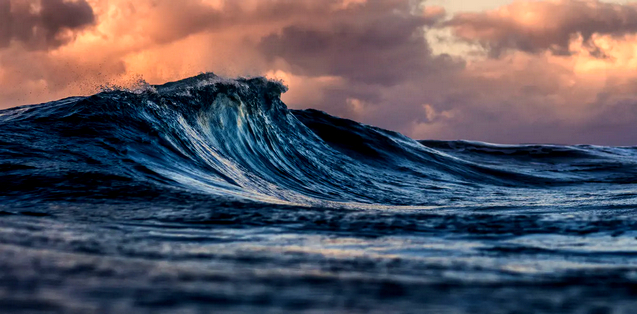
Silas Baisch/Unsplash, CC BY

Climate change is commonly discussed as though it’s a uniquely atmospheric phenomena. But the crisis is deeply entwined with the ocean, and this has largely been neglected in international climate talks.

The latest international climate negotiations made some progress by, for the first time, anchoring oceans permanently into the multilateral climate change regime. But the Glasgow Climate Pact is still leagues from where it needs to be to adequately reflect the importance of oceans to our climate system.

Most countries have targets for land-based emissions – but there are no such targets for oceans. Yet the ocean plays a vital role in helping balance the conditions humans and most other species need to survive, while also offering a substantial part of the solution to stop the planet warming over the crucial limit of 1.5℃ this century.

So how can oceans help us tackle the climate crisis? And what progress has been made in international negotiations?

The ocean’s incredible potential

Since industrialisation, the ocean has absorbed 93% of human-generated heat and one-third of anthropogenic carbon dioxide (CO₂).

The consequences of this are profound, including the thermal expansion of water (the key cause of sea level rise), ocean acidification, deoxygenation (oxygen loss), and forcing marine life to redistribute to other places.

Alarmingly, this may one day lead the ocean to reverse its role as a carbon sink and release CO₂ back into the atmosphere, as its absorption ability declines.

Equally important is ocean-based climate mitigation, which could provide more than 20% of the emissions reductions needed for the 1.5℃ goal.

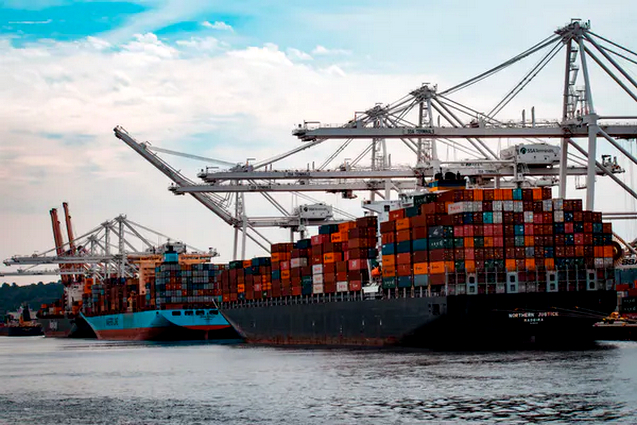
The shipping industry is responsible for about 3% of global emissions. Andy Li/Unsplash, CC BY

Crucially, we must see changes to maritime industries. The shipping industry alone has a similar carbon footprint to Germany – if shipping were a country it would be the world’s sixth-largest emitter. Although high on the International Maritime Organisation’s agenda, the decarbonisation of shipping still lacks adequate targets or processes.

Oceans can also provide climate-safe, sustainable food choices. Current food systems, such as emissions-intensive agriculture, fishing, and processed foods are responsible for one-third of global emissions. Considerable environmental (and health) benefits can be gained by shifting our diets to sustainable “blue foods”.

These include seafoods sourced from fisheries with sustainable management practices, such as avoiding overfishing and reducing carbon emissions. Markets and technologies should also be geared towards the large-scale production and consumption of aquatic plants such as seagrasses.

There’s also a wealth of opportunity in “blue carbon” – capturing CO₂ in the atmosphere by conserving and restoring marine ecosystems such as mangroves, seagrasses and salt marshes.

However, the success of nature-based solutions depends on a healthy ocean ecosystem. For example, there are emerging concerns around the impact of plastic pollution on plankton’s ability to absorb CO₂.

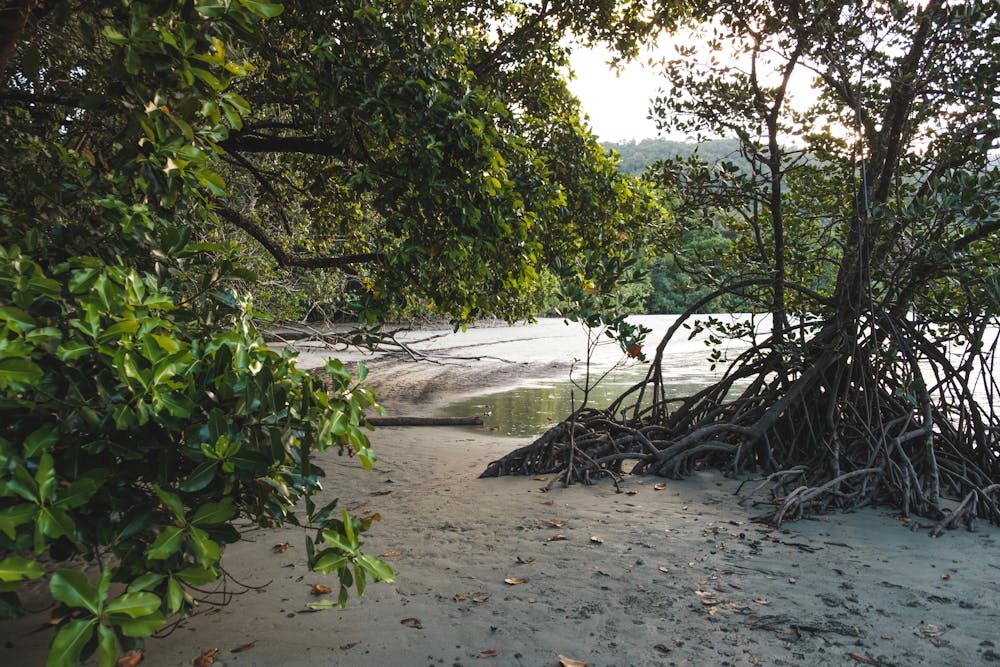
Conserving mangroves is an important way to sequester carbon from the atmosphere. Shutterstock

But perhaps the greatest impact would come from adopting offshore renewable energy. This has the potential to offer one-tenth of the emissions reductions we need to reach the 1.5℃ goal. The International Energy Agency has estimated offshore wind could power the world 18 times over its current consumption rate.

Climate talks are making slow progress

For more than a decade, the inclusion of oceans in climate talks has been piecemeal and inconsistent. Where they have been part of negotiations, including at COP26, talk has focused on the potential for coastal areas to adapt to climate change impacts such as sea-level rise, as first raised in international fora in 1989 by small island states.

The final COP26 agreement, known as the Glasgow Climate Pact, made slight progress.

The pact recognised the importance of ensuring the ocean ecosystem’s integrity. It established the “the Ocean and Climate Change Dialogue” as an annual process to strengthen ocean-based action. And it invited UNFCCC bodies to consider how to “integrate and strengthen ocean-based action into existing mandates and workplans” and report back.
While these are positive measures, at this stage they don’t require action by parties. Therefore, they’re only a theoretical inclusion, not action-oriented.

We still lack national targets and clear, mandatory international requirements for countries to consider sinks, sources and activities beyond the shoreline in their climate planning and reporting.

Where COP26 did progress was its focus on whether ocean impacts and mitigation will finally be brought into the mainstream climate agenda.

For the first time in five years, a new “Because the Ocean” declaration was released, which calls for the systematic inclusion of the oceans in the UNFCCC and Paris Agreement process.

A delegate from Tuvalu, a Pacific Island nation facing the existential threat of sea level rise, speaks at COP26. EPA/ROBERT PE

What do we do now?

What’s now needed is a list of mandated requirements that ensure countries report on and take responsibility for climate impacts within their maritime territories.

But as COP26 president Alok Sharma said of the summit as a whole, it was a “fragile win”. We still lack any reference to consistency with existing mechanisms, such as the law of the sea convention or how funding will be allocated specifically to oceans.

As such, the actual impact of COP26 on the inclusion of oceans in climate action remains uncertain. It will depend on how the UNFCCC bodies respond to these directives, and their success in extending obligations to state parties.

Responding to the climate crisis means we need to stop pretending the ocean and atmosphere are separate. We must start including ocean action as a routine part of climate action.

Links

20/11/2021

(The Conversation) Climate Change: How Elephants Help Pump Planet-Warming Carbon Underground

The Conversation - 

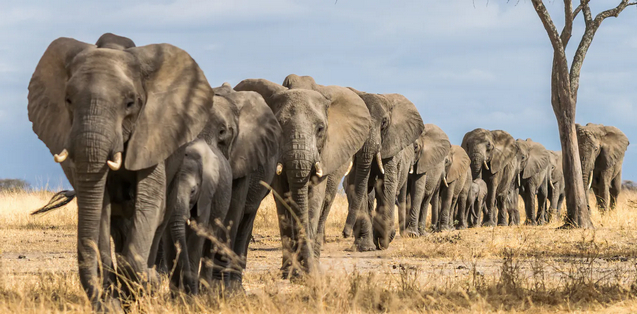
Hansen.Matthew.D/Shutterstock

Author
 is Carlsberg Foundation Visiting Postdoctoral Fellow at Oxford Ecosystems Lab, University of Oxford.     
Imagine you’re in a hot air balloon flying over an African savanna in the late growing season. Below, herds of elephants, zebras, wildebeests and rhinos roam a mosaic landscape dotted with lonesome trees and daubs of woodland on a canvas of yellow-brown grass. The hungry and rowdy herbivores are eating and trampling the vegetation that stores carbon and keeps it from heating the atmosphere.

You’d be forgiven for thinking that their voracious appetites and blundering steps might be disturbing and releasing the carbon stored in this ecosystem in much the same way wildfires do. But, incredibly, the way herbivores disturb the landscape actually helps it lock up more carbon in durable stores that are difficult to reach. In a new review which compiled evidence from lots of different studies, we uncovered how large herbivores could help slow climate change this way.

Forests are often evoked as the ultimate vessels for storing carbon. But carbon in the bark and leaves of trees is vulnerable to logging, pests and fires which can unleash decades of accumulated carbon in a matter of hours. Even in healthy forests, most of the carbon stored in vegetation above ground is decomposed and recycled to the atmosphere as greenhouse gas in less than a century.

The carbon stored in trees is released during forest fires. Mikhail Roop/Shutterstock

Meanwhile, the soil beneath savannas and grasslands where trees are sparse but herbivores are abundant can guard carbon for thousands and even tens of thousands of years in hard-to-reach underground pools. So how is this possible?

Research from 2009
showed how wildebeests returning to the Serengeti savanna of east Africa after a virus tore through their populations led to fewer catastrophic wildfires. Because the wildebeests trampled and ate the vegetation that had been fuelling the fires in their absence, their return in the 1960s allowed the plants to gradually reestablish and recover their pre-epidemic abundance, along with the carbon the landscape’s soil was storing.
This may sound counter-intuitive, but large herbivores and seasonal fires are natural elements of grassland ecosystems. Without wildebeests keeping on top of all that fuel, small fires turn into catastrophic blazes and consume everything.
But does it really matter for the climate whether herbivores or fires consume the vegetation? If you assume that 100% of the carbon in vegetation is released to the atmosphere as greenhouse gasses from fires or elephant digestion, then it shouldn’t.

But this isn’t what really happens. For one thing, the burned carbon that remains in the soil after a fire is resistant to decomposition by microbes, and often called black carbon.

Doing their bit for the climate. Henk Bogaard/Shutterstock

Meanwhile, up to half of the plant material eaten by large herbivores is excreted as dung and urine, which tends to be easier for decomposers in the soil (such as beetles, earthworms, fungi and bacteria) to break down compared to plant litter like dead leaves and fallen logs. Scientists once assumed that plant material eaten by microbes or animals was lost from the soil. But recent discoveries suggest this picture is far too simple.

While some of what’s eaten by decomposers is released as CO₂ to the atmosphere, most of it enters persistent soil pools of carbon. An effective way of forming long-term stores of carbon underground then is to feed the soil with easily decomposable organic material.

Large animals seem adept at reorganising where ecosystems store carbon, directing a larger fraction towards persistent and stable reservoirs underground. This shows how valuable intact wildlife communities can be, and should urge us to protect the few remaining herbivore-rich ecosystems on Earth, such as the African savanna. We may restore so much more by restoring nature’s four-legged ecosystem engineers in the places they have been lost.

Links

(BroadAgenda) How 1000 Moving Images Will Spur Climate Action

BroadAgenda - Hilary Wardhaugh

How 1000 moving images will spur climate action


Kangaroos in Queanbeyan Cemetery, NSW, during the fires. Picture: Lib Ferreira 

Author
Hilary Wardhaugh is a career professional photographer, based in Canberra and Queanbeyan
#everydayclimatecrisis is a visual petition of 1000 photos that will presented to the Australian Government in Canberra before the next Federal election. It will also be visible online via the link above.

So far, I have 350 extraordinary submissions – a few of which are featured here. I’m hoping for many more! 

This project is
 a call out to all women and non-binary people of Australia to create images about Australia’s climate crisis, in your local area and country-wide. 

I started #everydayclimatecrisis because, instead of feeling helpless about climate change, we do have a voice (in this case, in the form of a camera). And we can use it to make change. 

“Blah blah blah” is Swedish environmental activist Greta Thunberg’s rallying cry to the leaders of our world who seemingly put self interest and big business before humanity and the planet. 

Yes. The dialogue from the School Strike For Climate kids are using is angry and mocking. In Australia, it seems that our Federal leaders play politics while we grapple with what the next decade will deliver.

The remains of a property destroyed by the bushfires in Sarsfield, Victoria, Australia on Tuesday the 7th of January, 2020. Picture: Christina Simons

In a patriarchal world, our governments and colonial systems have exacerbated inequality globally and we have come to a tipping point. We need a reboot. A gender equal world is healthier, peaceful and productive. We also need to include women, First Nations people and other vulnerable communities in decision making. Indigenous people see culture, climate and nature as inseparable.

Recently at COP26 there was much talk about the existential climate crisis humanity faces and the need to set targets. It is short-sighted just having the captains of industry and politicians making decisions. Targets need to encompass all parts of society. Research and collaboration between science, humanities and the arts is all important to gain an ethical path that allows a just transition to a sustainable future and justice for all humanity.

When considering the climate crisis we face it is hard to imagine what will happen in the future – just as it may have been  hard to imagine what a  pandemic might do to the way we liveThat’s until it actually happened!

Wind farm. Picture: Melissa Stewart

The majority of women occupy less permanent and/or part-time employment. Women are also responsible for the majority of unpaid work, care and volunteering.  The political response in Australia to the pandemic has shown us that women are more vulnerable to the economic effects of crises, than men. The pandemic has also shown us that it was the care economy which is often made up of women’s roles that kept our country going – roles like  child care, health care, aged care and cleaning.

The pandemic was the opening act. The climate emergency we face is the main event! With the global environment teetering on catastrophic failure it is more important than ever to take a holistic approach to solutions by embracing women and our First Nations’ people, culture and wisdom. The Women’s Climate Congress states that “nurture of life in the natural world and care for the Earth must be at the centre of every policy government decision”. This is why I have created the #everydayclimatecrisis Visual Petition to the Australian Parliament. 

The petition does not require signatures or words, just photos. It a petition by women and non-binary people to photograph the effects of climate change in their area and share how they feel about it. Drawing from the old adage that ‘a picture is worth a 1000 words’ the aim is to get 1000 images which equates to 1,000,000 words. 
Collectively 1000 images responding to the climate crisis from women all over Australia is a powerful feminist document!
Photographic images can be created using a phone camera, DSLR or film camera and there is no age limit or need to be a professional photographer or artist. Creators will always retain their own copyright and all images submitted are only used for the Petition and promotion only. It is important to include phone photographs as most people have a mobile phone and it is often the only camera we have on our person most of the time, making the petition as democratic as possible. The petition aims to give a voice to people who would not necessarily have a say including those most vulnerable to the effects of climate change. 

Bird No More – Melbourne. Picture: Julie M Milton.

Hence, the petition is an egalitarian approach to image-making and usage. The petition asks for personal images to be used in protest for the greater good. I call it photo activism.

The word “everyday” means  “encountered or used routinely or typically : ORDINARY 

In the petition title the word “everyday” is used. It is not the intention that the images are photographically or contextually ordinary, but it does mean that images illustrating the effects of climate change are seen “everyday” or more importantly that many of us think about this climate crisis “everyday”. Ironically, it is not everyday we have a climate crisis. This is a one off; our only chance. 
By having women only submitting images challenges the industrial, capitalist and economic systems that have gotten us to this point. We need to be seen, heard and considered.
We want to represent how the climate crisis makes us feel and also know that by submitting our images to this petition we will have been represented because representation of women within the arts is still less than men. The document will be memorialising this moment in time and with the hope that it will become part of the national collection at the National Library of Australia..

Context is important. The climate crisis we face is existential and can be all consuming but there are dangers of narratives of doom and despair. Initially, the petition was only seeking images depicting the effects of this crisis, but thanks to some timely advice I realised that 1000 images of despair and failure would be too negative. 

So, with this in mind I now seek a variety of images, including those that illustrate the beauty of the land we live on and the hope generated by illustrating humans doing great things to repair damage. 
I want women to respond to the call out literally but also emotionally, personally and creatively.
Murray Darling water delivery. Picture: Louise Whelan

It is necessary to show the wonderful power of nature to restore and regenerate. Too much negativity and our problems are seemingly insurmountable so by adding some positivity and hope can inspire and help and change our behaviours. 

The first aim of the #everydayclimatecrisis Visual Petition is to have a tangible printed and digital record of this moment in time as documented by women and to be shared by women all over Australia.

The second aim of the #everydayclimatecrisis Visual Petition is to elevate women. Each woman who responds to the theme and submits to the petition will be represented in several ways as can be seen on our website. 

Phases Of The Tennis Ball. A recent Birrarung Harvest. Lisa Murray

Lastly, as with any petition there will be demands. The demands are to be collected from the photographers submitting at the same time as they submit their images. 

Dr Emma Dawson from Per capita states “We need a new social compact for Australia, centred on the concept of care: care for each other, care for our communities, care for our environment, care for our future.” 

Women Deliver have a set of  ideas that include: having women, First Nations and grassroots organisations as part of the decision making process, to include policies that help women’s resources and abilities to function and care after emergencies, to manage financial and recovery programs that include women and the care economy. A truly humanitarian future requires community, a care ethos and diversity!

The #everydayclimatecrisis Visual Petition needs to be more than a symbolic handover of 1000 diverse images. It will come with individuals’ demands and be on public record. If we can have our Prime Minister waving our petition around in Question Time rather than a lump of coal and that action being recorded in Hansard then possibly there would be no more blah blah blah!

Links

(The Guardian) Ten Ways To Confront The Climate Crisis Without Losing Hope

The Guardian - 

It’s easy to despair at the climate crisis, or to decide it’s already too late – but it’s not. Here’s how to keep the fight alive

Illustration: Klawe Rzeczy/The Guardian

Author
Rebecca Solnit is a Guardian US columnist. Her most recent books are Recollections of My Nonexistence and Orwell’s Roses.
The world as we knew it is coming to an end, and it’s up to us how it ends and what comes after. It’s the end of the age of fossil fuel, but if the fossil-fuel corporations have their way the ending will be delayed as long as possible, with as much carbon burned as possible. If the rest of us prevail, we will radically reduce our use of those fuels by 2030, and almost entirely by 2050. We will meet climate change with real change, and defeat the fossil-fuel industry in the next nine years.

If we succeed, those who come after will look back on the age of fossil fuel as an age of corruption and poison. The grandchildren of those who are young now will hear horror stories about how people once burned great mountains of poisonous stuff dug up from deep underground that made children sick and birds die and the air filthy and the planet heat up.

We must remake the world, and we can remake it better. The Covid-19 pandemic is proof that if we take a crisis seriously, we can change how we live, almost overnight, dramatically, globally, digging up great piles of money from nowhere, like the $3tn the US initially threw at the pandemic.

The climate summit that just concluded in Glasgow didn’t get us there, though many good and even remarkable things happened. Those people who in many cases hardly deserve the term “leader” were pulled forward by what activists and real leaders from climate-vulnerable countries demanded; they were held back by the vested interests and their own attachment to the status quo and the profit to be made from continued destruction. As the ever-acute David Roberts put it: “Whether and how fast India phases out coal has nothing at all to do with what its diplomat says in Glasgow and everything to do with domestic Indian politics, which have their own logic and are only faintly affected by international politics.”

Six months ago, the usually cautious International Energy Agency called for a stop to investment in new fossil-fuel projects, declaring: “The world has a viable pathway to building a global energy sector with net-zero emissions in 2050, but it is narrow and requires an unprecedented transformation of how energy is produced, transported and used globally.” Pressure from activists pushed and prodded the IEA to this point, and 20 nations committed at Cop26 to stop subsidies for overseas fossil fuel projects.

The emotional toll of the climate crisis has become an urgent crisis of its own. It’s best met, I believe, by both being well grounded in the facts, and working towards achieving a decent future – and by acknowledging there are grounds for fear, anxiety and depression in both the looming possibilities and in institutional inaction. What follows is a set of tools I’ve found useful both for the inward business of attending to my state of mind, and for the outward work of trying to do something about the climate crisis – which are not necessarily separate jobs.


1. Feed your feelings on facts

Beware of feelings that aren’t based on facts. I run across a lot of emotional responses to inaccurate analysis of the situation. Sometimes these are responses to nothing more than a vague apprehension that we’re doomed.

One of the curious things about the climate crisis is that the uninformed are often more grim and fatalistic than the experts in the field – the scientists, organisers and policymakers who are deep in the data and the politics. Too many people like to spread their despair, saying: “It’s too late” and “There’s nothing we can do”. These are excuses for doing nothing, and erase those doing something. That’s not what the experts say.

We still have time to choose the best rather than the worst scenarios, though the longer we wait the harder it gets, and the more dramatic the measures are required. We know what to do, and that knowledge is getting more refined and precise, but also more creative, all the time. The only obstacles are political and imaginative.


2. Pay attention to what’s already happening

Another oft-heard complaint is “nobody is doing anything about this”. But this is said by people who are not looking at what so many others are doing so passionately and often effectively. The climate movement has grown in power, sophistication and inclusiveness, and has won many battles. I have been around long enough to remember when the movement against what was then called “global warming” was small and mild-mannered, preaching the gospel of Priuses and compact fluorescent lightbulbs, and mostly being ignored.

One of the victories of climate activism – and consequences of dire climate events – is that a lot more people are concerned about climate than they were even a few years years ago, from ordinary citizens to powerful politicians. The climate movement – which is really thousands of movements with thousands of campaigns around the world – has had enormous impact.

In the US, where I live, a lot is happening at the local, state and federal levels. Local measures can seem insignificant, but often they scale up. For example, a few years ago the Californian city of Berkeley decided to ban the installation of gas appliances in new buildings. Berkeley is one small city, so it would be easy to dismiss the impact – but now more than 50 California municipalities have followed suit, and all-electric could become standard far beyond the state. In the UK, the group Insulate Britain has staged blockades while demanding that the government improve building insulation standards, which is something I never imagined people would protest about. But insulation is a survival and justice issue in this coming winter of rising fuel costs and scarcity, as well as a climate issue.

There are organisations, initiatives and legislation on various scales, and there is a scale that is right for everyone. Sometimes it’s getting your college to divest, or your city to change building regulations, or your state to adopt an aggressive clean-energy plan (as Oregon did this summer) or ban fracking (as New York State did a few years ago) or protect an old-growth forest.

If some past victories are hard to see, it’s because there’s nothing left behind to see: the coal-fired plant that was never built, the pipeline that was stopped, the drilling that was banned, the trees that weren’t chopped down. As my friend Daniel Jubelirer of the Sunrise Project advises, if you find the sheer volume of data and issues overwhelming, join up, learn as you go and perhaps pick an area to master.

A climate protest organised by the Indigenous Environmental Network, the Sunrise Movement and other groups in Washington DC, October 2021. Photograph: Chip Somodevilla/Getty Images


3. Look beyond the individual and find good people

When I ask people what they’re doing about the climate crisis, they often cite virtuous lifestyle choices, such as being vegan or not flying. Those are good things to do. They are also relatively insignificant. The world must change, but it won’t happen because one person does or does not consume something – and I would prefer we not imagine ourselves primarily as consumers.

As citizens of the Earth, we have a responsibility to participate. As citizens massed together, we have the power to affect change, and it is only on that scale that enough change can happen. Individual choices can slowly scale up, or sometimes be catalysts, but we’ve run out of time for the slow. It is not the things we refrain from doing, but those things we do passionately, and together, that will count the most. And personal change is not separate from collective change: in a municipality powered by clean energy, for instance, everyone is a clean-energy consumer.

If you live on a diet of mainstream news – which focuses on celebrities and elected politicians, and reserves the term “powerful” for high-profile and wealthy individuals – you will be told in a thousand ways that you have no role in the fate of the Earth, beyond your consumer choices.

Movements, campaigns, organisations, alliances and networks are how ordinary people become powerful – so powerful that you can see they inspire terror in elites, governments and corporations alike, who devote themselves to trying to stifle and undermine them. But these places are also where you meet dreamers, idealists, altruists – people who believe in living by principle. You meet people who are hopeful, or even more than hopeful: great movements often begin with people fighting for things that seem all but impossible at the outset, whether an end to slavery, votes for women or rights for LGTBQ+ people.

Values and emotions are contagious, and that applies whether you’re hanging out with the Zapatistas or the Kardashians. I have often met people who think the time I have spent around progressive movements was pure dutifulness or dues-paying, when in fact it was a reward in itself – because to find idealism amid indifference and cynicism is that good.


4. The future is not yet written

People who proclaim with authority what is or is not going to happen just bolster their own sense of self and sabotage your belief in what is possible. There was, according to conventional wisdom, never going to be marriage equality in Ireland or Spain, or a US president honouring trans visibility day, or Canada ceding 20% of its land mass to indigenous self-governance as Nunavut, or an end to Britain running on coal, or Costa Rica coming close to 100% clean energy. The historical record tells us that the unexpected happens regularly – and by unexpected, I mean unexpected to people who thought they knew what was going to happen.

In 2015, Christiana Figueres led 192 nations to a successful global climate treaty in Paris. But when she was first asked to take on the job, she blurted out that it was impossible. She took it on anyway, and the night before the treaty was announced, people around me were still saying it was impossible, and preparing for failure. Then it succeeded – not in finishing the job, but in moving it forward.

The future is not yet written. We are writing it now.

A wind turbine near Wolfsburg, Germany. Photograph: Felipe Trueba/EPA


5. Indirect consequences matter

In September, Harvard University announced it would divest from fossil fuel. It took organisers 10 years to make that happen. For more than nine years you could have looked at the campaign as unsuccessful, even though it was part of a global movement that got trillions of dollars out of fossil-fuel investments, recast the fossil-fuel industry as criminal and raised ethical questions for all investors to consider. This month, Bloomberg News reported that the “cost of capital” for fossil fuel and renewable energy projects used to be comparable, but thanks largely to shareholder and divestment activists, the cost for fossil projects is now about 20%, while that for renewables is between 3% and 5%. This affects what gets funded and what is profitable.

The campaign against the Keystone XL oil pipeline was, for many years, a jumble of wins and losses and stalls and setbacks – and then finally the pipeline was completely halted when Joe Biden came into office. This was not a gift from Biden; it was a debt being paid to the climate activists who had made it an important goal. Patience counts, and change is not linear. It radiates outward like ripples from a stone thrown into a pond. It matters in ways no one anticipates. Indirect consequences can be some of the most important ones.

The Keystone XL campaign was long and hard, and the heroes who fought it did a lot of things besides stop one pipeline. They made the Alberta tar sands – one of the filthiest fossil fuel operations on Earth – far better recognised as an environmental atrocity and a global climate bomb that had to be defused. The organisers built beautiful coalitions between farmers, Native landholders, local communities and an international movement. They taught us why pipelines are a pressure point, and inspired people to fight and win many other pipeline battles.

The Keystone XL campaign may have helped inspire the Lakota leaders at Standing Rock who stood up against the Dakota Access pipeline in 2016. That struggle didn’t stop the pipeline but it may yet. It’s not over. And it did so much else. A friend from Standing Rock told me it gave hope to the Native youth there and elsewhere, and a sense of their own agency and value that mattered. It led to many remarkable things, including a huge intertribal gathering and the healing of old wounds – notably when hundreds of former US soldiers got down on their knees to apologise for what the US army did to Native Americans.

And it inspired one young woman, who had driven there from New York with her friends, to decide to run for office. You wouldn’t have heard of her then, but you have now: Alexandria Ocasio-Cortez. As a congresswoman, she did so much to amplify the need for a Green New Deal. The deal hasn’t passed Congress, but it did change the sense of what is possible, and it undid the old false divide between jobs and the environment. It seems to have shaped the Biden administration’s emphasis on green jobs as part of an energy transition, and as such it’s out there in the world now in the form of the Build Back Better legislation plan.

If you follow the ripples from Standing Rock, to a young woman’s decision to run for Congress, and the Sunrise Movement’s espousal of a new framework on climate action, you can see indirect change – which demonstrates that our actions often matter, even when we don’t achieve our primary goal immediately. And even if we do, the impact may be far more complex than we had anticipated.

Activists and Indigenous community members protest against the Enbridge Line 3 pipeline from Alberta, Canada in Solvay, Minnesota, US, June 2021. Photograph: Kerem Yucel/AFP/Getty Images


6. Imagination is a superpower

There is a sad failure of imagination at the root of this crisis. An inability to perceive both the terrible and the wonderful. An inability to imagine how all these things are connected, how what we burn in our powerplants and car engines pumps out carbon dioxide that goes up into the sky. Some cannot see that the world, which has been so stable for 10,000 years, is now destabilised, and full of new perils and dangerous feedback loops. Others cannot imagine that we can actually do what is necessary – which is nothing less than building a new and better world. This is one of the remarkable things about this crisis: though the early climate movement emphasised austerity, a lot of what we need to give up is poison, destruction, injustice and devastation. The world could be far richer by many measures if we do what this catastrophe demands of us. If we don’t, catastrophes such as the violent flooding that recently cut off Canada’s largest port and stranded the city of Vancouver are reminders that the cost of addressing the crisis is dwarfed by the cost of not doing so.


7. Check the facts (and watch out for liars)

Thinking about the future requires imagination, but also precision. Waves of climate lies have washed over the public for decades. The age of climate denial is largely over, succeeded by more subtle distortions of the facts, and by false solutions from those who seek to benefit from stasis.

Oil companies are spending a lot on advertising that features outright lies and the hyping of minor projects or false solutions. These lies seek to prevent what must happen, which is that carbon must stay in the ground, and that everything from food production to transportation must change.

There is a lot of fuss about carbon capture technologies – and a very nice old joke that the best carbon capture technology of all is called a tree. The nonexistent technology of large-scale, human-made carbon capture is often brought up to suggest that we can keep producing those emissions. We cannot. Geoengineering is another distraction beloved by technocrats, apparently because they can imagine big, centralised technological innovation, but not the impact of countless small, localised changes.

In 2017, Mark Jacobson of Stanford University’s Solutions Project concluded that almost every nation on Earth already has the natural resources it needs to transition to renewable energy. “We have the solutions” read a banner at the huge 2014 New York City climate march, and they have only grown more effective since then.

A rally in support of the Global Climate Strike in Quezon City, Philippines, 2019. Photograph: Rolex dela Peña/EPA


8. History can guide us

The American left, someone once told a friend of mine, is bad at celebrating its victories. (The same may well go for the left in other countries, too.) We have victories. Some of them are very large, and are why your life is the shape it is. The victories are reminders that we are not powerless, and our work is not futile. The future is not yet written, but by reading the past, we see patterns that can help us shape that future.

To remember that things were different, and how they were changed, is to be equipped to make change – and to be hopeful, because hope lies in the possibility of things being different. Despair and depression often come from the sense that nothing will change, or that we have no capacity to make that change.

Sometimes it helps to understand that this very moment is astonishing. Early in this century, we had no adequate alternative to fossil fuel. Wind and solar were relatively expensive and inefficient, and battery technology was still in its infancy. The most unnoticed revolution of our era is an energy revolution: solar and wind costs have plummeted as new, more efficient designs have been invented, and they are now widely considered to be more than adequate to power our future.

The scale of change in the past 50 years is evidence of the power of movements. The nation I was born into 60 years ago had tiny lesbian and gay rights movements, nothing resembling a feminist movement, a Black-led civil rights movement whose victories mostly lay ahead, and a small conservation movement that had not yet morphed into an environmental movement – and few recognised the systemic interdependences at the heart of environmentalism. A lot of assumptions were yet to be dismantled; a lot of alternatives yet to be born.


9. Remember the predecessors

We are the first generations to face a catastrophe of the reach, scale and duration of climate change. But we are far from the first to live under some kind of threat, or to fear what is to come. I often think of those who were valiant and principled in the death camps of Nazi Germany. I think of my Latin American neighbours, some of whom braved terrifying migrations, walking across the desert for days to escape death squads, dictatorships and climate catastrophe. I think of the Indigenous people of the Americas, who already lived through the end of their worlds when their lands were stolen, their populations decimated and colonial domination disrupted their lives and cultures in every possible way. What it took to persevere under those conditions is almost unimaginable, and also all around us.

Indigenous leadership has mattered tremendously for the climate movement, in specific campaigns and as ongoing testimony that there are other ways to think about time, nature, value, wealth and human roles. A report that came out this summer demonstrated how powerful and crucial Native leadership has been for the climate movement: “Indigenous resistance has stopped or delayed greenhouse gas pollution equivalent to at least one-quarter of annual US and Canadian emissions.”

An old growth forest in Vancouver Island, Canada. Photograph: Cole Burston/AFP/Getty Images


10. Don’t neglect beauty

Climate chaos makes us fear that we will lose what is beautiful in this world. I want to say that in 50 years, and 100 years, the moon will rise, and be beautiful, and shine its silvery light across the sea, even if the coastline isn’t where it used to be. In 50 years, the light on the mountains, and the way every raindrop on a blade of grass refracts light will still be beautiful. Flowers will bloom and they will be beautiful; children will be born, and they, too, will be beautiful.

Only when it is over will we truly see the ugliness of this era of fossil fuels and rampant economic inequality. Part of what we are fighting for is beauty, and this means giving your attention to beauty in the present. If you forget what you’re fighting for, you can become miserable, bitter and lost.

For a long time we have told horror stories about ice and coral reefs and violent weather events to try to wake people up to the fact that the climate is changing. I have a different fear now – that this chaos will come to seem inevitable, and even normal, as war does to someone who has lived their life in wartime.

I believe we now need to tell stories about how beautiful, how rich, how harmonious the Earth we inherited was, how beautiful its patterns were, and in some times and places still are, and how much we can do to restore this and to protect what survives. To take that beauty as a sacred trust, and celebrate the memory of it. Otherwise we might forget why we are fighting. 

Links

Lethal Heating is a citizens' initiative